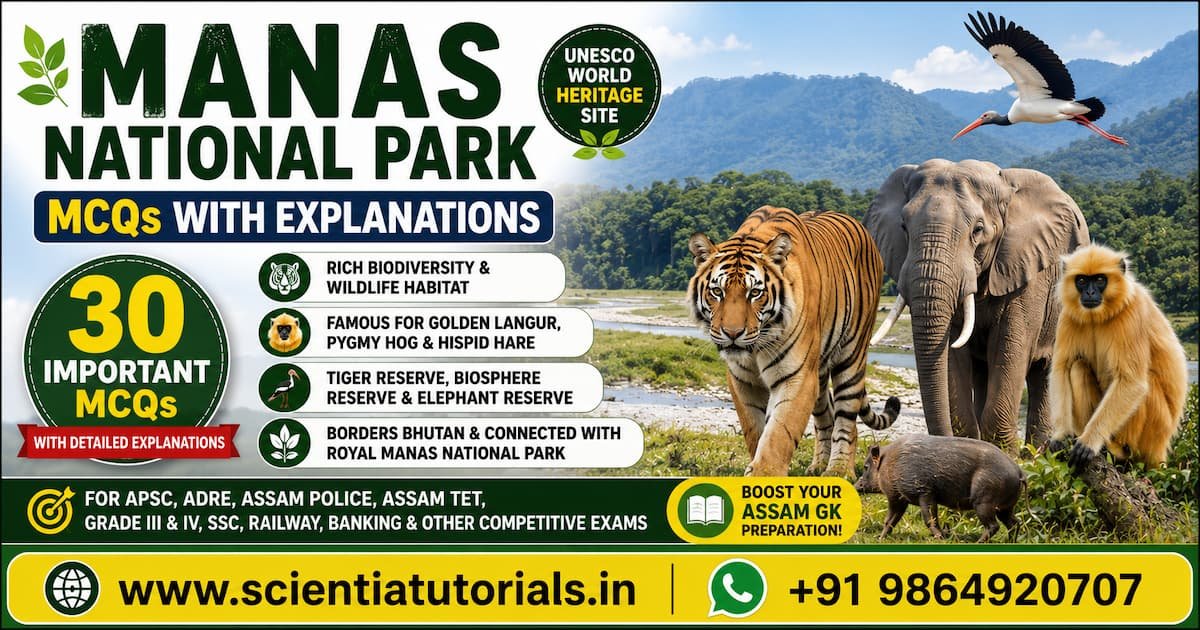
Manas National Park MCQs with Explanations | 30 Important Questions for APSC, ADRE & Assam Competitive Exams
Manas National Park MCQs with Explanations (1–30)
Exam-Oriented MCQs with Detailed Answers and Concept-Clearing Explanations
Useful for: APSC, ADRE, Assam Police, Assam TET, Grade III & Grade IV, SSC, Railway, Banking, and Other Competitive Examinations
MCQ 1
1. Manas National Park is located in which Indian state?
A. Arunachal Pradesh
B. Assam
C. Meghalaya
D. Nagaland
Answer: B. Assam
Explanation:
Manas National Park is located in the state of Assam, along the foothills of the Eastern Himalayas. It is one of India’s most significant protected areas due to its exceptional biodiversity.
- Option A: Arunachal Pradesh has Namdapha National Park.
- Option C: Meghalaya is known for Balpakram and Nokrek National Parks.
- Option D: Nagaland does not contain Manas National Park.
MCQ 2
2. Manas National Park is a UNESCO World Heritage Site since:
A. 1974
B. 1985
C. 1990
D. 2005
Answer: B. 1985
Explanation:
UNESCO declared Manas National Park a World Heritage Site in 1985 because of its outstanding biodiversity and ecological importance.
MCQ 3
3. The Manas River, after which the park is named, is a tributary of which river?
A. Barak River
B. Brahmaputra River
C. Subansiri River
D. Dhansiri River
Answer: B. Brahmaputra River
Explanation:
The Manas River originates in Bhutan and is an important tributary of the Brahmaputra River, forming the lifeline of the park.
MCQ 4
4. Manas National Park shares its international boundary with which country?
A. Nepal
B. Bangladesh
C. Bhutan
D. Myanmar
Answer: C. Bhutan
Explanation:
Manas National Park is contiguous with Royal Manas National Park in Bhutan, creating an important transboundary conservation landscape.
MCQ 5
5. Which protected area in Bhutan is connected with Manas National Park?
A. Jigme Dorji National Park
B. Royal Manas National Park
C. Phrumsengla National Park
D. Bumdeling Wildlife Sanctuary
Answer: B. Royal Manas National Park
Explanation:
India’s Manas National Park and Bhutan’s Royal Manas National Park together form one of South Asia’s richest wildlife corridors.
MCQ 6
6. Manas National Park is famous for conserving which endangered primate?
A. Lion-tailed Macaque
B. Golden Langur
C. Nilgiri Langur
D. Bonnet Macaque
Answer: B. Golden Langur
Explanation:
The Golden Langur is one of the flagship species of Manas National Park and is found mainly in Assam and Bhutan.
MCQ 7
7. Manas National Park is included under which tiger conservation programme?
A. Project Rhino
B. Project Tiger
C. Project Snow Leopard
D. Project Crocodile
Answer: B. Project Tiger
Explanation:
Manas is one of India’s important Project Tiger Reserves, helping conserve the endangered Royal Bengal Tiger.
MCQ 8
8. Which endangered bovine is found in Manas National Park?
A. Mithun
B. Wild Water Buffalo
C. Yak
D. Gayal
Answer: B. Wild Water Buffalo
Explanation:
The Wild Water Buffalo is one of the key endangered mammals found in Manas.
MCQ 9
9. Manas National Park is also recognized as a:
A. Biosphere Reserve only
B. Elephant Reserve only
C. Tiger Reserve, Biosphere Reserve, and Elephant Reserve
D. Desert Conservation Area
Answer: C. Tiger Reserve, Biosphere Reserve, and Elephant Reserve
Explanation:
Manas enjoys multiple conservation statuses:
- UNESCO World Heritage Site
- Project Tiger Reserve
- Elephant Reserve
- Biosphere Reserve
MCQ 10
10. Which rare bird is commonly associated with Manas National Park?
A. Bengal Florican
B. Peacock
C. Indian Roller
D. House Sparrow
Answer: A. Bengal Florican
Explanation:
The Bengal Florican, one of the world’s rarest bustards, inhabits the grasslands of Manas.
MCQ 11
11. Which river flows through Manas National Park?
A. Kopili River
B. Manas River
C. Dhansiri River
D. Dibang River
Answer: B. Manas River
Explanation:
The Manas River flows through the park and supports its rich floodplain ecosystem.
MCQ 12
12. Manas National Park is located at the foothills of which mountain range?
A. Aravalli Range
B. Eastern Himalayas
C. Vindhya Range
D. Satpura Range
Answer: B. Eastern Himalayas
Explanation:
The park lies at the foothills of the Eastern Himalayas, making it a biodiversity hotspot.
MCQ 13
13. Which endangered animal known as the “Pygmy Hog” is protected in Manas National Park?
A. Wild Boar
B. Pygmy Hog
C. Hog Deer
D. Barking Deer
Answer: B. Pygmy Hog
Explanation:
The Pygmy Hog is one of the world’s smallest and rarest wild pigs and is a flagship conservation species of Manas.
MCQ 14
14. Which endangered rabbit species is found in Manas National Park?
A. Himalayan Rabbit
B. Hispid Hare
C. Indian Hare
D. Black Rabbit
Answer: B. Hispid Hare
Explanation:
The Hispid Hare is a rare grassland species protected in Manas National Park.
MCQ 15
15. Which large mammal is NOT naturally found in Manas National Park?
A. Bengal Tiger
B. Asian Elephant
C. Asiatic Lion
D. One-Horned Rhinoceros
Answer: C. Asiatic Lion
Explanation:
The Asiatic Lion is found only in Gujarat’s Gir National Park, not in Manas.
MCQ 16
16. Manas National Park is famous for which grassland ecosystem?
A. Desert Grassland
B. Tropical Wet Alluvial Grassland
C. Alpine Meadow
D. Savannah
Answer: B. Tropical Wet Alluvial Grassland
Explanation:
Manas supports extensive tropical wet alluvial grasslands, ideal for many endangered species.
MCQ 17
17. Which organization declared Manas a World Heritage Site?
A. WWF
B. UNESCO
C. UNEP
D. IUCN
Answer: B. UNESCO
Explanation:
UNESCO recognized Manas in 1985 for its outstanding universal natural value.
MCQ 18
18. Manas National Park is situated mainly in which district of Assam?
A. Kamrup Metro
B. Baksa
C. Dibrugarh
D. Cachar
Answer: B. Baksa
Explanation:
The core area of Manas National Park lies in Baksa District, with parts extending into nearby districts.
MCQ 19
19. Which endangered primate besides the Golden Langur is found in Manas?
A. Hoolock Gibbon
B. Bonnet Macaque
C. Lion-tailed Macaque
D. Nilgiri Langur
Answer: A. Hoolock Gibbon
Explanation:
The Hoolock Gibbon, India’s only ape, inhabits the forests of Manas.
MCQ 20
20. Which large herbivore is commonly found in Manas National Park?
A. Nilgai
B. Swamp Deer
C. Sambar Deer
D. Chital
Answer: C. Sambar Deer
Explanation:
The Sambar Deer is one of the major prey species for tigers in Manas.
MCQ 21
21. Which of the following conservation categories applies to Manas National Park?
A. National Park only
B. Tiger Reserve only
C. UNESCO World Heritage Site only
D. All of the above
Answer: D. All of the above
Explanation:
Manas has multiple conservation recognitions including National Park, Tiger Reserve, Biosphere Reserve, Elephant Reserve, and UNESCO World Heritage Site.
MCQ 22
22. Which endangered bird species is frequently asked about in relation to Manas?
A. Bengal Florican
B. Indian Roller
C. Peacock
D. Common Myna
Answer: A. Bengal Florican
Explanation:
The Bengal Florican is among the most important birds associated with Manas.
MCQ 23
23. Which rare mammal is specially conserved in Manas under recovery programmes?
A. Blue Bull
B. Pygmy Hog
C. Blackbuck
D. Nilgai
Answer: B. Pygmy Hog
Explanation:
The Pygmy Hog Conservation Programme has significantly contributed to the recovery of this critically endangered species.
MCQ 24
24. Which neighboring national park in Assam is also a UNESCO World Heritage Site?
A. Orang National Park
B. Kaziranga National Park
C. Nameri National Park
D. Raimona National Park
Answer: B. Kaziranga National Park
Explanation:
Assam has two UNESCO World Heritage Sites:
- Manas National Park
- Kaziranga National Park
MCQ 25
25. Which of the following is NOT found in Manas National Park?
A. Golden Langur
B. Pygmy Hog
C. Snow Leopard
D. Bengal Tiger
Answer: C. Snow Leopard
Explanation:
Snow Leopards inhabit high Himalayan regions and are not found in Manas.
MCQ 26
26. Which animal symbolizes successful grassland conservation in Manas?
A. Pygmy Hog
B. Red Panda
C. Musk Deer
D. Yak
Answer: A. Pygmy Hog
Explanation:
The Pygmy Hog is regarded as an indicator species for healthy grassland ecosystems.
MCQ 27
27. The biodiversity of Manas is mainly due to its location in:
A. Western Ghats
B. Indo-Gangetic Plain
C. Himalayan Foothills
D. Deccan Plateau
Answer: C. Himalayan Foothills
Explanation:
The Himalayan foothills support a wide range of habitats and biodiversity.
MCQ 28
28. Which of the following correctly describes Manas National Park?
A. Marine National Park
B. Desert National Park
C. Floodplain Forest and Grassland Ecosystem
D. Cold Desert Ecosystem
Answer: C. Floodplain Forest and Grassland Ecosystem
Explanation:
Manas consists of grasslands, forests, wetlands, and riverine ecosystems, making it one of India’s richest biodiversity areas.
MCQ 29
29. Which famous cat species is protected under Project Tiger in Manas?
A. Leopard Cat
B. Bengal Tiger
C. Fishing Cat
D. Clouded Leopard
Answer: B. Bengal Tiger
Explanation:
The Royal Bengal Tiger is the flagship predator of Manas National Park.
MCQ 30
30. Which statement about Manas National Park is correct?
A. It is located in Rajasthan.
B. It borders Bhutan and is a UNESCO World Heritage Site.
C. It is famous only for crocodiles.
D. It is a marine protected area.
Answer: B. It borders Bhutan and is a UNESCO World Heritage Site.
Explanation:
Manas National Park is located in Assam, shares an international boundary with Bhutan, forms a transboundary conservation landscape with Royal Manas National Park, and has been a UNESCO World Heritage Site since 1985.
- Option A: Incorrect. Manas is in Assam.
- Option C: Incorrect. It is known for diverse wildlife, not only crocodiles.
- Option D: Incorrect. It is a terrestrial protected area.
Quick Revision: Manas National Park
| Topic | Key Fact |
|---|---|
| Location | Assam |
| UNESCO World Heritage Site | 1985 |
| International Border | Bhutan |
| Connected Protected Area | Royal Manas National Park (Bhutan) |
| River | Manas River |
| Tiger Reserve | Yes |
| Elephant Reserve | Yes |
| Biosphere Reserve | Yes |
| Famous Primate | Golden Langur |
| India’s Only Ape | Hoolock Gibbon |
| Rare Mammal | Pygmy Hog |
| Rare Rabbit | Hispid Hare |
| Rare Bird | Bengal Florican |
| Major Ecosystem | Tropical Wet Alluvial Grasslands |
Exam Tips
- Manas National Park became a UNESCO World Heritage Site in 1985.
- It shares an international boundary with Bhutan and is connected to Royal Manas National Park.
- Frequently asked species include the Golden Langur, Pygmy Hog, Hispid Hare, Hoolock Gibbon, Bengal Florican, Bengal Tiger, Wild Water Buffalo, and Asian Elephant.
- Remember that Manas is simultaneously a National Park, Tiger Reserve, Elephant Reserve, Biosphere Reserve, and UNESCO World Heritage Site, making it one of India’s most important protected areas for APSC, ADRE, Assam Police, Assam TET, Grade III & Grade IV, SSC, Railway, Banking, and other competitive examinations.