
Government of India Act 1858: End of Company Rule
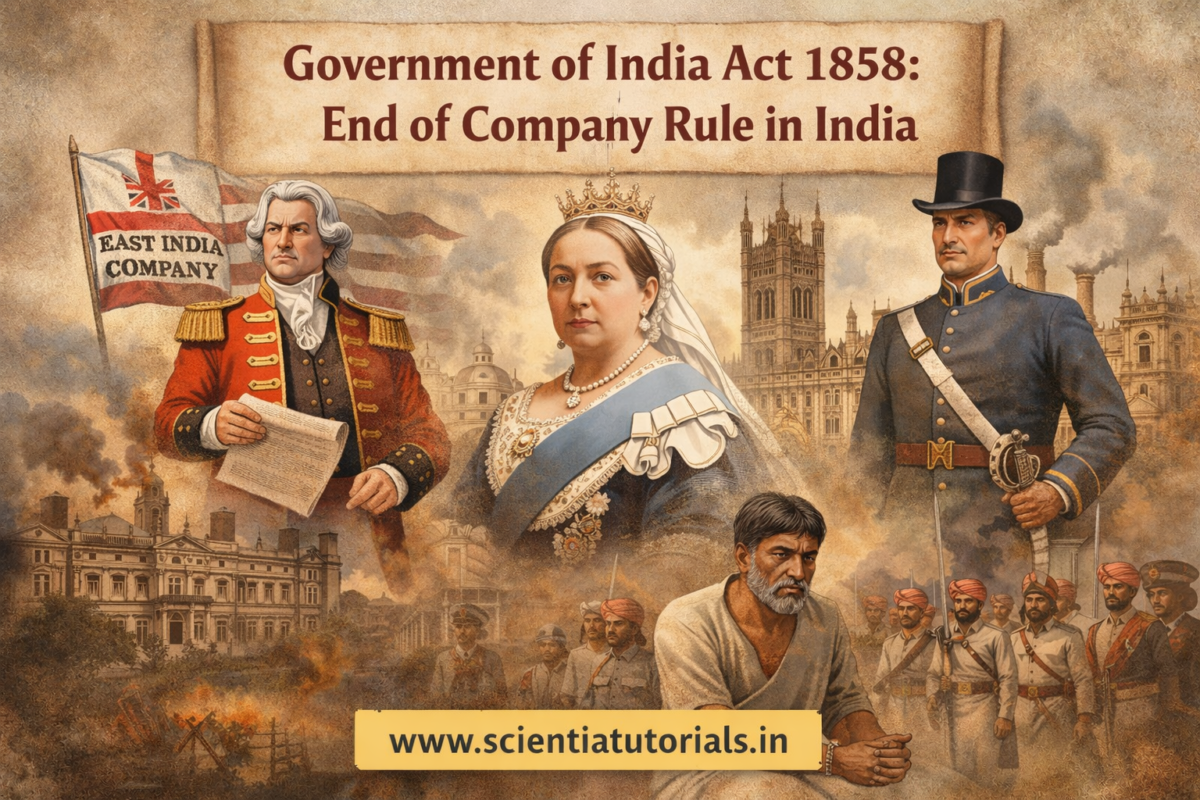

Government of India Act 1858: End of Company Rule
Chronologically Structured Study Module
(Timeline: 1858–1909 CE)
I. Introduction: Transition from Company Rule to Crown Rule
The Government of India Act 1858 marks a decisive turning point in the constitutional history of India. It formally ended the rule of the English East India Company and transferred governance directly to the British Crown. This Act was not merely an administrative reform but a structural transformation in colonial governance, laying the foundations of centralised imperial administration under direct British control.
The Act emerged in the aftermath of the Revolt of 1857, which exposed the weaknesses, corruption, and unaccountability of Company rule. The British Parliament concluded that India could no longer be governed by a commercial body and required direct state supervision. Thus began the era of Crown Rule (1858–1947), characterized by administrative centralization, bureaucratic control, and cautious constitutional development.
II. Historical Background: Company Rule Before 1858
1. Nature of East India Company Administration
By the mid-19th century, the East India Company had transformed from a trading corporation into a territorial power. It exercised political, military, revenue, and judicial authority without democratic accountability. Although several parliamentary Acts attempted to regulate the Company (1773–1853), real power remained concentrated in Company officials.
2. Structural Weaknesses
Company administration suffered from:
- Excessive centralization without accountability
- Economic exploitation of Indian resources
- Racial discrimination in administration and law
- Alienation of Indian rulers, soldiers, peasants, and intellectuals
3. Impact of the Revolt of 1857
The Revolt of 1857 exposed:
- Administrative inefficiency
- Military discontent
- Failure to understand Indian society and traditions
This crisis forced Britain to reassess its colonial governance model.
III. Enactment of the Government of India Act 1858
1. Parliamentary Decision
The British Parliament passed the Government of India Act in 1858 to abolish Company rule and bring India under direct Crown administration.
2. Royal Proclamation
The Act was followed by the Queen’s Proclamation of 1858, issued in the name of Queen Victoria, which promised:
- Non-interference in religious matters
- Equal treatment under law
- Respect for Indian princes and treaties
While symbolic, the proclamation aimed to restore Indian confidence in British authority.
IV. Key Provisions of the Government of India Act 1858
1. Abolition of the East India Company
The Act ended the Company’s political authority. All its powers, territories, revenues, and armed forces were transferred to the British Crown.
2. Transfer of Authority to the Crown
India was to be governed directly by the British government in London, marking a shift from corporate to imperial rule.
3. Creation of the Secretary of State for India
A new post, the Secretary of State for India, was created:
- A member of the British Cabinet
- Held supreme authority over Indian administration
- Responsible to the British Parliament
This ensured tighter parliamentary control over Indian affairs.
4. Council of India
The Secretary of State was assisted by a Council of India:
- Consisted of experienced administrators
- Advisory in nature
- Had no independent decision-making power
5. Governor-General Becomes Viceroy
The Governor-General of India was redesignated as the Viceroy, representing the British Crown in India. The Viceroy acted as the chief executive authority in India.
V. Administrative Reorganisation Under Crown Rule
1. Centralisation of Power
The Act strengthened central authority:
- Major decisions were taken in London
- Provinces functioned under strict central supervision
- Indian participation was negligible
2. Bureaucratic Expansion
A professional civil service expanded rapidly:
- Dominated by British officials
- Entry through competitive examinations held in England
- Indians largely excluded due to educational and geographic barriers
3. Military Reorganisation
After 1857:
- Indian soldiers were reduced in proportion
- European troops were increased
- Artillery and key positions were reserved for Europeans
This ensured tighter military control.
VI. Constitutional Nature of the Act
1. Administrative, Not Democratic Reform
The Act did not introduce representative institutions or popular participation. Its purpose was administrative efficiency and imperial security, not constitutional self-government.
2. Absence of Indian Representation
Indians had no role in:
- Law-making
- Policy formulation
- Executive decision-making
This reinforced authoritarian colonial rule.
3. Strengthening of Executive Authority
The Viceroy and Secretary of State exercised enormous powers with minimal checks, undermining constitutional balance.
VII. Impact on Princely States and Indian Society
1. Policy Towards Princely States
The British abandoned aggressive annexation:
- Doctrine of Lapse was discontinued
- Princes were assured protection of their territories
- Loyalty was exchanged for political subordination
2. Social and Religious Policy
The Crown promised:
- Religious neutrality
- Non-interference in customs
However, colonial laws continued to reshape Indian society indirectly.
VIII. Limitations of the Government of India Act 1858
1. Over-Centralisation
Decision-making was concentrated in Britain, ignoring Indian conditions and regional diversity.
2. No Political Rights
The Act did not grant:
- Civil liberties
- Freedom of expression
- Political participation
3. Racial Discrimination
Administrative and judicial systems favored Europeans, institutionalizing inequality.
4. Weak Accountability
Officials were accountable to Britain, not Indian subjects.
IX. Significance in Constitutional Evolution
1. Foundation of Crown Rule
The Act laid the administrative framework that governed India until 1947.
2. Prelude to Later Reforms
While authoritarian, the Act:
- Highlighted the absence of Indian participation
- Generated political awareness
- Led to demands for constitutional reforms
Later Acts (1861, 1892, 1909) emerged partly in response to these limitations.
3. Rise of Indian Political Consciousness
Educated Indians increasingly questioned:
- Centralised rule
- Exclusion from governance
- Economic exploitation
This eventually led to organized political movements.
X. Place of the Act in Module 2 (1858–1909 CE)
Within Module 2, the Government of India Act 1858 represents:
- The starting point of Crown Rule
- The beginning of centralised constitutional administration
- A shift from mercantile to imperial governance
All subsequent constitutional developments during this period must be understood as extensions, modifications, or reactions to the administrative framework established by this Act.
XI. Conclusion
The Government of India Act 1858 was a watershed in Indian constitutional history. It ended Company rule and inaugurated a new phase of direct imperial governance, marked by centralization, bureaucratic control, and political exclusion. While it brought administrative stability from the British perspective, it failed to address Indian aspirations for participation and rights.
Historically, the Act’s greatest significance lies not in what it granted, but in what it denied—representative governance and accountability—thereby sowing the seeds of constitutional nationalism that would later transform India’s political destiny.
Below is a well-structured, examination-oriented set of 25 Questions with clear and accurate Answers based strictly on the lesson “Government of India Act 1858: End of Company Rule”, aligned with Module 2: Crown Rule and Centralised Constitutional Administration (1858–1909 CE) under the course “Constitutional Developments and Independence in India – History of India.”
The questions progress from conceptual understanding to analytical evaluation, making them suitable for UG/PG history exams, UPSC/State PSC preparation, and semester assessments.
Questions with Answers
Lesson: Government of India Act 1858 – End of Company Rule
Q1. What was the Government of India Act 1858?
Answer:
The Government of India Act 1858 was a parliamentary legislation that ended the rule of the English East India Company and transferred the governance of India directly to the British Crown, marking the beginning of Crown Rule.
Q2. What historical event directly led to the enactment of the Government of India Act 1858?
Answer:
The Revolt of 1857 exposed the administrative failures, corruption, and unaccountability of Company rule, compelling the British Parliament to assume direct control over India.
Q3. Why did the British Parliament abolish Company rule in India?
Answer:
Company rule was abolished because a commercial body was considered unfit to govern a vast territory after the 1857 revolt, and direct imperial control was seen as necessary for stability and security.
Q4. How did the Act of 1858 change the nature of colonial governance in India?
Answer:
The Act transformed governance from corporate rule to direct imperial administration under the British Crown, centralising authority and strengthening bureaucratic control.
Q5. What was the significance of the transfer of power to the British Crown?
Answer:
The transfer symbolised the establishment of formal colonial rule, making India a direct responsibility of the British state rather than a trading company.
Q6. Who was declared the sovereign authority of India after 1858?
Answer:
The British monarch, represented by Queen Victoria, became the sovereign authority over India.
Q7. What was the Queen’s Proclamation of 1858?
Answer:
The proclamation promised religious tolerance, equal treatment under law, and respect for Indian princes, aiming to restore Indian confidence after the revolt.
Q8. What new administrative office was created by the Act of 1858?
Answer:
The Act created the office of the Secretary of State for India, a British Cabinet minister responsible for Indian administration.
Q9. What was the role of the Secretary of State for India?
Answer:
The Secretary of State exercised supreme control over Indian affairs, supervised administration, and was accountable to the British Parliament.
Q10. What was the Council of India, and what were its functions?
Answer:
The Council of India was an advisory body assisting the Secretary of State. It had no independent authority and functioned mainly to provide administrative advice.
Q11. How did the position of Governor-General change after 1858?
Answer:
The Governor-General was redesignated as the Viceroy, acting as the direct representative of the British Crown in India.
Q12. Did the Government of India Act 1858 introduce representative institutions?
Answer:
No, the Act was purely administrative and did not provide for elected bodies or Indian representation in governance.
Q13. How did the Act strengthen centralisation of power?
Answer:
Major decisions were taken in Britain, provincial governments were subordinated to the centre, and the Viceroy exercised wide executive authority.
Q14. What impact did the Act have on the Indian Civil Service?
Answer:
The civil service expanded under Crown rule but remained dominated by Europeans, with competitive examinations held in England limiting Indian participation.
Q15. How was the Indian army reorganised after 1858?
Answer:
European troops were increased, Indian soldiers were reduced proportionally, and key military positions were reserved for Europeans to prevent future revolts.
Q16. What policy did the British adopt towards princely states after 1858?
Answer:
The British abandoned aggressive annexation, respected princely territories, and sought loyalty in exchange for protection and indirect control.
Q17. Why is the Government of India Act 1858 described as authoritarian?
Answer:
It concentrated power in British hands, excluded Indians from decision-making, and lacked constitutional checks or democratic accountability.
Q18. What were the main limitations of the Government of India Act 1858?
Answer:
Key limitations included over-centralisation, absence of political rights, racial discrimination, and lack of accountability to Indian subjects.
Q19. How did the Act affect Indian political participation?
Answer:
It completely excluded Indians from governance, delaying the development of representative politics and constitutional self-government.
Q20. In what way did the Act promote bureaucratic rule?
Answer:
Governance was entrusted to professional administrators loyal to the Crown, creating a rigid, centralised bureaucratic system.
Q21. How did the Act differ from earlier constitutional experiments under Company rule?
Answer:
Unlike regulatory Acts that controlled the Company, the 1858 Act abolished it entirely and established direct state control.
Q22. Why is the Act of 1858 considered the foundation of Crown Rule?
Answer:
It established the administrative framework and authority that governed India directly under British sovereignty until independence.
Q23. How did the Act influence later constitutional developments?
Answer:
By exposing the absence of Indian participation, it generated demands for reforms, leading to later Acts such as those of 1861, 1892, and 1909.
Q24. Did the Act of 1858 guarantee civil liberties to Indians?
Answer:
No, it did not provide constitutional guarantees of civil liberties or fundamental rights.
Q25. Assess the historical significance of the Government of India Act 1858.
Answer:
The Act marked the end of Company rule and the start of Crown Rule, creating a centralised colonial state whose limitations ultimately stimulated Indian constitutional nationalism.
Below is a well-structured, examination-oriented set of 25 Multiple Choice Questions (MCQs) with correct answers and detailed concept-clearing explanations, developed strictly from the lesson “Government of India Act 1858: End of Company Rule”, in alignment with Module 2: Crown Rule and Centralised Constitutional Administration (1858–1909 CE) of the course “Constitutional Developments and Independence in India – History of India.”
These MCQs are suitable for UG/PG university exams, UPSC/State PSC preparation, NET/SET, and revision practice.
MCQs with Answers and Explanations
Lesson: Government of India Act 1858 – End of Company Rule
Q1. The Government of India Act 1858 was enacted primarily to:
A. Introduce representative government
B. Reform local self-government
C. End the rule of the East India Company
D. Establish federalism in India
Correct Answer: C
Explanation:
The Act abolished the political authority of the East India Company and transferred power directly to the British Crown, marking the formal end of Company rule.
Q2. Which event most directly prompted the enactment of the Government of India Act 1858?
A. Charter Act of 1853
B. Anglo-Sikh Wars
C. Revolt of 1857
D. Permanent Settlement
Correct Answer: C
Explanation:
The Revolt of 1857 exposed the failures of Company administration, convincing British authorities that India required direct Crown control.
Q3. After 1858, sovereignty over India vested in:
A. British Parliament
B. British Prime Minister
C. British Crown
D. Secretary of State for India
Correct Answer: C
Explanation:
The Act transferred sovereignty from a commercial company to the British Crown, symbolizing formal imperial rule.
Q4. The Governor-General of India was redesignated as:
A. Chief Commissioner
B. Secretary of State
C. Viceroy
D. Commander-in-Chief
Correct Answer: C
Explanation:
After 1858, the Governor-General became the Viceroy, acting as the Crown’s representative in India.
Q5. Which new office was created by the Government of India Act 1858?
A. Indian Legislative Council
B. Secretary of State for India
C. Indian Civil Service Commission
D. Federal Council
Correct Answer: B
Explanation:
The Act created the post of Secretary of State for India, a British Cabinet minister responsible for Indian affairs.
Q6. The Secretary of State for India was assisted by:
A. British Parliament
B. House of Lords
C. Council of India
D. Legislative Assembly
Correct Answer: C
Explanation:
The Council of India was an advisory body meant to assist the Secretary of State in administrative matters.
Q7. Which of the following best describes the Council of India?
A. Elected body
B. Independent executive authority
C. Advisory body without decision-making power
D. Judicial institution
Correct Answer: C
Explanation:
The Council was purely advisory and had no independent executive or legislative authority.
Q8. The Queen’s Proclamation of 1858 was issued in the name of:
A. King George III
B. Lord Canning
C. Queen Victoria
D. British Parliament
Correct Answer: C
Explanation:
The proclamation, issued by Queen Victoria, symbolised the assumption of Indian governance by the Crown.
Q9. One promise made in the Queen’s Proclamation of 1858 was:
A. Introduction of elections
B. Religious neutrality of the state
C. Indian self-government
D. Freedom of press
Correct Answer: B
Explanation:
The proclamation assured Indians that the British government would not interfere in religious beliefs and practices.
Q10. Which doctrine was effectively abandoned after 1858?
A. Subsidiary Alliance
B. Permanent Settlement
C. Doctrine of Lapse
D. Ryotwari System
Correct Answer: C
Explanation:
After 1858, the British assured princely states that annexation policies like the Doctrine of Lapse would no longer be pursued.
Q11. The Government of India Act 1858 can best be described as:
A. Democratic reform
B. Administrative reorganisation
C. Federal constitution
D. Representative charter
Correct Answer: B
Explanation:
The Act was administrative in nature and did not introduce democratic or representative institutions.
Q12. Which feature highlights the centralised nature of Crown Rule?
A. Provincial autonomy
B. Local self-government
C. Decision-making in Britain
D. Indian representation
Correct Answer: C
Explanation:
Key administrative decisions were taken in London, reinforcing centralisation.
Q13. Indian participation in governance after 1858 was:
A. Expanded significantly
B. Gradually introduced
C. Completely absent
D. Dominant at provincial level
Correct Answer: C
Explanation:
The Act provided no role for Indians in administration or law-making.
Q14. How did the Act affect the Indian Civil Service?
A. Indians dominated the service
B. Examinations were held in India
C. British control was strengthened
D. Service was abolished
Correct Answer: C
Explanation:
Although professionalised, the civil service remained dominated by Europeans, reinforcing bureaucratic rule.
Q15. Post-1858 military policy aimed primarily at:
A. Indianisation of army
B. Reducing military expenditure
C. Preventing another revolt
D. Promoting nationalism
Correct Answer: C
Explanation:
The army was reorganised to ensure British control and prevent future rebellions.
Q16. Which constitutional principle was absent in the Act of 1858?
A. Parliamentary sovereignty
B. Centralised authority
C. Popular sovereignty
D. Imperial control
Correct Answer: C
Explanation:
Authority flowed from the Crown, not from the Indian people, making popular sovereignty absent.
Q17. The Act of 1858 strengthened which form of governance?
A. Democratic governance
B. Bureaucratic governance
C. Federal governance
D. Local governance
Correct Answer: B
Explanation:
Administration was entrusted to a centralised bureaucracy accountable to Britain, not Indians.
Q18. Which body exercised ultimate control over Indian administration after 1858?
A. Indian Legislative Council
B. Governor-General’s Council
C. British Cabinet
D. Secretary of State for India
Correct Answer: D
Explanation:
The Secretary of State, as a Cabinet minister, held supreme authority over Indian affairs.
Q19. A major limitation of the Government of India Act 1858 was:
A. Excessive decentralisation
B. Grant of civil liberties
C. Exclusion of Indians from power
D. Weak executive authority
Correct Answer: C
Explanation:
The Act excluded Indians entirely from decision-making, reinforcing authoritarian rule.
Q20. The Act of 1858 marked the beginning of:
A. Responsible government
B. Crown Rule in India
C. Indian nationalism
D. Provincial autonomy
Correct Answer: B
Explanation:
It formally inaugurated Crown Rule, which lasted until 1947.
Q21. How did the Act treat princely states?
A. Encouraged annexation
B. Promised protection and continuity
C. Abolished their authority
D. Introduced elections
Correct Answer: B
Explanation:
The British assured princes of territorial security in exchange for loyalty.
Q22. Which statement best reflects the nature of the Act?
A. Reformist and liberal
B. Revolutionary and democratic
C. Conservative and authoritarian
D. Federal and decentralised
Correct Answer: C
Explanation:
The Act aimed at stability and control, not political reform or democracy.
Q23. The Act of 1858 differed from earlier Company-era Acts because it:
A. Regulated Company trade
B. Abolished the Company altogether
C. Introduced elected councils
D. Granted civil rights
Correct Answer: B
Explanation:
Earlier Acts regulated the Company; the 1858 Act ended its existence as a ruling authority.
Q24. The administrative system after 1858 was accountable mainly to:
A. Indian जनता
B. Provincial councils
C. British Parliament
D. Indian princes
Correct Answer: C
Explanation:
Officials were accountable to British authorities, not Indian subjects.
Q25. Historically, the significance of the Government of India Act 1858 lies in the fact that it:
A. Established Indian democracy
B. Ended colonialism
C. Laid the foundation of imperial administration
D. Granted self-rule
Correct Answer: C
Explanation:
The Act created the framework of centralised Crown administration that shaped later constitutional developments and nationalist resistance.