
Cabinet Mission Plan and Constituent Assembly
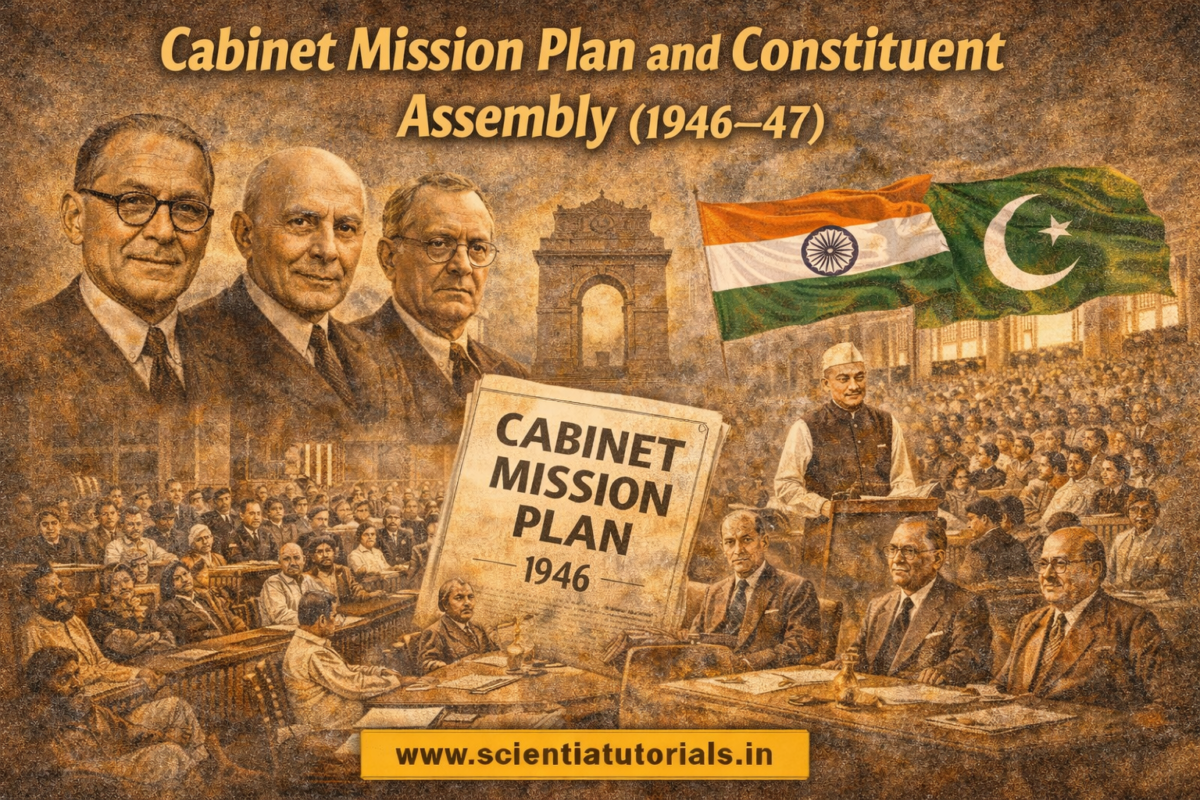

Cabinet Mission Plan and Constituent Assembly (1946–47) | History of India
Cabinet Mission Plan and Constituent Assembly (1946–1947 CE)
Course: Constitutional Developments and Independence in India – History of India
Module 8: Final Constitutional Negotiations and Transfer of Power
Timeline: 1945 – 1947 CE
Lesson: Cabinet Mission Plan and Constituent Assembly
Introduction: From Wartime Crisis to Constitutional Settlement
The period 1945–1947 marks the final phase of British constitutional engagement with India, culminating in independence and partition. After the Second World War, Britain emerged economically weakened, politically exhausted, and increasingly unable to sustain its empire. At the same time, Indian nationalism—strengthened by the Quit India Movement, INA trials, and mass political mobilisation—had made continued colonial rule untenable.
In this context, the Cabinet Mission Plan (1946) and the establishment of the Constituent Assembly represent the last serious attempt to achieve a constitutional transfer of power through negotiation rather than conflict. This lesson examines the objectives, proposals, responses, and ultimate failure of the Cabinet Mission, as well as the constitutional significance of the Constituent Assembly in shaping independent India.
1. Background to the Cabinet Mission (1945–1946)
1.1 Impact of World War II
World War II fundamentally altered Britain’s global position:
- Severe economic strain
- Dependence on American support
- Growing international pressure against colonialism
Britain recognised that India could no longer be governed without Indian consent.
1.2 Political Situation in India
By 1945:
- The Indian National Congress had mass support and demanded complete independence
- The All-India Muslim League, under Muhammad Ali Jinnah, insisted on Pakistan
- Communal tensions had intensified
- Constitutional deadlock had become acute
1.3 British Decision to Send the Cabinet Mission
In early 1946, the British government decided to send a high-level mission to:
- Devise a constitutional framework acceptable to major Indian parties
- Preserve Indian unity, if possible
- Ensure an orderly transfer of power
2. The Cabinet Mission (1946)
2.1 Composition of the Mission
The Cabinet Mission consisted of three British Cabinet members:
- Lord Pethick-Lawrence
- Sir Stafford Cripps
- A. V. Alexander
They arrived in India in March 1946.
2.2 Objectives of the Cabinet Mission
The Mission aimed to:
- Avoid partition of India
- Create a federal constitutional structure
- Safeguard minority interests
- Establish a Constituent Assembly
3. Proposals of the Cabinet Mission Plan
The Cabinet Mission Plan, announced in May 1946, had three key components:
3.1 A United Indian Union
The Mission proposed:
- A Union of India controlling foreign affairs, defence, and communications
- All other powers to rest with provinces
This arrangement aimed to maintain Indian unity while limiting central authority.
3.2 Grouping of Provinces
Provinces were divided into three groups:
- Group A: Hindu-majority provinces (e.g., Madras, Bombay, UP, Bihar)
- Group B: Muslim-majority provinces in the northwest
- Group C: Muslim-majority provinces in the northeast
Each group could:
- Frame its own constitution
- Exercise control over provincial subjects
This grouping was intended to satisfy Muslim League concerns without creating Pakistan.
3.3 Constituent Assembly
The Plan proposed:
- A Constituent Assembly of indirectly elected representatives
- Elections by provincial legislatures
- Participation of princely states through nomination
The Assembly would:
- Frame a constitution for the Union
- Decide group and provincial constitutions
4. Responses to the Cabinet Mission Plan
4.1 Congress Response
The Congress:
- Accepted the idea of a Constituent Assembly
- Accepted the Union in principle
- Objected to compulsory grouping of provinces
Congress feared that grouping would:
- Weaken central authority
- Institutionalise communal divisions
4.2 Muslim League Response
The Muslim League:
- Accepted the Plan initially
- Welcomed grouping as a step toward Pakistan
- Rejected Congress interpretations later
When disagreements emerged, the League withdrew its acceptance.
4.3 British Position
The British initially insisted that:
- The Plan must be accepted as a whole
- Grouping was compulsory
However, political ambiguity and changing interpretations weakened the Plan.
5. Breakdown of the Cabinet Mission Plan
5.1 Conflicting Interpretations
The Plan failed due to:
- Different interpretations by Congress and Muslim League
- British inability to enforce clarity
- Deep mistrust between parties
5.2 Direct Action Day (1946)
In August 1946, the Muslim League called Direct Action Day, leading to:
- Communal riots
- Massive loss of life
- Breakdown of law and order
This violence marked the collapse of constitutional compromise.
5.3 Interim Government Crisis
An Interim Government was formed under Jawaharlal Nehru, but:
- The Muslim League initially stayed out
- Later participation was marked by obstruction
- Governance became dysfunctional
6. Constituent Assembly of India
6.1 Formation of the Constituent Assembly
Despite political chaos, elections were held:
- Constituent Assembly met on 9 December 1946
- Congress dominated the Assembly
- Muslim League largely boycotted it
6.2 Objectives of the Constituent Assembly
The Assembly aimed to:
- Frame a sovereign constitution
- Establish democratic governance
- Secure fundamental rights
- Define federal structure
6.3 Historical Significance
For the first time:
- Indians assumed full responsibility for constitution-making
- British Parliament ceased to dominate constitutional design
7. Constituent Assembly as a Sovereign Body
7.1 Assertion of Sovereignty
The Constituent Assembly declared itself:
- A sovereign body
- Independent of British authority
After independence, it functioned both as:
- A constitution-making body
- A legislative body
7.2 Role of Leadership
Key figures included:
- Dr. B. R. Ambedkar
- Jawaharlal Nehru
- Rajendra Prasad
They shaped India’s constitutional vision.
8. From Cabinet Mission to Partition
8.1 Failure to Prevent Partition
The Cabinet Mission failed to:
- Reconcile Congress–League differences
- Prevent communal polarisation
This failure paved the way for:
- Acceptance of partition
- British decision to quit India rapidly
8.2 Mountbatten Plan and Transfer of Power
In 1947, the British adopted:
- Partition as unavoidable
- Speedy transfer of power
This led to:
- Indian Independence Act, 1947
- Creation of India and Pakistan
9. Constitutional Significance of the Cabinet Mission Plan
Despite its failure, the Plan:
- Established the Constituent Assembly
- Marked Britain’s acceptance of Indian constitution-making
- Represented the last attempt to preserve Indian unity
10. Comparative Assessment
| Aspect | Cabinet Mission Plan | Constituent Assembly |
|---|---|---|
| Nature | British initiative | Indian initiative |
| Objective | Prevent partition | Frame sovereign constitution |
| Outcome | Failed | Successful |
| Legacy | Interim transition | Foundation of Indian Republic |
Conclusion: From Negotiation to Nation-Making
The Cabinet Mission Plan represents the final constitutional effort of the British Empire to manage India’s transition through compromise. Its failure exposed the depth of political division and made partition unavoidable. However, the Constituent Assembly emerged as the true constitutional achievement of this period—transforming the struggle for freedom into the task of nation-building.
Between 1946 and 1947, India moved decisively from colonial subordination to constitutional sovereignty. The Constituent Assembly ensured that independence was not merely a transfer of power, but the beginning of a democratic constitutional order shaped by Indians themselves.
Examination Relevance
- Core topic for UPSC GS-I (Modern Indian History)
- Essential for GS-II (Constitutional Development)
- High-yield for State PSC, CUET, NET/SET
Below is a well-structured, examination-oriented set of 25 Questions with clear and accurate Answers, developed strictly from the lesson “Cabinet Mission Plan and Constituent Assembly”, and fully aligned with Module 8: Final Constitutional Negotiations and Transfer of Power (1945–1947) under the course Constitutional Developments and Independence in India – History of India.
Cabinet Mission Plan and Constituent Assembly (1946–1947): Questions & Answers
Q1. Why was the Cabinet Mission sent to India in 1946?
Answer:
The Cabinet Mission was sent to resolve the constitutional deadlock between Indian political parties, prevent partition if possible, and ensure an orderly transfer of power from British rule to Indian hands.
Q2. What were the international and domestic factors that compelled Britain to initiate final constitutional negotiations with India?
Answer:
Britain’s post-war economic weakness, global anti-colonial pressure, the impact of the Quit India Movement, INA trials, and growing communal tensions in India made continued colonial rule unsustainable.
Q3. Name the members of the Cabinet Mission.
Answer:
The Cabinet Mission consisted of Lord Pethick-Lawrence, Sir Stafford Cripps, and A. V. Alexander.
Q4. What were the primary objectives of the Cabinet Mission Plan?
Answer:
The objectives were to preserve Indian unity, create a federal constitutional structure, safeguard minority interests, and establish a Constituent Assembly to frame India’s constitution.
Q5. What type of political structure did the Cabinet Mission propose for India?
Answer:
It proposed a loose federal Union of India, with the centre controlling only defence, foreign affairs, and communications, while provinces retained extensive autonomy.
Q6. Explain the grouping of provinces under the Cabinet Mission Plan.
Answer:
Provinces were divided into three groups—Group A (Hindu-majority), Group B (north-west Muslim-majority), and Group C (north-east Muslim-majority)—each with the right to frame group constitutions.
Q7. Why was the grouping provision controversial?
Answer:
Congress feared compulsory grouping would weaken the centre and institutionalise communal divisions, while the Muslim League viewed it as a step toward Pakistan.
Q8. How was the Constituent Assembly to be formed under the Cabinet Mission Plan?
Answer:
Members were to be indirectly elected by provincial legislatures, with princely states represented through nomination.
Q9. What powers were assigned to the Union under the Cabinet Mission Plan?
Answer:
The Union was to control only defence, foreign affairs, and communications, while all other powers rested with provinces and groups.
Q10. How did the Indian National Congress respond to the Cabinet Mission Plan?
Answer:
The Indian National Congress accepted the Constituent Assembly and Union in principle but rejected compulsory grouping of provinces.
Q11. How did the Muslim League initially respond to the Cabinet Mission Plan?
Answer:
The All-India Muslim League initially accepted the Plan because grouping appeared to safeguard Muslim political interests.
Q12. Why did the Muslim League later withdraw its acceptance of the Plan?
Answer:
The League withdrew acceptance due to disagreements with Congress over interpretation of grouping and the fear that Congress dominance would undermine Muslim autonomy.
Q13. What role did conflicting interpretations play in the failure of the Cabinet Mission Plan?
Answer:
Congress and the Muslim League interpreted grouping and provincial autonomy differently, and British ambiguity failed to resolve these conflicts, leading to breakdown.
Q14. What was Direct Action Day, and why was it significant?
Answer:
Direct Action Day (August 1946) was called by the Muslim League to assert its demand for Pakistan. It led to widespread communal violence, marking the collapse of constitutional compromise.
Q15. What was the Interim Government, and who headed it?
Answer:
The Interim Government was formed in 1946 to manage administration during transition and was headed by Jawaharlal Nehru.
Q16. Why did the Interim Government fail to function smoothly?
Answer:
The Muslim League’s initial boycott and later obstructionist participation paralysed governance, deepening mistrust and instability.
Q17. When did the Constituent Assembly first meet?
Answer:
The Constituent Assembly first met on 9 December 1946.
Q18. Why did the Muslim League boycott the Constituent Assembly?
Answer:
The League boycotted the Assembly because it believed the Cabinet Mission Plan had failed and continued to demand a separate Pakistan.
Q19. What were the main objectives of the Constituent Assembly?
Answer:
The Assembly aimed to frame a sovereign constitution, establish democratic governance, define federal relations, and guarantee fundamental rights.
Q20. In what sense was the Constituent Assembly a sovereign body?
Answer:
It functioned independently of British authority and assumed full responsibility for constitution-making, especially after independence in 1947.
Q21. Name two prominent leaders associated with constitution-making in the Constituent Assembly.
Answer:
Key leaders included Dr. B. R. Ambedkar and Jawaharlal Nehru.
Q22. Why did the Cabinet Mission Plan fail to prevent partition?
Answer:
Deep communal divisions, mutual distrust between Congress and the Muslim League, and escalating violence made a unified constitutional settlement impossible.
Q23. How did the failure of the Cabinet Mission influence British policy?
Answer:
It convinced Britain that partition and rapid withdrawal were unavoidable, leading to acceptance of the Mountbatten Plan.
Q24. What was the constitutional significance of the Cabinet Mission Plan despite its failure?
Answer:
It formally established the Constituent Assembly and marked Britain’s acceptance of Indian constitution-making.
Q25. Assess the overall importance of the Constituent Assembly in India’s independence.
Answer:
The Constituent Assembly transformed independence from a political transfer of power into the creation of a sovereign democratic constitution shaped by Indians themselves.
Examination Value
✔ Core topic for UPSC GS-I & GS-II
✔ High-yield for State PSC & CUET
✔ Essential for understanding transfer of power and constitution-making
Below is a well-structured, examination-oriented set of 25 MCQs with correct answers and detailed, concept-clearing explanations, developed strictly from the lesson “Cabinet Mission Plan and Constituent Assembly”, and fully aligned with Module 8: Final Constitutional Negotiations and Transfer of Power (1945–1947 CE) under the course Constitutional Developments and Independence in India – History of India.
Cabinet Mission Plan and Constituent Assembly (1946–1947): MCQs with Explanations
MCQ 1.
The Cabinet Mission was sent to India in:
A. 1945
B. 1946
C. 1947
D. 1948
Correct Answer: B
Explanation:
The Cabinet Mission arrived in India in March 1946 to resolve the constitutional deadlock and facilitate a negotiated transfer of power.
MCQ 2.
Which of the following was NOT a member of the Cabinet Mission?
A. Lord Pethick-Lawrence
B. Sir Stafford Cripps
C. A. V. Alexander
D. Lord Mountbatten
Correct Answer: D
Explanation:
Lord Mountbatten became Viceroy later in 1947. The Cabinet Mission comprised Pethick-Lawrence, Cripps, and Alexander.
MCQ 3.
The primary objective of the Cabinet Mission Plan was to:
A. Grant immediate independence
B. Partition India
C. Preserve Indian unity and transfer power constitutionally
D. Establish British dominion permanently
Correct Answer: C
Explanation:
The Mission aimed to avoid partition and create a constitutional framework acceptable to all major Indian political groups.
MCQ 4.
Which structure did the Cabinet Mission propose for India?
A. Unitary state
B. Confederation
C. Loose federal union
D. Centralised federation
Correct Answer: C
Explanation:
The Mission proposed a weak central union controlling only defence, foreign affairs, and communications.
MCQ 5.
Which subjects were assigned to the Union under the Cabinet Mission Plan?
A. Education, health, defence
B. Defence, taxation, industry
C. Defence, foreign affairs, communications
D. Judiciary, defence, railways
Correct Answer: C
Explanation:
The Union was intentionally kept weak to satisfy provincial and communal concerns.
MCQ 6.
The grouping of provinces under the Cabinet Mission Plan was mainly intended to:
A. Strengthen central authority
B. Abolish communal politics
C. Accommodate Muslim League demands
D. Promote linguistic federalism
Correct Answer: C
Explanation:
Grouping allowed Muslim-majority provinces to function together, addressing the League’s fears of Hindu dominance.
MCQ 7.
How many provincial groups were proposed under the Cabinet Mission Plan?
A. Two
B. Three
C. Four
D. Five
Correct Answer: B
Explanation:
The provinces were divided into Group A, Group B, and Group C.
MCQ 8.
Which group consisted mainly of Hindu-majority provinces?
A. Group A
B. Group B
C. Group C
D. Group D
Correct Answer: A
Explanation:
Group A included Madras, Bombay, UP, Bihar, Central Provinces, and Orissa.
MCQ 9.
Why did the Indian National Congress oppose compulsory grouping?
A. It reduced provincial autonomy
B. It strengthened British authority
C. It institutionalised communal divisions and weakened the centre
D. It delayed elections
Correct Answer: C
Explanation:
Congress feared that grouping would encourage communal politics and undermine national unity.
MCQ 10.
Which political organisation initially accepted the Cabinet Mission Plan?
A. Hindu Mahasabha
B. All-India Muslim League
C. Communist Party of India
D. Akali Dal
Correct Answer: B
Explanation:
The Muslim League accepted the Plan because grouping supported its demand for Muslim political autonomy.
MCQ 11.
Why did the Muslim League later withdraw its acceptance of the Cabinet Mission Plan?
A. British pressure
B. Congress boycott
C. Differences over interpretation and demand for Pakistan
D. Financial issues
Correct Answer: C
Explanation:
The League believed Congress would dominate the Constituent Assembly, undermining Muslim interests.
MCQ 12.
Which event symbolised the collapse of constitutional compromise after the Cabinet Mission?
A. Quit India Movement
B. INA Trials
C. Direct Action Day (1946)
D. Royal Indian Navy Mutiny
Correct Answer: C
Explanation:
Direct Action Day led to massive communal violence, marking the breakdown of negotiations.
MCQ 13.
The Constituent Assembly of India first met on:
A. 15 August 1947
B. 26 January 1950
C. 9 December 1946
D. 20 February 1947
Correct Answer: C
Explanation:
The first sitting of the Constituent Assembly took place in New Delhi on 9 December 1946.
MCQ 14.
The members of the Constituent Assembly were elected by:
A. Direct adult franchise
B. British Parliament
C. Provincial legislatures
D. Nomination by the Viceroy
Correct Answer: C
Explanation:
Members were indirectly elected by provincial assemblies based on proportional representation.
MCQ 15.
Why did the Muslim League boycott the Constituent Assembly?
A. Fear of British domination
B. Financial disputes
C. Demand for Pakistan and rejection of a united India framework
D. Objection to elections
Correct Answer: C
Explanation:
The League refused to participate as it insisted on the creation of Pakistan.
MCQ 16.
Who headed the Interim Government formed in 1946?
A. Rajendra Prasad
B. Sardar Patel
C. Jawaharlal Nehru
D. C. Rajagopalachari
Correct Answer: C
Explanation:
Jawaharlal Nehru became the Vice-President of the Viceroy’s Executive Council, effectively heading the Interim Government.
MCQ 17.
The Constituent Assembly functioned as a sovereign body after:
A. 9 December 1946
B. 3 June 1947
C. 15 August 1947
D. 26 January 1950
Correct Answer: C
Explanation:
After independence, the Assembly became fully sovereign and responsible for law-making and constitution drafting.
MCQ 18.
Who is known as the chief architect of the Indian Constitution?
A. Jawaharlal Nehru
B. Rajendra Prasad
C. Dr. B. R. Ambedkar
D. Sardar Patel
Correct Answer: C
Explanation:
Dr. Ambedkar chaired the Drafting Committee and played the central role in constitution-making.
MCQ 19.
Which constitutional principle was firmly established by the Constituent Assembly?
A. Parliamentary sovereignty
B. British supremacy
C. Popular sovereignty
D. Imperial federation
Correct Answer: C
Explanation:
The Assembly embodied the principle that authority flows from the people of India.
MCQ 20.
Which plan finally replaced the Cabinet Mission Plan and led to partition?
A. Wavell Plan
B. Cripps Mission
C. Mountbatten Plan
D. Simon Commission
Correct Answer: C
Explanation:
The Mountbatten Plan (June 1947) accepted partition and provided for rapid transfer of power.
MCQ 21.
The Cabinet Mission Plan failed mainly due to:
A. British reluctance
B. Economic crisis
C. Congress–League political deadlock and communal tension
D. Peasant movements
Correct Answer: C
Explanation:
Mutual distrust and communal polarisation made compromise impossible.
MCQ 22.
Which Act legally transferred power from Britain to India and Pakistan?
A. Government of India Act, 1935
B. Cabinet Mission Plan
C. Indian Independence Act, 1947
D. Constituent Assembly Resolution
Correct Answer: C
Explanation:
The Indian Independence Act formally ended British rule.
MCQ 23.
The Cabinet Mission Plan is historically significant mainly because it:
A. Created Pakistan
B. Ended British rule
C. Established the Constituent Assembly framework
D. Abolished provinces
Correct Answer: C
Explanation:
Despite failure, it laid the constitutional foundation for India’s constitution-making.
MCQ 24.
Which of the following best summarises the role of the Constituent Assembly?
A. Colonial advisory body
B. British legislative council
C. Sovereign constitution-making body of India
D. Temporary committee
Correct Answer: C
Explanation:
It framed India’s Constitution and represented Indian sovereignty.
MCQ 25.
Overall, the Cabinet Mission and Constituent Assembly together represent:
A. British constitutional victory
B. Failure of Indian nationalism
C. Transition from colonial rule to constitutional sovereignty
D. Expansion of imperial authority
Correct Answer: C
Explanation:
They symbolise India’s final journey from colonial subjugation to constitutional self-rule.
Examination Utility
✔ High-yield for UPSC & State PSC Prelims
✔ Strong conceptual clarity for Mains
✔ Ideal for CUET, NET/SET & university exams
Targeting Exams Section
This lesson is structured to provide chronological clarity, constitutional analysis, and exam-oriented insights, making it highly relevant for competitive examinations and academic assessments.
Targeted Examinations
-
UPSC Civil Services Examination
-
GS Paper I (Modern Indian History)
-
GS Paper II (Constitutional Developments)
-
-
State Public Service Commission (PSC) Examinations
-
CUET (UG & PG – History)
-
NET / SET (History & Political Science)
-
University Semester & Entrance Examinations
Exam-Oriented Learning Outcomes
-
Analyse the objectives and provisions of the Cabinet Mission Plan
-
Understand the political responses of Congress and the Muslim League
-
Evaluate the failure of constitutional compromise and rise of partition
-
Explain the formation and role of the Constituent Assembly
-
Link final constitutional negotiations with the transfer of power in 1947
Related Keyphrases
-
Cabinet Mission Plan 1946 explained
-
Constituent Assembly of India formation
-
Final constitutional negotiations in India
-
Transfer of power 1947 constitutional history
-
Grouping of provinces Cabinet Mission
-
Congress and Muslim League response 1946
-
Direct Action Day constitutional impact
-
Indian constitution making process
-
Constitutional developments 1945–1947
-
Road to Indian independence 1947