
Pitt’s India Act of 1784 and the Dual Control System
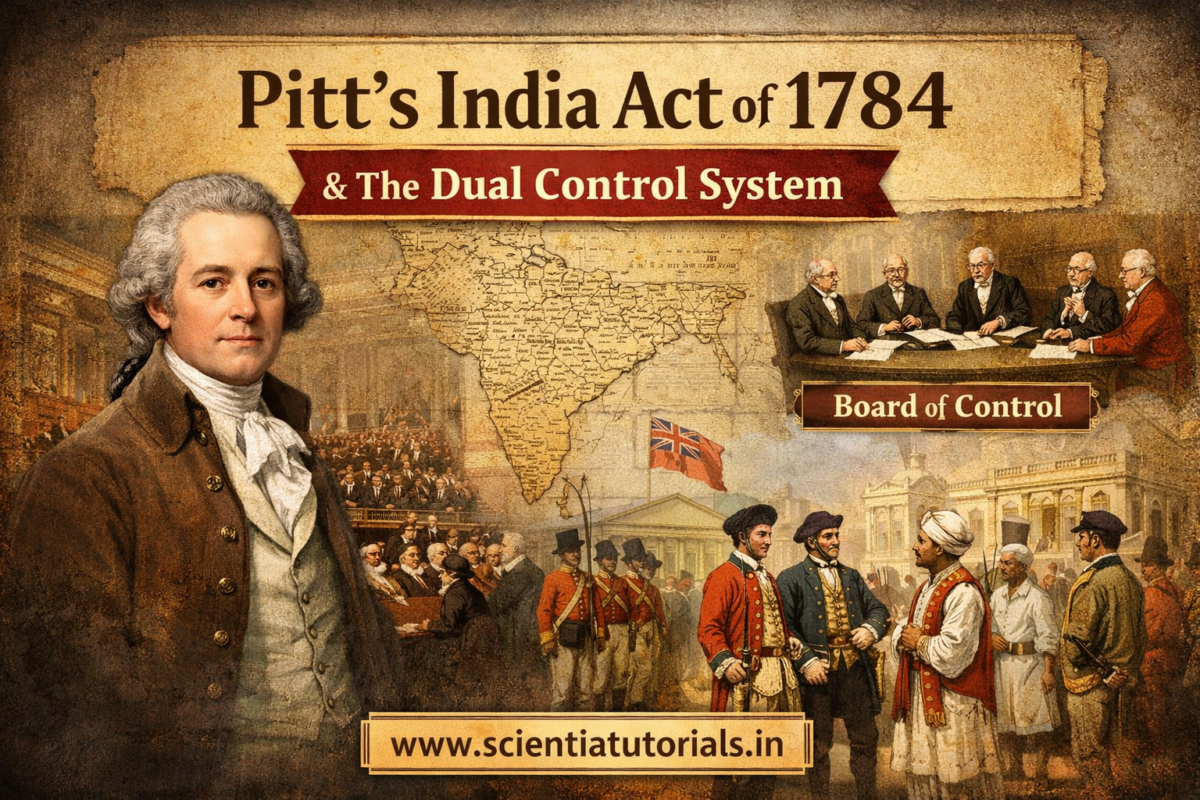

Pitt’s India Act of 1784
Course: Constitutional Developments and Independence in India – History of India
Module 1: Early Constitutional Experiments under Company Rule (c. 1773–1858 CE)
Lesson: Pitt’s India Act of 1784 and the Dual Control System
Based on the Lesson followed by the above Module and Course, we have created study materials aligned to the needs of UPSC, State PSC, UGC-NET, CUET, CBSE, and all school, college, and university examinations in India:
- Chronologically Structured Study Module,
- Questions with Answers,
- MCQs with Answers and detailed explanations.
Chronologically Structured Study Module
Introduction: Setting the Chronological Context (1773–1784)
The second half of the eighteenth century marked a decisive phase in the constitutional history of British India. Following the Battle of Plassey (1757) and the Battle of Buxar (1764), the East India Company transformed from a trading corporation into a territorial power. This rapid political expansion created administrative chaos, financial corruption, and severe governance failures in India.
The first major attempt by the British Parliament to regulate Company affairs was the Regulating Act of 1773. However, its limitations soon became apparent. By the early 1780s, growing political criticism in Britain, financial distress of the Company, and misgovernance in India necessitated a more effective constitutional framework.
It was against this backdrop that the Pitt’s India Act was enacted in 1784, introducing the famous Dual Control System, which fundamentally reshaped the governance of British India until 1858.
Background to Pitt’s India Act (1773–1784)
1. Failure of the Regulating Act, 1773
The Regulating Act was a pioneering but flawed experiment. Its key weaknesses included:
- Ambiguity in the division of powers between the British government and the Company
- Conflicts between the Governor-General and his Council
- Ineffective parliamentary supervision
- Continued corruption and political interference
The political crisis during the tenure of Warren Hastings exposed the Act’s structural inadequacies.
2. Political Developments in Britain
By the early 1780s:
- The Company faced severe financial instability
- British public opinion turned hostile due to reports of exploitation in India
- Parliamentary debates intensified over the need for direct state control
The Whig attempt to overhaul Company administration through Fox’s India Bill (1783) failed, paving the way for William Pitt the Younger’s reform.
Enactment of Pitt’s India Act, 1784
The Pitt’s India Act was passed during the prime ministership of William Pitt the Younger. Unlike earlier measures, it clearly differentiated between:
- Political functions (to be controlled by the British Crown)
- Commercial functions (to remain with the Company)
This distinction institutionalized a new constitutional arrangement known as Dual Control.
Key Provisions of Pitt’s India Act (Chronological & Structural Analysis)
1. Establishment of the Board of Control (1784)
A new body called the Board of Control was created to supervise civil, military, and political affairs of the Company.
Composition:
- Six commissioners appointed by the Crown
- Included the Secretary of State and the Chancellor of the Exchequer
Significance:
- Marked the formal entry of the British government into Indian administration
- Reduced the Company to a subordinate political position
2. Role of the Court of Directors
The Court of Directors continued to manage:
- Trade and commerce
- Appointments and patronage (subject to oversight)
However, all correspondence related to political and military matters required approval from the Board of Control.
3. Secret Committee Mechanism
A Secret Committee of the Court of Directors acted as the channel of communication between:
- The Board of Control in Britain
- The Company’s authorities in India
This ensured confidentiality in sensitive matters, especially foreign relations and defense.
4. Reorganization of Indian Administration
The Act strengthened the position of:
- Governor-General of Bengal
- Presidencies of Madras and Bombay placed under Bengal’s control
This enhanced centralization laid the groundwork for future administrative integration.
The Dual Control System: Concept and Functioning
Meaning of Dual Control
The Dual Control System implied:
- Political sovereignty exercised by the British Crown
- Administrative execution handled by the Company
This was not a division of power but a sharing of authority, often leading to overlap and conflict.
Working of Dual Control in Practice
| Sphere | Authority |
|---|---|
| Political & Military | Board of Control |
| Commercial & Revenue | Court of Directors |
| Communication | Secret Committee |
Though theoretically balanced, in practice, the Board of Control dominated decision-making.
Chronological Significance (1784–1858)
1. Consolidation of British Parliamentary Control
Between 1784 and 1813:
- The British Parliament steadily increased oversight
- Company autonomy declined
- India became a strategic imperial possession
2. Administrative Centralization
The Act reinforced:
- Bengal’s supremacy over other presidencies
- Uniformity in civil and military policies
This centralization influenced later reforms like the Charter Acts.
3. Impact on Indian Governance
For Indians:
- Governance became more systematic but exploitative
- Revenue extraction intensified
- No Indian representation was introduced
The Act was administrative, not democratic.
Evaluation of Pitt’s India Act
Merits
- Ended ambiguity of authority
- Established parliamentary supremacy
- Improved administrative coordination
- Reduced corruption at higher levels
Limitations
- Dual Control caused delays and conflicts
- Company retained commercial exploitation rights
- Indian interests were ignored
- Bureaucratic complexity increased
Comparison with Earlier and Later Acts
Regulating Act, 1773 vs Pitt’s India Act, 1784
| Aspect | Regulating Act | Pitt’s India Act |
|---|---|---|
| Control | Partial | Effective |
| Government role | Indirect | Direct |
| Structure | Vague | Clearly defined |
Towards the Charter Acts (1813–1853)
The Pitt’s India Act served as a constitutional bridge:
- From Company autonomy
- To Crown dominance (completed in 1858)
Long-Term Historical Importance
The Act:
- Institutionalized British state control
- Prepared ground for bureaucratic imperialism
- Influenced colonial governance models worldwide
It remained the constitutional basis of British Indian administration until the Government of India Act, 1858.
Examination-Oriented Key Takeaways
For UPSC & State PSC
- Emphasize Dual Control System
- Analyze administrative centralization
- Link with imperial expansion
For NET / University Exams
- Compare constitutional acts
- Assess limitations and evolution
For School-Level Exams
- Define Pitt’s India Act
- List main provisions
- Explain Dual Control simply
Conclusion
The Pitt’s India Act of 1784 represents a decisive milestone in India’s constitutional evolution under Company rule. By introducing the Dual Control System, it effectively subordinated the East India Company to British parliamentary authority while preserving its commercial role. Chronologically, the Act marks the transition from mercantile imperialism to bureaucratic colonialism—setting India firmly on the path toward Crown rule in 1858.
In the broader narrative of Indian constitutional history, the Act stands as a foundational experiment in imperial governance, revealing both the administrative ingenuity and inherent contradictions of British colonial rule.
Questions with Answers
Section A: Very Short Answer Questions
Q1. In which year was Pitt’s India Act passed?
Answer: Pitt’s India Act was passed in 1784.
Q2. Who introduced Pitt’s India Act in the British Parliament?
Answer: The Act was introduced by William Pitt the Younger.
Q3. Which organization’s political powers were curtailed by Pitt’s India Act?
Answer: The political powers of the East India Company were curtailed.
Q4. Name the body created to supervise political affairs in India under the Act.
Answer: The Board of Control.
Q5. What system of governance was introduced by Pitt’s India Act?
Answer: The Dual Control System.
Section B: Short Answer Questions
Q6. What were the main reasons for the enactment of Pitt’s India Act, 1784?
Answer:
The main reasons were:
- Failure of the Regulating Act of 1773
- Administrative corruption and misrule by the East India Company
- Financial crisis of the Company
- Growing demand in Britain for parliamentary control over Indian affairs
Q7. Explain the meaning of the Dual Control System.
Answer:
The Dual Control System referred to the division of authority between:
- The British government (through the Board of Control) for political and military matters
- The East India Company (through the Court of Directors) for commercial and administrative functions
Q8. What was the composition of the Board of Control?
Answer:
The Board of Control consisted of:
- Six members appointed by the Crown
- Included the Secretary of State and the Chancellor of the Exchequer
Q9. What role did the Court of Directors play after 1784?
Answer:
The Court of Directors retained control over:
- Trade and commerce
- Company appointments
However, all political correspondence required approval from the Board of Control.
Q10. Why was a Secret Committee created under Pitt’s India Act?
Answer:
The Secret Committee was created to ensure confidential communication between the Board of Control and Company officials in India, especially on matters of war, diplomacy, and defense.
Section C: Medium Answer Questions
Q11. Examine the limitations of the Regulating Act of 1773 that led to Pitt’s India Act.
Answer:
The Regulating Act of 1773 suffered from vague division of powers, conflicts between the Governor-General and his Council, lack of effective parliamentary control, and continued corruption. These weaknesses made it ineffective, necessitating a stronger constitutional framework through Pitt’s India Act.
Q12. How did Pitt’s India Act strengthen British parliamentary control over India?
Answer:
The Act established the Board of Control, allowing direct government supervision of political, military, and civil affairs. It reduced the Company’s autonomy and made Indian administration accountable to Parliament.
Q13. Discuss the impact of Pitt’s India Act on the Governor-General of Bengal.
Answer:
The Act strengthened the authority of the Governor-General of Bengal by:
- Increasing central control over Madras and Bombay
- Enhancing coordination in civil and military administration
This laid the foundation for centralized governance in India.
Q14. In what way did Pitt’s India Act mark a shift from commercial to political imperialism?
Answer:
The Act subordinated the Company’s political role to the British state, transforming it from a sovereign power into an administrative agency. This marked a transition from mercantile expansion to state-driven colonial rule.
Q15. Explain how the Dual Control System worked in practice.
Answer:
In practice, political decisions were made by the Board of Control, while the Company executed them. Although theoretically balanced, the system often caused delays, overlapping authority, and bureaucratic confusion.
Section D: Long Answer Questions
Q16. Critically analyze the Dual Control System introduced by Pitt’s India Act, 1784.
Answer:
The Dual Control System aimed to balance Company experience with government oversight. While it ended administrative ambiguity and established parliamentary supremacy, it also created overlapping authority, delays in decision-making, and bureaucratic complexity. Ultimately, it favored British imperial interests over Indian welfare.
Q17. Evaluate the significance of Pitt’s India Act in the constitutional development of British India.
Answer:
Pitt’s India Act was a landmark constitutional measure that:
- Established British state control over Indian administration
- Reduced Company autonomy
- Laid the groundwork for later Charter Acts
- Prepared the path for Crown rule in 1858
It represents a crucial stage in the evolution of colonial governance.
Q18. Compare the Regulating Act of 1773 with Pitt’s India Act of 1784.
Answer:
While the Regulating Act was the first attempt at regulation, it was vague and ineffective. Pitt’s India Act clearly defined authority, introduced the Board of Control, and ensured effective parliamentary supervision, making it a more successful administrative reform.
Q19. Discuss the administrative and political consequences of Pitt’s India Act on Indian governance.
Answer:
Administratively, it centralized authority and improved coordination. Politically, it intensified British control and exploitation. Indians had no representation, and governance remained authoritarian and revenue-oriented.
Q20. “Pitt’s India Act laid the foundation of Crown rule in India.” Explain.
Answer:
By asserting parliamentary supremacy and reducing the Company to an administrative agency, Pitt’s India Act initiated the process that culminated in the Government of India Act, 1858, transferring power directly to the British Crown.
Section E: Analytical & Examination-Focused Questions
Q21. Why is Pitt’s India Act considered a turning point in British Indian administration?
Answer:
Because it institutionalized government control, ended Company sovereignty, and introduced systematic colonial administration.
Q22. Did Pitt’s India Act improve governance for Indians? Give reasons.
Answer:
No. While administration became more organized, exploitation increased, and Indians remained excluded from power.
Q23. How far was Pitt’s India Act successful in checking corruption?
Answer:
It reduced corruption at higher levels through supervision but failed to address structural exploitation.
Q24. Trace the continuity of Pitt’s India Act up to 1858.
Answer:
The Act remained the constitutional basis of British India until 1858, influencing Charter Acts and ultimately leading to Crown rule.
Q25. Write a short note on the historical importance of Pitt’s India Act for competitive examinations.
Answer:
The Act is crucial for understanding:
- Dual Control System
- Growth of parliamentary supremacy
- Evolution of colonial administration
It is frequently asked in UPSC, State PSC, NET, and university exams.
Multiple Choice Questions
MCQs on Pitt’s India Act of 1784 & Dual Control System
MCQ 1
The Pitt’s India Act was passed primarily to:
A. Abolish the East India Company
B. Introduce Indian representation in administration
C. Remove the defects of the Regulating Act of 1773
D. Establish Crown rule in India
Correct Answer: C
Explanation:
The Act of 1784 was enacted to correct the administrative and constitutional weaknesses of the Regulating Act of 1773, particularly the lack of effective parliamentary control and ambiguity in authority.
MCQ 2
Pitt’s India Act was introduced by:
A. Lord North
B. Edmund Burke
C. William Pitt the Younger
D. Charles James Fox
Correct Answer: C
Explanation:
William Pitt the Younger, the British Prime Minister, introduced the Act after Fox’s India Bill failed in Parliament.
MCQ 3
Which body was created under Pitt’s India Act to control political affairs in India?
A. Court of Directors
B. Board of Trade
C. Board of Control
D. Governor-General’s Council
Correct Answer: C
Explanation:
The Board of Control represented the British government and supervised political, military, and civil affairs of the Company.
MCQ 4
The Dual Control System implies:
A. Equal power between Indians and British
B. Division of power between Parliament and Crown
C. Sharing of authority between Company and British government
D. Separation of judiciary and executive
Correct Answer: C
Explanation:
Dual Control meant that political power rested with the British government, while commercial and administrative functions remained with the Company.
MCQ 5
Which of the following functions remained with the East India Company after 1784?
A. Foreign relations
B. War and peace
C. Trade and commerce
D. Civil legislation
Correct Answer: C
Explanation:
The Company retained commercial activities, while political functions were supervised by the Board of Control.
MCQ 6
The Secret Committee under Pitt’s India Act consisted of:
A. Members of Parliament
B. British Cabinet Ministers
C. Selected members of the Court of Directors
D. Indian representatives
Correct Answer: C
Explanation:
The Secret Committee was a subset of the Court of Directors responsible for confidential correspondence with India.
MCQ 7
Which presidency was made supreme under Pitt’s India Act?
A. Bombay
B. Madras
C. Bengal
D. Calcutta
Correct Answer: C
Explanation:
The Governor-General of Bengal was given greater authority over Madras and Bombay, enhancing centralization.
MCQ 8
The Board of Control consisted of:
A. Five members
B. Six members
C. Eight members
D. Ten members
Correct Answer: B
Explanation:
The Board of Control had six members, including key British ministers.
MCQ 9
Which of the following was NOT a feature of Pitt’s India Act?
A. Parliamentary supervision
B. Dual control system
C. Indian representation
D. Centralization of authority
Correct Answer: C
Explanation:
The Act did not introduce Indian representation; it focused purely on administrative control.
MCQ 10
The Regulating Act of 1773 failed mainly because:
A. It abolished Company rule
B. It ignored parliamentary authority
C. It created administrative ambiguity
D. It introduced Crown rule
Correct Answer: C
Explanation:
The Regulating Act lacked a clear division of powers, leading to conflicts and inefficiency.
MCQ 11
Under Dual Control, final authority in political matters rested with:
A. Court of Directors
B. Governor-General
C. Board of Control
D. British Parliament directly
Correct Answer: C
Explanation:
The Board of Control had overriding authority in political and military affairs.
MCQ 12
Which of the following best describes the nature of Pitt’s India Act?
A. Democratic reform
B. Commercial reform
C. Administrative and constitutional reform
D. Social reform
Correct Answer: C
Explanation:
The Act reorganized the constitutional relationship between the Company and the British state.
MCQ 13
The Dual Control System resulted in:
A. Administrative efficiency only
B. Clear separation of powers
C. Overlapping authority and delays
D. Indian self-government
Correct Answer: C
Explanation:
Though intended to balance power, dual control often led to confusion and bureaucratic delay.
MCQ 14
Which event directly preceded Pitt’s India Act?
A. Battle of Plassey
B. Regulating Act of 1773
C. Fox’s India Bill, 1783
D. Charter Act of 1813
Correct Answer: C
Explanation:
The failure of Fox’s India Bill created political space for Pitt’s reform.
MCQ 15
Pitt’s India Act reduced the East India Company to:
A. A trading monopoly only
B. A subordinate administrative agency
C. A military power
D. A provincial authority
Correct Answer: B
Explanation:
The Company became an executing agency under government supervision.
MCQ 16
Which area was least affected by Pitt’s India Act?
A. Military administration
B. Political control
C. Commercial monopoly
D. Revenue collection
Correct Answer: C
Explanation:
The Company’s commercial monopoly remained intact until later Charter Acts.
MCQ 17
The Act of 1784 marked the beginning of:
A. Indian nationalism
B. Crown rule
C. Parliamentary control over India
D. Responsible government
Correct Answer: C
Explanation:
It was the first effective assertion of parliamentary supremacy over Indian affairs.
MCQ 18
Which Act finally ended the Dual Control System?
A. Charter Act, 1813
B. Charter Act, 1833
C. Government of India Act, 1858
D. Indian Councils Act, 1861
Correct Answer: C
Explanation:
The Government of India Act, 1858 abolished Company rule and ended dual control.
MCQ 19
Pitt’s India Act is best described as a transition from:
A. Political to economic imperialism
B. Mercantile to bureaucratic imperialism
C. Colonialism to nationalism
D. Company rule to self-rule
Correct Answer: B
Explanation:
The Act shifted governance from profit-driven expansion to bureaucratic state control.
MCQ 20
Which criticism is most commonly associated with Pitt’s India Act?
A. Excessive Indian participation
B. Complete abolition of Company
C. Bureaucratic complexity
D. Weak parliamentary role
Correct Answer: C
Explanation:
Dual authority created procedural delays and administrative complexity.
MCQ 21
The Act strengthened the position of:
A. Court of Directors
B. Governor-General of Bengal
C. Indian rulers
D. Local zamindars
Correct Answer: B
Explanation:
The Governor-General’s authority over other presidencies was enhanced.
MCQ 22
Which examination frequently asks questions on Dual Control System?
A. Only CBSE
B. Only UPSC
C. UPSC and State PSC
D. All competitive and academic exams
Correct Answer: D
Explanation:
The topic is relevant across school, university, and competitive examinations.
MCQ 23
The main objective of Pitt’s India Act was to ensure:
A. Company profits
B. Indian welfare
C. British parliamentary supremacy
D. Religious reforms
Correct Answer: C
Explanation:
The Act aimed to bring Indian administration under British state supervision.
MCQ 24
Which term best explains the governance structure after 1784?
A. Unitary control
B. Federal control
C. Dual control
D. Responsible control
Correct Answer: C
Explanation:
Authority was shared between the Company and the British government.
MCQ 25
Why is Pitt’s India Act important for constitutional history of India?
A. It introduced elections
B. It established Crown rule
C. It laid foundations of colonial administration
D. It ended British rule
Correct Answer: C
Explanation:
The Act institutionalized British state control and shaped colonial governance until 1858.
✔️ Examination Tip
For UPSC & State PSC, focus on Dual Control, Board of Control, and comparison with Regulating Act.
For NET/CUET, emphasize conceptual clarity and chronology.
For CBSE & universities, remember definitions, features, and significance.
-
Pitt’s India Act of 1784 explained
-
Dual Control System in British India
-
Pitt’s India Act features and significance
-
Pitt’s India Act 1784 UPSC notes
-
Constitutional developments under Company rule
-
Difference between Regulating Act 1773 and Pitt’s India Act
-
Board of Control under Pitt’s India Act
-
Dual government system in India 1784
-
Pitt’s India Act MCQs and questions answers
-
British parliamentary control over India
-
Evolution of colonial administration in India
-
Early constitutional experiments in British India
-
East India Company administration reforms
-
Transition from mercantile to bureaucratic imperialism
-
Foundations of Crown rule in India