
Growth of Indian Nationalism and Constitutional Consciousness
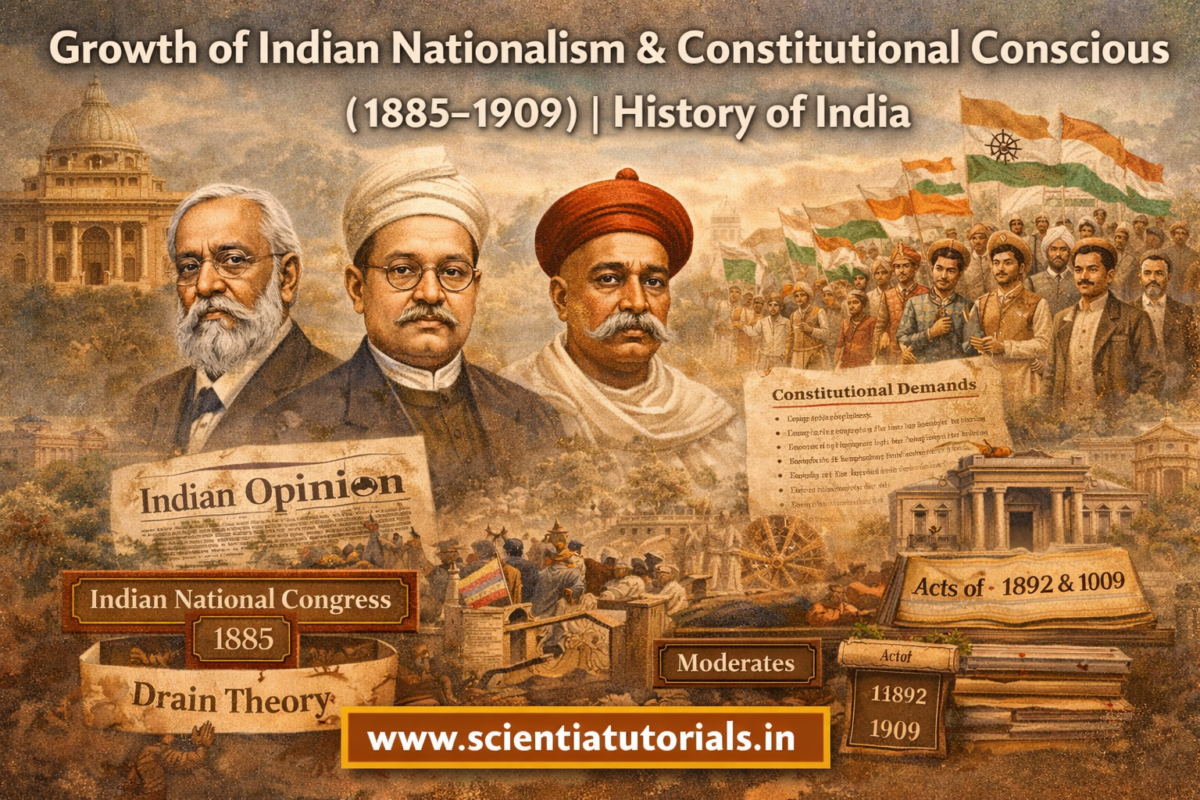

Growth of Indian Nationalism & Constitutional Consciousness (1885–1909) | History of India
Course: Constitutional Developments and Independence in India – History of India
Module 3: Rise of Indian Nationalism and Constitutional Demands
1. Introduction: Nationalism and Constitutional Awareness in Colonial India
The period 1885–1909 CE marks a decisive phase in modern Indian history when Indian nationalism acquired an organised, constitutional, and political character. Unlike earlier sporadic resistances, nationalism in this era was expressed through associations, petitions, public debates, and constitutional demands. The growth of Indian nationalism was closely linked with the emergence of constitutional consciousness—an awareness among educated Indians that political rights, representation, and responsible government could be sought through constitutional means.
This lesson examines how nationalism evolved during this period, how constitutional ideas spread among Indians, and how these developments shaped early demands for reform under British rule.
2. Historical Context: Post-1857 Political Environment
After the Revolt of 1857, British policy emphasised centralisation, order, and administrative control. Indians were excluded from real political power, but British rule also introduced:
- Western education
- A uniform legal system
- Modern communication (press, railways, telegraph)
These factors unintentionally created conditions for political awakening. By the 1880s, a new educated middle class began questioning colonial governance using the language of law, rights, and constitutionalism.
3. Meaning of Indian Nationalism in the Late 19th Century
Indian nationalism during this period did not initially demand independence. Instead, it focused on:
- Political unity beyond regional and religious identities
- Loyalty to the British Crown combined with criticism of colonial policies
- Gradual reform through constitutional means
Nationalism was thus moderate, reformist, and constitutional in character.
4. Growth of Constitutional Consciousness
Concept of Constitutional Consciousness
Constitutional consciousness refers to:
- Awareness of political rights
- Understanding of laws and institutions
- Demand for representation and accountability
Educated Indians believed that British liberal ideals—rule of law, equality, and representative government—should apply to India as well.
5. Role of Western Education
Western education played a critical role in shaping nationalist thought.
Impact
- Introduced ideas of liberty, democracy, and nationalism
- Familiarised Indians with British political institutions
- Created a class of lawyers, teachers, journalists, and administrators
This educated elite became the vanguard of early nationalism.
6. Role of the Press and Public Opinion
The late 19th century saw rapid growth of Indian-owned newspapers and journals.
Contributions
- Spread political ideas
- Criticised colonial policies
- Created all-India political awareness
The press acted as a bridge between leaders and the public, strengthening constitutional debates.
7. Economic Critique and Nationalist Thought
Economic exploitation under colonial rule became a central theme of nationalism.
Key Issues
- Drain of wealth to Britain
- Heavy taxation
- Decline of Indian industries
Economic criticism gave nationalism a material and popular foundation, beyond elite politics.
8. Early Political Associations before 1885
Before the formation of a national organisation, several regional associations emerged:
- Bombay Presidency Association
- Indian Association
- Poona Sarvajanik Sabha
These organisations demanded administrative reforms and prepared the ground for a national political platform.
9. Formation of the Indian National Congress (1885)
The founding of the Indian National Congress in 1885 marked the formal beginning of organised Indian nationalism.
Objectives
- Promote political unity
- Present Indian demands to the British government
- Encourage constitutional methods
Initially, the Congress functioned as a pressure group, not a revolutionary body.
10. Nature of Early Congress Leadership
The early Congress leadership consisted mainly of:
- Educated professionals
- Lawyers and journalists
- Urban middle class
Leaders such as Dadabhai Naoroji and Surendranath Banerjee believed in reform through dialogue and petitions.
11. Moderate Phase of Nationalism (1885–1905)
This period is often called the Moderate Phase of Indian nationalism.
Characteristics
- Faith in British justice
- Constitutional agitation
- Use of petitions, resolutions, and meetings
- Emphasis on gradual reform
The Moderates aimed to Indianise administration, not overthrow British rule.
12. Key Constitutional Demands of the Moderates
The Moderates demanded:
- Expansion of legislative councils
- Indian representation in administration
- Reduction in military expenditure
- Separation of judiciary from executive
These demands reflected growing constitutional awareness and political maturity.
13. Economic Nationalism and the Drain Theory
Economic critique became sharper through the Drain Theory, articulated by Dadabhai Naoroji.
Significance
- Explained how colonial rule impoverished India
- Provided scientific basis for political demands
- Strengthened nationalist ideology
Economic nationalism linked constitutional reform with material welfare.
14. British Response to Early Nationalism
The British response was cautious and limited.
Features
- Minor reforms
- Retention of executive dominance
- Suspicion of political mobilisation
The colonial state aimed to control, not empower, Indian political activity.
15. Indian Councils Act, 1892: Limited Constitutional Reform
The Indian Councils Act, 1892 introduced:
- Slight expansion of legislative councils
- Indirect election of some members
- Limited budget discussion
While modest, it acknowledged the legitimacy of Indian constitutional demands.
16. Limitations of Early Constitutional Reforms
Despite reforms:
- Executive remained unaccountable
- Indians lacked real power
- Councils were advisory
This gap between expectations and reality created political frustration.
17. Partition of Bengal and a New Phase of Nationalism (1905)
The Partition of Bengal in 1905 intensified nationalist politics.
Impact
- Mass protests
- Rise of swadeshi and boycott
- Politicisation of wider sections of society
Though beyond moderate constitutionalism, it reshaped nationalist consciousness.
18. Growth of Extremist Thought (1905–1909)
Leaders like Bal Gangadhar Tilak argued that:
- Constitutional methods were insufficient
- Political rights must be asserted more forcefully
This marked a shift from petitioning to mobilisation, though constitutional issues remained central.
19. Nationalism and Constitutional Debate within the Congress
The period saw debates between:
- Moderates: constitutional reform, gradualism
- Extremists: self-reliance, assertive nationalism
Despite differences, both shared the goal of political empowerment of Indians.
20. Morley–Minto Reforms, 1909
The Indian Councils Act, 1909 was a response to rising nationalism.
Features
- Expanded legislative councils
- Introduced elected members
- Retained executive supremacy
While limited, it marked the first official recognition of Indian political participation.
21. Constitutional Consciousness among Indians
By 1909, Indians had developed:
- Awareness of rights and representation
- Criticism of colonial constitutional limits
- Confidence in organised political action
Constitutional consciousness became a permanent feature of Indian politics.
22. Social Base of Nationalism
Initially urban and elite, nationalism gradually expanded to:
- Teachers
- Students
- Professionals
- Small traders
This broadened the movement’s social foundation.
23. Nationalism as a Unifying Force
Nationalism helped:
- Overcome regional divisions
- Create a sense of Indian identity
- Promote common political goals
This unity was essential for future mass movements.
24. Evaluation of the Period (1885–1909)
Achievements
- Creation of national political organisation
- Development of constitutional awareness
- Articulation of economic critique
Limitations
- Limited mass participation
- Dependence on British goodwill
- Slow pace of reform
25. Historical Significance
The period 1885–1909 CE laid the intellectual and organisational foundations of India’s freedom struggle. Indian nationalism evolved from elite constitutionalism to broader political assertion, preparing the ground for later mass movements.
26. Conclusion
The growth of Indian nationalism and constitutional consciousness during this period transformed Indians from subjects into politically aware citizens-in-the-making. Though limited in immediate success, constitutional demands educated Indians in political organisation, debate, and resistance—essential tools for the later struggle for independence.
📌 Examination Relevance
- Core topic for Modern Indian History
- Frequently asked in UPSC, State PSC, UGC-NET
- Key themes: INC formation, Moderate phase, constitutional demands, economic nationalism
Below is a well-structured, examination-oriented set of 25 Questions with clear and accurate Answers, developed strictly from the lesson “Growth of Indian Nationalism and Constitutional Consciousness (1885–1909 CE)”, and aligned with the Course, Module 3, and the given timeline.
The questions progress from conceptual understanding to analytical depth, making them suitable for school, university, and competitive examinations (UPSC/PSC/UGC-NET).
Growth of Indian Nationalism and Constitutional Consciousness (1885–1909)
Questions with Answers
1. Why is the period 1885–1909 considered crucial in the growth of Indian nationalism?
Answer:
This period marks the emergence of organised Indian nationalism through political associations, especially the Indian National Congress, and the development of constitutional methods to demand political reforms.
2. What is meant by ‘constitutional consciousness’ in colonial India?
Answer:
Constitutional consciousness refers to awareness among Indians about political rights, representative institutions, rule of law, and the demand for reforms through constitutional and legal means.
3. How did British rule after 1857 contribute indirectly to the rise of nationalism?
Answer:
British rule introduced Western education, modern administration, a unified legal system, and communication networks, which unintentionally promoted political awareness and unity among Indians.
4. Why did early Indian nationalism adopt a moderate and reformist character?
Answer:
Early nationalists believed in British liberal values and hoped that gradual reforms could be achieved through petitions, dialogue, and constitutional agitation.
5. What role did Western education play in the growth of nationalism?
Answer:
Western education exposed Indians to ideas of liberty, democracy, nationalism, and constitutional governance, creating an educated class that led the nationalist movement.
6. How did the Indian press contribute to constitutional consciousness?
Answer:
Indian newspapers and journals spread political ideas, criticised colonial policies, mobilised public opinion, and created awareness of rights and injustices.
7. Why did economic issues become central to nationalist thought?
Answer:
Colonial economic policies caused poverty, deindustrialisation, and heavy taxation, leading nationalists to argue that British rule was economically exploitative.
8. What were the early political associations before 1885, and why were they important?
Answer:
Associations like the Bombay Presidency Association and Indian Association raised political demands and prepared the groundwork for a national organisation.
9. Why was the formation of the Indian National Congress significant?
Answer:
It provided a national platform for political discussion, united Indians across regions, and articulated constitutional demands collectively.
10. What were the main objectives of the Indian National Congress in its early phase?
Answer:
The Congress aimed to promote political unity, represent Indian opinion, and seek administrative and constitutional reforms through peaceful means.
11. Who were the main social groups leading early Indian nationalism?
Answer:
Educated urban professionals such as lawyers, teachers, journalists, and civil servants formed the leadership of early nationalism.
12. Why is the early phase of nationalism (1885–1905) called the ‘Moderate Phase’?
Answer:
Because leaders relied on constitutional methods, expressed loyalty to the British Crown, and demanded gradual reforms rather than radical change.
13. What were the major constitutional demands of the Moderates?
Answer:
Expansion of legislative councils, Indianisation of services, reduction of military expenditure, and separation of judiciary from executive.
14. Explain the significance of the Drain Theory.
Answer:
Propounded by Dadabhai Naoroji, the Drain Theory explained how wealth was transferred from India to Britain, strengthening economic nationalism.
15. How did economic nationalism strengthen political demands?
Answer:
By linking constitutional reform with economic welfare, nationalists made their arguments more rational, persuasive, and relevant to Indian conditions.
16. How did the British government respond to early nationalist demands?
Answer:
The British introduced limited reforms while retaining executive control, showing caution and reluctance to share real power.
17. What changes were introduced by the Indian Councils Act, 1892?
Answer:
The Act slightly expanded legislative councils, allowed indirect elections, and permitted limited discussion on budgets.
18. Why were early constitutional reforms considered inadequate?
Answer:
Because legislative councils remained advisory, the executive was unaccountable, and Indians had no real decision-making power.
19. How did the Partition of Bengal (1905) affect Indian nationalism?
Answer:
It intensified political mobilisation, led to mass protests, and marked a shift from elite constitutionalism to broader popular participation.
20. What new ideas emerged in nationalism after 1905?
Answer:
Ideas of swadeshi, boycott, self-reliance, and more assertive political action gained prominence alongside constitutional demands.
21. How did nationalist debates reflect differences within the Congress?
Answer:
Moderates favoured gradual constitutional reform, while Extremists argued for stronger political pressure, though both aimed at Indian empowerment.
22. Why is the Indian Councils Act, 1909 important in this period?
Answer:
It expanded councils and introduced elected members, marking the first official recognition of Indian political participation.
23. How did constitutional consciousness transform Indians politically?
Answer:
It encouraged organised political action, debate on rights, and the belief that governance must be accountable to the people.
24. What were the limitations of nationalism during 1885–1909?
Answer:
Limited mass participation, dominance of elite leadership, and dependence on British goodwill restricted its immediate impact.
25. Assess the historical significance of the growth of Indian nationalism during 1885–1909.
Answer:
This period laid the organisational, ideological, and constitutional foundations of the freedom struggle, preparing Indians for later mass movements and demands for self-government.
📌 Examination Tip
- Short answers: Focus on definitions, years, and objectives
- Long answers: Link nationalism + constitutional demands + British response
- Competitive exams: Emphasise INC, Moderates, economic nationalism, and Acts of 1892 & 1909
Below is a well-structured, examination-oriented set of 25 Multiple Choice Questions (MCQs) with correct answers and detailed, concept-clearing explanations, developed strictly from the lesson “Growth of Indian Nationalism and Constitutional Consciousness (1885–1909 CE)” and aligned with Module 3: Rise of Indian Nationalism and Constitutional Demands.
Growth of Indian Nationalism and Constitutional Consciousness (1885–1909)
MCQs with Answers and Explanations
1. The year 1885 is significant in Indian history because it marks the:
A. Partition of Bengal
B. Foundation of the Indian National Congress
C. Morley–Minto Reforms
D. Beginning of Extremist politics
Correct Answer: B
Explanation:
The founding of the Indian National Congress in 1885 marked the beginning of organised, all-India political activity and constitutional nationalism.
2. Indian nationalism during the late 19th century was initially:
A. Revolutionary and violent
B. Communal in nature
C. Moderate and constitutional
D. Socialist
Correct Answer: C
Explanation:
Early nationalism relied on petitions, resolutions, and dialogue, reflecting faith in constitutional methods and British liberal values.
3. Constitutional consciousness refers to:
A. Awareness of religious identity
B. Understanding of military power
C. Awareness of political rights and institutions
D. Desire for armed struggle
Correct Answer: C
Explanation:
Constitutional consciousness involved awareness of rights, representative institutions, and the demand for accountable governance.
4. Which factor most directly contributed to the spread of constitutional ideas among Indians?
A. British military rule
B. Western education
C. Permanent Settlement
D. Subsidiary Alliance
Correct Answer: B
Explanation:
Western education introduced Indians to ideas of liberty, democracy, and constitutional government.
5. The educated middle class played a leading role in early nationalism because:
A. They controlled the army
B. They benefited from colonial exploitation
C. They understood modern political ideas
D. They opposed all reforms
Correct Answer: C
Explanation:
Education enabled this class to articulate political demands using constitutional language.
6. The Indian press contributed to nationalism mainly by:
A. Promoting loyalty to the British
B. Suppressing political debate
C. Spreading political awareness
D. Supporting colonial policies
Correct Answer: C
Explanation:
Newspapers criticised colonial rule and helped shape public opinion across regions.
7. Economic exploitation under British rule became a nationalist issue mainly due to:
A. Military spending
B. Religious policies
C. The drain of wealth
D. Language policies
Correct Answer: C
Explanation:
Nationalists argued that colonial rule drained India’s wealth to Britain, causing poverty and underdevelopment.
8. Which organisation provided the first all-India political platform?
A. Muslim League
B. Home Rule League
C. Indian National Congress
D. Swaraj Party
Correct Answer: C
Explanation:
The Indian National Congress unified Indians from different regions under one political organisation.
9. Early Congress leaders mainly belonged to the:
A. Peasantry
B. Industrial working class
C. Educated urban middle class
D. Princely families
Correct Answer: C
Explanation:
Lawyers, teachers, journalists, and professionals dominated early Congress leadership.
10. The Moderate phase of nationalism is generally dated between:
A. 1870–1885
B. 1885–1905
C. 1905–1919
D. 1919–1930
Correct Answer: B
Explanation:
Between 1885 and 1905, nationalist politics was dominated by Moderates advocating gradual reform.
11. Moderates believed that Indian interests could be protected through:
A. Armed rebellion
B. International pressure
C. Constitutional agitation
D. Mass civil disobedience
Correct Answer: C
Explanation:
They relied on petitions, meetings, and appeals to British liberal opinion.
12. Which of the following was NOT a demand of the Moderates?
A. Expansion of legislative councils
B. Indianisation of services
C. Immediate independence
D. Reduction of military expenditure
Correct Answer: C
Explanation:
Moderates did not demand independence; they sought reforms within British rule.
13. The Drain Theory was most clearly articulated by:
A. Gopal Krishna Gokhale
B. Bal Gangadhar Tilak
C. Dadabhai Naoroji
D. Lala Lajpat Rai
Correct Answer: C
Explanation:
Dadabhai Naoroji explained how colonial rule systematically transferred wealth from India to Britain.
14. Economic nationalism strengthened political nationalism because it:
A. Encouraged violence
B. Provided emotional slogans
C. Offered a rational critique of colonial rule
D. Rejected constitutional methods
Correct Answer: C
Explanation:
Economic analysis gave nationalism an objective and scientific basis.
15. Which Act represented the first official response to early nationalist demands?
A. Government of India Act, 1858
B. Indian Councils Act, 1861
C. Indian Councils Act, 1892
D. Indian Councils Act, 1909
Correct Answer: C
Explanation:
The Indian Councils Act, 1892 modestly expanded councils and allowed limited discussion.
16. Why were the reforms of 1892 considered inadequate?
A. They abolished councils
B. They excluded British officials
C. They retained executive dominance
D. They introduced universal franchise
Correct Answer: C
Explanation:
Legislative councils remained advisory, with no control over the executive.
17. The Partition of Bengal (1905) marked:
A. Decline of nationalism
B. Shift to mass political mobilisation
C. End of constitutional politics
D. Beginning of independence
Correct Answer: B
Explanation:
It transformed nationalism from elite politics to broader popular participation.
18. After 1905, nationalism became more:
A. Passive
B. Loyalist
C. Assertive
D. Apolitical
Correct Answer: C
Explanation:
Boycott, swadeshi, and mass agitation made nationalism more assertive.
19. Extremist leaders differed from Moderates mainly in their:
A. Final objective
B. Use of constitutional language
C. Methods of political struggle
D. Belief in nationalism
Correct Answer: C
Explanation:
Extremists favoured direct action and mass mobilisation over petitions.
20. Despite differences, Moderates and Extremists agreed on:
A. Immediate independence
B. Use of violence
C. Political empowerment of Indians
D. Support for colonial rule
Correct Answer: C
Explanation:
Both aimed to increase Indian control over governance.
21. The Indian Councils Act, 1909 is significant because it:
A. Introduced responsible government
B. Ended British rule
C. Expanded councils and elections
D. Gave autonomy to provinces
Correct Answer: C
Explanation:
The Act expanded representation, though executive authority remained intact.
22. Constitutional consciousness by 1909 meant that Indians:
A. Accepted colonial rule permanently
B. Rejected all reforms
C. Demanded political rights systematically
D. Avoided organised politics
Correct Answer: C
Explanation:
Indians increasingly demanded accountability, representation, and reforms.
23. The social base of nationalism during this period was mainly:
A. Rural peasants
B. Urban educated groups
C. Tribal communities
D. Princely elites
Correct Answer: B
Explanation:
Nationalism initially remained urban and elite-driven.
24. One major limitation of nationalism during 1885–1909 was:
A. Lack of leadership
B. Absence of ideology
C. Limited mass participation
D. Excessive violence
Correct Answer: C
Explanation:
The movement had not yet fully mobilised peasants and workers.
25. Historically, the period 1885–1909 is best described as:
A. Era of mass revolution
B. Phase of constitutional nationalism
C. Period of armed struggle
D. Time of political inactivity
Correct Answer: B
Explanation:
This phase laid the constitutional, ideological, and organisational foundations of India’s freedom struggle.
📌 Exam Strategy Tip
- Prelims: Focus on years, leaders, Acts, and key terms
- Mains: Link nationalism + constitutional demands + British response
- NET/SET: Emphasise concepts like constitutional consciousness and economic nationalism
🎯 Targeting Exams Section
This lesson on the Growth of Indian Nationalism and Constitutional Consciousness (1885–1909 CE) is a core topic in Modern Indian History and is highly relevant for the following examinations:
📘 School-Level Examinations
-
CBSE / ICSE Class 10 & 12 – History
-
State Board History examinations
-
Important for short answers, long answers, and MCQs
🎓 Undergraduate & University Exams
-
BA History (History of India / National Movement)
-
Semester exams covering early nationalism and constitutional demands
🏛️ Competitive Examinations
-
UPSC Civil Services Examination
-
GS Paper I (Modern Indian History)
-
Prelims questions on INC, Moderates, Acts of 1892 & 1909
-
-
State Public Service Commissions (PSC)
-
UGC–NET / SET (History)
-
SSC, TET, and Teaching Recruitment Exams
🔍 High-Priority Exam Themes
-
Growth of Indian nationalism (1885–1909)
-
Indian National Congress and its objectives
-
Moderate phase of nationalism
-
Constitutional consciousness and political awareness
-
Economic nationalism and Drain Theory
-
Indian Councils Acts of 1892 and 1909
-
Transition from moderate to assertive nationalism