
Government of India Act 1935: Salient Features
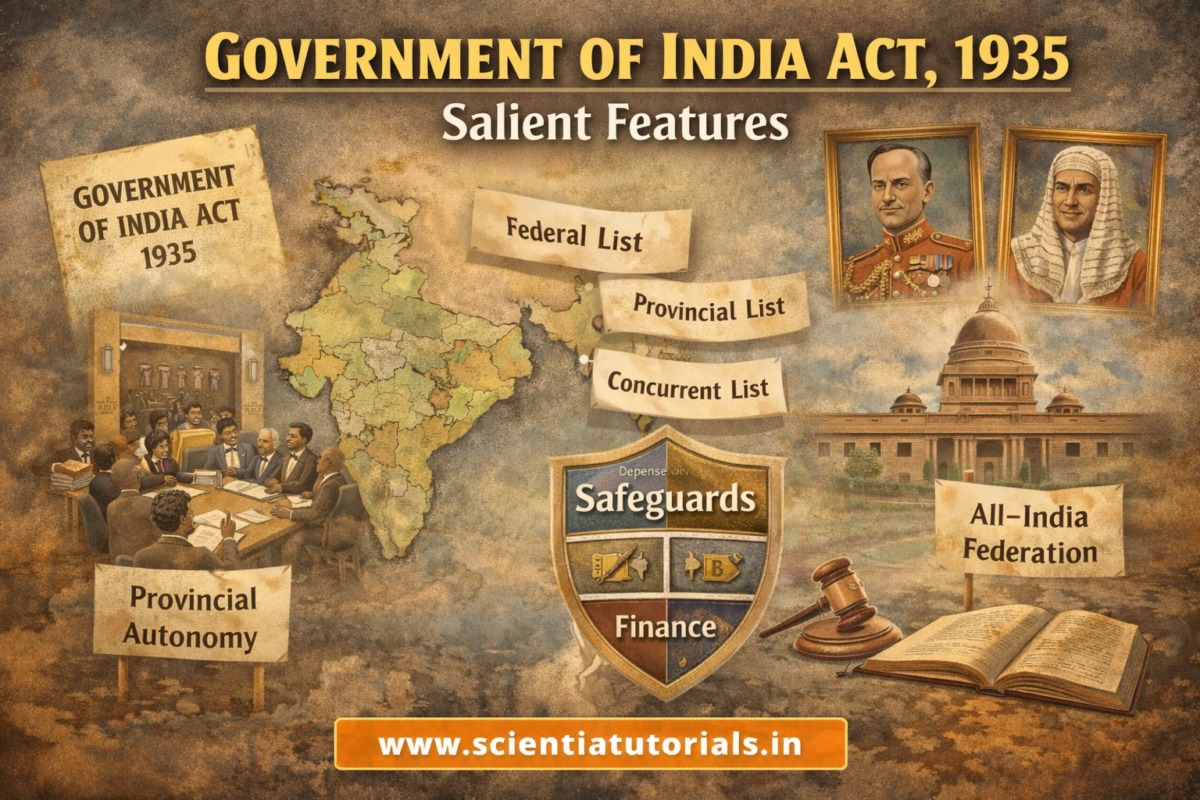

Government of India Act 1935: Salient Features | Provincial Autonomy – History of India
Government of India Act, 1935: Salient Features (1935–1939 CE)
Course: Constitutional Developments and Independence in India – History of India
Module 6: Towards Provincial Autonomy and Federal Vision
Timeline: 1935–1939 CE
1. Introduction: The Constitutional Context of the Government of India Act, 1935
The Government of India Act, 1935 stands as the most comprehensive and complex constitutional document enacted by the British Parliament for India before independence. It represented the culmination of nearly two decades of constitutional experimentation that began with the Government of India Act, 1919, and was shaped by the constitutional crisis of the late 1920s and early 1930s.
The Act was introduced at a time when:
- Dyarchy at the provincial level had demonstrably failed
- Nationalist movements had questioned the legitimacy of colonial rule
- Indian political opinion increasingly demanded autonomy and federalism
Although framed as a step towards self-government, the Act was fundamentally designed to reconcile limited Indian participation with continued British supremacy.
2. Background: Constitutional Developments Leading to the Act
2.1 Failure of the Government of India Act, 1919
The Government of India Act, 1919 introduced dyarchy in provinces, dividing subjects into reserved and transferred categories. In practice:
- Indian ministers lacked real authority
- Governors exercised overriding powers
- Financial control remained with British officials
This created administrative confusion and political frustration, discrediting dyarchy as a workable constitutional model.
2.2 Constitutional Crisis of the Late 1920s
The period witnessed:
- Appointment and boycott of the Simon Commission (1927–28)
- Drafting of the Nehru Report (1928)
- Demand for Poorna Swaraj (1929)
- Civil Disobedience Movement (1930–34)
These developments revealed the irreconcilable tension between Indian constitutional aspirations and British imperial control.
2.3 Round Table Conferences and White Papers
Between 1930 and 1932, three Round Table Conferences were held to discuss India’s constitutional future. While Indian participation was uneven, British policymakers used these discussions to:
- Justify federal restructuring
- Introduce safeguards for imperial interests
- Preserve communal and princely divisions
The outcomes were published as White Papers, which formed the basis of the Government of India Act, 1935.
3. Objectives of the Government of India Act, 1935
The Act sought to:
- Abolish dyarchy at the provincial level
- Introduce provincial autonomy
- Establish an all-India federation
- Retain British control over defence, finance, and administration
Its underlying objective was not independence, but the reorganisation of colonial governance in response to nationalist pressure.
4. Federal Structure: The All-India Federation
4.1 Proposed Federal Scheme
The Act proposed an All-India Federation comprising:
- British Indian provinces
- Princely States (to join voluntarily)
This was the first time a federal structure was envisaged for India.
4.2 Division of Powers
Legislative powers were divided into three lists:
- Federal List: Defence, foreign affairs, currency
- Provincial List: Police, education, agriculture
- Concurrent List: Criminal law, civil procedure
Residual powers were vested in the Governor-General, reinforcing central authority.
4.3 Failure of the Federal Scheme
The federation never came into operation because:
- Princely States refused to join
- Safeguards favoured British control
- Indian leaders viewed it as undemocratic
Thus, the federal vision remained constitutional theory rather than political reality.
5. Provincial Autonomy: The Core Feature
5.1 Abolition of Dyarchy in Provinces
One of the most significant features of the Act was the abolition of dyarchy at the provincial level, replacing it with provincial autonomy.
This meant:
- All provincial subjects were transferred to elected Indian ministers
- Ministers were responsible to provincial legislatures
- Governors were expected to act on ministerial advice
5.2 Reality of Provincial Autonomy
Despite its promise, autonomy was limited by:
- Governor’s special responsibilities
- Discretionary and overriding powers
- Control over finance and administration
Provincial autonomy thus operated within a framework of imperial supervision.
5.3 Elections of 1937
Under the Act, elections were held in 1937, resulting in:
- Formation of Congress ministries in most provinces
- First large-scale experience of Indian self-governance
- Implementation of social and economic reforms
This period (1937–1939) provided Indians with practical administrative experience, despite constitutional constraints.
6. Dyarchy at the Centre
6.1 Introduction of Central Dyarchy
While dyarchy was abolished in provinces, it was introduced at the central level, dividing subjects into:
- Reserved subjects: Defence, external affairs
- Transferred subjects: Administered by Indian ministers
This revealed British reluctance to part with control over strategic areas.
6.2 Significance of Central Dyarchy
Central dyarchy was never implemented because:
- Federation did not materialise
- Indian leaders rejected partial responsibility
Its inclusion highlighted the contradictory nature of the Act.
7. Role and Powers of the Governor-General
The Governor-General occupied a dominant constitutional position:
- Extensive executive authority
- Power to veto legislation
- Control over defence, external affairs, and finances
- Authority to suspend ministries during emergencies
These powers ensured that ultimate sovereignty remained with the British Crown.
8. Safeguards and Special Responsibilities
8.1 Nature of Safeguards
The Act incorporated safeguards to protect:
- British commercial interests
- Minority rights
- Financial stability
- Defence and external relations
8.2 Impact of Safeguards
While presented as protective measures, safeguards:
- Undermined responsible government
- Limited legislative autonomy
- Reinforced imperial control
They were widely criticised by Indian leaders as constitutional fetters.
9. Extension of Franchise
9.1 Expansion of Electorate
The Act significantly expanded the electorate:
- From about 7 million to nearly 35 million voters
- Still based on property, tax, and education qualifications
This marked progress but fell short of universal adult franchise.
9.2 Political Impact
Expanded franchise:
- Increased political participation
- Strengthened mass-based politics
- Enhanced legitimacy of provincial ministries
10. Bicameralism and Legislature
10.1 Central Legislature
The Act provided for a bicameral central legislature:
- Federal Assembly (Lower House)
- Council of States (Upper House)
However, limited powers and nominated elements restricted its effectiveness.
10.2 Provincial Legislatures
Provinces were given:
- Bicameral legislatures in larger provinces
- Enhanced legislative authority
This facilitated administrative experience and political training.
11. Federal Court of India
11.1 Establishment
The Act established the Federal Court of India in 1937 to:
- Interpret the constitution
- Resolve centre–province disputes
11.2 Constitutional Importance
The Federal Court:
- Laid foundations for judicial review
- Influenced post-independence constitutional jurisprudence
- Strengthened the rule of law
12. Evaluation of the Government of India Act, 1935
12.1 Positive Aspects
- Provincial autonomy
- Expansion of franchise
- Federal framework
- Administrative experience for Indians
12.2 Limitations
- Excessive safeguards
- Governor-General’s dominance
- Communal electorates
- Absence of full sovereignty
The Act was progressive in form but imperial in spirit.
13. Indian Nationalist Response
The Indian National Congress:
- Condemned the Act as inadequate
- Participated in elections pragmatically
- Used provincial ministries to demonstrate administrative competence
The experience strengthened demands for complete independence.
14. Historical Significance
14.1 Constitutional Significance
- Blueprint for federalism
- Basis for administrative structures
- Influence on the Indian Constitution
14.2 Political Significance
- Shift from protest to governance
- Prepared leadership for independence
15. Conclusion
The Government of India Act, 1935 represented the final and most elaborate constitutional experiment of British rule in India. While it stopped short of granting independence, it fundamentally reshaped Indian politics by introducing provincial autonomy and a federal vision. Its contradictions exposed the limits of colonial constitutionalism and reinforced the nationalist conviction that true self-government could only be achieved through independence.
Examination Insight
The Government of India Act, 1935 was both a milestone and a mirage—offering autonomy in appearance while retaining imperial control in substance.
Below is a well-structured, examination-oriented set of 25 Questions with clear and accurate Answers, developed strictly from the lesson “Government of India Act, 1935: Salient Features”, and aligned with Module 6: Towards Provincial Autonomy and Federal Vision (1935–1939 CE) of the course Constitutional Developments and Independence in India – History of India.
The questions progress from conceptual clarity → constitutional structure → critical evaluation, suitable for UPSC, State PSCs, UGC-NET, and University examinations.
Government of India Act, 1935: Salient Features (1935–1939 CE)
Questions with Answers
1. Why is the Government of India Act, 1935 considered a landmark in colonial constitutional history?
Answer:
The Government of India Act, 1935 was the most comprehensive constitutional statute enacted for British India. It introduced provincial autonomy, proposed an all-India federation, expanded the electorate, and reorganised centre–province relations.
2. What historical circumstances led to the enactment of the Government of India Act, 1935?
Answer:
The Act emerged from the failure of dyarchy under the Government of India Act, 1919, the constitutional crisis following the Simon Commission, the Civil Disobedience Movement, and discussions held during the Round Table Conferences.
3. What was the primary objective of the Government of India Act, 1935?
Answer:
Its main objective was to restructure colonial governance by granting limited autonomy to provinces while preserving British control over defence, finance, and external affairs.
4. What major change did the Act introduce at the provincial level?
Answer:
The Act abolished dyarchy in the provinces and introduced provincial autonomy, transferring all provincial subjects to elected Indian ministers.
5. What is meant by provincial autonomy under the Act?
Answer:
Provincial autonomy meant that ministers responsible to provincial legislatures controlled provincial administration, though subject to the Governor’s discretionary and special powers.
6. Why was provincial autonomy considered limited in practice?
Answer:
It was limited due to the Governor’s overriding powers, special responsibilities, financial control, and the ability to suspend ministries during emergencies.
7. What federal scheme was proposed under the Government of India Act, 1935?
Answer:
The Act proposed an All-India Federation consisting of British Indian provinces and princely states, with the latter joining voluntarily.
8. Why did the federal scheme of the Act never come into operation?
Answer:
The princely states refused to join the federation, and Indian political leaders opposed the extensive safeguards favouring British authority.
9. How were legislative powers divided under the federal scheme?
Answer:
Powers were divided into three lists: Federal, Provincial, and Concurrent Lists, with residual powers vested in the Governor-General.
10. What constitutional innovation did the Act introduce regarding dyarchy at the centre?
Answer:
While abolishing dyarchy in provinces, the Act introduced dyarchy at the central level, dividing subjects into reserved and transferred categories.
11. Why was central dyarchy never implemented?
Answer:
Central dyarchy could not be implemented because the proposed federation never came into existence.
12. Describe the powers of the Governor-General under the Act.
Answer:
The Governor-General possessed extensive executive authority, veto powers over legislation, control over defence and external affairs, and emergency powers.
13. What were “safeguards” under the Government of India Act, 1935?
Answer:
Safeguards were special provisions designed to protect British interests, minorities, defence, and financial stability, often overriding elected governments.
14. How did safeguards affect responsible government in India?
Answer:
They restricted legislative autonomy and undermined ministerial responsibility, ensuring continued imperial dominance.
15. How did the Act expand the electorate in India?
Answer:
The Act increased the electorate from about 7 million to nearly 35 million voters, though franchise remained limited by property, tax, and education qualifications.
16. What changes were made to the central legislature under the Act?
Answer:
A bicameral central legislature was proposed, consisting of the Federal Assembly and the Council of States, with limited powers.
17. How were provincial legislatures reorganised under the Act?
Answer:
Provinces were given enhanced legislative powers, and some larger provinces were provided with bicameral legislatures.
18. What was the significance of the elections held in 1937?
Answer:
The 1937 elections led to the formation of Congress ministries in most provinces, giving Indians practical experience in governance.
19. What role did the Federal Court of India play under the Act?
Answer:
The Federal Court, established in 1937, interpreted the constitution and resolved disputes between the centre and provinces.
20. How did the Government of India Act, 1935 influence India’s constitutional future?
Answer:
It provided a structural framework for federalism, judicial review, and administrative organisation later adapted in independent India.
21. How did the Indian National Congress initially respond to the Act?
Answer:
Congress criticised the Act as inadequate but decided to participate in elections to demonstrate administrative competence.
22. In what way did the Act prepare Indian leaders for independence?
Answer:
By administering provinces, Indian leaders gained practical experience in governance, policy-making, and administration.
23. Mention two positive features of the Government of India Act, 1935.
Answer:
- Introduction of provincial autonomy
- Expansion of the electorate
24. Mention two major limitations of the Government of India Act, 1935.
Answer:
- Excessive powers of the Governor-General
- Retention of imperial safeguards
25. Critically evaluate the historical significance of the Government of India Act, 1935.
Answer:
The Act was a milestone in constitutional development but failed to grant real sovereignty. It advanced autonomy in form while retaining British control in substance, reinforcing the demand for complete independence.
Exam Tip
In answers, link the Act’s features—provincial autonomy, federal scheme, safeguards—to its political impact during 1937–1939 for higher analytical scores.
Below is a well-structured, examination-oriented set of 25 Multiple Choice Questions (MCQs) with correct answers and detailed, concept-clearing explanations, developed strictly from the lesson “Government of India Act, 1935: Salient Features” and aligned with Module 6: Towards Provincial Autonomy and Federal Vision (1935–1939 CE) under the course Constitutional Developments and Independence in India – History of India.
The MCQs are framed to suit UPSC Prelims, State PSCs, UGC-NET, and University examinations, covering conceptual, analytical, and comparative dimensions.
Government of India Act, 1935: Salient Features (1935–1939 CE)
MCQs with Answers and Explanations
1. The Government of India Act, 1935 was primarily based on the recommendations of:
A. Simon Commission
B. Nehru Report
C. Round Table Conferences
D. Cabinet Mission
Correct Answer: C
Explanation:
The Act was framed mainly on the basis of discussions held during the Round Table Conferences (1930–1932) and the subsequent White Papers, reflecting British constitutional thinking.
2. Which Act abolished dyarchy at the provincial level?
A. Government of India Act, 1919
B. Government of India Act, 1935
C. Indian Councils Act, 1909
D. Indian Independence Act, 1947
Correct Answer: B
Explanation:
The Government of India Act, 1935 abolished dyarchy in provinces and replaced it with provincial autonomy.
3. Provincial autonomy under the Government of India Act, 1935 meant:
A. Complete independence of provinces
B. Governor rule in provinces
C. Responsible government in provinces
D. Abolition of legislatures
Correct Answer: C
Explanation:
Provincial autonomy meant that ministers responsible to elected legislatures controlled provincial administration, though subject to certain limitations.
4. Which of the following was a major limitation on provincial autonomy?
A. Universal adult franchise
B. Governor’s discretionary powers
C. Bicameral legislatures
D. Abolition of dyarchy
Correct Answer: B
Explanation:
Governors retained extensive discretionary and special powers, restricting the effective functioning of responsible government.
5. The Government of India Act, 1935 proposed which new constitutional arrangement for India?
A. Unitary system
B. Confederation
C. All-India Federation
D. Dominion government
Correct Answer: C
Explanation:
For the first time, the Act proposed an All-India Federation comprising British Indian provinces and princely states.
6. Why did the proposed All-India Federation fail to come into existence?
A. Opposition from British Parliament
B. Refusal of provinces
C. Refusal of princely states to join
D. Congress acceptance
Correct Answer: C
Explanation:
The federation required voluntary accession of princely states, which never materialised.
7. Under the federal scheme, legislative powers were divided into:
A. Two lists
B. Three lists
C. Four lists
D. Five lists
Correct Answer: B
Explanation:
Powers were divided into Federal, Provincial, and Concurrent Lists, a system later adopted in the Indian Constitution.
8. Residual powers under the Government of India Act, 1935 were vested in the:
A. Federal Legislature
B. Provincial Legislatures
C. Governor-General
D. Federal Court
Correct Answer: C
Explanation:
Unlike modern federal systems, residual powers were vested in the Governor-General, strengthening central control.
9. Which constitutional feature was introduced at the central level under the Act?
A. Provincial autonomy
B. Dyarchy
C. Complete responsible government
D. Dominion status
Correct Answer: B
Explanation:
Dyarchy was abolished in provinces but introduced at the centre, reflecting British reluctance to transfer real power.
10. Central dyarchy under the Act was never implemented because:
A. Congress opposed it
B. Federation never came into operation
C. British withdrew the provision
D. Provinces rejected it
Correct Answer: B
Explanation:
Central dyarchy depended on the establishment of the federation, which never materialised.
11. Which authority had overriding powers under the Government of India Act, 1935?
A. Federal Court
B. Council of States
C. Governor-General
D. Provincial Ministers
Correct Answer: C
Explanation:
The Governor-General possessed extensive executive, legislative, and emergency powers.
12. “Safeguards” under the Act primarily aimed to protect:
A. Indian political rights
B. British imperial interests
C. Provincial autonomy
D. Fundamental rights
Correct Answer: B
Explanation:
Safeguards were designed to protect British interests in defence, finance, minorities, and administration.
13. Which of the following was NOT a safeguard under the Act?
A. Defence
B. External affairs
C. Education policy
D. Financial stability
Correct Answer: C
Explanation:
Education was a provincial subject and not included among imperial safeguards.
14. The electorate under the Government of India Act, 1935 was:
A. Based on universal adult franchise
B. Reduced compared to 1919
C. Significantly expanded
D. Limited to elites only
Correct Answer: C
Explanation:
The Act expanded the electorate to nearly 35 million voters, though it remained restricted by property and educational qualifications.
15. Which year saw the first provincial elections under the Act?
A. 1935
B. 1936
C. 1937
D. 1939
Correct Answer: C
Explanation:
Provincial elections were held in 1937, leading to the formation of Congress ministries in several provinces.
16. The 1937 provincial ministries provided Indians with:
A. Complete sovereignty
B. Administrative experience
C. Dominion status
D. Judicial independence
Correct Answer: B
Explanation:
These ministries gave Indian leaders practical experience in governance, policy-making, and administration.
17. The central legislature under the Act was:
A. Unicameral
B. Bicameral
C. Nominated only
D. Abolished
Correct Answer: B
Explanation:
The Act provided for a bicameral central legislature consisting of the Federal Assembly and the Council of States.
18. Which judicial institution was established under the Act?
A. Supreme Court of India
B. Privy Council
C. Federal Court of India
D. High Court of Calcutta
Correct Answer: C
Explanation:
The Federal Court of India was established in 1937 to interpret the constitution and resolve centre–province disputes.
19. The Federal Court of India is important because it:
A. Ended British rule
B. Introduced judicial review
C. Enforced fundamental rights
D. Granted independence
Correct Answer: B
Explanation:
The Federal Court laid the foundation for judicial review, later incorporated into the Indian Constitution.
20. Which political party formed ministries in most provinces after the 1937 elections?
A. Muslim League
B. Justice Party
C. Indian National Congress
D. Hindu Mahasabha
Correct Answer: C
Explanation:
The Indian National Congress formed ministries in a majority of provinces, strengthening its political legitimacy.
21. Which feature of the Act most influenced the Constitution of independent India?
A. Communal electorates
B. Provincial autonomy
C. Imperial safeguards
D. Dyarchy at the centre
Correct Answer: B
Explanation:
Provincial autonomy influenced India’s later federal structure and centre–state relations.
22. The Government of India Act, 1935 can best be described as:
A. Fully democratic
B. Completely imperial
C. Progressive but restrictive
D. Revolutionary
Correct Answer: C
Explanation:
The Act expanded Indian participation but retained strong imperial controls, making it progressive in form but restrictive in spirit.
23. Which of the following was a major criticism of the Act by Indian nationalists?
A. Excessive provincial autonomy
B. Weak centre
C. Excessive powers of Governor-General
D. Universal franchise
Correct Answer: C
Explanation:
Indian leaders criticised the overwhelming powers of the Governor-General as incompatible with responsible government.
24. The Act ultimately strengthened the demand for independence because it:
A. Granted full self-rule
B. Revealed limits of colonial constitutionalism
C. Unified princely states
D. Ended communal politics
Correct Answer: B
Explanation:
Its contradictions convinced nationalists that genuine self-government was impossible under British rule.
25. Which statement best captures the historical significance of the Government of India Act, 1935?
A. It granted immediate independence
B. It ended British authority
C. It was the final constitutional experiment of British rule
D. It abolished colonial administration
Correct Answer: C
Explanation:
The Act represented the last and most elaborate constitutional experiment before independence, shaping India’s administrative future.
Prelims Strategy Note
Link: Failure of Dyarchy → Provincial Autonomy → Federal Vision → 1937 Ministries → Demand for Independence.
Targeting Exams Section
Targeting Exams
This lesson on Government of India Act, 1935: Salient Features is a core constitutional topic for the following examinations:
UPSC Civil Services Examination
-
Prelims
-
Features of the Government of India Act, 1935
-
Provincial autonomy vs dyarchy
-
Federal scheme, lists, and safeguards
-
-
Mains (GS Paper I)
-
Constitutional developments (1935–1939)
-
Transition from colonial reforms to autonomy
-
State Public Service Commissions (PSC)
-
Modern Indian History
-
Constitutional and Administrative History of India
UGC–NET (History & Political Science)
-
British constitutional experiments
-
Federalism and centre–province relations
-
Colonial administrative structures
University Examinations (UG & PG)
-
History of Modern India
-
Constitutional History of India
-
Indian National Movement (Inter-war Period)
Teaching & Recruitment Exams
-
TET, KVS, NVS, DSSSB
-
Exams requiring conceptual clarity in Indian polity and history
Why This Topic Is Exam-Important
-
Introduced provincial autonomy for the first time
-
Proposed India’s first federal constitutional framework
-
Provided administrative experience through 1937 provincial ministries
-
Directly influenced the Constitution of independent India
SEO & Study Advantage
-
High-frequency topic in UPSC Prelims MCQs
-
Ideal for GS-I Mains analytical questions
-
Forms a bridge between constitutional reform and independence