
Limitations of Early Constitutional Experiments in India
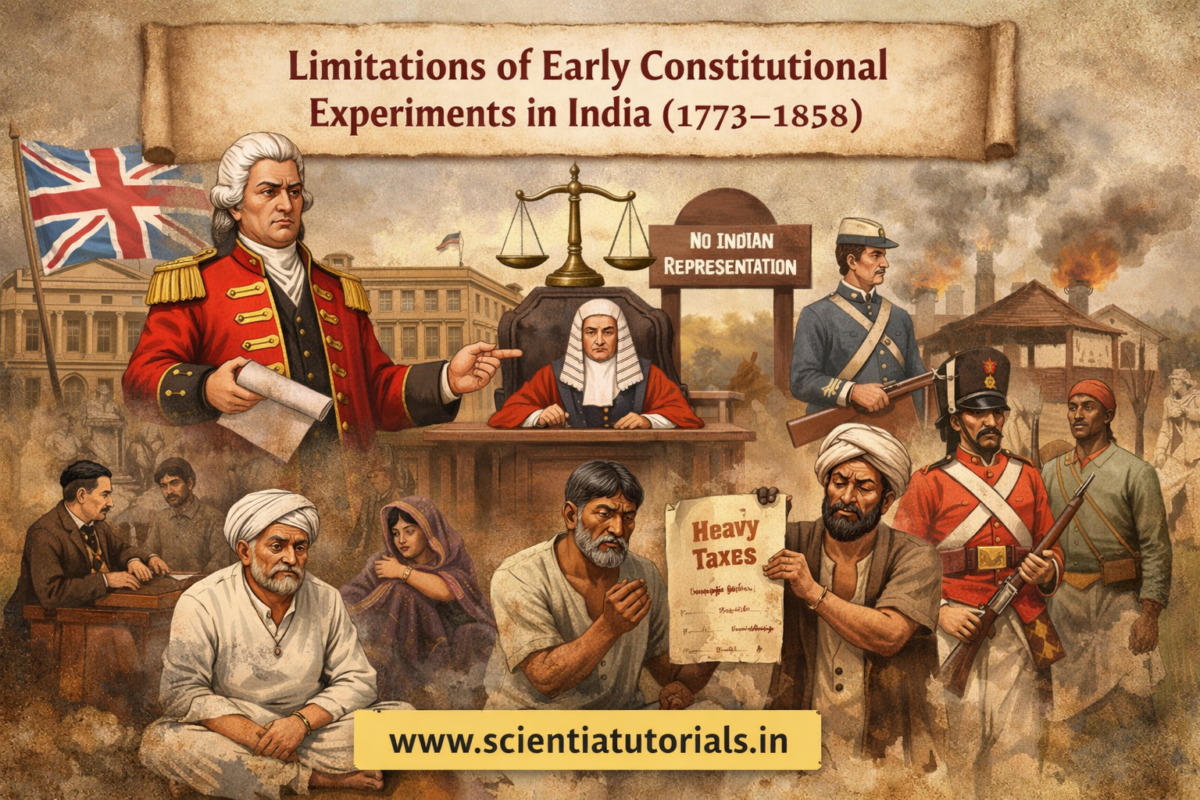

Limitations of Early Constitutional Experiments in India (1773–1858)
Course: Constitutional Developments and Independence in India – History of India
Module 1: Early Constitutional Experiments under Company Rule
Timeline: c. 1773 – 1858 CE
Lesson: Limitations of Early Constitutional Experiments in India
1. Introduction: Nature of Early Constitutional Experiments
The early constitutional experiments introduced by the British in India between 1773 and 1858 represented the initial attempts to regulate colonial governance under Company rule. These experiments included parliamentary interventions such as the Regulating Act of 1773, Pitt’s India Act of 1784, and the Charter Acts of 1813, 1833, and 1853. While these measures are often described as milestones in India’s constitutional history, they were deeply limited in scope, intent, and effectiveness.
These constitutional frameworks were not designed to promote representative governance or safeguard Indian interests. Instead, they aimed to protect British political authority, commercial interests, and administrative efficiency. Consequently, early constitutional experiments were marked by inherent contradictions, administrative confusion, and exclusionary practices.
2. Colonial Context and Purpose of Constitutional Experiments
2.1 Commercial Origins of Governance
The British constitutional presence in India evolved not from democratic ideals but from the commercial needs of the East India Company. The Company’s transformation from a trading corporation into a territorial power occurred without any systematic constitutional blueprint.
Early constitutional reforms were thus reactive, designed to:
- Control corruption among Company officials
- Secure British economic interests
- Prevent administrative collapse
- Assert parliamentary supervision
They were not rooted in Indian political traditions or public consent.
2.2 Parliamentary Motivation
The British Parliament intervened primarily to regulate the Company’s affairs, not to democratize colonial governance. The central concern was whether the Company’s mismanagement might endanger British political stability and finances. As a result, early constitutional experiments prioritized imperial accountability over Indian participation.
3. Absence of Indian Representation
3.1 Exclusion from Decision-Making
One of the most fundamental limitations of early constitutional experiments was the complete exclusion of Indians from legislative and executive decision-making. All constitutional authority rested with British officials appointed by the Crown or the Company.
Even when legislative councils were expanded (as in the Charter Act of 1853), Indians were not elected representatives but nominal or unofficial participants, if included at all.
3.2 Denial of Political Rights
No constitutional experiment before 1858 recognized:
- Political rights of Indians
- Representative institutions
- Electoral participation
- Accountability of rulers to the ruled
This absence of political inclusion created a system of governance that was authoritarian rather than constitutional in spirit.
4. Centralization without Accountability
4.1 Excessive Concentration of Power
Early constitutional reforms consistently moved toward administrative and legislative centralization, particularly after 1833. While centralization improved administrative uniformity, it also resulted in:
- Over-concentration of power in the Governor-General
- Weak provincial autonomy
- Distance between administration and local realities
This centralized authority was not balanced by representative checks or public accountability.
4.2 Governor-General’s Dominance
The Governor-General exercised wide-ranging powers over legislation, military affairs, and administration. Councils existed, but their authority was limited and often overridden. The absence of an independent legislature meant that executive authority dominated constitutional governance.
5. Ambiguity and Administrative Confusion
5.1 Poorly Defined Jurisdictions
Early constitutional measures often failed to clearly define the relationship between:
- Executive authorities
- Judicial institutions
- Legislative bodies
This resulted in frequent conflicts, especially between Company officials and judicial authorities.
5.2 Conflict Between Law and Administration
The introduction of British legal institutions, particularly courts, often clashed with administrative practices and local customs. Laws were framed without sufficient understanding of Indian society, leading to:
- Legal uncertainty
- Administrative paralysis
- Public resentment
These conflicts exposed the structural weakness of early constitutional designs.
6. Judicial Limitations and Legal Alienation
6.1 Alien Nature of British Law
British legal principles were introduced without adapting them to Indian social and cultural realities. Early constitutional experiments emphasized codification and uniformity but ignored:
- Indigenous legal traditions
- Customary practices
- Religious laws
This alienation undermined the legitimacy of colonial courts among Indian subjects.
6.2 Limited Access to Justice
The judicial system largely served British interests. Indian litigants faced:
- Language barriers
- Procedural complexity
- High costs
As a result, constitutional promises of justice remained largely theoretical rather than practical.
7. Economic Exploitation Embedded in Constitutional Frameworks
7.1 Revenue-Centric Governance
Early constitutional experiments did not reform exploitative revenue systems. Instead, they strengthened the Company’s ability to extract resources efficiently. Revenue administration became more centralized and rigid, leading to:
- Peasant impoverishment
- Agrarian distress
- Economic inequality
Constitutional reforms thus facilitated economic extraction rather than social welfare.
7.2 Commercial Priorities over Welfare
Even after the Company ceased to be a trading body, colonial governance continued to prioritize British economic interests. Infrastructure, taxation, and legal reforms were designed to support imperial trade and administration, not Indian development.
8. Racial and Cultural Bias
8.1 Racial Discrimination in Administration
Despite declarations of equality (notably in 1833), Indians were systematically excluded from higher administrative positions. Civil services remained dominated by Europeans due to:
- Racial prejudice
- Examination systems conducted in Britain
- Cultural assumptions about governance
This contradiction exposed the hollowness of constitutional equality.
8.2 Cultural Insensitivity
Early constitutional frameworks failed to recognize India’s diversity. Uniform laws and centralized administration ignored regional, linguistic, and cultural differences, resulting in governance that was mechanical and insensitive.
9. Weak Parliamentary Oversight
9.1 Distance from India
Although Parliament exercised theoretical control, effective supervision was limited by:
- Geographic distance
- Delayed communication
- Dependence on Company reports
This allowed Company officials substantial autonomy in practice.
9.2 Limited Transparency
Information reaching Britain was often filtered or distorted. Parliamentary debates focused more on British political interests than on Indian conditions, weakening constitutional accountability.
10. Absence of a Rights-Based Framework
10.1 No Fundamental Rights
Early constitutional experiments did not recognize:
- Civil liberties
- Freedom of expression
- Equality before law in practice
Rights were not codified or enforceable, making constitutional governance authority-centric rather than rights-centric.
10.2 Rule by Law, Not Rule of Law
Colonial governance emphasized rule through law to control society, not rule of law to protect citizens. Law became an instrument of domination rather than justice.
11. Disconnect Between Reform and Indian Society
11.1 Top-Down Reforms
Constitutional changes were imposed from above, without consultation or participation of Indians. This top-down approach prevented the development of:
- Political consciousness
- Constitutional culture
- Public trust in governance
11.2 Growth of Discontent
The failure of early constitutional experiments to address Indian aspirations contributed to:
- Administrative resentment
- Social alienation
- Political unrest
These tensions eventually surfaced in widespread resistance.
12. Chronological Consequences Leading to 1857
By the mid-19th century, the cumulative limitations of early constitutional experiments became evident:
- Over-centralized administration
- Racial exclusion
- Economic exploitation
- Cultural alienation
These factors played a significant role in shaping the background of the Revolt of 1857, which exposed the bankruptcy of Company rule and its constitutional framework.
13. Place of Early Experiments in India’s Constitutional Evolution
Despite their limitations, early constitutional experiments were not entirely without significance. They:
- Introduced centralized administration
- Established legislative and judicial institutions
- Familiarized India with constitutional governance
However, these developments were colonial in character and exclusionary in practice.
14. Examination Perspective: Key Analytical Themes
Students should focus on:
- Colonial objectives behind constitutional reforms
- Structural and ideological limitations
- Exclusion of Indians
- Centralization without representation
- Link between constitutional failure and 1857
Answers should emphasize critical analysis rather than descriptive narration.
15. Conclusion: Why Early Constitutional Experiments Failed
The early constitutional experiments in India failed to create a legitimate or inclusive system of governance because they were designed to serve imperial interests rather than Indian society. They lacked representation, accountability, cultural sensitivity, and a rights-based framework.
While these experiments laid the administrative foundations of colonial rule, their limitations exposed the contradictions of governing a vast and diverse society without consent or participation. The failure of these early constitutional efforts ultimately made direct Crown rule inevitable in 1858 and sowed the seeds of India’s later constitutional struggle for self-rule.
Below is a well-structured, examination-oriented set of 25 Questions with Answers based strictly on the lesson “Limitations of Early Constitutional Experiments in India”, aligned with Module 1: Early Constitutional Experiments under Company Rule (c. 1773–1858 CE) under the course “Constitutional Developments and Independence in India – History of India.”
The answers are analytical, concise, and suitable for university exams, competitive exams, and concept clarity.
Questions with Answers
Lesson: Limitations of Early Constitutional Experiments in India
Q1. What is meant by “early constitutional experiments” under Company rule in India?
Answer:
Early constitutional experiments refer to the series of administrative and legislative reforms introduced by the British Parliament between 1773 and 1858 to regulate the East India Company’s governance in India. These experiments aimed to control corruption, centralize authority, and impose British legal-administrative norms but stopped short of establishing representative or democratic institutions.
Q2. Why were these early constitutional experiments considered “limited” in nature?
Answer:
They were limited because they prioritized British commercial and political interests, excluded Indians from meaningful participation, lacked accountability mechanisms, and failed to adapt governance structures to Indian social and cultural realities.
Q3. How did the Regulating Act of 1773 reflect the limitations of early constitutional reforms?
Answer:
The Regulating Act of 1773 introduced central control through a Governor-General and Supreme Court but created jurisdictional conflicts, offered no Indian representation, and retained Company dominance, revealing its experimental and incomplete nature.
Q4. In what ways did the absence of Indian participation weaken early constitutional experiments?
Answer:
The exclusion of Indians from legislative councils and decision-making bodies alienated the governed population, prevented local perspectives from shaping policy, and undermined the legitimacy and effectiveness of colonial governance.
Q5. How did the dual system of administration contribute to constitutional limitations?
Answer:
The separation between Company administration and British parliamentary oversight caused confusion, overlapping authority, and inconsistent policies, limiting administrative efficiency and accountability.
Q6. Why did early constitutional reforms fail to establish the rule of law uniformly in India?
Answer:
British legal principles were selectively applied, judicial independence was compromised by executive interference, and laws often favored European interests over Indian subjects, leading to unequal justice.
Q7. Examine the role of the Governor-General in highlighting constitutional weaknesses.
Answer:
The Governor-General wielded excessive centralized power with minimal checks, concentrating authority in the executive and reducing collective decision-making, which contradicted constitutional balance.
Q8. How did economic exploitation limit the constitutional character of Company rule?
Answer:
Revenue extraction, monopoly trade practices, and exploitation of agrarian resources dominated governance priorities, sidelining constitutional ideals like welfare, rights, and justice.
Q9. Why were early legislative councils ineffective as constitutional bodies?
Answer:
Legislative councils were dominated by British officials, lacked representative character, functioned mainly as advisory bodies, and did not reflect popular consent or accountability.
Q10. How did racial discrimination undermine early constitutional governance?
Answer:
Legal and administrative systems privileged Europeans, institutionalizing racial inequality and denying Indians equal rights before law, which contradicted constitutional principles.
Q11. What administrative challenges exposed the weaknesses of constitutional experiments?
Answer:
Poor communication, vast territorial control, lack of trained personnel, and ignorance of local customs made centralized constitutional governance impractical and ineffective.
Q12. Why did British constitutional ideas fail to translate effectively in India?
Answer:
British constitutionalism evolved within a specific historical and social context, which was not replicated in India, leading to superficial and incompatible institutional transplantation.
Q13. How did Company commercial interests conflict with constitutional governance?
Answer:
Profit motives often overrode administrative fairness and accountability, making constitutional reforms secondary to economic exploitation.
Q14. Assess the limitations of judicial reforms introduced during this period.
Answer:
Judicial systems were complex, inaccessible to Indians, linguistically alien, and often biased, limiting their effectiveness in delivering justice.
Q15. How did early constitutional experiments fail to protect civil liberties?
Answer:
There were no guarantees of freedom of speech, press, or association, and repressive regulations curtailed dissent, reflecting authoritarian governance.
Q16. Why was there no concept of popular sovereignty in early constitutional reforms?
Answer:
Authority flowed from the British Crown and Parliament, not from the Indian people, making governance colonial rather than constitutional in a democratic sense.
Q17. How did administrative centralization limit provincial autonomy?
Answer:
Centralized decision-making ignored regional diversity, restricted local governance, and reduced administrative responsiveness.
Q18. Evaluate the impact of legal dualism on constitutional development.
Answer:
Separate legal systems for Europeans and Indians institutionalized inequality and weakened the universality of law, a core constitutional principle.
Q19. Why did early constitutional reforms fail to create political consciousness among Indians?
Answer:
The absence of representative institutions and political rights prevented Indians from engaging in constitutional politics during this period.
Q20. How did corruption expose the weaknesses of early constitutional structures?
Answer:
Weak oversight mechanisms allowed Company officials to misuse power, highlighting the inadequacy of constitutional controls.
Q21. Examine the role of British Parliament in limiting effective constitutional reform.
Answer:
Parliamentary interventions were hesitant, inconsistent, and primarily aimed at safeguarding British interests rather than establishing good governance in India.
Q22. How did the lack of accountability affect governance under Company rule?
Answer:
Officials were accountable mainly to Company authorities in Britain, not to Indian subjects, weakening responsible governance.
Q23. Why did early constitutional experiments fail to prevent administrative arbitrariness?
Answer:
Concentration of executive power and weak institutional checks allowed arbitrary decision-making.
Q24. How did these limitations contribute to Indian resistance in later periods?
Answer:
Administrative injustice, exclusion, and exploitation sowed dissatisfaction, laying the groundwork for political awakening and resistance movements.
Q25. Assess the historical significance of the limitations of early constitutional experiments.
Answer:
Despite their failures, these experiments exposed colonial contradictions, highlighted the need for representative governance, and indirectly shaped future constitutional reforms and nationalist demands.
Below is a well-structured, examination-oriented set of 25 Multiple Choice Questions (MCQs) with correct answers and detailed concept-clearing explanations, strictly based on the lesson “Limitations of Early Constitutional Experiments in India”, under Module 1: Early Constitutional Experiments under Company Rule (c. 1773–1858 CE) of the course “Constitutional Developments and Independence in India – History of India.”
These MCQs are suitable for UG/PG history exams, UPSC/State PSC preparation, and concept revision.
MCQs with Answers and Explanations
Lesson: Limitations of Early Constitutional Experiments in India
Q1. The primary objective of early constitutional experiments under Company rule was to:
A. Introduce democratic governance
B. Secure Indian participation
C. Regulate the East India Company’s administration
D. Grant political rights to Indians
Correct Answer: C
Explanation:
Early constitutional measures were designed mainly to regulate and control the East India Company’s administration, curb corruption, and protect British political and economic interests—not to introduce democracy or Indian participation.
Q2. Why are the constitutional reforms between 1773 and 1858 described as “experimental”?
A. They were implemented only in Bengal
B. They were temporary wartime measures
C. They were revised frequently due to administrative failures
D. They were drafted by Indian leaders
Correct Answer: C
Explanation:
Frequent amendments and new Acts reflected trial-and-error governance. British authorities continuously modified policies due to inefficiency, conflicts, and unintended consequences.
Q3. A major limitation of early constitutional experiments was:
A. Excessive Indian participation
B. Overemphasis on local self-government
C. Absence of representative institutions
D. Federal structure of administration
Correct Answer: C
Explanation:
There was no provision for elected bodies or popular representation. Legislative councils were dominated by British officials, limiting constitutional legitimacy.
Q4. The Regulating Act of 1773 failed mainly because:
A. It abolished the Company
B. It created administrative confusion
C. It granted independence to provinces
D. It introduced Indian suffrage
Correct Answer: B
Explanation:
The Act created overlapping jurisdictions between the Governor-General and the Supreme Court, leading to conflicts and administrative inefficiency.
Q5. Which factor most undermined the constitutional character of Company rule?
A. Judicial independence
B. Economic exploitation
C. Federal decentralization
D. Indian civil service
Correct Answer: B
Explanation:
Revenue extraction and commercial profit dominated governance priorities, marginalizing constitutional ideals such as justice, welfare, and accountability.
Q6. Early legislative councils were ineffective because they:
A. Were dominated by Indians
B. Had veto power over Parliament
C. Lacked representative and deliberative functions
D. Controlled military policy
Correct Answer: C
Explanation:
These councils mainly advised the executive and lacked independent legislative authority or popular representation.
Q7. The absence of Indian participation resulted in:
A. Strong political unity
B. Administrative efficiency
C. Lack of legitimacy of colonial governance
D. Decline in British authority
Correct Answer: C
Explanation:
Governance without Indian consent alienated the population and weakened moral and political legitimacy.
Q8. The concept of popular sovereignty was absent because:
A. India was geographically vast
B. Authority flowed from British Parliament and Crown
C. Indians rejected political participation
D. Provinces were autonomous
Correct Answer: B
Explanation:
Power originated in Britain, not from the Indian people, making governance colonial rather than constitutional-democratic.
Q9. Racial discrimination in administration primarily affected:
A. Revenue collection
B. Military recruitment
C. Equality before law
D. Trade monopolies
Correct Answer: C
Explanation:
Separate legal standards for Europeans and Indians violated the principle of legal equality, a cornerstone of constitutional governance.
Q10. Which administrative feature concentrated excessive power?
A. Provincial councils
B. Governor-General’s authority
C. Village administration
D. Judicial autonomy
Correct Answer: B
Explanation:
The Governor-General held extensive executive, legislative, and sometimes judicial influence with limited checks.
Q11. Why did British constitutional ideas fail to adapt effectively in India?
A. Indians rejected them
B. Britain lacked experience
C. They ignored India’s social and cultural context
D. They promoted local self-rule
Correct Answer: C
Explanation:
British constitutional models evolved in a European context and were transplanted without adequate adaptation to Indian realities.
Q12. The dual system of control resulted in:
A. Clear accountability
B. Administrative harmony
C. Overlapping authority
D. Provincial independence
Correct Answer: C
Explanation:
Authority was divided between the Company and the British government, causing confusion and inefficiency.
Q13. Early judicial reforms were limited because they were:
A. Accessible and inexpensive
B. Linguistically and culturally alien
C. Fully independent
D. Democratic in nature
Correct Answer: B
Explanation:
Courts operated in unfamiliar languages and procedures, making justice inaccessible to most Indians.
Q14. Which of the following best describes early constitutional governance?
A. Democratic and representative
B. Welfare-oriented
C. Authoritarian and centralized
D. Federal and decentralized
Correct Answer: C
Explanation:
Power was centralized in British hands with minimal accountability or popular participation.
Q15. The lack of civil liberties under Company rule is evident from:
A. Freedom of press
B. Elected assemblies
C. Repressive regulations
D. Independent judiciary
Correct Answer: C
Explanation:
Press restrictions, censorship, and suppression of dissent reflected authoritarian governance.
Q16. Parliamentary control over the Company was limited because:
A. Parliament lacked interest
B. Distance and slow communication
C. India was self-governing
D. Parliament opposed reforms
Correct Answer: B
Explanation:
Geographical distance and slow communication weakened effective parliamentary oversight.
Q17. Administrative centralization resulted in:
A. Better regional governance
B. Ignoring local diversity
C. Strong village autonomy
D. Political inclusion
Correct Answer: B
Explanation:
Centralized authority failed to account for India’s regional, linguistic, and cultural diversity.
Q18. Which principle of constitutionalism was most compromised?
A. Separation of powers
B. Parliamentary sovereignty
C. Federalism
D. Judicial review
Correct Answer: A
Explanation:
Executive dominance over legislative and judicial functions weakened institutional balance.
Q19. Corruption persisted mainly due to:
A. Excessive accountability
B. Strong judicial oversight
C. Weak institutional checks
D. Indian resistance
Correct Answer: C
Explanation:
Inadequate oversight allowed officials to misuse power with impunity.
Q20. Early constitutional experiments failed to generate political consciousness because:
A. Indians were politically inactive
B. There were no representative institutions
C. Education was widespread
D. Local self-government existed
Correct Answer: B
Explanation:
Without participation or rights, Indians had limited exposure to constitutional politics.
Q21. Legal dualism primarily created:
A. Judicial efficiency
B. Equality before law
C. Institutionalized inequality
D. Cultural integration
Correct Answer: C
Explanation:
Separate legal systems for Europeans and Indians violated constitutional equality.
Q22. British reforms were cautious mainly to:
A. Empower Indians
B. Avoid financial loss
C. Protect Company interests
D. Promote self-rule
Correct Answer: C
Explanation:
Reforms were designed to safeguard British economic and political dominance.
Q23. Early constitutional experiments contributed to nationalism by:
A. Granting rights
B. Encouraging self-government
C. Exposing colonial injustice
D. Supporting Indian leadership
Correct Answer: C
Explanation:
Administrative injustice and exclusion fostered resentment and political awareness.
Q24. The failure to ensure accountability resulted in:
A. Responsible government
B. Arbitrary administration
C. Provincial autonomy
D. Judicial activism
Correct Answer: B
Explanation:
Officials were accountable to Britain, not Indian subjects, enabling arbitrary rule.
Q25. Historically, the limitations of early constitutional experiments are important because they:
A. Established democracy
B. Prevented resistance
C. Revealed contradictions of colonial rule
D. Ensured economic equality
Correct Answer: C
Explanation:
These limitations highlighted the incompatibility of colonial domination with constitutional governance, shaping later reform demands.