
Constitutional Significance of Independence
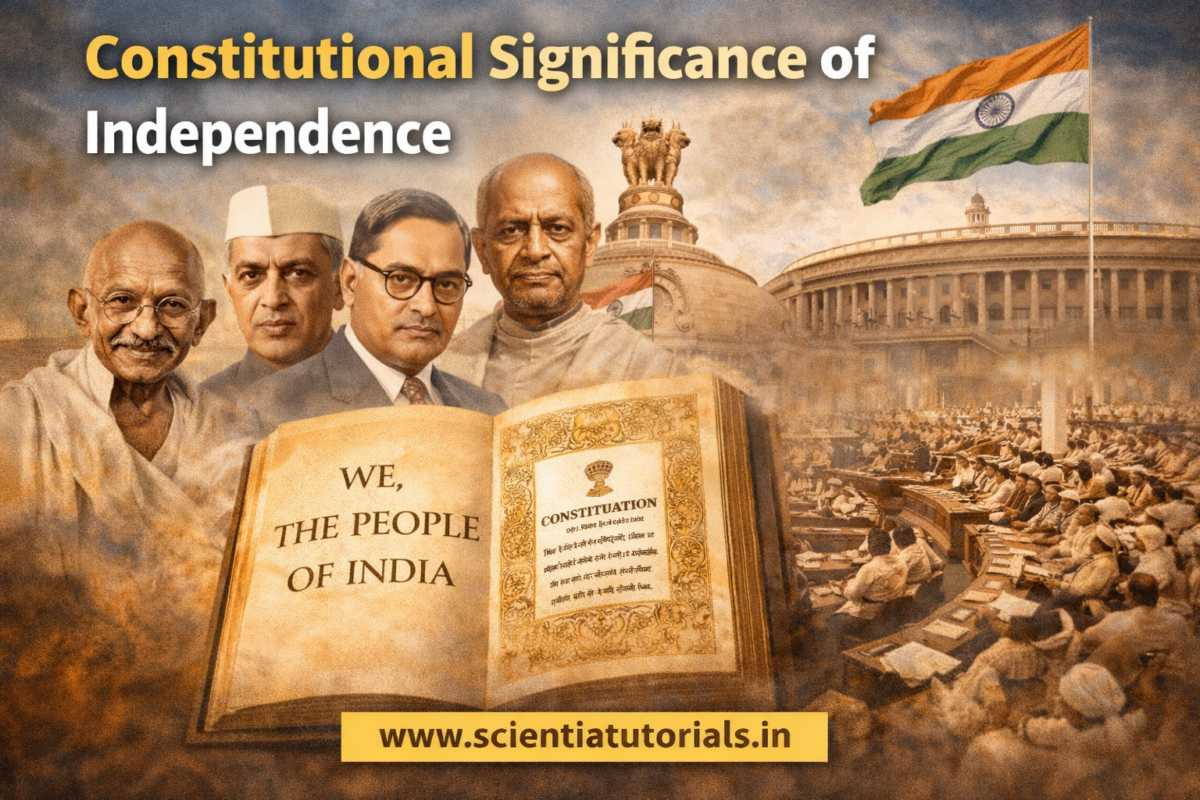

Constitutional Significance of Independence | History of India Post-1947
Course: Constitutional Developments and Independence in India – History of India
Module 9: Independence and Constitutional Legacy
Timeline: Post-1947 Context
Lesson: Constitutional Significance of Independence
1. Introduction: Independence as a Constitutional Turning Point
Indian Independence in 1947 marked far more than the end of colonial rule; it represented a fundamental constitutional transformation. For the first time in modern history, the Indian people acquired full sovereignty to determine the political, legal, and constitutional framework of their state. Independence ended externally imposed constitutional arrangements and inaugurated a new era in which constitutional authority flowed from the people of India themselves.
The constitutional significance of independence lies in the transition from colonial constitutionalism—designed to preserve imperial control—to a democratic, sovereign, and republican constitutional order. This lesson examines independence not merely as a political event, but as a constitutional watershed that reshaped governance, citizenship, rights, federalism, and state–society relations in post-1947 India.
2. Nature of Colonial Constitutionalism before 1947
2.1 Characteristics of Colonial Constitutions
Before independence, constitutional development in India was shaped by British imperial interests. Acts such as the Government of India Acts of 1919 and 1935 were framed by the British Parliament and imposed upon India. These constitutions:
- Denied popular sovereignty
- Retained ultimate authority in British hands
- Limited Indian participation in governance
- Prioritised administrative control over democratic legitimacy
2.2 Absence of Constituent Sovereignty
Under colonial rule, Indians did not possess constituent power. Constitutional change depended on British legislation rather than popular consent. Independence therefore represented a decisive break from externally controlled constitutionalism.
3. Independence and the Assertion of Sovereignty (1947)
3.1 End of British Sovereignty
With independence, British legislative and executive authority over India ceased completely. Sovereignty was transferred to Indian institutions, marking the legal and constitutional end of imperial domination.
3.2 People as the Source of Authority
Post-independence constitutional thinking was grounded in the principle that all authority emanates from the people. This principle later found expression in the Preamble of the Indian Constitution, which begins with the words “We, the People of India.”
4. Constituent Assembly and Constitutional Self-Determination
4.1 Transformation of the Constituent Assembly
Initially created under the Cabinet Mission Plan, the Constituent Assembly became a fully sovereign body after independence. It no longer functioned under British oversight and exercised absolute authority to frame the Constitution.
4.2 Democratic Legitimacy
Although indirectly elected, the Constituent Assembly reflected a broad spectrum of Indian society and political opinion. Its debates embodied the principle of constitutional self-determination and laid the foundation of democratic governance.
5. Independence and the Making of a Written Constitution
5.1 Need for a New Constitutional Framework
Independence created the necessity for a comprehensive written constitution to replace colonial legal arrangements. The objective was to establish a permanent, democratic framework capable of governing a diverse and plural society.
5.2 Adoption of the Constitution of India
The Constitution was adopted on 26 November 1949 and came into force on 26 January 1950. It transformed India from a dominion into a sovereign republic, completing the constitutional process initiated by independence.
6. Establishment of Democratic Governance
6.1 Introduction of Universal Adult Franchise
One of the most significant constitutional outcomes of independence was the adoption of universal adult franchise. Unlike many contemporary democracies, India granted voting rights to all adults irrespective of property, education, or gender.
6.2 Parliamentary Democracy
Independence enabled the establishment of a parliamentary system based on responsible government, ensuring executive accountability to the legislature.
7. Fundamental Rights and Constitutional Morality
7.1 Break from Colonial Restrictions
Colonial constitutions prioritised order and control over individual liberty. Independence allowed India to constitutionally guarantee fundamental rights such as equality, freedom of speech, religion, and protection from arbitrary state action.
7.2 Rights as a Limitation on State Power
The inclusion of justiciable fundamental rights ensured that state authority would be constitutionally limited, marking a sharp departure from colonial authoritarianism.
8. Directive Principles and Social Transformation
8.1 Vision of a Welfare State
Independence made it possible to constitutionally commit the state to social and economic transformation. The Directive Principles of State Policy aimed to reduce inequality, promote social justice, and secure dignified living conditions.
8.2 Balancing Liberty and Equality
The constitutional framework sought to harmonise individual freedoms with collective socio-economic goals, reflecting the transformative vision of independence.
9. Federalism and National Unity
9.1 Post-Partition Challenges
The trauma of partition influenced constitutional choices after independence. National unity and territorial integrity became paramount concerns.
9.2 Strong Centre with Federal Features
The Constitution established a federal system with a strong central government to prevent fragmentation, reflecting lessons learned from colonial decentralisation and partition.
10. Secularism as a Constitutional Principle
10.1 Independence and Religious Neutrality
In the aftermath of partition on religious lines, independence necessitated a constitutional commitment to secularism. The Indian state was conceived as neutral in matters of religion.
10.2 Protection of Minority Rights
Secularism ensured equal protection of all religions and safeguarded minority rights within a democratic framework.
11. Rule of Law and Judicial Independence
11.1 End of Executive Supremacy
Colonial rule vested extensive powers in the executive. Independence facilitated the establishment of the rule of law, subjecting all authorities to constitutional limits.
11.2 Independent Judiciary
Judicial independence became a cornerstone of constitutional governance, ensuring protection of rights and constitutional supremacy.
12. Citizenship and Nation-Building
12.1 Defining Indian Citizenship
Independence necessitated the constitutional definition of citizenship in a context of mass migration and displacement. Citizenship provisions aimed to create inclusive national identity.
12.2 Integration of Diverse Communities
The Constitution sought to integrate linguistic, cultural, and regional diversity within a single national framework.
13. Continuity and Change in Constitutional Structure
13.1 Retention of Administrative Frameworks
While independence marked a break from colonial sovereignty, administrative continuity was maintained to ensure stability.
13.2 Democratic Transformation of Institutions
Colonial institutions were reoriented to serve democratic objectives rather than imperial control.
14. Long-Term Constitutional Legacy of Independence
14.1 Constitutional Supremacy
Independence established the Constitution as the supreme law, replacing parliamentary sovereignty with constitutional supremacy.
14.2 Living Constitution
The post-independence constitutional order has demonstrated adaptability through amendments and judicial interpretation, reflecting the dynamic legacy of independence.
15. Critical Evaluation of Constitutional Outcomes
15.1 Achievements
- Establishment of democratic governance
- Protection of fundamental rights
- Maintenance of national unity
15.2 Limitations and Challenges
- Socio-economic inequalities
- Tensions between centralisation and federalism
- Challenges of constitutional implementation
16. Conclusion
The constitutional significance of independence lies in the transformation of India from a subject colony into a sovereign, democratic republic governed by a written constitution. Independence enabled the assertion of popular sovereignty, the protection of rights, and the creation of institutions committed to justice, liberty, equality, and fraternity. Despite challenges, the constitutional legacy of independence continues to shape India’s political and legal evolution, making it a foundational theme in the study of modern Indian constitutional history.
Examination Relevance:
This lesson is vital for analytical and essay-type questions on post-1947 constitutional developments, focusing on sovereignty, democracy, rights, federalism, and the long-term constitutional legacy of independence.
Below is a well-structured, examination-oriented set of 25 Questions with clear and accurate Answers based strictly on the lesson “Constitutional Significance of Independence”, aligned with Module 9: Independence and Constitutional Legacy (Post-1947 Context) under the course Constitutional Developments and Independence in India – History of India.
Questions with Answers
Lesson: Constitutional Significance of Independence (Post-1947)
1. Why is Indian Independence described as a constitutional turning point?
Answer:
Indian Independence marked the end of colonial constitutional control and the beginning of popular sovereignty. For the first time, Indians gained the authority to frame and operate their own constitutional system based on democratic principles.
2. How did independence transform the source of constitutional authority in India?
Answer:
After independence, constitutional authority flowed from the people of India rather than the British Parliament. This shift was later expressed in the Preamble of the Constitution with the phrase “We, the People of India.”
3. What is meant by colonial constitutionalism in India?
Answer:
Colonial constitutionalism refers to constitutional arrangements imposed by the British to maintain imperial control, limiting Indian participation and denying popular sovereignty.
4. How did independence break from colonial constitutional traditions?
Answer:
Independence ended externally imposed constitutions and enabled Indians to exercise constituent power, allowing them to design a constitutional system reflecting national aspirations.
5. What was the constitutional significance of the end of British sovereignty in 1947?
Answer:
The end of British sovereignty meant that Britain lost all legislative and executive authority over India, making Indian institutions fully sovereign.
6. How did independence affect the status of the Constituent Assembly?
Answer:
After independence, the Constituent Assembly became a sovereign body with unrestricted authority to frame India’s Constitution without British interference.
7. Why is the Constituent Assembly regarded as an instrument of constitutional self-determination?
Answer:
It represented Indian political will and deliberated freely on constitutional principles, embodying the right of the people to determine their own governance.
8. Why was a new written Constitution necessary after independence?
Answer:
Colonial legal frameworks were inadequate for a sovereign democratic state. A new Constitution was required to establish democratic institutions, rights, and governance principles.
9. When was the Constitution of India adopted and enforced?
Answer:
The Constitution was adopted on 26 November 1949 and came into force on 26 January 1950.
10. How did independence contribute to the establishment of democracy in India?
Answer:
Independence enabled the creation of a democratic system based on universal adult franchise, representative institutions, and responsible government.
11. Why is universal adult franchise considered a major constitutional outcome of independence?
Answer:
India granted voting rights to all adults irrespective of wealth, gender, or education, reflecting a deep commitment to democratic equality.
12. How did independence influence the adoption of fundamental rights?
Answer:
Freedom from colonial rule allowed India to constitutionally guarantee civil liberties and equality, limiting state power and protecting individual freedoms.
13. In what way do fundamental rights reflect a break from colonial governance?
Answer:
Colonial rule prioritised order over liberty, whereas fundamental rights place constitutional limits on state authority and protect citizens’ freedoms.
14. What is the constitutional significance of the Directive Principles of State Policy?
Answer:
They reflect the transformative goals of independence by committing the state to social justice, economic equality, and welfare-oriented governance.
15. How did independence shape India’s approach to federalism?
Answer:
The experience of partition led to the adoption of a federal system with a strong centre to maintain unity and prevent fragmentation.
16. Why did post-independence India emphasise a strong central government?
Answer:
Partition violence and political instability highlighted the need for central authority to preserve national integrity and effective governance.
17. What is the constitutional significance of secularism after independence?
Answer:
Secularism ensured state neutrality in religious matters and protected minority rights, especially important after partition on religious lines.
18. How did independence influence the principle of the rule of law?
Answer:
Independence replaced executive dominance with constitutional supremacy, ensuring that all authorities are subject to the law.
19. Why is judicial independence vital in the post-independence constitutional framework?
Answer:
An independent judiciary safeguards fundamental rights, enforces constitutional limits, and upholds the supremacy of the Constitution.
20. How did independence affect the concept of citizenship in India?
Answer:
Independence required the constitutional definition of citizenship to integrate diverse populations and address migration caused by partition.
21. What role did independence play in nation-building?
Answer:
Independence enabled the constitutional integration of linguistic, cultural, and regional diversity within a unified national framework.
22. How did post-independence India balance continuity and change?
Answer:
While colonial administrative structures were retained for stability, they were democratised and reoriented to serve public welfare.
23. What is meant by constitutional supremacy in independent India?
Answer:
Constitutional supremacy means that the Constitution, not Parliament or any authority, is the highest law of the land.
24. How has independence contributed to the idea of a “living Constitution”?
Answer:
The Constitution has evolved through amendments and judicial interpretation, reflecting adaptability to changing social and political needs.
25. Why is the constitutional significance of independence important for students of Indian history?
Answer:
It explains how India transitioned from colonial subjugation to a sovereign democratic republic and provides the foundation for understanding modern Indian governance.
Examination Tip:
For high-quality answers, students should link independence with sovereignty, Constituent Assembly, democracy, rights, federalism, and secularism, using a post-1947 chronological perspective.
Below is a well-structured set of 25 high-quality MCQs with correct answers and elaborate, concept-clearing explanations, developed strictly from the lesson “Constitutional Significance of Independence”, aligned with Module 9: Independence and Constitutional Legacy (Post-1947 Context) under the course Constitutional Developments and Independence in India – History of India.
These MCQs are suitable for UPSC (Prelims & Mains GS-I), State PSCs, UGC NET/SET, and University examinations.
MCQs with Answers and Explanations
Lesson: Constitutional Significance of Independence (Post-1947)
1. Indian Independence is constitutionally significant primarily because it:
A. Introduced provincial autonomy
B. Ended Company rule
C. Transferred sovereignty to the Indian people
D. Established dominion status permanently
Correct Answer: C
Explanation:
Independence marked the transfer of sovereignty from British authority to the people of India, enabling constitutional self-government.
2. Before 1947, constitutional authority in India ultimately rested with:
A. Provincial legislatures
B. Indian political parties
C. British Parliament
D. Indian princes
Correct Answer: C
Explanation:
All major constitutional changes before independence were enacted by the British Parliament, not by Indians themselves.
3. The most fundamental break from colonial constitutionalism after independence was:
A. Retention of administrative services
B. Assertion of popular sovereignty
C. Use of English language
D. Parliamentary system
Correct Answer: B
Explanation:
Popular sovereignty replaced imperial authority, making the people the ultimate source of constitutional power.
4. The phrase “We, the People of India” in the Preamble signifies:
A. Parliamentary supremacy
B. Judicial authority
C. Popular sovereignty
D. Federal dominance
Correct Answer: C
Explanation:
It reflects the constitutional principle that all authority flows from the people, a direct outcome of independence.
5. After independence, the Constituent Assembly of India became:
A. A consultative body
B. Subordinate to British Parliament
C. A fully sovereign constitution-making authority
D. An interim legislature only
Correct Answer: C
Explanation:
With the end of British rule, the Constituent Assembly exercised complete constituent and legislative sovereignty.
6. Which event completed the constitutional process initiated by independence?
A. Partition of India
B. First general elections
C. Adoption of the Constitution of India
D. Formation of the Planning Commission
Correct Answer: C
Explanation:
Independence created the authority; adoption of the Constitution (1950) institutionalised it.
7. Universal adult franchise after independence was revolutionary because:
A. It was limited to educated citizens
B. It excluded women
C. It granted voting rights without social or economic qualifications
D. It followed colonial electoral practices
Correct Answer: C
Explanation:
India adopted universal adult franchise at independence, unlike many countries that restricted voting rights.
8. Colonial constitutions in India were primarily designed to:
A. Promote democratic equality
B. Ensure social justice
C. Maintain imperial control
D. Guarantee fundamental rights
Correct Answer: C
Explanation:
Colonial constitutionalism prioritised administrative efficiency and British control, not democratic legitimacy.
9. Independence enabled the constitutional protection of fundamental rights mainly to:
A. Strengthen executive authority
B. Limit state power
C. Promote colonial law
D. Delay social reform
Correct Answer: B
Explanation:
Fundamental rights act as constitutional checks on state authority, a clear departure from colonial governance.
10. Which constitutional feature best reflects the transformative vision of independence?
A. Bicameral legislature
B. Directive Principles of State Policy
C. Emergency provisions
D. Ordinance-making power
Correct Answer: B
Explanation:
The Directive Principles aim at social and economic transformation, reflecting the goals of independence.
11. The adoption of a strong Centre in India’s federal system was influenced mainly by:
A. Colonial decentralisation
B. American constitutional model
C. Experience of partition and unity concerns
D. Pressure from princely states
Correct Answer: C
Explanation:
Partition highlighted the dangers of fragmentation, leading to a strong central structure.
12. Post-independence federalism in India can best be described as:
A. Confederal
B. Unitary
C. Federal with a strong Centre
D. Loose federation
Correct Answer: C
Explanation:
India adopted a federal system but with significant central powers to ensure national unity.
13. Secularism became a constitutional necessity after independence primarily due to:
A. Colonial religious policy
B. Linguistic diversity
C. Partition on religious lines
D. Influence of Western constitutions
Correct Answer: C
Explanation:
Partition made it essential to ensure religious neutrality and minority protection.
14. Independence transformed the relationship between state and religion by:
A. Establishing a theocratic state
B. Giving preference to majority religion
C. Ensuring state neutrality in religious matters
D. Eliminating religious freedom
Correct Answer: C
Explanation:
The Indian Constitution adopts secularism, ensuring equal respect for all religions.
15. Which principle replaced executive supremacy after independence?
A. Parliamentary sovereignty
B. Rule of law
C. Colonial authority
D. Administrative discretion
Correct Answer: B
Explanation:
The rule of law ensures that all authorities are subject to constitutional limits.
16. Judicial independence after independence is crucial because it:
A. Strengthens executive control
B. Enforces constitutional supremacy
C. Limits democratic participation
D. Weakens federalism
Correct Answer: B
Explanation:
An independent judiciary protects rights and ensures adherence to the Constitution.
17. Independence required constitutional definition of citizenship mainly because:
A. Colonial law was sufficient
B. India became a monarchy
C. Partition caused mass migration
D. Provinces demanded autonomy
Correct Answer: C
Explanation:
Large-scale migration after partition made citizenship a critical constitutional issue.
18. Nation-building after independence was constitutionally addressed through:
A. Cultural homogeneity
B. Centralised bureaucracy alone
C. Inclusive citizenship and rights
D. Military integration
Correct Answer: C
Explanation:
The Constitution aimed to integrate diverse communities through equal rights and citizenship.
19. Independence replaced parliamentary sovereignty with:
A. Executive supremacy
B. Judicial dominance
C. Constitutional supremacy
D. Federal dominance
Correct Answer: C
Explanation:
In independent India, the Constitution is the highest law, binding all institutions.
20. The idea of a “living Constitution” reflects:
A. Rigidity of the Constitution
B. Colonial continuity
C. Adaptability through amendments and interpretation
D. Executive discretion
Correct Answer: C
Explanation:
The Constitution evolves through amendments and judicial interpretation to meet changing needs.
21. Which of the following best captures continuity after independence?
A. Retention of British sovereignty
B. Preservation of colonial objectives
C. Retention of administrative structures
D. Continuation of imperial control
Correct Answer: C
Explanation:
Administrative continuity ensured stability, while objectives were democratically transformed.
22. The most enduring constitutional legacy of independence is:
A. Dominion status
B. Popular sovereignty and democracy
C. Colonial legal codes
D. Executive centralisation
Correct Answer: B
Explanation:
Independence laid the foundation for democratic governance based on popular sovereignty.
23. Which challenge remained unresolved despite constitutional transformation?
A. Sovereignty
B. Democratic legitimacy
C. Socio-economic inequality
D. Rule of law
Correct Answer: C
Explanation:
While political equality was achieved, socio-economic inequalities persisted.
24. Independence is best understood constitutionally as:
A. A symbolic political event
B. A military transfer of power
C. A foundational constitutional rupture
D. An administrative reform
Correct Answer: C
Explanation:
It marked a decisive constitutional break from colonial rule to self-governance.
25. For examinations, the constitutional significance of independence should be analysed in terms of:
A. Only political freedom
B. Military withdrawal
C. Sovereignty, democracy, rights, and institutions
D. Economic planning alone
Correct Answer: C
Explanation:
Independence reshaped the entire constitutional framework—sovereignty, rights, governance, and institutions.
Exam Strategy Tip
For MCQs on Constitutional Significance of Independence, focus on:
- Break from colonial constitutionalism
- Popular sovereignty
- Role of the Constituent Assembly
- Democracy, rights, federalism, secularism
- Long-term constitutional legacy
🎯 Targeting Exams Section
This lesson is highly relevant for the following examinations:
-
UPSC Civil Services Examination
(GS Paper I – Modern Indian History & Post-Independence India) -
State Public Service Commissions (PSC)
(History & General Studies) -
UGC NET / SET
(Modern Indian History & Constitutional Developments) -
University Semester Examinations
(BA/MA History, Political Science, Public Administration) -
SSC & Other Competitive Exams
(Post-1947 Indian polity & history sections)
Key Exam Focus Areas
-
Constitutional impact of Independence (1947)
-
Transition from colonial constitutionalism to sovereignty
-
Role of the Constituent Assembly after Independence
-
Democracy, Fundamental Rights, and Directive Principles
-
Federalism, secularism, and rule of law
-
Long-term constitutional legacy of Independence
🔑 Related Keyphrases
-
Constitutional legacy of Indian Independence
-
Post-1947 constitutional developments in India
-
Sovereignty after Indian Independence
-
Independence and Indian Constitution
-
Popular sovereignty in India
-
Democracy and Constitution after 1947
-
Fundamental rights after Independence
-
Federalism and unity in post-colonial India
-
History of India post-independence notes