
Impact of World War II on Indian Constitutional Politics
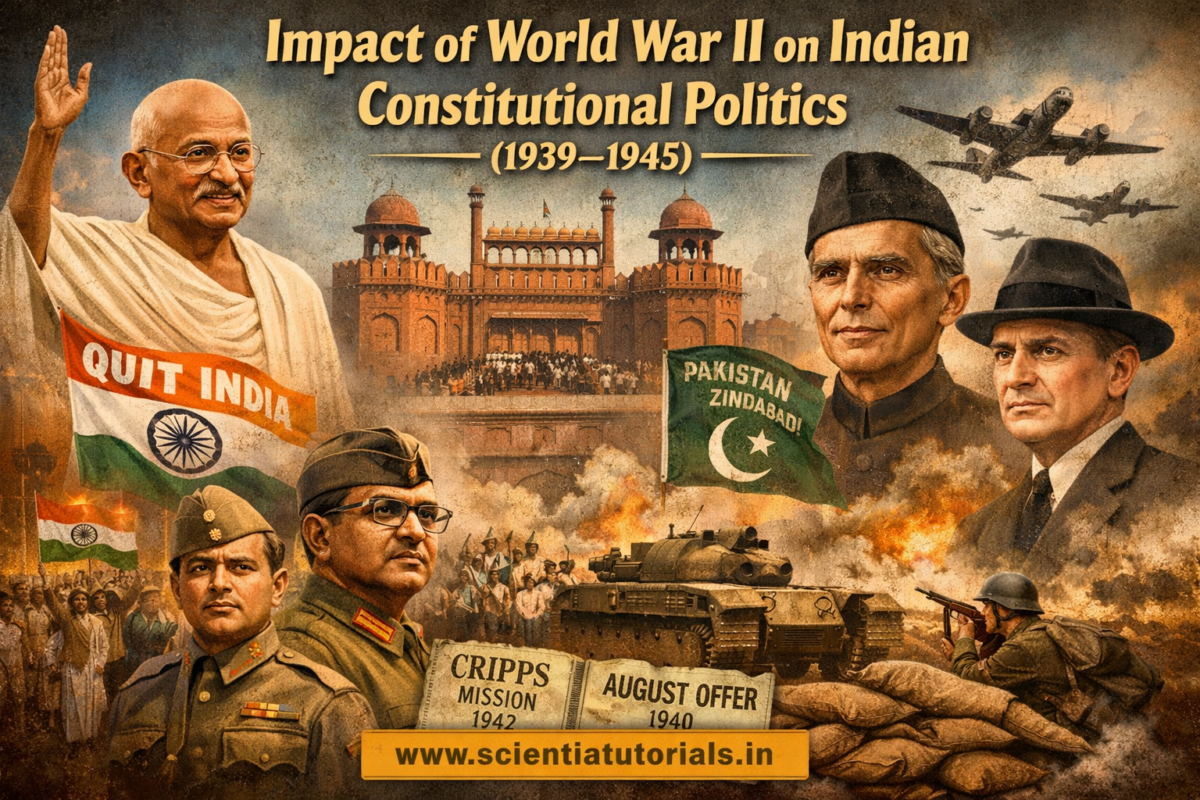

Impact of World War II on Indian Constitutional Politics (1939–45) | History of India
Impact of World War II on Indian Constitutional Politics (1939–1945 CE)
Course: Constitutional Developments and Independence in India – History of India
Module 7: Constitutional Developments during World War II
Timeline: 1939 – 1945 CE
Lesson Focus: Impact of World War II on Indian Constitutional Politics
Introduction: World War II as a Constitutional Turning Point
The outbreak of the Second World War in September 1939 marked a decisive turning point in the constitutional and political history of India. Unlike earlier phases of constitutional reform driven primarily by British administrative concerns, the war years witnessed an unprecedented convergence of imperial necessity, Indian nationalist resistance, and international pressures. Indian constitutional politics during this period moved rapidly from negotiation within colonial frameworks to mass confrontation and demands for complete independence.
This lesson examines how World War II fundamentally transformed Indian constitutional politics by intensifying nationalist demands, exposing the limitations of British constitutional promises, and accelerating the transition from colonial rule to independence.
1. India and the Outbreak of World War II (1939)
1.1 Unilateral Declaration of War
On 3 September 1939, the Viceroy Lord Linlithgow declared India’s entry into World War II without consulting Indian political leaders or legislatures. This action immediately highlighted the constitutional subordination of India, despite limited provincial autonomy under the Government of India Act, 1935.
Constitutional Significance
- Demonstrated the absolute authority of the British Crown in external affairs.
- Revealed the hollowness of responsible government under colonial rule.
- Provoked a political crisis between the British government and Indian leaders.
2. Congress Response and Resignation of Ministries (1939–1940)
2.1 Congress Protest
The Indian National Congress demanded:
- A clear declaration of India’s war aims.
- Immediate steps toward full self-government.
When these demands were rejected, the Congress adopted a confrontational stance.
2.2 Resignation of Provincial Ministries
By October–November 1939, Congress ministries in eight provinces resigned.
Constitutional Impact
- Exposed the fragility of provincial autonomy under the 1935 Act.
- Returned provinces to Governor’s Rule, strengthening authoritarian control.
- Marked a shift from constitutional participation to extra-constitutional mass politics.
3. Muslim League’s Strategic Position (1939–1940)
3.1 Political Opportunity for the Muslim League
The resignation of Congress ministries enabled the All-India Muslim League, under Muhammad Ali Jinnah, to project itself as the principal representative of Muslim political interests.
3.2 “Day of Deliverance” (1939)
The League celebrated 22 December 1939 as the “Day of Deliverance” from Congress rule.
Constitutional Consequences
- Intensified communal polarization.
- Strengthened the League’s demand for separate constitutional safeguards.
- Laid groundwork for future constitutional partition.
4. August Offer, 1940
4.1 Provisions of the August Offer
In August 1940, Lord Linlithgow announced proposals including:
- Expansion of the Viceroy’s Executive Council.
- Recognition of minority consent in constitutional changes.
- Promise of a post-war representative body.
4.2 Indian Response
- Congress rejected the offer as vague and non-committal.
- Muslim League welcomed the recognition of minority veto.
Constitutional Evaluation
- Introduced the idea that no constitution could be framed without minority approval.
- Shifted British policy from territorial unity to communal balancing.
5. Individual Satyagraha (1940–1941)
5.1 Nature of the Movement
Launched under Mahatma Gandhi, the Individual Satyagraha aimed to:
- Assert freedom of speech.
- Protest against forced participation in the war.
5.2 Constitutional Meaning
- Demonstrated controlled resistance rather than mass uprising.
- Reinforced civil liberties as a constitutional right.
- Maintained moral pressure without disrupting wartime stability.
6. Cripps Mission, 1942
6.1 Background
With Japan’s advance in Southeast Asia, Britain sought Indian cooperation. Sir Stafford Cripps was sent to India in March 1942.
6.2 Key Proposals
- Dominion status after the war.
- Constituent Assembly elected by provincial legislatures.
- Right of provinces to opt out of the future union.
6.3 Failure of the Mission
- Congress rejected the delayed transfer of power.
- Muslim League welcomed the opt-out clause.
Constitutional Significance
- First official acceptance of a Constituent Assembly.
- Introduced constitutional fragmentation as a legitimate option.
- Demonstrated British inability to reconcile Indian political demands.
7. Quit India Movement, 1942
7.1 Launch of the Movement
In August 1942, the Congress passed the Quit India Resolution demanding immediate British withdrawal.
7.2 British Response
- Arrest of top Congress leaders.
- Suppression of mass protests.
- Imposition of emergency powers.
Constitutional Impact
- Collapse of constitutional dialogue.
- Replacement of negotiation with revolutionary mass politics.
- Demonstrated that colonial constitutionalism had reached its limits.
8. Wartime Governance and Emergency Powers
8.1 Centralisation of Authority
During the war:
- Legislative bodies were marginalised.
- Executive authority expanded drastically.
- Civil liberties were suspended.
8.2 Constitutional Consequences
- Reinforced Indian distrust of British constitutional intentions.
- Highlighted the incompatibility of colonial rule with democratic governance.
- Strengthened the demand for sovereign constitutional authority.
9. Subhas Chandra Bose and Alternative Constitutional Vision
9.1 Formation of INA and Provisional Government
Subhas Chandra Bose established:
- Indian National Army (INA).
- Provisional Government of Free India (1943).
Constitutional Relevance
- Asserted the principle of national sovereignty.
- Challenged British legal authority over India.
- Internationalised the Indian freedom struggle.
10. Post-War Political Realignment (1945)
10.1 Changing Global Context
By 1945:
- Britain was economically weakened.
- Anti-colonial sentiment had global legitimacy.
- Indian participation in the war strengthened claims to self-rule.
10.2 Elections and Constitutional Transition
- Announcement of post-war elections.
- Acceptance of Constituent Assembly principle.
- Prelude to Cabinet Mission Plan (1946).
11. Overall Constitutional Impact of World War II
11.1 Structural Transformations
- Shift from gradual reform to immediate transfer of power.
- Acceptance of constitutional restructuring through Indian agency.
- Recognition of communal realities in constitutional design.
11.2 Long-Term Outcomes
- Discrediting of colonial constitutionalism.
- Emergence of sovereignty as the central constitutional principle.
- Acceleration toward independence and partition.
Conclusion: War as Catalyst of Constitutional Change
World War II acted as a constitutional accelerator rather than merely a political backdrop. It exposed the inherent contradictions of colonial governance, radicalised Indian political demands, and forced Britain to accept the inevitability of independence. By 1945, Indian constitutional politics had moved irreversibly from imperial reformism to sovereign constitution-making, setting the stage for freedom and constitutional democracy.
Examination Relevance
- Frequently asked in UPSC, State PSC, CUET, and university examinations.
- Critical for understanding the transition from colonial constitutionalism to independence.
- Essential linkage between wartime politics and post-war constitutional settlements.
Below is a well-structured, examination-oriented set of 25 Questions with clear and accurate Answers, strictly developed from the lesson “Impact of World War II on Indian Constitutional Politics (1939–1945)”, and fully aligned with Module 7 of the course Constitutional Developments and Independence in India – History of India.
The content is formatted for direct use in WordPress (Classic Editor) and suitable for UPSC, State PSC, CUET, and university examinations.
Impact of World War II on Indian Constitutional Politics (1939–1945): Questions & Answers
Q1. Why is World War II considered a turning point in Indian constitutional history?
Answer:
World War II marked a turning point because it exposed the limitations of colonial constitutional arrangements, intensified Indian demands for complete independence, and compelled Britain to reconsider its imperial control. The war accelerated the shift from gradual constitutional reform to demands for immediate transfer of power.
Q2. How did India enter World War II, and why did it cause a constitutional crisis?
Answer:
India was declared a participant in World War II in September 1939 by Lord Linlithgow without consulting Indian leaders or legislatures. This unilateral decision caused a constitutional crisis by highlighting India’s lack of sovereignty and responsible government.
Q3. What was the response of the Indian National Congress to India’s entry into the war?
Answer:
The Indian National Congress demanded a declaration of war aims and immediate steps toward self-government. When these demands were rejected, the Congress decided to resign its provincial ministries as a form of constitutional protest.
Q4. What was the significance of the resignation of Congress ministries in 1939?
Answer:
The resignations ended provincial autonomy in Congress-ruled provinces, leading to Governor’s Rule. Constitutionally, this exposed the fragility of the Government of India Act, 1935, and demonstrated the authoritarian nature of colonial governance during crises.
Q5. How did World War II benefit the political position of the All-India Muslim League?
Answer:
With Congress ministries resigning, the Muslim League emerged as a key political force. It projected itself as the sole representative of Muslim interests and gained British support by cooperating with the war effort.
Q6. What was the “Day of Deliverance” and why was it significant?
Answer:
The “Day of Deliverance” was observed by the Muslim League on 22 December 1939 to mark the end of Congress rule in provinces. It symbolised growing communal divisions and strengthened the League’s constitutional demands.
Q7. Explain the August Offer of 1940.
Answer:
The August Offer promised expansion of the Viceroy’s Executive Council and a post-war representative body, while recognising minority consent in constitutional changes. It was an attempt to secure Indian cooperation during the war.
Q8. Why did the Congress reject the August Offer?
Answer:
Congress rejected it because it did not promise immediate self-government or a constituent assembly and reinforced British control while legitimising communal vetoes.
Q9. What was the constitutional importance of recognising minority consent in the August Offer?
Answer:
It institutionalised the principle that constitutional change required minority approval, strengthening communal politics and paving the way for future demands for partition.
Q10. What was the Individual Satyagraha (1940–41)?
Answer:
The Individual Satyagraha was a limited protest launched by Mahatma Gandhi to affirm freedom of speech while avoiding mass civil disobedience during wartime.
Q11. How did Individual Satyagraha differ from earlier mass movements?
Answer:
Unlike mass movements, it involved selected individuals rather than the entire population, aiming to express constitutional dissent without threatening wartime stability.
Q12. Why was the Cripps Mission sent to India in 1942?
Answer:
The Cripps Mission was sent to secure Indian support for the war, especially after Japanese advances in Asia, and to offer post-war constitutional concessions.
Q13. What were the main proposals of the Cripps Mission?
Answer:
Key proposals included Dominion status after the war, a Constituent Assembly, and the right of provinces to opt out of the future Indian Union.
Q14. Why did the Congress reject the Cripps Mission proposals?
Answer:
Congress rejected them because power transfer was postponed until after the war, and the opt-out clause threatened Indian unity.
Q15. How did the Muslim League view the Cripps proposals?
Answer:
The Muslim League welcomed the opt-out provision as it legitimised the possibility of a separate Muslim state.
Q16. What was the Quit India Movement of 1942?
Answer:
The Quit India Movement was a mass struggle launched by the Congress demanding immediate British withdrawal from India.
Q17. How did the British government respond to the Quit India Movement?
Answer:
The British arrested Congress leaders, banned the organisation, suppressed protests, and ruled through emergency powers.
Q18. What was the constitutional impact of the Quit India Movement?
Answer:
It ended constitutional negotiations temporarily and proved that colonial constitutionalism could no longer manage Indian political aspirations.
Q19. How did wartime emergency powers affect Indian constitutional politics?
Answer:
Emergency powers centralised authority, curtailed civil liberties, and sidelined legislatures, deepening Indian distrust of British constitutional promises.
Q20. What role did Subhas Chandra Bose play during World War II?
Answer:
Subhas Chandra Bose formed the Indian National Army and the Provisional Government of Free India, offering an alternative constitutional vision based on complete sovereignty.
Q21. Why was the INA significant from a constitutional perspective?
Answer:
The INA challenged British legal authority and asserted India’s right to independent statehood, internationalising the constitutional struggle.
Q22. How did World War II weaken British constitutional authority in India?
Answer:
The war strained Britain economically and militarily, reducing its capacity to govern and forcing acceptance of Indian demands for self-rule.
Q23. What constitutional developments emerged immediately after World War II?
Answer:
Post-war developments included elections, acceptance of the Constituent Assembly principle, and preparation for negotiated transfer of power.
Q24. How did World War II accelerate India’s path to independence?
Answer:
It radicalised Indian politics, discredited colonial rule, legitimised sovereignty as a constitutional principle, and made British withdrawal inevitable.
Q25. Summarise the overall impact of World War II on Indian constitutional politics.
Answer:
World War II transformed Indian constitutional politics by ending faith in gradual reform, intensifying nationalist demands, institutionalising communal divisions, and accelerating the transition from colonial rule to independence and constitution-making.
Examination Tip
These questions are highly relevant for:
- UPSC GS-I & GS-II
- State PSC History Papers
- CUET & University Semester Exams
Below is a well-structured, examination-oriented set of 25 MCQs with correct answers and detailed, concept-clearing explanations, strictly developed from the lesson “Impact of World War II on Indian Constitutional Politics (1939–1945)”, and fully aligned with Module 7 of the course Constitutional Developments and Independence in India – History of India.
The format is WordPress Classic Editor friendly and ideal for UPSC, State PSC, CUET, and university exams.
Impact of World War II on Indian Constitutional Politics (1939–1945): MCQs with Explanations
MCQ 1.
India’s participation in World War II was declared in 1939 by:
A. The British Parliament
B. The Secretary of State for India
C. Lord Linlithgow
D. The Imperial Legislative Council
Correct Answer: C
Explanation:
The Viceroy declared India’s entry into the war without consulting Indian leaders or legislatures. This highlighted the absence of sovereignty and responsible government under colonial rule.
MCQ 2.
Which constitutional limitation was exposed by India’s unilateral entry into World War II?
A. Weak judiciary
B. Lack of provincial autonomy
C. Absence of federal structure
D. No control over external affairs
Correct Answer: D
Explanation:
External affairs remained entirely under British control, proving that Indian legislatures had no real authority in crucial constitutional matters.
MCQ 3.
Which political party resigned its provincial ministries in protest against India’s war participation?
A. Muslim League
B. Hindu Mahasabha
C. Indian National Congress
D. Justice Party
Correct Answer: C
Explanation:
The Congress resigned its ministries in 1939 to protest the undemocratic declaration of war and the absence of a commitment to Indian self-government.
MCQ 4.
The resignation of Congress ministries resulted in:
A. Transfer of power to Indians
B. Formation of interim government
C. Governor’s Rule in provinces
D. Expansion of provincial autonomy
Correct Answer: C
Explanation:
Once Congress ministries resigned, governors assumed direct control, exposing the fragile nature of provincial autonomy under the 1935 Act.
MCQ 5.
Which organisation observed the “Day of Deliverance” in December 1939?
A. Congress Socialist Party
B. Forward Bloc
C. Communist Party of India
D. All-India Muslim League
Correct Answer: D
Explanation:
The Muslim League celebrated the end of Congress ministries, marking a significant rise in communal politics during the war.
MCQ 6.
The “Day of Deliverance” symbolised:
A. Hindu–Muslim unity
B. End of British rule
C. Deepening communal divisions
D. Start of Quit India Movement
Correct Answer: C
Explanation:
It reflected growing political polarisation and strengthened separate constitutional claims by the Muslim League.
MCQ 7.
The August Offer was announced in:
A. 1939
B. 1940
C. 1942
D. 1945
Correct Answer: B
Explanation:
The August Offer of 1940 was Britain’s attempt to secure Indian support during the war by offering limited constitutional assurances.
MCQ 8.
Which principle was constitutionally significant in the August Offer?
A. Adult franchise
B. Parliamentary sovereignty
C. Minority consent for constitutional change
D. Provincial independence
Correct Answer: C
Explanation:
Recognising minority consent strengthened communal veto politics and weakened the idea of a unified constitutional authority.
MCQ 9.
Why did the Congress reject the August Offer?
A. It promised too much autonomy
B. It ended provincial governments
C. It lacked immediate self-government
D. It abolished the Constituent Assembly
Correct Answer: C
Explanation:
The Offer did not promise real power transfer or immediate independence, making it unacceptable to Congress.
MCQ 10.
Individual Satyagraha (1940–41) was launched under the leadership of:
A. Jawaharlal Nehru
B. Subhas Chandra Bose
C. Mahatma Gandhi
D. Rajendra Prasad
Correct Answer: C
Explanation:
Gandhi designed Individual Satyagraha as a limited protest to uphold civil liberties without disrupting wartime conditions.
MCQ 11.
The main objective of Individual Satyagraha was to:
A. Launch mass revolution
B. Support the British war effort
C. Assert freedom of speech
D. Form a provisional government
Correct Answer: C
Explanation:
It aimed to affirm moral and constitutional rights rather than overthrow the government through mass action.
MCQ 12.
The Cripps Mission was sent to India in:
A. 1940
B. 1941
C. 1942
D. 1944
Correct Answer: C
Explanation:
The mission was sent during World War II when Japanese advances made Indian cooperation strategically crucial.
MCQ 13.
Who headed the Cripps Mission?
A. Winston Churchill
B. Lord Wavell
C. Stafford Cripps
D. Clement Attlee
Correct Answer: C
Explanation:
Cripps represented the British Labour Party and proposed post-war constitutional arrangements for India.
MCQ 14.
Which proposal of the Cripps Mission had long-term constitutional consequences?
A. Immediate independence
B. Abolition of provinces
C. Right of provinces to opt out
D. Creation of princely federation
Correct Answer: C
Explanation:
The opt-out clause legitimised constitutional fragmentation and strengthened the idea of partition.
MCQ 15.
Why did the Congress reject the Cripps proposals?
A. They abolished civil liberties
B. Power transfer was postponed until after the war
C. They ended provincial autonomy
D. They ignored minorities
Correct Answer: B
Explanation:
Congress demanded immediate transfer of power, not deferred promises dependent on wartime outcomes.
MCQ 16.
The Quit India Movement was launched in:
A. 1940
B. 1941
C. 1942
D. 1945
Correct Answer: C
Explanation:
The movement marked a decisive shift from negotiation to mass confrontation with colonial authority.
MCQ 17.
The primary demand of the Quit India Movement was:
A. Dominion status
B. Provincial autonomy
C. Interim government
D. Immediate British withdrawal
Correct Answer: D
Explanation:
The demand reflected the belief that colonial rule was incompatible with democracy and constitutional freedom.
MCQ 18.
British response to the Quit India Movement included:
A. Negotiations with Congress
B. Grant of Dominion status
C. Arrest of leaders and emergency rule
D. Formation of Constituent Assembly
Correct Answer: C
Explanation:
The colonial state relied on repression rather than constitutional dialogue, proving the failure of colonial constitutionalism.
MCQ 19.
During World War II, wartime governance in India was characterised by:
A. Expansion of civil liberties
B. Decentralisation of power
C. Extreme centralisation and emergency powers
D. Parliamentary supremacy
Correct Answer: C
Explanation:
Emergency powers sidelined legislatures and reinforced authoritarian governance.
MCQ 20.
Who led the Indian National Army during World War II?
A. Jawaharlal Nehru
B. Bhagat Singh
C. Subhas Chandra Bose
D. C. Rajagopalachari
Correct Answer: C
Explanation:
Bose provided an alternative constitutional vision based on complete independence and national sovereignty.
MCQ 21.
The Provisional Government of Free India symbolised:
A. British constitutional reform
B. Dominion status
C. Assertion of Indian sovereignty
D. Provincial autonomy
Correct Answer: C
Explanation:
It challenged British legal authority and internationalised the Indian freedom struggle.
MCQ 22.
Which global factor weakened British control over India during the war?
A. Growth of princely states
B. Economic and military exhaustion of Britain
C. Strengthening of colonial bureaucracy
D. Decline of Indian nationalism
Correct Answer: B
Explanation:
The war drained Britain’s resources, making continued colonial rule unsustainable.
MCQ 23.
By 1945, Britain had accepted the principle of:
A. Indirect rule
B. Communal electorates
C. Constituent Assembly for India
D. Permanent imperial control
Correct Answer: C
Explanation:
Acceptance of a Constituent Assembly marked the end of colonial constitutional dominance.
MCQ 24.
World War II transformed Indian constitutional politics primarily by:
A. Strengthening colonial legitimacy
B. Delaying independence
C. Accelerating the transfer of power
D. Ending political mobilisation
Correct Answer: C
Explanation:
The war radicalised Indian demands and forced Britain to prepare for withdrawal.
MCQ 25.
Which of the following best summarises the constitutional impact of World War II on India?
A. Continuation of gradual reforms
B. Reinforcement of imperial authority
C. Shift from colonial reform to sovereign constitution-making
D. Decline of mass politics
Correct Answer: C
Explanation:
World War II discredited colonial constitutionalism and made sovereignty and self-determination the core constitutional principles.
Targeting Exams Section
This content is carefully designed to meet the requirements of major competitive and academic examinations, with emphasis on constitutional analysis, chronology, and political impact.
Targeted Examinations
-
UPSC Civil Services Examination
-
GS Paper I (Modern Indian History)
-
GS Paper II (Constitutional & Political Developments)
-
-
State Public Service Commissions (PSC)
-
CUET (UG & PG – History)
-
University Semester Examinations (History & Political Science)
-
NET / SET (Modern Indian History)
Exam-Focused Learning Outcomes
-
Understand the constitutional implications of World War II on colonial India
-
Analyse the failure of colonial constitutionalism during wartime
-
Evaluate the August Offer, Cripps Mission, and Quit India Movement
-
Link wartime politics with post-war constitutional transition
-
Develop strong answer-writing and MCQ-solving readiness
Related Keyphrases
-
World War II and Indian nationalism
-
Indian constitutional developments 1939–1945
-
Quit India Movement constitutional impact
-
Cripps Mission and Indian constitution
-
August Offer 1940 analysis
-
Wartime governance in British India
-
Constitutional politics during World War II
-
Road to Indian independence 1945
-
Colonial constitutionalism in India
-
Indian freedom struggle during World War II