
Accession of Jammu & Kashmir, Hyderabad, and Junagadh
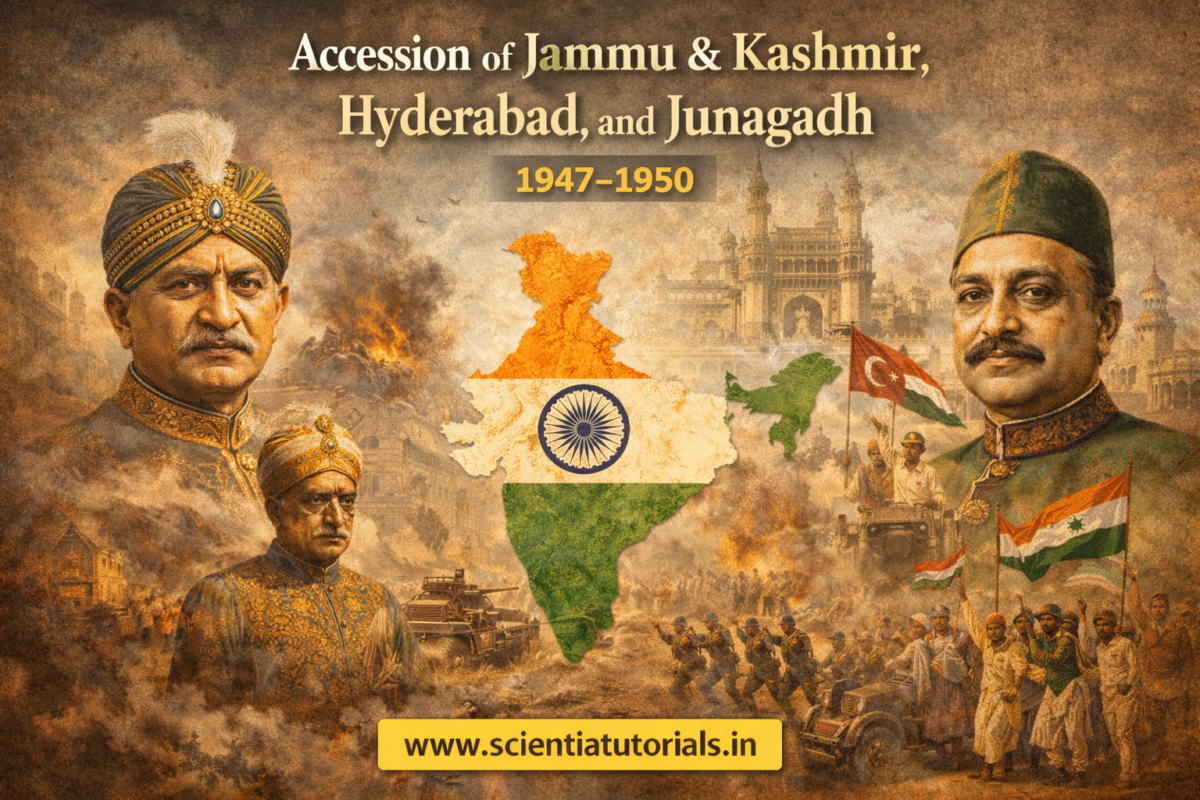

Course: Post-Independence and Contemporary India – History of India
Module 1: Transition from Colonial Rule to Independent India
Timeline: 1947–1950 (CE)
Lesson: Accession of Jammu & Kashmir, Hyderabad, and Junagadh
Based on the Lesson followed by the above Module and Course, we have created study materials aligned to the needs of UPSC, State PSC, UGC-NET, CUET, CBSE, and all school, college, and university examinations in India:
- Study Module with Revision Notes,
- Questions with Answers,
- MCQs with Answers and detailed explanations.
Introduction: Accession as the Crucible of Indian Unity
The transfer of power in August 1947 created not only two new dominions—India and Pakistan—but also a constitutional and political vacuum regarding the future of the princely states. Among the 565 princely states, three cases stood out for their complexity, controversy, and long-term consequences: Jammu & Kashmir, Hyderabad, and Junagadh.
These accessions tested the authority, diplomacy, constitutional vision, and military resolve of the newly independent Indian state. The manner in which these states were integrated shaped India’s territorial integrity, centre–state relations, foreign policy, and federal structure. This lesson provides a chronological, analytical, and examination-oriented study of these three accessions, placing them within the broader framework of nation-building between 1947 and 1950.
I. Constitutional Context of Accession (1947)
1. Lapse of British Paramountcy
With the Indian Independence Act, 1947, British paramountcy over princely states ended. Rulers were advised to accede to either India or Pakistan based on:
- Geographical contiguity
- Popular will
- Economic and administrative viability
The option of independence, though theoretically available, was discouraged as impractical.
2. Instrument of Accession
The legal basis of integration was the Instrument of Accession, under which rulers transferred control over:
- Defence
- Foreign affairs
- Communications
The accession was voluntary but irrevocable, giving it strong constitutional legitimacy.
II. Leadership Behind Accession Decisions
The integration strategy was led by:
- Sardar Vallabhbhai Patel – Deputy Prime Minister and Home Minister
- V P Menon – Secretary, States Department
Their approach combined constitutional legality, political realism, popular legitimacy, and controlled use of force.
III. Accession of Junagadh (1947)

1. Background
- Junagadh was a small princely state in Kathiawar (Gujarat)
- Muslim ruler (Nawab)
- Hindu-majority population (~80%)
- No geographical contiguity with Pakistan
Despite these factors, the Nawab acceded to Pakistan in August 1947, triggering widespread unrest.
2. Indian Response
India rejected the accession on grounds of:
- Violation of popular will
- Geographical impracticality
- Threat to territorial continuity
Popular revolts erupted, and a provisional government (Aarzi Hukumat) was formed.
3. Plebiscite and Integration
In February 1948, a plebiscite was held:
- Over 99% voted in favour of India
- Junagadh was formally integrated into India
Significance:
- Established the principle of popular sovereignty
- Set a precedent against arbitrary princely decisions
IV. Accession of Hyderabad (1948)
1. Background
- Largest princely state in India
- Ruled by the Nizam, a Muslim ruler
- Hindu-majority population
- Strategic location in south-central India
The Nizam sought independence, signing a Standstill Agreement with India.
2. Internal Disorder and Razakars
- Armed militia called Razakars terrorised civilians
- Communal violence increased
- Law and order collapsed
Hyderabad’s independence threatened:
- India’s territorial unity
- Internal security
- Democratic principles
3. Operation Polo (Police Action)
In September 1948, India launched Operation Polo:
- Limited military operation
- Lasted five days
- Nizam surrendered and signed the Instrument of Accession
Hyderabad was integrated as part of the Indian Union.
4. Evaluation
- Use of force justified as last resort
- Prevented balkanisation
- Reinforced authority of the Indian state
V. Accession of Jammu & Kashmir (1947)
1. Background
- Strategically crucial border state
- Hindu ruler (Maharaja Hari Singh)
- Muslim-majority population
- Bordering both India and Pakistan
The Maharaja initially sought independence.
2. Tribal Invasion and Crisis
In October 1947, tribal militias from Pakistan’s North-West Frontier Province invaded Kashmir:
- Looting and violence
- Collapse of state authority
Facing imminent collapse, the Maharaja sought Indian military help.
3. Instrument of Accession
On 26 October 1947, the Maharaja signed the Instrument of Accession to India:
- Accession was legal and unconditional
- Indian troops were airlifted to Srinagar
This marked the beginning of the first India–Pakistan war (1947–48).
4. Internationalisation of the Issue
- Pakistan contested the accession
- India approached the United Nations
- Ceasefire in 1949
- Division of territory along the Line of Control
Kashmir remains an unresolved and sensitive issue, but its accession to India is constitutionally valid.
VI. Comparative Analysis of the Three Accessions
| Aspect | Junagadh | Hyderabad | Jammu & Kashmir |
|---|---|---|---|
| Ruler–Population | Muslim ruler, Hindu majority | Muslim ruler, Hindu majority | Hindu ruler, Muslim majority |
| Method | Plebiscite | Military action | Accession after invasion |
| Use of Force | No | Yes | Defensive |
| Long-term Impact | Resolved | Resolved | Continuing dispute |
VII. Accession and the Indian Constitution
The experiences of accession influenced:
- Strong Union powers
- Emergency provisions
- Emphasis on unity and integrity
Under B R Ambedkar, the Constitution ensured:
- Equality before law
- Democratic governance in former princely states
- End of feudal privileges
VIII. Nation-Building Significance
1. Territorial Consolidation
Accession prevented fragmentation and foreign interference.
2. Strengthening of the Union
Demonstrated that sovereignty lay with the people and Constitution, not hereditary rulers.
3. Precedents in Federalism
Balanced central authority with state autonomy.
IX. Critiques and Historical Debates
- Junagadh: Pakistan questioned plebiscite legitimacy
- Hyderabad: Critics cite use of force
- Kashmir: Ongoing international dispute
Despite debates, historians broadly agree that accession was essential and inevitable.
X. Examination-Oriented Revision Notes
Key Terms
- Instrument of Accession
- Standstill Agreement
- Police Action (Operation Polo)
- Plebiscite
- Line of Control
Key Dates
- Aug 1947 – Junagadh accedes to Pakistan
- Oct 1947 – Kashmir invasion & accession
- Sept 1948 – Hyderabad integrated
- Jan 1950 – Constitution enforced
Answer-Writing Pointers
- Link accession with nation-building
- Compare methods used
- Highlight constitutional legality
- Use case studies effectively
Conclusion
The accession of Jammu & Kashmir, Hyderabad, and Junagadh represents the most decisive phase of India’s political consolidation between 1947 and 1950. Through constitutional instruments, popular legitimacy, and decisive action, India successfully transformed a fragmented subcontinent into a coherent nation-state.
These accessions were not merely territorial adjustments but defining moments that shaped India’s democracy, federalism, and sovereignty. Understanding them is essential to grasp the foundations of post-independence India.
Questions with Answers
Accession of Jammu & Kashmir, Hyderabad, and Junagadh
The questions are arranged into Short Answer and Long Answer categories and are fully aligned with UPSC, State PSCs, NET, CUET, CBSE, and university-level examinations in India.
Section A: Short Answer Questions
(Answer in about 30–80 words each)
Q1. What is meant by the accession of princely states?
Answer:
Accession refers to the legal process by which princely states joined the Indian Union after independence by signing the Instrument of Accession, transferring control over defence, foreign affairs, and communications to India.
Q2. Why did the lapse of British paramountcy create a political crisis in 1947?
Answer:
With the end of British paramountcy under the Indian Independence Act, 1947, princely states became legally sovereign. This raised the possibility of independence or accession to Pakistan, threatening India’s territorial unity.
Q3. What was the Instrument of Accession?
Answer:
The Instrument of Accession was a legal document through which princely rulers voluntarily acceded to India, handing over powers related to defence, foreign affairs, and communications.
Q4. Why was Junagadh’s accession controversial?
Answer:
Junagadh had a Hindu-majority population but a Muslim ruler who acceded to Pakistan despite lack of geographical contiguity, violating the principle of popular will.
Q5. How was Junagadh finally integrated into India?
Answer:
Junagadh was integrated through popular revolt followed by a plebiscite in February 1948, where over 99% of voters supported accession to India.
Q6. Why did the Nizam of Hyderabad refuse to accede to India?
Answer:
The Nizam sought to maintain Hyderabad’s independence to preserve his sovereignty and privileges, despite its Hindu-majority population and central location within India.
Q7. What were the Razakars?
Answer:
The Razakars were a paramilitary militia supporting the Nizam of Hyderabad. They were responsible for violence and lawlessness, worsening the internal situation in the state.
Q8. What was Operation Polo?
Answer:
Operation Polo was a limited military action undertaken by India in September 1948 to integrate Hyderabad after negotiations failed and internal disorder escalated.
Q9. Who was the ruler of Jammu & Kashmir in 1947?
Answer:
Jammu & Kashmir was ruled by Maharaja Hari Singh, a Hindu ruler governing a Muslim-majority state.
Q10. Why did Jammu & Kashmir accede to India?
Answer:
Jammu & Kashmir acceded to India following a tribal invasion from Pakistan in October 1947. The Maharaja sought Indian military assistance and signed the Instrument of Accession.
Section B: Medium Answer Questions
(Answer in about 120–180 words each)
Q11. Explain the role of the Instrument of Accession in integrating princely states.
Answer:
The Instrument of Accession provided the constitutional and legal basis for integrating princely states into India. It ensured voluntary accession while safeguarding India’s sovereignty over defence, foreign affairs, and communications. This mechanism allowed a smooth and largely peaceful transition from princely rule to democratic governance.
Q12. Discuss the Indian government’s response to Junagadh’s accession to Pakistan.
Answer:
India rejected Junagadh’s accession on grounds of popular will and geographical impracticality. Popular resistance was encouraged, a provisional government was formed, and a plebiscite was conducted, legitimising its accession to India.
Q13. Why was Hyderabad considered a threat to India’s unity?
Answer:
Hyderabad’s large size, strategic location, and aspiration for independence threatened India’s territorial continuity. The presence of Razakars and communal violence further endangered internal security.
Q14. Explain the circumstances leading to Operation Polo.
Answer:
Negotiations with the Nizam failed, violence escalated, and the Razakars created instability. India launched Operation Polo as a last resort to restore law and order and protect national unity.
Q15. How did the accession of Jammu & Kashmir differ from Junagadh and Hyderabad?
Answer:
Jammu & Kashmir acceded to India under emergency conditions following external aggression, whereas Junagadh was integrated through plebiscite and Hyderabad through military action.
Section C: Long Answer Questions
(Answer in about 250–400 words each)
Q16. Examine the accession of Junagadh as a case study in popular sovereignty.
Answer:
Junagadh’s accession highlights the primacy of popular will over princely authority. Despite the ruler’s decision to accede to Pakistan, India upheld democratic principles through a plebiscite, setting an important precedent in nation-building.
Q17. Analyse the integration of Hyderabad and assess the justification for the use of force.
Answer:
Hyderabad’s integration involved military action due to breakdown of law and order. Operation Polo was justified as a last resort to prevent fragmentation and restore democratic governance.
Q18. Discuss the accession of Jammu & Kashmir and its long-term implications.
Answer:
Jammu & Kashmir’s accession was legal and conditional on Indian military assistance. However, internationalisation of the issue led to prolonged conflict, shaping India–Pakistan relations.
Q19. Compare and contrast the accessions of Junagadh, Hyderabad, and Jammu & Kashmir.
Answer:
While Junagadh relied on plebiscite, Hyderabad required force, and Kashmir involved defence against external aggression. Together, they illustrate India’s flexible integration strategy.
Q20. “Accession of princely states was central to Indian nation-building.” Discuss with reference to these three cases.
Answer:
These accessions ensured territorial unity, strengthened the authority of the Union, and established democratic legitimacy in post-independence India.
Section D: Analytical / Comparative Questions
(Especially useful for UPSC & NET)
Q21. How did popular will influence India’s policy on accession?
Answer:
India emphasised popular consent, particularly in Junagadh, reinforcing democratic legitimacy.
Q22. Critically examine the role of force in the integration of princely states.
Answer:
Force was used selectively and as a last resort, primarily to safeguard national unity and public order.
Q23. What role did leadership play in handling these accessions?
Answer:
Leaders like Sardar Vallabhbhai Patel and V P Menon combined diplomacy with firmness, ensuring successful integration.
Q24. How did these accessions influence the framing of the Indian Constitution?
Answer:
Experiences of accession strengthened provisions related to Union authority, federalism, and national integrity under the guidance of B R Ambedkar.
Q25. Why are Jammu & Kashmir, Hyderabad, and Junagadh considered exceptional cases?
Answer:
Each case involved unique demographic, strategic, and political complexities, making them critical tests of India’s early nation-building capacity.
MCQs with Answers
Accession of Jammu & Kashmir, Hyderabad, and Junagadh
These MCQs are fully aligned with UPSC, State PSCs, NET, CUET, CBSE, and university examinations.
Q1. The legal basis for the accession of princely states to India was:
A. Indian Independence Act, 1947
B. Standstill Agreement
C. Instrument of Accession
D. Government of India Act, 1935
Correct Answer: C
Explanation:
The Instrument of Accession was the constitutional document through which princely rulers transferred powers over defence, foreign affairs, and communications to India.
Q2. British paramountcy over princely states lapsed under:
A. Cabinet Mission Plan
B. Mountbatten Plan
C. Indian Independence Act, 1947
D. Interim Government Resolution
Correct Answer: C
Explanation:
The Indian Independence Act, 1947 ended British paramountcy, making princely states legally sovereign.
Q3. Which princely state had a Hindu-majority population but a Muslim ruler who acceded to Pakistan?
A. Hyderabad
B. Kashmir
C. Junagadh
D. Bhopal
Correct Answer: C
Explanation:
Junagadh’s accession to Pakistan ignored geography and popular will, leading to Indian intervention.
Q4. Junagadh was finally integrated into India through:
A. UN arbitration
B. Military action
C. Plebiscite
D. Cabinet decision
Correct Answer: C
Explanation:
A plebiscite in February 1948 showed overwhelming support for accession to India.
Q5. The accession of Junagadh established the principle of:
A. Monarchical sovereignty
B. Military supremacy
C. Popular sovereignty
D. International arbitration
Correct Answer: C
Explanation:
India emphasized that the will of the people was superior to the ruler’s decision.
Q6. Hyderabad was ruled by the:
A. Maharaja
B. Nawab
C. Gaekwad
D. Nizam
Correct Answer: D
Explanation:
The Nizam of Hyderabad sought independence despite the state’s Hindu-majority population.
Q7. The Razakars were:
A. Congress volunteers
B. British paramilitary forces
C. Militia supporting the Nizam
D. Refugee protection units
Correct Answer: C
Explanation:
The Razakars were armed groups supporting the Nizam, responsible for violence and disorder.
Q8. Operation Polo was launched to integrate:
A. Junagadh
B. Kashmir
C. Hyderabad
D. Travancore
Correct Answer: C
Explanation:
Operation Polo (September 1948) was a limited military action to integrate Hyderabad.
Q9. Operation Polo is also known as:
A. Desert Storm
B. Police Action
C. Operation Vijay
D. Operation Unity
Correct Answer: B
Explanation:
The government termed the military intervention a “Police Action” to restore law and order.
Q10. Which princely state was the largest in India at independence?
A. Kashmir
B. Junagadh
C. Mysore
D. Hyderabad
Correct Answer: D
Explanation:
Hyderabad was the largest princely state, making its accession strategically vital.
Q11. Jammu & Kashmir was ruled in 1947 by:
A. Sheikh Abdullah
B. Maharaja Hari Singh
C. Jawaharlal Nehru
D. Liaquat Ali Khan
Correct Answer: B
Explanation:
Maharaja Hari Singh was the Hindu ruler of the Muslim-majority state of Jammu & Kashmir.
Q12. The immediate cause for Kashmir’s accession to India was:
A. Plebiscite
B. Economic crisis
C. Tribal invasion from Pakistan
D. Pressure from Britain
Correct Answer: C
Explanation:
A tribal invasion from Pakistan in October 1947 forced the Maharaja to seek Indian help.
Q13. Jammu & Kashmir acceded to India on:
A. 15 August 1947
B. 22 October 1947
C. 26 October 1947
D. 1 January 1948
Correct Answer: C
Explanation:
The Instrument of Accession was signed on 26 October 1947.
Q14. After Kashmir’s accession, India’s first military action was:
A. Operation Polo
B. Airlifting troops to Srinagar
C. UN mediation
D. Border fencing
Correct Answer: B
Explanation:
Indian troops were airlifted to Srinagar to repel invading forces.
Q15. Which accession led to the first India–Pakistan war?
A. Junagadh
B. Hyderabad
C. Kashmir
D. Bhopal
Correct Answer: C
Explanation:
Kashmir’s accession resulted in the 1947–48 India–Pakistan war.
Q16. The Kashmir issue was internationalised when India approached:
A. British Parliament
B. Commonwealth
C. United Nations
D. International Court of Justice
Correct Answer: C
Explanation:
India took the Kashmir issue to the United Nations in 1948.
Q17. The ceasefire line in Kashmir later became known as:
A. Radcliffe Line
B. McMahon Line
C. Line of Control
D. Durand Line
Correct Answer: C
Explanation:
The ceasefire line established in 1949 later became the Line of Control (LoC).
Q18. Which accession involved the least use of force?
A. Hyderabad
B. Kashmir
C. Junagadh
D. All involved force
Correct Answer: C
Explanation:
Junagadh was integrated through plebiscite without direct military conflict.
Q19. Which factor was common to Junagadh and Hyderabad?
A. Muslim ruler and Muslim majority
B. Hindu ruler and Hindu majority
C. Muslim ruler and Hindu majority
D. Hindu ruler and Muslim majority
Correct Answer: C
Explanation:
Both had Muslim rulers governing Hindu-majority populations.
Q20. Which principle guided India’s accession policy?
A. Absolute sovereignty of rulers
B. Popular will and territorial integrity
C. International mediation
D. Religious identity
Correct Answer: B
Explanation:
India emphasized democratic legitimacy and national unity.
Q21. The role of coordinating these accessions was led by:
A. Jawaharlal Nehru alone
B. Sardar Vallabhbhai Patel and V P Menon
C. British officials
D. UN representatives
Correct Answer: B
Explanation:
Patel and Menon combined political authority with administrative expertise.
Q22. Which accession remains a continuing international dispute?
A. Junagadh
B. Hyderabad
C. Kashmir
D. Mysore
Correct Answer: C
Explanation:
Kashmir remains unresolved due to India–Pakistan conflict.
Q23. From a constitutional perspective, accession ensured:
A. Continued princely autonomy
B. Equality before law
C. Military rule
D. Special treaties with rulers
Correct Answer: B
Explanation:
Accession brought princely states under the Indian Constitution.
Q24. Which accession best illustrates the use of force as a last resort?
A. Junagadh
B. Hyderabad
C. Kashmir
D. Bhopal
Correct Answer: B
Explanation:
Force was used only after negotiations failed and internal disorder escalated.
Q25. The accession of these three states primarily contributed to:
A. Expansion of colonial boundaries
B. Weakening of federalism
C. Territorial consolidation and nation-building
D. End of communalism
Correct Answer: C
Explanation:
Their integration prevented fragmentation and strengthened India’s unity.
✅ This MCQ set is fully exam-ready and suitable for objective examinations across UPSC, State PSCs, NET, CUET, CBSE, and higher-education institutions in India.
-
accession of jammu and kashmir 1947 explained
-
accession of hyderabad and operation polo notes
-
accession of junagadh plebiscite explained
-
integration of princely states jammu kashmir hyderabad junagadh
-
instrument of accession explained for upsc
-
jammu kashmir hyderabad junagadh accession comparison
-
princely states accession notes for upsc psc
-
post independence india accession of states
-
nation building through accession of princely states
-
accession of jammu kashmir hyderabad junagadh mcqs