
Evolution of Indian Democracy Since Independence
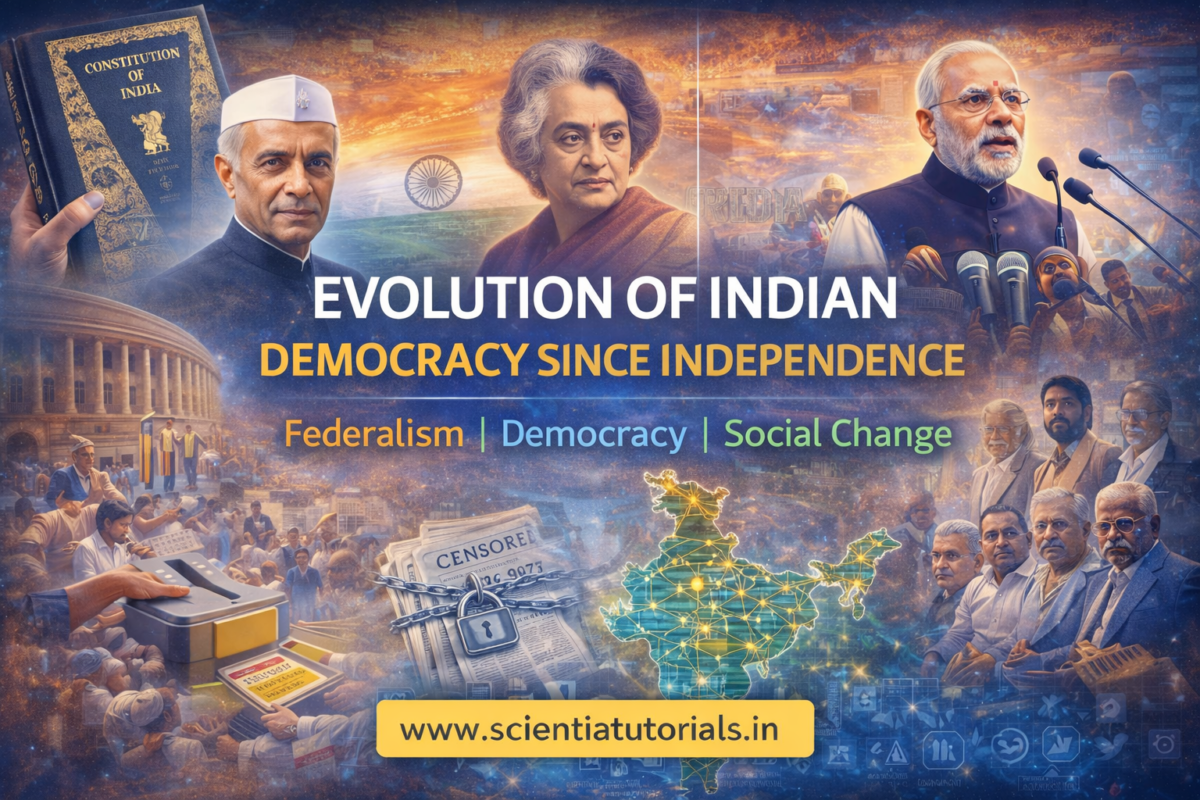

Evolution of Indian Democracy Since Independence
Course: Post-Independence and Contemporary India – History of India
Module 10: Assessment of Post-Independence India (1947–Present CE)
Lesson: Evolution of Indian Democracy Since Independence
Based on the Lesson followed by the above Module and Course, we have created study materials aligned to the needs of UPSC, State PSC, UGC-NET, CUET, CBSE, and all school, college, and university examinations in India:
- Chronologically Structured Study Module,
- Questions with Answers,
- MCQs with Answers and detailed explanations.
Chronologically Structured Study Module
Introduction: Indian Democracy as a Historical Process
The evolution of Indian democracy since Independence in 1947 is one of the most significant themes in the history of the modern world. Emerging from colonial rule with deep social divisions, economic backwardness, and low literacy, India adopted democracy not as a gradual experiment but as a founding principle of the new nation-state. Over the decades, Indian democracy has faced crises, adaptations, and transformations, yet it has displayed remarkable resilience.
This chronologically structured study module examines the evolution of Indian democracy from 1947 to the present, tracing its institutional foundations, phases of expansion and crisis, and contemporary challenges. The analysis situates democracy within India’s broader post-Independence journey of nation-building, social change, federalism, and constitutional governance.
I. Historical Context: Democracy at Independence (1947)
1. Colonial Legacy and Democratic Aspirations
At Independence, India inherited:
- Colonial administrative structures
- Limited experience with representative institutions
- Deep socio-economic inequalities
Yet, the freedom struggle itself was a mass democratic movement, involving peasants, workers, women, and marginalised groups. This historical experience shaped India’s commitment to democracy.
2. Framing of the Constitution (1946–1950)
The Constituent Assembly laid the foundations of Indian democracy by adopting:
- Universal adult franchise
- Parliamentary system
- Fundamental Rights
- Independent judiciary
The Constitution transformed subjects into citizens, making democracy central to India’s national identity.
II. Phase I (1950–1964): Democratic Consolidation under Nehru
1. Parliamentary Democracy and Institution-Building
Under the leadership of Jawaharlal Nehru, India focused on:
- Strengthening Parliament
- Upholding civil liberties
- Respecting opposition and dissent
Elections became regular and competitive, establishing democratic legitimacy.
2. Congress System and One-Party Dominance
This phase is often described as the Congress System, where:
- Congress dominated electoral politics
- Opposition existed but was fragmented
- Democracy functioned within a one-party dominant framework
Despite dominance, political competition and constitutionalism were preserved.
3. Democratic Significance
Historical Importance:
India’s successful conduct of elections and peaceful transfers of power during this phase disproved scepticism about democracy’s viability in a developing society.
III. Phase II (1964–1977): Democratic Strains and the Emergency
1. Leadership Change and Political Challenges
After Nehru, Indian democracy entered a turbulent phase marked by:
- Economic stress
- Political centralisation
- Rising mass movements
Leadership under Indira Gandhi significantly shaped this era.
2. Centralisation and Populist Democracy
Indira Gandhi’s period saw:
- Slogan-based mass mobilisation
- Weakening of internal party democracy
- Greater executive dominance
Democracy became more plebiscitary, relying on direct leader–people appeal.
3. The Emergency (1975–1977)
The declaration of Emergency marked the gravest crisis in Indian democratic history:
- Suspension of civil liberties
- Press censorship
- Curtailment of judicial review
Historical Assessment:
The Emergency exposed the vulnerability of democratic institutions but also tested their resilience.
IV. Phase III (1977–1989): Democratic Resilience and Restoration
1. Post-Emergency Democratic Revival
The defeat of the Congress in 1977 demonstrated:
- Electoral accountability
- Popular rejection of authoritarianism
The peaceful transition of power reaffirmed faith in democracy.
2. Coalition Experiments and Federal Politics
This period witnessed:
- Rise of non-Congress governments
- Assertion of regional interests
- Strengthening of federal democracy
Though unstable, coalitions expanded political participation.
3. Deepening of Democratic Culture
Democracy increasingly reflected:
- Social diversity
- Regional aspirations
- Grassroots political mobilisation
V. Phase IV (1989–1999): Coalition Era and Social Democracy
1. End of One-Party Dominance
The period from 1989 marked:
- Decline of Congress dominance
- Emergence of coalition governments
- Rise of regional parties
Coalition politics reshaped democratic functioning at the Centre.
2. Social Justice and Democratic Expansion
Key developments included:
- Assertion of backward classes
- Implementation of affirmative action
- Increased representation of marginalised groups
Democracy expanded from elite politics to social democracy.
3. Democratic Implications
While governance became complex, democracy became more inclusive and representative.
VI. Phase V (2000–2014): Rights-Based Democracy and Institutional Expansion
1. Democratic Governance in the Liberalisation Era
Post-1991 economic reforms altered state–society relations, but democracy adapted through:
- New regulatory institutions
- Judicial activism
- Civil society engagement
2. Rights-Based Legislations
This phase strengthened substantive democracy through:
- Right to Information
- Employment and food security measures
- Expansion of welfare entitlements
Democracy increasingly focused on rights, accountability, and transparency.
3. Media and Civil Society
The growth of media and civil society organisations:
- Enhanced public scrutiny
- Expanded democratic debate
- Increased citizen participation
VII. Phase VI (2014–Present): Majoritarianism, Centralisation, and Digital Democracy
1. Strong Leadership and Electoral Mandates
Under Narendra Modi, Indian democracy has experienced:
- Strong executive leadership
- Reduced coalition constraints
- Centralisation of decision-making
2. Democracy and Institutions
This phase has seen intense debates over:
- Independence of institutions
- Role of Parliament
- Federal balance
Supporters emphasise governance efficiency, while critics raise concerns about institutional autonomy.
3. Digital Democracy and Mass Participation
Technology has reshaped democracy through:
- Social media mobilisation
- Digital campaigns
- Direct citizen–state communication
Democracy today operates in a digitally mediated public sphere.
VIII. Indian Democracy in Comparative Perspective
1. Longevity and Continuity
Despite challenges, India stands out as:
- One of the world’s longest-running democracies
- A democracy sustained in a developing society
2. Diversity and Scale
Indian democracy manages:
- Linguistic, religious, and cultural diversity
- Large electorate and complex federal structure
This makes it a unique democratic experiment.
IX. Achievements and Limitations of Indian Democracy
Achievements:
- Regular elections and peaceful transfers of power
- Expansion of political participation
- Inclusion of marginalised communities
Limitations:
- Social and economic inequality
- Criminalisation of politics
- Institutional stress and democratic backsliding debates
For examinations, balanced answers must reflect both resilience and challenges.
X. Democracy as an Evolving Process
Indian democracy should not be seen as static. It evolves through:
- Constitutional interpretation
- Political mobilisation
- Social change and economic transformation
Each phase reflects the interaction between institutions and society.
Conclusion: Historical Significance of Indian Democracy
The evolution of Indian democracy since 1947 represents a remarkable historical journey—from constitutional idealism to mass participation, from crisis to recovery, and from procedural democracy to debates over its substantive quality.
Indian democracy has survived poverty, diversity, emergencies, coalitions, and globalisation. Its endurance lies not in perfection but in its capacity for self-correction. For students of history and polity, Indian democracy offers a powerful example of how democratic institutions adapt over time while remaining rooted in constitutional values.
Questions with Answers
Evolution of Indian Democracy Since Independence (1947–Present)
The questions are arranged into very short, short, medium, and long answer types, suitable for UPSC, State PSC, NET, CUET, CBSE, and university examinations.
I. Very Short Answer Questions
Q1. In which year did India become a democratic republic?
Answer:
India became a democratic republic in 1950.
Q2. Which document forms the foundation of Indian democracy?
Answer:
The Constitution of India forms the foundation of Indian democracy.
Q3. What type of democracy did India adopt after Independence?
Answer:
India adopted a parliamentary democracy.
Q4. Name the first Prime Minister of independent India.
Answer:
Jawaharlal Nehru was the first Prime Minister of independent India.
Q5. Which event is considered the gravest crisis in Indian democratic history?
Answer:
The Emergency (1975–1977) is considered the gravest crisis in Indian democracy.
II. Short Answer Questions
Q6. Why was the adoption of universal adult franchise significant in 1950?
Answer:
Universal adult franchise gave every adult citizen the right to vote regardless of caste, gender, or wealth. It transformed subjects into equal political citizens, making Indian democracy inclusive from its inception.
Q7. What is meant by the “Congress System” in Indian democracy?
Answer:
The Congress System refers to the period of one-party dominance (1950s–1960s) when the Congress Party dominated elections but allowed opposition within a democratic and constitutional framework.
Q8. How did the leadership of Jawaharlal Nehru contribute to democratic consolidation?
Answer:
Nehru strengthened parliamentary institutions, respected civil liberties, upheld judicial independence, and encouraged democratic debate, helping consolidate democracy in its formative years.
Q9. What changes occurred in Indian democracy during the Indira Gandhi era?
Answer:
The period witnessed centralisation of power, populist politics, weakening of internal party democracy, and eventually the declaration of Emergency, testing democratic institutions.
Q10. Why was the defeat of the Congress in the 1977 elections democratically significant?
Answer:
It showed that electoral accountability worked, proving that even a powerful ruling party could be removed peacefully through democratic means.
III. Medium Answer Questions
Q11. Examine the impact of the Emergency (1975–1977) on Indian democracy.
Answer:
The Emergency suspended civil liberties, censored the press, and curtailed judicial review. However, its end and the subsequent elections demonstrated the resilience of Indian democracy and strengthened democratic consciousness.
Q12. How did coalition politics after 1989 change the nature of Indian democracy?
Answer:
Coalition politics ended one-party dominance, increased the role of regional parties, strengthened federalism, and made democracy more inclusive and representative, though sometimes at the cost of stability.
Q13. Discuss the relationship between social justice and democracy in India since the 1990s.
Answer:
Democracy expanded beyond political equality to social representation, with greater participation of backward classes, Dalits, and minorities through affirmative action and regional mobilisation.
Q14. What role did rights-based legislations play in strengthening democracy after 2000?
Answer:
Laws such as the Right to Information enhanced transparency, accountability, and citizen participation, deepening substantive democracy.
Q15. How has media influenced democratic functioning in post-Independence India?
Answer:
Media expanded public debate, political awareness, and accountability, though concerns about sensationalism and bias have also emerged.
IV. Long Answer Questions
Q16. Trace the evolution of Indian democracy from 1950 to 1977.
Answer:
From 1950 to 1964, democracy consolidated under Nehru through institutions and elections. After 1964, economic stress and political centralisation intensified, culminating in the Emergency (1975–1977), which temporarily undermined democratic freedoms but ultimately reaffirmed democratic resilience.
Q17. Analyse the significance of the post-Emergency period in strengthening Indian democracy.
Answer:
The post-Emergency period restored civil liberties, reinforced constitutional safeguards, and increased public vigilance against authoritarianism. It reaffirmed the supremacy of the electorate in a democracy.
Q18. Discuss how coalition politics contributed to democratic deepening in India.
Answer:
Coalitions widened political participation, strengthened federal democracy, and brought marginalised and regional voices into national decision-making, making democracy more representative.
Q19. Evaluate the impact of economic liberalisation on Indian democracy.
Answer:
While liberalisation changed state–society relations and increased inequality, democracy adapted through new institutions, judicial activism, and rights-based policies to address citizen concerns.
Q20. Examine the nature of Indian democracy in the post-2014 period.
Answer:
The post-2014 period is marked by strong leadership, centralisation, and digital mobilisation. While governance efficiency improved, debates continue over institutional autonomy and democratic checks and balances.
V. Analytical and Essay-Type Questions
Q21. “Indian democracy has shown remarkable resilience despite repeated challenges.” Discuss.
Answer:
Indian democracy survived poverty, diversity, Emergency, coalition instability, and globalisation. Its resilience lies in regular elections, constitutionalism, and the people’s commitment to democratic values.
Q22. Compare the nature of Indian democracy in the Nehruvian era and the coalition era.
Answer:
The Nehruvian era emphasised institution-building and consensus, while the coalition era emphasised representation, federalism, and social diversity, though often with governance challenges.
Q23. How has the role of citizens evolved in Indian democracy since Independence?
Answer:
Citizens have evolved from voters to active participants, using media, courts, civil society, and digital platforms to influence governance.
Q24. Assess the achievements and limitations of Indian democracy since 1947.
Answer:
Achievements include universal franchise, peaceful transfers of power, and inclusion. Limitations include inequality, criminalisation of politics, and institutional stress.
Q25. Why is the evolution of Indian democracy an important theme in post-Independence history?
Answer:
It explains how constitutional ideals interact with social realities, making democracy central to understanding India’s political, social, and historical development.
MCQs with Answers
Evolution of Indian Democracy Since Independence (1947–Present)
These MCQs are suitable for UPSC (Prelims & Mains foundation), State PSC, NET, CUET, CBSE, and university examinations.
MCQ 1
India adopted democracy immediately after Independence primarily because:
A. It was imposed by the British
B. It suited India’s colonial administration
C. The freedom struggle had democratic roots
D. India lacked alternative political ideas
Correct Answer: C
Explanation:
India’s national movement was a mass democratic struggle involving elections, debates, and participation, making democracy a natural post-Independence choice.
MCQ 2
Universal adult franchise in India was introduced in:
A. 1947
B. 1949
C. 1950
D. 1952
Correct Answer: C
Explanation:
The Constitution of India (effective from 1950) granted universal adult franchise, regardless of literacy, caste, gender, or wealth.
MCQ 3
Which feature most clearly distinguishes Indian democracy from many post-colonial states?
A. Presidential system
B. One-party rule
C. Immediate adoption of mass democracy
D. Limited voting rights
Correct Answer: C
Explanation:
Unlike many newly independent nations, India adopted full democracy from the beginning, not after a transitional phase.
MCQ 4
The parliamentary form of government in India was inspired mainly by:
A. The American Constitution
B. The French Constitution
C. The British political system
D. The Soviet Constitution
Correct Answer: C
Explanation:
India adopted the Westminster model, ensuring executive accountability to Parliament.
MCQ 5
Who played the most important role in consolidating Indian democracy during its early years?
A. Sardar Patel
B. Rajendra Prasad
C. Jawaharlal Nehru
D. B. R. Ambedkar
Correct Answer: C
Explanation:
Jawaharlal Nehru upheld civil liberties, parliamentary debate, and constitutional values, ensuring democratic stability.
MCQ 6
The term “Congress System” refers to:
A. Absence of opposition parties
B. One-party authoritarian rule
C. One-party dominance with democratic competition
D. Coalition politics
Correct Answer: C
Explanation:
Although the Congress dominated elections, opposition and democratic institutions functioned freely.
MCQ 7
Which period is associated with the gravest crisis of Indian democracy?
A. 1962–1967
B. 1967–1971
C. 1975–1977
D. 1989–1991
Correct Answer: C
Explanation:
The Emergency (1975–1977) suspended civil liberties and press freedom.
MCQ 8
The Emergency in India was declared under which constitutional provision?
A. Article 352
B. Article 356
C. Article 360
D. Article 370
Correct Answer: A
Explanation:
Article 352 allows declaration of a National Emergency, which was invoked in 1975.
MCQ 9
Which leader was associated with the declaration of the Emergency?
A. Morarji Desai
B. Indira Gandhi
C. Rajiv Gandhi
D. Charan Singh
Correct Answer: B
Explanation:
Indira Gandhi declared the Emergency citing internal disturbances.
MCQ 10
The defeat of the Congress Party in the 1977 elections demonstrated that:
A. Democracy had collapsed
B. Judiciary was supreme
C. Electoral accountability survived
D. Opposition unity was permanent
Correct Answer: C
Explanation:
The peaceful transfer of power proved that Indian democracy could correct itself.
MCQ 11
Which period marked the beginning of coalition politics at the Centre?
A. 1977–1980
B. 1984–1989
C. 1989–1999
D. 2004–2014
Correct Answer: C
Explanation:
From 1989 onwards, coalition governments became common, ending one-party dominance.
MCQ 12
Coalition politics strengthened Indian democracy mainly by:
A. Weakening Parliament
B. Reducing voter participation
C. Increasing representation of regions and social groups
D. Ending federalism
Correct Answer: C
Explanation:
Coalitions gave regional parties and marginalised groups greater voice.
MCQ 13
The expansion of social justice in democracy since the 1990s is best reflected in:
A. Industrial policy
B. Electoral reforms
C. Affirmative action and representation
D. Foreign policy
Correct Answer: C
Explanation:
Democracy deepened through representation of backward classes and marginalised communities.
MCQ 14
Which factor most strengthened substantive democracy after 2000?
A. Military reforms
B. Rights-based legislations
C. Privatisation
D. Judicial appointments
Correct Answer: B
Explanation:
Laws like RTI improved transparency, accountability, and citizen participation.
MCQ 15
Media and civil society contributed to democracy by:
A. Limiting public debate
B. Expanding accountability and awareness
C. Ending parliamentary democracy
D. Replacing elections
Correct Answer: B
Explanation:
An active media and civil society expanded public scrutiny of power.
MCQ 16
The post-2014 phase of Indian democracy is often described as:
A. Coalition-driven
B. Weak executive
C. Strong leadership with centralisation
D. Military-dominated
Correct Answer: C
Explanation:
A strong electoral mandate enabled centralised and decisive governance.
MCQ 17
Which feature best characterises democracy in the digital age?
A. Decline of elections
B. End of citizen participation
C. Social media-driven political mobilisation
D. Judicial control over politics
Correct Answer: C
Explanation:
Digital platforms have reshaped campaigning, participation, and public discourse.
MCQ 18
Indian democracy is best described historically as:
A. Static and unchanging
B. Periodically suspended
C. An evolving and adaptive system
D. Purely procedural
Correct Answer: C
Explanation:
Democracy in India adapts to social change, crises, and new challenges.
MCQ 19
Which institution acts as the guardian of constitutional democracy in India?
A. Parliament
B. Executive
C. Judiciary
D. Election Commission alone
Correct Answer: C
Explanation:
The judiciary ensures constitutional supremacy through judicial review.
MCQ 20
One major limitation of Indian democracy has been:
A. Absence of elections
B. Lack of constitutional framework
C. Social and economic inequality
D. Absence of political parties
Correct Answer: C
Explanation:
Persistent inequality affects equal democratic participation.
MCQ 21
Which aspect shows the resilience of Indian democracy?
A. Suspension of rights
B. Survival through Emergency and crises
C. Centralisation of power
D. Decline of opposition
Correct Answer: B
Explanation:
Despite crises, democracy revived and corrected itself.
MCQ 22
The relationship between democracy and federalism in India is best described as:
A. Mutually exclusive
B. Contradictory
C. Complementary
D. Unrelated
Correct Answer: C
Explanation:
Federalism enables regional participation, strengthening democracy.
MCQ 23
Which era focused most on institution-building and consensus politics?
A. Post-Emergency era
B. Coalition era
C. Nehruvian era
D. Post-2014 era
Correct Answer: C
Explanation:
The Nehruvian period emphasised institutional stability and democratic norms.
MCQ 24
From a global perspective, Indian democracy is unique because:
A. It emerged after economic development
B. It is restricted to elites
C. It survived in a poor, diverse society
D. It rejected constitutionalism
Correct Answer: C
Explanation:
India sustained democracy despite poverty, diversity, and size, unlike many post-colonial states.
MCQ 25
For historians, the evolution of Indian democracy is important because it:
A. Is purely political theory
B. Explains constitutional ideals in practice
C. Ignores social change
D. Ends in 1950
Correct Answer: B
Explanation:
It shows how constitutional principles interact with social realities over time.
✔ Examination Utility
- Ideal for UPSC Prelims, State PSC, NET, CUET, CBSE, and university exams
- Emphasises chronology, concepts, and analytical clarity
- Useful for revision, mock tests, and objective practice
-
Evolution of Indian democracy since independence
-
Indian democracy from 1947 to present notes
-
Growth of democracy in post-independence India
-
Emergency 1975 impact on Indian democracy
-
Coalition politics and Indian democracy
-
Indian democracy UPSC history notes
-
Rights-based democracy in India after 2000
-
Challenges to Indian democracy in 21st century
-
Indian democracy history for PSC NET CUET
-
Assessment of Indian democracy since 1950
-
Democratic institutions in post-independence India
-
Indian democracy achievements and limitations