
Administrative Continuity and Legacy of Colonial Institutions
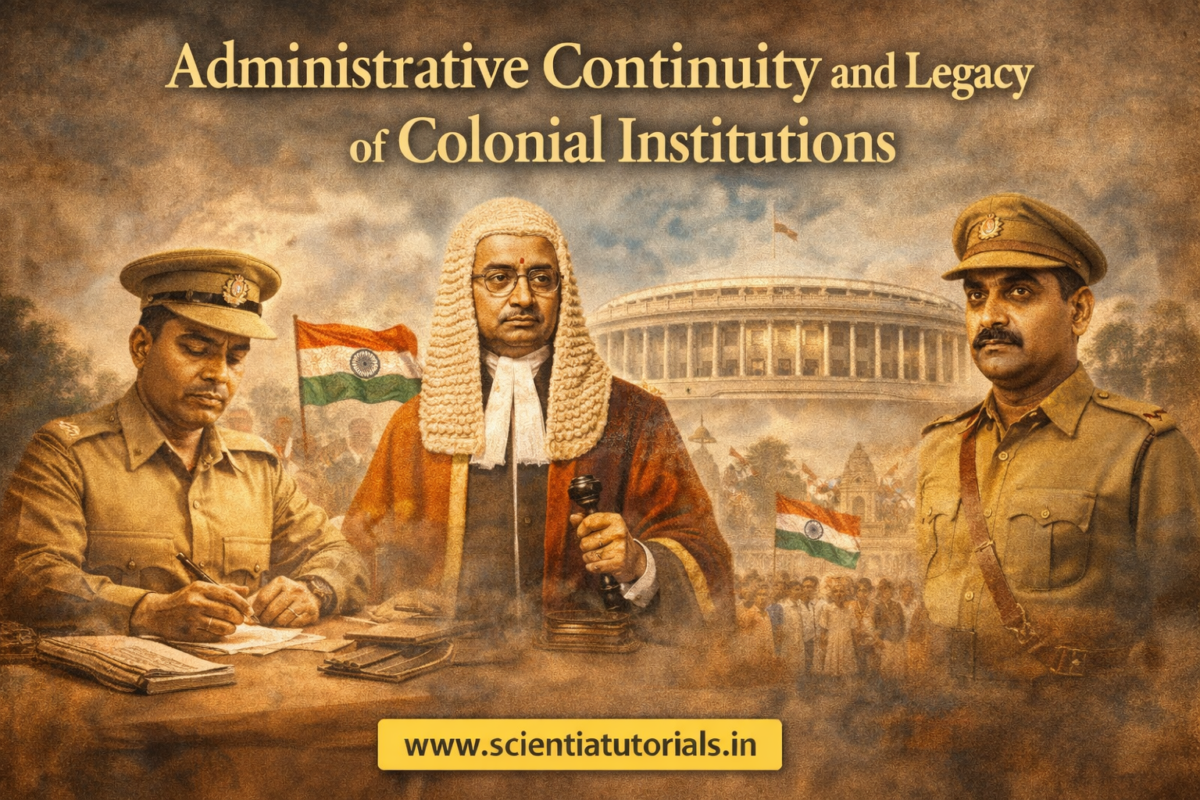

Course: Post-Independence and Contemporary India – History of India
Module 1: Transition from Colonial Rule to Independent India
Timeline: 1947–1950 (CE)
Lesson: Administrative Continuity and Legacy of Colonial Institutions
Based on the Lesson followed by the above Module and Course, we have created study materials aligned to the needs of UPSC, State PSC, UGC-NET, CUET, CBSE, and all school, college, and university examinations in India:
- Study Module with Revision Notes,
- Questions with Answers,
- MCQs with Answers and detailed explanations.
Introduction: Change Amid Continuity
The achievement of independence in August 1947 marked the end of British political domination in India, yet it did not imply a complete rupture with the colonial past. On the contrary, the Indian state inherited a vast and complex colonial administrative machinery that had evolved over nearly two centuries. In the immediate post-independence years (1947–1950), Indian leaders consciously chose administrative continuity rather than radical institutional disruption.
This lesson critically examines the continuation, adaptation, and transformation of colonial institutions—such as the civil services, police, judiciary, revenue system, and district administration—and evaluates how these legacies shaped the early Indian state and nation-building process. Understanding this continuity is essential for grasping why independent India functioned with relative stability despite Partition, refugee crises, and political uncertainty.
I. Conceptual Framework: Administrative Continuity
1. Meaning of Administrative Continuity
Administrative continuity refers to the retention of existing colonial institutions, laws, and procedures by the Indian state after independence, with gradual reforms rather than abrupt dismantling.
Indian leaders adopted this approach because:
- The new state faced multiple crises (Partition, refugee rehabilitation, princely state integration)
- There was an urgent need for order, stability, and governance
- Colonial institutions, though exploitative in origin, were efficient and functional
2. Colonial Institutions: An Overview
Key colonial administrative institutions inherited by India included:
- Indian Civil Service (ICS)
- Police and intelligence system
- Judicial structure
- Revenue and land administration
- District administration
- Central Secretariat and ministries
These institutions formed the backbone of governance in independent India.
II. The Indian Civil Service and Its Legacy
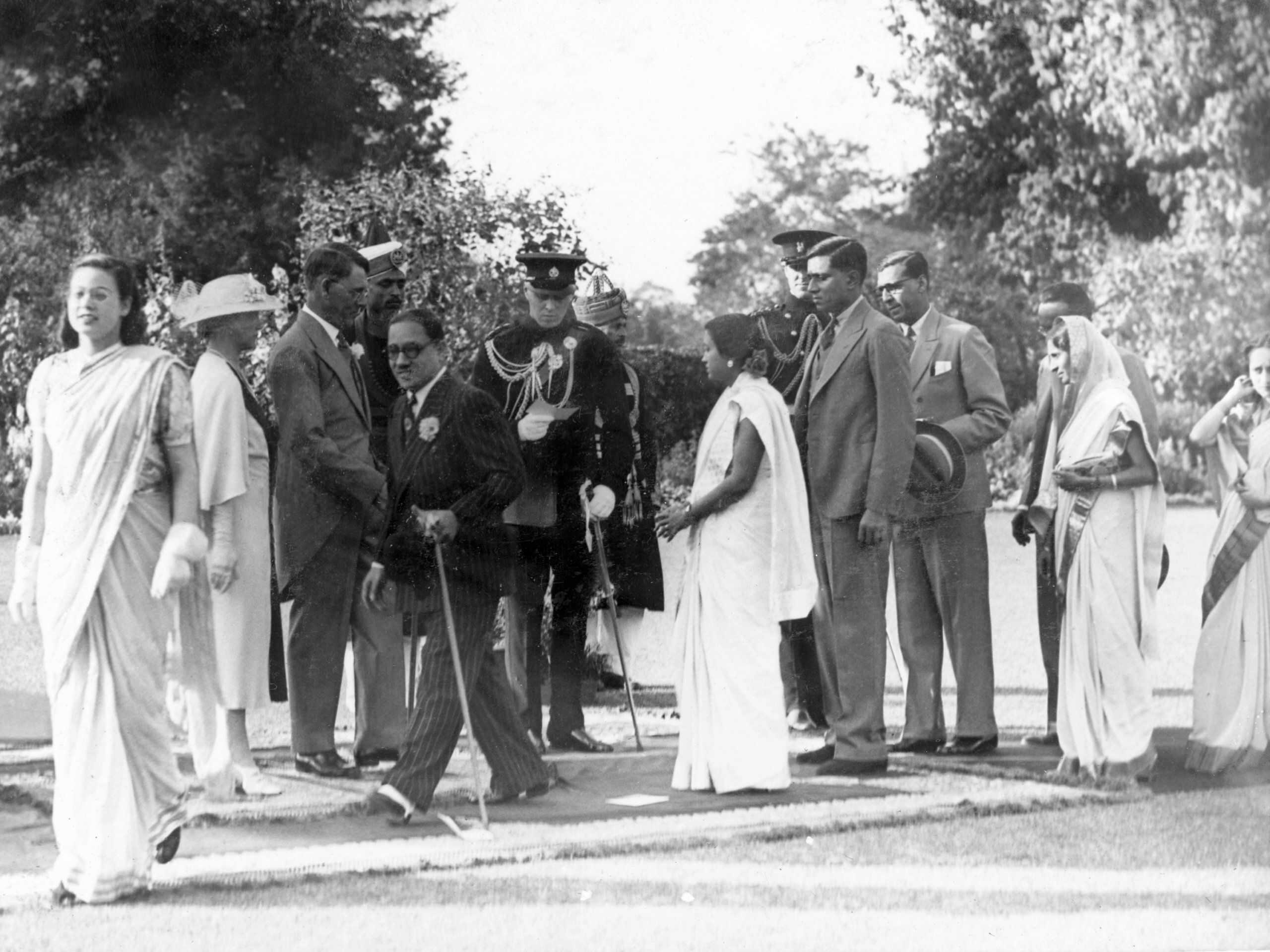
1. Indian Civil Service (ICS) under the British
The Indian Civil Service (ICS) was described as the “steel frame” of British rule. Its key features were:
- Highly centralised and hierarchical
- Politically neutral but loyal to colonial authority
- Responsible for law and order, revenue collection, and administration
Despite its elitist nature, the ICS was admired for its discipline, efficiency, and administrative reach.
2. Transformation into the Indian Administrative Service (IAS)
After independence:
- The ICS was replaced by the Indian Administrative Service (IAS)
- Recruitment became open to all Indians
- Officers were expected to serve a democratic and welfare-oriented state
Jawaharlal Nehru recognised the need for continuity, stating that destroying the administrative structure would lead to chaos.
3. Role in Nation-Building
The IAS played a crucial role in:
- Implementing refugee rehabilitation
- Integrating princely states
- Conducting elections
- Implementing land reforms and development programmes
Thus, a colonial institution was repurposed to serve a sovereign democratic republic.
III. Police and Internal Security Apparatus
1. Colonial Police System
The colonial police was designed primarily to:
- Maintain law and order
- Suppress dissent
- Protect colonial authority
It was governed by the Police Act of 1861, which remained in force after independence.
2. Post-Independence Continuity
Independent India retained:
- The same police structure
- Centralised command
- Preventive and coercive powers
This continuity was necessary due to:
- Communal violence after Partition
- Refugee movements
- Threats to internal security
However, it also raised concerns about authoritarian tendencies in a democratic state.
IV. Judicial System: Colonial Roots, Constitutional Transformation
1. Colonial Judiciary
The British established a modern judicial system with:
- Hierarchical courts
- Codified laws (IPC, CrPC, CPC)
- Principle of rule of law
This system replaced traditional and customary legal practices.
2. Judiciary in Independent India
Independent India retained:
- The entire legal framework
- British-era laws with modifications
- Judicial procedures and precedents
The Constitution transformed the judiciary by:
- Ensuring judicial independence
- Introducing Fundamental Rights
- Establishing the Supreme Court of India
Under the Constitution drafted under B R Ambedkar, the judiciary became the guardian of democracy, not colonial authority.
V. Revenue and Land Administration
1. Colonial Revenue System
British revenue policies such as:
- Permanent Settlement
- Ryotwari and Mahalwari systems
were designed for revenue extraction, often causing peasant distress.
2. Post-Independence Adaptation
Independent India retained:
- District revenue administration
- Land records and taxation systems
However, reforms were introduced:
- Abolition of zamindari
- Land ceiling laws
- Tenancy reforms
Thus, colonial frameworks were used to implement social justice-oriented reforms.
VI. District Administration: The Core of Governance
1. Role of the District Collector
The District Collector/District Magistrate was the linchpin of colonial governance, combining:
- Revenue administration
- Law and order
- Executive authority
2. Continuity After Independence
Post-1947, the District Collector:
- Continued as the chief administrator
- Implemented welfare schemes
- Coordinated development programmes
This continuity ensured administrative penetration into rural India, crucial for nation-building.
VII. Central Secretariat and Bureaucratic Culture
1. Secretariat System
The colonial secretariat system:
- Organised governance into departments
- Ensured record-based decision-making
- Maintained continuity of policy
Independent India retained this structure with Indian ministers replacing British officials.
2. Bureaucratic Ethos
The colonial ethos of:
- Proceduralism
- Hierarchy
- Rule-bound administration
continued, sometimes clashing with democratic expectations of responsiveness and accountability.
VIII. Administrative Continuity and the Constitution
1. Constitutional Recognition of Services
The Constitution:
- Recognised All-India Services (Article 312)
- Ensured continuity of laws (Article 372)
- Provided safeguards for civil servants
These provisions ensured stability during transition.
2. Balance Between Continuity and Change
While institutions were retained:
- Their objectives changed
- Authority now flowed from the Constitution
- Accountability shifted to elected representatives
This balance was crucial for democratic consolidation.
IX. Advantages of Administrative Continuity
1. Stability During Crisis
Continuity enabled India to:
- Handle Partition violence
- Manage refugee rehabilitation
- Integrate princely states
- Conduct first general elections (1951–52)
2. Institutional Memory and Expertise
Colonial institutions provided:
- Experienced personnel
- Established procedures
- Nationwide administrative networks
X. Criticisms and Limitations
1. Colonial Mindset
Critics argue:
- Bureaucracy retained authoritarian attitudes
- Citizen–state relationship remained distant
- Police reforms were neglected
2. Democratic Deficit
Colonial institutions were:
- Not designed for popular participation
- Often insensitive to local needs
These limitations continue to shape governance debates in India.
XI. Historiographical Perspectives
- Nationalist View: Continuity was pragmatic and essential
- Marxist View: Colonial institutions perpetuated elite dominance
- Liberal View: Institutions were neutral tools adapted for democracy
Most historians agree that administrative continuity ensured survival of the Indian state during its most fragile phase.
XII. Examination-Oriented Revision Notes
Key Terms
- Administrative Continuity
- Indian Civil Service / Indian Administrative Service
- District Collector
- Rule of Law
- All-India Services
Important Constitutional Provisions
- Article 312 – All-India Services
- Article 372 – Continuance of existing laws
Answer-Writing Pointers
- Link continuity with stability and nation-building
- Highlight transformation of purpose, not structure alone
- Use examples: IAS, judiciary, district administration
- Balance advantages with democratic criticisms
Conclusion
The period 1947–1950 demonstrates that independence did not mean institutional rupture. By retaining and reforming colonial administrative structures, India ensured governance continuity, political stability, and administrative effectiveness during a time of unprecedented crisis.
While colonial institutions carried authoritarian legacies, their adaptation under a democratic Constitution transformed them into instruments of nation-building and development. Understanding this continuity helps explain both the strengths and enduring challenges of the Indian administrative system today.
Questions with Answers
Administrative Continuity and Legacy of Colonial Institutions (1947–1950)
The questions are divided into Short Answer and Long Answer formats and are fully aligned with the requirements of UPSC, State PSCs, NET, CUET, CBSE, and university examinations in India.
Section A: Short Answer Questions
(Answer in about 30–80 words each)
Q1. What is meant by administrative continuity in post-independence India?
Answer:
Administrative continuity refers to the retention of colonial-era institutions, laws, and administrative practices by independent India after 1947, with gradual reforms instead of abrupt dismantling, to ensure stability and effective governance.
Q2. Why did independent India avoid dismantling colonial administrative institutions?
Answer:
India faced Partition violence, refugee rehabilitation, princely state integration, and economic instability. Retaining existing institutions ensured administrative stability, continuity of governance, and avoidance of chaos during the transition.
Q3. What was the Indian Civil Service (ICS)?
Answer:
The ICS was the elite administrative service of British India, responsible for revenue collection, law and order, and district administration. It was often called the “steel frame” of colonial governance.
Q4. Which service replaced the ICS after independence?
Answer:
The Indian Civil Service was replaced by the Indian Administrative Service (IAS), which became a key pillar of democratic governance in independent India.
Q5. How did the role of civil servants change after 1947?
Answer:
Civil servants shifted from serving colonial authority to implementing democratic policies, welfare programmes, and constitutional mandates under elected governments.
Q6. Which colonial law continues to govern policing in India?
Answer:
The Police Act of 1861 continues to form the legal basis of policing in India, reflecting strong colonial continuity.
Q7. What was the primary objective of the colonial police system?
Answer:
The colonial police was designed mainly to maintain law and order and suppress political dissent rather than to serve citizens.
Q8. Name two British-era legal codes retained after independence.
Answer:
The Indian Penal Code (IPC) and the Code of Criminal Procedure (CrPC) were retained after independence with minor modifications.
Q9. Who was the District Collector?
Answer:
The District Collector (or District Magistrate) was the key administrative officer at the district level, combining revenue, executive, and law-and-order functions.
Q10. What constitutional provision ensured continuity of colonial laws?
Answer:
Article 372 of the Indian Constitution ensured the continuance of existing laws until altered or repealed by the legislature.
Section B: Medium Answer Questions
(Answer in about 120–180 words each)
Q11. Explain why administrative continuity was considered necessary during 1947–1950.
Answer:
Administrative continuity was necessary because independent India faced simultaneous crises such as Partition violence, refugee rehabilitation, and integration of princely states. Abrupt institutional changes could have caused administrative paralysis. Retaining colonial institutions ensured governance stability and effective policy implementation during the fragile transition period.
Q12. Discuss the transformation of the Indian Civil Service into the IAS.
Answer:
The ICS was retained structurally but transformed into the IAS. Recruitment became open to all Indians, accountability shifted to elected representatives, and objectives changed from colonial control to democratic welfare and development. This transformation allowed continuity without compromising sovereignty.
Q13. Examine the continuity of the judicial system after independence.
Answer:
Independent India retained colonial courts, procedures, and laws but placed them under a constitutional framework guaranteeing judicial independence, fundamental rights, and rule of law. The judiciary’s role shifted from enforcing colonial authority to protecting citizens’ rights.
Q14. How did the district administration help in nation-building?
Answer:
District administration ensured delivery of relief, maintenance of law and order, implementation of land reforms, and execution of development programmes. Its continuity ensured effective governance at the grassroots level.
Q15. What were the limitations of retaining colonial institutions?
Answer:
Colonial institutions carried authoritarian attitudes, excessive hierarchy, and procedural rigidity. They were not designed for participatory democracy, leading to governance challenges and demands for administrative reforms.
Section C: Long Answer Questions
(Answer in about 250–400 words each)
Q16. Analyse the role of administrative continuity in ensuring political stability after independence.
Answer:
Administrative continuity provided experienced personnel, institutional memory, and nationwide administrative networks. It enabled the Indian state to handle Partition-related crises, integrate princely states, and conduct elections. Without continuity, governance could have collapsed during the transition.
Q17. Critically examine the legacy of colonial bureaucracy in independent India.
Answer:
While colonial bureaucracy ensured efficiency and stability, it also retained elitism, centralisation, and authoritarian tendencies. Independent India attempted to democratise bureaucracy, but many colonial traits continue to influence governance.
Q18. Discuss the role of the judiciary in transforming colonial legal institutions into democratic ones.
Answer:
Under the Constitution framed with major contributions from B R Ambedkar, the judiciary was empowered with judicial review, fundamental rights protection, and independence, redefining its colonial role.
Q19. Evaluate the continuity of the police system in a democratic India.
Answer:
Police continuity ensured internal security during crises but raised concerns of misuse of power and lack of accountability. The colonial policing model often conflicted with democratic values.
Q20. “Administrative continuity was a pragmatic choice, not ideological inertia.” Discuss.
Answer:
Continuity was chosen due to practical necessities of governance, not blind acceptance of colonial legacies. Institutions were retained but repurposed to serve democratic objectives.
Section D: Analytical / Comparative Questions
(Useful for UPSC & NET)
Q21. Compare administrative continuity in India with other post-colonial states.
Answer:
Unlike many post-colonial states that collapsed into instability, India’s continuity ensured stability, democratic consolidation, and administrative effectiveness.
Q22. How did administrative continuity influence centre–state relations?
Answer:
Strong centralised colonial structures strengthened Union authority in independent India, shaping India’s federal system with a strong centre.
Q23. What role did leadership play in supporting administrative continuity?
Answer:
Leaders like Jawaharlal Nehru believed dismantling administration would lead to chaos, advocating reform rather than rupture.
Q24. Assess administrative continuity from a democratic perspective.
Answer:
While continuity ensured stability, it limited popular participation and accountability, creating tensions between efficiency and democracy.
Q25. Why is administrative continuity considered foundational to post-independence India?
Answer:
It enabled governance during crises, facilitated nation-building, and laid the institutional foundation of the modern Indian state.
MCQs with Answers
Administrative Continuity and Legacy of Colonial Institutions
These MCQs are fully aligned with the standards of UPSC, State PSCs, NET, CUET, CBSE, and university examinations.
Q1. What does the term “administrative continuity” refer to in post-independence India?
A. Complete rejection of colonial institutions
B. Retention of colonial institutions with gradual reform
C. Immediate creation of entirely new institutions
D. Transfer of administration to the military
Correct Answer: B
Explanation:
Administrative continuity means retaining colonial institutions such as the civil services, judiciary, and police, while adapting them to democratic needs instead of dismantling them abruptly.
Q2. Why did independent India retain most colonial administrative structures after 1947?
A. Lack of nationalist leadership
B. British pressure
C. Need for stability during crises
D. Absence of constitutional authority
Correct Answer: C
Explanation:
India faced Partition violence, refugee rehabilitation, and princely state integration. Retaining existing institutions ensured stability and prevented administrative collapse.
Q3. The Indian Civil Service (ICS) was often described as:
A. The backbone of Indian nationalism
B. The steel frame of British rule
C. A revolutionary organisation
D. A judicial body
Correct Answer: B
Explanation:
The ICS was called the “steel frame” because it held together the administrative structure of British India.
Q4. The ICS was replaced after independence by the:
A. Indian Police Service
B. Indian Revenue Service
C. Indian Administrative Service
D. Provincial Civil Service
Correct Answer: C
Explanation:
The Indian Administrative Service (IAS) replaced the ICS and became the backbone of administration in independent India.
Q5. Who strongly supported retaining the administrative structure after independence?
A. Subhas Chandra Bose
B. Mahatma Gandhi
C. Jawaharlal Nehru
D. C. Rajagopalachari
Correct Answer: C
Explanation:
Nehru believed dismantling the administrative machinery would lead to chaos and weaken the new state.
Q6. Which colonial law continues to influence policing in India?
A. Indian Penal Code, 1860
B. Police Act, 1861
C. Criminal Law Amendment Act
D. Defence of India Act
Correct Answer: B
Explanation:
The Police Act of 1861, enacted after the Revolt of 1857, still governs policing structures in India.
Q7. The primary function of the colonial police system was to:
A. Promote public welfare
B. Protect civil liberties
C. Maintain law and order and suppress dissent
D. Implement development programmes
Correct Answer: C
Explanation:
Colonial policing focused on control and order, not citizen-oriented service.
Q8. Which of the following legal codes was retained after independence?
A. English Common Law only
B. Indian Penal Code
C. Roman Law
D. Religious laws exclusively
Correct Answer: B
Explanation:
The Indian Penal Code (IPC), drafted during British rule, continues to be the backbone of criminal law in India.
Q9. The highest judicial body created by the Indian Constitution is the:
A. Federal Court
B. Privy Council
C. Supreme Court of India
D. High Court of Calcutta
Correct Answer: C
Explanation:
The Constitution replaced the Privy Council with the Supreme Court of India as the apex judicial authority.
Q10. The colonial judiciary was transformed after independence primarily through:
A. Abolition of courts
B. Military control
C. Constitutional safeguards and fundamental rights
D. Religious law enforcement
Correct Answer: C
Explanation:
The Constitution ensured judicial independence, judicial review, and protection of fundamental rights.
Q11. The District Collector in colonial India combined which functions?
A. Judicial only
B. Revenue and military
C. Revenue, executive, and law and order
D. Legislative and executive
Correct Answer: C
Explanation:
The District Collector was the most powerful official at the district level, controlling multiple administrative functions.
Q12. Why was the district administration retained after independence?
A. To strengthen colonial control
B. For administrative efficiency and rural governance
C. Due to lack of alternatives
D. To support feudal interests
Correct Answer: B
Explanation:
District administration ensured effective governance, relief work, and development implementation at the grassroots level.
Q13. Which constitutional article ensured continuity of existing laws after independence?
A. Article 14
B. Article 21
C. Article 312
D. Article 372
Correct Answer: D
Explanation:
Article 372 allowed colonial laws to continue until modified or repealed.
Q14. Article 312 of the Constitution deals with:
A. Fundamental Rights
B. All-India Services
C. Emergency provisions
D. Amendment procedure
Correct Answer: B
Explanation:
Article 312 provides for the creation and continuation of All-India Services like IAS and IPS.
Q15. Which of the following best describes the colonial bureaucratic ethos retained after independence?
A. Participatory and flexible
B. Rule-bound and hierarchical
C. Revolutionary and radical
D. Decentralised and informal
Correct Answer: B
Explanation:
Colonial bureaucracy emphasised hierarchy, procedures, and rules—traits that largely continued post-independence.
Q16. One major advantage of administrative continuity was:
A. Elimination of inequality
B. Immediate democratisation
C. Stability during national crises
D. End of bureaucratic corruption
Correct Answer: C
Explanation:
Continuity helped India manage Partition, refugee resettlement, and princely state integration.
Q17. A major criticism of administrative continuity is that it:
A. Destroyed federalism
B. Encouraged excessive public participation
C. Retained authoritarian attitudes
D. Abolished local governance
Correct Answer: C
Explanation:
Many critics argue that colonial institutions retained coercive and authoritarian tendencies.
Q18. The colonial revenue administration was originally designed to:
A. Promote rural development
B. Ensure social justice
C. Maximise revenue extraction
D. Encourage cooperative farming
Correct Answer: C
Explanation:
British revenue systems primarily focused on extracting revenue for the colonial state.
Q19. Post-independence land reforms used colonial revenue structures mainly to:
A. Expand landlord power
B. Implement zamindari abolition
C. Increase taxes
D. Maintain feudal relations
Correct Answer: B
Explanation:
Colonial land records and administration were used to abolish zamindari and implement reforms.
Q20. Which institution became the “guardian of the Constitution” after independence?
A. Parliament
B. Executive
C. Judiciary
D. Civil Services
Correct Answer: C
Explanation:
The judiciary was empowered to protect fundamental rights and uphold constitutional values.
Q21. The continuation of colonial institutions reflects which approach of Indian leadership?
A. Revolutionary rupture
B. Pragmatic gradualism
C. Ideological rigidity
D. Foreign dependency
Correct Answer: B
Explanation:
Indian leaders chose pragmatic gradual reform instead of abrupt institutional destruction.
Q22. Which of the following best explains why India avoided administrative breakdown after independence?
A. British supervision
B. Foreign aid
C. Experienced administrative machinery
D. Military rule
Correct Answer: C
Explanation:
Existing institutions provided trained personnel and institutional memory.
Q23. From a democratic perspective, administrative continuity created tension between:
A. Religion and politics
B. Efficiency and participation
C. Judiciary and legislature
D. Centre and judiciary
Correct Answer: B
Explanation:
Efficient but hierarchical institutions often conflicted with democratic expectations of accountability and participation.
Q24. Which thinker is most associated with transforming colonial legal structures into democratic ones?
A. Jawaharlal Nehru
B. B R Ambedkar
C. Rajendra Prasad
D. Sardar Patel
Correct Answer: B
Explanation:
Ambedkar ensured constitutional safeguards, rights, and judicial independence.
Q25. Overall, administrative continuity in India after 1947 can be best described as:
A. A colonial failure
B. An obstacle to democracy
C. A foundational nation-building strategy
D. A temporary compromise
Correct Answer: C
Explanation:
Administrative continuity enabled governance, stability, and democratic consolidation during India’s most fragile phase.
✅ This MCQ set is fully exam-ready and suitable for objective examinations across UPSC, State PSCs, NET, CUET, CBSE, and higher-education institutions in India.
-
administrative continuity in post independence india
-
legacy of colonial institutions in modern india
-
colonial administrative system after independence
-
indian civil service to ias administrative continuity
-
colonial bureaucracy and indian nation building
-
administrative continuity 1947 to 1950 india
-
role of colonial institutions in post independence india
-
british administrative legacy in indian governance
-
colonial police judiciary bureaucracy in india
-
administrative continuity and indian constitution
-
impact of colonial administration on indian democracy
-
post independence india administrative structure notes
-
transition from colonial rule to independent india administration
-
administrative continuity mcqs and notes for upsc