
Changing Nature of Indian Politics and Governance
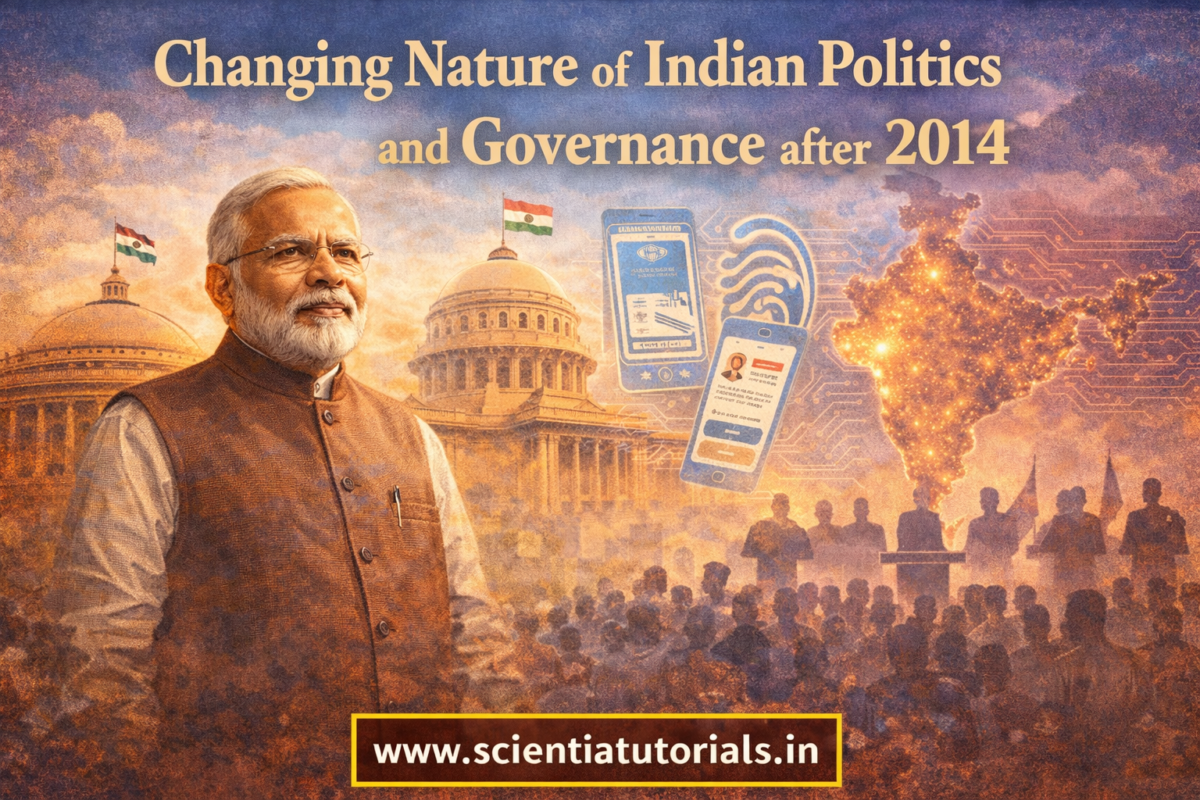

Changing Nature of Indian Politics and Governance (2014–Present)
Course Context
Course: Post-Independence and Contemporary India – History of India
Module 9: India in the 21st Century
Timeline: 2014–Present (CE)
Lesson: Changing Nature of Indian Politics and Governance
Based on the Lesson followed by the above Module and Course, we have created study materials aligned to the needs of UPSC, State PSC, UGC-NET, CUET, CBSE, and all school, college, and university examinations in India:
- Chronologically Structured Study Module,
- Questions with Answers,
- MCQs with Answers and detailed explanations.
Chronologically Structured Study Module
Introduction: A New Phase in Indian Democracy
The year 2014 marks a watershed in the political and governance history of independent India. The general elections of 2014 brought about a decisive shift in political power, leadership style, ideological orientation, and governance mechanisms. For the first time in three decades, a single party secured a clear majority in the Lok Sabha, ending the long phase of coalition-dominated politics at the Centre.
Since 2014, Indian politics has been characterized by strong leadership, centralisation of decision-making, ideological consolidation, electoral dominance, and governance reforms driven by technology and executive activism. The changing nature of Indian politics and governance must therefore be studied as a distinct historical phase, reflecting both continuity with the past and significant departures from earlier patterns.
This chronologically structured study module examines the political transformation, governance innovations, institutional changes, and democratic debates from 2014 to the present, in alignment with Module 9 of the course and the requirements of competitive and academic examinations.
I. Background: India on the Eve of 2014
1. Political Context (2004–2014)
- Era dominated by coalition governments.
- Perceived policy paralysis and governance fatigue.
- Rising public dissatisfaction over corruption and administrative inefficiency.
- Increasing role of media and civil society in political mobilization.
2. Socio-Economic Context
- Slowing economic growth after 2011.
- Aspirations of a young demographic.
- Demand for strong leadership, stability, and development-oriented governance.
These conditions created the context for a major political realignment in 2014.
II. The 2014 General Election: A Political Turning Point
1. Electoral Outcome
- Clear majority for the Bharatiya Janata Party.
- Formation of a strong central government under Narendra Modi.
- Decline of coalition constraints at the national level.
2. Significance of the Verdict
- Shift from coalition politics to majoritarian politics.
- Emphasis on leadership-centric electoral campaigns.
- Strengthening of executive authority.
The 2014 election redefined political competition and governance priorities in India.
III. Phase I: Consolidation of Power and Governance Reorientation (2014–2016)
1. Leadership-Centric Politics
- Strong personalization of power.
- Prime Minister emerged as the central figure in policy-making and public communication.
- Marginalization of collective cabinet decision-making.
2. Governance Narrative
- Focus on efficiency, delivery, and outcomes.
- Slogans emphasizing development, cleanliness, and administrative reform.
- Emphasis on minimum government and maximum governance.
3. Institutional Changes
- Greater role of the Prime Minister’s Office.
- Central agencies gained prominence.
- Push towards administrative discipline and performance monitoring.
IV. Phase II: Structural Reforms and Centralisation (2016–2019)
1. Economic and Administrative Reforms
- Introduction of nationwide indirect tax reform.
- Efforts to formalize the economy.
- Expansion of digital platforms for governance.
2. Digital Governance
- Use of technology to enhance service delivery.
- Direct benefit transfers and digital identification systems.
- Reduction of intermediaries in welfare delivery.
3. Federal Relations
- Stronger role of the Centre in policy design.
- States increasingly integrated into centrally driven frameworks.
- Ongoing debates over fiscal and administrative federalism.
V. Phase III: Electoral Dominance and Political Expansion (2019–2020)
1. Renewed Electoral Mandate
- Reaffirmation of popular support in the 2019 general elections.
- Consolidation of a dominant-party system.
- Weakening of opposition at the national level.
2. Ideological Consolidation
- Greater emphasis on cultural nationalism.
- Reassertion of identity-based narratives in politics.
- Reframing of national history and symbols.
3. Governance Style
- Speed and decisiveness in policy-making.
- Reduced scope for dissent within political institutions.
- Central leadership shaping national discourse.
VI. Phase IV: Governance Challenges and Crisis Management (2020–2022)
1. Pandemic and Governance
- Unprecedented public health and economic crisis.
- Centralized decision-making in crisis response.
- Use of executive powers and emergency governance tools.
2. State Capacity and Welfare
- Expansion of welfare mechanisms.
- Emphasis on targeted delivery and relief measures.
- Strengthening of executive control in extraordinary circumstances.
3. Democratic Implications
- Reduced space for legislative deliberation.
- Increased reliance on executive orders.
- Heightened debate on civil liberties and democratic norms.
VII. Phase V: Contemporary Trends (2022–Present)
1. Politics of Continuity
- Stability in leadership and policy direction.
- Electoral politics increasingly centered on performance narratives.
- Personalization of governance remains a defining feature.
2. Role of Technology and Media
- Digital platforms as tools of governance and political communication.
- Direct engagement with citizens.
- Social media shaping political narratives and mobilization.
3. Opposition and Democratic Contestation
- Fragmented opposition at the national level.
- Regional parties remain significant at the state level.
- Renewed efforts at opposition coordination.
VIII. Changing Nature of Governance
1. From Coalition Consensus to Executive Dominance
- Decline of bargaining politics.
- Faster decision-making.
- Reduced role of parliamentary committees.
2. Centralisation vs Federalism
- Centre-driven governance architecture.
- Ongoing debates on cooperative federalism.
- States both partners and subjects of central initiatives.
3. Bureaucracy and Policy Implementation
- Performance-based governance.
- Increased monitoring and accountability.
- Shift from process-based to outcome-based administration.
IX. Democratic Institutions and Constitutional Debates
1. Legislature
- Reduced sitting days and debates.
- Increased use of ordinances and executive instruments.
2. Judiciary
- Continued role in adjudicating constitutional and governance issues.
- Balancing executive authority and constitutional safeguards.
3. Media and Civil Society
- Changing relationship with the state.
- Supportive as well as critical roles.
- Debates over freedom of expression and dissent.
X. Political Culture and Electoral Behaviour
1. Rise of Identity and Nationalism
- National security and cultural identity as key electoral themes.
- Strong emotional appeal in political mobilization.
2. Welfare Politics
- Expansion of targeted welfare schemes.
- Direct political linkage between leadership and beneficiaries.
3. Voter Alignment
- Increasingly stable voter bases.
- Leadership and ideology shaping electoral choices.
XI. Continuity and Change in Indian Politics
Continuities
- Democratic framework and constitutional structure.
- Electoral competition and federal diversity.
- Judicial oversight and institutional checks.
Changes
- Strong executive dominance.
- Decline of coalition constraints.
- Transformation of governance through technology and centralisation.
Conclusion
The period from 2014 to the present represents a distinct and transformative phase in Indian political history. Marked by strong leadership, electoral dominance, centralisation of power, and governance innovation, this era has reshaped the functioning of Indian democracy and the nature of governance.
While the period has delivered political stability and administrative decisiveness, it has also generated important debates on federalism, institutional balance, democratic accountability, and the role of dissent. Understanding these changes is essential for comprehending India’s political trajectory in the 21st century.
Examination Relevance
- UPSC & State PSC: Contemporary Indian politics, governance, federalism
- NET & CUET: Political change and democratic processes
- School & University Exams: Post-2014 developments in Indian polity
Questions with Answers
Changing Nature of Indian Politics and Governance (2014–Present)
The questions are divided into Short Answer and Long Answer types and are aligned with the needs of UPSC, State PSC, NET, CUET, CBSE, and university examinations.
I. Short Answer Questions
1. Why is the year 2014 considered a turning point in Indian politics?
The year 2014 marked the end of coalition-era politics with the return of a single-party majority government, leading to strong leadership and centralized governance.
2. Which political party formed the government at the Centre in 2014?
The Bharatiya Janata Party formed the government at the Centre in 2014.
3. Who emerged as the central figure of Indian politics after 2014?
Narendra Modi emerged as the central figure, shaping both politics and governance.
4. What is meant by the ‘personalisation of power’ in post-2014 politics?
It refers to governance and electoral politics being centred on a single leader, rather than collective leadership or cabinet-based decision-making.
5. How did post-2014 politics differ from the coalition era (1996–2014)?
Post-2014 politics shifted from consensus-based coalition governance to executive-dominated, majoritarian governance.
6. What does the term ‘centralisation of governance’ imply?
It implies greater decision-making power concentrated at the Centre, particularly in the Prime Minister’s Office and central agencies.
7. How did digital governance transform administration after 2014?
Digital platforms improved service delivery, reduced intermediaries, and enabled direct interaction between the state and citizens.
8. What impact did the 2019 general election have on Indian politics?
It reinforced the dominant-party system and strengthened executive authority with renewed electoral legitimacy.
9. How has federalism been affected since 2014?
Federalism has become more Centre-driven, leading to debates on cooperative versus centralized federalism.
10. What role has ideology played in post-2014 politics?
Ideology has gained prominence through cultural nationalism, identity politics, and reinterpretation of national symbols.
11. How did the COVID-19 pandemic affect governance in India?
It led to centralised crisis management, expanded executive powers, and reliance on emergency governance mechanisms.
12. What change has occurred in the functioning of Parliament after 2014?
There has been a reduction in legislative deliberation, fewer sittings, and increased reliance on executive instruments.
13. How has welfare politics changed in recent years?
Welfare delivery has become targeted, technology-driven, and directly linked to political leadership, strengthening voter–state connections.
II. Long Answer Questions
14. Examine the political circumstances that led to the transformation of Indian politics in 2014.
Public dissatisfaction with corruption, governance paralysis, economic slowdown, and coalition instability created conditions for strong leadership and political realignment in 2014.
15. Discuss the shift from coalition politics to majoritarian politics after 2014.
The decline of coalition compulsions enabled faster decision-making, stronger executive control, and reduced bargaining politics, fundamentally altering governance style.
16. Analyze the changing role of the Prime Minister in post-2014 governance.
The Prime Minister became the principal policy-maker, communicator, and political symbol, leading to centralised and leader-centric governance.
17. How has executive dominance reshaped democratic institutions since 2014?
Executive dominance has reduced parliamentary oversight, expanded ordinance-making, and increased the role of central agencies in governance.
18. Evaluate the impact of digital governance on transparency and efficiency.
Digital governance improved efficiency and welfare delivery but also raised concerns about data privacy, exclusion, and surveillance.
19. Discuss the implications of centralisation for Indian federalism.
While centralisation enhanced policy uniformity and speed, it also generated tensions with states over autonomy, finances, and administrative authority.
20. Examine the role of ideology and nationalism in post-2014 electoral politics.
Nationalism and identity narratives became central electoral themes, mobilizing voters beyond traditional socio-economic issues.
21. How did governance respond to crisis situations such as the COVID-19 pandemic?
Governance relied heavily on executive authority, centralized coordination, and welfare expansion, raising debates on democratic accountability.
22. Critically assess the role of media and technology in shaping contemporary politics.
Media and social media enabled direct political communication and mobilization but also contributed to polarization and information control.
23. Discuss the changing nature of opposition politics in India after 2014.
Opposition parties weakened at the national level but remained significant regionally, leading to fragmented resistance and coalition attempts.
24. “Post-2014 Indian politics reflects both continuity and change.” Explain.
While democratic institutions and elections continue, governance style, leadership dominance, and centralisation mark significant departures from earlier patterns.
25. Why is the study of post-2014 politics crucial for understanding India in the 21st century?
It explains the transformation of democratic practices, governance models, and power structures shaping India’s contemporary political trajectory.
These questions provide conceptual clarity, chronological depth, analytical balance, and evaluative insight, making them highly suitable for answer writing, essays, and interviews in UPSC, State PSC, NET, CUET, CBSE, and university examinations.
Multiple Choice Questions
Changing Nature of Indian Politics and Governance (2014–Present)
The MCQs are aligned with the requirements of UPSC, State PSC, NET, CUET, CBSE, and university examinations.
1. Why is the 2014 General Election considered a watershed moment in Indian politics?
A. It marked the beginning of coalition politics
B. It ended the era of single-party dominance
C. It brought a clear single-party majority after decades
D. It abolished federalism
Correct Answer: C
Explanation:
The 2014 election ended nearly three decades of coalition governments and restored single-party majority rule, fundamentally altering governance dynamics.
2. Which political party secured a clear majority in the Lok Sabha in 2014?
A. Indian National Congress
B. Communist Party of India
C. Bharatiya Janata Party
D. Janata Dal (United)
Correct Answer: C
Explanation:
The BJP secured a decisive mandate, enabling strong executive leadership without coalition constraints.
3. Who emerged as the central figure shaping post-2014 Indian politics and governance?
A. Rahul Gandhi
B. Sonia Gandhi
C. Narendra Modi
D. Pranab Mukherjee
Correct Answer: C
Explanation:
Post-2014 politics has been characterized by leadership-centric governance, with the Prime Minister as the primary political and administrative authority.
4. The term “personalisation of power” in post-2014 India refers to:
A. Expansion of judicial authority
B. Collective cabinet governance
C. Central role of a single leader in decision-making
D. Increased role of state governments
Correct Answer: C
Explanation:
Governance and electoral politics increasingly revolve around one central leader, reducing the prominence of collective leadership.
5. Which political trend replaced coalition consensus after 2014?
A. Regional fragmentation
B. Technocratic governance
C. Majoritarian and executive-dominated politics
D. Judicial supremacy
Correct Answer: C
Explanation:
Single-party dominance enabled decisive, executive-driven governance, replacing coalition bargaining.
6. Centralisation of governance after 2014 mainly implies:
A. Weakening of the Prime Minister’s Office
B. Greater autonomy for states
C. Concentration of authority at the Centre
D. Complete decentralisation
Correct Answer: C
Explanation:
Decision-making increasingly shifted to the Centre and the Prime Minister’s Office, raising debates on federal balance.
7. Which institution gained enhanced importance in post-2014 governance?
A. State Cabinets
B. Inter-State Council
C. Prime Minister’s Office
D. Municipal Corporations
Correct Answer: C
Explanation:
The Prime Minister’s Office emerged as the core coordinating and policy-making body.
8. How did the 2019 General Election affect Indian politics?
A. It weakened executive authority
B. It restored coalition politics
C. It reinforced the dominant-party system
D. It reduced voter participation
Correct Answer: C
Explanation:
The 2019 mandate strengthened political dominance and legitimized continued centralisation of governance.
9. Which of the following best describes post-2014 governance style?
A. Slow and consensus-based
B. Bureaucracy-driven
C. Fast, centralised, and executive-led
D. Judiciary-controlled
Correct Answer: C
Explanation:
Governance emphasized speed, decisiveness, and strong executive control.
10. Digital governance after 2014 primarily aimed at:
A. Reducing citizen participation
B. Strengthening intermediaries
C. Improving efficiency and direct service delivery
D. Limiting welfare schemes
Correct Answer: C
Explanation:
Technology-based governance reduced intermediaries and improved transparency, efficiency, and reach.
11. The increased use of Direct Benefit Transfer (DBT) signifies:
A. Decline of welfare politics
B. Expansion of coalition bargaining
C. Technology-driven welfare delivery
D. Privatization of social services
Correct Answer: C
Explanation:
DBT reflects the shift toward digitally enabled, targeted welfare governance.
12. Which democratic institution has seen reduced deliberative space after 2014?
A. Judiciary
B. Election Commission
C. Parliament
D. Local Governments
Correct Answer: C
Explanation:
Reduced sittings and debates indicate a decline in parliamentary deliberation.
13. Post-2014 federal relations are best described as:
A. Fully decentralized
B. Balanced and equal
C. Centre-driven with cooperative claims
D. State-dominated
Correct Answer: C
Explanation:
Federalism increasingly reflects central leadership with limited state autonomy.
14. Which ideology gained prominence in post-2014 politics?
A. Socialism
B. Liberal internationalism
C. Cultural nationalism
D. Marxism
Correct Answer: C
Explanation:
Identity, nationalism, and cultural narratives became central to political mobilisation.
15. The COVID-19 pandemic governance model in India showed:
A. Decentralized decision-making
B. Judicial control
C. Centralised crisis management
D. Parliamentary supremacy
Correct Answer: C
Explanation:
Crisis governance relied heavily on central executive authority and emergency powers.
16. Which feature distinguishes post-2014 welfare politics?
A. Universal subsidies
B. Coalition negotiations
C. Direct leader–beneficiary linkage
D. Judicial monitoring
Correct Answer: C
Explanation:
Welfare delivery increasingly connects beneficiaries directly to central leadership, shaping electoral loyalty.
17. The concept of a “dominant-party system” refers to:
A. Absence of opposition
B. One party consistently winning national elections
C. Military-backed rule
D. Judicial supremacy
Correct Answer: B
Explanation:
A dominant-party system exists when one party repeatedly secures electoral dominance.
18. How has opposition politics changed since 2014?
A. Strengthened nationally
B. Eliminated completely
C. Weakened nationally but strong regionally
D. Fully united
Correct Answer: C
Explanation:
Opposition remains fragmented at the Centre but influential in states.
19. Which of the following best explains executive dominance?
A. Rise of judicial activism
B. Increased ordinance-making and policy control
C. Media control over politics
D. Local government empowerment
Correct Answer: B
Explanation:
Executive dominance is visible through ordinances, central agencies, and limited legislative scrutiny.
20. Media and social media after 2014 have primarily:
A. Reduced political communication
B. Enabled direct leader–citizen engagement
C. Eliminated traditional campaigning
D. Strengthened local governance
Correct Answer: B
Explanation:
Digital platforms enable direct political communication, bypassing intermediaries.
21. Which value faces the greatest debate in post-2014 governance?
A. Universal adult franchise
B. Federal balance and institutional autonomy
C. Judicial independence
D. Electoral competition
Correct Answer: B
Explanation:
Centralisation has sparked debates on federalism and institutional checks.
22. Which continuity remains strong despite political changes after 2014?
A. Coalition governance
B. Democratic elections
C. Weak executive
D. Parliamentary supremacy
Correct Answer: B
Explanation:
Despite governance changes, regular democratic elections continue.
23. Post-2014 Indian politics is best understood as:
A. Authoritarian rule
B. Military democracy
C. Democratic system with strong executive dominance
D. Judicial state
Correct Answer: C
Explanation:
India remains democratic but with centralised and leader-centric governance.
24. Why is the study of post-2014 politics important for contemporary history?
A. It explains colonial administration
B. It shows decline of democracy
C. It reveals transformation in governance and power structures
D. It focuses only on foreign policy
Correct Answer: C
Explanation:
Post-2014 politics reflects a new phase in democratic practice and governance style.
25. From an examination perspective, this topic is most relevant under:
A. Ancient Indian polity
B. Colonial constitutional history
C. Contemporary Indian politics and governance
D. Medieval state systems
Correct Answer: C
Explanation:
The topic is central to post-2014 Indian polity, governance reforms, and democratic debates.
These MCQs assess conceptual clarity, chronological understanding, analytical ability, and applied knowledge, making them ideal for UPSC Prelims, State PSCs, NET, CUET, CBSE, and university-level objective examinations.
-
changing nature of Indian politics after 2014
-
Indian governance reforms post 2014 notes
-
post-2014 Indian politics UPSC notes
-
centralisation of power in India after 2014
-
role of Prime Minister in Indian governance
-
coalition politics vs majoritarian politics India
-
digital governance and welfare politics India
-
federalism centre state relations after 2014
-
dominant party system in contemporary India
-
Indian politics and governance for State PSC
-
post-2014 democracy and governance debates
-
contemporary India polity Module 9 notes
-
Indian politics after 2014 NET and CUET