
Economic Crisis of 1991 and Structural Reforms
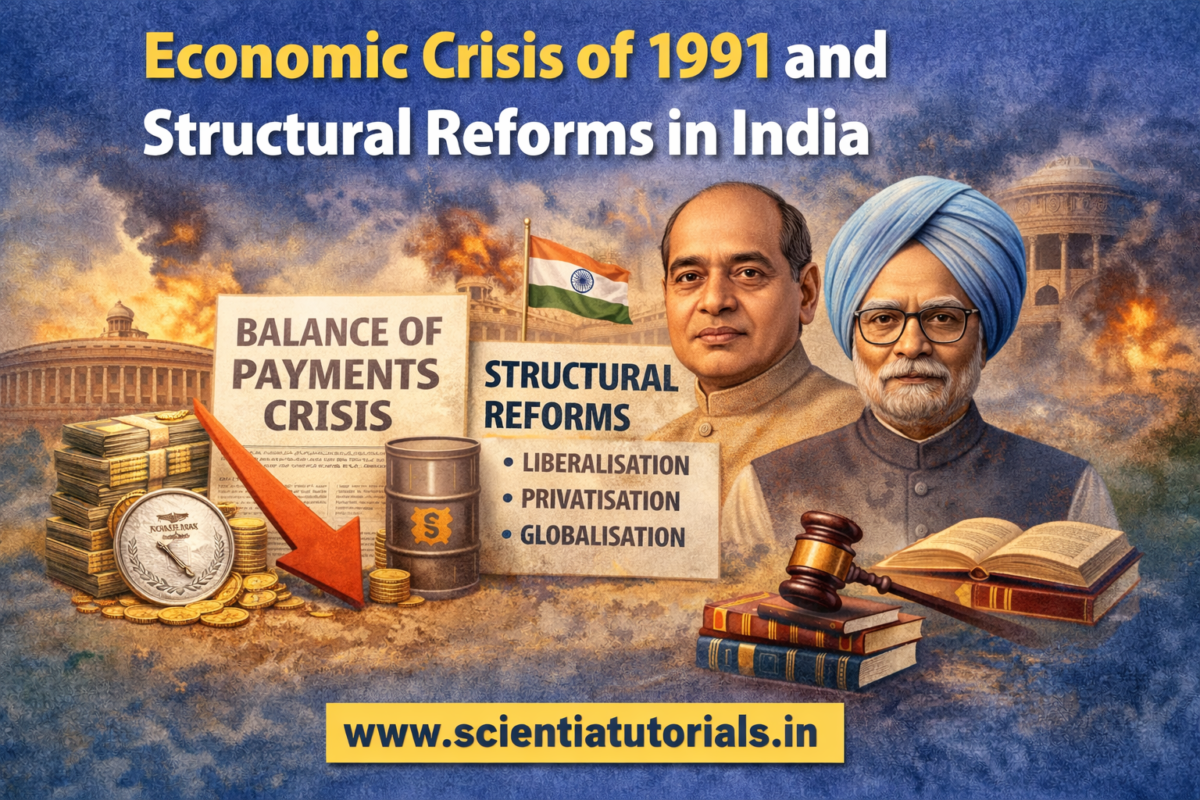

Economic Crisis of 1991 and Structural Reforms
Module 7: Economic Liberalisation and Global Integration
Timeline: 1991–2000 (CE)
Course: Post-Independence and Contemporary India – History of India
Based on the Lesson followed by the above Module and Course, we have created study materials aligned to the needs of UPSC, State PSC, UGC-NET, CUET, CBSE, and all school, college, and university examinations in India:
- Chronologically Structured Study Module,
- Questions with Answers,
- MCQs with Answers and detailed explanations.
Chronologically Structured Study Module
Introduction
The Economic Crisis of 1991 represents a decisive turning point in India’s post-Independence history. It marked the collapse of the long-standing state-led, inward-looking development model and the beginning of a new era of economic liberalisation, privatisation, and global integration. Unlike earlier economic slowdowns, the crisis of 1991 was systemic, exposing deep-rooted structural weaknesses in fiscal management, industrial policy, and external trade.
This chronologically structured study module traces the origins, unfolding, and consequences of the 1991 economic crisis, followed by a detailed analysis of the structural reforms of the 1990s. The content is developed in line with the objectives of Module 7 and is designed to meet the analytical and factual requirements of UPSC, State PSC, NET, CUET, CBSE, and university examinations, while remaining fully compatible with WordPress Classic Editor publishing.
I. Background: Indian Economy Before 1991
A. The Development Model (1950s–1980s)
From Independence until the late 1980s, India followed a development strategy characterised by:
- Centralised economic planning
- Dominance of the public sector
- Import substitution industrialisation
- Extensive regulation through licensing
While this model helped build basic industrial capacity, it also resulted in:
- Low productivity
- Inefficient public sector enterprises
- Weak export performance
- Rising fiscal deficits
By the late 1980s, the economy had reached a point where incremental adjustments were no longer sufficient.
II. Immediate Causes of the 1991 Economic Crisis
A. Fiscal Crisis
The Indian state faced a severe fiscal imbalance due to:
- Rising subsidies
- Loss-making public sector units
- High defence and administrative expenditure
- Declining tax revenues
By 1990–91:
- Fiscal deficit exceeded sustainable limits
- Public debt increased sharply
B. Balance of Payments Crisis
The most visible manifestation of the crisis was the balance of payments (BoP) emergency:
- Foreign exchange reserves fell to dangerously low levels
- India could finance only a few weeks of imports
- International creditworthiness declined
This forced India to pledge gold reserves and seek emergency external assistance.
III. External and Political Factors (1990–91)
A. External Shocks
The crisis was intensified by:
- The Gulf War (1990–91), which raised oil prices
- Decline in remittances from Indian workers abroad
- Collapse of the Soviet Union, a major trading partner
These shocks exposed the vulnerability of India’s closed economy.
B. Political Instability
The late 1980s and early 1990s witnessed:
- Coalition governments
- Weak political consensus
- Delayed economic decision-making
This governance uncertainty deepened the crisis and limited timely corrective action.
IV. The Crisis Moment of 1991
By mid-1991:
- Foreign exchange reserves were critically depleted
- Credit rating agencies downgraded India
- Risk of sovereign default loomed
India approached international financial institutions, including the International Monetary Fund and the World Bank, for emergency assistance.
This moment marked the end of economic gradualism and the acceptance of comprehensive structural reform.
V. Political Leadership and Reform Initiative
A. Narasimha Rao Government
The Congress government formed in 1991 under P. V. Narasimha Rao provided political stability during the crisis.
B. Role of the Finance Minister
The reform agenda was spearheaded by Manmohan Singh, who articulated the necessity of reform with the famous assertion that “no power on earth can stop an idea whose time has come.”
VI. New Economic Policy (1991): Framework of Reforms
The New Economic Policy (NEP), 1991 rested on three interconnected pillars:
A. Liberalisation
Key measures included:
- Abolition of industrial licensing for most sectors
- Reduction in government controls
- Simplification of regulatory procedures
Liberalisation aimed to:
- Increase efficiency
- Encourage competition
- Improve productivity
B. Privatisation
Privatisation involved:
- Disinvestment in public sector enterprises
- Reducing state monopoly in key sectors
- Encouraging private participation
The objective was not complete withdrawal of the state, but redefinition of its role.
C. Globalisation
Global integration was pursued through:
- Trade liberalisation
- Reduction of import tariffs
- Opening sectors to foreign direct investment (FDI)
India gradually integrated with the global economy, ending decades of protectionism.
VII. Structural Reforms of the 1990s (Chronological Overview)
A. Industrial Reforms
- End of license-permit-quota raj
- Entry of private players in core industries
- Competition policy reforms
B. Financial Sector Reforms
- Banking reforms based on Narasimham Committee recommendations
- Capital market liberalisation
- Strengthening of regulatory institutions
C. Trade Reforms
- Shift from import substitution to export promotion
- Rationalisation of tariffs
- Currency devaluation to boost exports
VIII. Social and Governance Implications
A. Governance Transformation
Reforms altered governance by:
- Reducing bureaucratic control
- Enhancing regulatory frameworks
- Increasing market-based decision-making
B. Social Impact
While reforms improved growth, they also:
- Increased inequality in the short term
- Generated employment in services
- Raised concerns about social security
The state increasingly focused on targeted welfare rather than universal control.
IX. India in the Global Economy (1991–2000)
By the late 1990s:
- India became an attractive destination for foreign investment
- Information technology and services expanded rapidly
- Export orientation increased
India’s global image shifted from a closed economy to an emerging market.
X. Critiques and Debates on Liberalisation
Major critiques included:
- Marginalisation of agriculture
- Regional disparities
- Vulnerability to global market fluctuations
Supporters argued that reforms:
- Revived growth
- Improved efficiency
- Prevented economic collapse
The debate remains central to contemporary economic discourse.
XI. Historical Significance of the 1991 Reforms
The reforms:
- Rescued India from economic collapse
- Redefined state-market relations
- Integrated India into the global economy
They represent the second major economic transformation after Independence, comparable in significance to early planning initiatives.
Conclusion
The Economic Crisis of 1991 was both a moment of breakdown and renewal. It exposed the structural weaknesses of India’s earlier development model and compelled a historic shift towards liberalisation and global integration. The structural reforms of the 1990s reshaped India’s economy, governance, and international standing, laying the foundation for 21st-century growth.
For students of contemporary Indian history, the 1991 crisis is essential to understanding:
- The political economy of reform
- The evolution of economic governance
- India’s integration into global systems
Examination Relevance
- UPSC GS I (Post-Independence India)
- UPSC GS III (Indian Economy – historical background)
- State PSC History & Economy
- NET / CUET Contemporary History
- University Semester Examinations
Questions with Answers
Economic Crisis of 1991 and Structural Reforms
The questions are graded from short to long answers, analytically framed, and fully aligned with UPSC, State PSC, NET, CUET, CBSE, and university examinations.
A. Very Short Answer Questions
1. What is meant by the Economic Crisis of 1991 in India?
Answer:
The Economic Crisis of 1991 refers to a severe fiscal and balance of payments crisis when India’s foreign exchange reserves fell to critically low levels, forcing the country to seek external financial assistance.
2. Which economic indicator most visibly reflected the 1991 crisis?
Answer:
The sharp depletion of foreign exchange reserves, sufficient for only a few weeks of imports.
3. Name one immediate cause of the 1991 economic crisis.
Answer:
Rising fiscal deficit due to high public expenditure and subsidies.
4. Which external event worsened India’s balance of payments position in 1990–91?
Answer:
The Gulf War (1990–91), which raised oil prices and reduced remittances.
5. Which international institution provided emergency financial assistance to India in 1991?
Answer:
The International Monetary Fund.
B. Short Answer Questions
6. Explain the fiscal crisis faced by India before 1991.
Answer:
India faced a widening fiscal deficit due to rising subsidies, inefficient public sector enterprises, increasing defence expenditure, and declining tax revenues, leading to unsustainable public debt.
7. What is meant by a balance of payments crisis?
Answer:
A balance of payments crisis occurs when a country cannot meet its external payment obligations due to insufficient foreign exchange reserves.
8. How did political instability contribute to the 1991 crisis?
Answer:
Coalition governments and frequent leadership changes delayed decisive economic action, weakened policy credibility, and aggravated economic uncertainty.
9. Why was India forced to pledge its gold reserves in 1991?
Answer:
India pledged gold to secure short-term foreign loans when foreign exchange reserves were nearly exhausted.
10. What was the New Economic Policy (1991)?
Answer:
The New Economic Policy introduced liberalisation, privatisation, and globalisation to restructure the Indian economy and overcome the crisis.
C. Medium Answer Questions
11. Discuss the structural weaknesses of the Indian economy before 1991.
Answer:
Structural weaknesses included overregulation, inefficient public sector enterprises, low export competitiveness, excessive protectionism, high fiscal deficits, and dependence on external borrowing.
12. Examine the role of external shocks in triggering the 1991 crisis.
Answer:
The Gulf War raised oil import costs, reduced remittances, and increased foreign exchange outflows. The collapse of the Soviet Union disrupted trade, intensifying the crisis.
13. Analyse the role of political leadership in managing the 1991 crisis.
Answer:
The government under P. V. Narasimha Rao provided political stability, while Manmohan Singh led economic reforms with clarity and conviction.
14. Explain the concept of liberalisation introduced in 1991.
Answer:
Liberalisation involved reducing government controls, dismantling industrial licensing, and promoting competition to improve efficiency and productivity.
15. How did globalisation alter India’s economic outlook in the 1990s?
Answer:
Globalisation integrated India with the world economy through trade liberalisation, foreign investment, and participation in global markets.
D. Long Answer Questions
16. Critically examine the causes of the Economic Crisis of 1991 in India.
Answer:
The crisis resulted from chronic fiscal deficits, inefficient public sector enterprises, protectionist policies, weak export performance, political instability, and adverse external shocks. It was cumulative rather than sudden.
17. Discuss the major components of the New Economic Policy of 1991.
Answer:
The policy rested on liberalisation (deregulation), privatisation (disinvestment), and globalisation (trade and investment reforms), redefining the role of the state and market.
18. Analyse the role of international financial institutions in India’s 1991 reforms.
Answer:
Institutions like the IMF and World Bank provided emergency assistance and policy guidance, facilitating stabilisation and structural adjustment.
19. How did the 1991 reforms change the nature of economic governance in India?
Answer:
Reforms reduced bureaucratic control, enhanced regulatory frameworks, encouraged market mechanisms, and shifted the state’s role from controller to facilitator.
20. Evaluate the short-term social impact of economic reforms.
Answer:
While growth improved, reforms initially led to job insecurity, regional disparities, and concerns over inequality, prompting debates on social justice.
E. Essay / Analytical Questions (UPSC / NET Level)
21. “The Economic Crisis of 1991 was a crisis of the development model rather than a temporary setback.” Discuss.
Answer:
The crisis exposed fundamental flaws in the state-led, inward-looking model, necessitating a paradigm shift towards market-oriented reforms.
22. Assess the historical significance of the 1991 economic reforms.
Answer:
The reforms rescued India from collapse, integrated it into the global economy, and laid the foundation for sustained growth in subsequent decades.
23. Examine the relationship between political stability and economic reform in 1991.
Answer:
Political stability under a decisive leadership enabled the implementation of difficult but necessary reforms despite opposition.
24. Compare India’s economic strategy before and after 1991.
Answer:
Pre-1991 strategy emphasised state control and protectionism, while post-1991 strategy focused on liberalisation, competition, and global integration.
25. To what extent did the 1991 reforms transform India into a global economic player by 2000?
Answer:
By 2000, India had improved growth rates, attracted foreign investment, expanded exports, and emerged as an important participant in the global economy.
Multiple Choice Questions
Economic Crisis of 1991 and Structural Reforms
MCQs with Answers and Explanations
Each MCQ includes four options, the correct answer, and an elaborate concept-clearing explanation, fully aligned with the requirements of UPSC, State PSC, NET, CUET, CBSE, and university examinations.
1. The Economic Crisis of 1991 in India was primarily triggered by:
A. Agricultural failure
B. Severe balance of payments crisis
C. Industrial stagnation alone
D. Collapse of state governments
Correct Answer: B
Explanation:
The immediate trigger of the 1991 crisis was the balance of payments emergency, when India’s foreign exchange reserves fell to critically low levels, threatening default on external obligations.
2. Which indicator most clearly reflected the severity of the 1991 crisis?
A. Decline in GDP growth
B. High inflation rate
C. Depletion of foreign exchange reserves
D. Rise in unemployment
Correct Answer: C
Explanation:
Foreign exchange reserves had fallen to a level sufficient to cover only a few weeks of imports, making the crisis acute and unavoidable.
3. Which of the following was NOT a long-term cause of the 1991 economic crisis?
A. Rising fiscal deficits
B. Inefficiency of public sector enterprises
C. Over-regulation of industry
D. Sudden natural disasters
Correct Answer: D
Explanation:
The crisis resulted from structural and policy failures accumulated over decades, not from natural disasters.
4. The fiscal crisis before 1991 was mainly due to:
A. Excessive tax collection
B. High subsidies and public expenditure
C. Decline in population growth
D. Reduction in defence spending
Correct Answer: B
Explanation:
Large subsidies, loss-making public sector units, and rising administrative and defence expenditure widened the fiscal deficit.
5. Which external event significantly worsened India’s economic position in 1990–91?
A. Asian Financial Crisis
B. Gulf War
C. Oil discovery in India
D. Formation of WTO
Correct Answer: B
Explanation:
The Gulf War raised oil prices and reduced remittances from Indian workers abroad, intensifying the balance of payments crisis.
6. India’s dependence on which trading partner declined sharply around 1991 due to geopolitical changes?
A. United States
B. Japan
C. Soviet Union
D. European Union
Correct Answer: C
Explanation:
The collapse of the Soviet Union disrupted India’s trade arrangements, worsening external sector stress.
7. Political instability before 1991 contributed to the crisis mainly by:
A. Strengthening policy coordination
B. Encouraging decisive reforms
C. Delaying difficult economic decisions
D. Increasing exports
Correct Answer: C
Explanation:
Coalition instability and frequent changes of government delayed corrective action and weakened economic confidence.
8. In 1991, India pledged its gold reserves primarily to:
A. Increase domestic investment
B. Fund welfare programmes
C. Secure emergency foreign loans
D. Reduce inflation
Correct Answer: C
Explanation:
Pledging gold helped India obtain short-term foreign exchange to meet immediate external payment obligations.
9. Which institution provided emergency assistance to India during the 1991 crisis?
A. Asian Development Bank
B. World Trade Organization
C. International Monetary Fund
D. United Nations
Correct Answer: C
Explanation:
The IMF extended financial assistance and supported stabilisation measures during the crisis.
10. The New Economic Policy (1991) was based on which three pillars?
A. Planning, protection, public sector
B. Liberalisation, privatisation, globalisation
C. Nationalisation, regulation, import substitution
D. Welfare, subsidies, state control
Correct Answer: B
Explanation:
The reform programme aimed to liberalise the economy, privatise selected public enterprises, and integrate India with the global economy.
11. Liberalisation in the Indian context mainly referred to:
A. Expansion of subsidies
B. Removal of industrial licensing and controls
C. Nationalisation of industries
D. Increased state regulation
Correct Answer: B
Explanation:
Liberalisation dismantled the license-permit-quota raj and reduced bureaucratic controls on industry.
12. Privatisation after 1991 primarily involved:
A. Complete withdrawal of the state
B. Selling all public sector enterprises
C. Disinvestment and reduced state monopoly
D. Expansion of government ownership
Correct Answer: C
Explanation:
Privatisation focused on disinvestment and redefining the state’s role, not total withdrawal from the economy.
13. Globalisation of the Indian economy meant:
A. Isolation from world markets
B. Import substitution
C. Greater integration with global trade and investment
D. Complete dependence on foreign aid
Correct Answer: C
Explanation:
Globalisation involved trade liberalisation, foreign investment, and participation in global economic networks.
14. Who provided political leadership during the initiation of the 1991 reforms?
A. Indira Gandhi
B. Rajiv Gandhi
C. P. V. Narasimha Rao
D. Atal Bihari Vajpayee
Correct Answer: C
Explanation:
Narasimha Rao’s leadership provided political stability at a critical moment of economic crisis.
15. Who was the chief architect of the economic reforms as Finance Minister in 1991?
A. Pranab Mukherjee
B. Manmohan Singh
C. Yashwant Sinha
D. P. Chidambaram
Correct Answer: B
Explanation:
Manmohan Singh conceptualised and implemented the reform programme, combining economic expertise with political feasibility.
16. One major industrial reform of the 1990s was:
A. Expansion of licensing
B. Nationalisation of industries
C. Abolition of industrial licensing for most sectors
D. Closure of private enterprises
Correct Answer: C
Explanation:
Ending industrial licensing marked a decisive break from the pre-1991 regulatory regime.
17. Financial sector reforms in the 1990s aimed to:
A. Strengthen state control over banks
B. Improve efficiency and regulation of banking
C. Abolish the banking system
D. Eliminate capital markets
Correct Answer: B
Explanation:
Banking and capital market reforms enhanced efficiency, competition, and regulatory oversight.
18. Trade reforms after 1991 focused on:
A. Import substitution
B. Export promotion and tariff reduction
C. Complete trade isolation
D. Ban on foreign goods
Correct Answer: B
Explanation:
Trade reforms shifted India from protectionism towards export-oriented growth.
19. Which sector benefited most rapidly from liberalisation in the 1990s?
A. Agriculture
B. Heavy industries
C. Information technology and services
D. Mining
Correct Answer: C
Explanation:
IT and services expanded rapidly due to global demand, skilled labour, and openness.
20. A major criticism of economic reforms was that they:
A. Reduced economic growth
B. Increased short-term inequality
C. Ended democracy
D. Eliminated all public welfare
Correct Answer: B
Explanation:
Critics argued that reforms initially widened social and regional inequalities.
21. The 1991 crisis demonstrated that India’s earlier development model was:
A. Fully sustainable
B. Militarily weak
C. Structurally inefficient
D. Export-oriented
Correct Answer: C
Explanation:
The crisis exposed the limitations of a heavily regulated, inward-looking model.
22. By the late 1990s, India’s global economic image had shifted towards:
A. Closed socialist economy
B. Agrarian economy
C. Emerging market economy
D. War-torn economy
Correct Answer: C
Explanation:
Liberalisation integrated India into global markets and improved investor confidence.
23. Which of the following best describes the nature of the 1991 crisis?
A. Sudden and accidental
B. Entirely externally imposed
C. Cumulative and structural
D. Short-term and reversible
Correct Answer: C
Explanation:
The crisis was the result of long-term structural and policy failures rather than a sudden shock alone.
24. The most important historical significance of the 1991 reforms was that they:
A. Abolished planning completely
B. Replaced democracy with markets
C. Redefined the role of the Indian state
D. Ended poverty immediately
Correct Answer: C
Explanation:
Reforms transformed the state’s role from controller to facilitator of economic activity.
25. In Indian economic history, the reforms of 1991 are best described as:
A. Minor policy adjustment
B. Reversal of Independence-era planning
C. Second major economic transformation after Independence
D. Temporary crisis management
Correct Answer: C
Explanation:
The 1991 reforms marked a paradigm shift comparable in significance to the early planning phase after Independence.
-
Economic crisis of 1991 in India causes and impact
-
Structural reforms in India after 1991 UPSC notes
-
New Economic Policy 1991 liberalisation privatisation globalisation
-
Balance of payments crisis India 1991 explanation
-
Indian economic reforms 1991 historical background
-
Role of IMF and World Bank in India 1991 crisis
-
Economic liberalisation in India 1990s study material
-
Post-1991 economic reforms and global integration India
-
Indian economy before and after 1991 reforms
-
UPSC GS notes on economic crisis of 1991
-
NET CUET Indian economy reforms 1991
-
Economic reforms of Narasimha Rao Manmohan Singh