
Independence and Partition of India: Causes, Consequences, and Challenges

Course: Post-Independence and Contemporary India – History of India
Module 1: Transition from Colonial Rule to Independent India
Timeline: 1947–1950 (CE)
Lesson: Independence and Partition of India: Causes, Consequences, and Challenges
Based on the Lesson followed by the above Module and Course, we have created study materials aligned to the needs of UPSC, State PSC, UGC-NET, CUET, CBSE, and all school, college, and university examinations in India:
- Study Module with Revision Notes,
- Questions with Answers,
- MCQs with Answers and detailed explanations.
Introduction: A Historic Transition (1947)
The year 1947 marks one of the most transformative and traumatic turning points in the history of the Indian subcontinent. After nearly two centuries of British colonial rule, India achieved independence, but the freedom came intertwined with the Partition of British India into two sovereign dominions—India and Pakistan. This lesson examines the causes, process, consequences, and challenges of Independence and Partition within a broader framework of nation-building between 1947 and 1950, culminating in the adoption of the Indian Constitution.
This study module is designed to provide chronological clarity, analytical depth, and exam-oriented revision notes, aligned with the objectives of the course Post-Independence and Contemporary India.
I. Background to Independence and Partition
1. Colonial Legacy and Rise of Nationalism
British colonial rule reshaped India’s political economy through centralized administration, revenue extraction, and commercialisation of agriculture. While colonialism caused widespread exploitation, it also unintentionally fostered modern political consciousness.
Key developments included:
- Growth of English education
- Emergence of the press
- Formation of political associations like the Indian National Congress (1885)
- Mass movements under Mahatma Gandhi in the 20th century
By the 1930s–40s, nationalism had become a mass phenomenon demanding Purna Swaraj (complete independence).
2. Communal Politics and the Two-Nation Theory
A critical factor leading to Partition was the growth of communalism in late colonial India.
- The All-India Muslim League, under Muhammad Ali Jinnah, articulated the Two-Nation Theory, arguing that Hindus and Muslims were separate nations.
- The Lahore Resolution (1940) demanded independent states for Muslims in north-western and eastern India.
British policies of divide and rule, separate electorates, and political bargaining further deepened religious polarization.
II. Immediate Causes of Partition
1. Failure of Constitutional Negotiations
Several attempts to transfer power peacefully failed:
- Cripps Mission (1942)
- Cabinet Mission Plan (1946)
The Cabinet Mission proposed a federal India with provincial autonomy, but disagreements between the Congress and the Muslim League over power-sharing led to its collapse.
2. Direct Action Day and Communal Violence
On 16 August 1946, the Muslim League observed Direct Action Day, leading to massive communal riots in Calcutta. Violence soon spread to:
- Noakhali (Bengal)
- Bihar
- Punjab
These events convinced British authorities that a united India might descend into civil war, making Partition appear inevitable.
3. British Decision to Quit India
Post-World War II Britain faced economic exhaustion. Under Prime Minister Clement Attlee, the British government decided on a hasty transfer of power.
- Lord Mountbatten was appointed the last Viceroy.
- The Mountbatten Plan (3 June 1947) accepted Partition as the solution.
III. The Partition of India (1947)
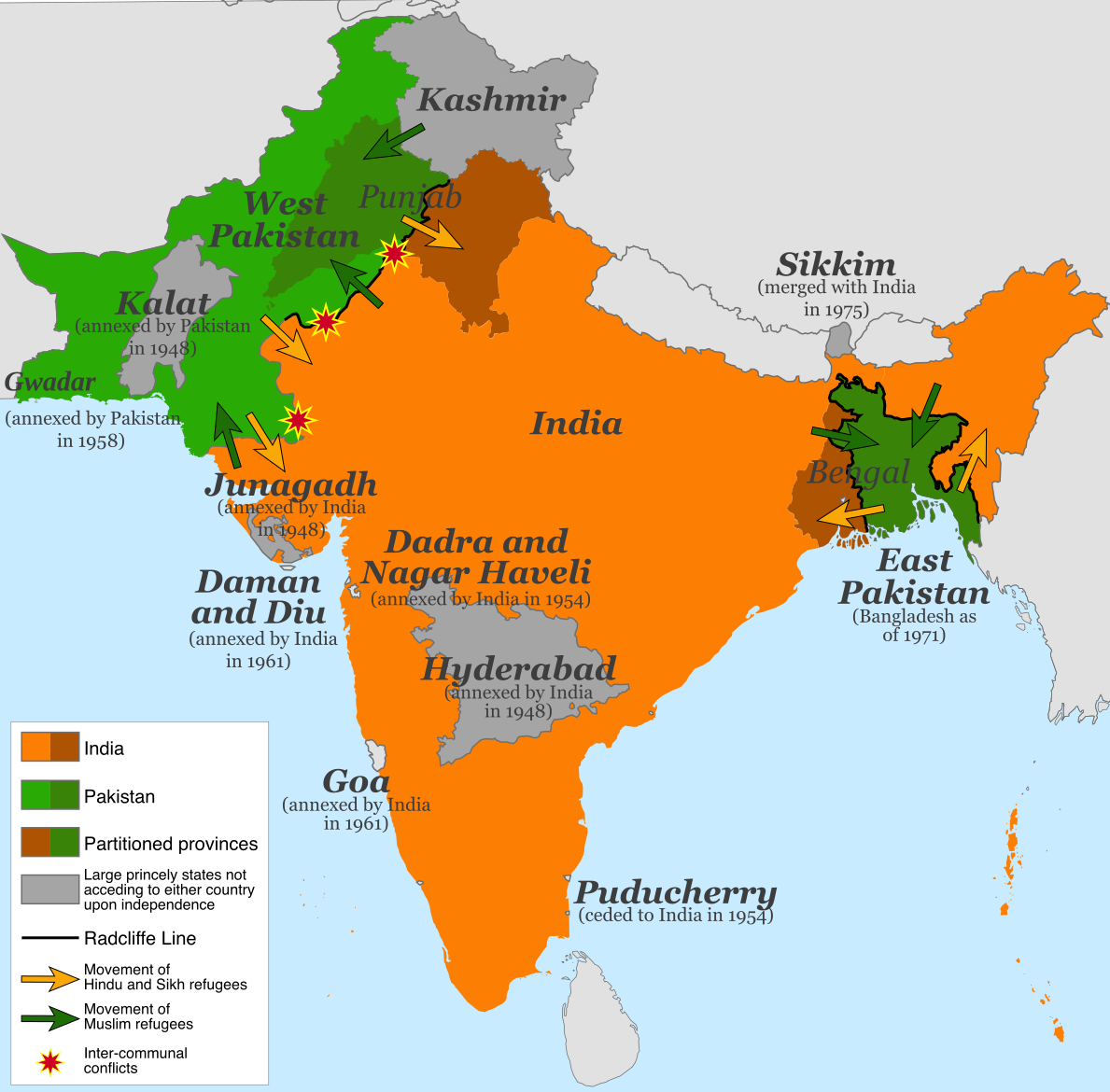
1. Drawing the Radcliffe Line
The boundary between India and Pakistan was drawn by Sir Cyril Radcliffe, who had no prior experience in India.
- Punjab and Bengal were partitioned along religious majorities.
- The Radcliffe Line was announced after independence, worsening chaos and confusion.
2. Human Cost of Partition
Partition resulted in one of the largest forced migrations in world history.
Key consequences:
- Around 14–15 million people displaced
- Nearly 1 million deaths
- Widespread sexual violence against women
- Breakdown of law and order
Punjab witnessed the worst violence, while Bengal experienced relatively lower casualties but deep socio-economic disruptions.
IV. Consequences of Independence and Partition
1. Refugee Crisis and Rehabilitation
India faced the immediate challenge of rehabilitating millions of refugees from:
- West Punjab (now Pakistan)
- East Bengal (now Bangladesh)
Measures taken:
- Establishment of refugee camps
- Allotment of evacuee property
- Creation of new townships (e.g., Faridabad)
Despite efforts, resettlement remained uneven and traumatic.
2. Economic Disruptions
Partition disrupted:
- Railways and irrigation systems
- Industrial centers (jute mills in East Pakistan, cotton in West Pakistan)
- Trade networks
India inherited most administrative structures but also faced food shortages, inflation, and fiscal stress.
3. Integration of Princely States
At independence, India comprised:
- British Indian provinces
- 565 princely states
Under the leadership of Sardar Vallabhbhai Patel and V. P. Menon, most states were integrated through:
- Instruments of Accession
- Diplomatic pressure
- Limited military action (e.g., Hyderabad, Junagadh)
This process was crucial for India’s territorial unity.
V. Political Challenges of the New Nation
1. Establishment of Sovereign Governance
India became independent on 15 August 1947, with:
- Jawaharlal Nehru as Prime Minister
- Lord Mountbatten as Governor-General (till 1948)
The Constituent Assembly assumed responsibility for drafting a democratic constitution.
2. Framing the Indian Constitution (1946–1950)


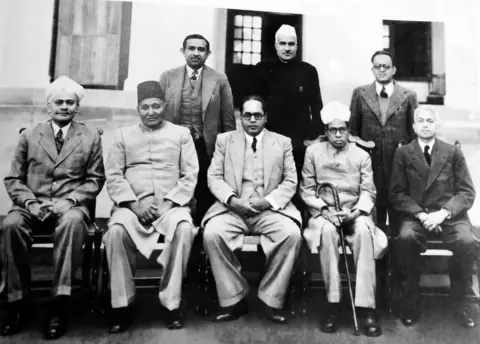
Under the chairmanship of Dr. Rajendra Prasad and the Drafting Committee led by B R Ambedkar, the Constitution aimed to:
- Ensure justice, liberty, equality
- Establish parliamentary democracy
- Balance unity with diversity
The Constitution came into force on 26 January 1950, marking the birth of the Republic of India.
VI. Social and Psychological Challenges
1. Communal Trauma and Memory
Partition left deep scars:
- Families divided across borders
- Persistent mistrust between communities
- Long-term India–Pakistan hostility
The violence challenged Gandhian ideals of non-violence and harmony.
2. Assassination of Mahatma Gandhi
On 30 January 1948, Mahatma Gandhi was assassinated.
Impact:
- Shock to the nation
- Loss of moral leadership
- Reinforced commitment to secularism and tolerance
VII. India–Pakistan Relations: Early Challenges
Key disputes included:
- Kashmir conflict (1947–48 war)
- Refugee property claims
- Division of military and financial assets
These issues shaped South Asian geopolitics for decades.
VIII. Historical Significance of 1947–1950
The transition from colonial rule to independence was not merely political but civilizational.
Key achievements:
- Peaceful transfer of power (despite violence)
- Successful integration of diverse regions
- Adoption of a visionary Constitution
Key limitations:
- Partition trauma
- Persistent communal tensions
- Incomplete social justice
IX. Examination-Oriented Revision Notes
Key Dates
- 16 Aug 1946 – Direct Action Day
- 3 June 1947 – Mountbatten Plan
- 15 Aug 1947 – Independence and Partition
- 30 Jan 1948 – Assassination of Gandhi
- 26 Jan 1950 – Constitution enforced
Key Terms
- Two-Nation Theory
- Radcliffe Line
- Princely States
- Constituent Assembly
- Dominion Status
Analytical Points for Answers
- Partition was a result of colonial policies + communal politics
- Independence involved simultaneous nation-building and crisis management
- The Constitution addressed the lessons of Partition through secularism and federalism
Conclusion
The period 1947–1950 represents a foundational phase in Indian history, defined by freedom, violence, hope, and institutional creativity. Understanding Independence and Partition is essential not only to grasp the origins of the Indian state but also to comprehend contemporary challenges related to identity, federalism, and democracy. This lesson provides a critical base for studying Post-Independence India in a structured, exam-oriented manner.
Questions with Answers
Independence and Partition of India (1947–1950)
Section A: Short Answer Questions
Q1. What is meant by the Partition of India (1947)?
Answer:
The Partition of India refers to the division of British India into two independent dominions—India and Pakistan—on 15 August 1947. It was based primarily on religious lines, leading to the creation of Pakistan as a Muslim-majority state. The process caused massive displacement, communal violence, and long-term political consequences in South Asia.
Q2. State the Two-Nation Theory.
Answer:
The Two-Nation Theory argued that Hindus and Muslims constituted two distinct nations with separate religious, cultural, and social identities. Therefore, they could not coexist within a single nation-state. This theory became the ideological foundation for the demand for Pakistan, led by Muhammad Ali Jinnah.
Q3. What was the significance of the Mountbatten Plan (1947)?
Answer:
The Mountbatten Plan, announced on 3 June 1947, proposed the partition of British India into India and Pakistan and fixed 15 August 1947 as the date for transfer of power. It marked the British decision to accept partition as unavoidable and accelerated the process of independence.
Q4. Who was responsible for drawing the Radcliffe Line?
Answer:
The Radcliffe Line was drawn by Sir Cyril Radcliffe, a British lawyer appointed to demarcate the boundaries between India and Pakistan. He had no prior knowledge of Indian geography or society and completed the task within a very short time.
Q5. Mention any two immediate causes of Partition.
Answer:
Two immediate causes of Partition were:
- Failure of the Cabinet Mission Plan (1946) due to disagreements between the Congress and the Muslim League.
- Escalation of communal violence after Direct Action Day (16 August 1946), which made coexistence increasingly difficult.
Q6. What was Direct Action Day?
Answer:
Direct Action Day was observed on 16 August 1946 by the Muslim League to press for the demand for Pakistan. It resulted in large-scale communal violence in Calcutta, later spreading to other regions, and marked a turning point towards the inevitability of Partition.
Q7. Why was Punjab the worst affected region during Partition?
Answer:
Punjab was the worst affected because it was divided between India and Pakistan and had a mixed population of Hindus, Muslims, and Sikhs. The sudden announcement of borders led to retaliatory violence, mass killings, and forced migrations on an unprecedented scale.
Q8. What was the refugee problem faced by independent India?
Answer:
Independent India had to rehabilitate millions of refugees who migrated from Pakistan. This involved providing food, shelter, employment, and permanent settlement, while managing shortages of resources and administrative challenges in a newly formed state.
Q9. What role did princely states play at the time of independence?
Answer:
At independence, around 565 princely states existed alongside British provinces. Their integration into India was essential for national unity and was achieved through diplomacy, persuasion, and, in some cases, military action.
Q10. When did India become a Republic?
Answer:
India became a Republic on 26 January 1950, when the Indian Constitution came into force, replacing the Government of India Act, 1935, as the supreme law of the land.
Section B: Medium Answer Questions
Q11. Analyse the role of British colonial policies in the Partition of India.
Answer:
British colonial policies played a significant role in the Partition of India. The policy of “divide and rule” encouraged communal identities by introducing separate electorates and recognizing communities as political entities. Constitutional reforms such as the Morley–Minto Reforms and the Government of India Act, 1935 institutionalized communal representation. During the final years, Britain prioritised a quick withdrawal over a carefully negotiated settlement, leading to hasty decisions. The lack of effective conflict management and the acceptance of Partition as a solution further aggravated communal tensions.
Q12. Discuss the human consequences of Partition.
Answer:
Partition resulted in one of the largest forced migrations in world history, with nearly 14–15 million people displaced. Around one million people were killed in communal violence, particularly in Punjab and Bengal. Women faced abduction, sexual violence, and social stigma. Families were permanently divided, and the trauma left deep psychological scars that continue to influence India–Pakistan relations and communal perceptions.
Q13. Explain the significance of the integration of princely states.
Answer:
The integration of princely states was vital for political stability and territorial unity of India. Without integration, India would have remained a fragmented entity. Under the leadership of Sardar Vallabhbhai Patel, most states acceded to India through the Instrument of Accession. This process laid the foundation for a strong, unified nation-state.
Q14. How did Partition affect India’s economy?
Answer:
Partition disrupted trade routes, industries, irrigation systems, and transport networks. India lost jute-producing areas to East Pakistan and faced shortages of raw materials. The influx of refugees put pressure on food supplies and employment. Despite these difficulties, India gradually rebuilt its economy through planning and state intervention.
Q15. What challenges did India face in the initial years of independence?
Answer:
India faced multiple challenges, including refugee rehabilitation, communal harmony, economic instability, integration of princely states, and framing a democratic constitution. These challenges had to be addressed simultaneously, making the transition period extremely complex.
Section C: Long Answer Questions
Q16. Examine the causes of the Partition of India.
Answer:
The Partition of India was the result of long-term and immediate causes. Long-term causes included British colonial policies that encouraged communal divisions, the growth of religious nationalism, and the failure to build a shared national identity. The Two-Nation Theory popularised by the Muslim League argued for a separate Muslim homeland. Immediate causes included the failure of the Cabinet Mission Plan, escalating communal violence after Direct Action Day, and Britain’s decision for a hurried transfer of power. Together, these factors made Partition appear unavoidable by 1947.
Q17. Evaluate the role of leadership during the transition to independence.
Answer:
Leadership played a decisive role during the transition. Jawaharlal Nehru provided political direction to the new nation, while Sardar Vallabhbhai Patel ensured territorial unity. However, differences between Congress and Muslim League leadership limited the possibility of a united India. British leadership under Lord Mountbatten prioritised speed over stability, contributing to the chaos of Partition.
Q18. Discuss the process and importance of constitution-making in post-independence India.
Answer:
The Constituent Assembly worked between 1946 and 1949 to frame a संविधान based on democratic principles. Led by B R Ambedkar, the Constitution addressed issues arising from Partition by emphasizing secularism, fundamental rights, and federalism. Its adoption on 26 January 1950 marked the successful transition from colonial rule to a sovereign republic.
Q19. Assess the social and psychological impact of Partition on Indian society.
Answer:
Partition deeply affected Indian society by generating long-lasting communal mistrust and trauma. Memories of violence, displacement, and loss became part of collective consciousness. The social fabric was strained, particularly in border regions, and the scars of Partition continue to influence politics and inter-community relations.
Q20. “Independence and Partition were simultaneous processes of nation-building and nation-breaking.” Explain.
Answer:
While independence marked the creation of a sovereign Indian state, Partition led to the disintegration of shared social and cultural bonds. Nation-building involved constitution-making, integration of states, and democratic governance, whereas nation-breaking involved violence, displacement, and division. Both processes occurred simultaneously, shaping modern India.
Section D: Analytical / Comparative Questions
(Useful for UPSC & NET)
Q21. Was Partition inevitable? Give arguments for and against.
Answer:
Arguments for inevitability include deep communal polarization, political deadlock, and British urgency to withdraw. Arguments against it point to the possibility of a federal solution under the Cabinet Mission Plan and failures of leadership and negotiation rather than inevitability.
Q22. Compare the impact of Partition on Punjab and Bengal.
Answer:
Punjab witnessed extreme violence and rapid population exchange, while Bengal experienced relatively less violence but long-term economic and refugee problems. Both regions suffered deeply, though in different ways.
Q23. How did the experience of Partition influence the secular nature of the Indian Constitution?
Answer:
The trauma of Partition reinforced the need for secularism to prevent religious domination. The Constitution guarantees freedom of religion and equality before law to avoid repetition of communal divisions.
Q24. Discuss the early India–Pakistan relationship in the context of Partition.
Answer:
Early relations were marked by hostility over Kashmir, refugee issues, and division of assets. Partition created enduring geopolitical tensions that shaped South Asian politics.
Q25. Why is the period 1947–1950 considered foundational in Indian history?
Answer:
This period laid the political, constitutional, and administrative foundations of modern India. Despite severe challenges, India successfully transitioned from colonial rule to a democratic republic.
MCQs with Answers
Independence and Partition of India (1947–1950)
Q1. The Two-Nation Theory primarily argued that:
A. India was geographically too large to remain united
B. Hindus and Muslims were distinct political communities
C. Muslims required economic safeguards
D. British rule was essential for stability
Correct Answer: B
Explanation:
The Two-Nation Theory asserted that Hindus and Muslims were separate nations with distinct religious, cultural, and social identities. This idea, championed by Muhammad Ali Jinnah, became the ideological basis for the demand for Pakistan.
Q2. Which event directly escalated communal violence and made Partition appear unavoidable?
A. Quit India Movement
B. Cripps Mission
C. Direct Action Day
D. INA Trials
Correct Answer: C
Explanation:
Direct Action Day (16 August 1946) led to massive communal riots in Calcutta, later spreading to other regions. It marked a decisive breakdown of negotiations and communal harmony.
Q3. The Cabinet Mission Plan (1946) failed mainly because:
A. Britain withdrew support
B. Congress rejected independence
C. Congress and Muslim League disagreed on power sharing
D. Princely states opposed it
Correct Answer: C
Explanation:
While the Cabinet Mission proposed a united but federated India, disagreements—especially over grouping of provinces and central authority—led to its collapse.
Q4. Who was responsible for drawing the boundary line between India and Pakistan?
A. Lord Mountbatten
B. V. P. Menon
C. Sir Cyril Radcliffe
D. Clement Attlee
Correct Answer: C
Explanation:
Sir Cyril Radcliffe was appointed to demarcate the boundaries. He completed the task within weeks, without adequate local knowledge, resulting in widespread confusion and violence.
Q5. The Mountbatten Plan was announced on:
A. 16 August 1946
B. 3 June 1947
C. 15 August 1947
D. 26 January 1950
Correct Answer: B
Explanation:
The Mountbatten Plan, announced on 3 June 1947, formally accepted the Partition of India and fixed 15 August 1947 as the date for transfer of power.
Q6. Which province witnessed the worst communal violence during Partition?
A. Bengal
B. Assam
C. Punjab
D. Bihar
Correct Answer: C
Explanation:
Punjab, with its mixed Hindu, Muslim, and Sikh population, experienced the most severe violence, mass killings, and forced migrations during Partition.
Q7. Approximately how many people were displaced during Partition?
A. 5 million
B. 8 million
C. 10 million
D. 14–15 million
Correct Answer: D
Explanation:
Partition resulted in one of the largest forced migrations in world history, displacing around 14–15 million people across the new borders.
Q8. Which of the following was NOT a consequence of Partition?
A. Refugee crisis
B. Communal violence
C. Integration of princely states
D. Long-term India–Pakistan hostility
Correct Answer: C
Explanation:
Integration of princely states was a challenge of post-independence India but not a direct consequence of Partition itself.
Q9. The policy of “divide and rule” refers to:
A. Military repression
B. Economic exploitation
C. Encouraging communal divisions
D. Administrative decentralization
Correct Answer: C
Explanation:
British colonial policy encouraged divisions among religious communities through separate electorates and communal representation, weakening national unity.
Q10. Who played the most significant role in integrating princely states into India?
A. Jawaharlal Nehru
B. Rajendra Prasad
C. C. Rajagopalachari
D. Sardar Vallabhbhai Patel
Correct Answer: D
Explanation:
Sardar Patel, along with V. P. Menon, used diplomacy, persuasion, and limited force to integrate over 560 princely states into the Indian Union.
Q11. India attained independence on:
A. 3 June 1947
B. 15 August 1947
C. 26 January 1948
D. 26 January 1950
Correct Answer: B
Explanation:
On 15 August 1947, India became an independent dominion, ending British colonial rule.
Q12. Who became the first Prime Minister of independent India?
A. Rajendra Prasad
B. Sardar Patel
C. Jawaharlal Nehru
D. C. Rajagopalachari
Correct Answer: C
Explanation:
Jawaharlal Nehru assumed office as India’s first Prime Minister and provided leadership during the crucial early years of independence.
Q13. Which area became East Pakistan after Partition?
A. Bihar
B. Assam
C. East Bengal
D. Orissa
Correct Answer: C
Explanation:
East Bengal, with a Muslim-majority population, became East Pakistan (later Bangladesh).
Q14. One major economic impact of Partition on India was:
A. Loss of cotton mills
B. Loss of tea plantations
C. Loss of jute-producing regions
D. Loss of coal mines
Correct Answer: C
Explanation:
Most jute-producing areas went to East Pakistan, while jute mills remained in India, disrupting the jute industry.
Q15. The Constituent Assembly of India was first convened in:
A. 1945
B. 1946
C. 1947
D. 1948
Correct Answer: B
Explanation:
The Constituent Assembly first met in December 1946 to draft India’s Constitution.
Q16. Who chaired the Drafting Committee of the Indian Constitution?
A. Jawaharlal Nehru
B. Rajendra Prasad
C. B R Ambedkar
D. K. M. Munshi
Correct Answer: C
Explanation:
Dr. B. R. Ambedkar, as Chairman of the Drafting Committee, played a central role in shaping the Constitution.
Q17. India became a Republic on:
A. 15 August 1947
B. 30 January 1948
C. 26 November 1949
D. 26 January 1950
Correct Answer: D
Explanation:
The Constitution came into force on 26 January 1950, marking India’s transformation into a sovereign republic.
Q18. The assassination of Mahatma Gandhi took place on:
A. 15 August 1947
B. 30 January 1948
C. 26 January 1950
D. 16 August 1946
Correct Answer: B
Explanation:
Mahatma Gandhi was assassinated on 30 January 1948, deeply shocking the nation during its formative years.
Q19. Which issue became the most enduring dispute between India and Pakistan?
A. Refugee property
B. Division of assets
C. Kashmir
D. Trade relations
Correct Answer: C
Explanation:
The Kashmir conflict, originating in 1947–48, became the central and most enduring source of tension between India and Pakistan.
Q20. Which principle was strengthened in the Indian Constitution due to the experience of Partition?
A. Theocratic rule
B. Absolute federalism
C. Secularism
D. Presidential system
Correct Answer: C
Explanation:
The trauma of communal violence reinforced the commitment to secularism, ensuring equality and religious freedom for all citizens.
Q21. Which of the following best describes the nature of independence in 1947?
A. Gradual and peaceful
B. Revolutionary and violent only
C. Simultaneously liberating and traumatic
D. Economically prosperous
Correct Answer: C
Explanation:
Independence brought freedom from colonial rule but was accompanied by Partition, violence, displacement, and trauma.
Q22. The Radcliffe Line was announced:
A. Before independence
B. Along with the Mountbatten Plan
C. After independence
D. After the Constitution was adopted
Correct Answer: C
Explanation:
The Radcliffe Line was announced after 15 August 1947, increasing uncertainty and violence.
Q23. Which body assumed responsibility for governance after independence?
A. British Parliament
B. Interim Government only
C. Constituent Assembly
D. Privy Council
Correct Answer: C
Explanation:
After independence, the Constituent Assembly functioned as both a legislative body and a constitution-making authority.
Q24. Which statement best explains why Partition is considered a “human tragedy”?
A. It weakened British power
B. It led to economic planning
C. It caused mass displacement and violence
D. It created new borders
Correct Answer: C
Explanation:
The scale of killings, displacement, and suffering made Partition one of the greatest humanitarian crises of the 20th century.
Q25. The period 1947–1950 is considered foundational because it witnessed:
A. Only political independence
B. Only economic reconstruction
C. Nation-building through constitutional and territorial consolidation
D. Complete social equality
Correct Answer: C
Explanation:
Between 1947 and 1950, India addressed refugee rehabilitation, integrated princely states, framed a democratic Constitution, and laid the foundations of the modern Indian state.
✔ This MCQ set is fully exam-ready and suitable for objective tests across UPSC, PSCs, NET, CUET, CBSE, and higher-education examinations in India.
-
causes and consequences of partition of india 1947
-
independence and partition of india notes for upsc
-
challenges faced by india after independence 1947
-
partition of india refugee problem and impact
-
transition from colonial rule to independent india
-
independence and partition of india mcqs and answers
-
post independence india history study material
-
nation building challenges after independence of india
-
partition of india effects on society and economy
-
independence and partition of india for cuet net psc