
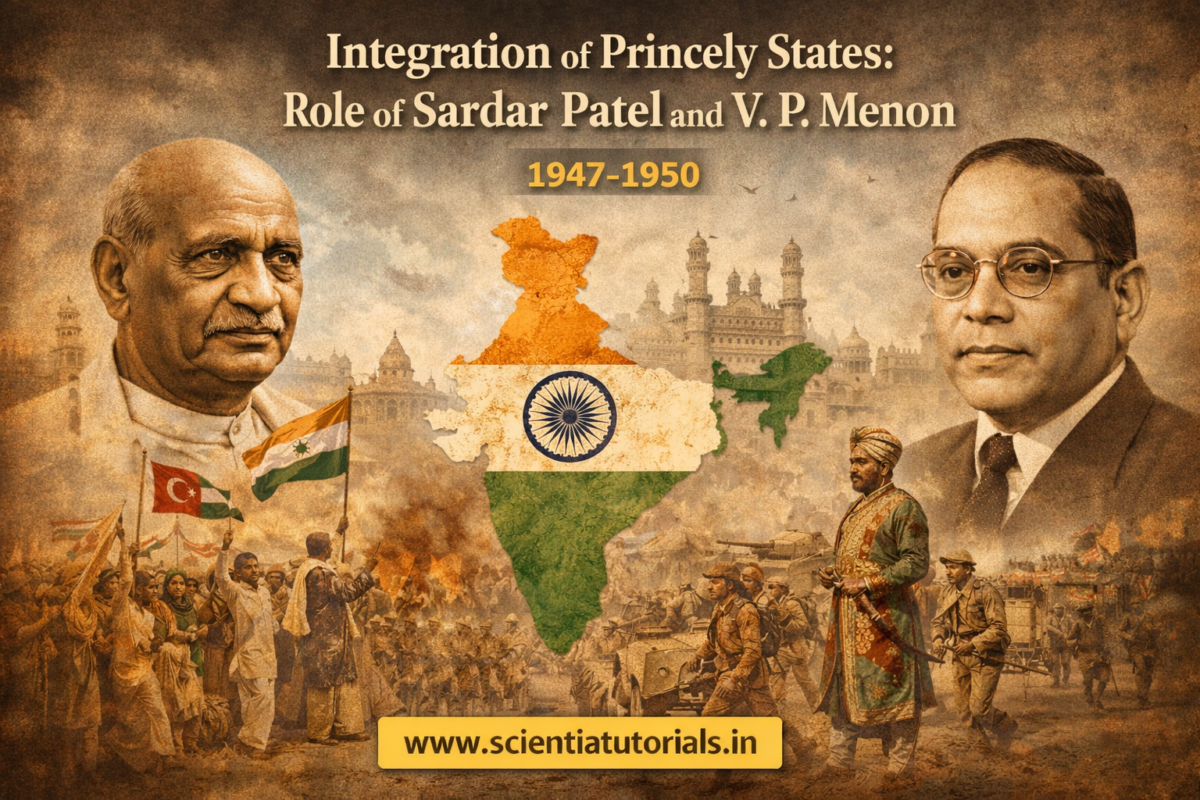
Integration of Princely States: Role of Sardar Patel and V. P. Menon

Course: Post-Independence and Contemporary India – History of India
Module 1: Transition from Colonial Rule to Independent India
Timeline: 1947–1950 (CE)
Lesson: Integration of Princely States: Role of Sardar Patel and V. P. Menon
Introduction: Political Unity as the First Test of Independence
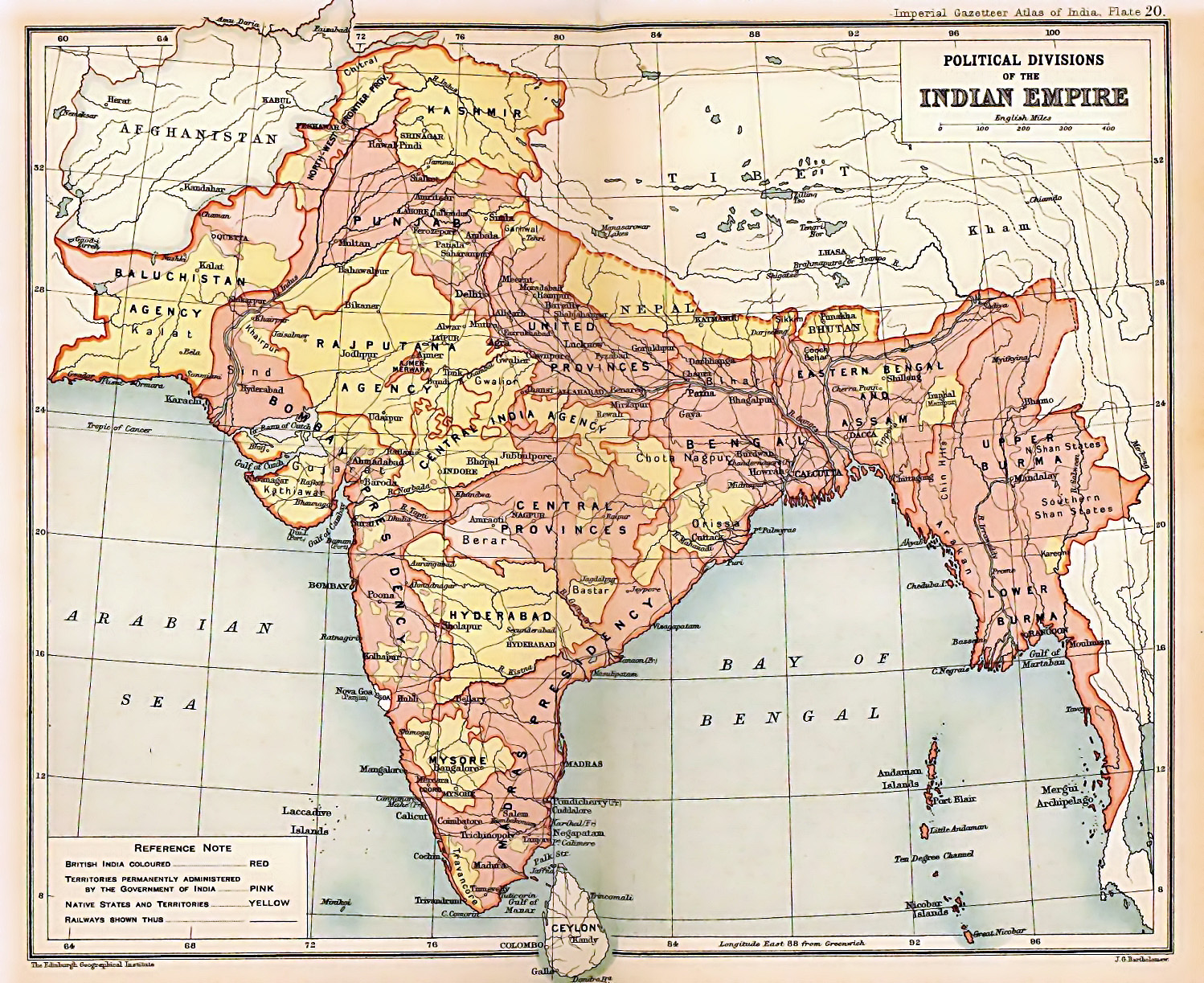
When India achieved independence on 15 August 1947, political freedom did not automatically guarantee territorial unity. Alongside British Indian provinces existed 565 princely states, covering nearly 40% of the subcontinent’s territory and one-third of its population. These states were ruled by hereditary princes under British paramountcy and were legally not part of British India.
The task of integrating these princely states into the Indian Union emerged as the first and most critical challenge of nation-building. The success of this mission depended largely on the extraordinary leadership and administrative skills of Sardar Vallabhbhai Patel and V P Menon. Their efforts ensured that India did not fragment into multiple sovereign entities but emerged as a unified nation-state.
This lesson examines the historical background, process, strategies, challenges, and long-term significance of the integration of princely states between 1947 and 1950.
I. Background: Princely States under British Rule
1. Nature of Princely States
- The princely states were governed by Indian rulers (maharajas, nawabs, nizams)
- They acknowledged British paramountcy but retained internal autonomy
- The British controlled defence, foreign affairs, and communications
At independence, princely states were given the option to accede to India, accede to Pakistan, or theoretically remain independent—a provision that posed serious threats to India’s unity.
2. The Political Vacuum of 1947
With the lapse of British paramountcy:
- Princes regained full sovereignty
- Several rulers dreamt of independence
- Some states had strategic locations and large territories
Without integration, India risked becoming a balkanised subcontinent, similar to Europe after World War I.
II. Leadership and Institutional Framework

1. Role of Sardar Vallabhbhai Patel
As Deputy Prime Minister and Home Minister, Sardar Patel:
- Took charge of the States Department
- Combined firmness with persuasion
- Earned the title “Iron Man of India”
Patel believed political unity was non-negotiable for India’s survival.
2. Role of V. P. Menon
V. P. Menon was:
- Secretary of the States Department
- A skilled administrator and negotiator
- The chief architect of practical integration strategies
Menon’s deep understanding of constitutional law and princely psychology complemented Patel’s political authority.
III. Instruments of Integration
1. Instrument of Accession
The primary legal mechanism used was the Instrument of Accession, under which rulers:
- Transferred control over defence, foreign affairs, and communications
- Retained autonomy over internal matters
This approach reassured princes while safeguarding India’s sovereignty.
2. Standstill Agreements
Temporary arrangements ensured continuity of administrative relations until full accession was negotiated.
IV. Strategy of Integration: Methods Adopted
1. Diplomacy and Persuasion
- Personal assurances to rulers
- Guarantees of privy purses
- Respect for royal titles and traditions
Most princes acceded peacefully due to Patel’s diplomatic skill.
2. Economic and Administrative Pressure
- Warning of economic isolation
- Emphasis on popular will
- Threat of administrative breakdown in isolated states
3. Use of Force (As a Last Resort)
While peaceful integration was preferred, military action was used when rulers defied national interest.
V. Major Case Studies of Integration
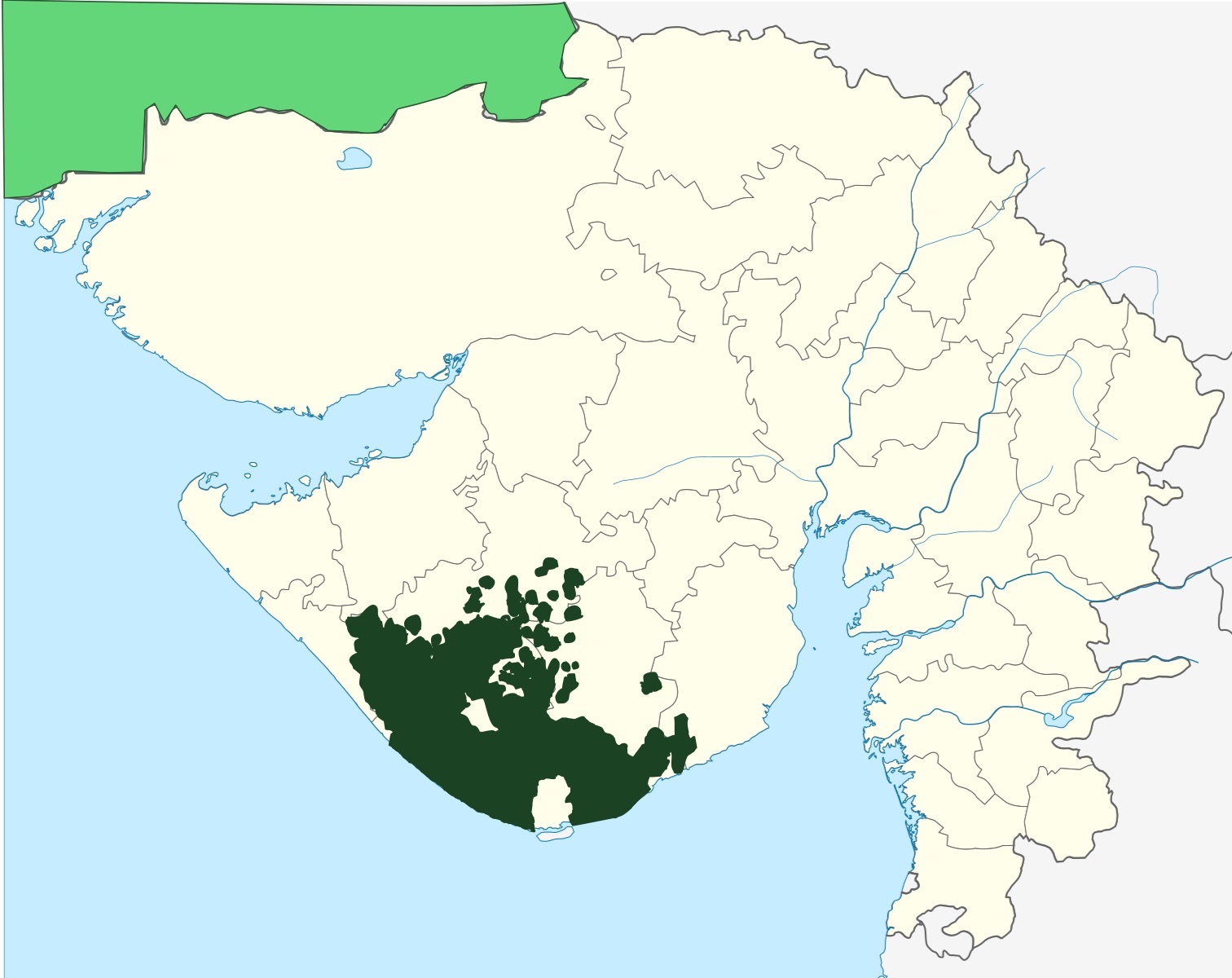
1. Junagadh (1947)
- Muslim ruler, Hindu-majority population
- Acceded to Pakistan despite geographic isolation
- Popular revolt and plebiscite
- Integrated into India peacefully
2. Hyderabad (1948)
- Largest princely state
- Nizam sought independence
- Presence of Razakars threatened law and order
Police Action (Operation Polo) led to Hyderabad’s integration in September 1948.
3. Jammu and Kashmir (1947)
- Hindu ruler, Muslim-majority population
- Faced tribal invasion from Pakistan
- Accession to India followed by military intervention
Kashmir remains a sensitive and unresolved issue, but accession was legally valid.
VI. Merger of Smaller States
Hundreds of small states were:
- Merged into unions (e.g., Rajasthan, Madhya Bharat)
- Integrated administratively for efficiency
- Brought under democratic governance
This phase marked the transition from monarchical rule to popular sovereignty.
VII. Integration and Democratic Transition
1. End of Privy Purses and Royal Authority
Initially retained to ensure smooth transition, privy purses were later abolished in 1971.
2. Extension of the Constitution

The Indian Constitution:
- Extended fundamental rights to former princely territories
- Ensured equality before law
- Ended feudal privileges
Under B R Ambedkar, constitutional integration completed political unification.
VIII. Challenges Faced During Integration
1. Resistance from Princes
- Fear of losing power and prestige
- Economic uncertainties
2. Communal and Regional Complications
- Religious demography (Junagadh, Kashmir)
- Strategic locations
3. Administrative Constraints
- Lack of trained personnel
- Refugee crisis simultaneously unfolding
Despite these obstacles, integration was achieved within two years, an extraordinary administrative feat.
IX. Significance of Integration in Nation-Building
1. Political Unity
Integration prevented:
- Balkanisation
- Foreign interference
- Internal fragmentation
2. Strengthening of the Indian State
- Central authority consolidated
- Federal structure strengthened
- Rule of law extended nationwide
3. Foundation for Economic Planning
Unified territory enabled:
- National planning
- Infrastructure development
- Balanced regional growth
X. Evaluation of Patel–Menon Partnership
The partnership between Patel and Menon represents:
- Political vision + administrative expertise
- Moral authority + practical realism
- Democratic ideals + national security concerns
Their success remains unmatched in post-colonial state formation.
XI. Historiographical Perspectives
- Nationalist historians view integration as a heroic achievement
- Some critics argue military actions undermined consent
- Overall consensus recognises integration as essential and inevitable
XII. Examination-Oriented Revision Notes
Key Terms
- Princely States
- Instrument of Accession
- Police Action
- Privy Purse
- States Department
Important Facts
- 565 princely states at independence
- States Department led by Patel
- Hyderabad integrated in September 1948
- Constitution enforced on 26 January 1950
Answer-Writing Pointers
- Emphasise leadership of Patel and Menon
- Use case studies (Junagadh, Hyderabad, Kashmir)
- Link integration with nation-building and Constitution
- Balance diplomacy and force in analysis
Conclusion
The integration of princely states stands as one of the greatest achievements of post-independence India. Through diplomatic tact, constitutional innovation, and decisive action, Sardar Vallabhbhai Patel and V. P. Menon transformed a fragmented political landscape into a unified Indian Union.
Between 1947 and 1950, political integration laid the foundation for democracy, constitutional governance, and national development. Without this success, India’s freedom would have remained incomplete. Understanding this process is therefore essential to appreciating the strength, resilience, and unity of modern India.
Questions with Answers
Integration of Princely States: Role of Sardar Patel and V. P. Menon
Section A: Short Answer Questions
(Answer in about 30–80 words each)
Q1. What were princely states?
Answer:
Princely states were semi-autonomous territories ruled by Indian princes under British paramountcy. While internal administration was controlled by rulers, defence, foreign affairs, and communications were managed by the British. At independence, there were about 565 such states.
Q2. Why did the integration of princely states become a major challenge in 1947?
Answer:
With the lapse of British paramountcy in 1947, princely states became legally independent. Many rulers considered independence, posing a threat of political fragmentation and weakening national unity.
Q3. Who headed the States Department after independence?
Answer:
The States Department was headed by Sardar Vallabhbhai Patel, who served as India’s Deputy Prime Minister and Home Minister.
Q4. What was the role of V. P. Menon in the integration process?
Answer:
V P Menon was the Secretary of the States Department and the chief architect of integration strategies, negotiating accession and drafting legal instruments.
Q5. What was the Instrument of Accession?
Answer:
The Instrument of Accession was a legal document through which princely rulers agreed to transfer control over defence, foreign affairs, and communications to the Indian Union.
Q6. What were Standstill Agreements?
Answer:
Standstill Agreements were temporary arrangements to maintain existing administrative relations between princely states and India until final accession decisions were made.
Q7. Why is Sardar Patel known as the “Iron Man of India”?
Answer:
Sardar Patel earned this title due to his firm determination, political will, and decisive leadership in integrating princely states and preventing the fragmentation of India.
Q8. Why was Junagadh’s accession controversial?
Answer:
Junagadh had a Hindu-majority population but a Muslim ruler who acceded to Pakistan despite its geographical isolation, leading to popular resistance and eventual integration into India.
Q9. What was Operation Polo?
Answer:
Operation Polo, also known as the Police Action of 1948, was a military operation conducted by India to integrate Hyderabad after the Nizam refused accession and internal disorder increased.
Q10. Why was Jammu and Kashmir strategically important?
Answer:
Jammu and Kashmir’s strategic location, border with Pakistan and China, and its political sensitivity made its accession a critical issue for India’s security and unity.
Section B: Medium Answer Questions
(Answer in about 120–180 words each)
Q11. Explain the political situation of princely states at the time of independence.
Answer:
At independence, princely states were no longer bound by British paramountcy and technically became sovereign. They were given the option to accede to India or Pakistan. Some rulers aspired to independence, creating uncertainty and threatening India’s territorial integrity. Immediate integration was essential to prevent fragmentation.
Q12. Discuss the methods adopted by Patel and Menon for integration.
Answer:
Patel and Menon used diplomacy, persuasion, and constitutional means such as the Instrument of Accession. They assured rulers of privy purses and respect for titles while emphasizing national unity. Force was used only as a last resort in cases like Hyderabad.
Q13. Why was Hyderabad considered the most difficult princely state to integrate?
Answer:
Hyderabad was the largest princely state with a strategic location and a Nizam who sought independence. The presence of the Razakars created law and order problems, making peaceful integration difficult.
Q14. How were smaller princely states integrated?
Answer:
Smaller states were merged into larger administrative units such as Rajasthan and Madhya Bharat to ensure efficient governance and democratic administration.
Q15. What role did the people of princely states play in integration?
Answer:
Popular movements and public opinion often supported accession to India, especially in states like Junagadh and Hyderabad, strengthening India’s position.
Section C: Long Answer Questions
(Answer in about 250–400 words each)
Q16. Analyse the role of Sardar Vallabhbhai Patel in the integration of princely states.
Answer:
Sardar Patel provided decisive leadership, combining firmness with diplomacy. As head of the States Department, he negotiated with rulers, reassured them of privileges, and used force only when necessary. His efforts ensured political unity and laid the foundation of a strong Indian Union.
Q17. Examine the contribution of V. P. Menon to the integration process.
Answer:
V. P. Menon was the key administrator behind integration. He drafted the Instrument of Accession, conducted negotiations, and advised Patel on constitutional and practical matters. His administrative skill was crucial to the swift and largely peaceful integration of states.
Q18. Discuss the integration of Junagadh and Hyderabad as case studies.
Answer:
Junagadh was integrated through popular will and plebiscite, while Hyderabad required military intervention through Operation Polo. These cases highlight India’s flexible approach combining democracy and decisive action.
Q19. How did the integration of princely states contribute to nation-building?
Answer:
Integration ensured political unity, strengthened central authority, enabled economic planning, and extended democratic governance across India.
Q20. “Integration of princely states was essential for the survival of Indian democracy.” Explain.
Answer:
Without integration, India would have been fragmented and unstable. Unified territory was necessary for constitutional governance, federalism, and democratic consolidation.
Section D: Analytical / Comparative Questions
(For UPSC & NET)
Q21. Compare the methods of integration used in Junagadh and Kashmir.
Answer:
Junagadh was integrated through plebiscite and popular revolt, while Kashmir acceded to India following external aggression and military intervention.
Q22. Was the use of force justified in the integration of Hyderabad? Critically evaluate.
Answer:
Given the breakdown of law and order and threat to national security, the use of force was justified as a last resort.
Q23. How did integration affect centre–state relations in independent India?
Answer:
Integration strengthened the Union government, shaping India’s federal structure with a strong centre.
Q24. Evaluate the integration of princely states from a constitutional perspective.
Answer:
Integration brought princely territories under the Constitution, ensuring equality, rule of law, and democratic governance.
Q25. Why is the Patel–Menon partnership considered unique in post-colonial history?
Answer:
Their partnership combined political authority with administrative expertise, achieving rapid and largely peaceful integration unmatched in other post-colonial states.
MCQs with Answers
Integration of Princely States (1947–1950)
Q1. At the time of independence, how many princely states existed in India?
A. About 300
B. About 400
C. About 565
D. About 700
Correct Answer: C
Explanation:
There were around 565 princely states at independence, covering nearly 40% of India’s territory. Their integration was essential to prevent political fragmentation.
Q2. British paramountcy over the princely states ended with:
A. The Cabinet Mission Plan
B. The Indian Independence Act, 1947
C. The Mountbatten Plan
D. The Government of India Act, 1935
Correct Answer: B
Explanation:
The Indian Independence Act, 1947 ended British paramountcy, making princely states legally sovereign and free to choose their future.
Q3. Which of the following was NOT an option given to princely states in 1947?
A. Accede to India
B. Accede to Pakistan
C. Remain independent
D. Join the United Nations directly
Correct Answer: D
Explanation:
Princely states could accede to India, Pakistan, or theoretically remain independent, but joining the UN independently was never an option.
Q4. Who headed the States Department after independence?
A. Jawaharlal Nehru
B. Sardar Vallabhbhai Patel
C. Rajendra Prasad
D. B. R. Ambedkar
Correct Answer: B
Explanation:
Sardar Patel, as Deputy Prime Minister and Home Minister, led the States Department and spearheaded integration.
Q5. V. P. Menon’s primary role in integration was that of:
A. Military commander
B. Constitutional advisor
C. Chief administrator and negotiator
D. Foreign policy strategist
Correct Answer: C
Explanation:
V P Menon was the chief administrator and negotiator who designed and implemented practical integration strategies.
Q6. The Instrument of Accession transferred control of:
A. All internal and external affairs
B. Defence, foreign affairs, and communications
C. Revenue and judiciary only
D. Defence and finance only
Correct Answer: B
Explanation:
The Instrument of Accession allowed India control over defence, foreign affairs, and communications, while rulers retained internal autonomy initially.
Q7. Standstill Agreements were meant to:
A. Grant permanent independence to states
B. Maintain existing arrangements temporarily
C. Transfer full sovereignty immediately
D. Conduct plebiscites
Correct Answer: B
Explanation:
Standstill Agreements ensured administrative continuity until final decisions on accession were made.
Q8. Which princely state acceded to Pakistan despite having a Hindu-majority population?
A. Hyderabad
B. Kashmir
C. Junagadh
D. Bhopal
Correct Answer: C
Explanation:
Junagadh’s Muslim ruler acceded to Pakistan despite its Hindu-majority population and geographical isolation, leading to controversy.
Q9. Junagadh was finally integrated into India through:
A. Military action only
B. Plebiscite and popular revolt
C. UN mediation
D. Royal abdication
Correct Answer: B
Explanation:
Popular resistance and a plebiscite demonstrated the will of the people, leading to Junagadh’s integration.
Q10. Hyderabad was integrated into India through:
A. Diplomatic negotiation alone
B. UN arbitration
C. Operation Polo
D. Cabinet Mission
Correct Answer: C
Explanation:
Operation Polo (Police Action, 1948) was a limited military operation undertaken after negotiations failed.
Q11. Hyderabad’s ruler was known as the:
A. Maharaja
B. Gaekwad
C. Nizam
D. Nawab
Correct Answer: C
Explanation:
The Nizam of Hyderabad sought independence, complicating the integration process.
Q12. Which group in Hyderabad posed a major law-and-order challenge?
A. Khudai Khidmatgars
B. Razakars
C. INA volunteers
D. Akali Dal
Correct Answer: B
Explanation:
The Razakars were a militant group supporting the Nizam, contributing to instability and violence.
Q13. Jammu and Kashmir acceded to India primarily due to:
A. Economic incentives
B. Plebiscite
C. Tribal invasion from Pakistan
D. Pressure from the British
Correct Answer: C
Explanation:
A tribal invasion from Pakistan forced the ruler of Kashmir to seek Indian military help and sign the Instrument of Accession.
Q14. The integration of princely states was largely completed by:
A. 1947
B. 1948
C. 1950
D. 1952
Correct Answer: B
Explanation:
Most princely states were integrated by 1948, though constitutional integration continued until 1950.
Q15. Smaller princely states were often:
A. Left independent
B. Merged into larger administrative units
C. Converted into colonies
D. Directly ruled by the army
Correct Answer: B
Explanation:
Mergers into larger units like Rajasthan and Madhya Bharat ensured administrative efficiency and democratic governance.
Q16. Why is Sardar Patel called the “Iron Man of India”?
A. His role in the freedom struggle alone
B. His economic reforms
C. His firm and decisive integration policy
D. His military background
Correct Answer: C
Explanation:
Patel’s determination and firmness in ensuring national unity earned him this title.
Q17. Which principle guided Patel’s integration policy?
A. Complete coercion
B. Absolute non-intervention
C. Diplomacy backed by firmness
D. International arbitration
Correct Answer: C
Explanation:
Patel preferred peaceful persuasion but did not hesitate to use force when national unity was threatened.
Q18. The role of popular will was most evident in:
A. Bhopal
B. Travancore
C. Junagadh
D. Mysore
Correct Answer: C
Explanation:
In Junagadh, public resistance and plebiscite played a decisive role.
Q19. Integration of princely states strengthened:
A. Only regional autonomy
B. Only provincial governments
C. Central authority and federal unity
D. Monarchical power
Correct Answer: C
Explanation:
Integration consolidated the Union government while laying the foundation of India’s federal structure.
Q20. Which of the following best describes the Patel–Menon partnership?
A. Political rivalry
B. Ideological opposition
C. Political leadership with administrative expertise
D. Military alliance
Correct Answer: C
Explanation:
Patel’s political authority combined with Menon’s administrative skill ensured swift and effective integration.
Q21. Privy purses were initially:
A. Abolished immediately
B. Granted to reassure princes
C. Paid by the British
D. Replaced by pensions
Correct Answer: B
Explanation:
Privy purses were guaranteed to princes to facilitate peaceful integration; they were abolished later in 1971.
Q22. Integration of princely states was essential for:
A. Ending colonial rule
B. Preventing Balkanisation of India
C. Establishing socialism
D. Reducing population
Correct Answer: B
Explanation:
Without integration, India could have fragmented into multiple sovereign entities.
Q23. From a constitutional perspective, integration ensured:
A. Continued royal privileges
B. Equality before law
C. Separate legal systems
D. Feudal autonomy
Correct Answer: B
Explanation:
Integration brought former princely territories under the Indian Constitution, ensuring equality and rule of law.
Q24. Which institution completed the political integration of India?
A. Planning Commission
B. Supreme Court
C. Indian Constitution (1950)
D. Election Commission
Correct Answer: C
Explanation:
The Constitution extended democratic governance and fundamental rights to all integrated territories.
Q25. The integration of princely states is best described as:
A. A minor administrative reform
B. A military conquest
C. A foundational nation-building process
D. A colonial legacy
Correct Answer: C
Explanation:
Integration was central to nation-building, enabling democracy, economic planning, and political stability.
✅ This MCQ set is fully exam-ready and suitable for objective examinations across UPSC, State PSCs, NET, CUET, CBSE, and higher-education institutions in India.
-
integration of princely states role of sardar patel
-
v p menon contribution to integration of princely states
-
integration of princely states in india 1947 1950
-
sardar vallabhbhai patel and indian unification
-
junagadh hyderabad kashmir integration case studies
-
instrument of accession explained for upsc
-
princely states integration notes for upsc psc
-
post independence india integration of states
-
nation building through integration of princely states
-
integration of princely states mcqs and answers