
Jawaharlal Nehru and the Vision of Modern India
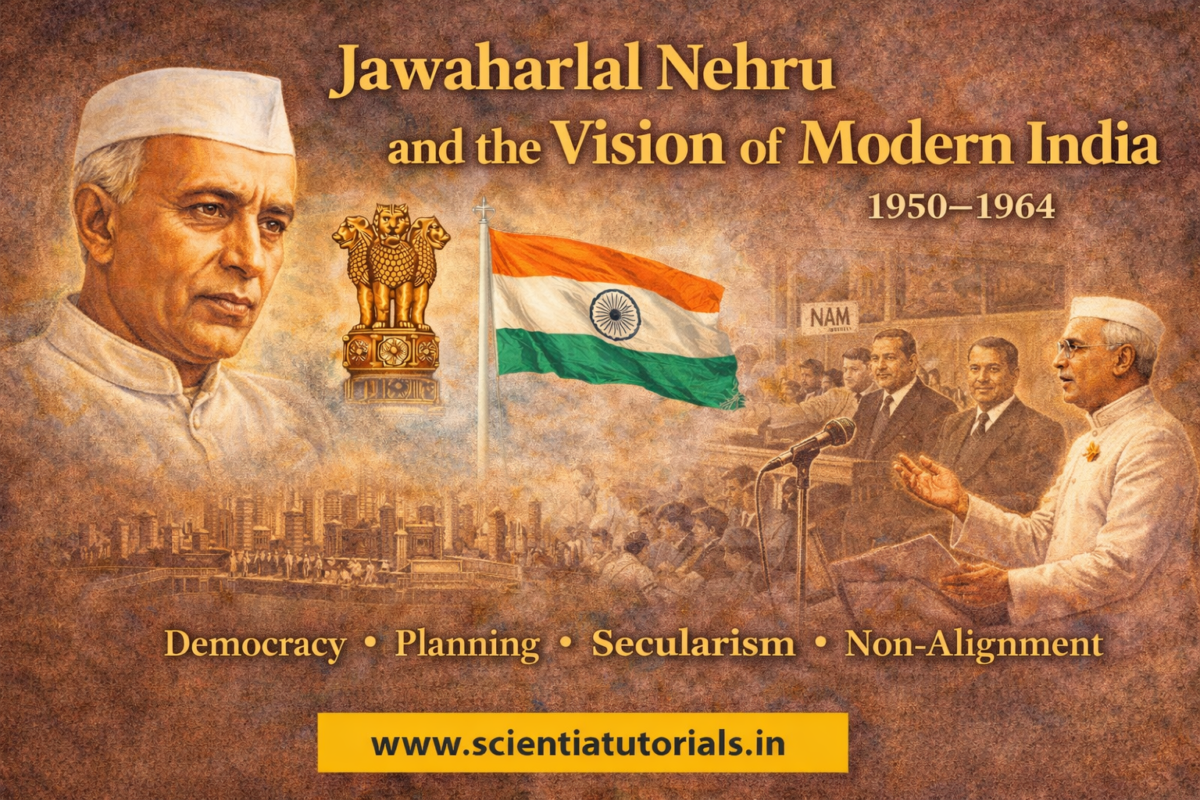

Jawaharlal Nehru and the Vision of Modern India
Course: Post-Independence and Contemporary India – History of India
Module 3: Early Nation-Building and Nehruvian India
Timeline: 1950–1964 (CE)
Lesson Type: Comprehensive Study Module with Detailed Revision Notes
Based on the Lesson followed by the above Module and Course, we have created study materials aligned to the needs of UPSC, State PSC, UGC-NET, CUET, CBSE, and all school, college, and university examinations in India:
- Study Module with Revision Notes,
- Questions with Answers,
- MCQs with Answers and detailed explanations.
Study Module with Revision Notes
1. Introduction: Nehru and the Making of Modern India
The early years after independence were decisive in shaping the political, economic, and intellectual foundations of India. At the centre of this transformative phase stood Jawaharlal Nehru, India’s first Prime Minister and the chief architect of its early nation-building strategy.
Nehru’s vision of modern India was rooted in:
- Democratic socialism
- Scientific temper and rationality
- Secularism and pluralism
- State-led economic development
- Independent foreign policy
Between 1950 and 1964, Nehru sought to transform a poor, colonial, agrarian society into a modern, self-reliant, and democratic nation-state. This lesson examines Nehru’s ideology, policies, achievements, limitations, and long-term legacy in the context of early nation-building.
2. Historical Context: India at Independence
2.1 Challenges Facing the New Nation
When India became independent, it faced enormous challenges:
- Widespread poverty and illiteracy
- Underdeveloped industry and infrastructure
- Refugee crisis after Partition
- Integration of princely states
- Communal tensions and regional diversity
The leadership had to simultaneously ensure political stability, economic growth, and national unity.
2.2 Nehru’s Ideological Influences
Nehru’s ideas were shaped by:
- Indian national movement
- Fabian socialism
- Enlightenment rationalism
- Anti-imperialism and internationalism
His writings, especially The Discovery of India, reveal a deep faith in science, democracy, and planning as tools of social transformation.
3. Political Vision: Democracy, Secularism, and Institutions
3.1 Commitment to Parliamentary Democracy
Nehru firmly believed that democracy was essential for India’s unity and progress. Under his leadership:
- Parliamentary democracy was strengthened
- Regular elections were held
- Opposition was respected
- Judiciary and press remained largely independent
This commitment ensured that democracy took root in India, unlike many newly independent nations that slid into authoritarianism.
3.2 Secularism and Pluralism
Nehru envisioned India as a secular state where:
- Religion would not determine citizenship
- State would treat all religions equally
- Minorities would feel secure
His secularism was not anti-religious but anti-communal, aimed at preserving unity in diversity.
3.3 Institution Building
Nehru emphasized strong institutions over charismatic rule. Key institutions strengthened or established included:
- Parliament
- Supreme Court
- Election Commission
- Planning Commission
These institutions became pillars of Indian democracy.
4. Economic Vision: Planned Development and Socialism
4.1 Rationale for Planning
Nehru rejected laissez-faire capitalism and instead advocated planned economic development, believing that:
- Market forces alone would deepen inequality
- State intervention was necessary for social justice
- Industrialization was key to national strength
4.2 Planning Commission and Five-Year Plans
The Planning Commission was established in 1950 to guide economic development.
First Five-Year Plan (1951–56)
- Focus on agriculture and irrigation
- Emphasis on food security
- Bhakra-Nangal and Hirakud projects
Second Five-Year Plan (1956–61)
- Based on the Mahalanobis model
- Focus on heavy industries and public sector
- Establishment of steel plants (Bhilai, Rourkela, Durgapur)
4.3 Public Sector and Mixed Economy
Nehru adopted a mixed economy:
- Public sector dominated heavy industries
- Private sector allowed in consumer goods
- Strategic sectors under state control
He famously described large dams and factories as the “temples of modern India.”
5. Scientific Temper and Education
5.1 Science and Technology
Nehru saw science as the engine of progress. His policies emphasized:
- Scientific research
- Technological self-reliance
- Rational thinking
Institutions like the Council of Scientific and Industrial Research (CSIR) were strengthened.
5.2 Higher Education and IITs
Nehru laid the foundations of modern higher education by establishing:
- Indian Institutes of Technology (IITs)
- Indian Institutes of Management (IIMs)
- Universities and research centres
These institutions later became global centres of excellence.
6. Foreign Policy Vision: Non-Alignment and Global Peace
6.1 Non-Aligned Movement (NAM)
Nehru believed India should not align with either the US or USSR during the Cold War.
Along with leaders like:
- Josip Broz Tito
- Gamal Abdel Nasser
Nehru played a key role in founding the Non-Aligned Movement (1961).
6.2 Panchsheel and Peaceful Coexistence
Nehru promoted Panchsheel, the five principles of peaceful coexistence:
- Mutual respect for sovereignty
- Non-aggression
- Non-interference
- Equality and mutual benefit
- Peaceful coexistence
These principles guided India’s diplomatic engagement.
6.3 Limitations: China and 1962 War
Nehru’s foreign policy faced a major setback during the Sino-Indian War of 1962, which:
- Shattered India’s sense of security
- Exposed military unpreparedness
- Damaged Nehru’s image
However, it did not fundamentally alter India’s commitment to non-alignment.
7. Social Vision: Unity, Equality, and Welfare
7.1 National Integration
Nehru worked to:
- Integrate princely states
- Reorganize states on linguistic lines (1956)
- Balance unity with diversity
Though initially hesitant, he accepted linguistic reorganization to strengthen federal unity.
7.2 Social Justice and Reform
Nehru supported:
- Abolition of zamindari system
- Expansion of public sector employment
- Women’s rights and legal reforms
The Hindu Code Bills aimed to modernize personal laws and improve women’s status.
8. Criticisms of the Nehruvian Model
8.1 Economic Criticism
- Slow growth (“Hindu rate of growth”)
- Inefficiency of public sector
- Bureaucratic controls (License Raj)
8.2 Political Criticism
- Excessive centralization
- Over-reliance on state planning
- Foreign policy idealism
Despite criticisms, Nehru’s policies provided stability and direction.
9. Nehru’s Legacy
Nehru’s long-term legacy includes:
- Entrenchment of democracy
- Strong institutional framework
- Scientific and educational base
- Independent foreign policy tradition
Many later reforms built upon or reacted to the Nehruvian framework.
10. Chronological Overview (1950–1964)
| Year | Event |
|---|---|
| 1950 | Constitution comes into force |
| 1951–52 | First General Elections |
| 1956 | Second Five-Year Plan |
| 1956 | States Reorganisation Act |
| 1961 | Non-Aligned Movement |
| 1962 | Sino-Indian War |
| 1964 | Death of Nehru |
11. Revision Notes (Exam-Oriented)
Key Concepts
- Nehruvian socialism
- Planned economy
- Scientific temper
- Non-alignment
Key Institutions
- Planning Commission
- IITs and CSIR
- Public sector enterprises
Thinker to Quote
- Jawaharlal Nehru on democracy and science
12. Importance for Competitive Examinations
- UPSC / State PSC: Nation-building, economic planning, foreign policy
- UGC-NET: Nehruvian ideology and state formation
- CUET / CBSE: Post-independence consolidation
- Universities: Analytical essays and debates
13. Conclusion
Jawaharlal Nehru’s vision of modern India was ambitious, idealistic, and deeply rooted in democratic values. While his model had limitations, it provided India with political stability, institutional strength, and a clear developmental direction during its most vulnerable years. Understanding Nehruvian India is essential to appreciating both the achievements and contradictions of India’s post-independence journey.
Questions with Answers
Below is a well-structured, examination-oriented set of 25 Questions with Clear and Accurate Answers based strictly on the lesson:
Jawaharlal Nehru and the Vision of Modern India
Course: Post-Independence and Contemporary India – History of India
Module 3: Early Nation-Building and Nehruvian India
Timeline: 1950–1964 (CE)
The questions are arranged into Very Short, Short, Medium, and Long Answer types, carefully aligned to the requirements of UPSC, State PSCs, UGC-NET, CUET, CBSE, and school, college, and university examinations in India.
I. Very Short Answer Questions
Q1. Who was the first Prime Minister of independent India?
Answer:
Jawaharlal Nehru was the first Prime Minister of independent India.
Q2. What is meant by the term “Nehruvian vision”?
Answer:
The Nehruvian vision refers to a model of nation-building based on democracy, secularism, scientific temper, planned economic development, and non-alignment in foreign policy.
Q3. During which period did Jawaharlal Nehru serve as Prime Minister?
Answer:
Jawaharlal Nehru served as Prime Minister from 1947 to 1964.
Q4. What type of economy did Nehru advocate for India?
Answer:
Nehru advocated a mixed economy with a strong public sector and planned development.
Q5. What was the main objective of the Planning Commission?
Answer:
The Planning Commission aimed to achieve economic growth, social justice, and balanced regional development through Five-Year Plans.
Q6. What does the term “scientific temper” signify?
Answer:
Scientific temper refers to the promotion of rational thinking, inquiry, and application of science for social progress.
Q7. Name one major institution established during the Nehru era.
Answer:
The Indian Institutes of Technology (IITs) were established during the Nehru era.
II. Short Answer Questions
Q8. Why is Jawaharlal Nehru considered the architect of early nation-building in India?
Answer:
Nehru laid the foundations of democracy, economic planning, secularism, scientific development, and independent foreign policy, shaping India’s political and developmental trajectory after independence.
Q9. Explain Nehru’s commitment to parliamentary democracy.
Answer:
Nehru respected constitutional values, ensured regular elections, upheld civil liberties, and allowed opposition and free press, thereby strengthening parliamentary democracy.
Q10. What was Nehru’s approach to secularism?
Answer:
Nehru’s secularism emphasized equal respect for all religions, state neutrality, and opposition to communal politics to preserve national unity.
Q11. Why did Nehru support state-led industrialization?
Answer:
He believed private capital was insufficient for rapid industrial growth and that the state must lead in heavy industries to ensure self-reliance and reduce inequality.
Q12. Mention two objectives of the First Five-Year Plan.
Answer:
- Agricultural development and food security
- Expansion of irrigation and infrastructure
Q13. What was Nehru’s role in the States Reorganisation Act of 1956?
Answer:
Though initially cautious, Nehru accepted linguistic reorganisation to accommodate regional aspirations and strengthen federal unity.
III. Medium Answer Questions
Q14. Discuss the main features of Nehruvian economic planning.
Answer:
Nehruvian planning emphasized Five-Year Plans, public sector dominance in heavy industries, a mixed economy, state control over strategic sectors, and long-term industrial growth combined with social justice.
Q15. Explain the significance of scientific and educational institutions established during the Nehru era.
Answer:
Institutions like IITs, CSIR, and universities promoted scientific research, technological self-reliance, and skilled manpower, laying the foundation for India’s future knowledge economy.
Q16. Examine Nehru’s vision of foreign policy.
Answer:
Nehru advocated non-alignment, peaceful coexistence, opposition to imperialism, and independent decision-making in world affairs, aiming to keep India out of Cold War rivalries.
Q17. How did Nehru promote national integration in post-independence India?
Answer:
He integrated princely states, addressed linguistic aspirations, opposed communalism, and promoted unity through democratic institutions and secular governance.
IV. Long Answer Questions
Q18. Critically examine Jawaharlal Nehru’s vision of modern India.
Answer:
Nehru’s vision combined democracy, socialism, secularism, and scientific temper. He prioritized institutions over personalities, planning over market forces, and peace over militarism. While his policies ensured stability and long-term capacity building, critics point to slow economic growth, bureaucratic controls, and idealism in foreign policy. Nevertheless, his framework gave India a durable democratic and institutional foundation.
Q19. Analyze the role of planning and the public sector in Nehruvian India.
Answer:
Planning aimed at rapid industrialization, reduction of inequality, and self-reliance. Public sector enterprises dominated steel, power, and heavy machinery. Although inefficiencies emerged, this strategy created industrial infrastructure and reduced dependence on foreign capital.
Q20. Evaluate Nehru’s contribution to the consolidation of Indian democracy.
Answer:
Nehru strengthened democratic norms through free elections, tolerance of dissent, respect for judiciary, and civil liberties. His leadership ensured that democracy survived in a newly independent, diverse, and poor society.
Q21. Discuss Nehru’s foreign policy achievements and limitations.
Answer:
Achievements include leadership in non-alignment, moral stature in global affairs, and support for decolonization. Limitations were exposed by the 1962 Sino-Indian War, revealing defence and diplomatic weaknesses.
V. Analytical and Contemporary Relevance Questions
Q22. Why is Nehruvian socialism described as democratic rather than revolutionary?
Answer:
It pursued social and economic transformation through constitutional means, democratic institutions, and gradual reforms rather than violent revolution.
Q23. How did Nehru balance idealism and pragmatism in governance?
Answer:
While guided by ideals of peace and equality, Nehru accepted compromises such as linguistic reorganisation and mixed economy to address practical realities.
Q24. In what ways does Nehru’s vision continue to influence India today?
Answer:
India’s democratic institutions, higher education system, public sector base, and foreign policy tradition of strategic autonomy reflect Nehru’s lasting influence.
Q25. Why is the study of Nehruvian India essential for understanding post-independence history?
Answer:
It explains how India chose democracy, planning, secularism, and non-alignment during its formative years, shaping the country’s long-term political and developmental path.
Below is a comprehensive, examination-oriented set of 25 Multiple Choice Questions (MCQs) with correct answers and detailed, concept-clearing explanations, developed strictly from the lesson:
Jawaharlal Nehru and the Vision of Modern India
Course: Post-Independence and Contemporary India – History of India
Module 3: Early Nation-Building and Nehruvian India
Timeline: 1950–1964 (CE)
These MCQs are carefully aligned with the standards of UPSC, State PSCs, UGC-NET, CUET, CBSE, and school, college, and university examinations in India.
MCQs with Answers and Explanations
Q1. Jawaharlal Nehru served as the Prime Minister of India during which period?
A. 1947–1962
B. 1947–1964
C. 1950–1964
D. 1952–1967
Correct Answer: B
Explanation:
Jawaharlal Nehru served as India’s Prime Minister from independence in 1947 until his death in 1964, shaping the country’s early nation-building phase.
Q2. Nehru’s vision of modern India was primarily based on:
A. Free-market capitalism
B. Revolutionary socialism
C. Democratic socialism
D. Religious nationalism
Correct Answer: C
Explanation:
Nehru supported democratic socialism, combining political democracy with state-led economic development and social justice.
Q3. Which economic model did Nehru promote for India?
A. Command economy
B. Capitalist economy
C. Mixed economy
D. Laissez-faire economy
Correct Answer: C
Explanation:
India adopted a mixed economy, where both public and private sectors operated, with the state controlling strategic industries.
Q4. The Planning Commission of India was established in:
A. 1948
B. 1950
C. 1952
D. 1955
Correct Answer: B
Explanation:
The Planning Commission was set up in 1950 to formulate Five-Year Plans and guide economic development.
Q5. The First Five-Year Plan (1951–56) primarily focused on:
A. Heavy industries
B. Defence production
C. Agriculture and irrigation
D. Export-led growth
Correct Answer: C
Explanation:
The First Five-Year Plan emphasized agriculture, irrigation, and food security to stabilize the economy after Partition.
Q6. The Second Five-Year Plan is associated with which model?
A. Harrod-Domar Model
B. Lewis Model
C. Mahalanobis Model
D. Rostow Model
Correct Answer: C
Explanation:
The Mahalanobis Model emphasized heavy industries and capital goods to build long-term industrial capacity.
Q7. Which sector was given priority under Nehruvian planning?
A. Agriculture only
B. Services sector
C. Heavy industries
D. Foreign trade
Correct Answer: C
Explanation:
Heavy industries like steel, power, and machine tools were prioritized to ensure self-reliant industrial growth.
Q8. Nehru described large dams and factories as:
A. Pillars of socialism
B. Engines of growth
C. Temples of modern India
D. Symbols of nationalism
Correct Answer: C
Explanation:
Nehru viewed modern infrastructure projects as symbols of scientific progress and nation-building.
Q9. Which institutions were established to promote scientific and technical education during Nehru’s era?
A. IIMs only
B. IITs only
C. IITs and CSIR
D. NCERT and UGC
Correct Answer: C
Explanation:
Institutions like IITs and CSIR were established or strengthened to promote scientific research and technical expertise.
Q10. The concept of “scientific temper” emphasized by Nehru refers to:
A. Technological supremacy
B. Blind faith in science
C. Rational and critical thinking
D. Industrial expansion
Correct Answer: C
Explanation:
Scientific temper encourages rational inquiry, evidence-based thinking, and rejection of superstition.
Q11. Nehru’s approach to secularism can best be described as:
A. Anti-religious
B. Religious neutrality with equal respect
C. State-sponsored religion
D. Cultural nationalism
Correct Answer: B
Explanation:
Nehru supported equal respect for all religions and opposed communal politics to preserve national unity.
Q12. Which constitutional value did Nehru consistently uphold in governance?
A. Authoritarianism
B. One-party dominance
C. Parliamentary democracy
D. Military rule
Correct Answer: C
Explanation:
Nehru strongly upheld parliamentary democracy, free elections, and civil liberties.
Q13. Nehru was one of the founders of which foreign policy movement?
A. Commonwealth of Nations
B. SEATO
C. Non-Aligned Movement
D. SAARC
Correct Answer: C
Explanation:
Nehru was a key architect of the Non-Aligned Movement, promoting independence from Cold War power blocs.
Q14. The principle of Panchsheel is associated with:
A. Domestic economic policy
B. Centre–state relations
C. Peaceful coexistence in foreign policy
D. Socialist planning
Correct Answer: C
Explanation:
Panchsheel outlined five principles of peaceful coexistence guiding India’s foreign relations.
Q15. Which event exposed major limitations of Nehru’s foreign policy?
A. Indo-Pak War of 1947
B. Bandung Conference
C. Sino-Indian War of 1962
D. Formation of NAM
Correct Answer: C
Explanation:
The 1962 war with China revealed weaknesses in defence preparedness and diplomacy.
Q16. States Reorganisation Act, 1956 was primarily based on:
A. Economic criteria
B. Religious identity
C. Linguistic basis
D. Colonial boundaries
Correct Answer: C
Explanation:
States were reorganized mainly on linguistic lines to accommodate regional aspirations.
Q17. Nehru initially opposed linguistic reorganisation because he feared:
A. Economic imbalance
B. Threat to national unity
C. Administrative inefficiency
D. Foreign interference
Correct Answer: B
Explanation:
Nehru worried linguistic states might weaken national unity, though he later accepted them.
Q18. Which social reform was closely associated with Nehru’s government?
A. Abolition of untouchability
B. Hindu Code Bills
C. Land ceiling laws
D. Mandal Commission
Correct Answer: B
Explanation:
The Hindu Code Bills modernized personal laws and improved women’s rights.
Q19. The term “Hindu rate of growth” refers to:
A. Rapid industrial growth
B. Stagnant agricultural growth
C. Slow economic growth during Nehru era
D. Growth led by religious institutions
Correct Answer: C
Explanation:
Critics used this term to describe India’s relatively slow economic growth under state-led planning.
Q20. Which of the following best describes Nehru’s leadership style?
A. Charismatic authoritarianism
B. Military leadership
C. Institution-centric and democratic
D. Populist and personalistic
Correct Answer: C
Explanation:
Nehru emphasized strong institutions over personal rule and respected democratic norms.
Q21. Nehru’s commitment to democracy is evident from:
A. Suspension of elections
B. Respect for opposition and free press
C. One-party rule
D. Frequent use of emergency powers
Correct Answer: B
Explanation:
Nehru allowed dissent, opposition politics, and a free press, strengthening democratic culture.
Q22. Which global role did Nehru envision for India?
A. Military superpower
B. Regional hegemon
C. Moral voice of the developing world
D. Ally of Western bloc
Correct Answer: C
Explanation:
Nehru envisioned India as a leader of newly independent nations and a voice for peace and anti-imperialism.
Q23. Nehru’s vision of education emphasized:
A. Religious instruction
B. Elite education only
C. Science, technology, and higher learning
D. Colonial curriculum
Correct Answer: C
Explanation:
He believed education and science were key to modernization and self-reliance.
Q24. Which criticism is commonly made against the Nehruvian economic model?
A. Excessive privatization
B. Over-centralization and bureaucratic controls
C. Neglect of industry
D. Export dependence
Correct Answer: B
Explanation:
Critics argue that state control led to inefficiency and excessive regulation (License Raj).
Q25. Which statement best captures the long-term legacy of Jawaharlal Nehru?
A. Economic failure but political success
B. Political instability and weak institutions
C. Strong democratic institutions and developmental base
D. Militarized and centralized state
Correct Answer: C
Explanation:
Despite limitations, Nehru left India with durable democratic institutions, scientific infrastructure, and an independent foreign policy tradition.
-
jawaharlal nehru vision of modern india
-
nehruvian vision of nation building
-
nehru and modern indian state
-
nehruvian india 1950 to 1964
-
early nation building under nehru
-
post independence india nehru era
-
jawaharlal nehru notes for upsc
-
nehruvian model questions answers
-
nehru and modern india mcqs
-
nehruvian india revision notes