
Proclamation of National Emergency: Causes and Context
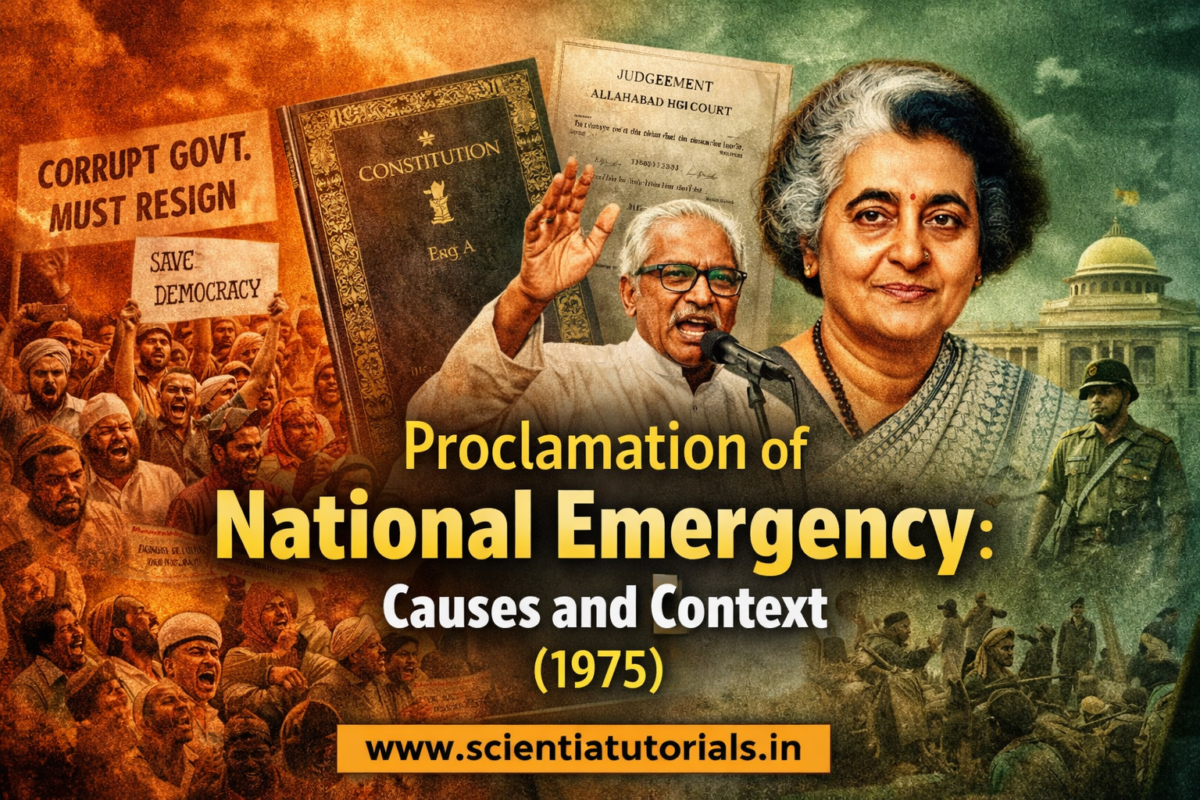

Proclamation of National Emergency – Causes and Context
Course: Post-Independence and Contemporary India – History of India
Module 5: Emergency and Crisis of Indian Democracy (1975–1977 CE)
Lesson: Proclamation of National Emergency – Causes and Context
Based on the Lesson followed by the above Module and Course, we have created study materials aligned to the needs of UPSC, State PSC, UGC-NET, CUET, CBSE, and all school, college, and university examinations in India:
- Study Module with Revision Notes,
- Questions with Answers,
- MCQs with Answers and detailed explanations.
Study Module with Revision Notes
I. Introduction: Emergency as a Turning Point in Indian Democracy
The Proclamation of National Emergency in June 1975 represents one of the most critical moments in the history of independent India. It marked the first and only internal Emergency declared under Article 352 of the Indian Constitution on grounds of internal disturbance. Unlike earlier emergencies (1962 and 1971), which were imposed due to external aggression, the 1975 Emergency directly challenged the democratic ethos, constitutional morality, and civil liberties of India.
This lesson examines the causes, political context, constitutional mechanisms, and immediate background that led to the proclamation of Emergency, situating it within the broader crisis of Indian democracy between 1975 and 1977.
II. Learning Objectives of the Lesson
After studying this lesson, students should be able to:
- Understand the constitutional provisions related to Emergency
- Analyse the political, social, and economic conditions preceding 1975
- Explain the role of leadership and opposition movements
- Assess the judicial and institutional context of the Emergency
- Critically evaluate the causes behind the suspension of democratic norms
- Link the Emergency to the broader theme of democratic crisis and political consolidation
III. Constitutional Framework of National Emergency
Article 352 of the Indian Constitution
Under Article 352, a National Emergency can be proclaimed if the security of India is threatened by:
- War
- External aggression
- Internal disturbance (term used prior to the 44th Constitutional Amendment)
The Emergency proclaimed on 25 June 1975 was justified on the ground of internal disturbance, a vague and undefined term that allowed wide executive discretion.
Implications of National Emergency
- Suspension of Fundamental Rights (Articles 14, 19, 21 in practice)
- Centralisation of power in the Union Government
- Weakening of federal structure
- Curtailment of press freedom and political opposition
IV. Political Background: India in the Early 1970s
Post-1971 Political Scenario
After the decisive victory in the 1971 India-Pakistan War, Indira Gandhi emerged as the most powerful leader in Indian politics. Her popularity peaked with:
- Creation of Bangladesh
- Nationalisation of banks
- Abolition of privy purses
However, this political consolidation soon faced serious challenges.
V. Economic Crisis and Social Unrest
Economic Factors
- High inflation due to oil shock (1973)
- Rising unemployment
- Food shortages and price rise
- Decline in industrial productivity
These conditions led to widespread dissatisfaction, especially among:
- Students
- Middle classes
- Urban poor
Popular Movements
- Gujarat Nav Nirman Movement (1974)
- Bihar Student Movement
Economic hardship became fertile ground for political mobilisation against the ruling Congress.
VI. Rise of Opposition Movements
Jayaprakash Narayan and “Total Revolution”
The most significant challenge came from Jayaprakash Narayan, popularly known as JP. He emerged as a moral and political voice against authoritarianism.
JP’s movement demanded:
- Resignation of corrupt governments
- Electoral reforms
- Decentralisation of power
- Restoration of democratic values
The call for “Total Revolution” transformed economic grievances into a mass political movement.
VII. Political Challenges to Indira Gandhi’s Leadership
Fragmentation of Opposition
- Non-Congress opposition lacked unity but gained momentum
- Street protests, strikes, and demonstrations intensified
Government’s Perception
The ruling leadership increasingly viewed:
- Opposition movements as threats to stability
- Protests as attempts to undermine constitutional authority
This led to growing intolerance towards dissent.
VIII. Judicial Context: Allahabad High Court Judgment (1975)
Background of the Case
Indira Gandhi’s 1971 election from Rae Bareli was challenged by Raj Narain on grounds of electoral malpractice.
The Verdict
On 12 June 1975, the Allahabad High Court:
- Found Indira Gandhi guilty of electoral irregularities
- Invalidated her election
- Barred her from holding elected office for six years
Political Impact
- Severe blow to her political legitimacy
- Opposition demanded her resignation
- Intensified mass mobilisation led by JP
This judgment became the immediate trigger for the Emergency.
IX. Immediate Context of the Emergency Proclamation
JP’s Call for Civil Resistance
JP appealed to:
- Students
- Trade unions
- Armed forces and police
to uphold the Constitution and resist unconstitutional authority. The government interpreted this as a call for insubordination.
Breakdown of Governance Narrative
The ruling establishment argued that:
- Law and order had collapsed
- Governance had become impossible
- National stability was under threat
X. Proclamation of National Emergency (25 June 1975)
On the night of 25 June 1975, the President proclaimed a National Emergency on the advice of the Prime Minister.
Key Features of the Proclamation
- No prior Cabinet discussion
- Rapid arrest of opposition leaders
- Press censorship imposed
- Fundamental Rights effectively suspended
The Emergency was formally justified as necessary to protect democracy, though it resulted in its suspension.
XI. Role of Institutions in the Emergency Context
Executive
- Centralisation of authority
- Rule by ordinance
- Dominance of Prime Minister’s Office
Legislature
- Parliament reduced to a rubber stamp
- Constitutional amendments passed with minimal debate
Judiciary
- Mixed response
- Some courts upheld executive actions
- Habeas corpus rights severely curtailed
The institutional balance envisaged by the Constitution was severely disrupted.
XII. Democratic Crisis: Nature and Interpretation
Was the Emergency Inevitable?
Historians differ:
- Some view it as a response to genuine instability
- Others see it as an authoritarian overreach to retain power
Structural Weaknesses Exposed
- Over-centralisation of power
- Weak internal democracy in political parties
- Inadequate safeguards against misuse of constitutional provisions
XIII. Long-Term Significance of the Emergency
Although the lesson focuses on causes and context, its importance lies in its long-term impact:
- Strengthened civil liberties discourse
- Led to the 44th Constitutional Amendment, limiting Emergency powers
- Enhanced public awareness of democratic rights
- Set precedent for judicial activism in later years
XIV. Examination-Oriented Revision Notes
Key Dates
- 1971 – Indira Gandhi’s electoral victory
- 1974 – Gujarat and Bihar movements
- 12 June 1975 – Allahabad High Court judgment
- 25 June 1975 – Proclamation of Emergency
Key Causes (Mnemonic: PEJUD)
- Political opposition
- Economic crisis
- JP movement
- Unfavourable judicial verdict
- Democratic centralisation
Frequently Asked Questions (Exam Focus)
- “Analyse the causes of the National Emergency of 1975.”
- “Examine the role of opposition movements in the proclamation of Emergency.”
- “Was the Emergency a constitutional necessity or political strategy?”
XV. Conclusion
The Proclamation of National Emergency in 1975 was not a sudden event but the culmination of economic distress, political confrontation, judicial intervention, and leadership insecurity. It exposed the vulnerabilities within India’s democratic framework while simultaneously reinforcing the importance of constitutional safeguards.
Understanding the causes and context of the Emergency is essential to appreciating the resilience of Indian democracy and the lessons drawn from its most severe crisis.
Questions with Answers
Lesson: Proclamation of National Emergency – Causes and Context (1975)
A. Very Short Answer Questions
Q1. On which date was the National Emergency proclaimed in India in 1975?
Answer:
The National Emergency was proclaimed on 25 June 1975.
Q2. Under which Article of the Indian Constitution was the Emergency of 1975 declared?
Answer:
The Emergency was declared under Article 352 of the Indian Constitution.
Q3. What was the official ground cited for the proclamation of Emergency in 1975?
Answer:
The Emergency was proclaimed on the ground of “internal disturbance.”
Q4. Name the Prime Minister of India at the time of the Emergency.
Answer:
The Prime Minister was Indira Gandhi.
Q5. Which High Court judgment acted as the immediate trigger for the Emergency?
Answer:
The Allahabad High Court judgment (12 June 1975) acted as the immediate trigger.
Q6. Who filed the election petition against Indira Gandhi?
Answer:
The election petition was filed by Raj Narain.
Q7. Which term replaced “internal disturbance” after the 44th Constitutional Amendment?
Answer:
The term “armed rebellion” replaced “internal disturbance.”
B. Short Answer Questions
Q8. Explain the meaning of “internal disturbance” in the context of the 1975 Emergency.
Answer:
“Internal disturbance” was a vague constitutional term that allowed the executive wide discretion to declare Emergency. It was not clearly defined and enabled the suspension of democratic rights even without armed rebellion.
Q9. Mention any three economic factors that contributed to the Emergency.
Answer:
- High inflation and price rise
- Rising unemployment
- Economic stress due to the 1973 oil crisis
Q10. What was the Gujarat Nav Nirman Movement?
Answer:
It was a popular mass movement in Gujarat (1974) against corruption, price rise, and misgovernance, leading to the resignation of the state government and inspiring wider opposition politics.
Q11. Briefly describe the role of Jayaprakash Narayan in the anti-Emergency movement.
Answer:
Jayaprakash Narayan led a nationwide movement demanding “Total Revolution,” mobilising students, workers, and opposition parties against corruption, authoritarianism, and erosion of democratic values.
Q12. Why was the Allahabad High Court verdict politically significant?
Answer:
The verdict invalidated Indira Gandhi’s election and disqualified her from office, severely undermining her legitimacy and intensifying political pressure for her resignation.
Q13. How did the government justify the proclamation of Emergency?
Answer:
The government argued that political instability, mass protests, and breakdown of law and order threatened national security and governance.
Q14. What was the impact of the Emergency on Fundamental Rights?
Answer:
Fundamental Rights, particularly Articles 14, 19, and 21, were effectively suspended, allowing arrests without trial and curtailment of civil liberties.
C. Long Answer Questions
Q15. Analyse the political causes that led to the proclamation of National Emergency in 1975.
Answer:
Political causes included growing opposition unity, mass protests led by Jayaprakash Narayan, erosion of Congress dominance, and increasing intolerance of dissent by the ruling leadership. The Allahabad High Court judgment further intensified the crisis.
Q16. Examine the economic context behind the Emergency.
Answer:
The early 1970s witnessed inflation, unemployment, food shortages, and economic stagnation due to global oil shocks and domestic policy constraints. These conditions fuelled public dissatisfaction and political unrest.
Q17. Discuss the role of opposition movements in the context of the Emergency.
Answer:
Opposition movements transformed economic grievances into mass political mobilisation. Student movements, trade unions, and non-Congress parties challenged the legitimacy of the ruling government, creating a climate of confrontation.
Q18. Explain the significance of Jayaprakash Narayan’s call for “Total Revolution.”
Answer:
The call sought comprehensive political, social, and economic reform through non-violent means. It questioned centralised authority and mobilised democratic forces against authoritarian tendencies.
Q19. Assess the role of the judiciary in the events leading to the Emergency.
Answer:
The judiciary played a crucial role through the Allahabad High Court judgment. However, during the Emergency, judicial independence weakened, as seen in restrictions on habeas corpus rights.
Q20. Why is the 1975 Emergency described as a crisis of Indian democracy?
Answer:
It involved suspension of civil liberties, censorship of the press, arrest of opposition leaders, and concentration of power, undermining democratic norms and constitutional safeguards.
Q21. Was the proclamation of Emergency constitutionally valid but democratically unjustified? Explain.
Answer:
While the Emergency followed constitutional procedures, its use to suppress political opposition rather than address genuine security threats made it democratically unjustified.
Q22. Discuss the role of leadership in the proclamation of Emergency.
Answer:
Leadership insecurity following electoral and judicial setbacks, coupled with a belief in strong central authority, played a decisive role in imposing Emergency.
Q23. Examine how the Emergency exposed weaknesses in India’s constitutional system.
Answer:
The Emergency revealed excessive executive power, vague constitutional provisions, weak institutional checks, and insufficient safeguards against misuse of authority.
Q24. How did the experience of Emergency influence later constitutional reforms?
Answer:
It led to the 44th Constitutional Amendment, which restricted Emergency powers, restored civil liberties, and strengthened democratic safeguards.
Q25. “The Emergency was a product of both structural weaknesses and immediate political pressures.” Discuss.
Answer:
Structural issues such as centralisation of power and weak institutional autonomy combined with immediate pressures like economic crisis, opposition mobilisation, and judicial verdicts to produce the Emergency.
MCQs with Answers
Lesson: Proclamation of National Emergency – Causes and Context (1975)
Q1. The National Emergency of 1975 was proclaimed under which Article of the Indian Constitution?
A. Article 356
B. Article 360
C. Article 352
D. Article 368
Correct Answer: C
Explanation:
Article 352 empowers the President to proclaim a National Emergency when the security of India is threatened by war, external aggression, or internal disturbance (as it existed before the 44th Amendment).
Q2. On what date was the National Emergency proclaimed in India?
A. 12 June 1975
B. 25 June 1975
C. 15 August 1975
D. 26 January 1976
Correct Answer: B
Explanation:
The Emergency was proclaimed on the night of 25 June 1975, marking the beginning of the gravest constitutional crisis in independent India.
Q3. The Emergency of 1975 was justified on which ground?
A. War
B. External aggression
C. Armed rebellion
D. Internal disturbance
Correct Answer: D
Explanation:
“Internal disturbance” was a vague and undefined term that allowed wide executive discretion and was later replaced by “armed rebellion” through the 44th Constitutional Amendment.
Q4. Who was the Prime Minister of India at the time of the Emergency?
A. Jawaharlal Nehru
B. Lal Bahadur Shastri
C. Morarji Desai
D. Indira Gandhi
Correct Answer: D
Explanation:
Indira Gandhi advised the President to proclaim the Emergency, making her leadership central to both its declaration and implementation.
Q5. Which judicial verdict acted as the immediate trigger for the Emergency?
A. Kesavananda Bharati case
B. Golaknath case
C. Allahabad High Court judgment
D. ADM Jabalpur judgment
Correct Answer: C
Explanation:
The Allahabad High Court judgment of 12 June 1975 invalidated Indira Gandhi’s election, triggering a major political crisis.
Q6. Who filed the election petition against Indira Gandhi?
A. Morarji Desai
B. Atal Bihari Vajpayee
C. Raj Narain
D. Jayaprakash Narayan
Correct Answer: C
Explanation:
Raj Narain challenged Indira Gandhi’s 1971 election on grounds of electoral malpractice.
Q7. Which Fundamental Right was most extensively suspended during the Emergency?
A. Right to Religion
B. Right to Constitutional Remedies
C. Right to Equality
D. Right to Property
Correct Answer: B
Explanation:
Suspension of the Right to Constitutional Remedies (Article 32) made enforcement of other rights practically impossible.
Q8. The slogan “Total Revolution” is associated with:
A. Ram Manohar Lohia
B. Jayaprakash Narayan
C. George Fernandes
D. Charan Singh
Correct Answer: B
Explanation:
Jayaprakash Narayan called for “Total Revolution” to bring comprehensive political, social, and economic reforms through democratic mobilisation.
Q9. Which movement preceded the Emergency and highlighted mass discontent?
A. Tebhaga Movement
B. Chipko Movement
C. Nav Nirman Movement
D. Telangana Movement
Correct Answer: C
Explanation:
The Gujarat Nav Nirman Movement (1974) protested corruption and price rise, becoming a precursor to nationwide opposition movements.
Q10. The Bihar Student Movement was significant because it:
A. Focused only on education reforms
B. Supported the Emergency
C. Mobilised youth against authoritarianism
D. Demanded linguistic reorganisation
Correct Answer: C
Explanation:
The Bihar Student Movement became a mass political movement under JP’s leadership, challenging authoritarian tendencies.
Q11. Which global economic factor worsened India’s economic condition in the early 1970s?
A. Great Depression
B. Asian Financial Crisis
C. Oil Shock of 1973
D. Collapse of Bretton Woods
Correct Answer: C
Explanation:
The 1973 oil crisis caused inflation, fiscal stress, and economic hardship, contributing to popular unrest.
Q12. Which institution was most affected by press censorship during the Emergency?
A. Judiciary
B. Election Commission
C. Media
D. Planning Commission
Correct Answer: C
Explanation:
The press was subjected to pre-censorship, severely curtailing freedom of expression.
Q13. Which constitutional amendment later replaced “internal disturbance” with “armed rebellion”?
A. 42nd Amendment
B. 44th Amendment
C. 52nd Amendment
D. 73rd Amendment
Correct Answer: B
Explanation:
The 44th Constitutional Amendment (1978) strengthened safeguards against misuse of Emergency powers.
Q14. Which of the following best describes the role of Parliament during the Emergency?
A. Actively challenged executive actions
B. Remained dissolved
C. Functioned as a rubber stamp
D. Controlled the executive
Correct Answer: C
Explanation:
Parliament largely endorsed executive decisions with minimal debate, weakening legislative oversight.
Q15. The Emergency exposed which major weakness of Indian democracy?
A. Excessive federalism
B. Weak political leadership
C. Over-centralisation of power
D. Judicial overreach
Correct Answer: C
Explanation:
The concentration of power in the executive revealed vulnerabilities in constitutional checks and balances.
Q16. Which right was specifically affected by preventive detention laws during the Emergency?
A. Right to Property
B. Right to Life and Personal Liberty
C. Right to Education
D. Right to Religion
Correct Answer: B
Explanation:
Article 21 was effectively nullified, allowing detention without trial.
Q17. The government justified the Emergency primarily as a measure to:
A. Promote socialism
B. Protect national security and stability
C. Implement land reforms
D. Control inflation
Correct Answer: B
Explanation:
The official justification emphasized law and order breakdown and threats to governance.
Q18. Which group formed the core of opposition mobilisation before the Emergency?
A. Industrialists
B. Students and middle classes
C. Armed forces
D. Bureaucracy
Correct Answer: B
Explanation:
Students and middle-class groups played a leading role in protests against corruption and authoritarianism.
Q19. The Emergency of 1975 is often described as:
A. A foreign policy crisis
B. A constitutional dictatorship
C. A socialist revolution
D. A military coup
Correct Answer: B
Explanation:
Although constitutional in form, the Emergency concentrated power in a manner resembling authoritarian rule.
Q20. Which institution showed a mixed response to Emergency measures?
A. Election Commission
B. Judiciary
C. Press Council
D. State Governments
Correct Answer: B
Explanation:
While some judges upheld executive actions, others later defended civil liberties, revealing institutional tension.
Q21. The Emergency most directly challenged which democratic principle?
A. Federalism
B. Secularism
C. Popular sovereignty
D. Rule of law
Correct Answer: D
Explanation:
Arbitrary arrests and suspension of rights undermined the rule of law.
Q22. Which of the following best explains the political context of the Emergency?
A. Strong opposition unity and leadership insecurity
B. Stable economy and weak opposition
C. External military threat
D. Coalition instability
Correct Answer: A
Explanation:
Opposition mobilisation combined with leadership insecurity following judicial setbacks created the immediate context.
Q23. The Emergency demonstrated that constitutional provisions can be:
A. Entirely rigid
B. Immune to misuse
C. Used against democratic spirit
D. Irrelevant in practice
Correct Answer: C
Explanation:
The Emergency showed that constitutional legality does not always ensure democratic morality.
Q24. Which amendment is considered a corrective response to the Emergency experience?
A. 39th Amendment
B. 42nd Amendment
C. 44th Amendment
D. 52nd Amendment
Correct Answer: C
Explanation:
The 44th Amendment restored civil liberties and restricted Emergency powers.
Q25. From an examination perspective, the Emergency best fits which theme of Module 5?
A. Economic planning
B. Crisis of democratic institutions
C. Regional politics
D. Electoral reforms
Correct Answer: B
Explanation:
The Emergency represents the most severe crisis of democratic institutions in post-independence India.
✔️ Exam Strategy Tip
- UPSC / State PSC: Analyse causes, institutions, and democratic implications
- NET / CUET: Focus on constitutional articles, amendments, and chronology
- CBSE / Universities: Emphasise concepts, movements, and key personalities
-
Proclamation of National Emergency 1975 causes and context
-
Emergency 1975 crisis of Indian democracy
-
National Emergency under Article 352 explained
-
Emergency and democratic breakdown in India
-
National Emergency 1975 UPSC history notes
-
Emergency 1975 causes for State PSC examinations
-
Emergency and Indian Constitution for NET and CUET
-
Emergency 1975 CBSE political science history
-
Role of Jayaprakash Narayan in Emergency 1975
-
JP movement and proclamation of Emergency
-
Indira Gandhi and National Emergency context
-
Opposition movements before Emergency 1975