
Janata Party Experiment and Political Realignments
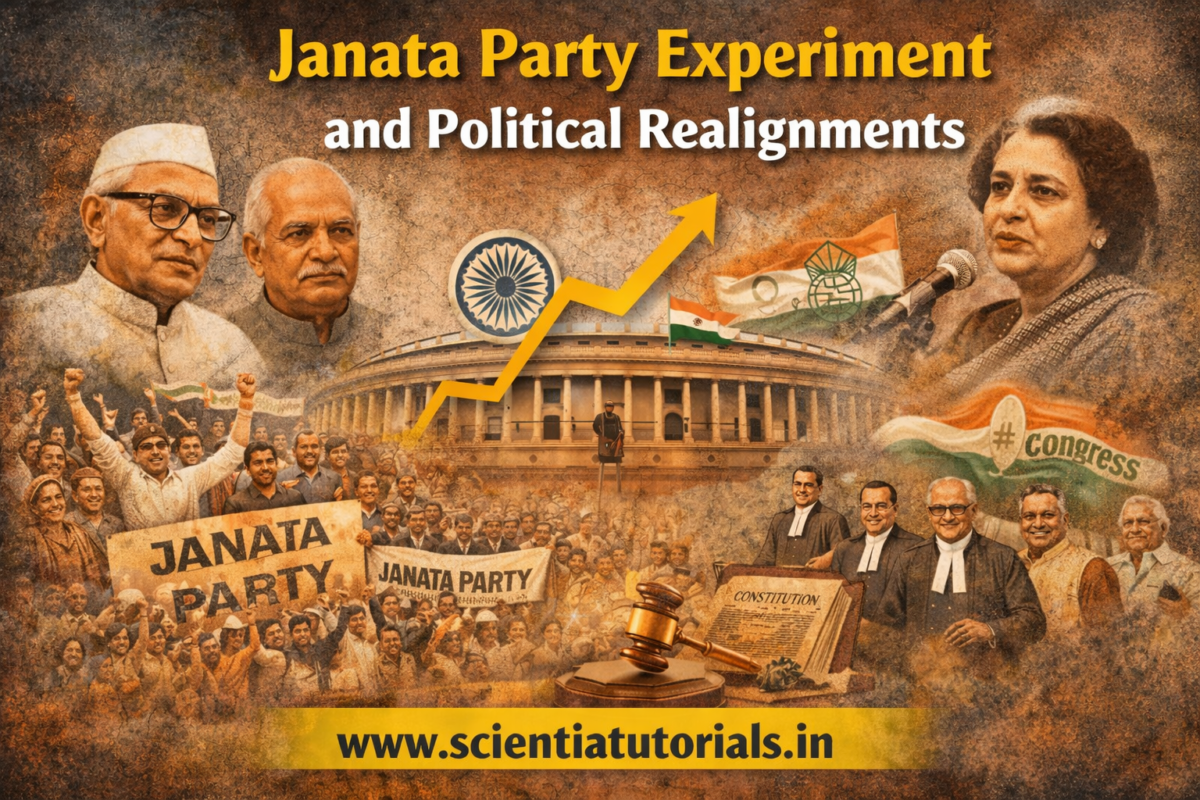

Janata Party Experiment and Political Realignments
- Course: Post-Independence and Contemporary India – History of India
- Module 6: Coalition Politics and Social Transformation
- Timeline: 1977–1991 (CE)
Based on the Lesson followed by the above Module and Course, we have created study materials aligned to the needs of UPSC, State PSC, UGC-NET, CUET, CBSE, and all school, college, and university examinations in India:
- Study Module with Revision Notes,
- Questions with Answers,
- MCQs with Answers and detailed explanations.
Study Module with Revision Notes
Janata Party Experiment and Political Realignments (1977–1991)
1. Introduction: From Congress Dominance to Coalition Politics
The period from 1977 to 1991 marks a decisive transition in Indian political history. It witnessed the collapse of one-party dominance, the emergence of coalition governments, and profound political and social realignments. The immediate catalyst for this transformation was the defeat of the Congress Party in the 1977 General Elections following the Emergency.
The Janata Party experiment (1977–79) represented India’s first sustained attempt at coalition governance at the national level. Though short-lived, it fundamentally altered political behaviour, party competition, federal dynamics, and the nature of democratic politics in India. This phase laid the foundations of the coalition era that would later mature in the 1990s.
2. Background: Political Climate after the Emergency
The Emergency (1975–77) profoundly reshaped Indian politics. Its withdrawal and the subsequent elections led to:
- Moral delegitimisation of authoritarian rule
- Heightened public awareness of civil liberties
- Unprecedented unity among opposition parties
The electorate decisively rejected Congress authoritarianism, especially in North India, paving the way for an alternative political formation.
3. Formation of the Janata Party (1977)
Origins and Composition
The Janata Party was formed in early 1977 through the merger of several opposition groups, including:
- Congress (O)
- Bharatiya Jana Sangh
- Socialist Party factions
- Bharatiya Lok Dal
This coalition brought together leaders with diverse ideological backgrounds, united primarily by opposition to Congress rule and commitment to restoring democracy.
Ideological Character
The Janata Party was not ideologically homogeneous. It combined:
- Socialists advocating welfare and decentralisation
- Conservatives emphasising cultural nationalism
- Agrarian leaders representing peasant interests
This ideological diversity later became a major source of internal conflict.
4. The Janata Government (1977–1979)
Leadership and Governance
The Janata Party formed the government under Morarji Desai, India’s first non-Congress Prime Minister.
Key features of governance included:
- Restoration of civil liberties
- Release of political prisoners
- Repeal of authoritarian measures
- Commitment to democratic norms
The government symbolised the return of constitutional democracy after the Emergency.
5. Achievements of the Janata Government
Despite its short tenure, the Janata government made several significant contributions:
(a) Democratic Restoration
- Ended censorship and repression
- Reaffirmed rule of law
- Re-established parliamentary supremacy
(b) Constitutional Reforms
- Passed the 44th Constitutional Amendment (1978)
- Made Emergency provisions more stringent
- Protected Fundamental Rights, especially Article 21
(c) Federal and Political Norms
- Encouraged political pluralism
- Reduced Congress monopoly over power
- Normalised opposition rule at the Centre
6. Internal Conflicts and Collapse of the Janata Party
Causes of Disintegration
The Janata experiment collapsed in 1979 due to:
- Ideological incompatibility among partners
- Leadership rivalries
- Lack of a common minimum programme
- Personal ambitions and factionalism
Disputes between leaders such as Morarji Desai and Charan Singh paralysed governance.
Fall of the Government
Charan Singh briefly became Prime Minister with outside support from Congress but resigned without facing Parliament. The Janata Party fragmented, marking the failure of India’s first coalition experiment.
7. Political Realignments after 1979
Return of Congress (1980)
The collapse of the Janata government led to the resurgence of Congress under Indira Gandhi in 1980. However, the political environment had changed permanently:
- Congress dominance was no longer unquestioned
- Opposition politics had gained legitimacy
- Coalition logic had entered national politics
8. Decline of One-Party Dominance
From 1977 onwards, Indian politics moved away from the Congress system toward:
- Competitive multi-party politics
- Frequent alternation of power
- Stronger opposition presence
Even when Congress returned to power, it faced fragmented mandates and regional challenges.
9. Rise of Regional Parties
A key political realignment during 1977–1991 was the emergence of regional and state-based parties, reflecting India’s social diversity.
Causes:
- Assertion of regional identities
- Uneven development
- Decline of Congress’s organisational strength
Impact:
- Strengthened federalism
- Increased bargaining power of states
- Made coalition governments inevitable
10. Social Transformation and New Political Forces
Agrarian Politics
Leaders like Charan Singh articulated peasant and agrarian interests, shifting political focus from urban elites to rural constituencies.
Caste and Social Justice
This period saw:
- Increased mobilisation of backward classes
- Foundations of Mandal politics (later in 1990s)
- Democratisation of political participation
Politics increasingly reflected social coalitions rather than elite consensus.
11. Role of Opposition and Democratic Deepening
The Janata experiment legitimised opposition rule and proved that:
- Democracy could function without Congress
- Power transfer through elections was normal
- Coalition governments were constitutionally viable
This deepened democratic norms and reduced fear of political instability.
12. Institutional and Electoral Changes
Electoral Behaviour
- Voters became more assertive
- Anti-incumbency became a normal phenomenon
- Electoral mandates became fragmented
Political Culture
- Shift from personality-centric to coalition-centric politics
- Negotiation and consensus replaced dominance
13. Janata Party as a Precursor to Later Coalitions
Though it failed, the Janata Party provided crucial lessons:
- Need for ideological coherence
- Importance of leadership discipline
- Necessity of a common minimum programme
Later coalitions (National Front, United Front, NDA, UPA) drew heavily from this experience.
14. Long-Term Significance of the Janata Experiment
The Janata Party experiment:
- Ended Congress monopoly
- Introduced coalition governance
- Strengthened federal and social representation
- Reshaped political alignments permanently
It marked the beginning of a new phase in Indian democracy.
15. Revision Notes for Examinations
Chronological Highlights
- 1977: Janata Party victory
- 1977–79: Janata government
- 1979: Collapse of coalition
- 1980: Congress returns, but dominance weakened
Key Concepts
- Coalition politics
- Political realignment
- Decline of one-party dominance
- Social and regional mobilisation
Keywords for Answers
- Post-Congress polity
- Opposition unity
- Federal assertion
- Coalition instability
Answer-Writing Tips (UPSC / NET)
- Link Janata failure to later coalition success
- Highlight social and regional shifts
- Use Janata Party as a turning point
16. Conclusion: Janata Party and the Making of Coalition India
The Janata Party experiment was short-lived but transformative. While it failed to provide stable governance, it fundamentally altered India’s political trajectory. It demonstrated that democracy in India was plural, competitive, and resilient, capable of adapting to social diversity and political fragmentation.
Between 1977 and 1991, Indian politics moved decisively toward coalition politics and social transformation, laying the groundwork for the complex but inclusive democratic order that followed.
Questions with Answers
The questions include short, medium, and long answer types, carefully designed for UPSC, State PSCs, UGC-NET, CUET, CBSE, and school, college, and university examinations.
A. Short Answer Questions
1. What is meant by the ‘Janata Party experiment’?
Answer:
The Janata Party experiment refers to India’s first experience of a non-Congress coalition government at the Centre (1977–79), formed after the defeat of Congress following the Emergency.
2. Which event directly led to the formation of the Janata Party?
Answer:
The 1977 General Elections, held after the withdrawal of the Emergency, led to the formation of the Janata Party.
3. Name the Prime Minister who headed the Janata government formed in 1977.
Answer:
Morarji Desai became India’s first non-Congress Prime Minister.
4. Mention any two political groups that merged to form the Janata Party.
Answer:
- Congress (O)
- Bharatiya Jana Sangh
(Socialist groups and Bharatiya Lok Dal were also part of the merger.)
5. Why was the Janata Party ideologically diverse?
Answer:
It brought together socialists, conservatives, agrarian leaders, and former Congress members united mainly by opposition to Congress dominance.
6. What constitutional amendment was a major achievement of the Janata government?
Answer:
The 44th Constitutional Amendment Act (1978), which strengthened democratic safeguards and limited Emergency powers.
7. Name the leader associated with agrarian politics during this period.
Answer:
Charan Singh was closely associated with peasant and agrarian interests.
8. What marked the end of the Janata Party government?
Answer:
Internal conflicts and leadership rivalries led to the collapse of the Janata government in 1979.
B. Medium Answer Questions
9. Discuss the circumstances that led to the victory of the Janata Party in 1977.
Answer:
Public resentment against the Emergency, suspension of civil liberties, press censorship, and authoritarian governance resulted in widespread opposition to Congress, leading to the Janata Party’s victory.
10. Explain the significance of the Janata Party experiment in Indian politics.
Answer:
It ended Congress monopoly, legitimised opposition rule, and introduced coalition politics at the national level.
11. Why did the Janata Party government fail to complete its full term?
Answer:
Ideological incompatibility, leadership rivalries, absence of a common minimum programme, and factionalism caused instability and collapse.
12. How did the Janata government contribute to democratic restoration?
Answer:
It restored civil liberties, released political prisoners, removed censorship, and reaffirmed constitutional governance.
13. Examine the role of leadership conflicts in the disintegration of the Janata Party.
Answer:
Conflicts between leaders like Morarji Desai and Charan Singh paralysed decision-making and fractured party unity.
14. How did the Janata Party experience influence future coalition politics?
Answer:
It highlighted the need for ideological clarity, coalition discipline, and consensus-based governance in later coalitions.
C. Long Answer Questions
15. Analyse the Janata Party experiment as a turning point in post-Independence Indian politics.
Answer:
The Janata Party experiment marked the end of one-party dominance, introduced coalition governance, and reshaped democratic competition. Though short-lived, it permanently altered India’s political structure.
16. “The failure of the Janata Party did not mean the failure of coalition politics.” Discuss.
Answer:
While the Janata government collapsed, it normalised coalition rule and paved the way for future stable coalitions by offering valuable lessons in governance.
17. Evaluate the achievements of the Janata government despite its short tenure.
Answer:
Key achievements included restoration of democracy, constitutional reforms, strengthening of civil liberties, and legitimisation of opposition rule.
18. Discuss the political realignments that followed the collapse of the Janata Party.
Answer:
The period saw the return of Congress, emergence of regional parties, decline of one-party dominance, and gradual acceptance of coalition politics.
19. How did the Janata Party period contribute to the rise of regional and social forces?
Answer:
It weakened central dominance, encouraged federal assertion, and facilitated political mobilisation of regional and agrarian interests.
20. Examine the role of the Janata Party in the decline of the ‘Congress system’.
Answer:
By defeating Congress at the Centre, the Janata Party shattered the myth of Congress invincibility and ushered in competitive multi-party politics.
D. Analytical and Comparative Questions
21. Compare coalition politics before and after the Janata Party experiment.
Answer:
Before 1977, coalitions were largely regional and unstable; after Janata, coalition politics became nationally acceptable and structurally embedded.
22. To what extent did social transformation shape political realignments during 1977–1991?
Answer:
Growing political participation of peasants, backward classes, and regions reshaped party competition and weakened elite-centric politics.
23. How did the Janata Party experiment strengthen Indian federalism?
Answer:
It reduced central dominance, empowered states, and encouraged regional political assertions within the federal structure.
24. Critically assess the role of opposition unity in the success and failure of the Janata Party.
Answer:
Opposition unity ensured electoral success but ideological diversity and lack of cohesion led to governance failure.
25. Why is the Janata Party experiment considered a precursor to the coalition era of the 1990s?
Answer:
It introduced coalition norms, opposition governance, and federal bargaining, laying the foundation for later coalition governments.
Multiple Choice Questions
Janata Party Experiment and Political Realignments
These MCQs are carefully framed for UPSC, State PSCs, UGC-NET, CUET, CBSE, and school, college, and university examinations.
1. The Janata Party experiment is historically significant because it:
A. Introduced socialism as state policy
B. Ended Emergency permanently
C. Established the first non-Congress government at the Centre
D. Abolished the Congress Party
Correct Answer: C
Explanation:
For the first time since Independence, a non-Congress coalition formed the Union government, breaking one-party dominance.
2. The immediate political background to the formation of the Janata Party was:
A. Economic liberalisation
B. The Emergency (1975–77)
C. Linguistic reorganisation of states
D. Sino-Indian War
Correct Answer: B
Explanation:
The Emergency created widespread opposition to Congress rule, encouraging opposition unity.
3. Who became the first non-Congress Prime Minister of India in 1977?
A. Charan Singh
B. Atal Bihari Vajpayee
C. Morarji Desai
D. Jagjivan Ram
Correct Answer: C
Explanation:
Morarji Desai headed the Janata government from 1977 to 1979.
4. Which of the following parties was NOT a constituent of the Janata Party?
A. Congress (O)
B. Bharatiya Jana Sangh
C. Bharatiya Lok Dal
D. Communist Party of India (Marxist)
Correct Answer: D
Explanation:
The CPI(M) supported the anti-Congress movement but did not merge into the Janata Party.
5. The Janata Party was ideologically:
A. Homogeneous and disciplined
B. Socialist and Marxist
C. Diverse and internally divided
D. Exclusively conservative
Correct Answer: C
Explanation:
The party included socialists, conservatives, agrarian leaders, and former Congress members.
6. One major achievement of the Janata government was:
A. Nationalisation of banks
B. 44th Constitutional Amendment
C. Green Revolution
D. Panchayati Raj reforms
Correct Answer: B
Explanation:
The 44th Amendment strengthened democratic safeguards and limited misuse of Emergency powers.
7. The 44th Constitutional Amendment ensured that:
A. Parliament became supreme
B. Emergency could be declared by states
C. Article 21 could not be suspended
D. Preventive detention was abolished
Correct Answer: C
Explanation:
Protection of the Right to Life and Personal Liberty became permanent even during Emergency.
8. Which leader symbolised agrarian and peasant interests during this period?
A. Rajiv Gandhi
B. Charan Singh
C. Jayaprakash Narayan
D. V. P. Singh
Correct Answer: B
Explanation:
Charan Singh championed rural and agrarian interests and later became Prime Minister.
9. The Janata government collapsed mainly due to:
A. Military intervention
B. Foreign pressure
C. Internal factionalism and leadership rivalry
D. Electoral defeat
Correct Answer: C
Explanation:
Ideological differences and leadership conflicts weakened the coalition.
10. Charan Singh’s government in 1979:
A. Completed a full term
B. Was supported by the Left parties
C. Resigned without facing Parliament
D. Introduced major reforms
Correct Answer: C
Explanation:
Charan Singh resigned before proving his majority in the Lok Sabha.
11. The collapse of the Janata Party led to:
A. End of coalition politics
B. Restoration of one-party dominance permanently
C. Return of Congress under Indira Gandhi
D. Military rule
Correct Answer: C
Explanation:
Congress returned to power in 1980, but the political environment had changed.
12. One major long-term impact of the Janata Party experiment was:
A. End of federalism
B. Rise of coalition politics
C. Decline of electoral democracy
D. Centralisation of power
Correct Answer: B
Explanation:
Coalition politics became a permanent feature of Indian democracy.
13. Which region showed the strongest support for the Janata Party in 1977?
A. South India
B. North India
C. North-East India
D. Western India
Correct Answer: B
Explanation:
North India strongly opposed Emergency excesses and voted against Congress.
14. The Janata Party experiment contributed to:
A. Weakening of opposition politics
B. Delegitimisation of elections
C. Decline of Congress system
D. End of socialism
Correct Answer: C
Explanation:
Congress lost its monopoly over national politics after 1977.
15. Which of the following best describes political realignment after 1977?
A. Shift to presidential system
B. Emergence of multi-party competition
C. One-party authoritarianism
D. Decline of regional politics
Correct Answer: B
Explanation:
Politics became competitive with multiple parties sharing power.
16. The Janata Party experiment showed that:
A. Coalition governments are unconstitutional
B. Democracy depends only on strong leaders
C. Opposition can govern at the Centre
D. Regional parties are irrelevant
Correct Answer: C
Explanation:
It legitimised opposition rule and peaceful transfer of power.
17. Which political trend accelerated during 1977–1991?
A. Centralisation of party system
B. Decline of voter participation
C. Rise of regional parties
D. Military influence
Correct Answer: C
Explanation:
Regional and state-based parties became increasingly influential.
18. The Janata Party experience influenced later coalitions by highlighting the need for:
A. Ideological rigidity
B. One-party rule
C. Common Minimum Programme
D. Presidential governance
Correct Answer: C
Explanation:
Later coalitions learned the importance of agreed policy frameworks.
19. Which social group gained political visibility during this phase?
A. Only urban elites
B. Backward classes and peasants
C. Industrial capitalists only
D. Armed forces
Correct Answer: B
Explanation:
Politics became more socially representative and inclusive.
20. The decline of Congress dominance after 1977 indicates:
A. Collapse of democracy
B. Weakening of Constitution
C. Maturation of democratic competition
D. End of national politics
Correct Answer: C
Explanation:
Power alternation is a sign of democratic maturity.
21. Which of the following best captures the nature of the Janata Party?
A. Cadre-based ideological party
B. Electoral alliance turned political party
C. Regional pressure group
D. Communist front
Correct Answer: B
Explanation:
It was an alliance formed mainly for electoral and anti-Congress purposes.
22. The Janata Party experiment strengthened Indian federalism by:
A. Weakening states
B. Encouraging regional assertion
C. Abolishing state governments
D. Centralising resources
Correct Answer: B
Explanation:
Coalition politics increased the bargaining power of states and regions.
23. Which election marked the beginning of coalition politics at the Centre?
A. 1967
B. 1971
C. 1977
D. 1989
Correct Answer: C
Explanation:
The 1977 elections brought the Janata coalition to power nationally.
24. The period 1977–1991 can best be described as:
A. Era of Congress monopoly
B. Transitional phase towards coalition democracy
C. Period of political stagnation
D. Phase of military dominance
Correct Answer: B
Explanation:
This phase laid the foundations for the coalition era of the 1990s.
25. The most important lesson of the Janata Party experiment was that:
A. Coalition governments always fail
B. Democracy requires ideological uniformity
C. Political unity must be sustained beyond elections
D. Opposition parties should avoid governance
Correct Answer: C
Explanation:
Electoral unity without governance cohesion leads to instability.
🔹 Exam-Oriented Long-Tail Keyphrases
-
Janata Party experiment 1977–79 UPSC notes
-
Political realignments in India after Emergency
-
Janata Party government achievements and failures
-
Coalition politics in India 1977–1991 exam notes
-
Janata Party experiment for UPSC State PSC NET CUET
🔹 Conceptual & Analytical Keyphrases
-
Causes of formation of Janata Party in India
-
Why did the Janata Party government fail
-
Significance of Janata Party experiment in Indian politics
-
Janata Party and decline of Congress system
-
Janata Party as beginning of coalition era in India
🔹 Coalition Politics & Federalism
-
Rise of coalition politics after 1977 in India
-
Janata Party experiment and Indian federalism
-
Opposition unity and coalition instability in India
-
Political fragmentation and coalition governments India
-
Lessons from Janata Party for coalition governance
🔹 Social & Political Transformation
-
Political realignments in India 1977–1991 explained
-
Rise of regional parties after Janata Party
-
Agrarian politics and Charan Singh era
-
Social transformation and electoral politics in India
-
Janata Party and democratisation of Indian politics
🔹 School, College & General Search Keyphrases
-
What was the Janata Party experiment
-
Janata Party experiment explained for students
-
Coalition politics in India class notes
-
Janata Party government simple explanation
-
Post-Emergency political changes in India