
Lal Bahadur Shastri and Indira Gandhi: Leadership Transition
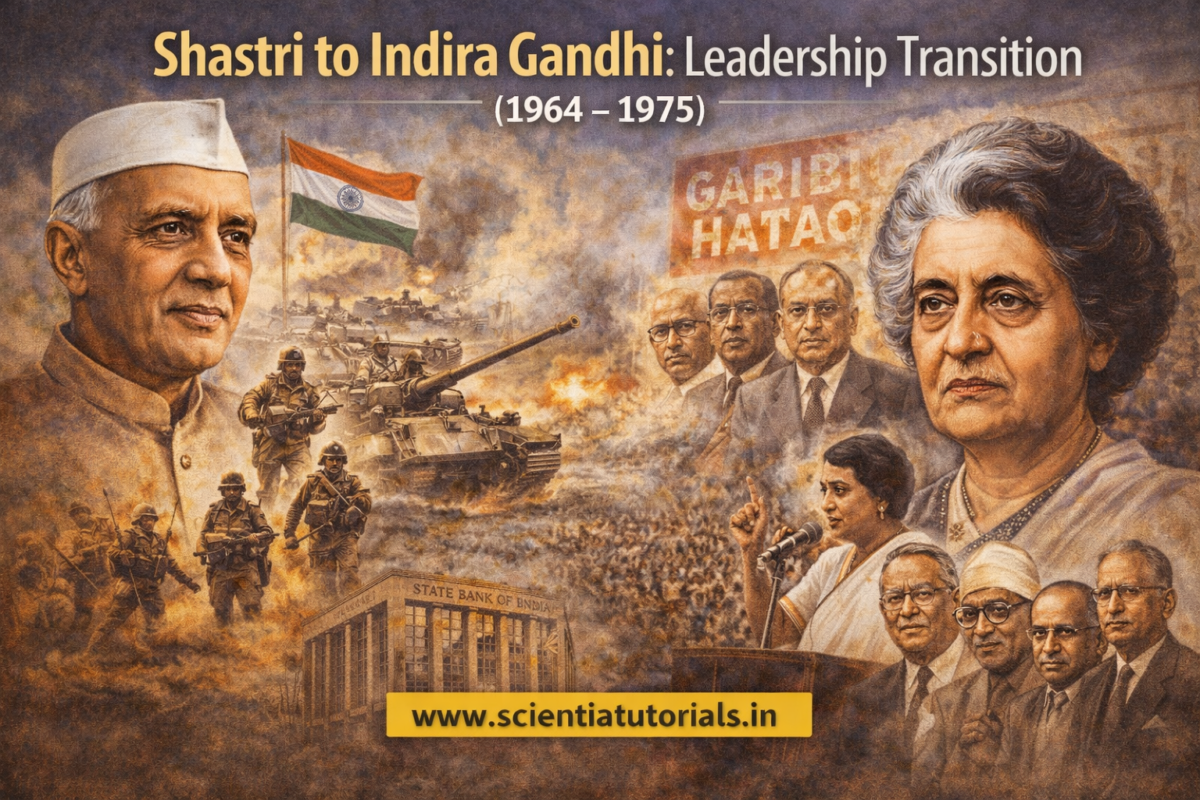

Lal Bahadur Shastri and Indira Gandhi: Leadership Transition (1964–1975)
Course: Post-Independence and Contemporary India – History of India
Module 4: Political Consolidation and Democratic Challenges
Timeline: 1964–1975 (CE)
Based on the Lesson followed by the above Module and Course, we have created study materials aligned to the needs of UPSC, State PSC, UGC-NET, CUET, CBSE, and all school, college, and university examinations in India:
- Study Module with Revision Notes,
- Questions with Answers,
- MCQs with Answers and detailed explanations.
Study Module with Revision Notes
Introduction: A Critical Phase of Political Transition
The period 1964–1975 marks a decisive phase in India’s post-Independence political evolution. The death of Jawaharlal Nehru in May 1964 ended an era of charismatic, consensus-driven leadership and ushered in a phase of leadership transition, institutional strain, and political experimentation.
This module focuses on the successive leadership of Lal Bahadur Shastri and Indira Gandhi, analysing how India navigated challenges of governance, economic stress, party fragmentation, wars, and democratic consolidation during this turbulent decade.
I. Background: End of the Nehruvian Consensus
1. Political Vacuum after 1964
Nehru’s death created:
- Absence of a towering national leader
- Increased role of party bosses (“Syndicate”)
- Growing assertion of states and regional leaders
The Congress system, though dominant, was no longer monolithic.
2. Structural Challenges
India in the mid-1960s faced:
- Economic stagnation and food shortages
- Aftermath of the 1962 war with China
- Rising population and unemployment
- Growing public dissatisfaction
Leadership transition thus occurred under crisis conditions.
II. Lal Bahadur Shastri: Consensus Leader in Crisis (1964–1966)
1. Rise to Prime Ministership
Shastri was chosen as Prime Minister because he was seen as:
- A compromise candidate
- Personally honest and non-confrontational
- Acceptable to senior Congress leaders
Despite initial perceptions, Shastri emerged as a firm and decisive leader.
2. Leadership Style and Political Philosophy
Shastri’s leadership was marked by:
- Simplicity and moral integrity
- Faith in democratic institutions
- Collective decision-making
His famous slogan “Jai Jawan, Jai Kisan” symbolised:
- Centrality of soldiers (national security)
- Importance of farmers (food security)
3. Economic and Agricultural Policies
a. Food Crisis and Green Revolution
India faced severe food shortages due to:
- Droughts (1965–66)
- Overdependence on food imports
Shastri encouraged:
- Use of high-yielding varieties (HYV seeds)
- Expansion of irrigation
- Scientific agriculture
These initiatives laid the foundation of the Green Revolution, later expanded under Indira Gandhi.
4. The Indo-Pak War of 1965
Shastri demonstrated resolute leadership during:
- Pakistan’s Operation Gibraltar in Kashmir
- Full-scale war along the western border
India’s firm response:
- Boosted national morale
- Restored confidence after the 1962 debacle
The war ended with the Tashkent Agreement (1966), restoring pre-war positions.
5. Sudden Death and Its Impact
Shastri’s sudden death in January 1966:
- Shocked the nation
- Created another leadership vacuum
- Reopened succession struggles within Congress
Despite his short tenure, Shastri strengthened India’s self-confidence and institutional continuity.
III. Indira Gandhi’s Rise: From Consensus to Centralisation (1966–1969)
1. Selection as Prime Minister
Indira Gandhi was chosen as Prime Minister because:
- She was perceived as politically inexperienced
- Party bosses expected her to be pliable
This perception proved historically incorrect.
2. Early Challenges
Indira Gandhi inherited:
- Economic crisis
- Droughts and inflation
- Factionalism within Congress
Her initial years were marked by dependence on senior leaders, but she gradually asserted autonomy.
3. Break with the Congress “Syndicate”
The turning point came with:
- Differences over economic policy
- Disagreements on presidential elections (1969)
Indira Gandhi projected herself as:
- Pro-poor
- Anti-elite
- Champion of socialism
This led to the split of the Congress in 1969 into:
- Congress (O) – Old Guard
- Congress (R) – Indira’s faction
IV. Ideological Shift: Populism and Centralisation
1. Bank Nationalisation (1969)
Indira Gandhi nationalised major banks to:
- Expand credit to agriculture and small industries
- Reduce elite control over finance
- Strengthen state authority
This move:
- Increased her popularity
- Marginalised party bosses
2. Abolition of Privy Purses (1971)
By ending privileges of former princely rulers:
- Indira reinforced egalitarian image
- Undermined remnants of feudal influence
3. “Garibi Hatao” and the 1971 Mandate
The 1971 election slogan “Garibi Hatao”:
- Directly appealed to the poor
- Shifted politics from organisation-based to leader-centric
Her massive electoral victory marked the rise of plebiscitary leadership.
V. Indira Gandhi and Political Consolidation (1971–1975)
1. Strengthening of the Central Government
Indira Gandhi:
- Centralised decision-making
- Reduced autonomy of party organisation
- Increased role of bureaucracy and PMO
Federal relations increasingly tilted towards the Centre.
2. The 1971 War and Regional Dominance
India’s decisive role in the Bangladesh crisis:
- Established India as a regional power
- Enhanced Indira Gandhi’s international stature
- Strengthened her domestic authority
VI. Democratic Challenges and Opposition Politics
1. Economic Strains
Despite political success, India faced:
- Inflation
- Unemployment
- Oil shock (1973)
Public dissatisfaction began to rise.
2. Growth of Opposition Movements
Major opposition trends included:
- Student movements
- Labour unrest
- JP Movement (Total Revolution)
Opposition accused the government of:
- Authoritarian tendencies
- Corruption
- Undermining democratic institutions
VII. Leadership Styles Compared: Shastri vs Indira Gandhi
| Aspect | Lal Bahadur Shastri | Indira Gandhi |
|---|---|---|
| Leadership Style | Consensus-based | Centralised |
| Political Approach | Institutional | Personalised |
| Economic Vision | Pragmatic | Populist-socialist |
| Party Relations | Collective | Dominant |
| Democratic Impact | Stabilising | Contested |
VIII. Historical Significance of the Leadership Transition
1. From Consensus to Centralisation
This period marked:
- Decline of Congress “system”
- Rise of charismatic, mass-based leadership
- Increasing role of executive power
2. Long-Term Implications
The Shastri–Indira transition:
- Prepared ground for stronger state intervention
- Altered centre–state relations
- Set precedents for later democratic crises
IX. Examination-Oriented Revision Notes
Key Dates
- 1964: Nehru’s death
- 1965: Indo-Pak War
- 1966: Shastri’s death; Indira becomes PM
- 1969: Congress split
- 1971: Electoral landslide
Key Slogans & Policies
- Jai Jawan, Jai Kisan
- Bank Nationalisation
- Garibi Hatao
Important Themes
- Leadership transition
- Centralisation of power
- Crisis management
- Democratic stress
Frequently Asked Questions
- “Assess Lal Bahadur Shastri’s contribution as Prime Minister.”
- “How did Indira Gandhi transform Indian politics after 1969?”
- “Was leadership centralisation inevitable during this period?”
Conclusion
The leadership transition from Lal Bahadur Shastri to Indira Gandhi represents a watershed in India’s political history. Shastri restored national confidence through humility, institutional faith, and crisis leadership, while Indira Gandhi reshaped Indian politics through centralisation, populism, and mass mobilisation.
Together, they presided over a decade that transformed India from a consensus-based democracy to a more assertive, centralised political system, setting the stage for both consolidation and confrontation in the years ahead.
Lal Bahadur Shastri and Indira Gandhi: Leadership Transition (1964–1975)
Questions with Answers (Short & Long Answer Types)
Course: Post-Independence and Contemporary India – History of India
Module 4: Political Consolidation and Democratic Challenges
The following 25 well-structured questions with accurate answers are designed to meet the requirements of UPSC, State PSCs, NET, CUET, CBSE, and university examinations. The set moves from concept-based short answers to analytical long answers, strictly aligned with the lesson and module objectives.
A. Short Answer Questions
Q1. When did the leadership transition from Nehru take place in India?
Answer:
The leadership transition began after the death of Jawaharlal Nehru in May 1964.
Q2. Who succeeded Nehru as Prime Minister of India?
Answer:
Lal Bahadur Shastri succeeded Nehru as Prime Minister.
Q3. Why was Lal Bahadur Shastri considered a consensus candidate?
Answer:
Shastri was seen as acceptable to all factions within the Congress due to his humility, integrity, and non-confrontational style.
Q4. What slogan is most closely associated with Lal Bahadur Shastri?
Answer:
“Jai Jawan, Jai Kisan,” highlighting the importance of soldiers and farmers.
Q5. Which major war took place during Shastri’s tenure?
Answer:
The Indo-Pak War of 1965 took place during his tenure.
Q6. What was the Tashkent Agreement (1966)?
Answer:
It was a peace agreement between India and Pakistan restoring pre-war positions after the 1965 war.
Q7. What economic challenge dominated Shastri’s period?
Answer:
Severe food shortages and droughts, leading to reliance on food imports.
Q8. Who became Prime Minister after Lal Bahadur Shastri’s death?
Answer:
Indira Gandhi became Prime Minister in 1966.
Q9. Why was Indira Gandhi initially considered a ‘weak’ Prime Minister?
Answer:
Congress leaders believed she would be controlled by senior party bosses known as the “Syndicate.”
Q10. What is meant by the Congress ‘Syndicate’?
Answer:
It refers to a group of powerful senior Congress leaders who dominated party organisation in the 1960s.
B. Medium Answer Questions
Q11. Explain the leadership style of Lal Bahadur Shastri.
Answer:
Shastri followed a consensus-based, institution-oriented leadership style rooted in moral authority, simplicity, and collective decision-making.
Q12. Discuss the significance of the Indo-Pak War of 1965 for Indian politics.
Answer:
The war restored national confidence after the 1962 defeat and demonstrated Shastri’s decisive leadership.
Q13. How did Shastri contribute to agricultural policy in India?
Answer:
He promoted scientific farming and laid the foundation of the Green Revolution to address food shortages.
Q14. What challenges did Indira Gandhi face during her early years as Prime Minister?
Answer:
Economic crisis, droughts, inflation, and factionalism within the Congress Party.
Q15. Why did Indira Gandhi break with the Congress Syndicate?
Answer:
Differences over economic policies and political control led her to assert independent authority.
Q16. What was the significance of the Congress split of 1969?
Answer:
It marked the decline of collective party leadership and the rise of leader-centric politics.
C. Long Answer Questions
Q17. Assess Lal Bahadur Shastri’s contribution as Prime Minister of India.
Answer:
Despite a short tenure, Shastri strengthened democratic institutions, led India confidently during the 1965 war, promoted food security, and restored public faith in governance after Nehru.
Q18. Analyse the circumstances that led to Indira Gandhi’s rise to power in 1966.
Answer:
A leadership vacuum after Shastri’s death, internal Congress politics, and her image as a compromise candidate facilitated her rise.
Q19. Examine how Indira Gandhi transformed the nature of political leadership in India.
Answer:
Indira shifted from consensus-based leadership to centralised, personalised authority, relying on mass appeal rather than party organisation.
Q20. Discuss the role of bank nationalisation in Indira Gandhi’s political consolidation.
Answer:
Bank nationalisation (1969) enhanced her pro-poor image, weakened party elites, and strengthened state control over the economy.
Q21. Compare the leadership styles of Lal Bahadur Shastri and Indira Gandhi.
Answer:
Shastri emphasised institutional consensus and humility, while Indira Gandhi relied on centralisation, charisma, and populism.
Q22. How did the 1971 general elections change Indian politics?
Answer:
Indira Gandhi’s landslide victory on the “Garibi Hatao” slogan legitimised personalised leadership and marginalised opposition forces.
Q23. Evaluate the democratic challenges during Indira Gandhi’s rule (1971–75).
Answer:
Centralisation of power, weakening of institutions, and intolerance of dissent raised concerns about democratic erosion.
Q24. Why is the Shastri–Indira transition considered a turning point in Indian politics?
Answer:
It marked the shift from institutionalised Congress dominance to charismatic, centralised leadership.
Q25. “Leadership transition after Nehru reshaped Indian democracy.” Discuss.
Answer:
The transition redefined power structures, strengthened the executive, altered party dynamics, and set the stage for future democratic crises and reforms.
✔ Examination Tips
- Quote 1964, 1965, 1969, and 1971 for chronology-based answers
- Balance institutional continuity (Shastri) with political transformation (Indira)
- Link leadership transition with democratic challenges
This question–answer set is fully aligned with the lesson, module, and course framework and is suitable for classroom teaching, academic revision, and competitive examination preparation across India.
MCQs with Answers and Explanations
Lal Bahadur Shastri and Indira Gandhi: Leadership Transition (1964–1975)
Course: Post-Independence and Contemporary India – History of India
Module 4: Political Consolidation and Democratic Challenges
The following 25 Multiple Choice Questions (MCQs) are carefully designed for UPSC, State PSCs, NET, CUET, CBSE, and university examinations. Each question includes a concept-clearing explanation for strong factual and analytical preparation.
1. The leadership transition discussed in this lesson begins with the death of:
A. Mahatma Gandhi
B. Rajendra Prasad
C. Jawaharlal Nehru
D. Vallabhbhai Patel
Correct Answer: C
Explanation:
Nehru’s death in May 1964 ended the era of charismatic, consensus-based leadership and initiated a phase of political transition.
2. Who succeeded Jawaharlal Nehru as Prime Minister of India?
A. Indira Gandhi
B. Morarji Desai
C. Lal Bahadur Shastri
D. Gulzarilal Nanda
Correct Answer: C
Explanation:
Lal Bahadur Shastri became Prime Minister in 1964 as a consensus candidate within the Congress Party.
3. Lal Bahadur Shastri is best described as a:
A. Charismatic mass leader
B. Military dictator
C. Consensus-oriented institutional leader
D. Radical socialist
Correct Answer: C
Explanation:
Shastri relied on collective decision-making, moral authority, and institutional continuity rather than personal charisma.
4. Which slogan is most closely associated with Lal Bahadur Shastri?
A. Garibi Hatao
B. Jai Hind
C. Jai Jawan, Jai Kisan
D. Inquilab Zindabad
Correct Answer: C
Explanation:
The slogan highlighted the importance of national defence and food security during crisis years.
5. The major external challenge faced by India during Shastri’s tenure was:
A. Sino-Indian War
B. Indo-Pak War of 1965
C. Bangladesh War
D. Kargil Conflict
Correct Answer: B
Explanation:
The 1965 Indo-Pak War tested India’s military preparedness and leadership after the 1962 defeat.
6. The Tashkent Agreement (1966) was signed between:
A. India and China
B. India and Pakistan
C. India and USSR
D. India and USA
Correct Answer: B
Explanation:
The agreement restored the pre-war status quo after the Indo-Pak War of 1965.
7. Which crisis dominated India’s domestic policy during 1964–66?
A. Industrial stagnation
B. Severe food shortages
C. Language riots
D. Banking collapse
Correct Answer: B
Explanation:
Droughts and food shortages compelled policy focus on agriculture and food security.
8. Lal Bahadur Shastri’s death in 1966 resulted in:
A. Political stability
B. Immediate general elections
C. Another leadership vacuum
D. Military intervention
Correct Answer: C
Explanation:
His sudden death reopened internal Congress power struggles.
9. Who became Prime Minister after Lal Bahadur Shastri’s death?
A. Morarji Desai
B. Indira Gandhi
C. Jagjivan Ram
D. Gulzarilal Nanda
Correct Answer: B
Explanation:
Indira Gandhi assumed office in 1966 amid economic and political challenges.
10. Indira Gandhi was initially perceived by Congress leaders as:
A. A strong mass leader
B. An authoritarian ruler
C. A weak and pliable leader
D. A socialist ideologue
Correct Answer: C
Explanation:
Senior leaders believed she would be controlled by the party “Syndicate”.
11. The term ‘Congress Syndicate’ refers to:
A. Youth wing of Congress
B. Group of socialist leaders
C. Powerful regional party bosses
D. Opposition alliance
Correct Answer: C
Explanation:
The Syndicate controlled party organisation and leadership selection in the 1960s.
12. The Congress split of 1969 was mainly caused by:
A. Foreign policy disputes
B. Linguistic reorganisation
C. Power struggle within the party
D. Economic recession
Correct Answer: C
Explanation:
Differences between Indira Gandhi and the Syndicate culminated in a formal split.
13. Which major policy strengthened Indira Gandhi’s popular image in 1969?
A. Green Revolution
B. Bank nationalisation
C. Abolition of states
D. Land revenue reform
Correct Answer: B
Explanation:
Bank nationalisation projected Indira Gandhi as pro-poor and anti-elite.
14. The slogan “Garibi Hatao” was associated with:
A. Shastri’s war policy
B. Congress split
C. Indira Gandhi’s 1971 election campaign
D. Emergency period
Correct Answer: C
Explanation:
It appealed directly to the poor and helped Indira secure a massive electoral mandate.
15. The 1971 general elections marked the rise of:
A. Coalition politics
B. Regional parties
C. Leader-centric politics
D. Military rule
Correct Answer: C
Explanation:
Politics became increasingly personalised around Indira Gandhi.
16. Which event significantly enhanced Indira Gandhi’s international stature?
A. 1965 War
B. 1971 Bangladesh War
C. Tashkent Agreement
D. NAM Summit
Correct Answer: B
Explanation:
India’s decisive role in the Bangladesh crisis established it as a regional power.
17. Compared to Shastri, Indira Gandhi’s leadership style was more:
A. Institutional and collective
B. Decentralised
C. Centralised and personalised
D. Passive
Correct Answer: C
Explanation:
Indira concentrated power in the Prime Minister’s Office and relied on mass appeal.
18. One major democratic concern during Indira Gandhi’s rule was:
A. Weak opposition
B. Over-centralisation of power
C. Foreign domination
D. Judicial supremacy
Correct Answer: B
Explanation:
Centralisation weakened party institutions and federal balance.
19. Shastri’s leadership is best remembered for:
A. Ideological radicalism
B. Emergency rule
C. Crisis management with humility
D. Authoritarian control
Correct Answer: C
Explanation:
Shastri combined decisiveness with democratic restraint.
20. The leadership transition from Shastri to Indira Gandhi signifies:
A. Continuity of Nehruvian consensus
B. Decline of democracy
C. Shift from consensus to centralisation
D. Military dominance
Correct Answer: C
Explanation:
This transition marked a fundamental change in political style and power structure.
21. Which factor most contributed to Indira Gandhi sidelining the Congress organisation?
A. Judicial activism
B. Electoral popularity
C. Foreign pressure
D. Military success
Correct Answer: B
Explanation:
Her direct appeal to the masses reduced dependence on party elites.
22. The political system under Shastri can best be described as:
A. Authoritarian
B. Populist
C. Institutional-democratic
D. Military-bureaucratic
Correct Answer: C
Explanation:
Shastri upheld democratic norms and collective leadership.
23. The period 1964–75 is significant because it:
A. Ended Congress dominance
B. Began coalition politics
C. Redefined leadership and democracy
D. Marked economic liberalisation
Correct Answer: C
Explanation:
Leadership transition reshaped party politics, federalism, and democratic functioning.
24. Which of the following best contrasts Shastri and Indira Gandhi?
A. War vs peace
B. Rural vs urban focus
C. Consensus vs centralisation
D. Weak vs strong economy
Correct Answer: C
Explanation:
Shastri relied on consensus, Indira on concentrated authority.
25. The long-term legacy of this leadership transition lies in:
A. Permanent political stability
B. Strengthening of opposition
C. Transformation of Indian political culture
D. Decline of elections
Correct Answer: C
Explanation:
The era reshaped leadership norms, party structure, and democratic challenges.
This MCQ set is fully aligned with the lesson, module, and course framework and suitable for competitive exams, school and university assessments, and structured revision.
-
Lal Bahadur Shastri and Indira Gandhi leadership transition
-
Political leadership change in India 1964–1975
-
Post-Nehru leadership transition in India
-
Shastri’s leadership and Jai Jawan Jai Kisan
-
Indira Gandhi rise to power 1966
-
Indo-Pak War 1965 and Shastri’s role
-
Congress split of 1969 explained
-
Bank nationalisation and Indira Gandhi
-
Garibi Hatao and 1971 elections
-
Centralisation of power under Indira Gandhi
-
Democratic challenges in India 1960s and 1970s
-
Political consolidation in post-Nehru India
-
Comparison of Shastri and Indira Gandhi leadership
-
UPSC notes on leadership transition in India
-
Indian politics after Nehru study material