
Coalition Governments and Political Stability
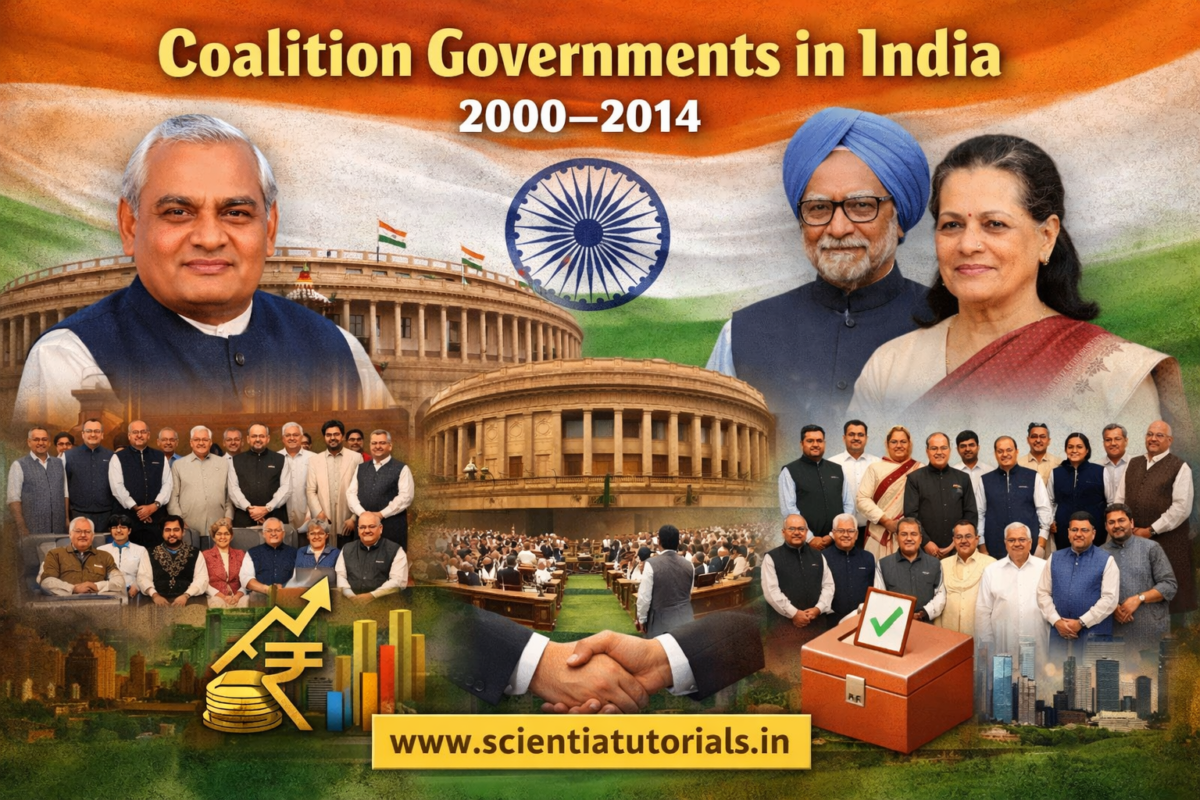

Coalition Governments and Political Stability (2000–2014 CE)
Course: Post-Independence and Contemporary India – History of India
Module 8: Contemporary India – Politics, Society, and Economy
Timeline: 2000–2014 (CE)
Based on the Lesson followed by the above Module and Course, we have created study materials aligned to the needs of UPSC, State PSC, UGC-NET, CUET, CBSE, and all school, college, and university examinations in India:
- Chronologically Structured Study Module,
- Questions with Answers,
- MCQs with Answers and detailed explanations.
Chronologically Structured Study Module
Introduction: Coalition Politics in Contemporary India
The period 2000–2014 marks a decisive phase in India’s political evolution, characterized by the institutionalization of coalition governments at the Centre. Unlike the unstable coalition experiments of the late 1980s and early 1990s, coalition politics in this era demonstrated relative durability, administrative continuity, and policy coherence. The dominance of single-party governments, particularly the Indian National Congress after 1947, had already declined by the late 1990s. From 2000 onwards, coalition governments became the new normal rather than a transitional anomaly.
This module examines coalition governments chronologically, focusing on their formation, functioning, ideological adjustments, leadership styles, challenges, and implications for political stability. It also evaluates how coalition politics reshaped Centre–State relations, federal bargaining, economic policymaking, and democratic deepening.
I. Background to Coalition Consolidation (Late 1990s Context)
Before entering the 21st century, India had experienced:
- Minority governments (1989–1991)
- Short-lived coalitions (1996–1999)
- Frequent elections and political instability
However, by 1999, political parties and voters had gained coalition literacy—a shared understanding that governance would require compromise, consensus, and power-sharing.
The general election of 1999 led to the formation of a stable coalition under Atal Bihari Vajpayee, marking a turning point in coalition governance.
II. National Democratic Alliance (NDA) Government, 1999–2004
A. Formation and Structure
The National Democratic Alliance (NDA) was a multi-party coalition led by the Bharatiya Janata Party (BJP). It included over 20 regional and national parties, reflecting India’s political diversity.
Key features:
- Coalition based on a Common Minimum Programme (CMP)
- Emphasis on governance rather than ideological rigidity
- Prime Minister Vajpayee’s consensual leadership
B. Political Stability under Vajpayee (2000–2004)
Despite ideological differences among partners, the NDA completed a full five-year term, a significant achievement in coalition history.
Factors contributing to stability:
- Vajpayee’s moderate and inclusive leadership
- Willingness to accommodate regional aspirations
- Avoidance of controversial ideological agendas
This period disproved the assumption that coalitions were inherently unstable.
C. Governance and Policy Orientation
- Continued economic liberalization with infrastructure focus (Golden Quadrilateral)
- Improved Centre–State relations
- Strong foreign policy initiatives (India–US engagement)
Coalition compulsions ensured that policymaking was consultative and negotiated, limiting abrupt or unilateral decisions.
D. 2004 Electoral Defeat
Despite administrative stability, the NDA lost the 2004 General Elections, partly due to:
- Perceived urban bias of “India Shining” campaign
- Rural distress and employment concerns
The transition of power, however, was peaceful—reflecting democratic maturity.
III. United Progressive Alliance (UPA) Phase I, 2004–2009
A. Emergence of UPA
The United Progressive Alliance (UPA) came to power under the leadership of the Indian National Congress.
Although Sonia Gandhi led the coalition politically, she declined the prime ministership, paving the way for Manmohan Singh.
B. External Support and the Left Parties
UPA-I was a minority coalition supported externally by the Left Front.
Implications:
- Government stability depended on outside support
- Economic reforms faced ideological constraints
- Parliamentary negotiations became central to governance
C. Governance Style and Political Stability
Despite minority status, UPA-I remained stable for five years due to:
- Effective parliamentary management
- Political consensus on welfare policies
- Manmohan Singh’s technocratic credibility
D. Landmark Policies
Coalition politics encouraged inclusive and welfare-oriented governance:
- Right to Information Act (2005)
- National Rural Employment Guarantee Act (NREGA)
- Expansion of social sector spending
These measures enhanced democratic legitimacy and mass support.
E. Indo–US Nuclear Deal Crisis (2008)
The Left withdrew support over the nuclear agreement with the United States.
Consequences:
- Vote of confidence tested coalition resilience
- Government survived through new alliances
- Demonstrated fluidity and adaptability of coalition politics
IV. UPA Phase II, 2009–2014
A. Electoral Mandate and Coalition Strengthening
The 2009 General Elections gave UPA a stronger mandate, reducing dependence on external support.
However:
- Coalition partners still exerted significant influence
- Internal contradictions persisted
B. Governance Challenges
UPA-II faced growing political instability due to:
- Coalition pressures
- Policy paralysis
- Declining parliamentary consensus
Regional parties increasingly prioritized state-level interests over coalition discipline.
C. Corruption Scandals and Political Fallout
Major controversies weakened coalition credibility:
- 2G Spectrum case
- Commonwealth Games scam
- Coal allocation issues
These episodes:
- Strained coalition unity
- Reduced public trust
- Paralyzed decision-making
D. Decline of Coalition Stability
By 2012–2014:
- Allies withdrew support intermittently
- Leadership authority weakened
- Governance appeared indecisive
While the government completed its term, functional stability declined despite numerical stability.
V. Role of Regional Parties in Coalition Politics
Coalition governments elevated the importance of regional parties such as:
- DMK, AIADMK
- TDP, BJD
- Trinamool Congress
Their influence resulted in:
- Stronger federal bargaining
- Policy decentralization
- Greater representation of regional identities
Coalitions thus deepened India’s federal democracy.
VI. Coalition Governments and Political Stability: An Assessment
Positive Outcomes
- End of single-party dominance
- Institutionalization of consensus politics
- Reduced authoritarian tendencies
- Peaceful power transitions
Limitations
- Slower decision-making
- Policy compromises
- Coalition blackmail by smaller parties
- Administrative delays
Yet, compared to the instability of earlier decades, coalitions after 2000 demonstrated predictable governance cycles.
VII. Comparative Perspective: NDA vs UPA
| Aspect | NDA (1999–2004) | UPA (2004–2014) |
|---|---|---|
| Leadership | Strong, charismatic | Technocratic, collective |
| Stability | High | Moderate |
| Coalition Management | Centralized | Negotiated |
| Policy Orientation | Infrastructure-driven | Welfare-oriented |
Both alliances contributed to normalizing coalition rule.
VIII. Impact on Indian Democracy
Coalition governments between 2000 and 2014:
- Strengthened parliamentary oversight
- Increased accountability
- Encouraged political accommodation
- Reflected social and regional diversity
Rather than weakening democracy, coalitions broadened participation and representation.
Conclusion
The period 2000–2014 represents the maturation of coalition politics in India. Coalition governments evolved from fragile arrangements into durable governing frameworks capable of completing full terms, managing economic reforms, and sustaining democratic institutions.
While challenges such as corruption, policy paralysis, and alliance management persisted, coalition politics ensured that governance remained inclusive, federal, and negotiated. This era laid the foundation for understanding contemporary Indian politics, where political stability is no longer equated with single-party dominance but with institutional adaptability and democratic consensus.
Examination Relevance
- Highly useful for UPSC, State PSCs, NET, CUET, and University exams
- Suitable for essay writing, GS-II answers, and comparative political analysis
- Provides chronological clarity and analytical depth on coalition governance
Questions with Answers
A. Short Answer Questions
1. What is meant by a coalition government?
A coalition government is formed when no single political party secures a majority, and multiple parties come together to form a government based on consensus, power-sharing, and a common minimum programme.
2. Why did coalition governments become common in India after the 1990s?
Coalition governments became common due to the decline of single-party dominance, the rise of regional parties, social diversification of politics, and the increasing importance of federal power-sharing.
3. Which alliance ruled India from 1999 to 2004, and who led it?
India was ruled by the National Democratic Alliance (NDA) from 1999 to 2004 under the leadership of Atal Bihari Vajpayee.
4. What role did the Common Minimum Programme (CMP) play in coalition governments?
The CMP provided a shared policy framework that allowed ideologically diverse coalition partners to govern together while avoiding contentious issues.
5. What was unique about the NDA government (1999–2004) in coalition history?
It was the first coalition government to complete a full five-year term, demonstrating that coalitions could provide political stability.
6. Name the coalition that came to power in 2004.
The United Progressive Alliance (UPA) came to power in 2004.
7. Who was the Prime Minister during both terms of the UPA government?
Manmohan Singh served as Prime Minister from 2004 to 2014.
8. Why is the 2004 change of government considered significant?
It demonstrated a peaceful transfer of power between coalitions, reflecting the maturity of Indian democracy.
9. What was the role of the Left parties during UPA-I (2004–2009)?
The Left Front provided external support, influencing economic and foreign policy decisions.
10. What led to the withdrawal of Left support in 2008?
The Left withdrew support over the Indo–US Civil Nuclear Agreement, opposing closer strategic ties with the United States.
B. Medium Answer Questions
11. How did coalition politics affect Centre–State relations after 2000?
Coalition politics strengthened Centre–State relations by:
- Increasing bargaining power of states
- Enhancing fiscal and political decentralization
- Giving regional parties a decisive role in national policymaking
This promoted cooperative federalism.
12. Explain the role of regional parties in coalition governments.
Regional parties:
- Represented local aspirations
- Acted as power brokers in coalition formation
- Influenced national policies on language, culture, and development
Their rise marked a shift from centralized to pluralistic politics.
13. Why was UPA-I considered relatively stable despite being a minority government?
UPA-I remained stable due to:
- External support from the Left
- Strong parliamentary management
- Welfare-oriented policies that built popular legitimacy
14. What is meant by ‘coalition dharma’?
‘Coalition dharma’ refers to the principles of consensus, compromise, and mutual respect required for the smooth functioning of coalition governments.
15. Distinguish between numerical stability and functional stability.
- Numerical stability: Having enough MPs to survive confidence votes
- Functional stability: Ability to govern effectively and take timely decisions
UPA-II had numerical stability but weak functional stability.
C. Long Answer Questions
16. Examine the factors responsible for the stability of the NDA government (1999–2004).
The stability of the NDA government can be attributed to:
- Inclusive leadership of Vajpayee
- Clear CMP
- Accommodation of regional interests
- Avoidance of ideological confrontation
It marked the normalization of coalition governance in India.
17. Analyse the impact of coalition governments on economic policymaking between 2000 and 2014.
Coalition governments led to:
- Gradual and negotiated reforms
- Emphasis on welfare alongside liberalization
- Policy delays due to alliance pressures
Economic decisions became more consultative but slower.
18. Discuss the achievements and limitations of UPA-I (2004–2009).
Achievements:
- RTI Act
- NREGA
- Expansion of social sector
Limitations:
- Dependence on external support
- Constraints on reforms
Overall, UPA-I balanced welfare with stability.
19. Why did political instability increase during UPA-II (2009–2014)?
Instability increased due to:
- Corruption scandals
- Coalition partner withdrawals
- Leadership fatigue
- Policy paralysis
These weakened governance credibility.
20. Compare coalition governance under NDA and UPA.
- NDA emphasized infrastructure and strong leadership
- UPA focused on welfare and collective decision-making
Both contributed to institutionalizing coalition rule.
21. How did coalition politics deepen Indian democracy?
Coalitions:
- Increased representation of social and regional groups
- Strengthened parliamentary oversight
- Prevented authoritarian centralization
They made democracy more inclusive and participatory.
22. Evaluate the statement: “Coalition governments are inherently unstable.”
The period 2000–2014 disproves this view, as coalitions:
- Completed full terms
- Ensured policy continuity
- Enabled peaceful power transitions
Instability was contextual, not inherent.
23. Discuss the role of leadership in ensuring coalition stability.
Strong leadership helps by:
- Managing allies
- Building consensus
- Resolving conflicts
Vajpayee’s leadership is a classic example.
24. What lessons does India’s coalition experience offer to federal democracies?
Key lessons include:
- Importance of negotiation
- Respect for diversity
- Institutional flexibility
Coalitions can enhance unity without uniformity.
25. “Coalition politics after 2000 marked a transition from dominance to consensus.” Explain.
Post-2000 politics shifted:
- From single-party dominance
- To shared governance and negotiated power
This transition reflects India’s social and political pluralism.
Exam Utility Note
- Ideal for GS-II (Polity & Governance)
- Useful for Political Science optional, essays, and CUET/NET objective preparation
- Structured for answer-writing practice at multiple levels
Multiple Choice Questions
Coalition Governments and Political Stability (2000–2014 CE)
The MCQs are aligned with the analytical and conceptual demands of UPSC, State PSCs, NET, CUET, CBSE, and university examinations.
1. What is the most accurate definition of a coalition government?
A. A government formed by a single dominant party
B. A government formed by military intervention
C. A government formed by multiple political parties sharing power
D. A government formed without parliamentary support
Correct Answer: C
Explanation:
A coalition government emerges when no single party secures a parliamentary majority, compelling multiple parties to share power. It is based on negotiation, compromise, and consensus-building.
2. Which factor most directly led to the rise of coalition governments in India after the 1990s?
A. Decline of voter participation
B. Rise of regional and identity-based parties
C. End of the Cold War
D. Judicial activism
Correct Answer: B
Explanation:
The rise of regional parties representing linguistic, caste, and regional aspirations fragmented the national vote, making coalition governments inevitable.
3. Which alliance formed the Union Government in 1999?
A. United Progressive Alliance
B. Left Democratic Front
C. National Democratic Alliance
D. United National Front
Correct Answer: C
Explanation:
The National Democratic Alliance (NDA) formed the government in 1999, marking a new phase of stable coalition governance.
4. Who served as Prime Minister during the NDA government (1999–2004)?
A. L.K. Advani
B. H.D. Deve Gowda
C. Atal Bihari Vajpayee
D. Narendra Modi
Correct Answer: C
Explanation:
Atal Bihari Vajpayee provided inclusive and consensual leadership, crucial for coalition stability.
5. Why is the NDA government (1999–2004) considered historically significant?
A. It introduced economic liberalization
B. It was the first minority government
C. It completed a full five-year term
D. It abolished coalition politics
Correct Answer: C
Explanation:
This was the first coalition government to complete a full term, disproving the belief that coalitions are inherently unstable.
6. What is a Common Minimum Programme (CMP)?
A. A constitutional amendment
B. A judicial guideline
C. A shared policy agenda of coalition partners
D. A party manifesto
Correct Answer: C
Explanation:
A CMP outlines mutually agreed policies, helping coalition partners govern without ideological conflict.
7. Which alliance came to power after the 2004 General Elections?
A. NDA
B. UPA
C. Third Front
D. National Front
Correct Answer: B
Explanation:
The United Progressive Alliance (UPA) assumed office in 2004.
8. Who served as Prime Minister during both UPA terms (2004–2014)?
A. Sonia Gandhi
B. Pranab Mukherjee
C. Manmohan Singh
D. P. Chidambaram
Correct Answer: C
Explanation:
Manmohan Singh served as Prime Minister for two consecutive terms, providing technocratic leadership.
9. UPA-I (2004–2009) was best described as which type of government?
A. Majority government
B. Minority government with external support
C. Presidential government
D. Non-parliamentary government
Correct Answer: B
Explanation:
UPA-I depended on external support from the Left parties, especially in Parliament.
10. Which political group provided external support to UPA-I?
A. NDA
B. Socialist Front
C. Left Front
D. Janata Dal
Correct Answer: C
Explanation:
The Left Front supported UPA-I while remaining outside the cabinet.
11. The Left parties withdrew support to UPA-I in 2008 mainly due to:
A. Corruption scandals
B. Food security policies
C. Indo–US Civil Nuclear Agreement
D. Disinvestment policy
Correct Answer: C
Explanation:
The Left opposed closer strategic ties with the United States, especially the nuclear deal.
12. What does the term ‘coalition dharma’ signify?
A. Ideological rigidity
B. Majoritarian dominance
C. Consensus and compromise
D. Judicial supremacy
Correct Answer: C
Explanation:
‘Coalition dharma’ refers to mutual respect, flexibility, and consensus, essential for coalition survival.
13. Which of the following was a major welfare initiative of UPA-I?
A. Golden Quadrilateral
B. NREGA
C. GST
D. Make in India
Correct Answer: B
Explanation:
The National Rural Employment Guarantee Act (NREGA) reflected UPA’s welfare-oriented coalition politics.
14. What major challenge weakened UPA-II (2009–2014)?
A. Foreign invasion
B. Judicial overreach
C. Corruption scandals
D. Lack of parliamentary majority
Correct Answer: C
Explanation:
Scandals like 2G spectrum and coal allocation eroded coalition credibility and governance effectiveness.
15. Which term best describes UPA-II’s condition after 2012?
A. Authoritarian stability
B. Policy paralysis
C. Military rule
D. Constitutional breakdown
Correct Answer: B
Explanation:
Coalition pressures and scandals led to delayed decision-making, often termed policy paralysis.
16. What is meant by ‘numerical stability’ in coalition politics?
A. Strong leadership
B. Administrative efficiency
C. Sufficient numbers to survive confidence votes
D. Popular support
Correct Answer: C
Explanation:
Numerical stability refers to parliamentary strength, not necessarily effective governance.
17. Which feature distinguishes ‘functional stability’?
A. Electoral majority
B. Ability to govern effectively
C. Presence of regional parties
D. External support
Correct Answer: B
Explanation:
Functional stability means effective policy implementation and decision-making, often weak in coalitions.
18. How did coalition politics affect Centre–State relations?
A. Increased centralization
B. Reduced role of states
C. Strengthened federal bargaining
D. Abolished federalism
Correct Answer: C
Explanation:
Regional parties enhanced state influence in national politics, strengthening cooperative federalism.
19. Which of the following is a positive outcome of coalition governments?
A. Faster authoritarian decisions
B. Reduced representation
C. Inclusive governance
D. Suspension of Parliament
Correct Answer: C
Explanation:
Coalitions broaden representation and reflect India’s social and regional diversity.
20. Which statement best reflects the impact of coalitions on Indian democracy?
A. They weakened Parliament
B. They ended federalism
C. They deepened democratic participation
D. They eliminated elections
Correct Answer: C
Explanation:
Coalition politics increased participation and accountability, strengthening democracy.
21. Which leadership style proved most effective for coalition stability?
A. Authoritarian
B. Confrontational
C. Consensus-oriented
D. Bureaucratic
Correct Answer: C
Explanation:
Consensus-oriented leadership, exemplified by Vajpayee, ensured coalition cohesion.
22. Which factor limited policy speed under coalition governments?
A. Presidential system
B. Coalition compulsions
C. Judicial review
D. Federal structure
Correct Answer: B
Explanation:
Multiple partners required negotiation, slowing decisions but increasing inclusivity.
23. Coalition politics after 2000 indicates a shift from:
A. Democracy to autocracy
B. Federalism to unitary rule
C. Dominance to consensus
D. Parliament to executive
Correct Answer: C
Explanation:
Indian politics transitioned from single-party dominance to negotiated governance.
24. Which election marked the normalization of coalition politics?
A. 1989
B. 1991
C. 1999
D. 2014
Correct Answer: C
Explanation:
The 1999 election established coalition governments as stable and legitimate.
25. Which conclusion is most accurate about coalition governments (2000–2014)?
A. They were a temporary failure
B. They undermined democracy
C. They became an institutional reality
D. They ended economic reforms
Correct Answer: C
Explanation:
Coalition governments became a permanent and functional feature of Indian democracy.
-
coalition governments in India after 2000
-
political stability under coalition governments in India
-
NDA and UPA coalition governments comparison
-
role of regional parties in coalition politics India
-
coalition governments and federalism in India
-
common minimum programme in coalition governments
-
coalition politics in contemporary India UPSC notes
-
coalition government challenges and achievements India
-
UPA government political stability and policy paralysis
-
NDA government 1999–2004 coalition stability analysis
-
coalition governments India GS II polity notes
-
evolution of coalition politics in post-1990 India
-
impact of coalition governments on Indian democracy
-
coalition government study material for UPSC and PSC
-
contemporary Indian politics coalition era notes