
Lesson 2: Ahom Administrative System – Paik System and Governance
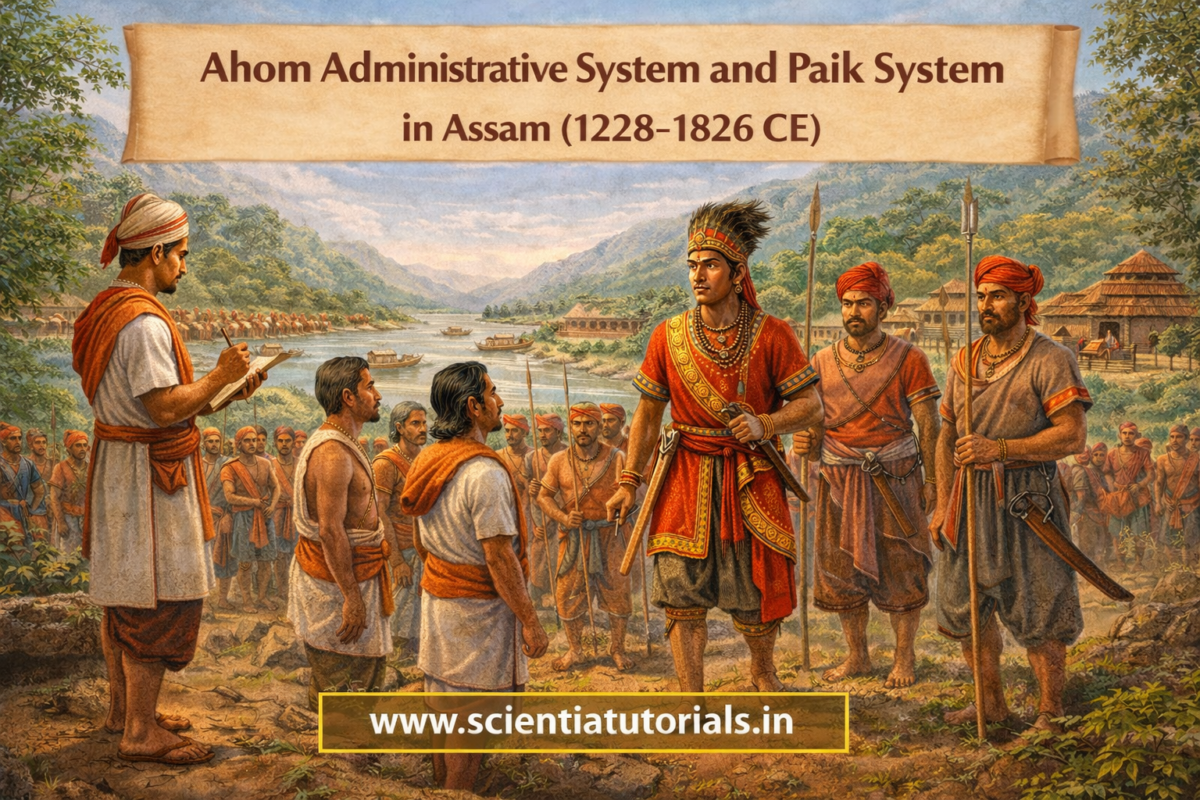
Ahom Administrative System and Paik System in Assam (1228–1826 CE)
Course: Assam History – Chronological Era-Wise Study Module for Competitive Exams
Module IV: Ahom Period in Assam History (1228 CE – 1826 CE)
Lesson 2: Ahom Administrative System – Paik System and Governance
This lesson is systematically organized into four clearly structured sections, as detailed below:
- Chronologically Structured Study Module
- Short-Answer Type Questions
- Long-Answer Type Questions
- Multiple-Choice Questions (MCQs) with Answers and Detailed Explanations
Chronologically Structured Study Module
1. Introduction: Importance of the Ahom Administrative System
The Ahom administrative system stands out as one of the most innovative and enduring governance models in medieval Indian history. At the heart of this system was the Paik system, a unique form of manpower organization that enabled the Ahom state to function efficiently for nearly six centuries without relying on a monetized economy.
Lesson 2 examines the structure, functioning, evolution, and historical significance of the Ahom administrative system, with special emphasis on the Paik system. For competitive examinations, this topic is extremely important as it links political history, administration, economy, and social organization of medieval Assam.
2. Chronological Context of Ahom Administration
The Ahom administrative system evolved gradually over time and can be studied across three broad chronological phases:
- Early Ahom Period (13th–15th Century CE) – Formation of basic administrative principles
- Middle Ahom Period (16th–17th Century CE) – Expansion, militarization, and institutional maturity
- Late Ahom Period (18th–early 19th Century CE) – Administrative strain, corruption, and decline
The Paik system was present throughout all these phases, though its efficiency and structure changed over time.
3. Foundations of Ahom Governance
3.1 Nature of the Ahom State
The Ahom state was:
- Centralized but flexible
- Non-feudal in the European sense
- Based on direct control of manpower rather than land revenue
Unlike contemporary kingdoms that relied heavily on taxation, the Ahoms depended on compulsory state service.
3.2 Ideological Basis
Ahom governance emphasized:
- Collective responsibility
- Loyalty to the state
- Service in return for land and protection
This ideology made the Paik system both an administrative and social institution.
4. The Paik System: Concept and Definition
4.1 Meaning of Paik
A Paik was an adult male subject of the Ahom kingdom who was liable to render service to the state. Every Paik was registered under the administration and assigned specific duties.
4.2 Core Principle
The Paik system was based on:
- Service instead of taxation
- State ownership of manpower
- Rotational labor obligations
This system enabled the Ahom rulers to mobilize labor for military, agricultural, and public works.
5. Organization of the Paik System
5.1 Grouping of Paiks
Paiks were organized into units known as gots:
- Each got generally consisted of four Paiks
- One Paik served the state at a time
- The remaining Paiks supported the serving Paik by cultivating his land
This ensured continuity of both service and livelihood.
5.2 Types of Paik Service
Paiks rendered various kinds of service:
- Military service – soldiers, guards, naval units
- Civil service – construction of roads, embankments, palaces
- Agricultural service – cultivation of state land
- Specialized service – artisans, boatmen, elephant keepers
6. Administrative Hierarchy under the Paik System
6.1 Local-Level Officials
Paiks were supervised by a structured hierarchy:
- Bora – in charge of 20 Paiks
- Saikia – in charge of 100 Paiks
- Hazarika – in charge of 1,000 Paiks
These officials ensured discipline and effective mobilization.
6.2 Higher Officials
At the higher level, administration was controlled by nobles and ministers who reported directly to the king.
7. Central Administration and the Ahom King
7.1 Position of the King
The Ahom king was the supreme authority:
- Head of administration
- Commander-in-chief of the army
- Final judicial authority
However, his power was balanced by powerful nobles.
7.2 Role of the Council of Ministers
Key officials such as the Burhagohain and Borgohain played crucial roles in governance. Their authority ensured checks on royal absolutism and maintained administrative stability.
8. Military Administration and the Paik System
8.1 Military Organization
The Paik system formed the backbone of the Ahom military:
- All soldiers were Paiks
- No standing army in the modern sense
- Rapid mobilization during emergencies
8.2 Naval Strength
Given Assam’s riverine geography dominated by the Brahmaputra River, naval Paiks played a crucial role in defense and transport.
9. Economic Basis of the Paik System
9.1 Non-Monetized Economy
The Ahom economy was largely non-monetized:
- Minimal use of coins
- No regular land revenue system
- State relied on labor service
9.2 Land and Paik Rights
Each Paik was allotted a plot of land for subsistence cultivation. This land was:
- Not hereditary private property
- Subject to continued service to the state
10. Judicial and Revenue Administration
10.1 Judicial Functions
Local officials exercised judicial authority:
- Minor disputes settled at village level
- Serious cases referred to higher officials or the king
10.2 Revenue Collection
Instead of taxes:
- Produce was sometimes collected in kind
- Labor itself was the primary “revenue”
11. Administrative Reforms under Later Ahom Rulers
11.1 Expansion of Administration
As the kingdom expanded:
- New Paiks were enrolled
- Administrative units multiplied
11.2 Hindu Influence
With the adoption of Hinduism, especially from the 16th century onwards:
- Brahmins were granted land
- Some revenue practices were introduced
- Paik system began to face pressure
12. Strengths of the Paik System
The Paik system was successful because:
- It ensured efficient manpower utilization
- It supported a large military without high costs
- It promoted social discipline and loyalty
This system explains the longevity of Ahom rule.
13. Limitations and Decline of the Paik System
13.1 Administrative Overload
By the 18th century:
- Paik duties became excessive
- Corruption increased
- Paiks were often exploited by officials
13.2 Social Discontent
Heavy service demands led to:
- Paik revolts
- Weakening of central authority
These problems contributed to the decline of Ahom power.
14. Comparison with Contemporary Systems
Unlike Mughal jagirdari or European feudalism:
- The Paik system was non-feudal
- It emphasized manpower over land revenue
- It was uniquely adapted to Assam’s geography
15. Role of the Paik System in State Expansion
The Paik system enabled:
- Large-scale military campaigns
- Construction of embankments and roads
- Agricultural expansion
Without this system, Ahom territorial expansion would not have been possible.
16. Impact on Assamese Society
The Paik system shaped Assamese society by:
- Organizing society around service groups
- Reducing rigid class distinctions
- Encouraging collective responsibility
However, it also limited individual economic freedom.
17. The Paik System and Ahom Longevity
Historians widely agree that:
- The Paik system was the backbone of Ahom governance
- Its efficiency sustained the kingdom for centuries
- Its breakdown accelerated political collapse
18. Examination-Oriented Key Points
- Paik system = compulsory state service
- Gots of four Paiks ensured rotation
- Bora–Saikia–Hazarika hierarchy
- Non-monetized administrative economy
- Decline due to overburden and corruption
19. Importance of Lesson 2 for Competitive Exams
This lesson is frequently tested in:
- APSC Prelims and Mains
- UPSC (History optional / regional history)
- ADRE, TET, and Assam-based exams
Questions often ask for:
- Definition of Paik system
- Administrative hierarchy
- Strengths and weaknesses
20. Conclusion
The Ahom administrative system, centered on the Paik system, represents a remarkable experiment in governance. By organizing society around compulsory service rather than taxation, the Ahoms created a self-sustaining political structure suited to Assam’s geography and social conditions.
While the system eventually declined under the pressures of expansion and changing economic realities, its historical importance cannot be overstated. Lesson 2 provides crucial insight into how the Ahoms governed, expanded, and sustained one of the longest-lasting kingdoms in Indian history.
Understanding the Paik system is essential for appreciating the administrative genius and limitations of the Ahom state and forms a core component of Assam history for competitive examinations.
Module IV: Ahom Period in Assam History (1228 CE – 1826 CE)
Lesson 2: Ahom Administrative System – Paik System and Governance
Short Answer Type Questions (with Answers)
1. What is meant by the Paik system?
Answer:
The Paik system was a compulsory state service system in which every adult male (Paik) had to serve the Ahom state in rotation.
2. Who was called a Paik in Ahom administration?
Answer:
A Paik was an adult male subject registered under the Ahom state and liable to render service instead of paying taxes.
3. What was the basic principle of the Paik system?
Answer:
Service to the state in place of monetary taxation.
4. How many Paiks formed a ‘got’?
Answer:
Usually four Paiks formed a got.
5. How did the got system ensure continuity of livelihood?
Answer:
While one Paik served the state, the remaining Paiks cultivated his land.
6. Name two types of services performed by Paiks.
Answer:
Military service and civil/public works service.
7. Which official was in charge of 20 Paiks?
Answer:
A Bora.
8. Which official supervised 100 Paiks?
Answer:
A Saikia.
9. Who controlled 1,000 Paiks in the Ahom administrative hierarchy?
Answer:
A Hazarika.
10. What was the role of the Ahom king in administration?
Answer:
The king was the supreme authority and head of administration, army, and judiciary.
11. Name two key Ahom ministers who checked royal power.
Answer:
The Burhagohain and Borgohain.
12. How was the Ahom army organized?
Answer:
It was organized through the Paik system without a permanent standing army.
13. Why was the Paik system suitable for Assam’s geography?
Answer:
Because Assam’s riverine and forested terrain required flexible manpower mobilization.
14. Which river played a major role in Ahom military and administration?
Answer:
The Brahmaputra River.
15. Was land privately owned under the Paik system?
Answer:
No, land was allotted for use and was linked to continued state service.
16. How did the Ahoms collect revenue from their subjects?
Answer:
Primarily through labor service rather than cash taxation.
17. What type of economy supported the Paik system?
Answer:
A largely non-monetized agrarian economy.
18. Name one specialized category of Paik service.
Answer:
Boatmen, artisans, or elephant keepers.
19. What judicial powers did local officials possess?
Answer:
They settled minor disputes at village and local levels.
20. How did Ahom expansion affect the Paik system?
Answer:
Expansion increased the demand for Paik service and administrative complexity.
21. What change occurred in the Paik system after the Ahoms adopted Hinduism?
Answer:
Land grants to Brahmins increased, putting pressure on Paik manpower.
22. Mention one strength of the Paik system.
Answer:
It enabled efficient manpower utilization for administration and defense.
23. Mention one weakness of the Paik system.
Answer:
Overburdening of Paiks led to dissatisfaction and revolts.
24. Why did the Paik system decline in the 18th century?
Answer:
Due to excessive service demands, corruption, and administrative overload.
25. How did the Paik system contribute to Ahom longevity?
Answer:
It sustained the state economically and militarily without heavy taxation.
26. Was the Paik system similar to Mughal jagirdari?
Answer:
No, it was manpower-based, unlike the land-revenue-based jagirdari system.
27. What social impact did the Paik system have on Assamese society?
Answer:
It organized society around collective service and responsibility.
28. What happened when the Paik system weakened?
Answer:
Central authority weakened, contributing to the decline of Ahom rule.
29. Which phase of Ahom history saw the maximum strain on the Paik system?
Answer:
The late Ahom period (18th–early 19th century).
30. Why is the Paik system important for competitive exams?
Answer:
It explains Ahom administration, economy, military organization, and state durability.
✅ Exam Utility Tip:
These answers are ideal for questions, APSC/ADRE/TET exams, and quick revision of Ahom administrative history.
Module IV: Ahom Period in Assam History (1228 CE – 1826 CE)
Lesson 2: Ahom Administrative System – Paik System and Governance
Long Answer Type Questions (with Answers)
1. Explain the significance of the Ahom administrative system in medieval Assam.
Answer:
The Ahom administrative system was one of the most distinctive and durable systems of governance in medieval India. Its uniqueness lay in its dependence on manpower rather than land revenue or monetary taxation. Centered on the Paik system, it enabled the Ahom rulers to mobilize labor, maintain a strong military, construct public works, and administer a vast territory for nearly 600 years. This system ensured political stability, economic self-sufficiency, and social discipline, making it a cornerstone of Ahom longevity.
2. Describe the historical evolution of the Paik system during the Ahom period.
Answer:
The Paik system evolved gradually from the early Ahom period. Initially, it functioned as a simple service-based arrangement for defense and agriculture. During the middle Ahom period, especially in the 16th and 17th centuries, it became more institutionalized and militarized due to territorial expansion and external threats. In the late Ahom period, excessive demands, corruption, and administrative strain weakened the system, contributing to political decline.
3. Define the Paik system and explain its basic principles.
Answer:
The Paik system was a compulsory state service system under which every adult male subject, known as a Paik, had to render service to the state. Its basic principles included service in lieu of taxation, state control over manpower, rotational labor, and collective responsibility. Instead of paying taxes, Paiks contributed labor for military, administrative, and public works.
4. Discuss the organization of Paiks into gots and its significance.
Answer:
Paiks were grouped into units called gots, usually consisting of four Paiks. From each got, one Paik served the state at a time, while the others supported him by cultivating his land. This rotational system ensured that state service did not deprive a Paik of livelihood. It balanced administrative needs with economic sustainability and was a key factor in the efficiency of the system.
5. Examine the different types of services performed by Paiks.
Answer:
Paiks performed diverse services, including military duties as soldiers and guards, civil duties such as building roads, embankments, palaces, and forts, agricultural service on state land, and specialized services as artisans, boatmen, elephant keepers, and craftsmen. This multifunctional role made the Paik system the backbone of Ahom administration.
6. Analyze the administrative hierarchy under the Paik system.
Answer:
The Paik system operated through a well-defined hierarchy. At the lowest level, a Bora supervised 20 Paiks, a Saikia supervised 100 Paiks, and a Hazarika supervised 1,000 Paiks. Above them were higher nobles and ministers. This hierarchy ensured discipline, accountability, and efficient mobilization of manpower across the kingdom.
7. Describe the role of the Ahom king in administration and governance.
Answer:
The Ahom king was the supreme authority, serving as head of administration, commander-in-chief of the army, and chief judicial authority. However, his power was not absolute. Influential nobles and ministers ensured checks and balances, preventing autocracy and maintaining administrative stability.
8. Discuss the role of Ahom ministers in governance.
Answer:
Ministers such as the Burhagohain and Borgohain played crucial roles in administration, military affairs, and state policy. They advised the king, supervised officials, and sometimes acted as regents. Their authority helped balance royal power and ensured continuity of governance even during weak reigns.
9. Explain how the Paik system supported the Ahom military organization.
Answer:
The Paik system formed the backbone of the Ahom military. All soldiers were Paiks, and there was no permanent standing army. During emergencies, Paiks could be rapidly mobilized. This flexible system allowed the Ahoms to maintain a large and effective fighting force at minimal cost.
10. Assess the importance of riverine geography in Ahom administration and defense.
Answer:
Assam’s riverine geography, especially the Brahmaputra River, shaped Ahom administration and defense. Rivers facilitated transport, communication, and trade, while naval Paiks protected the kingdom from invasions. Control over river routes was vital for military success and administrative cohesion.
11. Examine the economic basis of the Paik system.
Answer:
The Paik system functioned within a largely non-monetized agrarian economy. Instead of collecting taxes in cash, the state relied on labor service and occasional collection of produce in kind. Each Paik was allotted land for subsistence cultivation, linking economic survival directly to state service.
12. How did land rights function under the Paik system?
Answer:
Land allotted to Paiks was not private hereditary property. It was granted for use as long as the Paik continued to serve the state. This arrangement ensured state control over land and manpower while preventing the rise of feudal landholding classes.
13. Discuss the judicial functions within the Ahom administrative system.
Answer:
Judicial authority was decentralized. Local officials such as Boras and Saikias handled minor disputes at village levels, while serious cases were referred to higher officials or the king. This system ensured swift justice and reduced administrative burden on the center.
14. Analyze the impact of Ahom expansion on the Paik system.
Answer:
As the Ahom kingdom expanded, administrative demands increased. More Paiks were enrolled, and service obligations grew heavier. While this initially strengthened the state, over time it overburdened Paiks and strained the system.
15. Explain the influence of Hinduism on Ahom administration.
Answer:
With the gradual adoption of Hinduism, especially from the 16th century onwards, land grants to Brahmins increased. This reduced the pool of Paiks and introduced revenue practices that conflicted with the service-based system, weakening the Paik structure.
16. Evaluate the strengths of the Paik system.
Answer:
The Paik system’s strengths included efficient manpower utilization, low administrative cost, strong military organization, and social discipline. It enabled the Ahoms to govern a large territory without a complex revenue bureaucracy.
17. Discuss the limitations of the Paik system.
Answer:
Over time, excessive service demands, corruption among officials, and lack of flexibility led to Paik exploitation. The system also limited individual economic freedom and adaptability to changing economic conditions.
18. Analyze the causes behind the decline of the Paik system.
Answer:
The decline was caused by administrative overload, increasing corruption, social discontent, external invasions, and the incompatibility of the system with emerging economic realities. Paik revolts weakened central authority.
19. Compare the Paik system with the Mughal jagirdari system.
Answer:
Unlike the Mughal jagirdari system, which was based on land revenue assignments, the Paik system was manpower-based. It was non-feudal, service-oriented, and better suited to Assam’s geography and economy.
20. Discuss the social impact of the Paik system on Assamese society.
Answer:
The Paik system organized society around collective service, reducing rigid class distinctions. However, it also imposed heavy obligations, limiting personal freedom and contributing to social tension in later periods.
21. How did the Paik system contribute to the longevity of Ahom rule?
Answer:
By ensuring a steady supply of labor and soldiers without heavy taxation, the Paik system sustained the Ahom state economically and militarily, contributing significantly to its long duration.
22. Assess the role of the Paik system in state-building under the Ahoms.
Answer:
The Paik system was central to state-building. It enabled territorial expansion, construction of infrastructure, and effective governance, transforming the Ahoms into one of the most successful medieval dynasties.
23. Why is the Paik system considered unique in Indian administrative history?
Answer:
It was unique because it relied on compulsory service rather than taxation, emphasized collective responsibility, and was adapted to local conditions rather than imported models.
24. Evaluate Lesson 2 as a key component of Ahom history.
Answer:
Lesson 2 provides insight into the administrative genius and limitations of the Ahom state. It explains how governance, economy, and military organization were interconnected and why the system eventually failed.
25. Conclude with a critical assessment of the Paik system.
Answer:
The Paik system was a remarkable administrative innovation that sustained Ahom rule for centuries. While it was effective in a pre-modern agrarian context, its rigidity and overexploitation eventually led to decline. Nevertheless, it remains one of the most significant administrative experiments in Assam’s history.
✅ Exam Utility Note:
These long answers are suitable for questions, APSC & UPSC mains, and analytical essays, emphasizing chronology, structure, strengths, and weaknesses of the Ahom administrative system.
Module IV: Ahom Period in Assam History (1228 CE – 1826 CE)
Lesson 2: Ahom Administrative System – Paik System and Governance
MCQs with Answers and Concept-Clearing Explanations
1. The Paik system of the Ahoms was primarily a system of:
A. Land revenue collection
B. Monetary taxation
C. Compulsory state service
D. Feudal land grants
Correct Answer: C
Explanation:
The Paik system was based on compulsory service to the state. Every adult male (Paik) had to render labor or military service instead of paying taxes.
2. Who was called a ‘Paik’ in Ahom administration?
A. A land revenue officer
B. A hereditary noble
C. An adult male liable for state service
D. A temple priest
Correct Answer: C
Explanation:
A Paik was an adult male subject registered under the state, responsible for rendering service to the Ahom kingdom.
3. What was the basic principle underlying the Paik system?
A. Taxation in kind
B. Cash revenue system
C. Service in lieu of tax
D. Private land ownership
Correct Answer: C
Explanation:
Instead of collecting revenue, the Ahom state relied on labor and service, making manpower its chief resource.
4. How many Paiks usually formed a ‘got’?
A. Two
B. Three
C. Four
D. Five
Correct Answer: C
Explanation:
A got generally consisted of four Paiks, ensuring rotation of service and continuity of livelihood.
5. The got system was important because it:
A. Eliminated agriculture
B. Ensured continuous state service and subsistence
C. Encouraged private landholding
D. Reduced military manpower
Correct Answer: B
Explanation:
While one Paik served the state, others cultivated his land, ensuring both service and economic survival.
6. Which official supervised 20 Paiks?
A. Saikia
B. Hazarika
C. Phukan
D. Bora
Correct Answer: D
Explanation:
A Bora was the lowest-ranking Paik officer, in charge of 20 Paiks.
7. A Saikia was responsible for supervising:
A. 50 Paiks
B. 100 Paiks
C. 500 Paiks
D. 1,000 Paiks
Correct Answer: B
Explanation:
A Saikia controlled 100 Paiks, forming the middle tier of Paik administration.
8. The officer in charge of 1,000 Paiks was known as:
A. Bora
B. Saikia
C. Hazarika
D. Rajkhowa
Correct Answer: C
Explanation:
A Hazarika was a senior Paik officer overseeing 1,000 Paiks.
9. The Paik system was best suited to Assam because of:
A. Urban economy
B. Coastal trade
C. Riverine and agrarian geography
D. Desert terrain
Correct Answer: C
Explanation:
Assam’s rivers, forests, and fertile land required flexible manpower mobilization, which the Paik system provided.
10. Which river was central to Ahom military transport and administration?
A. Barak
B. Subansiri
C. Brahmaputra River
D. Teesta
Correct Answer: C
Explanation:
The Brahmaputra River enabled communication, transport, naval defense, and administrative integration.
11. Which type of economy supported the Paik system?
A. Capitalist
B. Monetized
C. Non-monetized agrarian
D. Industrial
Correct Answer: C
Explanation:
The Ahom economy was largely non-monetized, relying on agriculture and labor instead of cash revenue.
12. Under the Paik system, land allotted to Paiks was:
A. Hereditary private property
B. State land linked to service
C. Sold in open markets
D. Tax-free religious land
Correct Answer: B
Explanation:
Paik land was conditional upon continued service and not private hereditary property.
13. Which of the following was NOT a type of Paik service?
A. Military service
B. Public works
C. Industrial factory work
D. Agricultural service
Correct Answer: C
Explanation:
Industrial factory work did not exist; Paiks served in military, civil, and agricultural roles.
14. The Ahom army under the Paik system was characterized by:
A. A permanent standing army
B. Mercenary forces
C. Service-based military organization
D. European drill methods
Correct Answer: C
Explanation:
The Ahom military relied on Paik service, allowing rapid mobilization without maintaining a standing army.
15. Which ministers acted as checks on the king’s power?
A. Rajkhowas
B. Boras
C. Burhagohain and Borgohain
D. Saikias
Correct Answer: C
Explanation:
The Burhagohain and Borgohain were powerful nobles who balanced royal authority.
16. Judicial powers at the local level were exercised by:
A. Only the king
B. Foreign judges
C. Local Paik officials
D. Religious leaders
Correct Answer: C
Explanation:
Local officials settled minor disputes, ensuring decentralized justice.
17. One major strength of the Paik system was:
A. Heavy cash revenue
B. Efficient manpower utilization
C. Private landownership
D. Urban commercial growth
Correct Answer: B
Explanation:
Efficient use of manpower enabled large-scale administration and military strength at low cost.
18. One major weakness of the Paik system was:
A. Lack of soldiers
B. Excessive monetization
C. Overburdening of Paiks
D. Absence of agriculture
Correct Answer: C
Explanation:
In later periods, Paiks were overworked and exploited, leading to unrest.
19. The decline of the Paik system became evident during:
A. Early Ahom period
B. Middle Ahom period
C. Late Ahom period
D. British period only
Correct Answer: C
Explanation:
During the 18th century, corruption, revolts, and administrative strain weakened the system.
20. Which factor weakened the Paik system after the 16th century?
A. Introduction of Buddhism
B. Adoption of Hinduism and land grants
C. Maritime trade expansion
D. European influence alone
Correct Answer: B
Explanation:
Land grants to Brahmins reduced Paik manpower and conflicted with the service-based model.
21. The Paik system can best be described as:
A. Feudal
B. Capitalist
C. Manpower-based
D. Colonial
Correct Answer: C
Explanation:
It was a manpower-based administrative system, not a land-revenue or feudal arrangement.
22. Compared to Mughal jagirdari, the Paik system was:
A. More monetized
B. Less centralized
C. Service-oriented rather than revenue-based
D. Identical in structure
Correct Answer: C
Explanation:
The Mughal system focused on land revenue, while the Paik system emphasized service obligations.
23. How did the Paik system shape Assamese society?
A. By creating rigid caste hierarchies
B. By promoting collective responsibility
C. By encouraging urban elites
D. By abolishing agriculture
Correct Answer: B
Explanation:
Society was organized around collective service and duty, reducing rigid class divisions.
24. The Paik system was crucial to Ahom longevity because it:
A. Ensured foreign trade
B. Reduced dependence on taxation
C. Created merchant guilds
D. Promoted coinage
Correct Answer: B
Explanation:
By avoiding heavy taxation, the Ahoms maintained loyalty and stability for centuries.
25. Which statement best summarizes the Paik system?
A. A failed feudal experiment
B. A cash-based revenue system
C. A unique service-based administrative model
D. A colonial administrative structure
Correct Answer: C
Explanation:
The Paik system was a unique, service-based governance model, central to Ahom administration and military strength.
✅ Exam Strategy Tip:
These MCQs are highly useful for APSC Prelims, ADRE, TET, and UPSC (State History), testing both conceptual clarity and analytical understanding of Ahom administration.
Ahom Administrative System and Paik System in Assam
The Ahom administrative system was the backbone of one of the longest-ruling dynasties in Indian history. From 1228 CE to 1826 CE, the Ahoms governed Assam through a unique manpower-based administrative framework known as the Paik system, which replaced monetary taxation with compulsory state service.
Historical Background of Ahom Administration
After their arrival in Assam, the Ahoms gradually evolved an administrative system suited to local geographical and social conditions. Instead of relying on land revenue, the Ahom state exercised direct control over manpower. This system proved effective in a region dominated by rivers, forests, and agrarian settlements along the Brahmaputra River valley.
The Paik System: Core Features
Under the Paik system, every adult male subject, known as a Paik, was required to render service to the state. Paiks were grouped into units called gots, usually consisting of four members, ensuring rotational service without loss of livelihood. Service included military duties, construction of embankments, roads, palaces, and other public works.
Administrative Hierarchy and Governance
The Paik system functioned through a well-defined hierarchy—Bora, Saikia, and Hazarika—responsible for supervising Paiks at different levels. The Ahom king stood at the apex of administration, assisted by powerful ministers such as the Burhagohain and Borgohain, ensuring checks and balances within governance.
Strengths and Limitations
The Paik system ensured efficient manpower utilization, supported a strong military without heavy taxation, and contributed to the longevity of Ahom rule. However, during the late Ahom period, excessive service demands and corruption weakened the system, leading to social discontent and administrative decline.
Historical Significance
The Ahom administrative system represents a unique experiment in governance based on service, discipline, and adaptability. Its success explains how the Ahoms sustained political authority in Assam for nearly six centuries.
📌 Exam Relevance
This topic is highly important for APSC, UPSC (State History), ADRE, and TET examinations, especially for questions on medieval administration, Paik system structure, and Ahom governance.