
Lesson 1: Sources of Ancient Assam History – Puranas, Inscriptions, Foreign Accounts
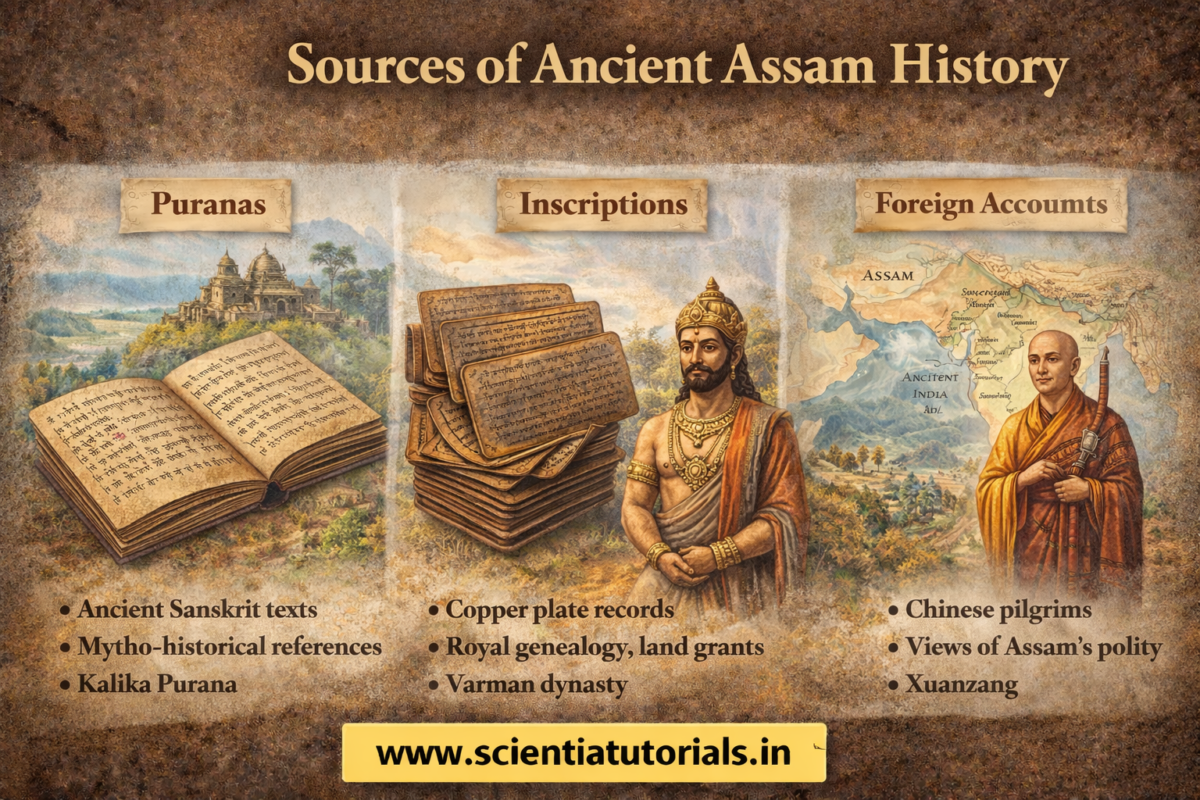
Sources of Ancient Assam History: Puranas, Inscriptions & Foreign Accounts
Course: Assam History: Chronological Era-Wise Study Module for Competitive Exams
Module II: Ancient Assam – Pragjyotisha–Kamarupa Period (c. 4th Century CE – 7th Century CE)
Lesson 1: Sources of Ancient Assam History – Puranas, Inscriptions, Foreign Accounts
This lesson is systematically organized into four clearly structured sections, as detailed below:
- Chronologically Structured Study Module
- Short-Answer Type Questions
- Long-Answer Type Questions
Multiple-Choice Questions (MCQs) with Answers and Detailed Explanations
Chronologically Structured Study Module
Introduction to Sources of Ancient Assam History: Puranas, Inscriptions & Foreign Accounts
The reconstruction of Ancient Assam’s history during the Pragjyotisha–Kamarupa period (c. 4th–7th century CE) depends primarily on a careful study of literary, epigraphic, and foreign sources. Unlike prehistoric and protohistoric Assam, this period marks the transition to history, where written records begin to appear, though often scattered and indirect.
This lesson is designed as a chronologically structured and examination-oriented study module, focusing on the nature, content, reliability, and historical value of different sources. Understanding these sources is essential for competitive exams such as UPSC, APSC, and other state-level examinations, where questions frequently test the ability to evaluate sources rather than merely recall facts.
Historical Context: Pragjyotisha–Kamarupa Period
The Pragjyotisha–Kamarupa period represents the first clearly historical phase of Assam. The region known as Pragjyotishpura (later identified with Kamarupa) emerged as a significant political and cultural centre in eastern India.
Chronologically, this phase witnessed:
- Formation of early state structures
- Rise of dynastic rule
- Integration of Assam into pan-Indian political and cultural networks
To understand these developments, historians rely on three broad categories of sources:
- Puranic and other literary sources
- Epigraphic sources (inscriptions)
- Foreign accounts
I. Puranic and Literary Sources
1. Nature of Puranic Sources
The Puranas are ancient Sanskrit texts that combine mythology, genealogy, cosmology, and historical traditions. Though not strictly historical in the modern sense, they are invaluable for reconstructing early Assam’s past.
Important Puranic references to Assam appear in:
- Kalika Purana
- Mahabharata
- Vayu Purana
- Brahma Purana
2. Pragjyotisha and Kamarupa in the Puranas
The Puranas frequently refer to Pragjyotisha as an ancient and sacred land. These texts:
- Associate Pragjyotisha with legendary rulers such as Naraka and Bhagadatta
- Describe the region as a stronghold of Shakta traditions
- Link Assam to broader Indian mytho-historical narratives
The Kalika Purana, composed in the early medieval period but preserving older traditions, is especially significant. It provides:
- Geographical descriptions of Kamarupa
- Religious importance of the Kamakhya region
- Early dynastic references
3. Historical Value of Puranic Sources
For historians, Puranic texts are useful in:
- Understanding early political geography
- Tracing dynastic traditions and genealogies
- Studying religious and cultural history
However, they must be used critically, as mythological elements often overshadow factual details.
4. Limitations of Puranic Sources
- Chronology is vague and symbolic
- Events are often exaggerated
- Myth and history are deeply intertwined
Thus, Puranic sources are best used in correlation with inscriptions and archaeological evidence.
II. Epigraphic Sources: Inscriptions
1. Importance of Inscriptions
Inscriptions are the most reliable and direct sources for reconstructing ancient Assam’s political history. They provide:
- Names of kings and dynasties
- Administrative practices
- Religious grants and land donations
- Chronological clues
Most inscriptions of ancient Assam are found in the form of copper plate grants.
2. Major Inscriptions of Ancient Assam
The most important inscriptions belong to the Varman dynasty, which ruled Kamarupa from the 4th to the 7th century CE.
Key inscriptions include:
- Dubbi Copper Plate Inscription
- Nidhanpur Copper Plate Inscription
These inscriptions provide invaluable information about:
- Kings such as Bhaskaravarman
- Land grants to Brahmanas
- Administrative divisions and officers
3. Political Information from Inscriptions
Epigraphic records help establish:
- Genealogy of rulers
- Extent of the Kamarupa kingdom
- Relations with contemporary powers such as the Guptas
They confirm that Kamarupa was a well-organized state integrated into the political system of early India.
4. Socio-economic and Religious Data
Inscriptions reveal:
- Prevalence of land grants
- Growth of Brahmanical institutions
- Patronage of Shaiva and Shakta traditions
They also provide insight into:
- Agrarian expansion
- Social hierarchy
- Economic administration
5. Limitations of Epigraphic Sources
- Mostly royal and elite-centric
- Limited information on common people
- Often eulogistic in nature
Despite these limitations, inscriptions remain the backbone of ancient Assam’s political history.
III. Foreign Accounts
1. Nature of Foreign Sources
Foreign accounts, especially those of Chinese pilgrims, provide external perspectives on Assam. These sources are particularly valuable for:
- Cross-verifying indigenous records
- Understanding Assam’s international connections
2. Chinese Pilgrims and Assam
The most important foreign reference comes from Xuanzang (Hiuen Tsang), who visited India in the 7th century CE.
Xuanzang’s account includes:
- Description of Kamarupa’s geography
- Character and administration of King Bhaskaravarman
- Cultural and religious conditions
3. Historical Importance of Xuanzang’s Account
Xuanzang’s observations are significant because:
- They provide an outsider’s view of Assam
- They confirm epigraphic data
- They highlight Assam’s diplomatic relations with North India
His account establishes Kamarupa as an independent and respected kingdom.
4. Limitations of Foreign Accounts
- Based on limited duration of stay
- Influenced by personal perceptions
- Lack detailed administrative information
Nevertheless, foreign accounts are invaluable for corroborative history.
IV. Comparative Evaluation of Sources
| Source Type | Strengths | Limitations |
|---|---|---|
| Puranas | Cultural, religious, genealogical data | Mythological, vague chronology |
| Inscriptions | Accurate political and administrative data | Elite-centric |
| Foreign Accounts | External perspective, corroboration | Limited scope |
A balanced historical reconstruction requires integrating all three types.
V. Chronological Reconstruction of Ancient Assam
By correlating sources:
- Puranas provide early traditions
- Inscriptions establish firm chronology
- Foreign accounts validate political status
Together, they allow historians to trace Assam’s evolution from legendary Pragjyotisha to historical Kamarupa.
VI. Importance of Sources for Competitive Exams
Prelims
- Identification of inscriptions and texts
- Source-based factual questions
Mains
- Critical evaluation of sources
- Comparative questions on reliability
Optional Papers
- Detailed analysis of historiography
Conclusion
The history of ancient Assam during the Pragjyotisha–Kamarupa period is reconstructed through a careful synthesis of Puranic traditions, epigraphic records, and foreign accounts. Each source type has its strengths and limitations, but together they present a coherent picture of Assam’s early historical development.
For competitive exam aspirants, mastering this lesson is crucial—not merely to remember names and texts, but to analyze sources critically and understand how history is written.
Key Takeaway for Aspirants
Ancient Assam’s history is not derived from a single source but from the intelligent correlation of myths, inscriptions, and foreign observations.
Short Answer Type Questions (with Answers)
Course: Assam History – Chronological Era-Wise Study Module for Competitive Exams
Module II: Ancient Assam – Pragjyotisha–Kamarupa Period
Lesson 1: Sources of Ancient Assam History – Puranas, Inscriptions, Foreign Accounts
1. What marks the beginning of the historical period in Assam?
Answer: The appearance of written records such as inscriptions, Puranic references, and foreign accounts marks the beginning of the historical period in Assam.
2. Which period is known as the Pragjyotisha–Kamarupa phase of Assam?
Answer: The period from the 4th century CE to the 7th century CE is known as the Pragjyotisha–Kamarupa phase.
3. Name the three main categories of sources for ancient Assam history.
Answer: Puranic and literary sources, inscriptions, and foreign accounts.
4. What was Pragjyotishpura?
Answer: Pragjyotishpura was the ancient capital region of early Assam and later became associated with the kingdom of Kamarupa.
5. Why are Puranas considered important sources for ancient Assam?
Answer: Puranas provide early references to Pragjyotisha, dynastic traditions, and the religious and cultural importance of Assam.
6. Which Purana is most closely associated with Assam?
Answer: Kalika Purana.
7. Name two other Puranas that mention Pragjyotisha or Kamarupa.
Answer: Vayu Purana and Brahma Purana.
8. Which epic provides legendary references to early Assam rulers?
Answer: The Mahabharata.
9. What kind of information do Puranic sources mainly provide?
Answer: Genealogical traditions, religious importance, mytho-historical narratives, and political geography.
10. Mention one limitation of Puranic sources.
Answer: They mix mythology with history and lack precise chronology.
11. Why are inscriptions considered the most reliable sources of ancient Assam history?
Answer: They provide direct, contemporary, and factual information about rulers, administration, and land grants.
12. What type of inscriptions are most common in ancient Assam?
Answer: Copper plate inscriptions.
13. Which dynasty’s inscriptions are most important for early Assam history?
Answer: The Varman dynasty.
14. Name one important copper plate inscription of Assam.
Answer: The Dubbi Copper Plate Inscription.
15. What information do copper plate grants usually contain?
Answer: Details of land grants, royal genealogy, administrative officials, and religious donations.
16. What do inscriptions reveal about the economy of Kamarupa?
Answer: They indicate agrarian expansion, land grants, and the growth of Brahmanical institutions.
17. Name another significant copper plate inscription of ancient Assam.
Answer: The Nidhanpur Copper Plate Inscription.
18. What is a major limitation of epigraphic sources?
Answer: They mainly focus on kings and elites and provide little information about common people.
19. Who is the most important foreign visitor to ancient Assam?
Answer: Xuanzang (Hiuen Tsang).
20. In which century did Xuanzang visit Kamarupa?
Answer: In the 7th century CE.
21. Which ruler of Kamarupa is described in Xuanzang’s account?
Answer: King Bhaskaravarman.
22. What type of information does Xuanzang provide about Assam?
Answer: Geography, political conditions, administration, and cultural life.
23. Why are foreign accounts useful for historians?
Answer: They provide external perspectives and help corroborate indigenous sources.
24. Mention one limitation of foreign accounts.
Answer: They are based on limited observation and personal impressions.
25. How do inscriptions and foreign accounts complement each other?
Answer: Inscriptions provide internal political data, while foreign accounts offer external confirmation.
26. Which source is most useful for reconstructing political chronology?
Answer: Inscriptions.
27. Which source is most useful for understanding religious and cultural traditions?
Answer: Puranic and literary sources.
28. Why should different sources be studied together for ancient Assam history?
Answer: Each source has limitations, and only their correlation gives a balanced historical picture.
29. What does the study of sources reveal about Kamarupa’s position in early India?
Answer: Kamarupa was an independent, well-organized kingdom integrated into the wider Indian world.
30. Why is this lesson important for competitive examinations?
Answer: It helps answer source-based, analytical, and historiographical questions on ancient Assam.
Exam Tip
In short answers, clearly mention the source type (Purana, inscription, or foreign account) and one key contribution or limitation to secure full marks.
Long Answer Type Questions (with Model Answers)
Course: Assam History – Chronological Era-Wise Study Module for Competitive Exams
Module II: Ancient Assam – Pragjyotisha–Kamarupa Period (c. 4th Century CE – 7th Century CE)
Lesson 1: Sources of Ancient Assam History – Puranas, Inscriptions, Foreign Accounts
1. Explain the importance of sources in reconstructing the history of ancient Assam.
Answer:
The history of ancient Assam cannot be reconstructed from archaeology alone; it requires written sources that illuminate political, social, and cultural developments. Sources such as Puranic texts, inscriptions, and foreign accounts provide information on dynasties, administration, religion, and Assam’s relations with the wider Indian world. Each source type contributes differently—Puranas offer cultural memory, inscriptions give factual political data, and foreign accounts provide external verification. Together, they form the foundation of ancient Assam historiography.
2. Discuss the historical significance of the Pragjyotisha–Kamarupa period.
Answer:
The Pragjyotisha–Kamarupa period marks the transition of Assam from protohistory to history. During this phase, Assam emerged as an organized kingdom with defined territory, dynastic rule, and diplomatic relations with other Indian powers. The availability of written sources from this period enables historians to reconstruct Assam’s early political and cultural history with greater accuracy.
3. Examine the nature of Puranic sources as historical materials for ancient Assam.
Answer:
Puranic sources are religious-cum-historical texts that combine mythology, genealogy, and regional traditions. For Assam, they preserve early references to Pragjyotisha, legendary rulers, and sacred geography. Although not chronological histories, they reflect how ancient society perceived its past and identity. When critically analyzed, Puranas help trace early political geography and cultural traditions.
4. Analyze the references to Pragjyotisha and Kamarupa in the Puranas.
Answer:
Puranic texts describe Pragjyotisha as an ancient and sacred land associated with powerful rulers like Naraka and Bhagadatta. They highlight the religious importance of the region, especially Shakta traditions. These references situate Assam within the broader mytho-historical narrative of India, emphasizing its antiquity and cultural integration.
5. Discuss the historical value of the Kalika Purana for the study of ancient Assam.
Answer:
The Kalika Purana is particularly significant because it focuses on Kamarupa and preserves local traditions. It provides descriptions of geography, religious centers, and dynastic legends. Though composed later, it reflects older traditions and is crucial for understanding the religious and cultural landscape of ancient Assam.
6. What are the limitations of Puranic sources in reconstructing ancient Assam history?
Answer:
Puranic sources lack precise chronology, often exaggerate events, and mix myth with history. Political events are presented symbolically rather than factually. Therefore, while culturally rich, Puranas must be corroborated with inscriptions and archaeology for reliable historical reconstruction.
7. Why are inscriptions considered the most reliable sources of ancient Assam history?
Answer:
Inscriptions are contemporary records issued by rulers and officials. They provide direct information on kings, administration, land grants, and religious patronage. Unlike literary texts, inscriptions are less symbolic and more factual, making them the backbone of ancient Assam’s political history.
8. Describe the nature and purpose of copper plate inscriptions in ancient Assam.
Answer:
Copper plate inscriptions were mainly land grant charters issued by kings to Brahmanas or religious institutions. They recorded the donor’s genealogy, territorial extent, administrative divisions, and religious merit. Their durable nature ensured long-term preservation, making them invaluable historical sources.
9. Examine the historical importance of the Dubbi Copper Plate Inscription.
Answer:
The Dubbi Copper Plate Inscription is one of the earliest inscriptions of Assam. It provides crucial information on the Varman dynasty and confirms the existence of an organized state in Kamarupa during the early historic period. It also helps establish early political chronology.
10. Discuss the contribution of the Nidhanpur Copper Plate Inscription to Assam’s history.
Answer:
The Nidhanpur Copper Plate Inscription offers detailed information on royal genealogy, administrative officials, and land grants. It helps historians understand the extent of Kamarupa’s territory and its administrative sophistication during the 7th century CE.
11. Analyze the political information provided by inscriptions of ancient Assam.
Answer:
Inscriptions reveal dynastic succession, titles of kings, territorial boundaries, and relations with contemporary powers. They confirm that Kamarupa was an independent and well-structured kingdom with a stable administrative system.
12. How do inscriptions help in understanding the socio-economic structure of ancient Assam?
Answer:
Epigraphic records highlight agrarian expansion through land grants, the rise of Brahmanical institutions, and the role of temples. They indicate social hierarchy, economic management, and state patronage of religion, shedding light on the socio-economic foundations of ancient Assam.
13. What are the limitations of epigraphic sources for reconstructing ancient Assam history?
Answer:
Inscriptions are elite-centric and focus mainly on kings, donors, and religious beneficiaries. They provide limited insight into the lives of common people and often exaggerate royal achievements. Hence, they need to be supplemented with other sources.
14. Discuss the importance of foreign accounts as sources of ancient Assam history.
Answer:
Foreign accounts offer an external perspective on Assam’s political and cultural life. They help verify indigenous sources and provide information on Assam’s international standing. Such accounts are especially valuable when indigenous records are silent or fragmentary.
15. Examine the account of Xuanzang and its significance for Assam history.
Answer:
The Chinese pilgrim Xuanzang visited Kamarupa in the 7th century CE. His account describes the kingdom’s geography, administration, and ruler Bhaskaravarman. Xuanzang’s observations confirm the political independence and cultural vitality of Kamarupa.
16. What information does Xuanzang provide about King Bhaskaravarman?
Answer:
Xuanzang portrays Bhaskaravarman as a powerful and learned ruler who maintained diplomatic relations with North Indian kingdoms. This corroborates epigraphic evidence and highlights Assam’s importance in early Indian politics.
17. Analyze the limitations of foreign accounts in reconstructing ancient Assam history.
Answer:
Foreign accounts are based on limited observation and personal impressions. They may lack detailed administrative information and sometimes reflect cultural bias. Despite these limitations, they remain valuable for corroboration.
18. Compare Puranic sources and inscriptions as historical materials.
Answer:
Puranas provide cultural and religious narratives with weak chronology, while inscriptions offer precise political and administrative data. Puranas explain ideological context, whereas inscriptions establish factual history. Both are complementary.
19. Compare inscriptions and foreign accounts as sources of ancient Assam history.
Answer:
Inscriptions provide internal, official records, while foreign accounts offer external perspectives. Inscriptions are more reliable for chronology, whereas foreign accounts help validate and contextualize indigenous records.
20. Why is correlation of different sources essential for reconstructing ancient Assam history?
Answer:
Each source type has limitations. Correlating Puranas, inscriptions, and foreign accounts ensures a balanced reconstruction by combining cultural memory, factual data, and external validation.
21. Discuss how sources help trace the political evolution of Kamarupa.
Answer:
Puranas trace legendary origins, inscriptions establish dynastic rule, and foreign accounts confirm international relations. Together, they show Kamarupa’s evolution into a stable early historic kingdom.
22. Evaluate the role of sources in understanding the religious history of ancient Assam.
Answer:
Puranic texts highlight Shakta traditions, inscriptions record temple grants, and foreign accounts note religious practices. These sources collectively reveal the religious diversity and importance of Assam.
23. How do historical sources reflect Assam’s integration into the wider Indian world?
Answer:
Puranic references link Assam to pan-Indian myths, inscriptions show administrative parallels with other Indian kingdoms, and foreign accounts describe diplomatic relations, proving Assam’s integration into Indian civilization.
24. Discuss the relevance of this lesson for competitive examinations.
Answer:
This lesson trains aspirants to analyze sources critically, compare their reliability, and answer historiographical questions—skills essential for prelims, mains, and optional papers.
25. Conclude with an assessment of the overall importance of sources for studying ancient Assam history.
Answer:
The history of ancient Assam during the Pragjyotisha–Kamarupa period is reconstructed through the combined use of Puranic traditions, inscriptions, and foreign accounts. While no single source is sufficient, their integration provides a coherent and reliable historical narrative. Understanding these sources is fundamental for comprehending Assam’s early political, cultural, and religious development.
Exam-Oriented Tip
In long answers, always classify sources, explain their contribution, mention limitations, and conclude with the need for correlation—this ensures high analytical scores.
Multiple Choice Questions (MCQs) with Answers & Explanations
Course: Assam History – Chronological Era-Wise Study Module for Competitive Exams
Module II: Ancient Assam – Pragjyotisha–Kamarupa Period (c. 4th Century CE – 7th Century CE)
Lesson 1: Sources of Ancient Assam History – Puranas, Inscriptions, Foreign Accounts
MCQ 1
The Pragjyotisha–Kamarupa period of Assam broadly covers which time span?
A. 1st century BCE – 3rd century CE
B. 3rd century BCE – 5th century CE
C. 4th century CE – 7th century CE
D. 7th century CE – 10th century CE
Correct Answer: C
Explanation: This period marks the early historic phase of Assam, supported by inscriptions and foreign accounts from the 4th–7th centuries CE.
MCQ 2
Which of the following marks the transition of Assam from protohistory to history?
A. Appearance of stone tools
B. Composition of folklore
C. Availability of written records
D. Expansion of agriculture
Correct Answer: C
Explanation: The emergence of inscriptions, literary references, and foreign accounts signals the beginning of historical reconstruction.
MCQ 3
Which ancient region later came to be known as Kamarupa?
A. Tamralipti
B. Vanga
C. Pragjyotishpura
D. Magadha
Correct Answer: C
Explanation: Pragjyotishpura is identified as the early political nucleus of Kamarupa.
MCQ 4
Which category of sources is considered the most reliable for reconstructing political history of ancient Assam?
A. Puranic texts
B. Folk traditions
C. Inscriptions
D. Archaeological remains alone
Correct Answer: C
Explanation: Inscriptions are contemporary, direct records providing factual political and administrative data.
MCQ 5
The Puranas are best described as:
A. Purely historical chronicles
B. Religious texts with mytho-historical elements
C. Official state records
D. Foreign travelogues
Correct Answer: B
Explanation: Puranas combine mythology, genealogy, religion, and historical traditions.
MCQ 6
Which Purana is most closely associated with the history and religious traditions of Assam?
A. Vishnu Purana
B. Matsya Purana
C. Kalika Purana
D. Padma Purana
Correct Answer: C
Explanation: The Kalika Purana contains extensive references to Kamarupa and Shakta traditions.
MCQ 7
Legendary rulers such as Naraka and Bhagadatta are associated with Assam mainly through:
A. Inscriptions
B. Archaeological remains
C. Puranic and epic traditions
D. Foreign accounts
Correct Answer: C
Explanation: Such figures appear in Puranic texts and the Mahabharata.
MCQ 8
A major limitation of Puranic sources is that they:
A. Are written in Prakrit
B. Lack any religious content
C. Mix mythology with history
D. Are entirely foreign in origin
Correct Answer: C
Explanation: Mythological narratives often obscure precise historical chronology.
MCQ 9
Which dynasty’s inscriptions are most important for reconstructing early Kamarupa history?
A. Gupta dynasty
B. Maurya dynasty
C. Varman dynasty
D. Pala dynasty
Correct Answer: C
Explanation: The Varman rulers issued several copper plate grants forming the core epigraphic evidence.
MCQ 10
Most inscriptions of ancient Assam are found in the form of:
A. Rock edicts
B. Stone pillars
C. Copper plate grants
D. Palm-leaf manuscripts
Correct Answer: C
Explanation: Copper plates were durable and commonly used for recording land grants.
MCQ 11
Which inscription is considered one of the earliest epigraphic records of Assam?
A. Allahabad Pillar Inscription
B. Hathigumpha Inscription
C. Dubbi Copper Plate Inscription
D. Junagarh Inscription
Correct Answer: C
Explanation: The Dubbi Copper Plate Inscription provides early dynastic information.
MCQ 12
The Nidhanpur Copper Plate Inscription is important because it provides information on:
A. Harappan trade
B. Gupta administration
C. Genealogy and administration of Kamarupa rulers
D. Buddhist monastic life
Correct Answer: C
Explanation: The Nidhanpur Copper Plate Inscription records land grants and royal lineage.
MCQ 13
Copper plate inscriptions mainly record:
A. Military campaigns only
B. Judicial verdicts
C. Land grants and religious donations
D. Trade tariffs
Correct Answer: C
Explanation: These inscriptions legitimized royal grants to Brahmanas and institutions.
MCQ 14
What socio-economic information do inscriptions of ancient Assam provide?
A. Urban trade guilds
B. Agrarian expansion and Brahmanical patronage
C. Industrial production
D. Maritime commerce
Correct Answer: B
Explanation: Land grants indicate agricultural growth and social hierarchy.
MCQ 15
A major limitation of epigraphic sources is that they are:
A. Entirely fictional
B. Focused mainly on elite and royal activities
C. Written in foreign languages only
D. Chronologically inaccurate
Correct Answer: B
Explanation: Inscriptions rarely reflect the lives of common people.
MCQ 16
Which foreign traveller provides the most valuable account of ancient Assam?
A. Fa-Hien
B. Megasthenes
C. Xuanzang
D. Al-Biruni
Correct Answer: C
Explanation: The Chinese pilgrim Xuanzang visited Kamarupa in the 7th century CE.
MCQ 17
Xuanzang visited Assam during the reign of which ruler?
A. Samudragupta
B. Harshavardhana
C. Bhaskaravarman
D. Kumaragupta
Correct Answer: C
Explanation: Xuanzang described the court and character of King Bhaskaravarman.
MCQ 18
Which type of information is especially valuable in foreign accounts?
A. Exact administrative manuals
B. External and comparative perspectives
C. Mythological genealogies
D. Land revenue records
Correct Answer: B
Explanation: Foreign accounts help corroborate indigenous sources.
MCQ 19
A limitation of foreign accounts is that they:
A. Are always inaccurate
B. Are based on limited observation
C. Focus only on archaeology
D. Ignore religion completely
Correct Answer: B
Explanation: Travellers’ impressions are shaped by brief visits and personal viewpoints.
MCQ 20
Which source type is most useful for reconstructing religious traditions of ancient Assam?
A. Inscriptions only
B. Puranic texts
C. Foreign accounts only
D. Numismatic evidence
Correct Answer: B
Explanation: Puranas preserve religious myths, sacred geography, and cult traditions.
MCQ 21
Which combination of sources gives the most balanced reconstruction of ancient Assam history?
A. Archaeology alone
B. Puranas alone
C. Inscriptions and archaeology only
D. Puranas, inscriptions, and foreign accounts
Correct Answer: D
Explanation: Correlating all sources compensates for individual limitations.
MCQ 22
The historical importance of foreign accounts lies mainly in their ability to:
A. Replace indigenous sources
B. Provide royal genealogies
C. Corroborate and validate local records
D. Establish mythology
Correct Answer: C
Explanation: External confirmation strengthens historical reliability.
MCQ 23
Which source is most useful for establishing political chronology of Kamarupa?
A. Folk traditions
B. Puranas
C. Inscriptions
D. Foreign travelogues
Correct Answer: C
Explanation: Inscriptions provide dates, rulers’ names, and administrative details.
MCQ 24
What do the combined sources reveal about Kamarupa’s position in early India?
A. It was a minor tribal area
B. It was isolated from Indian politics
C. It was an independent and respected kingdom
D. It was under constant foreign rule
Correct Answer: C
Explanation: Epigraphic and foreign accounts confirm Kamarupa’s political autonomy.
MCQ 25
For competitive examinations, this lesson is most important because it develops:
A. Only factual memory
B. Understanding of historiography and source criticism
C. Knowledge of medieval taxation
D. Modern economic theory
Correct Answer: B
Explanation: Exams often test the ability to analyze and evaluate historical sources.
Final Exam Tip
In MCQs, always link the source type with the kind of information it provides—political (inscriptions), cultural-religious (Puranas), and corroborative (foreign accounts).
-
sources of ancient Assam history
-
Puranas as sources of Assam history
-
inscriptions of ancient Kamarupa
-
copper plate inscriptions of Assam
-
foreign accounts on ancient Assam
-
Pragjyotisha Kamarupa historical sources
-
Assam history sources for APSC
-
ancient Assam historiography notes
-
Xuanzang account of Kamarupa
-
UPSC Assam ancient history sources