
Lesson 1: Prehistoric Assam – Paleolithic, Mesolithic, and Neolithic Cultures
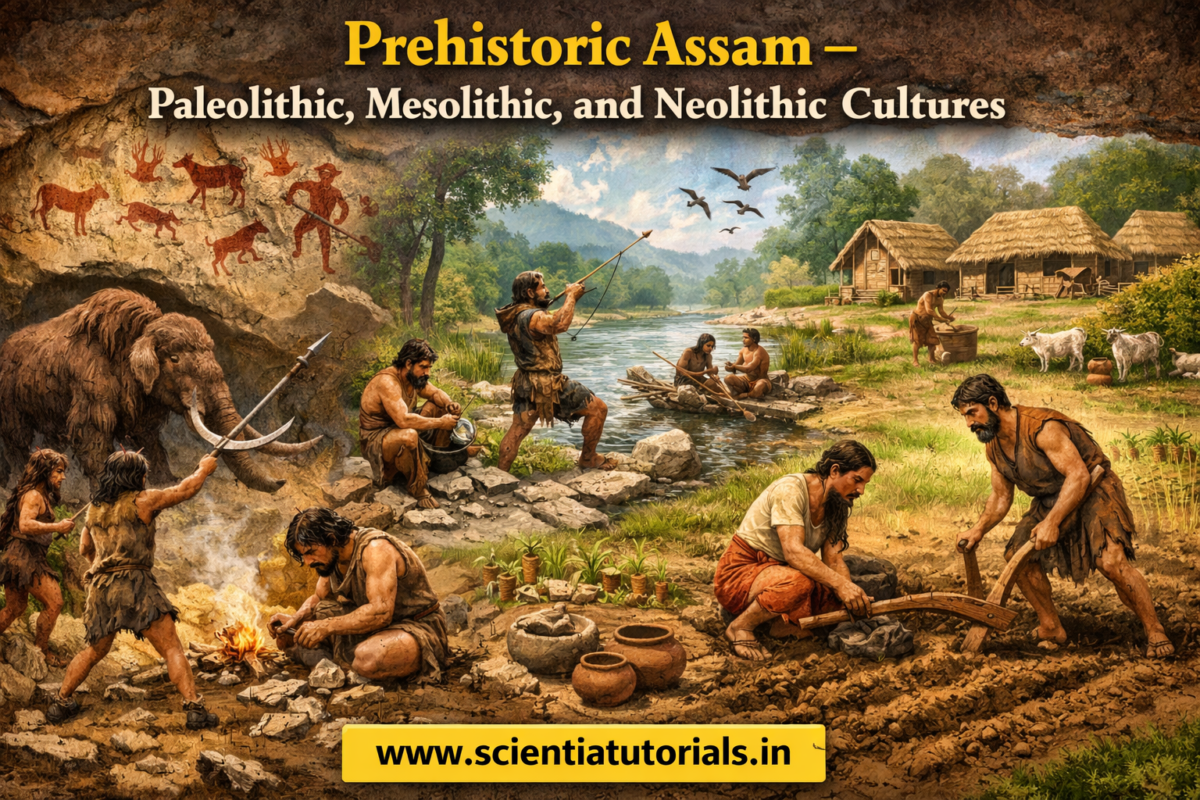
Prehistoric Assam – Paleolithic, Mesolithic, and Neolithic Cultures
Course: Assam History – Chronological Era-Wise Study Module for Competitive Exams
Module I: Prehistoric and Protohistoric Assam (c. 2,00,000 BCE – 4th Century CE)
Lesson 1: Prehistoric Assam – Paleolithic, Mesolithic, and Neolithic Cultures
This lesson is systematically organized into four clearly structured sections, as detailed below:
- Chronologically Structured Study Module
- Short-Answer Type Questions
- Long-Answer Type Questions
- Multiple-Choice Questions (MCQs) with Answers and Detailed Explanations
Chronologically Structured Study Module
1. Introduction to Prehistoric Assam
Prehistoric Assam represents the earliest phase of human occupation in the Brahmaputra and Barak Valley regions, long before the emergence of written records or organized political structures. The study of this period relies entirely on archaeological evidence such as stone tools, pottery fragments, habitation sites, and environmental indicators. Understanding prehistoric Assam is crucial for reconstructing the foundations of Assamese society, including early subsistence patterns, technological development, and cultural evolution.
Chronologically, the prehistoric period of Assam broadly spans from approximately 2,00,000 BCE to the early centuries of the Common Era, overlapping with protohistoric developments. This long phase is conventionally divided into three major cultural stages based on tool technology and lifestyle: the Paleolithic, Mesolithic, and Neolithic periods. Each stage reflects gradual but significant changes in human adaptation to the region’s unique geographical and ecological conditions.
2. Geographical Context and Environmental Setting
Assam’s geographical location played a decisive role in shaping its prehistoric culture. The region lies at the crossroads of South Asia, Southeast Asia, and East Asia, making it an important corridor for early human migration. The fertile alluvial plains of the Brahmaputra and Barak rivers, surrounded by hills and forests, provided abundant natural resources such as water, flora, fauna, and stone suitable for tool-making.
The climatic conditions of prehistoric Assam were largely humid and monsoonal, supporting dense forests and diverse wildlife. These environmental factors influenced early human settlement patterns, encouraging hunting, gathering, fishing, and eventually agriculture. The river systems also facilitated mobility, seasonal migration, and cultural exchange among early communities.
3. Paleolithic Culture in Assam (c. 2,00,000 BCE – 10,000 BCE)
The Paleolithic phase marks the earliest evidence of human presence in Assam. This period is characterized by the use of rudimentary stone tools made primarily through the technique of flaking. Paleolithic humans were nomadic hunter-gatherers who depended entirely on nature for survival.
Archaeological discoveries of Paleolithic tools in Assam are relatively limited compared to other parts of India, but significant finds have been reported from areas such as the Garo Hills, Khasi Hills, Karbi Anglong plateau, and parts of the Brahmaputra Valley. These tools include hand axes, cleavers, choppers, and flakes, generally made of quartzite and other locally available stones.
The Paleolithic inhabitants of Assam lived in open-air sites, riverbanks, and rock shelters. Their subsistence economy was based on hunting wild animals, collecting edible plants, roots, fruits, and fishing in nearby rivers and streams. Social organization was simple, likely based on small kin-based groups with minimal social stratification.
From an examination perspective, the Paleolithic phase is important for understanding early human adaptation, tool typology, and regional variation in prehistoric India, especially in the context of North-East India.
4. Mesolithic Culture in Assam (c. 10,000 BCE – 4,000 BCE)
The Mesolithic period represents a transitional phase between the Paleolithic hunting-gathering economy and the Neolithic agricultural way of life. In Assam, this phase is marked by the development of microlithic tools—small, finely crafted stone implements designed for greater efficiency.
Mesolithic tools discovered in Assam include blades, points, scrapers, and arrowheads, often made of quartz, chert, or chalcedony. These microliths suggest the use of composite tools such as spears, arrows, and sickles, indicating technological advancement.
During this period, human groups began to settle for longer durations in favorable locations, especially near rivers and forest margins. There is evidence of increased reliance on fishing, small game hunting, and plant collection. Seasonal mobility continued, but with greater territorial familiarity and resource management.
Socially, Mesolithic communities displayed increased cooperation and group cohesion. The beginnings of symbolic expression, ritual behavior, and possibly early forms of art can be inferred, although direct evidence in Assam remains limited.
For competitive examinations, the Mesolithic phase is significant for understanding cultural transition, microlithic technology, and early semi-sedentary life in prehistoric Assam.
5. Neolithic Culture in Assam (c. 4,000 BCE – 1,500 BCE)
The Neolithic period marks a major transformation in the prehistoric history of Assam. This phase is characterized by the introduction of agriculture, domestication of animals, polished stone tools, pottery, and permanent settlements. Neolithic culture in Assam shows strong affinities with Southeast Asian Neolithic traditions, highlighting Assam’s role as a cultural bridge between India and Southeast Asia.
One of the most important Neolithic sites in Assam is Daojali Hading in the North Cachar Hills (Dima Hasao district). Excavations at this site have revealed polished stone axes, adzes, celts, cord-impressed pottery, and evidence of habitation floors. These findings indicate settled village life and an economy based on agriculture and animal husbandry.
Neolithic communities in Assam practiced shifting cultivation (jhum), which involved clearing forest land, cultivating crops for a few years, and then moving to new areas. Crops likely included rice and other cereals, while domesticated animals may have included pigs and cattle.
Pottery became an essential feature of daily life, used for cooking, storage, and ritual purposes. The presence of pottery also suggests advancements in food processing and storage, contributing to population growth and social complexity.
Neolithic Assam provides crucial insights into the origins of agrarian society, village organization, and early cultural traditions that later influenced historic Assamese society.
6. Protohistoric Developments in Assam
The protohistoric phase refers to the period when societies had not yet developed indigenous writing systems but are mentioned indirectly in early literary sources or show signs of increasing social complexity. In Assam, the protohistoric phase overlaps with the late Neolithic and early metal-using cultures.
Archaeological evidence suggests the gradual introduction of metal tools, especially copper and iron, towards the end of the Neolithic period. These developments improved agricultural productivity and craftsmanship. Social differentiation became more pronounced, and long-distance trade networks likely emerged, connecting Assam with neighboring regions.
Protohistoric Assam laid the foundation for the emergence of early political entities such as Pragjyotisha, which appear in ancient Indian texts. Thus, the protohistoric phase serves as a bridge between prehistoric culture and early historical Assam.
7. Cultural and Ethno-Historical Significance
The prehistoric and protohistoric cultures of Assam are closely linked to the region’s ethnic diversity. Many scholars suggest that several present-day tribal communities of Assam and the North-East retain cultural practices, agricultural methods, and social customs that originated during the Neolithic period.
The continuity of traditions such as shifting cultivation, community-based resource sharing, and nature worship reflects the deep historical roots of Assamese society. Understanding this continuity is essential for developing a nuanced regional historical perspective.
8. Importance of Prehistoric Assam in Competitive Examinations
From an examination standpoint, this lesson is highly relevant for:
- APSC (CCE) Prelims and Mains
- Assam Police, ADRE, and SSC (North-East posts)
- UGC-NET, CUET (UG/PG), and university examinations
- UPSC GS Paper I (Ancient and Regional History)
Questions are frequently asked on:
- Classification of prehistoric cultures
- Key archaeological sites in Assam
- Neolithic features and Daojali Hading
- Cultural transition from hunting-gathering to agriculture
A strong conceptual understanding of prehistoric Assam helps aspirants answer both objective and analytical questions effectively.
9. Conclusion
The study of Prehistoric and Protohistoric Assam provides the earliest chapter of Assam’s long and complex historical journey. From primitive stone tools to settled agricultural communities, this period reflects human resilience, adaptability, and innovation in a challenging yet resource-rich environment. Chronologically structured understanding of Paleolithic, Mesolithic, and Neolithic cultures not only strengthens regional history preparation but also enhances broader comprehension of Indian prehistoric developments.
This lesson lays a solid foundation for subsequent modules on ancient, medieval, and modern Assam, enabling learners to approach Assam History with clarity, continuity, and exam-oriented precision.
Short Answer Type Questions
Lesson 1: Prehistoric Assam – Paleolithic, Mesolithic, and Neolithic Cultures
1. What is meant by the term ‘Prehistoric period’ in the context of Assam?
Answer:
The prehistoric period in Assam refers to the phase of human history before the use of written records, reconstructed primarily through archaeological evidence such as stone tools, pottery, and habitation sites.
2. Mention the approximate chronological span of prehistoric Assam.
Answer:
Prehistoric Assam broadly spans from about 2,00,000 BCE to the early centuries of the Common Era, overlapping with protohistoric developments.
3. Name the three main cultural stages of prehistoric Assam.
Answer:
The three main cultural stages are the Paleolithic, Mesolithic, and Neolithic periods.
4. Which geographical factors influenced early human settlement in Assam?
Answer:
The fertile Brahmaputra and Barak river valleys, abundant forests, availability of stone resources, and a humid monsoonal climate influenced early human settlement in Assam.
5. What type of economy did Paleolithic people in Assam follow?
Answer:
Paleolithic people followed a hunter-gatherer economy, relying on hunting wild animals, fishing, and collecting forest produce.
6. What kinds of stone tools are associated with the Paleolithic culture in Assam?
Answer:
Paleolithic tools include hand axes, cleavers, choppers, and flakes, usually made of quartzite and other locally available stones.
7. Mention any two regions where Paleolithic tools have been found in Assam.
Answer:
Paleolithic tools have been found in the Garo Hills and Karbi Anglong regions of Assam.
8. What distinguishes the Mesolithic period from the Paleolithic period in Assam?
Answer:
The Mesolithic period is distinguished by the use of microlithic tools, greater efficiency in hunting and fishing, and a gradual shift towards semi-sedentary life.
9. What are microliths?
Answer:
Microliths are small, finely worked stone tools used as parts of composite implements such as arrows, spears, and sickles.
10. How did subsistence patterns change during the Mesolithic period in Assam?
Answer:
Subsistence patterns expanded to include fishing, small-game hunting, and systematic plant collection, alongside continued hunting.
11. What major transformation marks the Neolithic period in Assam?
Answer:
The major transformation is the adoption of agriculture, domestication of animals, and the establishment of permanent settlements.
12. Name the most important Neolithic archaeological site in Assam.
Answer:
Daojali Hading in the North Cachar Hills is the most important Neolithic site in Assam.
13. What types of tools are associated with Neolithic culture in Assam?
Answer:
Neolithic culture is associated with polished stone tools such as axes, adzes, and celts.
14. What is shifting cultivation, and how is it related to Neolithic Assam?
Answer:
Shifting cultivation, or jhum, is a farming method involving temporary clearing of forest land for cultivation, widely practiced by Neolithic communities in Assam.
15. What role did pottery play in Neolithic Assam?
Answer:
Pottery was used for cooking, storage, and domestic purposes, reflecting technological advancement and settled life.
16. How does Neolithic culture of Assam show links with Southeast Asia?
Answer:
Similarities in polished stone tools, cord-impressed pottery, and agricultural practices indicate cultural links with Southeast Asia.
17. What is meant by the term ‘Protohistoric period’ in Assam?
Answer:
The protohistoric period refers to the phase lacking indigenous written records but showing increasing social complexity and indirect references in early literary sources.
18. Which metals began to be used during the protohistoric phase in Assam?
Answer:
Copper and iron began to be used during the protohistoric phase in Assam.
19. How did the use of metal tools affect society in protohistoric Assam?
Answer:
Metal tools improved agricultural efficiency, craftsmanship, and social differentiation, contributing to economic growth.
20. What is the historical significance of Daojali Hading?
Answer:
Daojali Hading provides evidence of settled Neolithic life, agriculture, pottery, and cultural links with Southeast Asia.
21. How does prehistoric Assam contribute to understanding ethnic diversity in the region?
Answer:
Many present-day tribal customs, agricultural practices, and social traditions trace their origins to prehistoric and Neolithic cultures.
22. Why is the study of prehistoric Assam important for competitive examinations?
Answer:
It helps in understanding regional historical development, archaeological concepts, and frequently asked factual and analytical questions in exams.
23. What sources are used to reconstruct prehistoric Assam history?
Answer:
Prehistoric history is reconstructed using archaeological evidence, including tools, pottery, and habitation remains.
24. What type of settlements existed during the Paleolithic period in Assam?
Answer:
Paleolithic people lived in temporary camps, open-air sites, riverbanks, and rock shelters.
25. How does the protohistoric phase act as a bridge in Assam’s history?
Answer:
It bridges prehistoric culture and early historic Assam, leading to the emergence of early political entities like Pragjyotisha.
Long Answer Type Questions
Lesson 1: Prehistoric Assam – Paleolithic, Mesolithic, and Neolithic Cultures
1. Discuss the significance of prehistoric studies in reconstructing the early history of Assam.
Answer:
The study of prehistoric Assam is crucial for understanding the earliest phase of human occupation in the region, long before the emergence of written records. Since Assam lacks indigenous inscriptions for this period, archaeological evidence such as stone tools, pottery, and habitation sites forms the primary basis for reconstruction. Prehistoric studies reveal how early humans adapted to Assam’s riverine and forested environment, developed subsistence strategies, and gradually transitioned from hunting-gathering to agriculture. This phase also explains the roots of Assam’s ethnic diversity and cultural continuity, making it indispensable for a holistic understanding of regional history.
2. Examine the geographical and environmental factors that influenced prehistoric human settlement in Assam.
Answer:
Assam’s geography played a decisive role in shaping prehistoric settlement patterns. The fertile plains of the Brahmaputra and Barak rivers provided abundant water, food resources, and fertile soil. The surrounding hills and forests offered shelter, stone for tools, and diverse flora and fauna. The humid monsoonal climate supported rich biodiversity, facilitating hunting, fishing, and gathering. Additionally, Assam’s location as a corridor between South Asia and Southeast Asia enabled early human migration and cultural exchange, influencing the development of prehistoric cultures.
3. Describe the main features of Paleolithic culture in Assam.
Answer:
The Paleolithic culture in Assam represents the earliest stage of human life, characterized by the use of crude stone tools such as hand axes, cleavers, and choppers made primarily from quartzite. Paleolithic humans were nomadic hunter-gatherers who depended on hunting animals, fishing, and collecting forest produce. Settlements were temporary, located near riverbanks, open-air sites, or rock shelters. Social organization was simple, with small kin-based groups and minimal technological advancement.
4. Analyse the nature of Paleolithic tools found in Assam and their significance.
Answer:
Paleolithic tools found in regions such as Karbi Anglong and the Garo Hills are mostly large, roughly flaked implements. Their significance lies in demonstrating early human ingenuity and adaptation to local resources. These tools were multifunctional, used for cutting, hunting, and processing food. Their presence confirms the antiquity of human settlement in Assam and places the region within the broader framework of Indian prehistoric culture.
5. How does the Mesolithic period represent a transitional phase in prehistoric Assam?
Answer:
The Mesolithic period marks a transition from purely nomadic hunting-gathering to semi-sedentary life. The introduction of microlithic tools allowed greater efficiency in hunting and fishing. Humans began to exploit a wider range of food resources, including fish and small animals. Seasonal settlements emerged, reflecting better adaptation to the environment. This transitional phase laid the groundwork for agricultural practices and permanent settlements of the Neolithic age.
6. Discuss the technological advancements of the Mesolithic period in Assam.
Answer:
The hallmark of Mesolithic technology is the use of microliths—small, finely crafted stone tools. These tools were often mounted on wooden or bone handles to form composite weapons. Such advancements increased hunting efficiency and resource utilization. The development of microliths reflects growing skill, planning, and specialization among prehistoric communities in Assam.
7. Examine the subsistence patterns of Mesolithic communities in Assam.
Answer:
Mesolithic communities practiced a diversified subsistence economy. Alongside hunting large animals, they increasingly relied on fishing, trapping small animals, and systematic plant collection. This broad-based subsistence strategy reduced dependence on any single food source and contributed to population stability and growth.
8. Discuss the major features of Neolithic culture in Assam.
Answer:
The Neolithic culture marks a revolutionary shift marked by agriculture, domestication of animals, polished stone tools, pottery, and permanent settlements. Communities practiced shifting cultivation and lived in settled villages. Pottery became common, indicating food storage and cooking practices. Social life became more complex, with cooperation and division of labor emerging.
9. Describe the archaeological importance of Daojali Hading.
Answer:
Daojali Hading, located in the North Cachar Hills, is the most significant Neolithic site in Assam. Excavations revealed polished stone tools, cord-impressed pottery, and evidence of settled life. The site demonstrates cultural connections with Southeast Asia and provides crucial insights into early agriculture and village life in Assam.
10. Explain the agricultural practices of Neolithic Assam.
Answer:
Neolithic communities practiced shifting cultivation or jhum farming. Forest land was cleared, cultivated for a few years, and then abandoned to restore fertility. Crops such as rice were grown, and animals were domesticated. This method suited Assam’s hilly terrain and forest environment and continues among some communities even today.
11. Analyse the role of pottery in Neolithic Assam.
Answer:
Pottery played a vital role in Neolithic Assam, serving domestic and storage needs. Cord-impressed pottery indicates technological innovation and cultural links with Southeast Asia. The use of pottery reflects sedentary life, surplus production, and advancements in daily living.
12. How does Neolithic Assam reflect cultural links with Southeast Asia?
Answer:
Similarities in tool types, pottery styles, and agricultural practices suggest strong cultural connections between Neolithic Assam and Southeast Asia. These links highlight Assam’s role as a cultural bridge and migration corridor in prehistoric times.
13. Define the protohistoric phase of Assam and explain its characteristics.
Answer:
The protohistoric phase refers to a period lacking indigenous written records but showing advanced social and technological development. It is characterized by the introduction of metal tools, increased trade, and emerging social hierarchy. This phase bridges prehistoric and early historic Assam.
14. Discuss the introduction and impact of metals in protohistoric Assam.
Answer:
The use of copper and iron tools improved agricultural efficiency and craftsmanship. Metal tools enabled forest clearance, better farming implements, and weapons, contributing to economic growth and social stratification.
15. How did prehistoric cultures influence the ethnic and cultural formation of Assam?
Answer:
Many cultural practices of present-day tribal communities—such as shifting cultivation, community living, and nature worship—have roots in prehistoric traditions. These continuities highlight the lasting influence of prehistoric cultures on Assamese society.
16. Assess the importance of prehistoric Assam for understanding Indian prehistory as a whole.
Answer:
Prehistoric Assam expands the geographical scope of Indian prehistory beyond the Indus and Gangetic regions. It demonstrates regional diversity, migration routes, and cultural interaction, enriching the broader understanding of early Indian history.
17. Explain the role of rivers in shaping prehistoric life in Assam.
Answer:
Rivers provided water, food, fertile land, and transportation routes. Most prehistoric settlements were located near riverbanks, emphasizing their importance in survival and settlement planning.
18. What methodological challenges are involved in studying prehistoric Assam?
Answer:
Challenges include limited excavation, lack of written records, climatic conditions affecting preservation, and accessibility of sites. Despite these issues, archaeology remains the primary tool for reconstruction.
19. Why is the study of prehistoric Assam important for competitive examinations?
Answer:
It strengthens conceptual clarity in ancient and regional history, addresses frequently asked questions, and helps candidates write analytical answers linking Assam history with Indian history.
20. Conclude by evaluating the overall significance of the prehistoric and protohistoric phases in Assam’s historical development.
Answer:
The prehistoric and protohistoric phases form the foundation of Assam’s historical evolution. They explain early human adaptation, cultural continuity, and the transition to organized society. Understanding these phases provides essential context for the emergence of early states like Pragjyotisha and enriches the study of Assam within the broader Indian historical framework.
MCQs with Answers and Detailed Explanations
Lesson 1: Prehistoric Assam – Paleolithic, Mesolithic, and Neolithic Cultures
1. Which of the following best defines the prehistoric period of Assam?
A. Period described in early Sanskrit texts
B. Period before British rule
C. Period before the use of written records
D. Period of Ahom administration
Correct Answer: C
Explanation:
Prehistory refers to the period before written records. In Assam, this phase is reconstructed through archaeological evidence such as tools and pottery, not textual sources.
2. The prehistoric period of Assam broadly begins around:
A. 10,000 BCE
B. 50,000 BCE
C. 2,00,000 BCE
D. 4th century CE
Correct Answer: C
Explanation:
Archaeological evidence suggests human presence in Assam from approximately 2,00,000 BCE, marking the beginning of the Paleolithic phase.
3. Which of the following cultural stages comes first in chronological order?
A. Mesolithic
B. Neolithic
C. Protohistoric
D. Paleolithic
Correct Answer: D
Explanation:
The Paleolithic is the earliest cultural stage, followed by the Mesolithic and Neolithic periods.
4. Paleolithic people in Assam primarily depended on:
A. Agriculture and trade
B. Pastoralism
C. Hunting and gathering
D. Industrial production
Correct Answer: C
Explanation:
Paleolithic humans were hunter-gatherers, relying on hunting animals, fishing, and collecting forest produce.
5. Which type of tools is most commonly associated with the Paleolithic culture in Assam?
A. Polished stone axes
B. Microliths
C. Hand axes and cleavers
D. Iron implements
Correct Answer: C
Explanation:
Paleolithic tools were large, crudely shaped implements such as hand axes, cleavers, and choppers.
6. Paleolithic tools in Assam were generally made from:
A. Iron ore
B. Quartzite and local stones
C. Copper
D. Clay
Correct Answer: B
Explanation:
Early humans used locally available stones, especially quartzite, to manufacture Paleolithic tools.
7. Which region is known for Paleolithic tool findings in Assam?
A. Brahmaputra delta
B. Karbi Anglong plateau
C. Majuli Island
D. Barak Valley plains
Correct Answer: B
Explanation:
Paleolithic tools have been reported from hilly regions such as Karbi Anglong, indicating early human activity.
8. What is the defining feature of Mesolithic culture?
A. Use of iron tools
B. Large hand-made tools
C. Use of microliths
D. Urban settlements
Correct Answer: C
Explanation:
The Mesolithic period is marked by microlithic tools, which were small and efficient.
9. Microliths were mainly used to make:
A. Pottery
B. Composite tools
C. Ornaments
D. Shelter structures
Correct Answer: B
Explanation:
Microliths were often mounted on wooden or bone handles to form composite tools like arrows and spears.
10. Which subsistence activity became more prominent during the Mesolithic period in Assam?
A. Large-scale agriculture
B. Industrial production
C. Fishing and small-game hunting
D. Plantation farming
Correct Answer: C
Explanation:
Mesolithic people diversified their subsistence, especially fishing and hunting small animals.
11. The Mesolithic period in Assam is best described as:
A. Fully nomadic
B. Fully settled
C. Transitional phase
D. Urban phase
Correct Answer: C
Explanation:
It represents a transition from nomadic Paleolithic life to settled Neolithic agriculture.
12. Which major change marks the beginning of the Neolithic period in Assam?
A. Introduction of writing
B. Adoption of agriculture
C. Development of urban centers
D. Use of bronze tools
Correct Answer: B
Explanation:
The Neolithic period is defined by the beginning of agriculture and settled life.
13. Which is the most important Neolithic site in Assam?
A. Ambari
B. Sarutaru
C. Daojali Hading
D. Majuli
Correct Answer: C
Explanation:
Daojali Hading provides clear evidence of Neolithic culture, including tools and pottery.
14. Neolithic tools in Assam are typically:
A. Rough and unpolished
B. Made of iron
C. Polished stone implements
D. Wooden tools only
Correct Answer: C
Explanation:
Neolithic tools are characterized by polished stone axes and adzes, reflecting technological advancement.
15. Shifting cultivation practiced in Neolithic Assam is also known as:
A. Wet rice farming
B. Terrace farming
C. Jhum cultivation
D. Plantation farming
Correct Answer: C
Explanation:
Jhum cultivation involved clearing forest land for temporary farming and was well-suited to Assam’s terrain.
16. Pottery became widespread in Assam during the:
A. Paleolithic period
B. Mesolithic period
C. Neolithic period
D. Protohistoric period
Correct Answer: C
Explanation:
Pottery is a key feature of the Neolithic period, indicating settled life and surplus production.
17. Cord-impressed pottery found in Assam suggests:
A. Urbanization
B. Cultural links with Southeast Asia
C. Roman trade
D. Iron Age culture
Correct Answer: B
Explanation:
Cord-impressed pottery shows cultural similarities with Southeast Asian Neolithic traditions.
18. The protohistoric phase of Assam is best described as:
A. Fully prehistoric
B. Fully historic
C. Transitional between prehistory and history
D. Post-Ahom phase
Correct Answer: C
Explanation:
The protohistoric phase acts as a bridge between prehistoric culture and early historic society.
19. Which metals were first introduced in protohistoric Assam?
A. Gold and silver
B. Bronze and zinc
C. Copper and iron
D. Tin and lead
Correct Answer: C
Explanation:
The introduction of copper and iron marked technological progress during the protohistoric phase.
20. The use of metal tools primarily led to:
A. Decline of agriculture
B. Reduced population
C. Improved agricultural productivity
D. Loss of cultural identity
Correct Answer: C
Explanation:
Metal tools enabled efficient farming and forest clearance, increasing agricultural productivity.
21. Prehistoric settlements in Assam were commonly located near:
A. Deserts
B. Riverbanks
C. Coastal areas
D. Plateaus only
Correct Answer: B
Explanation:
Rivers provided water, food, fertile land, and transport, making riverbanks ideal settlement locations.
22. Which factor best explains Assam’s importance in prehistoric migration?
A. Coastal access
B. Desert routes
C. Corridor between South and Southeast Asia
D. Mountain isolation
Correct Answer: C
Explanation:
Assam served as a migration corridor connecting South Asia with Southeast Asia.
23. Many present-day tribal practices in Assam have their roots in:
A. Medieval culture
B. Colonial policies
C. Prehistoric traditions
D. Modern reforms
Correct Answer: C
Explanation:
Practices like shifting cultivation and community living trace back to prehistoric traditions.
24. Which of the following sources is most important for studying prehistoric Assam?
A. Inscriptions
B. Coins
C. Archaeological evidence
D. Literary texts
Correct Answer: C
Explanation:
Since there are no written records, archaeology is the primary source for prehistoric studies.
25. The study of prehistoric Assam is important mainly because it:
A. Focuses on dynastic history
B. Explains early colonial rule
C. Provides the foundation of Assam’s historical development
D. Deals with modern political movements
Correct Answer: C
Explanation:
Prehistoric Assam explains the origins of human settlement, culture, and society, forming the base of later historical developments.
📌 Primary Long-Tail Keyphrases
-
prehistoric Assam history study material
-
Paleolithic Mesolithic Neolithic Assam notes
-
prehistoric Assam for competitive exams
-
Assam history prehistoric period notes
📌 Exam-Oriented Long-Tail Keyphrases
-
prehistoric Assam history for APSC preparation
-
Assam prehistoric culture MCQs and notes
-
UPSC GS Paper 1 Assam prehistoric history
-
CUET and UGC NET Assam history notes
📌 Concept-Focused Long-Tail Keyphrases
-
Neolithic culture of Assam Daojali Hading
-
Mesolithic microlithic culture in Assam
-
Paleolithic stone tools found in Assam
-
protohistoric Assam cultural development