
Lesson 1: Integration of Assam into Independent India
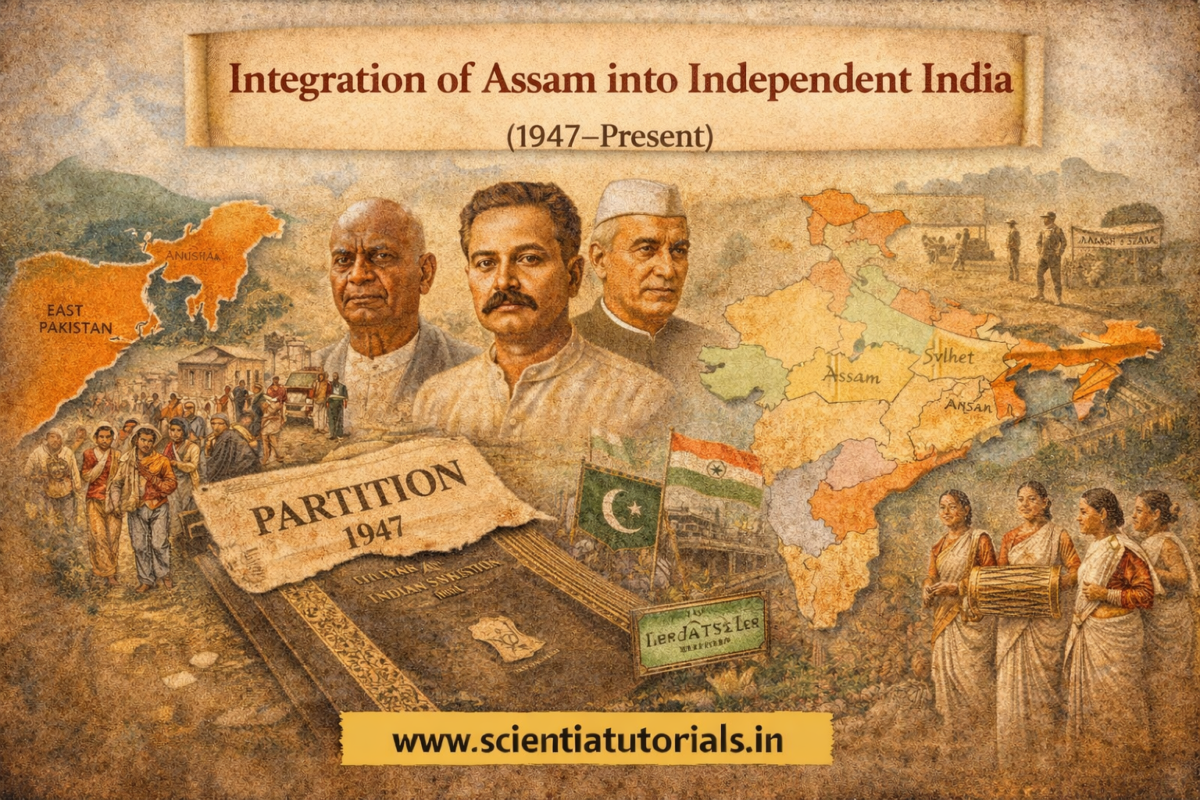
Integration of Assam into Independent India (1947–Present)
Module VI: Post-Independence Assam (1947 CE – Present)
Lesson 1: Integration of Assam into Independent India
This lesson is systematically organized into four clearly structured sections, as detailed below:
- Chronologically Structured Study Module
- Short-Answer Type Questions
- Long-Answer Type Questions
Multiple-Choice Questions (MCQs) with Answers and Detailed Explanations
Chronologically Structured Study Module
Introduction: Context and Learning Objectives
The integration of Assam into Independent India after 1947 CE was not a simple administrative transition but a complex historical process shaped by colonial legacies, Partition-related challenges, ethnic diversity, border issues, and nation-building imperatives. Unlike many regions of mainland India, Assam occupied a strategic frontier position, sharing international borders with East Pakistan (now Bangladesh), Bhutan, China, and Myanmar, and internal borders with newly reorganized hill areas.
This lesson provides a chronologically structured, examination-oriented study of how Assam was integrated into the Indian Union after independence. It examines political leadership, constitutional measures, administrative restructuring, and early post-independence challenges, with particular emphasis on nation-building, territorial integrity, and federal integration.
Learning Objectives
After completing this lesson, learners will be able to:
- Understand the historical background of Assam at Independence
- Analyze the role of leadership in integrating Assam with India
- Explain constitutional and administrative measures taken after 1947
- Examine challenges of Partition, migration, and border security
- Critically assess the long-term implications of integration policies
- Write chronologically organized, analytical answers for competitive examinations
I. Assam on the Eve of Independence (1946–1947)
1. Colonial Legacy and Political Position
At the end of British rule, Assam was a Chief Commissioner’s Province (earlier) and later a Governor’s Province with limited political autonomy. It was economically underdeveloped but strategically vital due to its resources (tea, oil) and frontier location.
2. Impact of Partition Debates
During the final phase of British rule, Assam faced serious uncertainty regarding its future. The demand for Pakistan and communal politics raised fears that Assam might be:
- Isolated from India
- Forced into Pakistan due to its Muslim-majority neighboring districts
The situation made Assam’s integration into India a highly sensitive political issue.
II. Role of Gopinath Bordoloi in Assam’s Integration
1. Leadership during a Critical Phase
Gopinath Bordoloi, the Premier of Assam, played a decisive role in safeguarding Assam’s future.
2. Opposition to Grouping Plan
Under the Cabinet Mission Plan (1946), Assam was proposed to be grouped with Bengal in a section that could potentially join Pakistan. Bordoloi strongly opposed this grouping, arguing that it violated Assam’s political and cultural autonomy.
3. Advocacy at the National Level
Bordoloi worked closely with national leaders like Jawaharlal Nehru and Sardar Vallabhbhai Patel, ensuring Assam remained within India.
Outcome: Assam emerged as a full-fledged constituent unit of the Indian Union in 1947.
III. Assam and the Partition of India (1947)
1. Geographic and Demographic Challenges
Unlike Punjab and Bengal, Assam did not witness large-scale communal violence, but Partition deeply affected it through:
- Influx of refugees from East Pakistan
- Demographic changes
- Pressure on land and resources
2. Sylhet Referendum (1947)
The Sylhet district of Assam held a referendum in which most of Sylhet voted to join East Pakistan.
Consequences
- Assam lost a culturally and economically significant region
- Barak Valley remained with India
- Assam’s boundaries were permanently altered
IV. Immediate Administrative Integration after Independence
1. Continuity of Colonial Administration
After independence, Assam initially retained much of the colonial administrative structure, including:
- District administration
- Revenue and police systems
This continuity ensured administrative stability during transition.
2. Establishment of Popular Government
Assam became a full state within the Indian Union, governed under the Constitution of India, which came into force in 1950.
V. Constitutional Framework and Assam
1. Federal Structure of India
India adopted a federal system with strong central authority, crucial for integrating border states like Assam.
2. Special Provisions for Tribal Areas
The Sixth Schedule of the Constitution provided autonomy to tribal areas through Autonomous District Councils.
Objectives
- Protect tribal identity
- Ensure self-governance
- Prevent alienation
This provision was directly influenced by Assam’s ethnic diversity.
VI. Integration of Tribal and Hill Areas
1. Historical Background
During colonial rule, hill areas were administered separately as Excluded or Partially Excluded Areas.
2. Post-Independence Policy
After 1947, India sought to integrate these regions politically while respecting cultural autonomy.
3. Administrative Reorganization
- Formation of autonomous councils
- Gradual political inclusion of hill tribes
This approach balanced national integration with regional autonomy.
VII. Refugee Influx and Migration Issues
1. Refugees from East Pakistan
Partition led to continuous migration of Hindu refugees into Assam, especially into:
- Barak Valley
- Brahmaputra Valley
2. Challenges
- Pressure on land
- Employment competition
- Cultural anxiety among indigenous communities
Migration soon became a central political issue in post-independence Assam.
VIII. Border and Security Concerns
1. International Borders
Assam shared long and porous borders with East Pakistan, making border management a priority.
2. Strategic Importance
Assam became critical to India’s defense policy in the Northeast, especially after:
- Chinese assertion over Tibet
- Increasing regional instability
IX. Reorganization of Assam and the Northeast
1. Linguistic and Ethnic Aspirations
Post-independence integration was followed by demands for:
- Separate states
- Autonomy for ethnic groups
2. Gradual Territorial Changes
Assam’s integration process continued through reorganization, leading to the creation of new states in later decades (Nagaland, Meghalaya, etc.).
This demonstrated that integration was dynamic, not static.
X. Political Integration and Democratic Participation
1. Introduction of Universal Adult Franchise
For the first time, the people of Assam participated in democratic governance through elections.
2. Growth of Political Institutions
- State legislature
- Political parties
- Electoral politics
These institutions deepened Assam’s integration into India’s democratic framework.
XI. Economic Integration with India
1. National Planning Framework
Assam was integrated into India’s planned economy through:
- Five-Year Plans
- Central investments
2. Limitations
Despite integration, Assam faced:
- Infrastructure deficits
- Regional imbalance
Economic integration remained uneven and incomplete.
XII. Cultural and Emotional Integration
1. Assamese Identity within Indian Nationalism
Post-independence policies sought to balance:
- Assamese linguistic-cultural identity
- Indian national identity
2. Role of Education and Media
National institutions helped promote a sense of belonging while preserving regional culture.
XIII. Challenges to Integration in Early Post-Independence Period
- Migration and demographic change
- Border insecurity
- Ethnic and linguistic tensions
- Economic underdevelopment
These challenges tested the resilience of India’s federal structure.
XIV. Assessment of Integration Strategy
Positive Aspects
- Assam retained territorial integrity
- Constitutional safeguards for diversity
- Democratic inclusion
Limitations
- Inadequate handling of migration
- Delayed economic development
- Rising regional discontent
Integration was political success but socio-economic work in progress.
XV. Long-Term Significance of Assam’s Integration
For India
- Secured the Northeast within the Union
- Strengthened federalism
For Assam
- Access to democratic governance
- Constitutional protection
- Participation in nation-building
XVI. Examination-Oriented Key Points
- 1947 → Assam becomes part of independent India
- Role of Gopinath Bordoloi
- Sylhet Referendum
- Sixth Schedule and tribal autonomy
- Migration as post-independence issue
- Integration as a continuing process
Conclusion
The integration of Assam into Independent India was a crucial chapter in India’s nation-building process. It required visionary leadership, constitutional innovation, and political sensitivity to regional diversity. While Assam’s inclusion within India in 1947 was a historic achievement—largely due to the efforts of leaders like Gopinath Bordoloi—the challenges that followed revealed that integration is not merely territorial, but social, economic, and emotional.
Understanding this process is essential for appreciating the political history of Assam and the broader challenges of integrating a diverse frontier region into a modern nation-state. This lesson thus forms the foundation for studying post-independence Assam in Module VI and is indispensable for UPSC, APSC, and State-level competitive examinations.
Short Answer Type Questions
Course: Assam History: Chronological Era-Wise Study Module for Competitive Exams
Module VI: Post-Independence Assam (1947 CE – Present)
Lesson 1: Integration of Assam into Independent India
1. In which year was Assam integrated into independent India?
Answer: Assam was integrated into independent India in 1947 CE.
2. Who was the Premier of Assam at the time of Independence?
Answer: Gopinath Bordoloi was the Premier of Assam.
3. Why was Assam’s integration into India considered strategically important?
Answer: Due to its frontier location, international borders, and strategic resources like tea and oil.
4. What major political plan threatened Assam’s autonomy before Independence?
Answer: The Cabinet Mission Plan (1946), especially its proposal for grouping Assam with Bengal.
5. How did Gopinath Bordoloi oppose the Cabinet Mission Plan?
Answer: He strongly rejected compulsory grouping with Bengal and defended Assam’s political autonomy.
6. Which national leaders supported Bordoloi’s stand on Assam?
Answer: Jawaharlal Nehru and Sardar Vallabhbhai Patel.
7. What was the Sylhet Referendum?
Answer: A 1947 plebiscite in which most of Sylhet voted to join East Pakistan.
8. Which part of Sylhet remained with India after Partition?
Answer: The Barak Valley remained with India.
9. How did the Partition of India affect Assam demographically?
Answer: It led to a large influx of refugees from East Pakistan.
10. Did Assam witness large-scale communal violence during Partition?
Answer: No, communal violence was relatively limited compared to Punjab and Bengal.
11. Under which Constitution did Assam become a state of India?
Answer: Under the Constitution of India.
12. When did the Constitution of India come into force?
Answer: On 26 January 1950.
13. What type of federal system did India adopt after Independence?
Answer: A federal system with a strong central government.
14. Which constitutional provision safeguards tribal areas in Assam?
Answer: The Sixth Schedule of the Constitution.
15. What is the main purpose of the Sixth Schedule?
Answer: To provide autonomy and self-governance to tribal areas.
16. What were tribal areas called during British rule?
Answer: Excluded and Partially Excluded Areas.
17. What administrative approach was adopted for hill areas after 1947?
Answer: Political integration with cultural autonomy through autonomous councils.
18. From which country did most refugees migrate to Assam after 1947?
Answer: East Pakistan (now Bangladesh).
19. Name one major problem caused by post-independence migration in Assam.
Answer: Pressure on land and resources.
20. Why was border security a major concern for Assam after Independence?
Answer: Due to long and porous international borders.
21. How did Independence change political participation in Assam?
Answer: Introduction of universal adult franchise and democratic elections.
22. What role did elections play in Assam’s integration?
Answer: They strengthened democratic inclusion and political integration.
23. How was Assam economically integrated into India after 1947?
Answer: Through Five-Year Plans and central investment.
24. Mention one limitation of economic integration in Assam.
Answer: Slow development and regional imbalance.
25. What role did culture play in Assam’s integration with India?
Answer: It helped balance Assamese identity with Indian nationalism.
26. Why is Assam’s integration described as a continuing process?
Answer: Because reorganization, migration, and ethnic issues continued after 1947.
27. Name one positive outcome of Assam’s integration into India.
Answer: Preservation of territorial integrity within the Indian Union.
28. Mention one major post-independence challenge to Assam’s integration.
Answer: Migration and demographic change.
29. How did federalism help integrate Assam into India?
Answer: By allowing regional autonomy within national unity.
30. Why is the study of Assam’s integration important for competitive exams?
Answer: It explains nation-building challenges, federalism, and post-colonial state formation.
These 30 short answer questions with concise, exam-oriented answers are fully aligned with Module VI, Lesson 1 and are ideal for UPSC, APSC, and other State-level competitive examinations.
Long Answer Type Questions
Course: Assam History: Chronological Era-Wise Study Module for Competitive Exams
Module VI: Post-Independence Assam (1947 CE – Present)
Lesson 1: Integration of Assam into Independent India
1. Examine the historical background of Assam on the eve of Indian Independence.
Answer:
On the eve of Independence in 1947, Assam was a strategically important but politically vulnerable province. It was geographically isolated from mainland India, connected only by the narrow Siliguri Corridor, and surrounded by international borders. Economically, Assam was underdeveloped despite rich resources like tea and oil. Politically, Partition debates and communal politics raised fears that Assam might be detached from India or grouped with Pakistan. These factors made Assam’s integration a sensitive national issue.
2. Why was the integration of Assam into India more complex than many other provinces?
Answer:
Assam’s integration was complex due to its frontier location, ethnic diversity, colonial administrative legacy, and Partition-related uncertainties. Unlike most provinces, Assam faced threats of territorial dismemberment, refugee influx, border insecurity, and the challenge of integrating tribal and hill areas, making its post-independence transition uniquely difficult.
3. Discuss the role of Gopinath Bordoloi in safeguarding Assam’s future at Independence.
Answer:
Gopinath Bordoloi played a decisive role in ensuring Assam’s integration into India. As Premier of Assam, he strongly opposed the Cabinet Mission Plan’s proposal to group Assam with Bengal. He argued that such grouping would undermine Assam’s autonomy and expose it to Pakistan. Through persistent advocacy at the national level, Bordoloi ensured Assam remained a constituent unit of India in 1947.
4. Analyze the Cabinet Mission Plan and its implications for Assam.
Answer:
The Cabinet Mission Plan (1946) proposed grouping provinces into sections. Assam was placed in a group with Bengal, which could later decide to join Pakistan. This threatened Assam’s political autonomy and raised fears of forced inclusion in Pakistan. Assam’s leadership, led by Bordoloi, resisted this plan, making the rejection of compulsory grouping a crucial step in Assam’s integration.
5. How did national leaders support Assam’s integration into India?
Answer:
National leaders such as Jawaharlal Nehru and Sardar Vallabhbhai Patel supported Assam’s cause by recognizing its strategic importance and backing Bordoloi’s stand. Their support ensured Assam’s interests were protected during negotiations leading to Independence.
6. Examine the impact of the Partition of India on Assam.
Answer:
Partition did not cause large-scale communal violence in Assam but had profound long-term effects. The province experienced continuous migration of refugees from East Pakistan, leading to demographic changes, land pressure, and social tension. Partition also altered Assam’s boundaries, especially through the loss of Sylhet.
7. Discuss the Sylhet Referendum and its consequences for Assam.
Answer:
In 1947, the Sylhet district held a referendum in which the majority voted to join East Pakistan. As a result, most of Sylhet was separated from Assam, while the Barak Valley remained in India. This reduced Assam’s territory and population and had lasting cultural, economic, and political implications.
8. How did Assam’s administrative integration take place after Independence?
Answer:
After Independence, Assam initially retained colonial administrative structures to ensure stability. Gradually, these were adapted to suit democratic governance under the Indian constitutional framework. District administration, revenue systems, and law enforcement continued with modifications, facilitating a smooth transition.
9. Explain the constitutional framework that integrated Assam into the Indian Union.
Answer:
Assam became a full-fledged state under the Constitution of India, which came into force in 1950. The Constitution established India as a federal state with a strong Centre, ensuring both national unity and regional autonomy—crucial for integrating a border state like Assam.
10. Analyze the significance of the Sixth Schedule for Assam.
Answer:
The Sixth Schedule provided autonomous governance to tribal areas through Autonomous District Councils. It aimed to protect tribal identity, land rights, and customary laws while integrating these regions into India. This provision was vital in managing Assam’s ethnic diversity and preventing alienation.
11. Discuss the integration of tribal and hill areas in post-independence Assam.
Answer:
Colonial-era Excluded and Partially Excluded Areas were gradually integrated through constitutional safeguards and administrative reforms. Rather than forced assimilation, the Indian state adopted a policy of autonomy within unity, balancing national integration with respect for local cultures.
12. Examine the problem of migration in post-independence Assam.
Answer:
Migration from East Pakistan emerged as one of the most persistent challenges after 1947. Refugees settled in both valleys, increasing population pressure and competition over land and employment. Over time, migration became a politically sensitive issue, shaping Assam’s post-independence politics.
13. Why did migration become a major political issue in Assam?
Answer:
Migration altered demographic patterns, created economic stress, and generated fears of cultural marginalization among indigenous communities. These concerns transformed migration from a humanitarian issue into a central political question in Assam.
14. Discuss the importance of border security in Assam after Independence.
Answer:
Assam’s long and porous borders with East Pakistan made border management critical. The province’s strategic location in the Northeast also increased its importance in India’s defense planning, especially in the context of regional instability and later geopolitical developments.
15. Analyze the role of democratic institutions in integrating Assam with India.
Answer:
The introduction of universal adult franchise and regular elections allowed the people of Assam to participate directly in governance. State legislatures, political parties, and electoral politics deepened democratic integration and strengthened the bond between Assam and the Indian Union.
16. How did economic planning contribute to Assam’s integration?
Answer:
Assam was integrated into India’s planned economy through Five-Year Plans and central investment. National planning aimed to develop infrastructure, agriculture, and industry. However, economic integration remained uneven due to geographical and structural constraints.
17. Critically assess the limitations of economic integration in Assam.
Answer:
Despite inclusion in national planning, Assam suffered from slow industrial growth, inadequate infrastructure, and regional imbalance. These limitations created dissatisfaction and highlighted the gap between political integration and economic development.
18. Discuss cultural integration and identity in post-independence Assam.
Answer:
Cultural integration involved balancing Assamese linguistic and cultural identity with Indian nationalism. Education, media, and cultural institutions promoted national unity while preserving regional heritage, fostering emotional integration.
19. Examine the role of federalism in integrating Assam into India.
Answer:
India’s federal structure allowed Assam to retain a distinct identity while remaining part of the Union. Central authority ensured security and unity, while state autonomy addressed regional aspirations, making federalism a key integrative mechanism.
20. Analyze the reorganization of Assam and its impact on integration.
Answer:
Post-independence demands for autonomy led to the reorganization of Assam and the creation of new states in the Northeast. While this reduced Assam’s territorial size, it helped address ethnic aspirations and strengthened long-term national integration.
21. Discuss the political challenges faced by Assam in the early post-independence years.
Answer:
Challenges included migration, ethnic tensions, administrative reorganization, and economic underdevelopment. These issues tested the effectiveness of integration policies and required continuous political negotiation.
22. Evaluate the success of India’s integration strategy in Assam.
Answer:
India’s strategy succeeded in preserving Assam’s territorial integrity and democratic inclusion. However, unresolved socio-economic issues and identity concerns revealed the limits of purely political integration.
23. How did Assam’s integration influence India’s Northeast policy?
Answer:
Assam’s experience shaped India’s broader Northeast policy by emphasizing autonomy, federalism, and development as tools of integration rather than coercion.
24. Why is Assam’s integration described as a continuing process?
Answer:
Integration did not end in 1947. Ongoing issues such as migration, development, and identity politics mean that integration remains an evolving and dynamic process.
25. Conclude with an overall assessment of the historical significance of Assam’s integration into India.
Answer:
The integration of Assam into Independent India was a landmark achievement in nation-building. It secured a strategically vital frontier, upheld democratic principles, and demonstrated the flexibility of Indian federalism. While challenges persisted, Assam’s integration laid the foundation for its participation in India’s political, economic, and cultural life, making it a crucial chapter in post-independence Indian history.
These 25 long answer questions with structured, analytical answers are fully aligned with Module VI, Lesson 1 and are designed to help aspirants write high-quality, exam-ready responses for UPSC, APSC, and other State-level competitive examinations.
Multiple Choice Questions (MCQs) with Answers & Explanations
Course: Assam History: Chronological Era-Wise Study Module for Competitive Exams
Module VI: Post-Independence Assam (1947 CE – Present)
Lesson 1: Integration of Assam into Independent India
MCQ 1
Assam became a part of independent India in:
A. 1946
B. 1947
C. 1950
D. 1952
Correct Answer: B
Explanation:
With the end of British rule in 1947, Assam became a constituent unit of independent India.
MCQ 2
Who was the Premier of Assam at the time of India’s Independence?
A. Bishnuram Medhi
B. Tarun Ram Phukan
C. Gopinath Bordoloi
D. Syed Mohammad Saadulla
Correct Answer: C
Explanation:
Gopinath Bordoloi was the Premier of Assam and played a decisive role in its integration into India.
MCQ 3
Why was Assam’s integration into India considered strategically important?
A. Its large population
B. Its fertile agricultural land
C. Its frontier location and resources
D. Its industrial development
Correct Answer: C
Explanation:
Assam’s international borders, frontier position, and resources like tea and oil made its integration strategically vital for India.
MCQ 4
Which plan threatened to group Assam with Bengal before Independence?
A. Mountbatten Plan
B. Wavell Plan
C. Cabinet Mission Plan
D. Cripps Mission
Correct Answer: C
Explanation:
The Cabinet Mission Plan (1946) proposed compulsory grouping that could have placed Assam with Bengal, risking its autonomy.
MCQ 5
What was Assam’s main objection to the Cabinet Mission Plan?
A. Delay in Independence
B. Lack of elections
C. Compulsory grouping with Bengal
D. Absence of tribal safeguards
Correct Answer: C
Explanation:
Assam opposed compulsory grouping as it could have led to Assam being drawn into Pakistan against its will.
MCQ 6
Which national leaders supported Assam’s stand against compulsory grouping?
A. Gandhi and Ambedkar
B. Nehru and Patel
C. Bose and Tilak
D. Rajendra Prasad and Azad
Correct Answer: B
Explanation:
Jawaharlal Nehru and Sardar Vallabhbhai Patel supported Assam’s integration with India.
MCQ 7
The Sylhet Referendum was held in:
A. 1946
B. 1947
C. 1948
D. 1950
Correct Answer: B
Explanation:
In 1947, Sylhet held a referendum to decide whether to join India or Pakistan.
MCQ 8
What was the outcome of the Sylhet Referendum?
A. Entire Sylhet remained with India
B. Entire Sylhet joined Pakistan
C. Most of Sylhet joined Pakistan
D. Sylhet became an independent region
Correct Answer: C
Explanation:
Most of Sylhet voted to join East Pakistan, while the Barak Valley remained with India.
MCQ 9
Which region of Assam remained with India after the Sylhet Referendum?
A. Cachar
B. Goalpara
C. Barak Valley
D. Karimganj only
Correct Answer: C
Explanation:
The Barak Valley continued to remain part of Assam and India.
MCQ 10
How did Partition affect Assam demographically?
A. Population decline
B. No significant impact
C. Influx of refugees from East Pakistan
D. Emigration to Pakistan
Correct Answer: C
Explanation:
Partition led to continuous migration of refugees from East Pakistan into Assam.
MCQ 11
Compared to Punjab and Bengal, communal violence in Assam during Partition was:
A. Extremely severe
B. Moderate
C. Very limited
D. Non-existent
Correct Answer: C
Explanation:
Assam witnessed relatively limited communal violence during Partition.
MCQ 12
Under which Constitution did Assam become a full state of India?
A. Government of India Act, 1935
B. Indian Independence Act, 1947
C. Constitution of India
D. Cabinet Mission Plan
Correct Answer: C
Explanation:
Assam became a state under the Constitution of India.
MCQ 13
The Constitution of India came into force on:
A. 15 August 1947
B. 26 January 1950
C. 26 November 1949
D. 2 October 1950
Correct Answer: B
Explanation:
The Constitution came into force on 26 January 1950.
MCQ 14
India adopted which type of federal system after Independence?
A. Weak Centre and strong states
B. Confederation
C. Strong Centre with federal features
D. Unitary system
Correct Answer: C
Explanation:
A strong Centre was considered necessary for integrating border states like Assam.
MCQ 15
Which constitutional provision safeguards tribal areas in Assam?
A. Fifth Schedule
B. Sixth Schedule
C. Seventh Schedule
D. Ninth Schedule
Correct Answer: B
Explanation:
The Sixth Schedule provides autonomy to tribal areas through Autonomous District Councils.
MCQ 16
During British rule, Assam’s hill areas were classified as:
A. Princely States
B. Native States
C. Excluded and Partially Excluded Areas
D. Autonomous Provinces
Correct Answer: C
Explanation:
These areas were administered separately during colonial rule.
MCQ 17
Post-independence policy towards tribal areas emphasized:
A. Forced assimilation
B. Complete isolation
C. Integration with autonomy
D. Military administration
Correct Answer: C
Explanation:
India followed a policy of political integration while preserving cultural autonomy.
MCQ 18
Most post-Partition migrants to Assam came from:
A. Nepal
B. Burma
C. East Pakistan
D. Sri Lanka
Correct Answer: C
Explanation:
Migration from East Pakistan was the most significant demographic change.
MCQ 19
Which issue emerged as the most persistent challenge after 1947 in Assam?
A. Industrialization
B. Migration
C. Language policy
D. Education
Correct Answer: B
Explanation:
Migration became a long-term political and social issue in post-independence Assam.
MCQ 20
Why was border security a priority for Assam after Independence?
A. Smuggling of tea
B. International borders and strategic location
C. Internal insurgency only
D. Administrative convenience
Correct Answer: B
Explanation:
Assam’s porous international borders made security a major concern.
MCQ 21
What democratic change strengthened Assam’s political integration after 1947?
A. Nomination system
B. Adult franchise and elections
C. Governor’s rule
D. Indirect elections
Correct Answer: B
Explanation:
Universal adult franchise allowed people to actively participate in governance.
MCQ 22
Assam was economically integrated into India mainly through:
A. Private investment only
B. Colonial trade networks
C. Five-Year Plans
D. Foreign aid
Correct Answer: C
Explanation:
National planning frameworks integrated Assam into India’s economy.
MCQ 23
Which was a limitation of Assam’s economic integration?
A. Excessive industrial growth
B. Over-centralization
C. Slow and uneven development
D. Decline in agriculture
Correct Answer: C
Explanation:
Despite planning, development remained uneven and slow.
MCQ 24
Assam’s post-independence integration is best described as:
A. Instant and complete
B. Forced and coercive
C. Gradual and continuing
D. Temporary
Correct Answer: C
Explanation:
Integration involved continuous political, social, and economic processes.
MCQ 25
Overall, the integration of Assam into India highlights the importance of:
A. Military control
B. Federalism and accommodation of diversity
C. Economic isolation
D. Cultural uniformity
Correct Answer: B
Explanation:
Assam’s integration demonstrates how federalism, leadership, and respect for diversity contributed to nation-building.
These 25 MCQs with detailed explanations are fully aligned with Module VI, Lesson 1 and are ideal for objective-type revision, prelims preparation, and competitive examinations such as UPSC, APSC, and other State PSCs.