
Lesson 1: Treaty of Yandabo (1826) and British Annexation of Assam
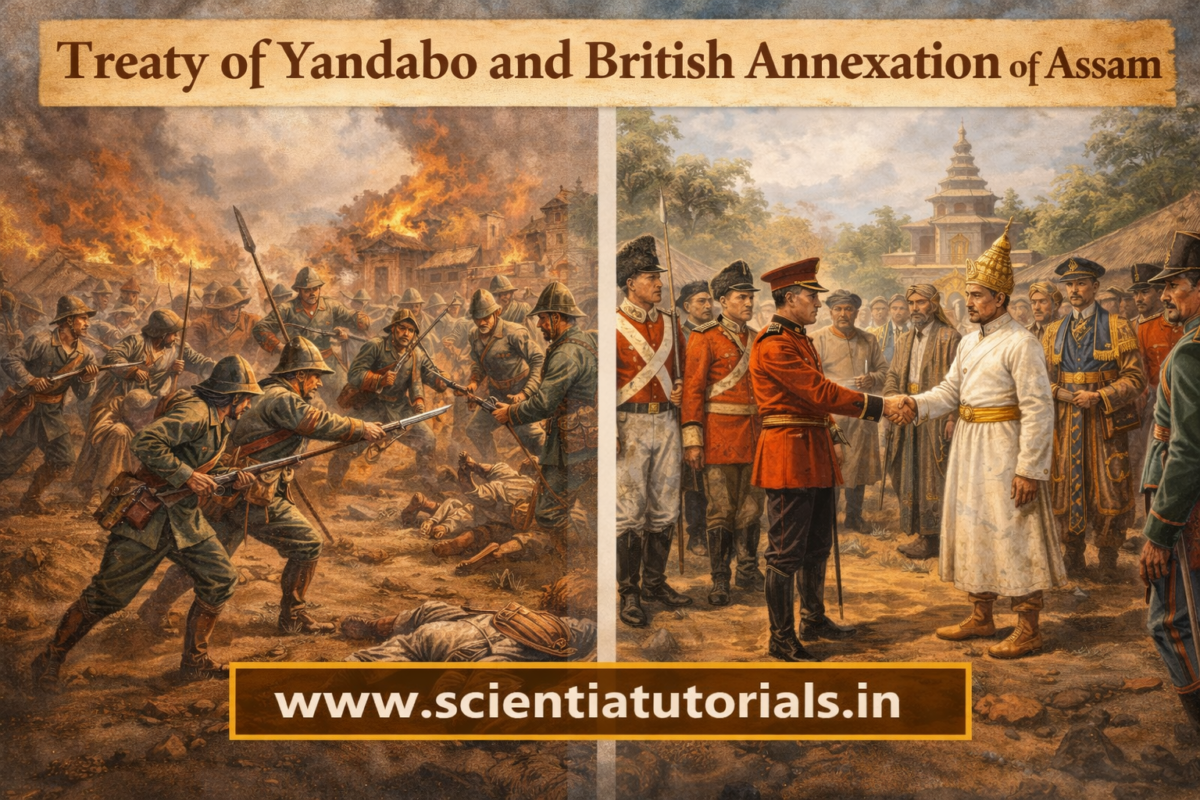
Treaty of Yandabo and British Annexation of Assam
Module V: Colonial Assam under British Rule (1826 CE – 1947 CE)
Lesson 1: Treaty of Yandabo (1826) and British Annexation of Assam
This lesson is systematically organized into four clearly structured sections, as detailed below:
- Chronologically Structured Study Module
- Short-Answer Type Questions
- Long-Answer Type Questions
- Multiple-Choice Questions (MCQs) with Answers and Detailed Explanations
Chronologically Structured Study Module
1. Introduction and Lesson Objectives
The year 1826 CE marks a decisive watershed in the history of Assam. With the signing of the Treaty of Yandabo, Assam passed from centuries of indigenous rule—most notably the Ahoms—into the hands of the British. This event inaugurated Module V: Colonial Assam under British Rule (1826–1947 CE) and laid the foundation for far-reaching political, economic, administrative, and social transformations.
This lesson examines the Treaty of Yandabo (1826) and the British annexation of Assam in a chronological, analytical, and examination-oriented framework, focusing on causes, provisions, immediate consequences, and historical significance.
Lesson Objectives
After completing this lesson, learners will be able to:
- Understand the geopolitical context leading to the Treaty of Yandabo
- Trace the role of the First Anglo-Burmese War (1824–1826)
- Analyze the provisions and implications of the treaty for Assam
- Examine how British annexation altered Assam’s political structure
- Answer competitive-exam questions with clarity and historical accuracy
2. Assam on the Eve of British Rule (Early 19th Century)
By the early 19th century, Assam was in a state of political collapse and social distress. The once-powerful Ahom Kingdom had weakened due to internal decay and external aggression.
Key Conditions before 1826
- Collapse of Ahom authority after decades of rebellion
- Devastation caused by Burmese invasions (1817–1824)
- Absence of a stable indigenous administration
- Economic decline and depopulation
This vacuum of power created conditions that facilitated British intervention.
3. Burmese Expansion and Its Impact on Assam
After the fall of effective Ahom control, the Burmese Empire expanded westward into Assam.
Nature of Burmese Rule in Assam
- Harsh military occupation
- Destruction of villages and agricultural lands
- Large-scale killings and forced migrations
- Economic and demographic collapse
The Burmese occupation not only devastated Assam but also alarmed the British, who saw Burmese expansion as a threat to their eastern frontiers.
4. The First Anglo-Burmese War (1824–1826)
Causes of the War
The First Anglo-Burmese War was triggered by competing imperial interests in Northeast India and Southeast Asia.
Major Causes:
- Burmese expansion into Assam and Manipur
- Threat to British-controlled Bengal frontier
- British desire to secure trade routes and territorial influence
Course of the War
- British forces entered Assam in 1824
- Burmese resistance was strong but poorly sustained
- Prolonged warfare strained Burmese resources
- British military superiority ultimately prevailed
The war concluded with negotiations that culminated in the Treaty of Yandabo.
5. Treaty of Yandabo (1826): Background and Signing
The Treaty of Yandabo was signed in February 1826 at Yandabo village in Burma (Myanmar), bringing the First Anglo-Burmese War to an end.
Parties to the Treaty
- British East India Company
- Burmese Empire (Konbaung Dynasty)
The treaty was a diplomatic settlement that drastically reshaped the political map of Northeast India.
6. Main Provisions of the Treaty of Yandabo
The treaty imposed severe territorial and political losses on Burma.
Key Provisions
- Burma ceded Assam to the British
- British control over Manipur was recognized
- Burma renounced claims over Cachar and Jaintia
- Heavy war indemnity imposed on Burma
- Exchange of prisoners and establishment of peace
These provisions effectively transferred Assam to British sovereignty.
7. British Annexation of Assam (1826)
Nature of Annexation
The annexation of Assam was not the result of conquest against a unified local power but rather the outcome of imperial diplomacy following military intervention.
Immediate Administrative Measures
- British military administration established
- Ahom monarchy formally abolished
- British officers appointed to govern Assam
- Assam attached administratively to Bengal
This marked the end of indigenous political sovereignty in Assam.
8. Early British Administration in Assam (1826–1838)
Transitional Phase
Initially, the British were unsure whether to retain Assam permanently or restore local rule.
Key Features:
- Direct rule by Company officials
- Revenue collection experiments
- Maintenance of law and order
- Limited understanding of local society
In 1838, Assam was formally incorporated into the British administrative framework.
9. End of the Ahom Political System
The Treaty of Yandabo effectively ended the Ahom political tradition that had ruled Assam for nearly six centuries.
Consequences
- Abolition of Ahom kingship
- Collapse of the Paik system
- Displacement of traditional elites
- Loss of political autonomy
Assam was now governed as a colonial territory.
10. Economic Motives Behind British Annexation
While security concerns prompted British entry, economic interests ensured permanent annexation.
Economic Attractions of Assam
- Fertile agricultural land
- Strategic location near China and Southeast Asia
- Potential for plantation crops (later tea)
- Control over riverine trade routes
Assam soon became an important economic asset of the British Empire.
11. Strategic Importance of Assam for the British
From a geopolitical perspective, Assam served as:
- A buffer zone against Burma and China
- A military base in Northeast India
- A gateway to Southeast Asian trade
Thus, annexation was crucial for British imperial strategy.
12. Social and Political Impact on Assamese Society
British annexation transformed Assamese society profoundly.
Political Impact
- Loss of self-rule
- Introduction of colonial bureaucracy
- Replacement of traditional institutions
Social Impact
- Disruption of traditional social order
- Marginalization of indigenous elites
- Cultural and administrative alienation
These changes sowed the seeds of later resistance movements.
13. Assam’s Integration into British India
After annexation, Assam gradually became part of British India’s administrative and economic system.
Key Developments
- Inclusion under Bengal Presidency
- Introduction of British laws and courts
- Expansion of colonial infrastructure
This integration fundamentally altered Assam’s historical trajectory.
14. Chronological Summary of Events
| Year | Event |
|---|---|
| 1817–1824 | Burmese occupation of Assam |
| 1824 | British military intervention |
| 1824–1826 | First Anglo-Burmese War |
| 1826 | Treaty of Yandabo signed |
| 1826 | British annexation of Assam |
15. Examination-Oriented Analysis
For competitive examinations, it is important to note:
- Treaty of Yandabo = starting point of British rule in Assam
- Annexation was the result of Anglo-Burmese rivalry, not direct Ahom resistance
- British rule replaced a long tradition of indigenous governance
- 1826 marks the transition from medieval to colonial Assam
16. Long-Term Historical Significance
The Treaty of Yandabo reshaped Assam’s destiny:
- Introduced colonial economy and administration
- Linked Assam to global imperial networks
- Paved the way for tea plantations and modern infrastructure
- Generated new forms of resistance and nationalism
It stands as one of the most significant diplomatic events in Assam’s history.
17. Conclusion
The Treaty of Yandabo (1826) and the subsequent British annexation of Assam marked a fundamental break in Assam’s historical continuity. What began as a regional conflict between Burma and the British culminated in the loss of Assamese sovereignty and the beginning of colonial rule. While British administration introduced new systems and economic changes, it also dismantled indigenous institutions and autonomy. Understanding this transition is essential for comprehending the later colonial and nationalist history of Assam.
Short Answer Type Questions with Answers
(Treaty of Yandabo and British Annexation of Assam)
These questions are suitable for APSC, UPSC (GS-I), Assam TET, State PSCs, and university examinations.
1. In which year was the Treaty of Yandabo signed?
Answer:
The Treaty of Yandabo was signed in 1826 CE.
2. Which war ended with the Treaty of Yandabo?
Answer:
The First Anglo-Burmese War (1824–1826) ended with the Treaty of Yandabo.
3. Between which two parties was the Treaty of Yandabo signed?
Answer:
Between the British East India Company and the Burmese Empire.
4. Name the treaty that marked the beginning of British rule in Assam.
Answer:
The Treaty of Yandabo.
5. Which territory was ceded to the British as a result of the Treaty of Yandabo?
Answer:
Assam was ceded to the British.
6. What was the political condition of Assam before British annexation?
Answer:
Assam was politically unstable due to the collapse of Ahom rule and Burmese occupation.
7. Which external power occupied Assam before British intervention?
Answer:
The Burmese (Myanmar).
8. During which years did the Burmese occupation of Assam take place?
Answer:
Between 1817 and 1824 CE.
9. Why did the Burmese occupation alarm the British?
Answer:
It threatened British frontiers in Bengal and regional trade routes.
10. In which year did British forces first enter Assam?
Answer:
In 1824 CE.
11. What was the immediate cause of British annexation of Assam?
Answer:
The outcome of the First Anglo-Burmese War and the Treaty of Yandabo.
12. Did the British annex Assam through direct war with the Ahoms?
Answer:
No, annexation occurred through diplomatic settlement after the Anglo-Burmese War.
13. Which indigenous political system ended with British annexation?
Answer:
The Ahom monarchy and Paik system.
14. What happened to the Ahom kingship after 1826?
Answer:
The Ahom kingship was abolished.
15. Under which presidency was Assam initially placed by the British?
Answer:
Under the Bengal Presidency.
16. Name one administrative measure taken by the British immediately after annexation.
Answer:
Establishment of British military and civil administration.
17. What was the strategic importance of Assam for the British?
Answer:
It acted as a buffer zone against Burma and a gateway to Southeast Asia.
18. Mention one economic reason for British interest in Assam.
Answer:
Assam’s fertile land and trade potential.
19. Which traditional Ahom institution collapsed after British annexation?
Answer:
The Paik system.
20. How did British annexation affect Assamese political sovereignty?
Answer:
Assam lost its indigenous political independence.
21. What type of administration was introduced in Assam after 1826?
Answer:
Colonial bureaucratic administration under the British East India Company.
22. Which year marks the transition from medieval to colonial Assam history?
Answer:
1826 CE.
23. How did British annexation affect Assamese society initially?
Answer:
It disrupted traditional institutions and marginalized indigenous elites.
24. What was the long-term significance of the Treaty of Yandabo for Assam?
Answer:
It laid the foundation of colonial rule and economic restructuring.
25. Why is the Treaty of Yandabo considered a turning point in Assam history?
Answer:
Because it ended indigenous rule and began British colonial administration.
Long Answer Type Questions with Answers
(Treaty of Yandabo and British Annexation of Assam)
The answers are framed to meet requirements for APSC, UPSC (GS-I), Assam TET, State PSCs, and university examinations, with emphasis on chronology, causation, and historical significance.
1. Discuss the political condition of Assam on the eve of British annexation.
Answer:
On the eve of British annexation, Assam was politically unstable and socially distressed. The Ahom Kingdom had virtually collapsed due to internal decay, succession disputes, and the long-drawn Moamoria Rebellion. Burmese invasions between 1817 and 1824 further devastated the region, destroying villages, depopulating large areas, and dismantling administrative structures. There was no effective indigenous authority capable of governing Assam, creating a political vacuum that facilitated British intervention.
2. Analyze the causes that led to British intervention in Assam.
Answer:
British intervention in Assam was caused by a combination of strategic and political factors. The westward expansion of the Burmese Empire into Assam and Manipur threatened British-controlled Bengal. The instability in Assam endangered British trade routes and frontier security. Additionally, the absence of a stable local government made intervention easier. Thus, British entry into Assam was driven by security concerns, imperial rivalry, and regional instability.
3. Examine the role of Burmese expansion in shaping the fate of Assam.
Answer:
Burmese expansion played a decisive role in Assam’s fate. After the collapse of Ahom authority, Burma occupied Assam and imposed harsh military rule. Their oppressive administration led to economic ruin, depopulation, and widespread suffering. Burmese presence alarmed the British, who viewed it as a strategic threat. Consequently, Burmese expansion directly triggered British military intervention, which ultimately resulted in the annexation of Assam.
4. Discuss the causes of the First Anglo-Burmese War (1824–1826).
Answer:
The First Anglo-Burmese War was caused by conflicting imperial ambitions. Burmese occupation of Assam and Manipur threatened British frontiers in Bengal. Disputes over border territories, combined with British concerns about trade security and regional dominance, escalated tensions. These factors culminated in open warfare in 1824 between the British East India Company and the Burmese Empire.
5. Trace the course of the First Anglo-Burmese War with special reference to Assam.
Answer:
British forces entered Assam in 1824 to expel Burmese troops. Fighting continued for two years across Assam and Burma. Although Burmese resistance was initially strong, prolonged warfare exhausted their resources. British military superiority, better logistics, and naval strength eventually forced Burma to negotiate. The war ended in 1826 with the signing of the Treaty of Yandabo.
6. Explain the circumstances under which the Treaty of Yandabo was signed.
Answer:
The Treaty of Yandabo was signed in February 1826 at Yandabo village in Burma after Burma’s defeat in the First Anglo-Burmese War. Burma faced military exhaustion and financial collapse, while the British sought territorial security and compensation. The treaty was imposed as a peace settlement that reflected British dominance and Burmese defeat.
7. Discuss the main provisions of the Treaty of Yandabo.
Answer:
The Treaty of Yandabo required Burma to cede Assam to the British and renounce claims over Manipur, Cachar, and Jaintia. Burma also had to pay a heavy war indemnity and accept British diplomatic presence. These provisions drastically reduced Burmese influence in Northeast India and transferred Assam to British control.
8. Examine how the Treaty of Yandabo led to the British annexation of Assam.
Answer:
The treaty legally transferred Assam from Burmese control to the British. Since there was no effective indigenous authority to reclaim power, the British established direct administration. Thus, annexation occurred through diplomatic settlement rather than conquest of a local state, marking the beginning of British rule in Assam.
9. Was British annexation of Assam a planned imperial move or a circumstantial outcome? Discuss.
Answer:
British annexation of Assam was initially circumstantial rather than pre-planned. The British intervened primarily to counter Burmese expansion. However, once Assam came under their control, its strategic and economic value encouraged permanent annexation. Over time, circumstantial intervention turned into deliberate imperial expansion.
10. Analyze the immediate administrative measures taken by the British in Assam after 1826.
Answer:
After annexation, the British established military and civil administration in Assam. The Ahom monarchy was abolished, traditional institutions dismantled, and Company officials appointed. Assam was placed under the Bengal Presidency, marking the introduction of colonial bureaucracy and law.
11. Discuss the end of the Ahom political system following British annexation.
Answer:
British annexation ended nearly six centuries of Ahom political tradition. The monarchy was abolished, the Paik system dismantled, and traditional elites lost authority. Indigenous governance structures were replaced by colonial administration, resulting in the loss of Assamese political sovereignty.
12. Examine the economic motives behind British annexation of Assam.
Answer:
Although security concerns prompted intervention, economic motives ensured permanent annexation. Assam’s fertile land, river-based trade routes, and strategic location near Southeast Asia attracted British interest. Later developments, such as tea cultivation, confirmed Assam’s economic importance within the British Empire.
13. Assess the strategic importance of Assam in British imperial policy.
Answer:
Strategically, Assam served as a buffer against Burma and China, secured the northeastern frontier of British India, and provided access to Southeast Asian trade routes. Its location made it a vital military and administrative outpost for British imperial expansion.
14. Discuss the social impact of British annexation on Assamese society.
Answer:
British annexation disrupted traditional social structures. Indigenous elites lost status, and colonial administration alienated local society. New legal and administrative systems replaced customary practices, creating social dislocation and dissatisfaction that later contributed to resistance movements.
15. Examine the political consequences of annexation for Assam.
Answer:
Politically, Assam lost self-rule and became a colonial territory. Decision-making shifted to British officials, and local participation in governance was minimal. This marked a fundamental transformation from indigenous to colonial political systems.
16. How did British annexation integrate Assam into British India?
Answer:
Assam was initially attached to the Bengal Presidency and later developed into a separate administrative unit. British laws, courts, revenue systems, and infrastructure were introduced, integrating Assam into the colonial framework of British India.
17. Analyze the long-term significance of the Treaty of Yandabo for Assam.
Answer:
The Treaty of Yandabo reshaped Assam’s historical trajectory by initiating colonial rule. It introduced new economic systems, administrative structures, and global linkages. At the same time, it ended political autonomy and laid the groundwork for future nationalist movements.
18. Why is 1826 considered a watershed year in Assam’s history?
Answer:
The year 1826 marks the transition from medieval to colonial Assam. Indigenous rule ended, and British colonial administration began. This year fundamentally altered Assam’s political, economic, and social development.
19. Critically assess whether British rule in Assam was a direct result of Ahom weakness.
Answer:
British rule was not solely the result of Ahom weakness but a combination of internal collapse and external aggression. While Ahom decline created vulnerability, Burmese invasions and British imperial interests ultimately determined Assam’s annexation.
20. Summarize the process of British annexation of Assam in a chronological framework.
Answer:
Between 1817 and 1824, Burmese occupation devastated Assam. British forces entered Assam in 1824 during the First Anglo-Burmese War. The war ended in 1826 with the Treaty of Yandabo, which ceded Assam to the British. Subsequently, British administration was established, ending indigenous rule and inaugurating colonial Assam.
MCQs with Answers and Explanations
(Treaty of Yandabo and British Annexation of Assam)
These MCQs are aligned with APSC, UPSC (GS-I), Assam TET, State PSCs, and university examinations.
1. The Treaty of Yandabo was signed in the year:
A. 1817
B. 1824
C. 1826
D. 1833
Correct Answer: C. 1826
Explanation:
The Treaty of Yandabo was signed in 1826 CE, marking the formal end of the First Anglo-Burmese War and the beginning of British rule in Assam.
2. Which war directly led to the Treaty of Yandabo?
A. Anglo-French War
B. First Anglo-Burmese War
C. Anglo-Maratha War
D. Anglo-Ahom War
Correct Answer: B. First Anglo-Burmese War
Explanation:
The First Anglo-Burmese War (1824–1826) ended with the Treaty of Yandabo, reshaping the political map of Northeast India.
3. The Treaty of Yandabo was signed between the British and:
A. Ahom Kingdom
B. Manipur Kingdom
C. Burmese Empire
D. Khasi Chiefs
Correct Answer: C. Burmese Empire
Explanation:
The treaty was signed between the British East India Company and the Burmese Empire (Konbaung Dynasty).
4. Which territory was ceded to the British as a result of the Treaty of Yandabo?
A. Bengal
B. Manipur
C. Assam
D. Tripura
Correct Answer: C. Assam
Explanation:
Under the treaty, Burma formally ceded Assam to the British, ending indigenous political control.
5. The Treaty of Yandabo marked the end of which historical phase in Assam?
A. Colonial rule
B. Burmese occupation
C. Indigenous rule
D. Modern era
Correct Answer: C. Indigenous rule
Explanation:
The treaty ended centuries of indigenous political authority and inaugurated British colonial rule in Assam.
6. Before British annexation, Assam was under the occupation of:
A. Mughals
B. French
C. Burmese
D. Portuguese
Correct Answer: C. Burmese
Explanation:
Between 1817 and 1824, Assam suffered under harsh Burmese military occupation.
7. The Burmese occupation of Assam took place mainly between:
A. 1800–1810
B. 1817–1824
C. 1824–1826
D. 1830–1838
Correct Answer: B. 1817–1824
Explanation:
This period witnessed severe devastation, depopulation, and economic collapse in Assam.
8. Which factor most alarmed the British and prompted intervention in Assam?
A. Tea cultivation
B. Ahom resistance
C. Burmese expansion
D. Missionary activity
Correct Answer: C. Burmese expansion
Explanation:
Burmese expansion threatened British frontiers in Bengal and regional trade interests.
9. British military forces entered Assam for the first time in:
A. 1817
B. 1820
C. 1824
D. 1826
Correct Answer: C. 1824
Explanation:
British forces entered Assam in 1824 during the First Anglo-Burmese War.
10. The annexation of Assam by the British was primarily the result of:
A. Direct conquest of Ahoms
B. Diplomatic settlement
C. Religious conflict
D. Commercial treaty
Correct Answer: B. Diplomatic settlement
Explanation:
Assam was annexed through the diplomatic provisions of the Treaty of Yandabo, not by direct war with local rulers.
11. Which indigenous political institution ended after 1826?
A. Zamindari system
B. Paik system
C. Mansabdari system
D. Ryotwari system
Correct Answer: B. Paik system
Explanation:
The Paik system, the backbone of Ahom administration, collapsed after British annexation.
12. After annexation, Assam was initially placed under the:
A. Madras Presidency
B. Bombay Presidency
C. Bengal Presidency
D. Punjab Administration
Correct Answer: C. Bengal Presidency
Explanation:
Assam was administratively attached to the Bengal Presidency in the early colonial phase.
13. Which of the following best describes the British motive for retaining Assam?
A. Religious expansion
B. Cultural integration
C. Strategic and economic interests
D. Humanitarian concern
Correct Answer: C. Strategic and economic interests
Explanation:
Assam’s location, fertile land, and trade potential made it strategically and economically valuable.
14. Assam was strategically important to the British because it:
A. Controlled coastal trade
B. Was rich in gold mines
C. Acted as a buffer against Burma
D. Had large urban centers
Correct Answer: C. Acted as a buffer against Burma
Explanation:
Assam served as a buffer zone protecting British India’s northeastern frontier.
15. Which year is considered the beginning of colonial rule in Assam?
A. 1817
B. 1824
C. 1826
D. 1838
Correct Answer: C. 1826
Explanation:
1826 marks the formal beginning of British colonial administration in Assam.
16. The Treaty of Yandabo was signed at:
A. Calcutta
B. Rangoon
C. Yandabo village
D. Mandalay
Correct Answer: C. Yandabo village
Explanation:
The treaty was signed at Yandabo village in Burma (present-day Myanmar).
17. Which company represented British interests in the Treaty of Yandabo?
A. Royal African Company
B. Dutch East India Company
C. British East India Company
D. Hudson’s Bay Company
Correct Answer: C. British East India Company
Explanation:
The British East India Company was the political and military authority representing Britain.
18. One immediate political consequence of the treaty for Assam was:
A. Restoration of Ahom rule
B. Creation of an independent state
C. Establishment of British administration
D. Division of Assam
Correct Answer: C. Establishment of British administration
Explanation:
British officers took over administration after 1826, abolishing indigenous governance.
19. Which of the following best describes the nature of British annexation of Assam?
A. Sudden conquest
B. Peaceful merger
C. Outcome of imperial rivalry
D. Religious conversion
Correct Answer: C. Outcome of imperial rivalry
Explanation:
British annexation resulted from Anglo-Burmese imperial rivalry rather than local resistance.
20. The Treaty of Yandabo ended the First Anglo-Burmese War but resulted in:
A. Independence of Assam
B. Strengthening of Burmese power
C. British expansion in Northeast India
D. Restoration of Ahom monarchy
Correct Answer: C. British expansion in Northeast India
Explanation:
The treaty expanded British territorial control and influence in the region.
21. Which aspect of Assamese life was most immediately affected by British annexation?
A. Language
B. Political sovereignty
C. Religion
D. Family system
Correct Answer: B. Political sovereignty
Explanation:
Assam lost its political independence and came under colonial rule.
22. Which historical transition does the year 1826 represent in Assam?
A. Ancient to medieval
B. Medieval to colonial
C. Colonial to modern
D. Tribal to feudal
Correct Answer: B. Medieval to colonial
Explanation:
1826 marks the shift from indigenous (medieval) rule to colonial administration.
23. Which of the following was NOT a provision of the Treaty of Yandabo?
A. Cession of Assam
B. War indemnity on Burma
C. Restoration of Ahom king
D. British control over Manipur
Correct Answer: C. Restoration of Ahom king
Explanation:
The treaty ended indigenous rule; it did not restore the Ahom monarchy.
24. The long-term historical significance of the Treaty of Yandabo lies in the fact that it:
A. Ended all wars in Assam
B. Introduced plantation economy
C. Began colonial transformation of Assam
D. United Northeast India
Correct Answer: C. Began colonial transformation of Assam
Explanation:
The treaty initiated political, economic, and administrative changes under colonial rule.
25. Which statement best summarizes the importance of the Treaty of Yandabo for Assam?
A. It restored peace under Ahoms
B. It marked the beginning of British rule
C. It strengthened Burmese authority
D. It ended European influence
Correct Answer: B. It marked the beginning of British rule
Explanation:
The treaty formally transferred Assam to British control, making it a landmark event in Assam’s history.