
Lesson 2: Archaeological Sites of Early Assam – Ambari, Daojali Hading, Sarutaru
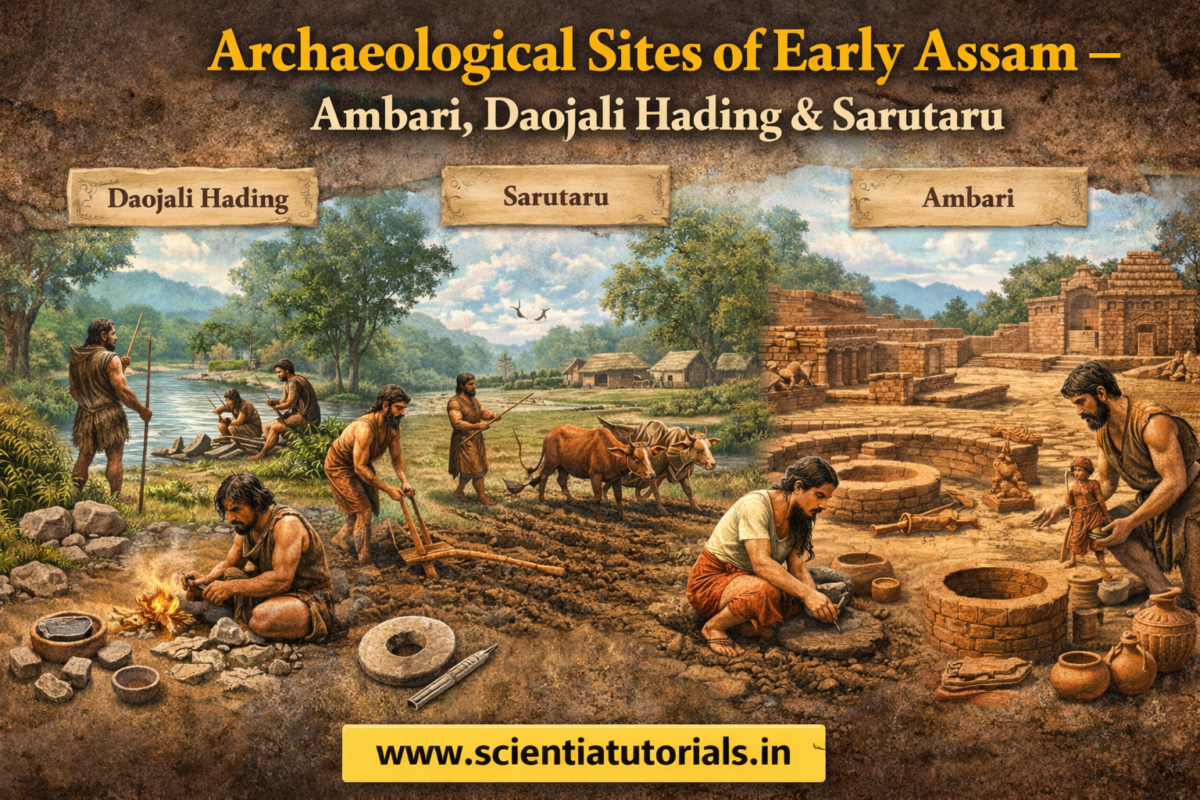
Archaeological Sites of Early Assam: Ambari, Daojali Hading & Sarutaru
Course: Assam History: Chronological Era-Wise Study Module for Competitive Exams
Module I: Prehistoric and Protohistoric Assam (c. 2,00,000 BCE – 4th Century CE)
Lesson 2: Archaeological Sites of Early Assam – Ambari, Daojali Hading, Sarutaru
This lesson is systematically organized into four clearly structured sections, as detailed below:
- Chronologically Structured Study Module
- Short-Answer Type Questions
- Long-Answer Type Questions
- Multiple-Choice Questions (MCQs) with Answers and Detailed Explanations
Introduction
The reconstruction of early Assam’s history relies heavily on archaeological evidence due to the absence of written records for most of the prehistoric and protohistoric periods. Archaeological sites act as tangible witnesses to human activity, technological evolution, subsistence patterns, cultural continuity, and external contacts. In the context of Assam, sites such as Ambari, Daojali Hading, and Sarutaru are of immense importance.
This lesson provides a chronologically structured, examination-oriented study of these sites, linking them to the broader prehistoric and protohistoric developments in Assam between c. 2,00,000 BCE and the 4th century CE. The focus is on timeline-based interpretation, material culture, cultural transitions, and their relevance for competitive examinations such as APSC, UPSC, and state-level exams.
Chronological Framework of Early Archaeology in Assam
Before analyzing individual sites, it is essential to situate them within a clear chronological framework:
- Lower Paleolithic to Mesolithic (c. 2,00,000 BCE – 10,000 BCE): Sparse evidence in Assam, mainly surface tools and riverine finds.
- Neolithic Phase (c. 7,000 BCE – 2,000 BCE): Marked by polished stone tools, pottery, food production, and permanent or semi-permanent settlements.
- Chalcolithic and Early Iron Age (c. 2,000 BCE – 500 BCE): Limited but emerging evidence of metallurgy and socio-economic complexity.
- Protohistoric and Early Historic Phase (c. 500 BCE – 4th Century CE): Urbanization, trade contacts, brick structures, coins, inscriptions, and early religious practices.
The three sites discussed in this lesson represent different stages within this long chronological continuum.
1. Daojali Hading: Neolithic Foundations of Assam
Chronological Position
- Period: c. 2,700 BCE – 1,500 BCE (Neolithic phase)
- Cultural Context: Early food-producing communities of Assam
Location and Discovery
Daojali Hading is located in the Dima Hasao (North Cachar Hills) district of Assam. Excavations conducted in the mid-20th century revealed one of the earliest Neolithic cultures in Northeast India.
Material Culture
The archaeological assemblage at Daojali Hading includes:
- Polished stone axes and adzes
- Cord-impressed and plain pottery
- Grinding stones and celts
- Evidence of wattle-and-daub houses
These artefacts reflect a settled agrarian lifestyle, marking a decisive transition from hunting-gathering to food production.
Economic and Cultural Life
- Subsistence: Agriculture combined with hunting and fishing
- Technology: Advanced stone tool technology compared to Paleolithic and Mesolithic phases
- Cultural Links: Strong similarities with Neolithic cultures of Southeast Asia and South China, suggesting migration and diffusion routes through the Patkai hills
Historical Significance
Daojali Hading establishes Assam as:
- A major Neolithic cultural zone
- A bridge between Indian and Southeast Asian prehistoric cultures
- Evidence that settled life in Assam began much earlier than textual traditions suggest
Examination Relevance
- Frequently asked in APSC and Assam-centric exams
- Important for questions on Neolithic cultures of Northeast India
- Demonstrates cultural diffusion and early agriculture
2. Sarutaru: Transitional Phases in Central Assam
Chronological Position
- Period: Late Neolithic to Chalcolithic / Early Iron Age (c. 2,000 BCE – 500 BCE)
Location
Sarutaru is situated in Kamrup district, near Guwahati, in the fertile Brahmaputra valley—an area that later became the political heartland of ancient Assam.
Archaeological Findings
Excavations at Sarutaru have yielded:
- Polished stone tools alongside early metal objects
- Pottery with improved firing techniques
- Habitation remains indicating continuity of settlement
Cultural Interpretation
Sarutaru represents a transitional phase:
- From stone-based Neolithic cultures to metal-using communities
- From small village settlements to more organized habitation patterns
Economic Life
- Mixed economy of agriculture, animal domestication, and craft production
- Gradual introduction of metal tools suggests increasing technological sophistication
Historical Importance
Sarutaru fills a crucial chronological gap between Daojali Hading and Ambari by showing:
- Continuity rather than abrupt cultural change
- Indigenous development of early metallurgy in Assam
Examination Relevance
- Useful for answers on cultural transition in prehistoric Assam
- Often cited in analytical questions on continuity and change
3. Ambari: Protohistoric and Early Urban Assam
Chronological Position
- Period: c. 4th century BCE – 4th century CE
- Cultural Phase: Protohistoric to Early Historic
Location and Excavation
Ambari lies in the heart of modern Guwahati and is one of the most important archaeological sites of Assam. Excavations by the Archaeological Survey of India have revealed a continuous cultural sequence.
Material Culture
Findings from Ambari include:
- Brick structures and ring wells
- Terracotta figurines and plaques
- Pottery of Northern Black Polished Ware (NBPW) tradition
- Beads, seals, and iron implements
Urban and Economic Features
- Evidence of planned settlements
- Craft specialization such as pottery and terracotta production
- Trade links with the Gangetic plains and possibly Southeast Asia
Religious and Cultural Life
- Terracotta figurines suggest early forms of religious practices
- Association with early Shaiva and Shakta traditions
- Possible identification with ancient Pragjyotishpura, the legendary capital of early Assam
Historical Significance
Ambari marks:
- The urban threshold of Assam
- Integration of Assam into broader Indian civilization
- The transition from prehistory to history through material culture
Examination Relevance
- Highly important for UPSC and APSC prelims and mains
- Frequently asked in relation to early urbanization in Assam
- Key site for understanding protohistoric Assam
Comparative Chronological Analysis
| Site | Period | Cultural Stage | Key Features |
|---|---|---|---|
| Daojali Hading | c. 2700–1500 BCE | Neolithic | Agriculture, polished tools |
| Sarutaru | c. 2000–500 BCE | Transitional | Early metallurgy |
| Ambari | c. 400 BCE–400 CE | Protohistoric/Early Historic | Urbanization, trade |
This progression demonstrates a gradual and indigenous evolution of Assamese society, rather than sudden external imposition.
Thematic Linkages for Competitive Exams
1. Continuity and Change
- Stone tools → metal tools → urban crafts
- Village settlements → proto-urban centers
2. Assam in the Asian Cultural Network
- Daojali Hading links Assam to Southeast Asia
- Ambari connects Assam to the Gangetic plains
3. Archaeology as a Source
- Material culture compensates for absence of early texts
- Reinforces the importance of archaeology in regional history
Conclusion
The archaeological sites of Ambari, Daojali Hading, and Sarutaru collectively form the backbone of early Assam’s historical reconstruction. Chronologically arranged, they reveal a long process of human adaptation, technological innovation, and cultural integration from the Neolithic age to the threshold of recorded history.
For competitive examinations, these sites are not merely factual references but analytical tools to understand regional diversity, cultural continuity, and Assam’s unique position in Indian history. Mastery of this lesson enables aspirants to confidently handle objective, descriptive, and analytical questions related to prehistoric and protohistoric Assam.
Key Takeaway for Aspirants
Assam’s early history is best understood not through myths alone but through archaeology—where Daojali Hading marks beginnings, Sarutaru bridges transitions, and Ambari announces urban civilization.
Short Answer Type Questions (with Answers)
Course: Assam History – Chronological Era-Wise Study Module
Module I: Prehistoric and Protohistoric Assam
Lesson 2: Archaeological Sites of Early Assam – Ambari, Daojali Hading, Sarutaru
1. What is the importance of archaeology in reconstructing early Assam’s history?
Answer: Archaeology provides material evidence such as tools, pottery, and structures that help reconstruct Assam’s prehistoric and protohistoric past in the absence of written records.
2. Name the three major archaeological sites discussed in this lesson.
Answer: Ambari, Daojali Hading, and Sarutaru.
3. Which archaeological site represents the Neolithic phase of Assam most clearly?
Answer: Daojali Hading represents the Neolithic phase of Assam most clearly.
4. Where is Daojali Hading located?
Answer: Daojali Hading is located in the Dima Hasao (North Cachar Hills) district of Assam.
5. Mention two important artefacts found at Daojali Hading.
Answer: Polished stone axes and cord-impressed pottery.
6. What type of economy is associated with Daojali Hading?
Answer: A food-producing economy based on agriculture combined with hunting and fishing.
7. Daojali Hading shows cultural similarities with which regions?
Answer: Southeast Asia and South China.
8. Which site represents a transitional phase between the Neolithic and metal-using cultures in Assam?
Answer: Sarutaru.
9. Where is Sarutaru situated?
Answer: Sarutaru is located in the Kamrup district of Assam, near the Brahmaputra valley.
10. What kind of tools indicate the transitional nature of Sarutaru?
Answer: The presence of both polished stone tools and early metal objects.
11. What does Sarutaru reveal about cultural change in prehistoric Assam?
Answer: It reveals gradual and continuous cultural transition rather than abrupt change.
12. Which archaeological site marks the beginning of urbanization in Assam?
Answer: Ambari.
13. In which modern city is Ambari located?
Answer: Ambari is located in present-day Guwahati.
14. Mention two structural remains found at Ambari.
Answer: Brick structures and ring wells.
15. What type of pottery tradition is associated with Ambari?
Answer: Northern Black Polished Ware (NBPW).
16. What do terracotta figurines found at Ambari indicate?
Answer: Early religious beliefs and craft specialization.
17. Ambari is often identified with which ancient city mentioned in tradition?
Answer: Pragjyotishpura.
18. What is the approximate chronological span of Ambari?
Answer: From about the 4th century BCE to the 4th century CE.
19. How does Ambari reflect Assam’s contact with other regions of India?
Answer: Through evidence of trade, NBPW pottery, and urban features similar to the Gangetic plains.
20. Which site provides the earliest evidence of settled life in Assam?
Answer: Daojali Hading.
21. How does Sarutaru help historians understand technological development in Assam?
Answer: It shows the gradual introduction of metal technology alongside stone tools.
22. Arrange Daojali Hading, Sarutaru, and Ambari in chronological order.
Answer: Daojali Hading → Sarutaru → Ambari.
23. Which archaeological site is most relevant for studying protohistoric Assam?
Answer: Ambari.
24. What is the significance of archaeology for competitive examinations in the context of Assam history?
Answer: Archaeology provides factual and analytical content essential for understanding early Assam in prelims and mains examinations.
25. How do these three sites together contribute to the understanding of Assam’s early history?
Answer: Together, they show the evolution of Assamese society from Neolithic settlements to protohistoric urban centers in a clear chronological sequence.
Exam Tip
For short-answer questions, remember the chronological flow: Neolithic beginnings at Daojali Hading, transitional developments at Sarutaru, and protohistoric urbanization at Ambari.
Long Answer Type Questions (with Model Answers)
Course: Assam History – Chronological Era-Wise Study Module for Competitive Exams
Module I: Prehistoric and Protohistoric Assam (c. 2,00,000 BCE – 4th Century CE)
Lesson 2: Archaeological Sites of Early Assam – Ambari, Daojali Hading, Sarutaru
1. Discuss the importance of archaeological sources for reconstructing the early history of Assam.
Answer:
The early history of Assam largely predates written records, making archaeology the primary source for understanding its prehistoric and protohistoric past. Archaeological evidence such as stone tools, pottery, habitation remains, and structural ruins helps historians reconstruct patterns of human settlement, subsistence, technology, and cultural evolution. Sites like Daojali Hading, Sarutaru, and Ambari illustrate a continuous cultural sequence from Neolithic village life to protohistoric urbanization. Thus, archaeology fills the gaps left by the absence of inscriptions and literary texts and forms the backbone of early Assam’s historiography.
2. Examine the Neolithic culture of Assam with special reference to Daojali Hading.
Answer:
Daojali Hading represents the most significant Neolithic cultural site in Assam. Dating roughly from c. 2700 BCE onwards, it reveals the transition from hunting-gathering to settled agriculture. The discovery of polished stone axes, adzes, grinding stones, and cord-impressed pottery indicates food production, tool specialization, and permanent or semi-permanent habitation. The Neolithic culture at Daojali Hading also shows affinities with Southeast Asian Neolithic traditions, suggesting migration and cultural diffusion through the northeastern corridor. This site firmly establishes Assam as an important Neolithic zone in the Indian subcontinent.
3. Describe the geographical location of Daojali Hading and explain its historical significance.
Answer:
Daojali Hading is located in the Dima Hasao (North Cachar Hills) district of Assam. Its hill-based location distinguishes it from the river-valley sites of the Brahmaputra region. Historically, its significance lies in providing the earliest clear evidence of settled life in Assam. The site highlights how hill regions acted as corridors for prehistoric migrations and cultural exchanges between India and Southeast Asia, thereby broadening our understanding of Assam’s early human history.
4. Analyze the material culture discovered at Daojali Hading and what it reveals about Neolithic life.
Answer:
The material culture of Daojali Hading includes polished stone tools, celts, cord-impressed pottery, and grinding stones. These artefacts indicate an agrarian economy, food processing, and domestic craft activities. The presence of wattle-and-daub houses points to organized settlements. Together, these remains reveal a society that had moved beyond mere survival to a stable lifestyle based on agriculture, community living, and technological advancement.
5. Discuss Sarutaru as a transitional archaeological site in the cultural history of Assam.
Answer:
Sarutaru occupies a crucial transitional position between the Neolithic and early metal-using phases of Assam’s prehistory. The coexistence of polished stone tools with early metal artefacts indicates gradual technological change rather than abrupt cultural replacement. This site demonstrates continuity in settlement patterns and subsistence strategies while highlighting increasing technological sophistication. Sarutaru thus bridges the chronological and cultural gap between Daojali Hading and Ambari.
6. Explain the importance of Sarutaru in understanding technological evolution in early Assam.
Answer:
Sarutaru is vital for understanding how early Assamese societies transitioned from stone-based technologies to metal usage. The presence of both stone and metal tools suggests experimentation and adaptation. This gradual shift reflects indigenous technological development rather than sudden external influence. Sarutaru helps historians trace the local roots of metallurgy in Assam.
7. Evaluate the economic life reflected at the Sarutaru archaeological site.
Answer:
The economic life at Sarutaru was based on mixed subsistence. Agriculture remained central, supplemented by animal domestication and craft production. Improved pottery techniques and early metal tools suggest surplus production and increasing specialization. This economy laid the foundation for later protohistoric and urban developments in the Brahmaputra valley.
8. Discuss Ambari as a protohistoric and early historic archaeological site of Assam.
Answer:
Ambari is the most important protohistoric and early historic archaeological site in Assam. Located in present-day Guwahati, it shows continuous occupation from around the 4th century BCE to the 4th century CE. Excavations have revealed brick structures, ring wells, terracotta figurines, iron implements, and Northern Black Polished Ware pottery. These findings indicate urban planning, craft specialization, and long-distance trade, marking Ambari as the earliest urban center of Assam.
9. Describe the structural remains found at Ambari and their historical implications.
Answer:
Structural remains at Ambari include brick-built houses, drains, and ring wells. These indicate planned settlements, water management systems, and permanent habitation. Such features reflect a high level of socio-economic organization and urban consciousness, placing Ambari firmly within the protohistoric and early historic phases of Assam.
10. Examine the significance of pottery findings at Ambari.
Answer:
The discovery of Northern Black Polished Ware at Ambari links Assam with the broader Gangetic cultural zone. This pottery tradition is associated with urbanization, trade, and early state formation. Its presence at Ambari suggests economic and cultural interaction between Assam and northern India, integrating the region into pan-Indian historical processes.
11. What do terracotta figurines from Ambari reveal about early Assamese society?
Answer:
Terracotta figurines from Ambari reflect early religious beliefs, artistic expression, and craft specialization. Many figurines are associated with fertility cults and early forms of Shaiva and Shakta traditions. These artefacts indicate the emergence of organized religious practices and cultural complexity in protohistoric Assam.
12. Discuss the identification of Ambari with ancient Pragjyotishpura.
Answer:
Ambari is often identified with Pragjyotishpura, the legendary capital mentioned in early Indian traditions. While direct textual proof is limited, the scale of urban remains, religious artefacts, and strategic location support this identification. Archaeology thus provides material backing to literary traditions associated with early Assam.
13. Compare Daojali Hading and Ambari in terms of cultural development.
Answer:
Daojali Hading represents the Neolithic stage marked by agriculture, stone tools, and village life, whereas Ambari reflects protohistoric urbanization with brick structures, metallurgy, and trade. Together, they illustrate a long-term cultural evolution from simple agrarian communities to complex urban societies in Assam.
14. Trace the chronological development of early Assam using Daojali Hading, Sarutaru, and Ambari.
Answer:
The chronological sequence begins with Daojali Hading (Neolithic agrarian settlements), followed by Sarutaru (transitional phase with early metallurgy), and culminates at Ambari (protohistoric urban center). This progression shows continuity, gradual technological change, and increasing socio-economic complexity.
15. Analyze the role of geography in the development of early Assamese settlements.
Answer:
Hill regions like Daojali Hading facilitated early migrations and Neolithic settlements, while fertile river valleys such as Kamrup supported agricultural surplus and urban growth, as seen at Sarutaru and Ambari. Geography thus played a decisive role in shaping Assam’s cultural trajectory.
16. Discuss Assam’s cultural contacts with Southeast Asia as reflected in archaeological evidence.
Answer:
Neolithic artefacts from Daojali Hading show similarities with Southeast Asian cultures, indicating migration routes and cultural diffusion. These contacts highlight Assam’s role as a cultural corridor between South Asia and Southeast Asia in prehistoric times.
17. Evaluate the concept of continuity and change in Assam’s prehistoric culture.
Answer:
The archaeological sequence of Assam shows strong continuity in settlement and subsistence patterns, alongside gradual technological change. The transition from stone to metal tools and from villages to towns occurred organically, without abrupt cultural breaks.
18. How does archaeology help integrate Assam into the broader narrative of Indian history?
Answer:
Archaeological findings at Ambari, particularly NBPW and urban structures, link Assam with pan-Indian developments such as urbanization and trade. Archaeology thus situates Assam firmly within the mainstream of Indian historical evolution.
19. Discuss the relevance of these archaeological sites for competitive examinations.
Answer:
These sites are crucial for both factual and analytical questions in exams like UPSC and APSC. They help candidates address themes such as cultural evolution, regional diversity, and the role of archaeology in history writing.
20. Conclude with an assessment of the overall significance of archaeological studies for early Assam.
Answer:
Archaeological studies provide the most reliable framework for understanding early Assam. From Neolithic beginnings at Daojali Hading to urban life at Ambari, archaeology reveals a rich, continuous, and regionally distinctive historical process. It transforms myths and traditions into verifiable historical narratives, making it indispensable for the study of Assam’s ancient past.
Exam-Oriented Tip
In long answers, always link sites chronologically and highlight continuity, technological change, and regional significance—this fetches higher analytical marks.
Multiple Choice Questions (MCQs) with Answers & Explanations
Course: Assam History – Chronological Era-Wise Study Module for Competitive Exams
Module I: Prehistoric and Protohistoric Assam (c. 2,00,000 BCE – 4th Century CE)
Lesson 2: Archaeological Sites of Early Assam – Ambari, Daojali Hading, Sarutaru
MCQ 1
Which of the following is the most important source for reconstructing the prehistoric history of Assam?
A. Literary texts
B. Epigraphic records
C. Archaeological evidence
D. Foreign travel accounts
Correct Answer: C
Explanation:
Prehistoric Assam lacks written records. Therefore, archaeological evidence such as tools, pottery, and habitation remains is the primary source for reconstructing early history.
MCQ 2
Which archaeological site of Assam is most closely associated with the Neolithic culture?
A. Ambari
B. Sarutaru
C. Daojali Hading
D. Pragjyotishpura
Correct Answer: C
Explanation:
Daojali Hading is the clearest representative of Neolithic culture in Assam, marked by polished stone tools and early agriculture.
MCQ 3
Daojali Hading is located in which district of Assam?
A. Kamrup
B. Dima Hasao
C. Nagaon
D. Sonitpur
Correct Answer: B
Explanation:
Daojali Hading is situated in the Dima Hasao (North Cachar Hills) district, highlighting the role of hill regions in early settlements.
MCQ 4
Which of the following artefacts is characteristic of Daojali Hading?
A. Northern Black Polished Ware
B. Ring wells
C. Polished stone axes
D. Punch-marked coins
Correct Answer: C
Explanation:
Polished stone axes and adzes are typical Neolithic artefacts found at Daojali Hading, indicating settled agricultural life.
MCQ 5
The Neolithic culture of Daojali Hading shows affinities with which region?
A. Central Asia
B. Deccan Plateau
C. Southeast Asia
D. Western India
Correct Answer: C
Explanation:
Archaeological similarities suggest cultural diffusion and migration links between Daojali Hading and Southeast Asian Neolithic cultures.
MCQ 6
Which site represents a transitional phase between Neolithic and early metal-using cultures in Assam?
A. Ambari
B. Sarutaru
C. Daojali Hading
D. Sadiya
Correct Answer: B
Explanation:
Sarutaru shows both stone tools and early metal artefacts, indicating gradual technological transition.
MCQ 7
Sarutaru is located in which region of Assam?
A. Barak Valley
B. Brahmaputra Valley (Kamrup)
C. Hill districts only
D. Upper Assam
Correct Answer: B
Explanation:
Sarutaru is situated in the Kamrup district near the Brahmaputra valley, an area favorable for agricultural and cultural continuity.
MCQ 8
The coexistence of stone and metal tools at Sarutaru suggests:
A. Sudden cultural replacement
B. Foreign invasion
C. Gradual technological change
D. Decline of Neolithic culture
Correct Answer: C
Explanation:
The evidence points to continuity and gradual evolution rather than abrupt cultural change.
MCQ 9
Which archaeological site marks the beginning of urbanization in Assam?
A. Daojali Hading
B. Sarutaru
C. Ambari
D. Haflong
Correct Answer: C
Explanation:
Ambari provides evidence of planned settlements, brick structures, and urban life.
MCQ 10
Ambari is located in present-day:
A. Tezpur
B. Silchar
C. Guwahati
D. Jorhat
Correct Answer: C
Explanation:
Ambari lies in the heart of modern Guwahati, indicating continuity of settlement in the region.
MCQ 11
Which pottery tradition links Ambari with the Gangetic plains?
A. Grey Ware
B. Red Ware
C. Northern Black Polished Ware
D. Painted Grey Ware
Correct Answer: C
Explanation:
Northern Black Polished Ware (NBPW) is associated with early urban centers and trade networks of ancient India.
MCQ 12
Which of the following structures has been found at Ambari?
A. Rock-cut caves
B. Megaliths
C. Ring wells
D. Stupas
Correct Answer: C
Explanation:
Ring wells at Ambari indicate advanced water management and planned urban settlements.
MCQ 13
Terracotta figurines from Ambari mainly indicate:
A. Military activities
B. Agricultural tools
C. Religious beliefs and art
D. Foreign trade routes
Correct Answer: C
Explanation:
Terracotta figurines suggest early religious practices, artistic expression, and craft specialization.
MCQ 14
Ambari is often identified with which ancient city mentioned in tradition?
A. Kamarupa
B. Pragjyotishpura
C. Pataliputra
D. Tamralipti
Correct Answer: B
Explanation:
Based on archaeological and traditional evidence, Ambari is often associated with the ancient city of Pragjyotishpura.
MCQ 15
Arrange the following sites in correct chronological order:
- Ambari
- Daojali Hading
- Sarutaru
A. 1–2–3
B. 2–3–1
C. 3–2–1
D. 2–1–3
Correct Answer: B
Explanation:
Daojali Hading (Neolithic) → Sarutaru (Transitional) → Ambari (Protohistoric/Early Historic).
MCQ 16
Which site provides the earliest evidence of settled agriculture in Assam?
A. Ambari
B. Sarutaru
C. Daojali Hading
D. Guwahati
Correct Answer: C
Explanation:
Daojali Hading shows clear evidence of food production and settled life.
MCQ 17
The archaeological sequence of Assam shows:
A. Abrupt cultural breaks
B. No continuity
C. Gradual cultural evolution
D. Total external influence
Correct Answer: C
Explanation:
Evidence from the three sites shows continuity and gradual transformation over time.
MCQ 18
Which factor played a major role in early settlement growth in Kamrup region?
A. Desert climate
B. Fertile river valleys
C. Volcanic soil
D. Coastal trade
Correct Answer: B
Explanation:
The fertile Brahmaputra valley supported agriculture and long-term settlements like Sarutaru and Ambari.
MCQ 19
Which site best reflects Assam’s integration into pan-Indian cultural networks?
A. Daojali Hading
B. Sarutaru
C. Ambari
D. Haflong
Correct Answer: C
Explanation:
NBPW, urban features, and trade evidence at Ambari link Assam with the Gangetic plains.
MCQ 20
The Neolithic culture of Assam is important because it:
A. Shows earliest iron usage
B. Marks beginning of urbanization
C. Indicates transition to food production
D. Represents decline of tribal society
Correct Answer: C
Explanation:
Neolithic culture signifies the shift from hunting-gathering to agriculture and settled life.
MCQ 21
Which archaeological site fills the gap between Neolithic villages and urban centers in Assam?
A. Ambari
B. Sarutaru
C. Daojali Hading
D. Sadiya
Correct Answer: B
Explanation:
Sarutaru represents the transitional phase bridging Daojali Hading and Ambari.
MCQ 22
Early metallurgy in Assam is best understood through evidence from:
A. Daojali Hading
B. Sarutaru
C. Ambari alone
D. Literary texts
Correct Answer: B
Explanation:
Sarutaru shows early metal objects alongside stone tools, indicating initial metallurgical practices.
MCQ 23
Which of the following best describes the nature of cultural change in prehistoric Assam?
A. Violent replacement
B. Sudden migration
C. Gradual and indigenous
D. Entirely imported
Correct Answer: C
Explanation:
The archaeological record indicates slow, indigenous development with external contacts.
MCQ 24
For competitive exams, these archaeological sites are most useful for answering questions on:
A. Medieval administration
B. Colonial economy
C. Cultural evolution and chronology
D. Modern political movements
Correct Answer: C
Explanation:
The sites help in understanding chronological development and cultural transitions in early Assam.
MCQ 25
Which statement best summarizes the significance of Ambari?
A. It is only a Neolithic village
B. It marks the decline of prehistoric culture
C. It represents Assam’s earliest urban phase
D. It lacks trade evidence
Correct Answer: C
Explanation:
Ambari represents the protohistoric and early historic urbanization of Assam with trade, crafts, and planned settlements.
Final Exam Tip
In MCQs, focus on chronology, site–culture association, and key artefacts—these are the most frequently tested areas.
-
archaeological sites of early Assam for APSC
-
Ambari archaeological site Assam history
-
Daojali Hading Neolithic culture Assam
-
Sarutaru prehistoric site Kamrup
-
prehistoric and protohistoric Assam study notes
-
Assam archaeology for competitive exams
-
Neolithic sites in Northeast India
-
early urbanisation in Assam Ambari
-
Assam history archaeology MCQs and notes
-
chronological study of early Assam history