
Lesson 2: Colonial Administration and Revenue Systems
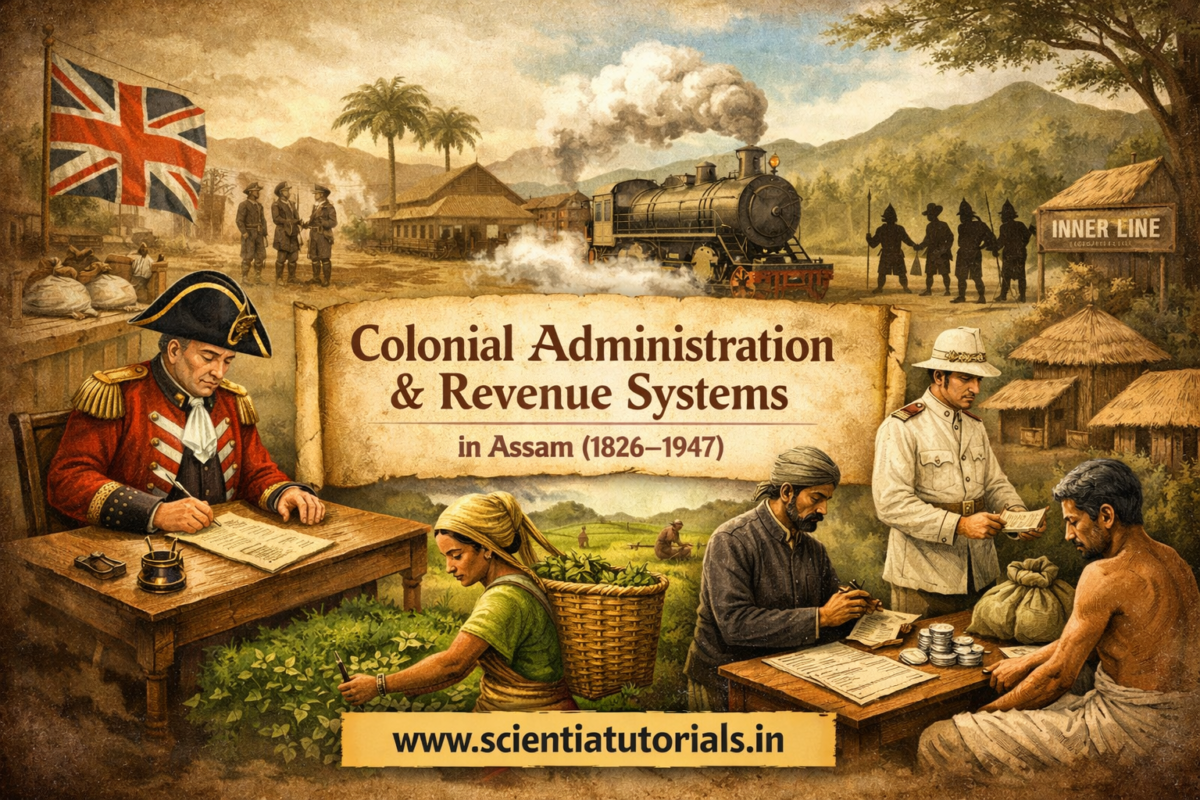
Colonial Administration and Revenue Systems in Assam
Module V: Colonial Assam under British Rule (1826 CE – 1947 CE)
Lesson 2: Colonial Administration and Revenue Systems
This lesson is systematically organized into four clearly structured sections, as detailed below:
- Chronologically Structured Study Module
- Short-Answer Type Questions
- Long-Answer Type Questions
- Multiple-Choice Questions (MCQs) with Answers and Detailed Explanations
Chronologically Structured Study Module
Introduction: Context and Learning Objectives
The year 1826 CE marked a decisive turning point in the history of Assam with the signing of the Treaty of Yandabo, through which Assam came under British control. From this moment until 1947 CE, colonial rule fundamentally transformed the political, administrative, and economic structures of the region. This lesson focuses on the colonial administrative framework and revenue systems introduced by the British and examines their chronological evolution, objectives, mechanisms, and long-term consequences.
Learning Objectives
After completing this lesson, learners should be able to:
- Understand the chronological development of colonial administration in Assam
- Explain the revenue systems introduced by the British and their regional variations
- Analyze the impact of colonial policies on agrarian society, land ownership, and tribal communities
- Assess how administrative and revenue changes contributed to economic restructuring and social transformation in Assam
- Prepare exam-oriented answers for competitive examinations such as APSC, UPSC, and State-level tests
I. Background: From Ahom Administration to British Rule (Pre-1826 to Early Colonial Phase)
Before British intervention, Assam was governed primarily under the Ahom administrative system, which was based on the Paik system. Land was not privately owned; instead, individuals rendered service to the state in exchange for land use. Revenue was largely collected in kind or through labor obligations.
With the defeat of the Burmese and the signing of the Treaty of Yandabo, Assam was annexed by the British East India Company. Initially, British officials had limited knowledge of Assam’s geography, economy, and society. Early colonial policies were therefore experimental, extractive, and often disruptive.
II. Early Colonial Administration in Assam (1826–1838)
1. Military and Transitional Administration
Immediately after annexation, Assam was placed under military administration. British officers exercised combined civil and military powers to maintain order and collect revenue. This period was marked by uncertainty and administrative improvisation.
2. Incorporation into Bengal Presidency
In 1838, Assam was formally placed under the Bengal Presidency. The administrative headquarters were initially located outside Assam, leading to neglect and mismanagement. The region was treated as a peripheral frontier province, primarily valued for its strategic location and resource potential.
3. Abolition of the Paik System
One of the earliest and most significant changes was the abolition of the Paik system. While this was intended to modernize administration, it disrupted traditional social structures and forced peasants into a cash-based revenue economy.
III. Establishment of a Structured Colonial Administration (1838–1874)
1. Introduction of District Administration
Assam was divided into districts, each headed by a Deputy Commissioner (DC) who combined executive, judicial, and revenue powers. This concentration of authority was a hallmark of colonial governance.
2. Role of British Officials
British administrators such as Commissioners and DCs became the backbone of colonial rule. Indigenous participation in administration was minimal, limited mostly to clerical roles.
3. Language and Administrative Control
In 1836, Bengali was imposed as the official language of administration, marginalizing Assamese. Although Assamese was restored in 1873, this episode reflected the centralized and insensitive nature of colonial administration.
IV. Revenue Systems in Colonial Assam: Chronological Development
Revenue collection was the primary objective of British rule. The systems introduced in Assam evolved over time but consistently aimed at maximizing state income.
V. Early Revenue Experiments (1826–1850)
1. Revenue Farming
Initially, the British adopted revenue farming, where the right to collect revenue was auctioned to contractors. This system led to widespread exploitation, as contractors extracted excessive taxes to maximize profits.
2. High Revenue Demands
Land revenue assessments were often unrealistic and ignored local agricultural conditions. Peasants were forced to sell produce or borrow money, leading to indebtedness.
3. Impact on Peasantry
The shift from subsistence to cash payments destabilized rural life. Many peasants lost land due to inability to pay revenue, marking the beginning of land alienation in Assam.
VI. Introduction of the Ryotwari System in Assam
Unlike large parts of northern India where Zamindari prevailed, Assam largely followed a Ryotwari-like system.
Key Features
- The ryot (cultivator) was recognized as the landholder
- Revenue was assessed directly on individual peasants
- Periodic settlements determined revenue rates
Consequences
- While theoretically empowering peasants, in practice the system imposed heavy revenue burdens
- Failure to pay revenue resulted in confiscation or auction of land
- Peasants became increasingly vulnerable to moneylenders
VII. Revenue Settlements and Land Policies (1850–1900)
1. Periodic Land Settlements
The British introduced periodic settlements, reassessing land revenue every 20–30 years. Each settlement often resulted in higher revenue demands, disregarding floods, soil fertility, and traditional practices.
2. Land Classification
Land was classified into categories such as:
- Annual patta land
- Periodic patta land
- Wasteland
This classification enabled the colonial state to bring vast tracts under taxation.
3. Wasteland Rules and Immigration
The Wasteland Rules encouraged settlement of “unused” land by immigrant cultivators, particularly from eastern Bengal. While this increased revenue, it altered Assam’s demographic and agrarian balance, creating long-term social tensions.
VIII. Administration and Revenue in Tribal Areas
1. Special Administrative Arrangements
Tribal areas were governed under special regulations, often excluded from regular revenue administration. These regions were labeled as “excluded” or “partially excluded” areas.
2. Inner Line Regulation (1873)
The Inner Line Regulation restricted the movement of outsiders into tribal regions. While intended to protect tribal societies, it also facilitated colonial control and resource extraction.
3. Impact on Tribal Economy
Traditional land ownership patterns were disrupted. Forest laws and restrictions on shifting cultivation (jhum) undermined tribal livelihoods.
IX. Forest Revenue and Commercialization of Resources
1. Forest Acts
Colonial forest policies converted large forest areas into Reserved Forests. Communities lost customary rights over forest resources.
2. Revenue from Timber and Forest Produce
Forests became a major source of colonial revenue through timber extraction, particularly for railways and tea plantations.
3. Resistance
Forest policies triggered tribal uprisings and peasant protests, highlighting the conflict between colonial revenue interests and indigenous rights.
X. Tea Plantations and Revenue Administration
1. Growth of Tea Industry
Assam emerged as a major tea-producing region under British rule. Large tracts of land were leased at nominal rates to European planters.
2. Revenue Implications
While plantations generated export wealth, the colonial state prioritized planter interests over local peasants. Revenue concessions to planters contrasted sharply with heavy taxation on cultivators.
3. Labor Exploitation
Indentured labor from central India was brought under harsh conditions, adding a new dimension to colonial economic exploitation.
XI. Administrative Reorganization: Creation of Chief Commissioner’s Province (1874)
In 1874, Assam was separated from Bengal and made a Chief Commissioner’s Province. This allowed for more focused administration but did not fundamentally alter exploitative revenue policies.
Later, in 1912, Assam became a separate province, further consolidating administrative structures.
XII. Late Colonial Period: Reforms and Continuities (1900–1947)
1. Limited Reforms
Legislative councils and limited Indian representation were introduced. However, real power remained with British officials.
2. Persistent Revenue Pressure
Despite nationalist movements and economic hardships, land revenue demands remained high.
3. Nationalist Critique
Indian nationalists criticized colonial revenue systems for impoverishing peasants and draining wealth from Assam.
XIII. Impact Assessment: Long-Term Consequences
Economic Impact
- Monetization of the rural economy
- Growth of commercial agriculture
- Persistent rural indebtedness
Social Impact
- Decline of traditional institutions
- Emergence of landless peasants
- Increased migration and demographic change
Administrative Legacy
- Modern district administration
- Codified land records and revenue laws
- Centralized bureaucratic governance
XIV. Examination-Oriented Key Points
- 1826 Treaty of Yandabo → Beginning of British rule
- Abolition of Paik system → Shift to cash revenue
- Ryotwari-style revenue system in Assam
- Wasteland Rules → Immigration and land settlement
- Forest Acts → Loss of customary rights
- 1874 → Assam becomes Chief Commissioner’s Province
Conclusion
Colonial administration and revenue systems in Assam were designed primarily to serve imperial economic interests. While they introduced modern administrative structures, they also dismantled indigenous systems and imposed heavy burdens on peasants and tribal communities. Understanding these policies chronologically is essential for appreciating both the colonial transformation of Assam and the roots of many post-independence challenges.
This lesson provides a comprehensive, examination-oriented foundation for analyzing colonial governance in Assam and prepares learners to critically engage with questions on administration, revenue, and socio-economic change under British rule.
Short Answer Type Questions
Course: Assam History: Chronological Era-Wise Study Module for Competitive Exams
Module V: Colonial Assam under British Rule (1826–1947 CE)
Lesson 2: Colonial Administration and Revenue Systems
1. What event marked the beginning of British rule in Assam?
Answer: British rule in Assam began in 1826 CE after the signing of the Treaty of Yandabo, which ended the First Anglo-Burmese War.
2. Which organization initially took over the administration of Assam after 1826?
Answer: The administration of Assam was initially taken over by the British East India Company.
3. What administrative system existed in Assam before British rule?
Answer: Before British rule, Assam was governed mainly under the Paik system introduced by the Ahoms.
4. Why did the British abolish the Paik system?
Answer: The Paik system was abolished because it did not suit the British objective of collecting regular cash revenue.
5. What type of administration was introduced immediately after annexation?
Answer: A military and transitional administration was introduced immediately after annexation.
6. When was Assam placed under the Bengal Presidency?
Answer: Assam was placed under the Bengal Presidency in 1838 CE.
7. Who was the chief administrative officer of a district in colonial Assam?
Answer: The Deputy Commissioner (DC) was the chief administrative officer of a district.
8. What were the main powers of a Deputy Commissioner?
Answer: The Deputy Commissioner exercised executive, judicial, and revenue powers.
9. Which language was imposed as the official administrative language in 1836?
Answer: Bengali was imposed as the official language of administration in 1836.
10. When was Assamese restored as the official language?
Answer: Assamese was restored as the official language in 1873 CE.
11. What was the primary objective of British revenue policy in Assam?
Answer: The primary objective was maximization of land revenue for the colonial state.
12. What was revenue farming?
Answer: Revenue farming was a system where the right to collect revenue was auctioned to private contractors.
13. Why did revenue farming fail in Assam?
Answer: It failed due to over-exploitation of peasants, corruption, and excessive revenue demands.
14. Which revenue system was largely followed in Assam?
Answer: A Ryotwari-type system was largely followed in Assam.
15. Who was recognized as the landholder under the Ryotwari system?
Answer: The ryot (cultivator) was recognized as the landholder.
16. What were periodic land settlements?
Answer: Periodic land settlements were reassessments of land revenue conducted every 20–30 years.
17. What was the impact of periodic settlements on peasants?
Answer: They often resulted in increased revenue demands, causing indebtedness and land loss.
18. What were the Wasteland Rules?
Answer: The Wasteland Rules encouraged settlement of unused land to increase agricultural output and revenue.
19. Which group was encouraged to settle under the Wasteland Rules?
Answer: Immigrant cultivators, especially from eastern Bengal, were encouraged to settle.
20. What was the Inner Line Regulation of 1873?
Answer: The Inner Line Regulation restricted the movement of outsiders into tribal areas.
21. Why were tribal areas kept outside regular revenue administration?
Answer: Tribal areas were considered politically sensitive and economically backward, requiring special administration.
22. How did forest policies affect tribal communities?
Answer: Forest policies curtailed traditional rights and disrupted tribal livelihoods.
23. Why were forests important to the colonial revenue system?
Answer: Forests generated revenue through timber extraction and commercial forest produce.
24. How did tea plantations influence revenue administration in Assam?
Answer: Large tracts were leased cheaply to planters, prioritizing export-oriented revenue over peasant welfare.
25. What kind of labor system was used in tea plantations?
Answer: An indentured labor system was used, often involving harsh working conditions.
26. When was Assam made a Chief Commissioner’s Province?
Answer: Assam became a Chief Commissioner’s Province in 1874 CE.
27. What was the significance of making Assam a separate province in 1912?
Answer: It allowed greater administrative focus on Assam’s regional issues.
28. How did colonial revenue systems contribute to rural indebtedness?
Answer: High revenue demands forced peasants to borrow from moneylenders, leading to chronic indebtedness.
29. What economic change did colonial revenue systems introduce?
Answer: They introduced the monetization of the rural economy.
30. Name one long-term legacy of colonial administration in Assam.
Answer: The creation of a centralized district administration and codified land records.
Long Answer Type Questions
Course: Assam History: Chronological Era-Wise Study Module for Competitive Exams
Module V: Colonial Assam under British Rule (1826–1947 CE)
Lesson 2: Colonial Administration and Revenue Systems
1. Examine the circumstances that led to the establishment of British rule in Assam in 1826.
Answer:
British rule in Assam was established in 1826 CE following the conclusion of the First Anglo-Burmese War. The war ended with the signing of the Treaty of Yandabo, through which Burma ceded Assam to the British. Prior to this, Assam had suffered political instability due to Burmese invasions, weakening Ahom authority. The British initially viewed Assam as a strategic frontier and a buffer region, rather than a revenue-rich province. Consequently, early colonial administration was experimental and primarily aimed at securing control rather than systematic governance.
2. Describe the nature of early colonial administration in Assam between 1826 and 1838.
Answer:
In the initial phase after annexation, Assam was placed under military and transitional administration. British officers exercised combined civil, military, and judicial powers. This period lacked a clear administrative structure, as the British were unfamiliar with local institutions and conditions. Revenue collection was irregular, and governance depended heavily on ad hoc decisions. The main objective was to maintain law and order and secure British authority in a newly acquired and strategically sensitive region.
3. Analyze the impact of the abolition of the Paik system on Assamese society.
Answer:
The Paik system, which required compulsory service to the state instead of cash payments, formed the backbone of Ahom administration. Its abolition disrupted traditional social and economic arrangements. Peasants were suddenly required to pay cash revenue, forcing them into the monetized economy. This transition caused widespread hardship, land alienation, and indebtedness, especially among small cultivators. Social hierarchies based on service obligations weakened, while economic inequalities deepened.
4. Discuss the incorporation of Assam into the Bengal Presidency and its consequences.
Answer:
Assam was incorporated into the Bengal Presidency in 1838, which resulted in administrative neglect. Decisions were often taken by officials unfamiliar with Assam’s geography and society. Policies designed for Bengal were imposed without modification, leading to misgovernance. The imposition of Bengali as the official language further alienated the Assamese population. This phase reinforced Assam’s status as a peripheral region within British India.
5. Explain the structure and functions of district administration in colonial Assam.
Answer:
Colonial Assam was divided into districts, each headed by a Deputy Commissioner (DC). The DC combined executive, judicial, and revenue powers, making him the most influential official at the district level. This centralized authority ensured efficient control and revenue collection but limited local participation in governance. Indigenous officials were largely confined to subordinate roles, reinforcing colonial dominance.
6. Critically examine the British language policy in colonial Assam.
Answer:
In 1836, Bengali was imposed as the official language of administration and education. This decision marginalized Assamese language and culture, creating resentment among the local population. After sustained protests by Assamese intellectuals, Assamese was restored in 1873. The episode highlights the insensitivity of colonial policies and the role of language in shaping regional identity and resistance.
7. Discuss the objectives of British revenue policy in Assam.
Answer:
The primary objective of British revenue policy was maximization of state income. Revenue collection was designed to finance colonial administration and imperial interests rather than local development. Land revenue became the chief source of income, and policies were framed to ensure regular and predictable cash flows to the colonial treasury.
8. Evaluate the system of revenue farming introduced in early colonial Assam.
Answer:
Revenue farming involved auctioning the right to collect land revenue to private contractors. While administratively convenient, it proved disastrous. Contractors extracted excessive taxes to maximize profits, leading to peasant exploitation, corruption, and widespread dissatisfaction. Due to these failures, the system was eventually abandoned.
9. Describe the Ryotwari-type revenue system followed in Assam and assess its impact.
Answer:
Under the Ryotwari-type system, the cultivator (ryot) was recognized as the landholder and paid revenue directly to the state. Although it appeared progressive, high revenue assessments and strict enforcement made peasants vulnerable. Failure to pay revenue often resulted in land confiscation, increasing rural distress and landlessness.
10. Explain the significance of periodic land settlements in colonial Assam.
Answer:
Periodic land settlements involved reassessment of land revenue every 20–30 years. These settlements usually raised revenue demands, ignoring natural calamities such as floods. While they helped the colonial state maximize income, they increased peasant insecurity and indebtedness.
11. Analyze the Wasteland Rules and their impact on Assam’s agrarian structure.
Answer:
The Wasteland Rules aimed to bring “unused” land under cultivation to increase revenue. Immigrant cultivators, mainly from eastern Bengal, were encouraged to settle. This policy altered Assam’s demographic composition and agrarian relations, creating competition for land and long-term social tensions.
12. Discuss the colonial administration of tribal areas in Assam.
Answer:
Tribal areas were governed under special regulations and often excluded from regular revenue systems. These regions were classified as “excluded” or “partially excluded” areas. While this limited direct taxation, it facilitated indirect control and resource extraction by the colonial state.
13. Examine the Inner Line Regulation of 1873 and its objectives.
Answer:
The Inner Line Regulation restricted the movement of outsiders into tribal regions. Its stated objective was to protect tribal societies, but it also helped the British control frontier areas and regulate access to resources.
14. Analyze the impact of forest policies on tribal and peasant communities.
Answer:
Colonial forest policies converted large tracts into Reserved Forests, depriving communities of traditional rights. Restrictions on shifting cultivation and forest use undermined livelihoods, leading to resistance and uprisings. Forests became revenue-generating assets rather than community resources.
15. Discuss the role of forests in the colonial revenue system of Assam.
Answer:
Forests generated revenue through timber extraction and commercial forest produce. Timber was crucial for railway construction and tea plantations. The commercialization of forests prioritized imperial needs over local welfare.
16. Examine the growth of tea plantations and their administrative implications.
Answer:
The expansion of tea plantations transformed Assam’s economy. Large land concessions were granted to European planters at nominal rates. Administrative and revenue policies favored plantation interests, often at the expense of peasants and tribal communities.
17. Critically assess the labor system in Assam’s tea plantations.
Answer:
Tea plantations relied on indentured labor recruited from central India. Workers faced harsh working conditions, low wages, and restricted mobility. This system reflected the exploitative nature of colonial economic policies.
18. Discuss the significance of making Assam a Chief Commissioner’s Province in 1874.
Answer:
In 1874, Assam was separated from Bengal and made a Chief Commissioner’s Province. This allowed greater administrative focus on regional issues but did not fundamentally change exploitative revenue practices.
19. Explain the administrative changes after Assam became a separate province in 1912.
Answer:
The creation of Assam as a separate province in 1912 strengthened provincial administration and legislative institutions. However, real power remained with British officials, and revenue priorities remained unchanged.
20. Analyze the continuity and change in colonial revenue policies during the late colonial period (1900–1947).
Answer:
While limited reforms and Indian representation were introduced, core revenue policies remained exploitative. High land revenue demands persisted despite economic hardships and nationalist protests, reflecting continuity in colonial priorities.
21. Examine the economic impact of colonial administration and revenue systems on Assam.
Answer:
Colonial policies led to monetization of the rural economy, commercialization of agriculture, and growth of export-oriented sectors like tea. However, they also caused rural indebtedness and uneven development.
22. Discuss the social consequences of colonial land and revenue policies in Assam.
Answer:
These policies weakened traditional institutions, increased landlessness, and altered demographic patterns through migration. Social inequalities intensified, particularly affecting peasants and tribal communities.
23. Assess the contribution of colonial administration to modern governance in Assam.
Answer:
Colonial rule introduced district administration, codified laws, and land records. While these laid the foundation for modern governance, they were designed primarily for control and extraction.
24. Evaluate colonial administration in Assam as an instrument of imperial control.
Answer:
Colonial administration centralized power in British hands, marginalized local participation, and prioritized imperial interests. Administrative efficiency served political domination rather than democratic governance.
25. Conclude by critically analyzing the overall legacy of colonial administration and revenue systems in Assam.
Answer:
The colonial legacy in Assam is mixed. While it introduced modern administrative frameworks, it dismantled indigenous systems and imposed exploitative revenue policies. Many post-independence challenges—agrarian distress, demographic tensions, and uneven development—can be traced to colonial administrative and revenue practices.
Multiple Choice Questions (MCQs) with Answers & Explanations
Course: Assam History: Chronological Era-Wise Study Module for Competitive Exams
Module V: Colonial Assam under British Rule (1826–1947 CE)
Lesson 2: Colonial Administration and Revenue Systems
MCQ 1
The formal beginning of British rule in Assam is associated with which event?
A. Battle of Plassey
B. First Anglo-Burmese War
C. Annexation of Bengal
D. Revolt of 1857
Correct Answer: B
Explanation:
British rule in Assam began in 1826 CE after the First Anglo-Burmese War, concluded by the Treaty of Yandabo, through which Burma ceded Assam to the British.
MCQ 2
Which organization initially administered Assam after its annexation in 1826?
A. British Crown
B. Bengal Presidency
C. British East India Company
D. Government of India
Correct Answer: C
Explanation:
After 1826, Assam was administered by the British East India Company, which governed newly acquired territories before the transfer to Crown rule in 1858.
MCQ 3
The traditional administrative system of pre-colonial Assam was known as the:
A. Zamindari system
B. Ryotwari system
C. Paik system
D. Mahalwari system
Correct Answer: C
Explanation:
The Paik system was a service-based administrative and military system under the Ahoms, where subjects rendered labor instead of paying cash revenue.
MCQ 4
Why did the British abolish the Paik system in Assam?
A. It was militarily ineffective
B. It was against British law
C. It did not generate cash revenue
D. It promoted tribal autonomy
Correct Answer: C
Explanation:
The Paik system was incompatible with British objectives because it relied on labor service, whereas the colonial state required regular cash revenue.
MCQ 5
Immediately after annexation, Assam was placed under which type of administration?
A. Civil administration
B. Provincial administration
C. Military and transitional administration
D. Autonomous administration
Correct Answer: C
Explanation:
In the early years, British officers exercised combined civil and military powers, reflecting the experimental nature of governance in a newly annexed frontier region.
MCQ 6
In which year was Assam placed under the Bengal Presidency?
A. 1826
B. 1836
C. 1838
D. 1874
Correct Answer: C
Explanation:
Assam was placed under the Bengal Presidency in 1838, leading to administrative neglect and imposition of Bengal-centric policies.
MCQ 7
Who was the most powerful official at the district level in colonial Assam?
A. Collector
B. Commissioner
C. Deputy Commissioner
D. Magistrate
Correct Answer: C
Explanation:
The Deputy Commissioner (DC) combined executive, judicial, and revenue powers, making him the central figure in district administration.
MCQ 8
Which language was imposed as the official administrative language of Assam in 1836?
A. Assamese
B. English
C. Hindi
D. Bengali
Correct Answer: D
Explanation:
In 1836, Bengali was imposed as the official language, marginalizing Assamese until its restoration in 1873.
MCQ 9
What was the main objective of British revenue policy in Assam?
A. Rural development
B. Peasant welfare
C. Maximization of land revenue
D. Tribal protection
Correct Answer: C
Explanation:
Colonial revenue policies were designed primarily to ensure maximum and regular income for the British administration.
MCQ 10
Revenue farming refers to:
A. Collection of revenue in kind
B. Auctioning the right to collect revenue
C. Tax exemption for peasants
D. Government-managed farming
Correct Answer: B
Explanation:
Under revenue farming, private contractors were auctioned the right to collect revenue, often leading to peasant exploitation.
MCQ 11
Why did the system of revenue farming fail in Assam?
A. Low agricultural productivity
B. Administrative corruption only
C. Over-exploitation by contractors
D. Natural calamities
Correct Answer: C
Explanation:
Contractors extracted excessive revenue to maximize profits, causing widespread peasant distress and resistance.
MCQ 12
Which revenue system was largely followed in colonial Assam?
A. Zamindari
B. Mahalwari
C. Ryotwari-type system
D. Ijara system
Correct Answer: C
Explanation:
Assam largely followed a Ryotwari-type system, where revenue was assessed directly on individual cultivators.
MCQ 13
Under the Ryotwari system, who was recognized as the landholder?
A. Zamindar
B. State
C. Village community
D. Ryot (cultivator)
Correct Answer: D
Explanation:
The ryot was treated as the landholder, though high revenue demands often undermined this theoretical ownership.
MCQ 14
Periodic land settlements in Assam were conducted mainly to:
A. Reduce revenue demand
B. Protect peasants
C. Reassess and increase revenue
D. Abolish land tax
Correct Answer: C
Explanation:
Periodic settlements reassessed land revenue every 20–30 years and usually resulted in higher revenue demands.
MCQ 15
The Wasteland Rules primarily aimed at:
A. Forest conservation
B. Encouraging land revenue growth
C. Protecting tribal land
D. Promoting industrialization
Correct Answer: B
Explanation:
The Wasteland Rules sought to bring “unused” land under cultivation to expand the revenue base.
MCQ 16
Which group was mainly encouraged to settle under the Wasteland Rules?
A. European planters
B. Tribal communities
C. Immigrant peasants from eastern Bengal
D. Military settlers
Correct Answer: C
Explanation:
Immigrant cultivators from eastern Bengal were encouraged to settle, altering Assam’s agrarian and demographic structure.
MCQ 17
The Inner Line Regulation of 1873 was introduced to:
A. Increase land revenue
B. Promote tea cultivation
C. Restrict outsider entry into tribal areas
D. Abolish shifting cultivation
Correct Answer: C
Explanation:
The Inner Line Regulation restricted outsider movement into tribal regions, officially to protect tribal societies.
MCQ 18
Why were many tribal areas excluded from regular revenue administration?
A. They were unproductive
B. They were politically sensitive frontier regions
C. They had no population
D. They were fully autonomous
Correct Answer: B
Explanation:
Tribal areas were considered sensitive frontier zones requiring special administrative arrangements.
MCQ 19
Colonial forest policies mainly aimed at:
A. Environmental protection
B. Tribal welfare
C. Commercial exploitation of forests
D. Agricultural expansion
Correct Answer: C
Explanation:
Forests were treated as revenue-generating assets, particularly for timber extraction.
MCQ 20
Which sector benefited most from colonial forest and land policies in Assam?
A. Small peasants
B. Tribal communities
C. European tea planters
D. Village artisans
Correct Answer: C
Explanation:
European tea planters received large land concessions and forest access at nominal rates.
MCQ 21
What type of labor system was prevalent in Assam’s tea plantations?
A. Free wage labor
B. Bonded slavery
C. Indentured labor
D. Guild labor
Correct Answer: C
Explanation:
Tea plantations relied on indentured labor recruited under restrictive and exploitative conditions.
MCQ 22
In which year was Assam made a Chief Commissioner’s Province?
A. 1838
B. 1858
C. 1874
D. 1912
Correct Answer: C
Explanation:
In 1874, Assam was separated from Bengal and made a Chief Commissioner’s Province for administrative convenience.
MCQ 23
Assam became a separate province in:
A. 1905
B. 1912
C. 1919
D. 1935
Correct Answer: B
Explanation:
In 1912, Assam was recognized as a separate province, though British control remained dominant.
MCQ 24
One major economic impact of colonial revenue systems was:
A. Decline of monetization
B. Complete agrarian prosperity
C. Monetization of the rural economy
D. Abolition of land ownership
Correct Answer: C
Explanation:
Cash revenue demands forced peasants into a monetized economy, increasing dependence on markets and moneylenders.
MCQ 25
Which of the following is a long-term legacy of colonial administration in Assam?
A. Paik system
B. Decentralized village republics
C. Centralized district administration
D. Abolition of land records
Correct Answer: C
Explanation:
Colonial rule left behind a centralized district administration with codified land records, which continues to shape governance in Assam.