
Lesson 2: State Reorganization and Creation of North-Eastern States
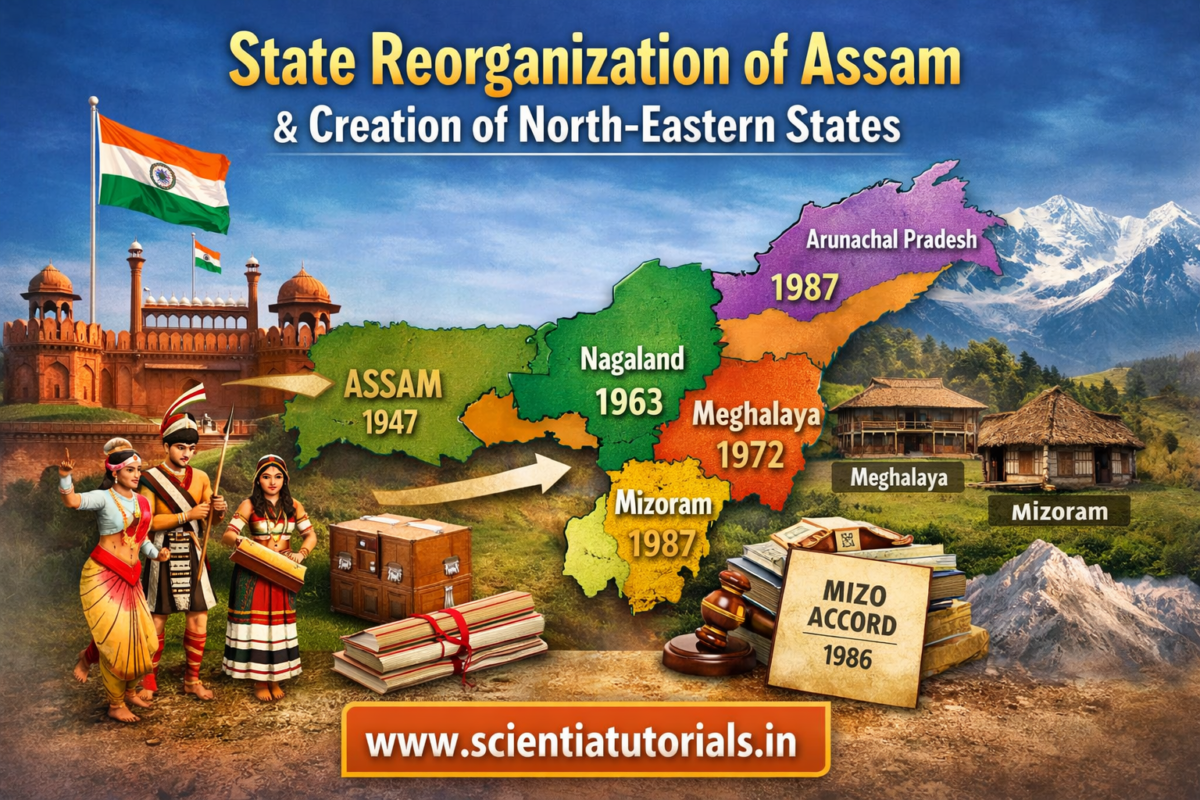
State Reorganization of Assam & Creation of North-Eastern States | Post-Independence History
Module VI: Post-Independence Assam (1947 CE – Present)
Lesson 2: State Reorganization and Creation of North-Eastern States
Lesson Objectives
This lesson aims to help learners:
- Understand the chronological evolution of Assam’s political boundaries after 1947.
- Analyze the administrative, ethnic, and linguistic factors behind state reorganization in the North-East.
- Trace the step-by-step creation of new North-Eastern states from Assam.
- Evaluate the impact of reorganization on Assam’s polity, society, and federal relations.
- Prepare exam-oriented answers for APSC, UPSC, State PSCs, and other competitive examinations.
I. Historical Background: Assam at the Time of Independence (1947)
At the time of India’s independence in 1947, Assam was one of the largest provinces in eastern India, both in territorial extent and ethnic diversity. The province included:
- Present-day Assam
- Hill districts inhabited by Naga, Mizo, Khasi, Garo, and other tribes
- Frontier tracts bordering Tibet (China), Burma (Myanmar), and East Pakistan (now Bangladesh)
Key Characteristics in 1947:
- Assam was ethnically heterogeneous, comprising plains tribes, hill tribes, caste Hindu Assamese, Bengalis, tea garden communities, and migrants.
- Colonial administrative convenience, rather than ethnic homogeneity, defined provincial boundaries.
- The Partition of India (1947) separated Sylhet (except Karimganj) from Assam, creating early territorial adjustment.
Exam Focus:
Question often asked: Why was Assam particularly vulnerable to post-independence reorganization?
Answer Hint: Ethnic diversity, geographical isolation, colonial boundaries, and tribal aspirations.
II. Early Post-Independence Challenges (1947–1955)
1. Administrative Integration of Tribal Areas
After independence, the Indian government faced the challenge of integrating tribal-dominated hill areas with democratic governance while preserving autonomy.
- The Sixth Schedule of the Indian Constitution provided Autonomous District Councils for tribal areas of Assam.
- This arrangement recognized traditional institutions but also planted seeds for future demands for separate statehood.
2. Rise of Ethnic and Regional Aspirations
- Hill tribes increasingly felt culturally and politically marginalized by the Assam plains administration.
- Language debates (Assamese vs tribal languages) intensified political distrust.
III. The States Reorganisation Act, 1956: A Turning Point
Background
The States Reorganisation Act, 1956 reorganized Indian states primarily on linguistic lines.
Impact on Assam:
- Assam retained most of its territory, unlike other Indian states that were reorganized drastically.
- However, the Act laid the constitutional groundwork for future separations by recognizing linguistic and cultural identity as valid bases for statehood.
Key Outcomes:
- Creation of NEFA (North-East Frontier Agency) as a centrally administered territory (later Arunachal Pradesh).
- Hill areas continued within Assam but with enhanced autonomy.
Exam Tip:
Although Assam was not immediately broken up in 1956, the Act legitimized identity-based political claims in the North-East.
IV. Creation of Nagaland (1963): First Major Break-up of Assam
Background
The Naga Hills witnessed early nationalist mobilization under organizations like the Naga National Council.
Chronology:
- 1957: Naga Hills-Tuensang Area created as a Union Territory.
- 1963: Formation of Nagaland, carved out of Assam.
Significance:
- Marked the first reduction of Assam’s territory.
- Set a precedent for other hill regions demanding separate statehood.
- Demonstrated the Indian state’s willingness to accommodate ethnic aspirations through federal restructuring.
V. Reorganization under the North-Eastern Areas (Reorganisation) Act, 1971
The year 1971–72 represents the most significant phase of Assam’s territorial reorganization.
1. Creation of Meghalaya (1972)
- Initially formed as an autonomous state within Assam (1970).
- Achieved full statehood in 1972 as Meghalaya.
Causes:
- Khasi, Garo, and Jaintia tribal movements
- Cultural and linguistic distinctiveness
- Opposition to Assamese linguistic dominance
2. Statehood to Manipur and Tripura (1972)
Although not carved directly from Assam, their elevation reshaped the regional balance.
- Manipur
- Tripura
Impact on Assam:
- Reduced Assam’s role as the sole dominant political unit in the region.
- Strengthened the concept of multi-state North-East India.
VI. Creation of Mizoram (1987): Outcome of Insurgency and Accord
Background
The Mizo movement began as a famine-relief protest and later evolved into a political insurgency.
Chronological Development:
- 1972: Mizo Hills separated from Assam as a Union Territory.
- 1986: Mizo Accord signed.
- 1987: Formation of Mizoram.
Significance:
- Demonstrated peaceful resolution through political negotiation.
- Further reduced Assam’s hill areas.
- Reinforced the federal principle of asymmetric accommodation.
VII. Arunachal Pradesh (1987): From Frontier Tract to State
Originally part of Assam as tribal frontier tracts, the region evolved administratively:
- 1954: Became NEFA
- 1972: Union Territory
- 1987: Full statehood as Arunachal Pradesh
Importance:
- Strategic border state with China
- Minimal ethnic conflict with Assam compared to other separations
- Reflected India’s security-driven state formation
VIII. Assam After Reorganization: A Shrinking but Consolidated State
By the late 1980s, Assam had lost:
- Nagaland
- Meghalaya
- Mizoram
- Arunachal Pradesh
Consequences for Assam:
- Loss of territory but greater administrative focus on the Brahmaputra and Barak valleys.
- Rise of Assamese sub-nationalism, culminating in movements like the Assam Movement (1979–85).
- Renewed debates over identity, migration, and federal rights.
Exam Insight:
State reorganization did not end Assam’s challenges; rather, it reshaped the nature of political conflicts.
IX. Evaluation of State Reorganization in the North-East
Positive Outcomes:
- Reduced ethnic alienation
- Improved administrative accessibility
- Strengthened Indian federalism through accommodation
Limitations:
- Did not fully eliminate insurgency
- Created new inter-state boundary disputes
- Led to economic dependency of smaller states on the Centre
X. Chronological Summary Table (Quick Revision)
| Year | Event |
|---|---|
| 1947 | Assam at independence |
| 1956 | States Reorganisation Act |
| 1963 | Creation of Nagaland |
| 1972 | Meghalaya, Manipur, Tripura become states |
| 1987 | Mizoram and Arunachal Pradesh become states |
XI. Importance for Competitive Examinations
UPSC / APSC Relevance:
- GS Paper I: Post-independence consolidation
- GS Paper II: Federalism and state reorganization
- Assam History Optional / State-specific papers
Frequently Asked Questions:
- Discuss the causes and consequences of Assam’s reorganization after independence.
- How did ethnic diversity shape state formation in North-East India?
- Evaluate the role of constitutional provisions in resolving regional aspirations.
Conclusion
The reorganization of Assam and the creation of North-Eastern states represent one of post-independence India’s most complex federal experiments. Driven by ethnic aspirations, administrative necessity, and national integration, this process transformed Assam from a vast colonial province into a core state within a plural North-East region. Understanding this chronology is essential not only for examinations but also for appreciating the evolving nature of Indian federalism in a culturally diverse landscape.
Module VI – Lesson 2: Short Answer Type Questions
State Reorganization and Creation of North-Eastern States
(For APSC, UPSC, and other Competitive Examinations)
Below is a well-structured set of 25 Short Answer Type Questions with concise, accurate, and exam-oriented answers, strictly based on the lesson and aligned with the course objectives.
1. What was the territorial position of Assam at the time of India’s independence in 1947?
Answer:
In 1947, Assam was a large province comprising present-day Assam, Nagaland, Meghalaya, Mizoram, Arunachal Pradesh, and other hill and frontier areas.
2. Why was Assam considered administratively complex after independence?
Answer:
Assam was ethnically, linguistically, and geographically diverse, containing plains communities, hill tribes, and frontier tracts with distinct political aspirations.
3. What constitutional provision addressed tribal administration in post-independence Assam?
Answer:
The Sixth Schedule of the Indian Constitution, which provided Autonomous District Councils for tribal areas.
4. What was the main objective of the Sixth Schedule?
Answer:
To protect tribal identity, customs, and self-governance while integrating tribal areas into the Indian constitutional framework.
5. How did linguistic issues contribute to reorganization demands in Assam?
Answer:
The promotion of Assamese language created apprehension among hill tribes and linguistic minorities, strengthening demands for separate political units.
6. What was the significance of the States Reorganisation Act, 1956 for Assam?
Answer:
Although Assam’s boundaries remained largely intact, the Act legitimized linguistic and cultural identity as a basis for future state formation.
7. Which region became the first separate state carved out of Assam?
Answer:
Nagaland in 1963.
8. Why was Nagaland granted statehood in 1963?
Answer:
Due to sustained political movements, ethnic nationalism, and demands for self-rule by the Naga people.
9. What precedent did the creation of Nagaland set?
Answer:
It established state reorganization as a viable solution to ethnic and regional aspirations in the North-East.
10. Which Act led to major reorganization of North-Eastern India in the early 1970s?
Answer:
The North-Eastern Areas (Reorganisation) Act, 1971.
11. When did Meghalaya attain full statehood?
Answer:
In 1972.
12. Why was Meghalaya separated from Assam?
Answer:
Due to cultural, linguistic, and ethnic distinctiveness of Khasi, Garo, and Jaintia tribes and opposition to Assamese dominance.
13. How did the creation of Manipur and Tripura affect Assam politically?
Answer:
It reduced Assam’s regional dominance and promoted a multi-state political structure in North-East India.
14. What was the status of the Mizo Hills before becoming a state?
Answer:
It was first a district of Assam, later a Union Territory from 1972.
15. When was Mizoram formed, and what agreement preceded it?
Answer:
Mizoram was formed in 1987 following the Mizo Accord of 1986.
16. How did insurgency influence state reorganization in Mizoram?
Answer:
Insurgency led to negotiations with the Union Government, resulting in peaceful state formation.
17. What was NEFA, and how was it related to Assam?
Answer:
NEFA (North-East Frontier Agency) was a frontier region earlier administered as part of Assam.
18. When did Arunachal Pradesh become a full-fledged state?
Answer:
In 1987, as Arunachal Pradesh.
19. Why was Arunachal Pradesh’s statehood strategically important?
Answer:
Due to its international border with China and the need for direct administrative control.
20. How did Assam’s territorial size change between 1947 and 1987?
Answer:
Assam lost large hill and frontier regions, emerging as a comparatively smaller but more consolidated state.
21. What impact did reorganization have on Assamese sub-nationalism?
Answer:
It intensified identity-based politics, contributing to movements like the Assam Movement (1979–85).
22. Did state reorganization completely resolve ethnic conflicts in the North-East?
Answer:
No, it reduced alienation but did not eliminate insurgency or boundary disputes.
23. Mention one positive outcome of state reorganization in the North-East.
Answer:
Improved political representation and administrative accessibility for ethnic communities.
24. Mention one limitation of North-Eastern state reorganization.
Answer:
Continued economic dependence of smaller states on the central government.
25. Why is the reorganization of Assam important for competitive examinations?
Answer:
It illustrates post-independence nation-building, federalism, ethnic politics, and constitutional accommodation in India.
Module VI – Lesson 2: Long Answer Type Questions
State Reorganization and Creation of North-Eastern States
(For UPSC, APSC, State PSCs & University Examinations)
Below is a well-structured set of 20 Long Answer Type Questions with analytical, chronological, and exam-ready answers, fully aligned with the lesson, module, and course framework.
1. Discuss the political and administrative condition of Assam at the time of India’s independence in 1947.
Answer:
At independence, Assam was a vast and diverse province comprising present-day Assam along with Nagaland, Meghalaya, Mizoram, Arunachal Pradesh, and frontier tracts. The province was characterized by ethnic heterogeneity, linguistic plurality, tribal autonomy, and difficult terrain. Colonial boundaries ignored cultural realities, making governance complex. The integration of tribal hill areas with plains administration emerged as a major post-independence challenge, laying the foundation for future reorganization.
2. Examine the role of ethnic diversity in shaping post-independence state reorganization in Assam.
Answer:
Ethnic diversity played a decisive role in Assam’s reorganization. Hill tribes such as Nagas, Mizos, Khasis, and Garos possessed distinct languages, customs, and political traditions. Many feared cultural domination by Assamese-speaking plains people. These anxieties led to political mobilization and demands for autonomy or statehood. The Indian state eventually responded by reorganizing territories to accommodate ethnic aspirations within the federal framework.
3. Analyze the significance of the Sixth Schedule in the governance of tribal areas of Assam.
Answer:
The Sixth Schedule of the Indian Constitution provided Autonomous District Councils to tribal regions of Assam. It aimed to protect tribal land, culture, and customary laws while integrating them into democratic governance. Though it ensured limited autonomy, it failed to fully satisfy aspirations for self-rule, eventually contributing to demands for separate states such as Meghalaya and Mizoram.
4. Critically assess the impact of the States Reorganisation Act, 1956 on Assam.
Answer:
The States Reorganisation Act, 1956 reorganized India largely on linguistic lines. Assam remained territorially intact, but the Act legitimized linguistic and cultural identity as bases for political units. This indirectly strengthened tribal movements in Assam’s hill areas. Thus, while not immediately fragmenting Assam, the Act prepared the ideological ground for later reorganization.
5. Trace the circumstances leading to the creation of Nagaland in 1963.
Answer:
The Naga Hills witnessed early political mobilization under organizations like the Naga National Council. Demands for sovereignty, armed resistance, and prolonged unrest compelled the Indian government to seek political accommodation. In 1957, the Naga Hills-Tuensang Area was formed, and in 1963 Nagaland became India’s first separate state carved out of Assam, marking a major shift in North-East policy.
6. Why is the creation of Nagaland considered a landmark in India’s federal history?
Answer:
Nagaland’s formation established statehood as a solution to ethnic conflict. It marked India’s willingness to adapt federal structures to accommodate cultural distinctiveness, setting a precedent for future reorganization in the North-East.
7. Examine the causes behind the formation of Meghalaya.
Answer:
Meghalaya emerged from the demands of Khasi, Garo, and Jaintia tribes who opposed linguistic and administrative domination by Assam. Cultural distinctiveness, Christian missionary influence, and dissatisfaction with Assam’s governance led to autonomy in 1970 and full statehood in 1972 under the North-Eastern Areas (Reorganisation) Act, 1971.
8. Discuss the provisions and significance of the North-Eastern Areas (Reorganisation) Act, 1971.
Answer:
The Act reorganized the North-East by granting statehood to Meghalaya, Manipur, and Tripura, while upgrading Mizoram and Arunachal Pradesh to Union Territories. It reduced Assam’s territorial size and institutionalized a multi-state North-East, strengthening cooperative federalism.
9. Evaluate the political impact of the creation of Manipur and Tripura on Assam.
Answer:
Though not carved directly from Assam, statehood to Manipur and Tripura reduced Assam’s political dominance in the region. It ended Assam’s role as the primary administrative center of the North-East and redistributed regional leadership.
10. Trace the evolution of the Mizo Hills from a district of Assam to the state of Mizoram.
Answer:
Initially part of Assam, the Mizo Hills experienced political unrest due to famine neglect and cultural alienation. Insurgency under the Mizo National Front led to the creation of a Union Territory in 1972. The Mizo Accord (1986) ended insurgency, and Mizoram became a state in 1987, exemplifying peaceful conflict resolution.
11. How did insurgency influence state formation in Mizoram?
Answer:
Insurgency forced the Indian state to recognize political grievances. Negotiation, rather than prolonged military action, resulted in constitutional accommodation, making Mizoram a successful example of peace-based state reorganization.
12. Discuss the administrative evolution of Arunachal Pradesh from NEFA to statehood.
Answer:
Originally part of Assam’s frontier tracts, the region became NEFA in 1954, a Union Territory in 1972, and finally a state in 1987 as Arunachal Pradesh. Strategic security considerations and administrative efficiency drove this transformation.
13. Why was Arunachal Pradesh’s statehood strategically significant for India?
Answer:
Bordering China, Arunachal Pradesh’s statehood strengthened India’s administrative control, infrastructure development, and national integration in a sensitive frontier region.
14. Assess the cumulative impact of state reorganization on Assam’s territorial and political identity.
Answer:
Between 1947 and 1987, Assam lost most of its hill and frontier areas. While territorially reduced, it emerged as a more cohesive state focused on the Brahmaputra and Barak valleys. Politically, reorganization sharpened Assamese identity and regional consciousness.
15. Examine the relationship between Assam’s reorganization and the rise of Assamese sub-nationalism.
Answer:
Territorial reduction, demographic anxieties, and migration issues contributed to Assamese sub-nationalism. These factors culminated in movements such as the Assam Movement (1979–85), reshaping state politics.
16. To what extent did state reorganization resolve ethnic tensions in the North-East?
Answer:
While reorganization reduced alienation and improved representation, it did not completely end insurgency or ethnic conflict. Boundary disputes and economic challenges persisted.
17. Analyze state reorganization in the North-East as an experiment in Indian federalism.
Answer:
The North-East demonstrates India’s flexible federalism, where state boundaries were repeatedly adjusted to balance unity and diversity. It highlights the accommodative nature of the Indian Constitution.
18. Compare the causes of state formation in Nagaland and Mizoram.
Answer:
Nagaland emerged from ethnic nationalism and armed resistance, whereas Mizoram resulted from socio-economic neglect and later peaceful negotiation. Both illustrate different pathways to statehood.
19. Discuss the economic consequences of reorganization for Assam.
Answer:
Assam lost resource-rich and strategic territories but gained administrative focus. However, reduced geographical influence and regional leadership posed economic and political challenges.
20. Conclude with an evaluation of Assam’s reorganization in post-independence India.
Answer:
Assam’s reorganization reflects the dynamic nature of Indian nation-building. While it reduced Assam’s size, it strengthened democratic accommodation, ethnic recognition, and federal stability in a sensitive region.
Module VI – Lesson 2: MCQs with Answers & Explanations
State Reorganization and Creation of North-Eastern States
(For UPSC, APSC, State PSCs & Competitive Exams)
Below is a carefully structured set of 25 Multiple Choice Questions (MCQs).
Each question includes four options, the correct answer, and an elaborate explanation to clarify concepts and strengthen exam readiness.
1. At the time of India’s independence in 1947, which of the following regions were part of Assam?
A. Nagaland and Mizoram only
B. Meghalaya, Nagaland, Mizoram, and Arunachal Pradesh
C. Tripura and Manipur only
D. Sikkim and Tripura
Correct Answer: B
Explanation:
In 1947, Assam was a large province that included present-day Meghalaya, Nagaland, Mizoram, and Arunachal Pradesh along with the Brahmaputra and Barak valleys.
2. Which constitutional provision governs the administration of tribal areas in Assam and other North-Eastern states?
A. Fifth Schedule
B. Sixth Schedule
C. Seventh Schedule
D. Ninth Schedule
Correct Answer: B
Explanation:
The Sixth Schedule provides Autonomous District Councils to protect tribal land, culture, and self-governance, especially in Assam’s hill regions.
3. The primary reason for post-independence reorganization of Assam was:
A. Economic backwardness
B. Ethnic and cultural diversity
C. Colonial pressure
D. Foreign invasion
Correct Answer: B
Explanation:
Ethnic heterogeneity, linguistic plurality, and tribal aspirations made Assam particularly vulnerable to reorganization demands.
4. The States Reorganisation Act of 1956 reorganized Indian states mainly on the basis of:
A. Religion
B. Geography
C. Language
D. Economic resources
Correct Answer: C
Explanation:
The Act reorganized states largely on linguistic lines, indirectly strengthening identity-based demands in Assam’s hill areas.
5. Which was the first state carved out of Assam after independence?
A. Meghalaya
B. Mizoram
C. Arunachal Pradesh
D. Nagaland
Correct Answer: D
Explanation:
Nagaland became a separate state in 1963, marking the first major territorial reduction of Assam.
6. Nagaland attained statehood in which year?
A. 1957
B. 1961
C. 1963
D. 1972
Correct Answer: C
Explanation:
After prolonged political movements, Nagaland was formally created as a state in 1963.
7. The creation of Nagaland is significant because it:
A. Ended all insurgencies in the region
B. Established statehood as a solution to ethnic conflict
C. Strengthened Assam politically
D. Was based on economic planning
Correct Answer: B
Explanation:
Nagaland set a precedent that ethnic aspirations could be addressed through federal restructuring.
8. Which Act was responsible for the major reorganization of the North-East in the early 1970s?
A. Government of India Act, 1935
B. States Reorganisation Act, 1956
C. North-Eastern Areas (Reorganisation) Act, 1971
D. Constitutional Amendment Act, 1962
Correct Answer: C
Explanation:
The North-Eastern Areas (Reorganisation) Act, 1971 reshaped the political map of the region.
9. Meghalaya became a full-fledged state in:
A. 1969
B. 1970
C. 1971
D. 1972
Correct Answer: D
Explanation:
Though initially an autonomous state, Meghalaya achieved full statehood in 1972.
10. Meghalaya was primarily formed due to the aspirations of which communities?
A. Bodos and Karbis
B. Nagas and Kukis
C. Khasis, Garos, and Jaintias
D. Mizos and Reangs
Correct Answer: C
Explanation:
Cultural and linguistic distinctiveness of Khasi, Garo, and Jaintia tribes drove the demand for Meghalaya.
11. Which of the following states did NOT emerge directly from Assam?
A. Nagaland
B. Meghalaya
C. Mizoram
D. Manipur
Correct Answer: D
Explanation:
Manipur was a Union Territory before becoming a state; it was not carved directly from Assam.
12. Manipur and Tripura were granted statehood in:
A. 1963
B. 1970
C. 1972
D. 1987
Correct Answer: C
Explanation:
Both Manipur and Tripura became states in 1972, reshaping regional political balance.
13. The Mizo Hills were separated from Assam as a Union Territory in:
A. 1963
B. 1972
C. 1977
D. 1986
Correct Answer: B
Explanation:
The Mizo Hills became a Union Territory in 1972 before attaining statehood later.
14. Mizoram attained statehood following which agreement?
A. Shillong Accord
B. Assam Accord
C. Mizo Accord
D. Panchsheel Agreement
Correct Answer: C
Explanation:
The Mizo Accord of 1986 ended insurgency and paved the way for statehood in 1987.
15. Mizoram became a state in:
A. 1972
B. 1978
C. 1986
D. 1987
Correct Answer: D
Explanation:
Mizoram was granted full statehood in 1987, marking a peaceful resolution of conflict.
16. NEFA stands for:
A. North-East Federal Authority
B. North-East Frontier Agency
C. North-Eastern Federation of Assam
D. National Eastern Frontier Area
Correct Answer: B
Explanation:
NEFA referred to frontier areas administered separately due to strategic and tribal considerations.
17. Arunachal Pradesh became a state in:
A. 1972
B. 1980
C. 1987
D. 1992
Correct Answer: C
Explanation:
After being a Union Territory, Arunachal Pradesh attained statehood in 1987.
18. The statehood of Arunachal Pradesh was primarily influenced by:
A. Linguistic movements
B. Economic prosperity
C. Strategic and security considerations
D. Religious factors
Correct Answer: C
Explanation:
Its international border with China made statehood strategically important for India.
19. By the late 1980s, Assam had lost which of the following regions?
A. Only Nagaland
B. Only Meghalaya
C. All major hill and frontier areas
D. Barak Valley
Correct Answer: C
Explanation:
Assam lost Nagaland, Meghalaya, Mizoram, and Arunachal Pradesh between 1963 and 1987.
20. Which movement reflected the rise of Assamese sub-nationalism after reorganization?
A. Naga Movement
B. Mizo Movement
C. Assam Movement
D. Telangana Movement
Correct Answer: C
Explanation:
The Assam Movement (1979–85) emerged from identity, migration, and political concerns.
21. One positive outcome of North-Eastern state reorganization was:
A. Complete end of insurgency
B. Improved ethnic representation
C. Elimination of boundary disputes
D. Economic self-sufficiency
Correct Answer: B
Explanation:
Reorganization improved political representation and reduced feelings of marginalization.
22. A major limitation of state reorganization in the North-East is:
A. Cultural homogenization
B. Continued economic dependence on the Centre
C. Excessive industrialization
D. Decline of federalism
Correct Answer: B
Explanation:
Many smaller states remain financially dependent on central assistance.
23. State reorganization in the North-East best reflects which feature of Indian federalism?
A. Rigid federalism
B. Asymmetric and flexible federalism
C. Confederalism
D. Unitary system
Correct Answer: B
Explanation:
India adapted its federal structure to accommodate regional diversity and special needs.
24. Which of the following best describes Assam after reorganization?
A. Larger but weaker
B. Smaller but administratively more focused
C. Politically irrelevant
D. Economically isolated
Correct Answer: B
Explanation:
Though territorially reduced, Assam emerged more administratively consolidated.
25. Why is the reorganization of Assam and the North-East important for competitive exams?
A. It explains ancient history
B. It highlights colonial economic policy
C. It illustrates post-independence nation-building and federalism
D. It focuses only on geography
Correct Answer: C
Explanation:
The topic is central to understanding post-independence integration, ethnic politics, and Indian federalism.