
Lesson 1: Arrival of the Ahoms and Establishment of Ahom Rule
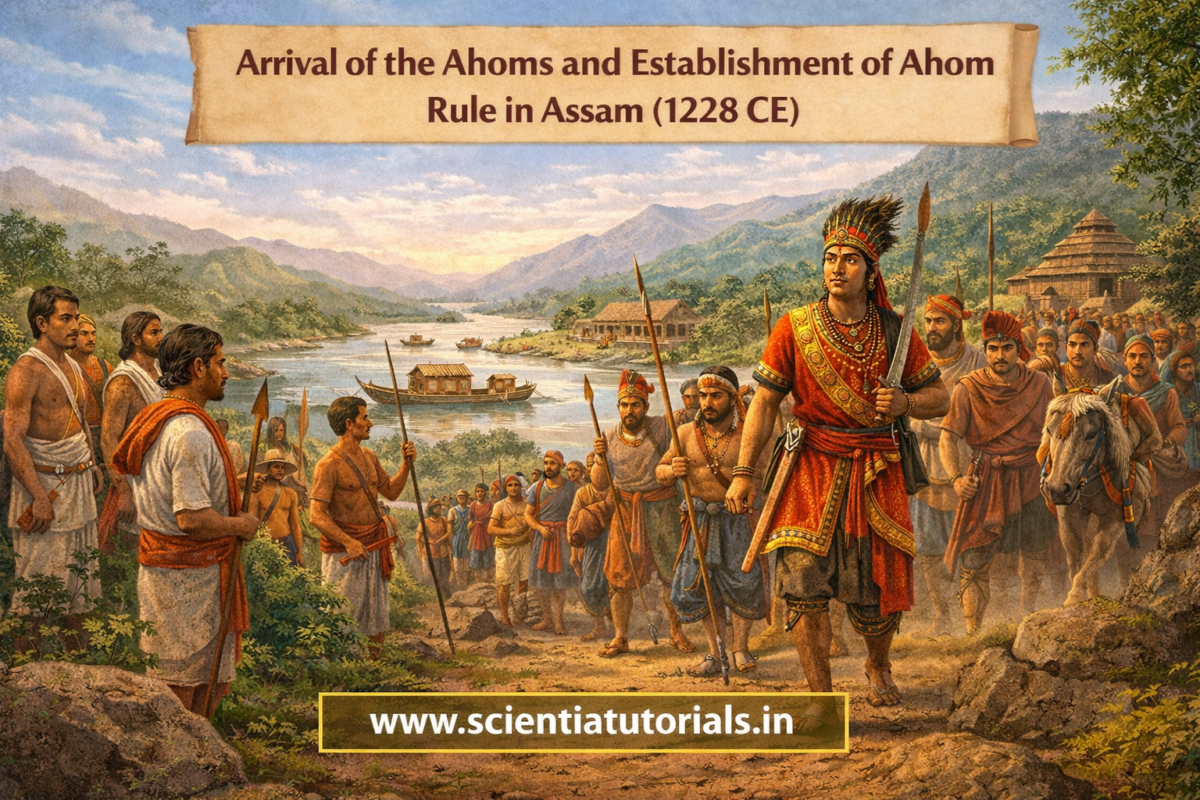
Arrival of the Ahoms and Establishment of Ahom Rule in Assam (1228 CE)
Course: Assam History – Chronological Era-Wise Study Module for Competitive Exams
Module IV: Ahom Period in Assam History (1228 CE – 1826 CE)
Lesson 1: Arrival of the Ahoms and Establishment of Ahom Rule
This lesson is systematically organized into four clearly structured sections, as detailed below:
- Chronologically Structured Study Module
- Short-Answer Type Questions
- Long-Answer Type Questions
- Multiple-Choice Questions (MCQs) with Answers and Detailed Explanations
Chronologically Structured Study Module
1. Introduction: Significance of the Ahom Arrival in Assam History
The arrival of the Ahoms in the early 13th century marks one of the most decisive turning points in the history of Assam. Unlike many medieval dynasties in India, the Ahoms established a long-lasting political system that endured for nearly six centuries (1228–1826 CE). Lesson 1 focuses on the circumstances of the Ahom migration, the leadership of Sukaphaa, early encounters with local powers, and the gradual establishment of Ahom rule in the Brahmaputra valley.
For competitive examinations, this lesson is foundational. It explains the origins of Ahom political authority, the early strategies of state formation, and the roots of institutions that later defined Assam’s medieval polity. Chronologically, it serves as the entry point to understanding the entire Ahom period.
2. Chronological Framework of Module IV
Module IV covers the Ahom Period from 1228 CE to 1826 CE, which can be broadly divided into phases:
- 1228–14th Century CE – Arrival of the Ahoms and early settlement
- 15th–16th Century CE – Consolidation and expansion
- 17th Century CE – Ahom–Mughal conflicts and military maturity
- 18th–early 19th Century CE – Decline, internal crisis, and British annexation
Lesson 1 is confined to the first phase, emphasizing migration, settlement, and initial political consolidation.
3. Origins of the Ahoms: Homeland and Migration
3.1 Ethnic and Cultural Background
The Ahoms belonged to the Tai ethnic group, originally inhabiting regions of Southeast Asia and southern China. They followed Tai customs, spoke a Tai language, and practiced ancestor worship along with animistic beliefs.
3.2 Causes of Migration
The migration of the Ahoms was not a sudden invasion but a gradual movement prompted by:
- Political instability in their homeland
- Pressure from rival Tai groups
- The search for fertile land and political opportunity
This migratory background shaped the Ahoms’ adaptive and accommodative political culture.
4. Leadership of Sukaphaa: The Founder of Ahom Rule
The Ahom migration into Assam was led by Sukaphaa, a visionary leader whose role was central to the establishment of Ahom rule.
Key Features of Sukaphaa’s Leadership:
- Military skill combined with diplomacy
- Ability to adapt to local conditions
- Emphasis on peaceful coexistence with indigenous groups
Sukaphaa is remembered not merely as a conqueror but as a state-builder.
5. Entry into Assam (1228 CE): A Watershed Moment
In 1228 CE, Sukaphaa and his followers entered the Brahmaputra valley through the Patkai hills. This date is traditionally accepted as the beginning of Ahom rule in Assam.
Geographical Importance
The Ahoms settled in the eastern Brahmaputra valley, a region characterized by:
- Fertile alluvial plains
- Dense forests
- Numerous rivers and tributaries of the Brahmaputra River
These geographical features influenced early Ahom settlement patterns and defense strategies.
6. Initial Settlements and the Choice of Charaideo
6.1 Establishment of Charaideo
One of Sukaphaa’s most significant acts was the establishment of Charaideo as the first Ahom capital. Charaideo later became the sacred center of Ahom royalty.
6.2 Strategic Significance
Charaideo was chosen because:
- It was naturally protected by hills and forests
- It allowed control over surrounding agricultural land
- It symbolized political and spiritual authority
The burial mounds (maidams) at Charaideo later became symbols of Ahom royal tradition.
7. Encounter with Indigenous Powers
7.1 Political Landscape of Assam
When the Ahoms arrived, Assam was not politically unified. The region was inhabited by:
- Chutiya kingdom in the east
- Kachari kingdoms in central Assam
- Various tribal chiefdoms
7.2 Ahom Strategy of Coexistence
Rather than immediate large-scale warfare, the Ahoms adopted a policy of:
- Alliances and matrimonial relations
- Gradual expansion
- Respect for local customs
This approach reduced resistance and facilitated integration.
8. Military and Diplomatic Methods of Early Ahoms
8.1 Military Organization
The Ahoms possessed strong military traditions, including:
- Knowledge of guerrilla warfare
- Use of terrain and forests for defense
- Collective military responsibility
8.2 Diplomacy and Accommodation
Early Ahom rulers often absorbed defeated groups rather than displacing them. Local chiefs were allowed to retain status under Ahom overlordship.
9. Establishment of Ahom Political Authority
9.1 From Migration to State Formation
The transformation of the Ahoms from migrants to rulers was gradual. Political authority emerged through:
- Control of land and agriculture
- Organization of manpower
- Creation of loyal administrative structures
9.2 Role of Agriculture
Wet-rice cultivation became the economic base of Ahom power. Clearing forests and settling cultivators ensured food security and population growth.
10. Early Administrative Practices
Although the mature Paik system developed later, its foundations were laid during the early Ahom period.
Key Features:
- Collective labor obligations
- State control over manpower
- Integration of local populations into service groups
This system enabled the Ahoms to mobilize resources without a cash-based economy.
11. Cultural Adaptation and Assimilation
11.1 Interaction with Local Society
The Ahoms gradually adopted:
- Local languages (eventually Assamese)
- Indigenous customs and rituals
- Hindu practices alongside Tai traditions
11.2 Religious Transition
Initially followers of Tai religion, the Ahoms later embraced Hinduism, especially Shaivism, while retaining elements of ancestor worship. This cultural flexibility strengthened their legitimacy.
12. Challenges Faced by Early Ahom Rulers
The early phase of Ahom rule was not without difficulties:
- Hostility from neighboring kingdoms
- Environmental challenges such as floods
- Need to maintain unity among followers
The survival of the Ahoms during this formative stage highlights their resilience and strategic foresight.
13. Consolidation of Power after Sukaphaa
After Sukaphaa’s death, his successors continued the work of consolidation:
- Expanding territorial control
- Strengthening administration
- Maintaining balance between force and diplomacy
By the 14th century, the Ahoms had emerged as a stable political power in eastern Assam.
14. Historical Significance of the Ahom Establishment
The establishment of Ahom rule was historically significant because:
- It ended political fragmentation in eastern Assam
- It laid the foundation for a centralized medieval state
- It introduced institutions that endured for centuries
No other dynasty in Assam ruled for such a long uninterrupted period.
15. Examination-Oriented Key Takeaways
- Ahoms entered Assam in 1228 CE under Sukaphaa
- Charaideo was the first Ahom capital
- Early Ahom policy emphasized coexistence and assimilation
- Agriculture and manpower organization formed the economic base
- Cultural adaptability ensured long-term survival
16. Importance of Lesson 1 for Competitive Exams
This lesson is frequently tested in:
- APSC Prelims and Mains
- UPSC (History optional / regional history)
- ADRE, TET, and other Assam-based exams
Questions often focus on dates, personalities, early settlements, and the nature of Ahom state formation.
17. Conclusion
The arrival of the Ahoms and the establishment of their rule in Assam was not a sudden conquest but a carefully negotiated historical process. Under Sukaphaa’s leadership, the Ahoms combined migration, diplomacy, military skill, and cultural assimilation to create a durable political system.
Lesson 1 provides the foundation for understanding the entire Ahom period. It explains how a small Tai group transformed into one of the most successful ruling dynasties in Indian medieval history, shaping Assam’s political, social, and cultural trajectory for nearly 600 years.
Understanding this lesson is essential for grasping both the continuity and uniqueness of Assam’s historical development during the medieval era.
Module IV: Ahom Period in Assam History (1228 CE – 1826 CE)
Lesson 1: Arrival of the Ahoms and Establishment of Ahom Rule
Short Answer Type Questions (with Answers)
1. Who led the Ahoms into Assam?
Answer: The Ahoms were led into Assam by Sukaphaa.
2. In which year did the Ahoms enter Assam?
Answer: The Ahoms entered Assam in 1228 CE.
3. From which ethnic group did the Ahoms belong?
Answer: The Ahoms belonged to the Tai ethnic group.
4. Through which hills did the Ahoms enter Assam?
Answer: The Ahoms entered Assam through the Patkai hills.
5. Name the first capital of the Ahom kingdom.
Answer: Charaideo was the first capital of the Ahom kingdom.
6. Why is 1228 CE considered a landmark year in Assam history?
Answer: It marks the beginning of Ahom rule in Assam.
7. Mention one reason for the Ahom migration towards Assam.
Answer: Political instability and search for fertile land in their homeland.
8. What type of society did the Ahoms originally belong to?
Answer: They belonged to a Tai tribal society with animistic beliefs.
9. Which major river valley became the center of early Ahom settlements?
Answer: The Brahmaputra River valley.
10. What was the religious belief of the Ahoms before adopting Hinduism?
Answer: They practiced ancestor worship and animism.
11. Name two indigenous powers present in Assam when the Ahoms arrived.
Answer: The Chutiya kingdom and Kachari kingdoms.
12. What strategy did Sukaphaa adopt towards local tribes?
Answer: Peaceful coexistence through alliances and diplomacy.
13. Why was Charaideo chosen as the Ahom capital?
Answer: Due to its strategic location, natural defense, and fertile land.
14. What are ‘maidams’?
Answer: Maidams are royal burial mounds of Ahom kings and nobles.
15. What type of agriculture supported early Ahom settlements?
Answer: Wet-rice cultivation.
16. How did the Ahoms deal with defeated local chiefs?
Answer: They often absorbed them into the Ahom administration.
17. What was the main basis of Ahom political power in the early period?
Answer: Control over land, agriculture, and manpower.
18. Name one important quality of Sukaphaa as a leader.
Answer: He was both a skilled diplomat and a capable military leader.
19. Did the Ahoms impose their language immediately on local people?
Answer: No, they gradually adopted local languages.
20. What administrative idea later developed from early Ahom practices?
Answer: The Paik system.
21. How did geography help the Ahoms in establishing rule?
Answer: Forests, rivers, and hills provided natural defense and resources.
22. What was the Ahom approach towards cultural assimilation?
Answer: Adaptation and gradual assimilation into local society.
23. How long did Ahom rule last in Assam?
Answer: Nearly 600 years (1228–1826 CE).
24. What was the main challenge faced by early Ahoms?
Answer: Resistance from local kingdoms and environmental difficulties.
25. Why is Sukaphaa remembered as a great state-builder?
Answer: He laid the foundation of a stable and long-lasting Ahom state.
26. What marked the transition of Ahoms from migrants to rulers?
Answer: Establishment of settlements, capital, and political authority.
27. How did Ahom rule differ from many medieval dynasties?
Answer: It was long-lasting, adaptive, and inclusive.
28. State one historical significance of the Ahom arrival.
Answer: It initiated the formation of a unified medieval Assamese state.
29. Which phase of Ahom history does Lesson 1 focus on?
Answer: The arrival and early establishment phase (13th century CE).
30. Why is this lesson important for competitive examinations?
Answer: It explains the origin, leadership, and foundation of Ahom rule in Assam.
✅ Exam Utility Tip:
These short answers are ideal for 2–4 mark questions, objective-to-subjective transitions, and quick revision for APSC, ADRE, TET, and UPSC (State History) examinations.
Module IV: Ahom Period in Assam History (1228 CE – 1826 CE)
Lesson 1: Arrival of the Ahoms and Establishment of Ahom Rule
Long Answer Type Questions (with Answers)
1. Describe the historical significance of the arrival of the Ahoms in Assam in 1228 CE.
Answer:
The arrival of the Ahoms in 1228 CE marks a decisive turning point in Assam’s medieval history. It initiated the establishment of a political system that lasted nearly six centuries. Unlike earlier short-lived dynasties, the Ahoms created a stable, adaptive, and inclusive state. Their arrival ended prolonged political fragmentation in eastern Assam and laid the foundation for centralized governance, agrarian expansion, and cultural assimilation.
2. Trace the origins of the Ahoms and explain the causes behind their migration to Assam.
Answer:
The Ahoms belonged to the Tai ethnic group, originally inhabiting regions of Southeast Asia and southern China. Political instability, inter-tribal conflicts, and the search for fertile land prompted their gradual westward migration. Assam’s fertile Brahmaputra valley and relatively fragmented political landscape offered favorable conditions for settlement and state formation.
3. Examine the role of Sukaphaa in the establishment of Ahom rule.
Answer:
Sukaphaa was the founder and chief architect of Ahom rule in Assam. He combined military strength with diplomacy and foresight. Rather than pursuing aggressive conquest, he emphasized coexistence, alliances, and cultural adaptation. His leadership transformed a migrating Tai group into a stable political power and earned him recognition as a visionary state-builder.
4. Why is Sukaphaa regarded more as a state-builder than a conqueror?
Answer:
Sukaphaa avoided large-scale warfare and instead focused on settlement, diplomacy, and integration. He respected local customs, forged alliances with indigenous groups, and promoted agriculture. These policies ensured long-term stability and legitimacy, distinguishing him from typical medieval conquerors.
5. Discuss the geographical route and significance of the Ahom entry into Assam.
Answer:
The Ahoms entered Assam through the Patkai hills in 1228 CE. This route allowed them controlled access into the Brahmaputra valley. The surrounding hills and forests provided natural defense, while the fertile plains supported agriculture. Geography thus played a crucial role in the success of early Ahom settlements.
6. Analyze the importance of the Brahmaputra River valley in the establishment of Ahom rule.
Answer:
The Brahmaputra valley offered fertile alluvial soil, abundant water resources, and natural communication routes. It supported wet-rice cultivation, trade, and population growth. Control over this valley became the economic and strategic foundation of Ahom political power.
7. Explain the significance of Charaideo as the first Ahom capital.
Answer:
Charaideo was strategically chosen due to its natural defenses, proximity to fertile land, and symbolic value. It became the political and spiritual center of the Ahom state. Later, it evolved into a sacred royal site marked by maidams, reinforcing Ahom dynastic identity.
8. Describe the political condition of Assam at the time of the Ahom arrival.
Answer:
Assam was politically fragmented, with powers such as the Chutiya kingdom, Kachari kingdoms, and various tribal chiefdoms. There was no centralized authority, which allowed the Ahoms to gradually expand through diplomacy and selective warfare.
9. How did the Ahoms deal with indigenous tribes and local rulers?
Answer:
The Ahoms adopted a policy of accommodation. Indigenous chiefs were often absorbed into the Ahom system and allowed to retain status under Ahom overlordship. This inclusive approach minimized resistance and promoted stability.
10. Discuss the military strategies adopted by the early Ahoms.
Answer:
Early Ahom military strategy emphasized guerrilla warfare, use of terrain, and collective responsibility. Forests and rivers were used defensively, and warfare was combined with diplomacy, making Ahom expansion effective yet sustainable.
11. Examine the role of agriculture in the consolidation of Ahom power.
Answer:
Agriculture, particularly wet-rice cultivation, formed the economic backbone of early Ahom rule. Clearing forests and settling cultivators ensured food security, manpower availability, and state revenue, strengthening political authority.
12. How did the Ahoms transition from a migratory group to a ruling power?
Answer:
This transition occurred through settlement, agricultural expansion, political alliances, and administrative organization. Establishing a capital, controlling land, and integrating local populations enabled the Ahoms to evolve into rulers.
13. Describe the early administrative practices of the Ahoms.
Answer:
Early administration relied on collective labor obligations and manpower organization. Though the mature Paik system developed later, its foundations were laid during this period, enabling resource mobilization without a cash economy.
14. Analyze the Ahom policy of cultural adaptation.
Answer:
The Ahoms gradually adopted local languages, customs, and social practices. Over time, they embraced Hinduism while retaining Tai traditions. This flexibility helped them gain legitimacy among local populations.
15. Discuss the religious beliefs of the early Ahoms.
Answer:
Initially, the Ahoms practiced ancestor worship and animism. With increased interaction with local society, they gradually adopted Hindu practices, particularly Shaivism, blending them with traditional beliefs.
16. What challenges did the early Ahoms face in Assam?
Answer:
They faced resistance from neighboring kingdoms, environmental challenges like floods, and the task of maintaining unity among followers. Their survival highlights their adaptability and strategic planning.
17. Explain the importance of diplomacy in early Ahom expansion.
Answer:
Diplomacy allowed the Ahoms to avoid unnecessary conflict. Alliances, matrimonial relations, and recognition of local elites facilitated peaceful expansion and long-term stability.
18. How did geography help the Ahoms defend their early settlements?
Answer:
Hills, forests, and river networks provided natural defenses. These features hindered enemy movement and enabled the Ahoms to practice effective defensive warfare.
19. Assess the contribution of Sukaphaa’s successors to early consolidation.
Answer:
Sukaphaa’s successors continued policies of expansion, administration, and cultural integration. They strengthened Ahom authority and ensured continuity of governance.
20. Why did Ahom rule last longer than most medieval dynasties in Assam?
Answer:
Longevity resulted from adaptive governance, inclusive policies, strong agrarian base, effective military organization, and cultural assimilation.
21. Compare Ahom state formation with earlier political systems in Assam.
Answer:
Earlier states were shorter-lived and less centralized. The Ahoms introduced durable institutions, systematic administration, and long-term political vision.
22. Discuss the historical importance of the year 1228 CE.
Answer:
The year 1228 CE marks the beginning of Ahom rule, initiating a new era of political stability and cultural synthesis in Assam.
23. How did the Ahoms integrate local populations into their state system?
Answer:
Through land grants, service obligations, cultural adaptation, and administrative inclusion, local populations became stakeholders in the Ahom state.
24. Evaluate Lesson 1 as a foundation for understanding the Ahom period.
Answer:
Lesson 1 explains the origins, leadership, and early strategies of Ahom rule. It provides the base for understanding later political, military, and cultural developments.
25. Conclude by assessing the establishment of Ahom rule as a historical process.
Answer:
The establishment of Ahom rule was a gradual and negotiated process rather than a sudden conquest. Through diplomacy, adaptation, and strategic planning, the Ahoms created one of the most enduring political systems in Indian medieval history.
✅ Exam Utility Note:
These answers are ideal for questions, APSC/UPSC mains, and analytical essays, emphasizing chronology, causation, and historical significance.
Module IV: Ahom Period in Assam History (1228 CE – 1826 CE)
Lesson 1: Arrival of the Ahoms and Establishment of Ahom Rule
MCQs with Answers and Concept-Clearing Explanations
1. The Ahoms entered Assam in which year?
A. 1206 CE
B. 1215 CE
C. 1228 CE
D. 1243 CE
Correct Answer: C
Explanation:
The year 1228 CE is traditionally accepted as the beginning of Ahom rule in Assam, marking the entry of the Ahoms into the Brahmaputra valley.
2. Who led the Ahom migration into Assam?
A. Rudra Singha
B. Suhungmung
C. Sukaphaa
D. Gadadhar Singha
Correct Answer: C
Explanation:
Sukaphaa was the founder of the Ahom kingdom and the leader who guided the Tai group into Assam.
3. The Ahoms originally belonged to which ethnic group?
A. Tibeto-Burman
B. Indo-Aryan
C. Tai
D. Mongol
Correct Answer: C
Explanation:
The Ahoms were part of the Tai ethnic group, originating from Southeast Asia and southern China.
4. Through which mountain range did the Ahoms enter Assam?
A. Arakan Yoma
B. Patkai Hills
C. Garo Hills
D. Khasi Hills
Correct Answer: B
Explanation:
The Patkai Hills served as the gateway through which Sukaphaa and his followers entered Assam.
5. The first capital of the Ahom kingdom was:
A. Garhgaon
B. Rangpur
C. Sivasagar
D. Charaideo
Correct Answer: D
Explanation:
Charaideo was established as the first Ahom capital and later became the sacred royal center of the Ahoms.
6. Which river valley became the core region of early Ahom settlement?
A. Barak Valley
B. Teesta Valley
C. Brahmaputra River Valley
D. Subansiri Valley
Correct Answer: C
Explanation:
The fertile Brahmaputra valley provided agricultural surplus and strategic advantages, forming the backbone of Ahom power.
7. What was the primary objective of Ahom migration into Assam?
A. Religious expansion
B. Trade monopoly
C. Search for fertile land and political opportunity
D. Maritime dominance
Correct Answer: C
Explanation:
The Ahoms migrated due to political pressures in their homeland and the search for fertile land suitable for settlement.
8. Which of the following best describes Sukaphaa’s policy towards local tribes?
A. Immediate conquest
B. Forced displacement
C. Diplomatic coexistence
D. Cultural isolation
Correct Answer: C
Explanation:
Sukaphaa emphasized diplomacy, alliances, and peaceful coexistence rather than large-scale warfare.
9. When the Ahoms arrived, Assam was:
A. Politically unified
B. Under Mughal control
C. Politically fragmented
D. A Buddhist theocracy
Correct Answer: C
Explanation:
Assam consisted of multiple kingdoms and tribal chiefdoms, making it politically fragmented.
10. Which indigenous kingdoms were present during the early Ahom period?
A. Chola and Chera
B. Chutiya and Kachari
C. Pala and Sena
D. Koch and Mughal
Correct Answer: B
Explanation:
The Chutiya and Kachari kingdoms were significant regional powers during the Ahom arrival.
11. What strategy helped the Ahoms establish long-term rule?
A. Continuous warfare
B. Strict cultural imposition
C. Adaptation and assimilation
D. Heavy taxation
Correct Answer: C
Explanation:
The Ahoms adapted to local customs, languages, and social systems, ensuring acceptance and stability.
12. Early Ahom economy was primarily based on:
A. Trade and commerce
B. Mining
C. Wet-rice cultivation
D. Handicrafts
Correct Answer: C
Explanation:
Wet-rice cultivation formed the economic foundation of early Ahom settlements.
13. Which feature later evolved into the Paik system?
A. Coin-based taxation
B. Collective labor organization
C. Land revenue auctions
D. Merchant guilds
Correct Answer: B
Explanation:
Early manpower organization and collective service obligations laid the foundation of the Paik system.
14. The term ‘maidam’ refers to:
A. Military fort
B. Temple complex
C. Royal burial mound
D. Administrative office
Correct Answer: C
Explanation:
Maidams are burial mounds of Ahom kings and nobles, especially concentrated at Charaideo.
15. Which quality best explains Sukaphaa’s success as a ruler?
A. Religious orthodoxy
B. Diplomatic foresight
C. Naval strength
D. Economic exploitation
Correct Answer: B
Explanation:
Sukaphaa’s diplomatic approach and adaptability ensured peaceful expansion and long-term survival.
16. How did the Ahoms treat defeated local chiefs?
A. Executed them
B. Expelled them
C. Absorbed them into administration
D. Converted them forcibly
Correct Answer: C
Explanation:
Local chiefs were often incorporated into the Ahom system, reducing resistance.
17. What type of religion did the Ahoms initially follow?
A. Buddhism
B. Islam
C. Hinduism
D. Animism and ancestor worship
Correct Answer: D
Explanation:
Before adopting Hinduism, the Ahoms practiced Tai religious traditions centered on ancestor worship.
18. Which factor helped the Ahoms defend their early settlements?
A. Fortified coastal cities
B. Desert terrain
C. Forests, hills, and rivers
D. Naval fleets
Correct Answer: C
Explanation:
Natural geography provided strong defensive advantages to early Ahom settlements.
19. The Ahom state formation can best be described as:
A. Sudden conquest
B. Colonial expansion
C. Gradual consolidation
D. Religious empire
Correct Answer: C
Explanation:
Ahom rule emerged gradually through settlement, diplomacy, and integration.
20. Which statement best explains the longevity of Ahom rule?
A. Exclusive ethnic identity
B. Flexible and inclusive governance
C. Continuous warfare
D. External support
Correct Answer: B
Explanation:
The Ahoms survived for nearly 600 years due to adaptability, inclusive policies, and strong institutions.
21. What marked the transformation of the Ahoms from migrants to rulers?
A. Establishment of Charaideo
B. Defeat of the Mughals
C. Adoption of Hinduism
D. British recognition
Correct Answer: A
Explanation:
Establishing a capital and permanent settlements marked the shift from migration to statehood.
22. Which phase of Ahom history is covered in Lesson 1?
A. Decline of Ahom rule
B. Ahom-Mughal conflict
C. Arrival and early establishment
D. British annexation
Correct Answer: C
Explanation:
Lesson 1 focuses on the arrival of the Ahoms and the initial formation of their rule.
23. Why is the year 1228 CE important for competitive exams?
A. It marks Mughal invasion
B. It marks British entry
C. It marks the start of Ahom rule
D. It marks the fall of Kamarupa
Correct Answer: C
Explanation:
1228 CE is a key chronological marker frequently asked in exams.
24. Which administrative principle characterized early Ahom governance?
A. Cash-based taxation
B. Manpower control
C. Urban bureaucracy
D. Merchant councils
Correct Answer: B
Explanation:
Control and organization of manpower formed the backbone of early Ahom administration.
25. The arrival of the Ahoms ultimately led to:
A. Political instability
B. Cultural isolation
C. Formation of a long-lasting medieval state
D. Immediate colonial rule
Correct Answer: C
Explanation:
Ahom arrival resulted in the creation of one of the most enduring medieval states in Indian history.
✅ Exam Strategy Note:
These MCQs are ideal for APSC Prelims, ADRE, TET, and UPSC (State History) preparation, focusing on chronology, leadership, geography, and state formation concepts rather than rote memorization.
Arrival of the Ahoms and Establishment of Ahom Rule in Assam
The arrival of the Ahoms in 1228 CE marks the beginning of a decisive phase in Assam’s medieval history. This event laid the foundation of one of the longest-ruling dynasties in India, shaping Assam’s political, social, and cultural evolution for nearly six centuries.
Historical Background
The Ahoms belonged to the Tai ethnic group and migrated gradually from Southeast Asia under the leadership of Sukaphaa. Their movement was driven by political pressures in their homeland and the search for fertile land suitable for settlement and state formation.
Entry into Assam and Early Settlements
In 1228 CE, Sukaphaa entered Assam through the Patkai hills and settled in the eastern Brahmaputra River valley. The region’s fertile plains, forests, and river networks provided ideal conditions for agriculture, defense, and expansion.
Establishment of Charaideo
Sukaphaa established Charaideo as the first Ahom capital. Charaideo later emerged as the political and spiritual center of the Ahom state and symbolized royal authority and continuity.
Nature of Early Ahom Rule
The Ahoms followed a policy of coexistence and assimilation rather than aggressive conquest. Indigenous tribes and local chiefs were gradually integrated into the Ahom system through diplomacy, alliances, and administrative inclusion. Wet-rice cultivation and manpower organization formed the economic base of early Ahom rule.
Historical Significance
The establishment of Ahom rule ended political fragmentation in eastern Assam and introduced stable institutions that endured for centuries. The adaptive and inclusive governance model adopted by the Ahoms explains the remarkable longevity of their rule from 1228 CE to 1826 CE.
📌 Exam Relevance
This topic is highly important for APSC, UPSC (State History), ADRE, TET, and other Assam-based competitive examinations, especially for questions related to chronology, leadership, and medieval state formation.