
Lesson 1: Decline of Kamarupa and Political Fragmentation
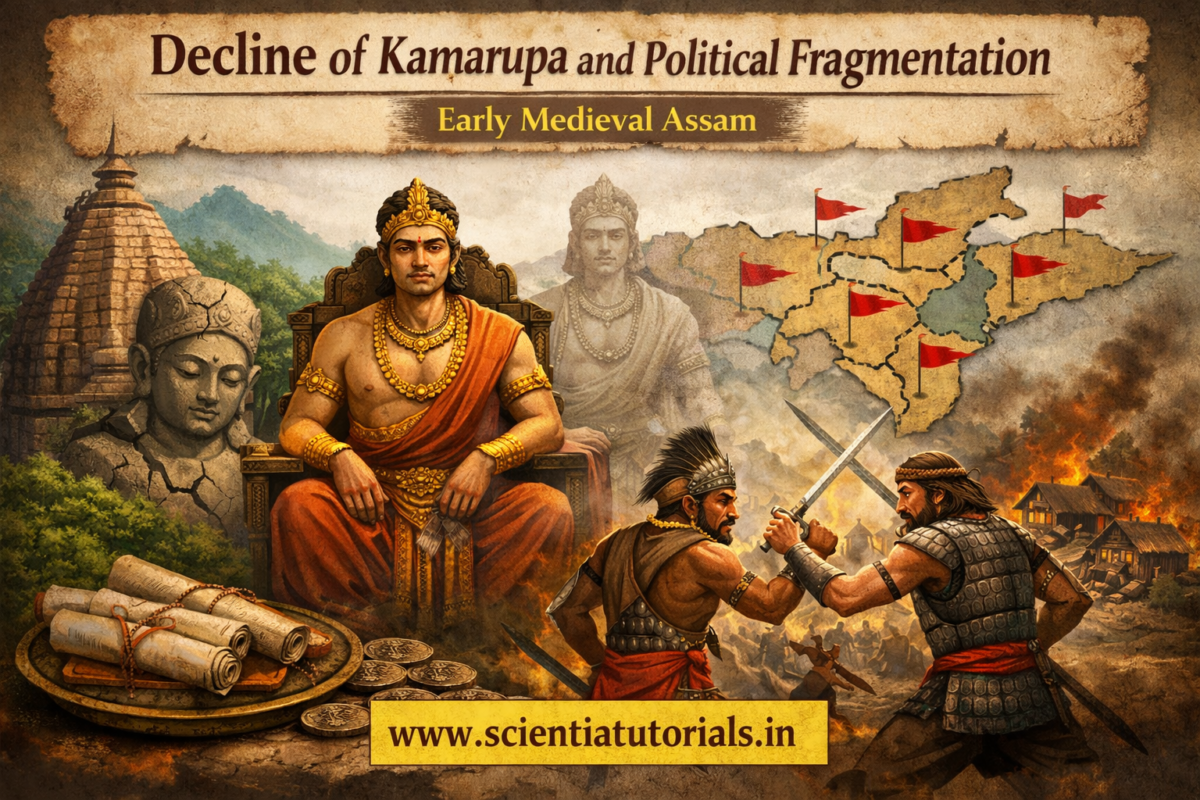
Decline of Kamarupa and Political Fragmentation – Early Medieval Assam History
Module III: Early Medieval Assam (c. 7th Century CE – 13th Century CE)
Lesson 1: Decline of Kamarupa and Political Fragmentation
This lesson is systematically organized into four clearly structured sections, as detailed below:
- Chronologically Structured Study Module
- Short-Answer Type Questions
- Long-Answer Type Questions
- Multiple-Choice Questions (MCQs) with Answers and Detailed Explanations
Chronologically Structured Study Module
Introduction
The Early Medieval period in Assam, spanning roughly from the 7th century CE to the 13th century CE, marks a decisive transition in the political and administrative history of the Brahmaputra Valley. This era witnessed the gradual decline of the powerful kingdom of Kamarupa and the emergence of multiple regional polities, setting the stage for a fragmented but dynamic political landscape.
For competitive examinations, understanding this phase is crucial because it explains:
- The end of centralized monarchy in early Assam
- The rise of feudal tendencies and local chiefs
- The background for later medieval states, including the Ahoms
This chronologically structured study module examines the decline of Kamarupa, its causes, key transitional rulers, and the process of political fragmentation, strictly aligned with the objectives of Module III of the course.
1. Kamarupa Before Decline: A Brief Political Context
1.1 Territorial Extent and Political Strength
From the 4th century CE, Kamarupa had emerged as one of the most prominent kingdoms of eastern India. By the 7th century CE, it stretched from the Karatoya River in the west to the Dikkaravasini (near present-day Sadiya) in the east, and from the Himalayan foothills in the north to the hills of present-day Meghalaya in the south.
Under rulers like Bhaskaravarman, Kamarupa:
- Maintained diplomatic ties with North Indian powers
- Enjoyed administrative stability
- Was recognized in contemporary foreign accounts
1.2 Administrative Foundations
Kamarupa followed a monarchical system supported by:
- Land grants (agraharas)
- Brahmanical institutions
- Provincial governors (vishayapatis and mandalikas)
However, many of these institutions later contributed to political decentralization, which accelerated decline.
2. Chronological Phases of Decline of Kamarupa
Phase I: Post-Bhaskaravarman Vacuum (Late 7th Century CE)
The death of Bhaskaravarman around 650 CE marked the first major turning point.
Key Developments:
- No strong successor with comparable authority
- Breakdown of central command
- Rise of local military elites
The absence of a clear line of succession weakened royal legitimacy, leading to internal instability.
Phase II: Weakening of Central Authority (8th–9th Century CE)
During this phase, Kamarupa rulers struggled to exercise effective control over distant territories.
Chronological Characteristics:
- Increasing dependence on samantas (feudatories)
- Growth of hereditary land grants
- Diminishing royal revenue base
The kingdom gradually shifted from a centralized monarchy to a semi-feudal polity, undermining unity.
Phase III: Late Kamarupa Rulers and Fragmentation (10th–12th Century CE)
By the 10th century CE, Kamarupa had effectively lost its political cohesion.
Notable developments include:
- Rise of independent regional rulers
- Decline of royal inscriptions
- Shrinking core territory around central Assam
This period culminated in the complete political disintegration of Kamarupa.
3. Major Causes Behind the Decline of Kamarupa
3.1 Dynastic Weakness and Succession Disputes
After strong rulers, the throne was often occupied by inefficient or short-lived kings, leading to:
- Frequent power struggles
- Lack of continuity in governance
- Erosion of royal authority
This made the kingdom vulnerable to both internal revolts and external pressures.
3.2 Rise of Feudalism and Land Grants
One of the most significant long-term causes was the extensive grant of land to Brahmins and officials.
Consequences:
- Reduced royal control over revenue
- Growth of autonomous landed elites
- Emergence of semi-independent local chiefs
Over time, these chiefs transformed into regional rulers, directly challenging central power.
3.3 Administrative Over-Extension
The vast geographical size of Kamarupa became a liability.
- Poor communication networks
- Difficult terrain of hills and forests
- Limited military reach
The king’s authority became nominal in frontier regions, accelerating fragmentation.
3.4 External Pressures and Regional Instability
Though no single foreign invasion destroyed Kamarupa, continuous pressures from:
- Eastern Himalayan tribes
- Neighboring regional powers
contributed to the weakening of internal stability.
4. Political Fragmentation After the Decline of Kamarupa
4.1 Emergence of Regional Kingdoms
Following the decline, Assam witnessed the rise of multiple localized political units, including:
- Western Assam polities
- Central Brahmaputra Valley chiefs
- Eastern frontier principalities
Each of these functioned independently, often engaging in conflict with neighbors.
4.2 Role of Tribal and Local Chiefs
Tribal leaders gradually transformed into territorial rulers.
Key characteristics:
- Control over limited territories
- Military-based authority
- Personal loyalty rather than institutional governance
This marked a shift from state-based power to clan-based rule.
4.3 Disappearance of a Unified Assamese State
Between the 12th and early 13th centuries CE, Assam lacked:
- A single sovereign authority
- Uniform administrative systems
- Centralized taxation
This period is best described as one of political atomization rather than chaos.
5. Cultural and Social Continuities Despite Political Decline
Despite political fragmentation, several elements of continuity remained:
5.1 Religious Institutions
- Brahmanical traditions continued
- Temples remained centers of influence
- Sanskrit learning survived in agraharas
5.2 Language and Identity
- Early Assamese linguistic forms evolved
- Shared cultural memory of Kamarupa persisted
These continuities later helped in reintegrating Assam under new powers.
6. Transition to the Late Medieval Period
The political vacuum created by the decline of Kamarupa eventually paved the way for:
- New state formations
- Military innovations
- Integration of tribal and non-tribal societies
By the 13th century CE, Assam was ready for a new political experiment, which culminated in the rise of the Ahom state.
7. Chronological Summary for Competitive Exams
7th Century CE
- Height of Kamarupa under Bhaskaravarman
- Beginning of decline after his death
8th–9th Century CE
- Weak rulers
- Expansion of feudal land grants
- Decline of centralized authority
10th–12th Century CE
- Political fragmentation
- Rise of regional chieftains
- Shrinking of Kamarupa’s influence
Early 13th Century CE
- End of Kamarupa as a political entity
- Prelude to new medieval powers
8. Examination-Oriented Key Takeaways
- The decline of Kamarupa was gradual, not sudden
- Feudalism played a central role in political fragmentation
- Political decline did not mean cultural collapse
- Fragmentation laid the foundation for later medieval states
- Chronology is essential for understanding cause-and-effect
Conclusion
The decline of Kamarupa and subsequent political fragmentation represents a defining phase in Assam’s early medieval history. While the collapse of centralized authority weakened political unity, it also allowed regional identities and power structures to emerge. For competitive examinations, this lesson is vital because it explains the transition from ancient to medieval Assam, highlighting how decline, continuity, and transformation collectively shaped the region’s historical trajectory.
Short Answer Type Questions
Module III: Early Medieval Assam
Lesson 1: Decline of Kamarupa and Political Fragmentation
1. What was Kamarupa?
Answer:
Kamarupa was an ancient kingdom in the Brahmaputra Valley that existed from about the 4th century CE and played a dominant political role in early Assam.
2. Which period marks the Early Medieval phase in Assam?
Answer:
The Early Medieval phase in Assam spans roughly from the 7th century CE to the 13th century CE.
3. Who was the last great ruler of Kamarupa?
Answer:
Bhaskaravarman was the last great ruler of Kamarupa.
4. Why is the death of Bhaskaravarman considered a turning point?
Answer:
His death created a political vacuum, as no equally powerful successor emerged, leading to instability and decline of central authority.
5. What happened to Kamarupa after the 7th century CE?
Answer:
After the 7th century CE, Kamarupa gradually declined due to weak rulers, administrative breakdown, and political fragmentation.
6. What is meant by political fragmentation?
Answer:
Political fragmentation refers to the breakdown of a centralized state into multiple independent or semi-independent regional powers.
7. Name one major cause of the decline of Kamarupa.
Answer:
One major cause was the weakening of central authority due to feudal land grants.
8. How did land grants weaken the Kamarupa kingdom?
Answer:
Land grants reduced royal revenue and strengthened local elites, making them increasingly autonomous from the king.
9. What role did feudalism play in the decline of Kamarupa?
Answer:
Feudalism encouraged decentralization by empowering local chiefs and landlords at the expense of royal authority.
10. Why did succession disputes weaken Kamarupa?
Answer:
Succession disputes led to internal conflicts, instability, and frequent changes of rulers, weakening governance.
11. How did geography contribute to political fragmentation?
Answer:
Difficult terrain, forests, hills, and rivers limited communication and military control over distant regions.
12. Was Kamarupa destroyed by a single foreign invasion?
Answer:
No, Kamarupa declined gradually and was not destroyed by any single foreign invasion.
13. What happened to central administration during the decline?
Answer:
Central administration weakened, and effective control remained limited to the core areas of the kingdom.
14. Who were samantas?
Answer:
Samantas were feudatory chiefs or subordinate rulers who gradually became powerful and independent.
15. What political condition existed in Assam by the 10th century CE?
Answer:
By the 10th century CE, Assam experienced extensive political fragmentation and regional autonomy.
16. Did political decline lead to cultural collapse?
Answer:
No, cultural and religious traditions continued despite political decline.
17. Which institutions preserved culture during political fragmentation?
Answer:
Brahmanical institutions, temples, and agraharas preserved culture and learning.
18. What type of rule replaced centralized monarchy?
Answer:
Localized rule by regional chiefs and clan-based authorities replaced centralized monarchy.
19. How did tribal chiefs gain political importance?
Answer:
Tribal chiefs gained power by controlling land and military resources, eventually becoming regional rulers.
20. What was the political situation of Assam in the 12th century CE?
Answer:
Assam lacked a unified state and was divided among multiple small and medium regional powers.
21. Why is the decline of Kamarupa important for Assam’s history?
Answer:
It explains the transition from ancient centralized rule to medieval regional polities.
22. How did fragmentation prepare the ground for later states?
Answer:
Fragmentation allowed new political experiments and integration of diverse groups, paving the way for later kingdoms.
23. What type of authority replaced institutional governance?
Answer:
Personal loyalty and military strength replaced institutional governance.
24. Which century marks the end of Kamarupa as a political entity?
Answer:
The early 13th century CE marks the end of Kamarupa as a political entity.
25. How is the decline of Kamarupa best described?
Answer:
The decline of Kamarupa was gradual, structural, and evolutionary rather than sudden or catastrophic.
Long Answer Type Questions
Module III: Early Medieval Assam
Lesson 1: Decline of Kamarupa and Political Fragmentation
1. Discuss the historical significance of Kamarupa in early Assam and explain why its decline marks a turning point in Assam’s history.
Answer:
Kamarupa was the earliest powerful political formation in Assam, providing territorial unity, administrative structure, and cultural identity to the Brahmaputra Valley. From the 4th to the 7th century CE, it functioned as a centralized monarchy with effective governance.
Its decline marked a major turning point because it ended centralized rule and ushered in an era of political fragmentation. This transition reshaped Assam’s political culture, paving the way for regional polities and later medieval states.
2. Examine the role of Bhaskaravarman in the political history of Kamarupa.
Answer:
Bhaskaravarman was the last great ruler of Kamarupa and a contemporary of Harshavardhana. His reign represented the peak of Kamarupa’s political power, diplomatic engagement, and administrative stability.
After his death, the absence of a strong successor created a power vacuum. Thus, Bhaskaravarman’s reign represents both the zenith and the immediate prelude to decline.
3. Analyse the causes behind the decline of Kamarupa in a chronological framework.
Answer:
The decline of Kamarupa was gradual and can be analysed chronologically. After the 7th century CE, weak successors failed to maintain centralized control. Between the 8th and 9th centuries, feudal land grants reduced royal authority. By the 10th century, local chiefs became autonomous, and political unity collapsed.
Thus, dynastic weakness, feudalism, administrative over-extension, and regional pressures collectively caused the decline.
4. How did feudal land grants contribute to political fragmentation in early medieval Assam?
Answer:
Land grants to Brahmins and officials weakened royal revenue and control. These grants created hereditary landed elites who exercised judicial and administrative authority in their regions.
Over time, such elites transformed into semi-independent rulers, undermining the central monarchy and accelerating political fragmentation across Assam.
5. Explain the concept of political fragmentation with reference to early medieval Assam.
Answer:
Political fragmentation refers to the breakdown of centralized authority and the rise of multiple autonomous political units. In early medieval Assam, this occurred after the decline of Kamarupa when local chiefs, samantas, and tribal leaders established independent control over territories.
This resulted in the absence of a unified state between the 10th and 13th centuries.
6. Why was the decline of Kamarupa not sudden or catastrophic?
Answer:
The decline of Kamarupa was gradual because no single invasion or event destroyed it. Instead, internal weaknesses, administrative decay, and decentralization eroded royal power over centuries.
This evolutionary decline distinguishes Kamarupa from states that collapsed due to sudden military conquest.
7. Assess the impact of succession disputes on the stability of Kamarupa.
Answer:
Succession disputes weakened political stability by causing internal conflicts and short reigns. Rival claimants diverted attention from governance and defense.
Such instability reduced public loyalty to the monarchy and encouraged local elites to assert independence.
8. How did geography influence the decline and fragmentation of Kamarupa?
Answer:
The vast expanse of Kamarupa, combined with rivers, forests, and hilly terrain, made communication and military control difficult.
As central authority weakened, distant regions effectively slipped out of royal control, accelerating political fragmentation.
9. Discuss the role of samantas in weakening central authority in Kamarupa.
Answer:
Samantas were subordinate chiefs entrusted with land and administrative duties. Over time, they accumulated military strength and local loyalty.
As central authority declined, samantas asserted autonomy, transforming from subordinates into independent rulers.
10. Examine the political condition of Assam between the 10th and 12th centuries CE.
Answer:
Between the 10th and 12th centuries CE, Assam lacked a unified political authority. Multiple small kingdoms and chieftaincies existed, often in conflict with each other.
This period is best described as one of decentralized and localized rule rather than anarchy.
11. Did the decline of Kamarupa lead to cultural decline? Explain.
Answer:
No, political decline did not result in cultural collapse. Religious institutions, Brahmanical traditions, and Sanskrit learning continued through temples and agraharas.
Cultural continuity helped preserve Assamese identity despite political fragmentation.
12. Analyse the transformation of tribal chiefs into political rulers during this period.
Answer:
Tribal chiefs gained control over land and armed followers. As royal authority weakened, they emerged as territorial rulers.
This transformation integrated tribal leadership into Assam’s evolving political structure.
13. How did political fragmentation prepare the ground for later medieval states?
Answer:
Fragmentation encouraged experimentation with governance and integration of diverse communities. It weakened rigid hierarchies and allowed new political forces to rise.
This environment eventually enabled the emergence of stronger medieval states.
14. Evaluate the administrative weaknesses that hastened the decline of Kamarupa.
Answer:
Administrative weaknesses included poor communication, excessive land grants, and lack of bureaucratic control.
These factors limited the king’s authority and facilitated decentralization.
15. Explain why early medieval Assam lacked a centralized state for several centuries.
Answer:
After Kamarupa’s decline, no power could consolidate authority across the region. Geographic challenges and entrenched local elites prevented unification.
Thus, Assam remained politically fragmented until the late medieval period.
16. Discuss the role of religion in maintaining continuity during political decline.
Answer:
Religion provided institutional stability through temples and Brahmanical settlements. These institutions preserved learning, rituals, and social order.
They acted as cultural anchors during political instability.
17. How did land grants alter the nature of kingship in Assam?
Answer:
Land grants reduced the king’s economic base and increased dependence on local elites. Kingship became symbolic rather than authoritative.
This shift undermined centralized governance.
18. Assess the significance of the decline of Kamarupa in understanding medieval Assam.
Answer:
The decline explains the transition from ancient centralized rule to medieval regional polities.
It provides historical context for later state formation and political integration.
19. Why is the study of political fragmentation important for competitive exams?
Answer:
It highlights cause-and-effect relationships, transitions between historical periods, and structural changes in governance.
Such analytical understanding is crucial for descriptive answers.
20. Conclude with an overall assessment of the decline of Kamarupa.
Answer:
The decline of Kamarupa was a gradual, structural process marked by decentralization and fragmentation. While political unity collapsed, cultural continuity persisted.
This phase laid the foundation for later medieval developments, making it a crucial chapter in Assam’s history.
MCQs with Answers and Explanations
Module III: Early Medieval Assam
Lesson 1: Decline of Kamarupa and Political Fragmentation
1. The Early Medieval period in Assam broadly covers which time span?
A. 3rd century BCE – 4th century CE
B. 4th century CE – 6th century CE
C. 7th century CE – 13th century CE
D. 10th century CE – 16th century CE
Correct Answer: C
Explanation:
Historians generally define Early Medieval Assam as the period from the 7th to the 13th century CE, marking the decline of ancient polities and the emergence of medieval regional powers.
2. Kamarupa was primarily located in which geographical region?
A. Barak Valley
B. Surma Valley
C. Brahmaputra Valley
D. Irrawaddy Valley
Correct Answer: C
Explanation:
Kamarupa was centered in the Brahmaputra Valley, which formed the political and cultural heartland of early Assam.
3. Who is regarded as the last great ruler of Kamarupa?
A. Pushyavarman
B. Narayanavarman
C. Harshavardhana
D. Bhaskaravarman
Correct Answer: D
Explanation:
Bhaskaravarman represented the zenith of Kamarupa’s political power. After his death, centralized authority rapidly weakened.
4. The decline of Kamarupa began significantly after which event?
A. Chinese invasion
B. Arab invasion
C. Death of Bhaskaravarman
D. Rise of Ahoms
Correct Answer: C
Explanation:
The death of Bhaskaravarman created a political vacuum, as no equally strong successor emerged, initiating the decline.
5. Which of the following best describes the nature of Kamarupa’s decline?
A. Sudden and catastrophic
B. Caused by foreign conquest
C. Gradual and structural
D. Entirely cultural
Correct Answer: C
Explanation:
Kamarupa declined gradually due to internal weaknesses like feudalism and weak rulers, not due to a single destructive event.
6. What is meant by political fragmentation?
A. Cultural decline
B. Religious conflict
C. Breakdown of centralized authority into regional powers
D. Foreign occupation
Correct Answer: C
Explanation:
Political fragmentation refers to the emergence of multiple autonomous or semi-autonomous political units after the collapse of a central authority.
7. Which factor most weakened royal authority in late Kamarupa?
A. Trade expansion
B. Urbanization
C. Feudal land grants
D. Coinage reforms
Correct Answer: C
Explanation:
Land grants reduced royal revenue and empowered local elites, accelerating decentralization.
8. To whom were most land grants given during the later Kamarupa period?
A. Merchants
B. Soldiers
C. Brahmins and officials
D. Foreign traders
Correct Answer: C
Explanation:
Land grants to Brahmins and officials created hereditary landed interests beyond royal control.
9. What was the long-term impact of land grants on Kamarupa?
A. Stronger army
B. Centralized administration
C. Rise of autonomous local rulers
D. Increased trade
Correct Answer: C
Explanation:
Grantees gradually became independent power holders, undermining the monarchy.
10. Who were samantas in early medieval Assam?
A. Priests
B. Traders
C. Feudatory chiefs
D. Foreign envoys
Correct Answer: C
Explanation:
Samantas were subordinate chiefs who later asserted autonomy as central authority weakened.
11. Which century saw extensive political fragmentation in Assam?
A. 6th century CE
B. 7th century CE
C. 10th century CE
D. 15th century CE
Correct Answer: C
Explanation:
By the 10th century CE, Kamarupa’s authority had collapsed, leading to fragmentation.
12. Which geographical factor hindered effective control by Kamarupa kings?
A. Deserts
B. Plateaus
C. Rivers, forests, and hills
D. Coastal regions
Correct Answer: C
Explanation:
Difficult terrain limited communication and military reach, aiding decentralization.
13. Was Kamarupa destroyed by a single foreign invasion?
A. Yes, by Arabs
B. Yes, by Tibetans
C. No
D. Yes, by Ahoms
Correct Answer: C
Explanation:
Kamarupa declined due to internal factors, not a decisive foreign invasion.
14. What political condition prevailed in Assam between the 10th and 12th centuries?
A. Strong empire
B. Colonial rule
C. Multiple regional polities
D. Complete anarchy
Correct Answer: C
Explanation:
Assam was divided among several local rulers, though not entirely lawless.
15. Which institution helped preserve culture despite political decline?
A. Military camps
B. Trade guilds
C. Temples and agraharas
D. Royal courts
Correct Answer: C
Explanation:
Religious institutions maintained learning and cultural continuity.
16. Political decline in Kamarupa led to which cultural outcome?
A. Total cultural collapse
B. Loss of Assamese identity
C. Cultural continuity despite political change
D. Forced cultural uniformity
Correct Answer: C
Explanation:
Culture and religion continued even after political fragmentation.
17. Which form of authority replaced centralized kingship?
A. Bureaucratic rule
B. Democratic councils
C. Local and clan-based authority
D. Colonial administration
Correct Answer: C
Explanation:
Power shifted to local chiefs relying on personal loyalty and military strength.
18. Tribal chiefs became rulers mainly due to:
A. Foreign support
B. Royal appointment
C. Control over land and armed followers
D. Trade wealth
Correct Answer: C
Explanation:
Military control and territorial dominance enabled tribal leaders to become rulers.
19. The decline of Kamarupa is important because it explains:
A. Assam’s colonial history
B. Spread of Buddhism
C. Transition from ancient to medieval Assam
D. Industrial development
Correct Answer: C
Explanation:
This phase bridges ancient centralized rule and medieval regional states.
20. Which century marks the effective end of Kamarupa as a political entity?
A. 9th century CE
B. 10th century CE
C. 11th century CE
D. Early 13th century CE
Correct Answer: D
Explanation:
By the early 13th century CE, Kamarupa ceased to exist as a unified political entity.
21. Political fragmentation mainly resulted in:
A. Stronger monarchy
B. Uniform administration
C. Rise of small and medium powers
D. Foreign domination
Correct Answer: C
Explanation:
Fragmentation encouraged the growth of localized political units.
22. Which term best describes kingship during the decline?
A. Absolute
B. Divine
C. Symbolic and weakened
D. Democratic
Correct Answer: C
Explanation:
Kings increasingly lost real administrative and military control.
23. The decline of Kamarupa prepared the ground for:
A. British rule
B. Mughal conquest
C. Later medieval state formation
D. Cultural isolation
Correct Answer: C
Explanation:
Fragmentation created conditions for new political experiments.
24. Why is the decline of Kamarupa described as evolutionary?
A. It was sudden
B. It was violent
C. It unfolded over several centuries
D. It was externally imposed
Correct Answer: C
Explanation:
The decline occurred gradually through structural changes.
25. For competitive exams, which aspect of Kamarupa’s decline is most important?
A. Exact dates only
B. Names of kings only
C. Chronology, causes, and consequences
D. Mythological accounts
Correct Answer: C
Explanation:
Examiners focus on analytical understanding—how and why decline occurred and its impact.
-
decline of Kamarupa kingdom in Assam
-
political fragmentation in early medieval Assam
-
early medieval Assam history study notes
-
causes of decline of Kamarupa
-
Bhaskaravarman and decline of Kamarupa
-
feudalism in early medieval Assam
-
transition from ancient to medieval Assam
-
regional kingdoms after Kamarupa
-
Assam history for APSC and UPSC
-
early medieval Assam polity notes
Decline of Kamarupa and Political Fragmentation – Early Medieval Assam
The Early Medieval period in Assam (c. 7th–13th century CE) marks a decisive transformation in the region’s political history. This era witnessed the gradual decline of the powerful kingdom of Kamarupa and the emergence of multiple regional political units, resulting in prolonged political fragmentation.
Understanding this transition is essential for competitive examinations as it explains the shift from ancient centralized monarchy to medieval decentralized rule in Assam.