
Lesson 2: Rise of Regional Powers – Chutiya, Kachari, and Kamata Kingdoms
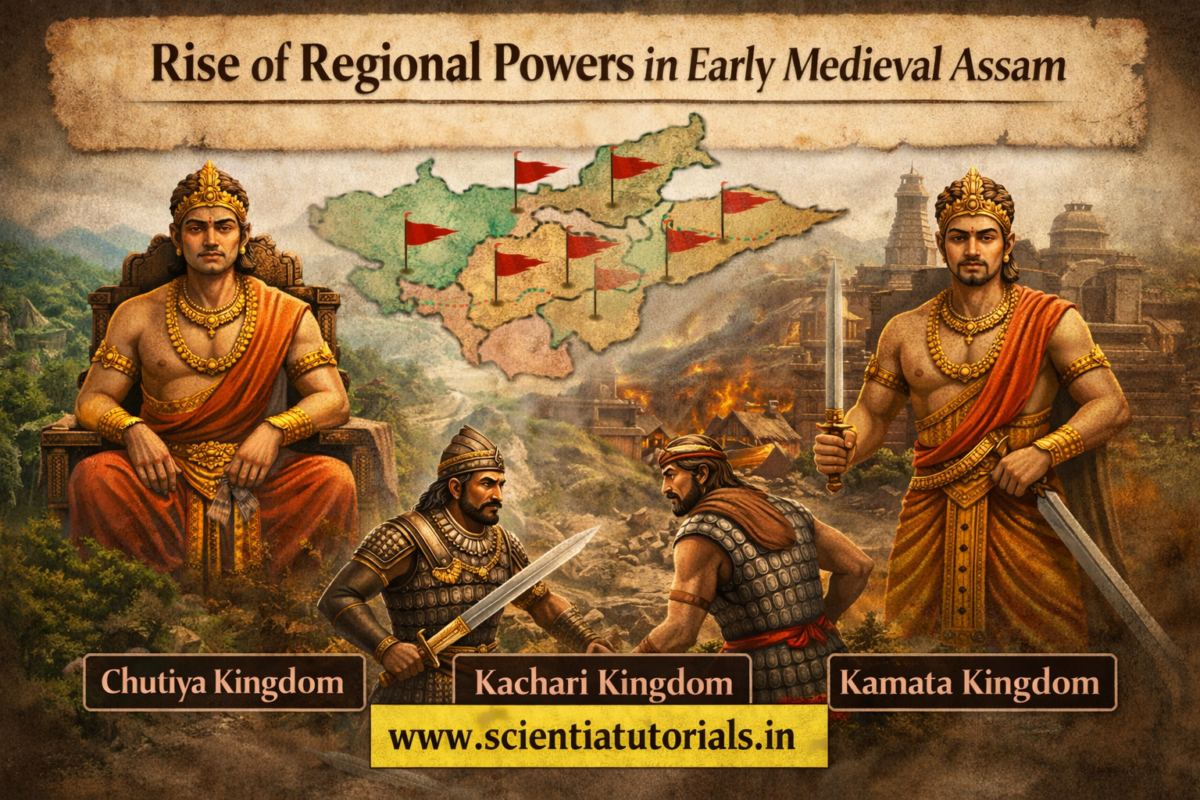
Rise of Regional Powers in Early Medieval Assam
Module III: Early Medieval Assam (c. 7th Century CE – 13th Century CE)
Lesson 2: Rise of Regional Powers – Chutiya, Kachari, and Kamata Kingdoms
This lesson is systematically organized into four clearly structured sections, as detailed below:
- Chronologically Structured Study Module
- Short-Answer Type Questions
- Long-Answer Type Questions
- Multiple-Choice Questions (MCQs) with Answers and Detailed Explanations
Chronologically Structured Study Module
Introduction
The Early Medieval period in Assam (c. 7th–13th century CE) represents a transformative phase marked by the decline of centralized authority and the rise of regional political powers. After the disintegration of the ancient kingdom of Kamarupa, Assam did not descend into chaos; instead, it witnessed the emergence of powerful regional kingdoms that exercised effective control over distinct geographical and cultural zones.
Among these, three kingdoms assumed particular historical importance:
- The Chutiya Kingdom
- The Kachari Kingdom
- The Kamata Kingdom
This lesson examines the chronological rise, political evolution, and historical significance of these kingdoms, helping students understand how regional state formation replaced ancient imperial structures in early medieval Assam. For competitive examinations, this topic is essential to grasp the transition from political fragmentation to regional consolidation.
1. Historical Background: From Fragmentation to Regional Powers
1.1 Political Vacuum After Kamarupa
By the 10th–12th centuries CE, the centralized authority of Kamarupa had collapsed. The decline of royal administration, expansion of feudal land grants, and rise of local chiefs created a political vacuum.
This vacuum enabled:
- Tribal chiefs to become territorial rulers
- Local clans to organize stable political units
- Region-specific kingdoms to emerge
Thus, the Early Medieval period became an era of regionalization of power rather than imperial unification.
1.2 Nature of Early Medieval State Formation
The new regional kingdoms shared certain features:
- Control over limited but clearly defined territories
- Dependence on military strength and local loyalty
- Integration of tribal and non-tribal societies
- Gradual adoption of Brahmanical political symbols
These features are clearly visible in the rise of the Chutiya, Kachari, and Kamata kingdoms.
2. The Rise of the Chutiya Kingdom
2.1 Geographical Location and Origin
The Chutiya Kingdom emerged in eastern Assam, particularly in the upper Brahmaputra Valley, covering areas around present-day Sadiya, Dhemaji, and Lakhimpur.
- Strategic location near river routes
- Access to forest and hill resources
- Control over trade corridors connecting Assam with Arunachal hills
The Chutiyas were originally a tribal community that gradually developed into a structured political power.
2.2 Chronological Development
- c. 12th century CE: Emergence of Chutiya political authority
- Consolidation under hereditary rulers
- Expansion along the Brahmaputra and its tributaries
By the late early medieval period, the Chutiya Kingdom had become one of the strongest regional powers in eastern Assam.
2.3 Political and Administrative Features
Key characteristics of the Chutiya state included:
- Hereditary monarchy
- Fortified capitals and military organization
- Control over agrarian surplus
- Integration of tribal customs with emerging Brahmanical practices
The kingdom demonstrated how tribal polities could transform into territorial states.
2.4 Historical Significance
The Chutiya Kingdom is significant because:
- It represents early state formation in eastern Assam
- It controlled strategic frontier zones
- It later interacted with and resisted emerging powers
For exams, it is important to note that the Chutiya Kingdom laid the groundwork for later political developments in Upper Assam.
3. The Rise of the Kachari Kingdom
3.1 Origins of the Kachari (Dimasa) Power
The Kacharis, also known as Dimasas, were a major ethnic group in Assam. Their political authority evolved gradually from tribal leadership to organized kingship.
The Kachari Kingdom initially emerged in:
- Central Assam
- Areas south of the Brahmaputra
- Foothills and plains suitable for agriculture
3.2 Chronological Expansion
- Early phase: Control over small territories
- 10th–12th centuries CE: Expansion into central Assam
- Establishment of permanent capitals
The Kachari rulers successfully consolidated power during the period when no single authority dominated Assam.
3.3 Administrative and Military Organization
The Kachari state was marked by:
- Strong clan-based administration
- Efficient mobilization of armed forces
- Control over fertile agricultural lands
Unlike ancient centralized states, Kachari rule relied heavily on personal loyalty and kinship networks.
3.4 Cultural and Political Importance
The Kachari Kingdom:
- Integrated tribal traditions with emerging state institutions
- Contributed to cultural diversity of Assam
- Maintained political continuity for centuries
Its endurance highlights the stability of regional powers in early medieval Assam.
4. The Rise of the Kamata Kingdom
4.1 Geographical Setting
The Kamata Kingdom emerged in western Assam and North Bengal, particularly in the lower Brahmaputra Valley.
Key geographical advantages:
- Fertile plains
- Trade connections with Bengal
- Strategic location for military expansion
4.2 Chronological Emergence
- 12th–13th centuries CE: Formation of Kamata Kingdom
- Consolidation of power in western Assam
- Control over former Kamarupa territories
Kamata became one of the most prominent successor states to Kamarupa.
4.3 Political Structure
The Kamata rulers:
- Claimed legitimacy as successors of ancient Kamarupa
- Adopted Brahmanical titles and rituals
- Maintained organized administration
This kingdom shows continuity of political ideas even after the decline of ancient empires.
4.4 Historical Significance
The Kamata Kingdom is important because:
- It re-established political authority in western Assam
- It served as a bridge between ancient and later medieval states
- It influenced subsequent regional polities
For competitive exams, Kamata is crucial in understanding state reorganization after Kamarupa.
5. Comparative Analysis of Regional Kingdoms
5.1 Common Features
All three kingdoms shared:
- Regional territorial control
- Military-based authority
- Gradual Sanskritization of political culture
- Integration of tribal elements
5.2 Differences
| Aspect | Chutiya | Kachari | Kamata |
|---|---|---|---|
| Region | Eastern Assam | Central Assam | Western Assam |
| Origin | Tribal | Tribal (Dimasa) | Post-Kamarupa polity |
| Political Model | Military-monarchy | Clan-based rule | Brahmanical kingship |
Such comparisons are frequently asked in descriptive and analytical questions.
6. Impact on Early Medieval Assam
6.1 Political Impact
- End of imperial centralization
- Emergence of regional balance of power
- Stable governance at local levels
6.2 Social and Cultural Impact
- Interaction between tribal and caste societies
- Expansion of agriculture
- Cultural diversity within political unity
These developments shaped Assam’s medieval history.
7. Transition Towards the Late Medieval Period
By the 13th century CE, Assam had:
- Multiple stable regional kingdoms
- Experience of state-building at local levels
- Political structures capable of adaptation
This environment later enabled the rise of stronger and more centralized medieval states.
8. Chronological Summary for Competitive Exams
- 7th–9th centuries CE: Decline of centralized authority
- 10th–11th centuries CE: Rise of Kachari power
- 12th century CE: Emergence of Chutiya and Kamata kingdoms
- 13th century CE: Consolidation of regional states
9. Examination-Oriented Key Takeaways
- Early Medieval Assam was marked by regionalization of power
- Chutiya, Kachari, and Kamata kingdoms filled the political vacuum
- These kingdoms ensured political stability after Kamarupa
- Tribal origins played a key role in state formation
- Chronology and regional comparison are crucial for exams
Conclusion
The rise of the Chutiya, Kachari, and Kamata kingdoms represents a defining chapter in the political history of early medieval Assam. These regional powers replaced ancient imperial authority with localized yet stable political systems, ensuring continuity of governance and culture. For competitive examinations, this lesson is essential to understand how Assam transitioned from political fragmentation to structured regional statehood, laying the foundation for later medieval developments.
Short Answer Type Questions
Module III: Early Medieval Assam
Lesson 2: Rise of Regional Powers – Chutiya, Kachari, and Kamata Kingdoms
1. Which period is known as the Early Medieval period in Assam?
Answer:
The Early Medieval period in Assam roughly spans from the 7th century CE to the 13th century CE.
2. What major political change followed the decline of Kamarupa?
Answer:
The decline of Kamarupa led to political fragmentation and the rise of regional powers.
3. Name three major regional kingdoms that emerged in early medieval Assam.
Answer:
The Chutiya Kingdom, Kachari Kingdom, and Kamata Kingdom.
4. In which part of Assam did the Chutiya Kingdom emerge?
Answer:
The Chutiya Kingdom emerged in eastern Assam, especially in the upper Brahmaputra Valley.
5. What was the tribal origin of the Chutiya Kingdom?
Answer:
The Chutiyas originated as a tribal community that later evolved into a territorial state.
6. Which century marks the rise of the Chutiya Kingdom?
Answer:
The Chutiya Kingdom rose around the 12th century CE.
7. Why was the location of the Chutiya Kingdom strategically important?
Answer:
Its location allowed control over river routes, frontier regions, and trade connections with hill areas.
8. Who were the Kacharis also known as?
Answer:
The Kacharis were also known as the Dimasas.
9. In which region did the Kachari Kingdom primarily develop?
Answer:
The Kachari Kingdom developed mainly in central Assam and areas south of the Brahmaputra.
10. What type of administration characterized the Kachari Kingdom?
Answer:
The Kachari Kingdom followed a clan-based and kinship-oriented administration.
11. How did the Kachari rulers maintain political control?
Answer:
They relied on personal loyalty, military strength, and control over fertile agricultural lands.
12. Which regional kingdom emerged in western Assam after Kamarupa?
Answer:
The Kamata Kingdom emerged in western Assam.
13. During which centuries did the Kamata Kingdom rise?
Answer:
The Kamata Kingdom rose during the 12th and 13th centuries CE.
14. Why is the Kamata Kingdom considered a successor state of Kamarupa?
Answer:
Because it controlled former Kamarupa territories and claimed political legitimacy from the ancient kingdom.
15. What political ideology did the Kamata rulers adopt?
Answer:
They adopted Brahmanical political symbols and royal titles.
16. What common feature linked the Chutiya, Kachari, and Kamata kingdoms?
Answer:
All were regional powers that emerged after political fragmentation and exercised localized authority.
17. How did tribal chiefs become kings in early medieval Assam?
Answer:
Tribal chiefs gained control over land and armed followers, gradually transforming into territorial rulers.
18. What role did military strength play in regional state formation?
Answer:
Military strength was essential for territorial expansion and maintenance of authority.
19. Did the rise of regional kingdoms bring political stability?
Answer:
Yes, they provided localized stability despite the absence of a centralized empire.
20. How did early medieval kingdoms integrate tribal and non-tribal societies?
Answer:
They combined tribal customs with Brahmanical political practices.
21. What economic base supported these regional kingdoms?
Answer:
Agriculture, control of land, and local resources formed the economic base.
22. Why is the rise of regional powers important in Assam’s history?
Answer:
It explains the transition from ancient imperial rule to medieval regional statehood.
23. Which kingdom played a key role in eastern Assam’s political history?
Answer:
The Chutiya Kingdom played a key role in eastern Assam.
24. Which kingdom showed strong cultural continuity despite tribal origins?
Answer:
The Kachari Kingdom showed strong cultural continuity.
25. How did the rise of regional powers prepare Assam for later medieval states?
Answer:
They developed administrative experience, political organization, and military structures.
Long Answer Type Questions
Module III: Early Medieval Assam
Lesson 2: Rise of Regional Powers – Chutiya, Kachari, and Kamata Kingdoms
1. Explain the historical background that led to the rise of regional powers in early medieval Assam.
Answer:
The rise of regional powers in early medieval Assam was a direct consequence of the decline of centralized authority after the fall of Kamarupa. From the 7th century CE onwards, weak rulers, feudal land grants, and administrative breakdown reduced royal control. This created a political vacuum that enabled local chiefs and tribal leaders to establish independent authority. By the 10th–12th centuries CE, Assam witnessed the emergence of regional kingdoms that ensured political stability at the local level.
2. Analyse the nature of state formation in early medieval Assam.
Answer:
State formation in early medieval Assam was regional and gradual. Unlike ancient centralized empires, new states were limited in size and based on personal loyalty, military strength, and control of land. Tribal chiefs transformed into kings, adopting Brahmanical symbols for legitimacy. This process marked a transition from imperial rule to localized political authority.
3. Discuss the geographical factors that facilitated the rise of regional kingdoms in Assam.
Answer:
Assam’s geography—rivers, fertile plains, hills, and forests—favoured regional rather than centralized control. Difficult terrain restricted long-distance administration but allowed local rulers to dominate specific zones. River valleys supported agriculture, while frontier regions enabled autonomous political development. These conditions encouraged the rise of multiple regional kingdoms.
4. Examine the origin and rise of the Chutiya Kingdom in early medieval Assam.
Answer:
The Chutiya Kingdom emerged in eastern Assam, particularly in the upper Brahmaputra Valley. Originating from a tribal community, the Chutiyas gradually developed a structured monarchy around the 12th century CE. Their strategic control over river routes and frontier zones helped them consolidate power and become a dominant regional force in Upper Assam.
5. Discuss the political and administrative features of the Chutiya Kingdom.
Answer:
The Chutiya Kingdom followed hereditary monarchy supported by military organization. Fortified capitals, control of agrarian resources, and integration of tribal customs with emerging Brahmanical practices defined its administration. The kingdom illustrates how tribal polities evolved into territorial states in early medieval Assam.
6. Assess the historical significance of the Chutiya Kingdom in Assam’s medieval history.
Answer:
The Chutiya Kingdom was significant for consolidating political authority in eastern Assam. It safeguarded frontier regions and laid the foundation for later political developments. Its rise demonstrates the adaptability of tribal societies in forming stable states during the early medieval period.
7. Trace the origin and expansion of the Kachari Kingdom.
Answer:
The Kachari Kingdom originated from the Dimasa tribal group. Initially occupying limited territories in central Assam, the Kacharis expanded their control between the 10th and 12th centuries CE. By establishing permanent capitals and organized administration, they emerged as one of the most enduring regional powers of Assam.
8. Analyse the clan-based political system of the Kachari Kingdom.
Answer:
The Kachari political system was based on kinship and clan loyalty. Authority rested on personal allegiance to the ruler rather than formal bureaucracy. This system allowed flexibility, ensured military cohesion, and suited the social structure of the Dimasa people, contributing to political stability.
9. Evaluate the cultural role of the Kachari Kingdom in early medieval Assam.
Answer:
The Kachari Kingdom played a crucial role in preserving indigenous traditions while gradually adopting Brahmanical elements. This cultural synthesis enriched Assam’s social fabric and highlights the coexistence of tribal and non-tribal influences in medieval state formation.
10. Discuss the emergence of the Kamata Kingdom as a successor state to Kamarupa.
Answer:
The Kamata Kingdom arose in western Assam and North Bengal during the 12th–13th centuries CE. It occupied former Kamarupa territories and claimed legitimacy as its successor. Through organized administration and Brahmanical political ideology, Kamata re-established centralized authority in the western region.
11. Examine the political ideology and administration of the Kamata Kingdom.
Answer:
Kamata rulers adopted Brahmanical titles, rituals, and administrative practices to legitimize their authority. Unlike tribal-origin kingdoms, Kamata emphasized continuity with ancient political traditions, reflecting a blend of regional power and classical kingship ideals.
12. Compare the origins of the Chutiya, Kachari, and Kamata kingdoms.
Answer:
The Chutiya and Kachari kingdoms originated from tribal societies, while the Kamata Kingdom emerged as a post-Kamarupa polity. Despite different origins, all three developed territorial states and adopted similar methods of governance, highlighting diverse paths to state formation.
13. Analyse the role of military power in the rise of regional kingdoms in Assam.
Answer:
Military strength was central to the rise of regional kingdoms. Control over armed followers enabled rulers to expand territory, suppress rivals, and enforce authority. In the absence of centralized armies, localized military organization became the backbone of political power.
14. How did agriculture support the growth of regional states in early medieval Assam?
Answer:
Agriculture formed the economic base of regional kingdoms. Control over fertile riverine plains ensured food surplus and revenue, which sustained armies and administration. Expansion of cultivation strengthened the political and economic stability of these states.
15. Discuss the integration of tribal and Brahmanical elements in regional kingdoms.
Answer:
Regional kingdoms integrated tribal customs with Brahmanical rituals to gain legitimacy. Kings adopted Sanskrit titles while maintaining indigenous traditions. This synthesis ensured acceptance among diverse populations and strengthened political authority.
16. Examine the nature of political authority in early medieval Assam.
Answer:
Political authority was localized and personalized. Kings relied on loyalty, military strength, and land control rather than centralized bureaucracy. This decentralized nature distinguished early medieval Assam from ancient imperial systems.
17. Did the rise of regional powers bring stability to Assam? Explain.
Answer:
Yes, regional powers provided localized stability. Although Assam lacked a unified empire, these kingdoms maintained order within their territories, encouraged agriculture, and ensured cultural continuity.
18. Assess the impact of regionalization on Assam’s political culture.
Answer:
Regionalization encouraged diversity in governance while preserving shared cultural values. It fostered political experimentation and prepared the ground for stronger medieval states.
19. Why is the study of regional kingdoms important for understanding Assam’s medieval history?
Answer:
Studying regional kingdoms explains the transition from ancient centralized rule to medieval decentralized governance. It highlights continuity, adaptation, and resilience in Assam’s political history.
20. Explain how the rise of regional kingdoms paved the way for later medieval state formation.
Answer:
Regional kingdoms developed administrative experience, military organization, and political legitimacy. These foundations later enabled the emergence of more centralized medieval states.
21. Compare early medieval regional kingdoms with ancient Kamarupa.
Answer:
Unlike Kamarupa’s centralized empire, regional kingdoms were smaller and localized. However, they ensured stability and continuity during a period of political transition.
22. Conclude with an overall assessment of the rise of regional powers in early medieval Assam.
Answer:
The rise of the Chutiya, Kachari, and Kamata kingdoms marked a crucial phase in Assam’s history. These regional powers replaced imperial authority with localized governance, ensured political stability, and preserved cultural continuity. Their emergence represents a vital bridge between ancient and medieval Assam.
Multiple Choice Questions
MCQs with Answers and Explanations
Module III: Early Medieval Assam
Lesson 2: Rise of Regional Powers – Chutiya, Kachari, and Kamata Kingdoms
The questions are aligned with the standards of UPSC, APSC, State PSCs, TET, and university examinations.
1. The rise of regional powers in early medieval Assam was primarily a result of:
A. Foreign invasions
B. Colonial interference
C. Decline of centralized authority after Kamarupa
D. Industrial expansion
Correct Answer: C
Explanation:
After the decline of Kamarupa, centralized political authority weakened. This political vacuum enabled local and tribal chiefs to establish independent regional kingdoms.
2. Which period is associated with the rise of regional kingdoms in Assam?
A. 3rd century BCE – 4th century CE
B. 4th–6th century CE
C. 7th–13th century CE
D. 15th–18th century CE
Correct Answer: C
Explanation:
The 7th–13th centuries CE mark the Early Medieval period, during which regional powers replaced ancient imperial structures in Assam.
3. Which of the following kingdoms emerged in eastern Assam?
A. Kamata
B. Kachari
C. Chutiya
D. Koch
Correct Answer: C
Explanation:
The Chutiya Kingdom emerged in eastern Assam, particularly in the upper Brahmaputra Valley.
4. The Chutiya Kingdom mainly developed in which region?
A. Barak Valley
B. Lower Brahmaputra Valley
C. Central Assam plains
D. Upper Brahmaputra Valley
Correct Answer: D
Explanation:
The Chutiya Kingdom controlled the upper Brahmaputra Valley, including frontier zones that were strategically important.
5. The Chutiya Kingdom rose to prominence around which century?
A. 8th century CE
B. 10th century CE
C. 12th century CE
D. 14th century CE
Correct Answer: C
Explanation:
The Chutiyas emerged as a strong regional power around the 12th century CE.
6. The Chutiya Kingdom originated from:
A. A Brahmanical ruling clan
B. A foreign dynasty
C. A tribal community
D. A merchant guild
Correct Answer: C
Explanation:
The Chutiyas were originally a tribal group that gradually evolved into a territorial kingdom.
7. The Kachari rulers are also known as:
A. Koch
B. Tai
C. Dimasa
D. Moran
Correct Answer: C
Explanation:
The Kachari Kingdom was ruled by the Dimasa people, a major ethnic group of Assam.
8. The Kachari Kingdom primarily developed in:
A. Eastern Assam
B. Western Assam
C. Central Assam and areas south of the Brahmaputra
D. Barak Valley only
Correct Answer: C
Explanation:
The Kacharis expanded their power mainly in central Assam and the southern plains.
9. Which feature best characterizes the Kachari political system?
A. Bureaucratic administration
B. Republican councils
C. Clan-based and kinship-oriented rule
D. Colonial governance
Correct Answer: C
Explanation:
Kachari administration was based on clan loyalty and personal allegiance rather than formal bureaucracy.
10. Which regional kingdom emerged in western Assam after the decline of Kamarupa?
A. Chutiya
B. Kachari
C. Ahom
D. Kamata
Correct Answer: D
Explanation:
The Kamata Kingdom emerged in western Assam and parts of North Bengal.
11. The Kamata Kingdom rose mainly during:
A. 9th–10th centuries CE
B. 10th–11th centuries CE
C. 12th–13th centuries CE
D. 14th–15th centuries CE
Correct Answer: C
Explanation:
The Kamata Kingdom consolidated power in the 12th–13th centuries CE.
12. Why is the Kamata Kingdom regarded as a successor state of Kamarupa?
A. It adopted tribal customs
B. It was founded by the same dynasty
C. It occupied former Kamarupa territories and claimed legitimacy
D. It defeated all other regional kingdoms
Correct Answer: C
Explanation:
Kamata rulers claimed continuity from ancient Kamarupa and ruled over its western regions.
13. Which political ideology did Kamata rulers mainly adopt?
A. Tribal customary law
B. Buddhist republicanism
C. Brahmanical kingship traditions
D. Democratic councils
Correct Answer: C
Explanation:
Kamata rulers adopted Brahmanical rituals and titles to legitimize their authority.
14. A common feature of Chutiya, Kachari, and Kamata kingdoms was:
A. Maritime trade dominance
B. Colonial administration
C. Regional territorial control
D. Complete cultural isolation
Correct Answer: C
Explanation:
All three kingdoms exercised authority over limited but well-defined regions.
15. Which factor was most crucial in the rise of regional kingdoms?
A. Coinage reforms
B. Urbanization
C. Military strength and control of land
D. Foreign alliances
Correct Answer: C
Explanation:
Military power and land control enabled local chiefs to assert political authority.
16. The economic base of early medieval regional kingdoms was mainly:
A. Overseas trade
B. Mining
C. Agriculture and land revenue
D. Industrial production
Correct Answer: C
Explanation:
Agricultural surplus supported administration and military organization.
17. The rise of regional powers indicates which political trend?
A. Centralization
B. Imperialism
C. Regionalization of power
D. Colonial expansion
Correct Answer: C
Explanation:
Early medieval Assam witnessed regionalization rather than centralized empire-building.
18. How did tribal chiefs transform into kings?
A. Through foreign support
B. By royal appointment
C. By controlling territory and armed followers
D. By trade wealth
Correct Answer: C
Explanation:
Control over land and military strength enabled tribal leaders to become rulers.
19. Which of the following was NOT a characteristic of early medieval regional kingdoms?
A. Localized authority
B. Military-based rule
C. Highly centralized bureaucracy
D. Integration of tribal elements
Correct Answer: C
Explanation:
These kingdoms lacked centralized bureaucratic systems typical of ancient empires.
20. The rise of regional kingdoms brought which outcome to Assam?
A. Total political chaos
B. Cultural collapse
C. Localized political stability
D. Foreign domination
Correct Answer: C
Explanation:
Despite fragmentation, regional kingdoms maintained stability within their territories.
21. Which kingdom played a major role in eastern Assam’s political consolidation?
A. Kamata
B. Kachari
C. Chutiya
D. Koch
Correct Answer: C
Explanation:
The Chutiya Kingdom was the dominant regional power in eastern Assam.
22. The Kachari Kingdom is important historically because it:
A. Introduced coinage
B. Controlled coastal trade
C. Maintained long political continuity
D. Established the first empire
Correct Answer: C
Explanation:
The Kachari Kingdom showed remarkable continuity and adaptability.
23. Which concept best explains early medieval state formation in Assam?
A. Sudden conquest
B. Colonial rule
C. Gradual regional consolidation
D. Industrialization
Correct Answer: C
Explanation:
State formation was gradual, evolving from tribal and local authority.
24. The rise of regional kingdoms helped prepare Assam for:
A. British rule
B. Mughal conquest
C. Later medieval centralized states
D. Cultural isolation
Correct Answer: C
Explanation:
These kingdoms laid administrative and military foundations for later state-building.
25. For competitive exams, the study of regional kingdoms is important mainly because it explains:
A. Mythological traditions
B. Trade networks only
C. Transition from ancient to medieval political structures
D. Colonial economy
Correct Answer: C
Explanation:
This topic highlights political transition, continuity, and adaptation—key analytical themes in exams.