
Lesson 2: Political History of Pragjyotisha and Kamarupa
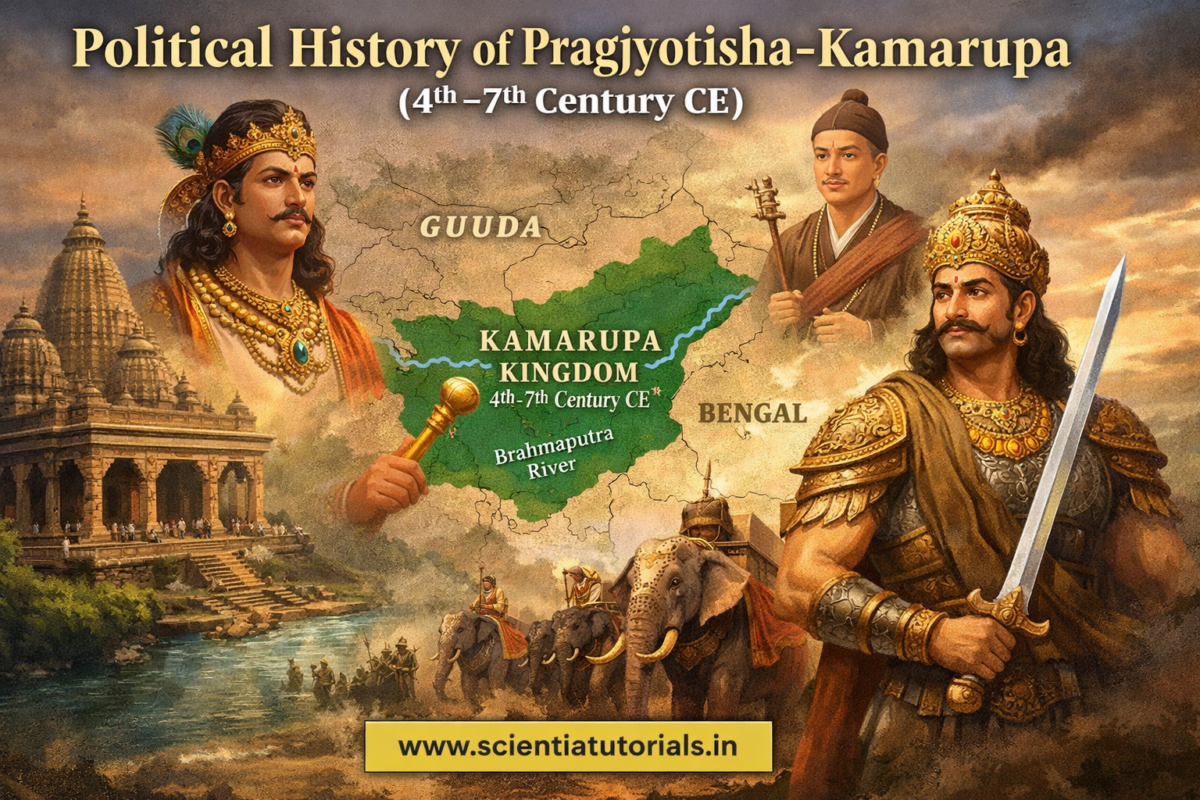
Political History of Pragjyotisha and Kamarupa
Module II: Ancient Assam – Pragjyotisha–Kamarupa Period (c. 4th Century CE – 7th Century CE)
Lesson 2: Political History of Pragjyotisha and Kamarupa
Chronologically Structured Study Module for Competitive Exams
This lesson is systematically organized into four clearly structured sections, as detailed below:
- Chronologically Structured Study Module
- Short-Answer Type Questions
- Long-Answer Type Questions
- Multiple-Choice Questions (MCQs) with Answers and Detailed Explanations
Lesson Objectives
After studying this lesson, learners should be able to:
- Understand the chronological political evolution of Pragjyotisha into Kamarupa.
- Identify the major dynasties, rulers, and administrative patterns of early Assam.
- Analyse Assam’s political relations with North India, especially the Gupta age.
- Develop exam-ready answers using timelines, cause–effect analysis, and key facts.
1. Historical Background and Chronological Framework
The political history of ancient Assam during the 4th–7th centuries CE marks a decisive phase when the region transitioned from semi-legendary polities to well-documented historical kingdoms. Earlier references to Pragjyotisha appear in epic and Puranic literature, but from the 4th century CE onwards, inscriptions and foreign accounts enable historians to reconstruct a reliable political narrative.
The kingdom of Pragjyotisha–Kamarupa emerged as one of the frontier states of early historic India, strategically located between the Brahmaputra valley and the eastern Himalayan ranges. Its political development must be studied chronologically to understand continuity, change, and consolidation of power.
2. Pragjyotisha: From Legendary Polity to Early State Formation
Pragjyotisha is mentioned in early Indian texts as a powerful eastern kingdom. However, its historical political structure becomes clearer only in the early centuries CE.
Key Features of Early Pragjyotisha
- Ruled by indigenous dynasties with Aryanised political traditions.
- Capital traditionally identified near present-day Guwahati.
- Served as a buffer kingdom between mainland India and eastern tribal regions.
Though early rulers remain obscure, Pragjyotisha laid the foundation for statehood, which later crystallised into the kingdom of Kamarupa.
3. Emergence of Kamarupa as a Political Entity (c. 4th Century CE)
By the 4th century CE, the political identity of the region shifted from Pragjyotisha to Kamarupa, marking a new historical phase. This change was not abrupt but represented territorial expansion, administrative consolidation, and royal legitimacy.
Factors Behind the Rise of Kamarupa
- Decline of smaller tribal chiefdoms.
- Influence of Gupta imperial polity in North India.
- Need for centralized authority in the Brahmaputra valley.
The earliest historical ruler of Kamarupa was Pushyavarman, who established the Varman dynasty around the mid-4th century CE.
4. Pushyavarman and the Foundation of the Varman Dynasty
Political Significance of Pushyavarman
- Considered the founder of the Varman dynasty.
- Adopted Gupta-style royal titles, reflecting political alignment.
- Established Kamarupa as a hereditary monarchy.
Pushyavarman’s reign marks the beginning of recorded political history of Assam. He strengthened internal administration and initiated diplomatic relations with contemporary powers.
5. Kamarupa and the Gupta Connection
The political history of early Kamarupa cannot be understood without reference to the Gupta Empire. The famous Allahabad Pillar inscription mentions Kamarupa and Davaka as frontier kingdoms that acknowledged Gupta supremacy.
Political Implications
- Kamarupa retained internal autonomy.
- Accepted nominal suzerainty of the Guptas.
- Benefited from political stability and cultural exchange.
Rulers of Kamarupa were contemporaries of Samudragupta, whose expansionist policies shaped North Indian politics.
6. Successors of Pushyavarman: Consolidation Phase (4th–5th Century CE)
Following Pushyavarman, a series of capable rulers strengthened the kingdom:
Important Early Varman Rulers
- Samudravarman – Expanded territory and maintained Gupta relations.
- Balavarman – Continued consolidation and defended frontiers.
- Kalyanavarman – Strengthened royal authority.
This phase represents political stabilization, during which Kamarupa emerged as a regional power rather than a frontier dependency.
7. Mahendravarman and the Assertion of Sovereignty
A major turning point came during the reign of Mahendravarman (c. late 5th century CE).
Political Achievements
- Asserted full sovereignty after the decline of Gupta power.
- Expanded influence across the Brahmaputra valley.
- Strengthened military and administrative institutions.
The decline of the Guptas allowed Kamarupa to emerge as an independent kingdom, no longer under symbolic imperial control.
8. Narayanavarman and Bhutivarman: Expansion and Stability
The 6th century CE witnessed territorial expansion under capable rulers.
Key Developments
- Narayanavarman expanded control towards eastern Assam.
- Bhutivarman consolidated territories and promoted Brahmanical institutions.
Land grants issued during this period reveal:
- Development of feudal administrative practices.
- Growing role of Brahmins in legitimising royal authority.
9. Bhaskaravarman: Zenith of Kamarupa’s Political Power (7th Century CE)
The reign of Bhaskaravarman (c. 600–650 CE) represents the golden age of Kamarupa’s political history.
Political Achievements
- Extended Kamarupa’s influence across North-East India.
- Formed a strategic alliance with Harshavardhana.
- Played a decisive role in the defeat of Gauda ruler Shashanka.
Diplomatic Excellence
Bhaskaravarman sent embassies and gifts, establishing Kamarupa as a recognized power in North Indian politics.
10. Kamarupa in the Account of Xuanzang
The Chinese pilgrim Xuanzang visited Kamarupa during Bhaskaravarman’s reign.
Political Observations by Xuanzang
- Described Kamarupa as a prosperous and well-administered kingdom.
- Noted the king’s intelligence, diplomacy, and generosity.
- Highlighted peaceful governance and social stability.
Xuanzang’s account confirms the political maturity of Kamarupa by the 7th century CE.
11. Administrative Structure of Pragjyotisha–Kamarupa
Nature of Kingship
- Hereditary monarchy with divine legitimacy.
- Kings used grand titles such as Maharajadhiraja.
Administrative Features
- Land grants to Brahmins and officials.
- Decentralised administration with local chiefs.
- Military supported by elephant forces and infantry.
This political system ensured effective control over a geographically diverse region.
12. Decline of the Varman Dynasty (Post-7th Century CE)
After Bhaskaravarman’s death:
- Lack of strong successors.
- Rise of regional powers.
- Gradual weakening of central authority.
The decline paved the way for later dynasties like the Salastambhas, marking a new political phase in Assam’s history.
13. Chronological Timeline for Quick Revision
- c. 4th century CE – Pushyavarman establishes Varman dynasty
- 4th–5th century CE – Gupta-Kamarupa relations
- Late 5th century CE – Mahendravarman asserts independence
- 6th century CE – Territorial expansion under Narayanavarman
- 7th century CE – Bhaskaravarman’s reign and alliance with Harsha
14. Examination-Oriented Key Takeaways
- Pragjyotisha–Kamarupa represents early state formation in North-East India.
- The Varman dynasty ensured political continuity for nearly 300 years.
- Gupta influence shaped early administration but did not eliminate autonomy.
- Bhaskaravarman elevated Kamarupa to pan-Indian political relevance.
15. Model Answer Pointers (For UPSC/APSC/State Exams)
- Begin with chronological introduction.
- Mention key rulers and dynasties with dates.
- Highlight external relations (Guptas, Harsha).
- Conclude with historical significance of Kamarupa.
Conclusion
The political history of Pragjyotisha and Kamarupa from the 4th to 7th centuries CE illustrates the transformation of Assam from a frontier region into a powerful and independent kingdom. Through capable rulers, strategic diplomacy, and administrative innovation, Kamarupa secured a lasting place in early Indian history—making this period indispensable for competitive exam preparation.
Short Answer Type Questions
Lesson 2: Political History of Pragjyotisha and Kamarupa
(Module II: Ancient Assam – Pragjyotisha–Kamarupa Period)
Below is a well-structured set of 25 Short Answer Type Questions with precise, exam-oriented answers, strictly developed from the lesson and aligned with the course objectives for APSC/UPSC/State-level competitive exams.
1. What was Pragjyotisha in ancient Assam?
Answer: Pragjyotisha was an early political and cultural region of ancient Assam, mentioned in epics and Puranas, which later evolved into the historical kingdom of Kamarupa.
2. During which period did the Pragjyotisha–Kamarupa kingdom flourish?
Answer: The Pragjyotisha–Kamarupa kingdom flourished mainly between the 4th and 7th centuries CE.
3. Who founded the Varman dynasty of Kamarupa?
Answer: The Varman dynasty was founded by Pushyavarman in the mid-4th century CE.
4. Why is Pushyavarman considered historically significant?
Answer: Pushyavarman is significant for establishing a hereditary monarchy in Kamarupa and laying the foundation of recorded political history in ancient Assam.
5. What was the capital of Pragjyotisha–Kamarupa?
Answer: Pragjyotishpura, identified with the region around present-day Guwahati, served as the capital.
6. Which Gupta ruler mentioned Kamarupa in his inscriptions?
Answer: Samudragupta mentioned Kamarupa in the Allahabad Pillar Inscription.
7. What was the political status of Kamarupa under the Guptas?
Answer: Kamarupa accepted nominal Gupta suzerainty but retained internal autonomy as a frontier kingdom.
8. Name two immediate successors of Pushyavarman.
Answer: Samudravarman and Balavarman were immediate successors of Pushyavarman.
9. Which ruler asserted Kamarupa’s independence after Gupta decline?
Answer: Mahendravarman asserted Kamarupa’s sovereignty in the late 5th century CE.
10. What role did Mahendravarman play in Kamarupa’s political history?
Answer: He strengthened royal authority and transformed Kamarupa into an independent regional power.
11. Who ruled Kamarupa during the early 6th century CE?
Answer: Narayanavarman and Bhutivarman ruled Kamarupa during the early 6th century CE.
12. What administrative practice became prominent during Bhutivarman’s reign?
Answer: The system of land grants to Brahmins became prominent, indicating early feudal tendencies.
13. Who was the most powerful ruler of the Varman dynasty?
Answer: Bhaskaravarman was the most powerful ruler of the Varman dynasty.
14. During which century did Bhaskaravarman rule?
Answer: Bhaskaravarman ruled during the 7th century CE.
15. Which North Indian ruler formed an alliance with Bhaskaravarman?
Answer: Bhaskaravarman formed an alliance with Harshavardhana.
16. Against which ruler did Bhaskaravarman and Harsha jointly campaign?
Answer: They campaigned against Shashanka, the ruler of Gauda.
17. Which Chinese pilgrim visited Kamarupa in the 7th century CE?
Answer: The Chinese pilgrim Xuanzang visited Kamarupa.
18. What did Xuanzang observe about Kamarupa’s administration?
Answer: Xuanzang described Kamarupa as a well-governed, peaceful, and prosperous kingdom.
19. What title was commonly used by Kamarupa kings?
Answer: Kamarupa kings used grand titles such as Maharajadhiraja.
20. What type of monarchy existed in Pragjyotisha–Kamarupa?
Answer: A hereditary monarchy with divine legitimacy existed in Pragjyotisha–Kamarupa.
21. Name one military feature of Kamarupa.
Answer: The use of war elephants was a significant military feature of Kamarupa.
22. How long did the Varman dynasty rule Kamarupa?
Answer: The Varman dynasty ruled for nearly three centuries (c. 4th–7th century CE).
23. What caused the decline of the Varman dynasty?
Answer: Weak successors and rising regional powers led to the decline of the Varman dynasty.
24. Which dynasty succeeded the Varmans in Kamarupa?
Answer: The Salastambha dynasty succeeded the Varmans.
25. Why is the Pragjyotisha–Kamarupa period important in Assam history?
Answer: It marks the transition from legendary rule to a stable, historically documented state system in ancient Assam.
Long Answer Type Questions
Lesson 2: Political History of Pragjyotisha and Kamarupa
(Module II: Ancient Assam – Pragjyotisha–Kamarupa Period)
Below is a carefully structured set of 20 Long Answer Type Questions with comprehensive, exam-ready answers, developed strictly from the lesson and aligned with the chronological, analytical, and interpretative requirements of UPSC, APSC, and other state-level competitive examinations.
1. Trace the political evolution of Pragjyotisha into the kingdom of Kamarupa.
Answer:
Pragjyotisha, initially known through epic and Puranic traditions, represented an early political and cultural region in ancient Assam. Its transformation into Kamarupa during the 4th century CE marked the shift from a semi-legendary polity to a historically documented state. This evolution was driven by territorial consolidation in the Brahmaputra valley, the emergence of hereditary kingship, and the influence of North Indian political models, especially those of the Guptas. The establishment of the Varman dynasty institutionalised monarchy and administration, giving Kamarupa a stable political identity.
2. Discuss the significance of the Varman dynasty in the political history of ancient Assam.
Answer:
The Varman dynasty holds immense significance as it provided Assam with its first long-lasting and well-documented ruling line. Beginning in the mid-4th century CE, the dynasty ruled for nearly three centuries, ensuring political continuity and stability. The Varmans consolidated territorial control, adopted Gupta-style governance, promoted Brahmanical ideology for legitimacy, and established Kamarupa as a regional power. Their rule laid the foundations of state formation, administration, and diplomacy in ancient Assam.
3. Examine the role of Pushyavarman in laying the foundation of Kamarupa.
Answer:
Pushyavarman is regarded as the founder of the Varman dynasty and the first historical ruler of Kamarupa. He established a hereditary monarchy, adopted imperial titles influenced by Gupta traditions, and initiated diplomatic relations with North Indian powers. His reign marks the beginning of authentic political history in Assam, transforming the region into an organised kingdom with central authority.
4. Analyse the political relationship between Kamarupa and the Gupta Empire.
Answer:
Kamarupa maintained a frontier relationship with the Gupta Empire, particularly during the reign of Samudragupta. While acknowledging nominal Gupta suzerainty, Kamarupa retained full internal autonomy. This relationship ensured political stability, facilitated cultural exchange, and helped the Varman rulers adopt advanced administrative practices without losing sovereignty. The alliance was pragmatic rather than submissive.
5. Describe the process of political consolidation in Kamarupa during the 4th–5th centuries CE.
Answer:
Political consolidation in Kamarupa occurred through the strengthening of royal authority, suppression of local chieftains, and expansion of territory under early Varman rulers such as Samudravarman and Balavarman. Administrative structures were standardised, and diplomatic ties with powerful neighbours ensured security. This phase transformed Kamarupa from a frontier state into a stable regional kingdom.
6. Explain the importance of Mahendravarman’s reign in the political history of Kamarupa.
Answer:
Mahendravarman ruled during a transitional phase following the decline of Gupta power. He asserted Kamarupa’s complete political independence, strengthened military capabilities, and expanded territorial control. His reign symbolised the emergence of Kamarupa as a sovereign kingdom rather than a subordinate frontier polity.
7. Discuss the expansionist policies of Kamarupa during the 6th century CE.
Answer:
During the 6th century CE, rulers such as Narayanavarman and Bhutivarman pursued expansionist policies to consolidate control over eastern Assam. This expansion was supported by military strength and administrative integration of newly acquired territories. The period also saw increased land grants, indicating political stability and the rise of early feudal structures.
8. Evaluate the administrative system of Pragjyotisha–Kamarupa.
Answer:
The administrative system was based on hereditary monarchy with divine legitimacy. The king was the supreme authority, assisted by officials and local chiefs. Land grants to Brahmins played a key role in governance and revenue management. Decentralisation allowed efficient control over a geographically diverse region, while loyalty to the monarch ensured political unity.
9. Assess the role of land grants in strengthening royal authority in Kamarupa.
Answer:
Land grants served both administrative and ideological purposes. They rewarded loyalty, promoted Brahmanical culture, and legitimised royal authority. By granting tax-free lands, kings secured the support of religious elites, which helped stabilise governance and integrate social and political systems.
10. Analyse the reign of Bhaskaravarman as the zenith of Kamarupa’s political power.
Answer:
Bhaskaravarman ruled in the 7th century CE and elevated Kamarupa to unprecedented political prominence. His strategic diplomacy, military strength, and administrative efficiency transformed the kingdom into a major regional power. His reign represents the peak of political maturity and influence in ancient Assam.
11. Examine Bhaskaravarman’s alliance with Harshavardhana and its significance.
Answer:
Bhaskaravarman formed a strategic alliance with Harshavardhana to counter the expansionist ruler Shashanka of Gauda. This alliance integrated Kamarupa into North Indian power politics and enhanced its prestige. It demonstrated Bhaskaravarman’s diplomatic foresight and political acumen.
12. Discuss the political significance of Xuanzang’s visit to Kamarupa.
Answer:
The visit of Xuanzang provides valuable external confirmation of Kamarupa’s political stability. Xuanzang described the kingdom as well-governed and prosperous, praising the king’s wisdom and administration. His account enhances the historical credibility of indigenous sources.
13. How did geography influence the political history of Kamarupa?
Answer:
The Brahmaputra valley’s fertile plains supported agriculture and population growth, while surrounding hills provided natural defence. Geography helped Kamarupa maintain autonomy and control trade routes, contributing to political stability and territorial expansion.
14. Compare the political systems of Pragjyotisha and early Kamarupa.
Answer:
Pragjyotisha represented an early, loosely organised polity with semi-legendary rulers. In contrast, Kamarupa developed a structured monarchy, administrative institutions, and diplomatic relations. The transition reflects political maturation and state formation.
15. Examine the military organisation of Kamarupa.
Answer:
The military relied on infantry, cavalry, and war elephants, well-suited to the region’s terrain. A strong military enabled territorial expansion, internal stability, and resistance against external threats.
16. Analyse the causes behind the decline of the Varman dynasty.
Answer:
After Bhaskaravarman’s death, weak successors, administrative fragmentation, and the rise of local powers weakened central authority. These factors gradually led to the decline of the Varman dynasty.
17. Discuss the historical importance of the Varman dynasty in North-East India.
Answer:
The Varman dynasty integrated Assam into the broader framework of Indian political history. It established long-term governance, cultural synthesis, and diplomatic engagement, making Assam a recognised political entity.
18. Explain how Kamarupa maintained autonomy despite external pressures.
Answer:
Kamarupa used strategic diplomacy, geographical advantages, and military strength to retain autonomy while engaging with powerful neighbours like the Guptas and Harsha.
19. Assess the contribution of Kamarupa to early Indian political traditions.
Answer:
Kamarupa contributed to the diffusion of monarchical institutions, land grant systems, and regional diplomacy, enriching early Indian political culture.
20. Conclude with an assessment of the political legacy of Pragjyotisha–Kamarupa.
Answer:
The Pragjyotisha–Kamarupa polity represents a crucial phase in Assam’s transition to statehood. Its rulers established durable political institutions, engaged in pan-Indian diplomacy, and ensured regional stability. The legacy of this period shaped subsequent political developments in Assam and remains central to its historical identity.
MCQs with Answers and Explanations
Lesson 2: Political History of Pragjyotisha and Kamarupa
(Module II: Ancient Assam – Pragjyotisha–Kamarupa Period | For UPSC/APSC & State Exams)
Below is a well-structured set of 25 Multiple Choice Questions (MCQs) with correct answers and detailed, concept-clearing explanations, strictly based on the lesson and aligned with the chronological and analytical focus of the course.
1. Pragjyotisha is historically significant because it:
A. Was a Gupta provincial capital
B. Represented the earliest political identity of ancient Assam
C. Was founded by the Mauryas
D. Was a Buddhist republic
Correct Answer: B
Explanation: Pragjyotisha represents the earliest known political and cultural identity of ancient Assam, later evolving into the historical kingdom of Kamarupa.
2. The transition from Pragjyotisha to Kamarupa became historically clear from:
A. 2nd century BCE
B. 1st century CE
C. 4th century CE
D. 8th century CE
Correct Answer: C
Explanation: From the 4th century CE onwards, inscriptions and foreign accounts provide reliable historical evidence for the Kamarupa kingdom.
3. Who founded the Varman dynasty of Kamarupa?
A. Samudravarman
B. Bhaskaravarman
C. Pushyavarman
D. Mahendravarman
Correct Answer: C
Explanation: Pushyavarman founded the Varman dynasty in the mid-4th century CE, marking the beginning of recorded political history in Assam.
4. The capital of Pragjyotisha–Kamarupa was:
A. Tezpur
B. Sadiya
C. Pragjyotishpura
D. Hajo
Correct Answer: C
Explanation: Pragjyotishpura, identified with the Guwahati region, served as the political capital of the kingdom.
5. Which Gupta ruler mentioned Kamarupa in his inscriptions?
A. Chandragupta I
B. Chandragupta II
C. Samudragupta
D. Kumaragupta
Correct Answer: C
Explanation: Samudragupta mentioned Kamarupa as a frontier kingdom in the Allahabad Pillar Inscription.
6. What was the political status of Kamarupa under Gupta rule?
A. Directly annexed province
B. Military colony
C. Independent rival kingdom
D. Frontier state acknowledging suzerainty
Correct Answer: D
Explanation: Kamarupa acknowledged Gupta suzerainty but retained full internal autonomy, typical of frontier kingdoms.
7. Which dynasty ruled Kamarupa for nearly three centuries?
A. Salastambha
B. Pala
C. Varman
D. Mlechchha
Correct Answer: C
Explanation: The Varman dynasty ruled from the 4th to the 7th century CE, providing long-term political continuity.
8. Which ruler asserted Kamarupa’s independence after the decline of the Guptas?
A. Balavarman
B. Mahendravarman
C. Bhutivarman
D. Narayanavarman
Correct Answer: B
Explanation: Mahendravarman asserted sovereignty when Gupta power declined in the late 5th century CE.
9. The 6th century CE in Kamarupa is marked by:
A. Political fragmentation
B. Expansion and consolidation
C. Foreign invasions
D. Buddhist dominance
Correct Answer: B
Explanation: Rulers like Narayanavarman and Bhutivarman expanded territory and consolidated administration during this period.
10. Land grants in Kamarupa mainly indicate:
A. Decline of agriculture
B. Military feudalism
C. Growth of Brahmanical institutions
D. Complete decentralisation
Correct Answer: C
Explanation: Land grants to Brahmins strengthened royal legitimacy and administrative control, reflecting Brahmanical influence.
11. Who was the most powerful ruler of the Varman dynasty?
A. Pushyavarman
B. Samudravarman
C. Bhaskaravarman
D. Kalyanavarman
Correct Answer: C
Explanation: Bhaskaravarman elevated Kamarupa to its political zenith in the 7th century CE.
12. Bhaskaravarman ruled during the reign of:
A. Ashoka
B. Harshavardhana
C. Pulakesin II
D. Rajaraja Chola
Correct Answer: B
Explanation: Bhaskaravarman was a contemporary and ally of Harshavardhana.
13. The alliance between Bhaskaravarman and Harsha was aimed against:
A. Guptas
B. Vakatakas
C. Shashanka of Gauda
D. Tibet
Correct Answer: C
Explanation: Their alliance was directed against Shashanka, the aggressive ruler of Gauda.
14. Which Chinese pilgrim visited Kamarupa in the 7th century CE?
A. Fa-Hien
B. I-Tsing
C. Xuanzang
D. Sung-Yun
Correct Answer: C
Explanation: Xuanzang visited Kamarupa and provided valuable political observations.
15. Xuanzang described Kamarupa as:
A. Militaristic and aggressive
B. Poor and underdeveloped
C. Well-governed and prosperous
D. Constantly at war
Correct Answer: C
Explanation: Xuanzang praised the kingdom’s administration, stability, and prosperity.
16. The nature of kingship in Kamarupa was:
A. Elective monarchy
B. Tribal confederacy
C. Hereditary monarchy with divine legitimacy
D. Republic
Correct Answer: C
Explanation: Kingship was hereditary and supported by Brahmanical ideology.
17. Which military feature was prominent in Kamarupa?
A. Naval fleet
B. War elephants
C. Gunpowder units
D. Horse archers
Correct Answer: B
Explanation: War elephants played a crucial role due to terrain suitability.
18. Geography helped Kamarupa by:
A. Isolating it completely
B. Preventing agriculture
C. Providing fertile plains and natural defence
D. Encouraging nomadism
Correct Answer: C
Explanation: The Brahmaputra valley supported agriculture, while hills provided defence.
19. The decline of the Varman dynasty was mainly due to:
A. Foreign invasions
B. Religious conflict
C. Weak successors and regionalism
D. Economic collapse
Correct Answer: C
Explanation: After Bhaskaravarman, weak rulers and rising local powers weakened central authority.
20. Which dynasty succeeded the Varmans in Kamarupa?
A. Pala
B. Salastambha
C. Ahom
D. Koch
Correct Answer: B
Explanation: The Salastambha dynasty followed the Varmans, marking a new political phase.
21. Kamarupa is described as a “frontier kingdom” because:
A. It had no fixed boundaries
B. It lay between India and eastern tribal regions
C. It was newly conquered
D. It lacked administration
Correct Answer: B
Explanation: Its geographical position made it a bridge between mainland India and the eastern frontier.
22. The adoption of Gupta titles by Kamarupa rulers indicates:
A. Loss of independence
B. Cultural and political influence
C. Military defeat
D. Religious conversion
Correct Answer: B
Explanation: Gupta influence shaped royal ideology without eliminating political autonomy.
23. Which factor most contributed to political stability in Kamarupa?
A. Constant warfare
B. Strong central monarchy
C. Tribal democracy
D. Foreign administration
Correct Answer: B
Explanation: A strong hereditary monarchy ensured continuity and control.
24. The political importance of Kamarupa lies in:
A. Its maritime trade
B. Its role in early Buddhist councils
C. Early state formation in North-East India
D. Its colonial administration
Correct Answer: C
Explanation: Kamarupa represents early and sustained state formation in North-East India.
25. Which statement best summarises the political history of Pragjyotisha–Kamarupa?
A. A short-lived tribal kingdom
B. A continuously conquered region
C. A transition from legend to organised statehood
D. A theocratic Buddhist empire
Correct Answer: C
Explanation: The region evolved from legendary references to a well-documented, organised political state between the 4th–7th centuries CE.
-
political history of Pragjyotisha and Kamarupa
-
Varman dynasty of Kamarupa rulers
-
ancient Assam political history notes
-
Pragjyotisha to Kamarupa transition
-
Bhaskaravarman and Harshavardhana alliance
-
Gupta relations with Kamarupa kingdom
-
4th to 7th century Assam history
-
Kamarupa kingdom for APSC UPSC