
History of Delhi – Chronological Era-Wise Study Module for Competitive Exams
History of Delhi – Chronological Era-Wise Study Module for Competitive Exams (Chronological | Era-Wise | Exam-Oriented) In this Course, each Lesson under the Modules is divided into 4 Sections, as mentioned below: Chronologically Structured Study Module, Short Answer Type Questions, …

Overview
History of Delhi – Chronological Era-Wise Study Module for Competitive Exams
(Chronological | Era-Wise | Exam-Oriented)
In this Course, each Lesson under the Modules is divided into 4 Sections, as mentioned below:
- Chronologically Structured Study Module,
- Short Answer Type Questions,
- Long Answer Type Questions,
- MCQs with Answers and detailed explanations.

History of Delhi for Competitive Exams
The History of Delhi – Chronological Era-Wise Study Module for Competitive Exams is a structured and exam-oriented online learning course designed to provide a clear chronological understanding of the historical evolution of Delhi from prehistoric times to the present day.
This course systematically traces Delhi’s journey as an ancient settlement, medieval power center, imperial capital, colonial city, and modern national capital, with a strong focus on political history, administrative systems, urban development, and cultural transformation. Each module is organized era-wise, ensuring conceptual clarity and continuity—an essential requirement for UPSC, APSC, SSC, State PSCs, NET, TET, and other competitive examinations.
Developed in alignment with NCERT textbooks and official exam syllabi, the course emphasizes important rulers, key events, governance models, architectural growth, and socio-economic changes, presented in an SEO-friendly, learner-centric format suitable for online platforms and LMS-based study.
Overall, this course serves as a comprehensive, reliable, and revision-friendly resource for aspirants seeking both conceptual depth and exam readiness in the history of Delhi.

Module I: Pre-Historic & Ancient Settlements of Delhi
Timeline: Prehistoric Period – 8th Century CE
Historical Context Overview:
This module traces the earliest human settlements and ancient political-cultural developments in the Delhi region, highlighting archaeological evidence and early urbanization.
Lesson-wise Breakdown:
- Lesson 1: Prehistoric Settlements and Archaeological Evidence in the Delhi Region
- Lesson 2: Indraprastha and the Mahabharata Tradition – Myth and History
- Lesson 3: Painted Grey Ware Culture and Early Iron Age Delhi
- Lesson 4: Mauryan Administration and Imperial Influence in Delhi
- Lesson 5: Post-Mauryan Polities and Trade Networks of Ancient Delhi
- Lesson 6: Gupta Age and Cultural-Administrative Growth in Delhi
- Lesson 7: Decline of Gupta Authority and Regional Transitions
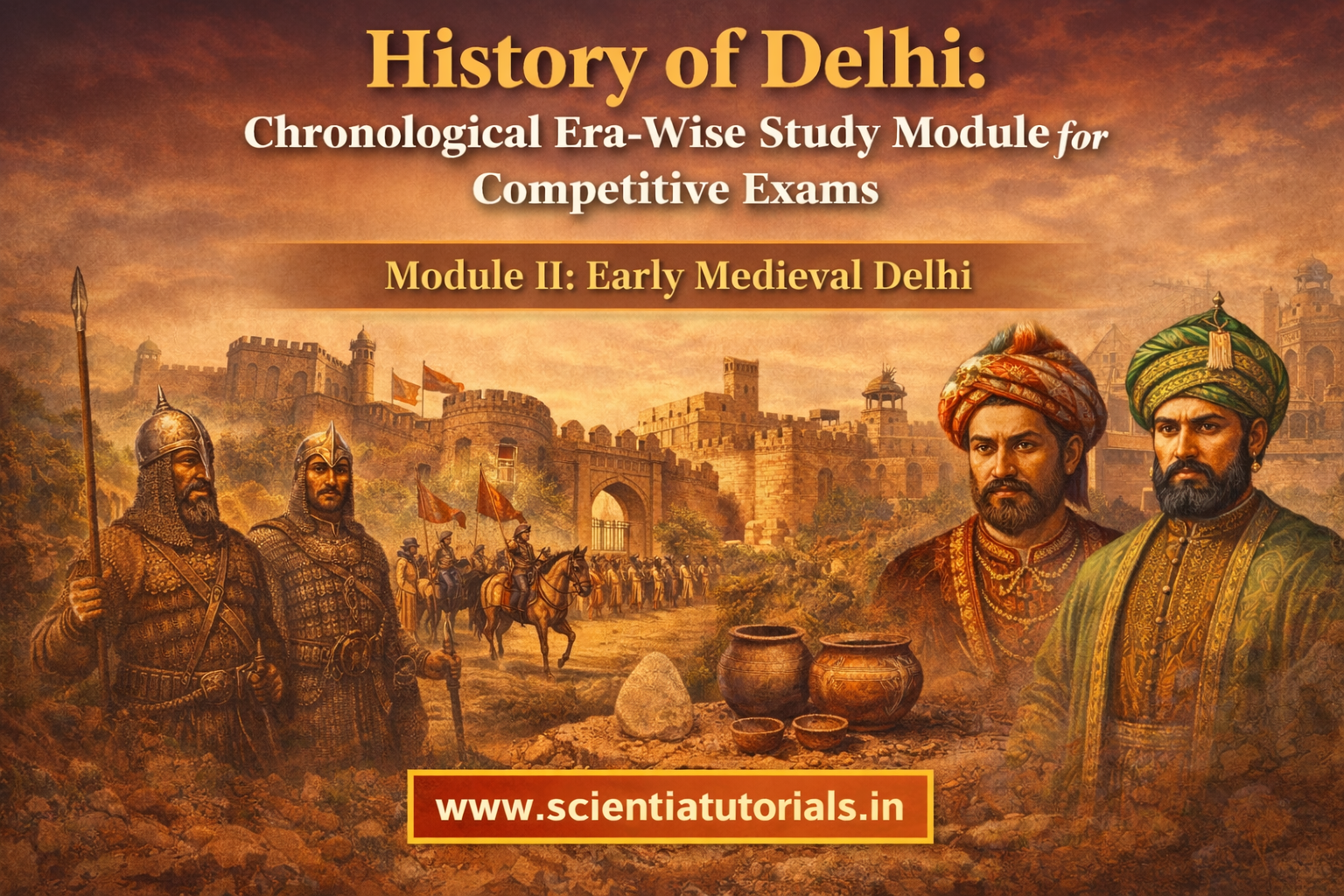
Module II: Early Medieval Delhi
Timeline: 8th Century CE – 12th Century CE
Historical Context Overview:
This era marks Delhi’s transition from ancient polities to early medieval kingdoms, laying foundations for Islamic rule through political fragmentation and regional powers.
Lesson-wise Breakdown:
- Lesson 1: Post-Gupta Political Landscape of North India
- Lesson 2: Tomara Dynasty and the Foundation of Dhillika
- Lesson 3: Chauhan Rule and the Rise of Rajput Power in Delhi
- Lesson 4: Lal Kot and Qila Rai Pithora – Early Fortified Cities
- Lesson 5: Socio-Economic Life in Early Medieval Delhi
- Lesson 6: Turkish Invasions and the Battle of Tarain
- Lesson 7: Transition from Rajput Rule to Sultanate Authority

Module III: Delhi Sultanate Period
Timeline: 1206 CE – 1526 CE
Historical Context Overview:
The Delhi Sultanate established centralized Islamic rule, introducing new administrative systems, architecture, and socio-cultural transformations.
Lesson-wise Breakdown:
- Lesson 1: Foundation of the Delhi Sultanate and Slave Dynasty
- Lesson 2: Qutbuddin Aibak and Iltutmish – Administrative Consolidation
- Lesson 3: Khalji Dynasty and Market Control Reforms
- Lesson 4: Tughlaq Experiments in Administration and Economy
- Lesson 5: Sayyid and Lodi Dynasties – Decline of Central Authority
- Lesson 6: Administrative Structure of the Delhi Sultanate
- Lesson 7: Art, Architecture, and Urban Growth under the Sultans
- Lesson 8: Causes of Decline and the First Battle of Panipat
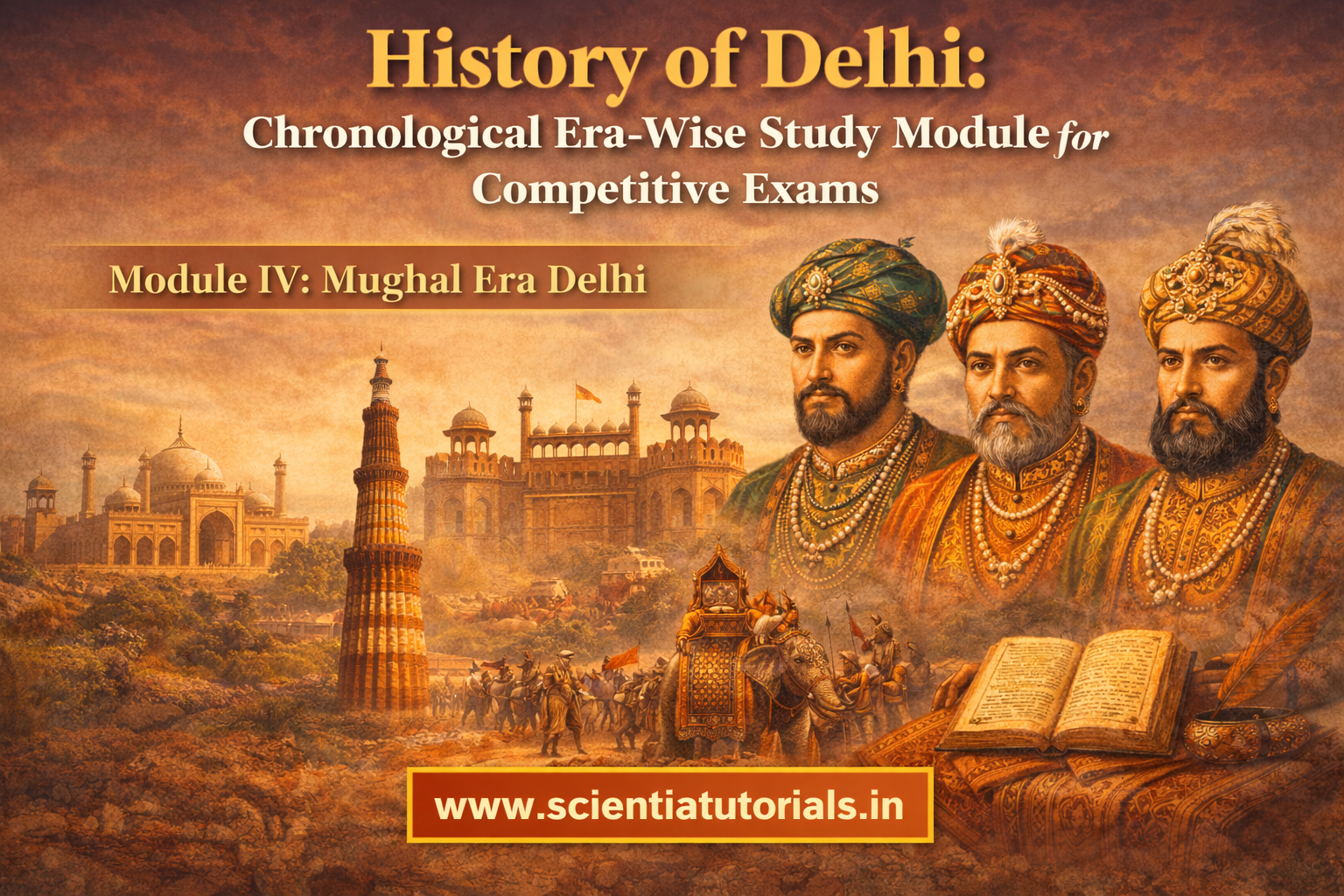
Module IV: Mughal Era Delhi
Timeline: 1526 CE – 1707 CE
Historical Context Overview:
Delhi emerged as a grand imperial capital under the Mughals, witnessing political stability, cultural synthesis, and architectural brilliance.
Lesson-wise Breakdown:
- Lesson 1: Babur and the Establishment of Mughal Rule
- Lesson 2: Humayun, Sher Shah Suri, and Administrative Reforms
- Lesson 3: Akbar’s Imperial Policies and Governance Model
- Lesson 4: Jahangir and Shah Jahan – Cultural and Architectural Zenith
- Lesson 5: Shahjahanabad – Urban Planning and Imperial Delhi
- Lesson 6: Aurangzeb and Expansion of the Mughal Empire
- Lesson 7: Mughal Administration, Mansabdari, and Revenue System
- Lesson 8: Society, Culture, and Economy in Mughal Delhi
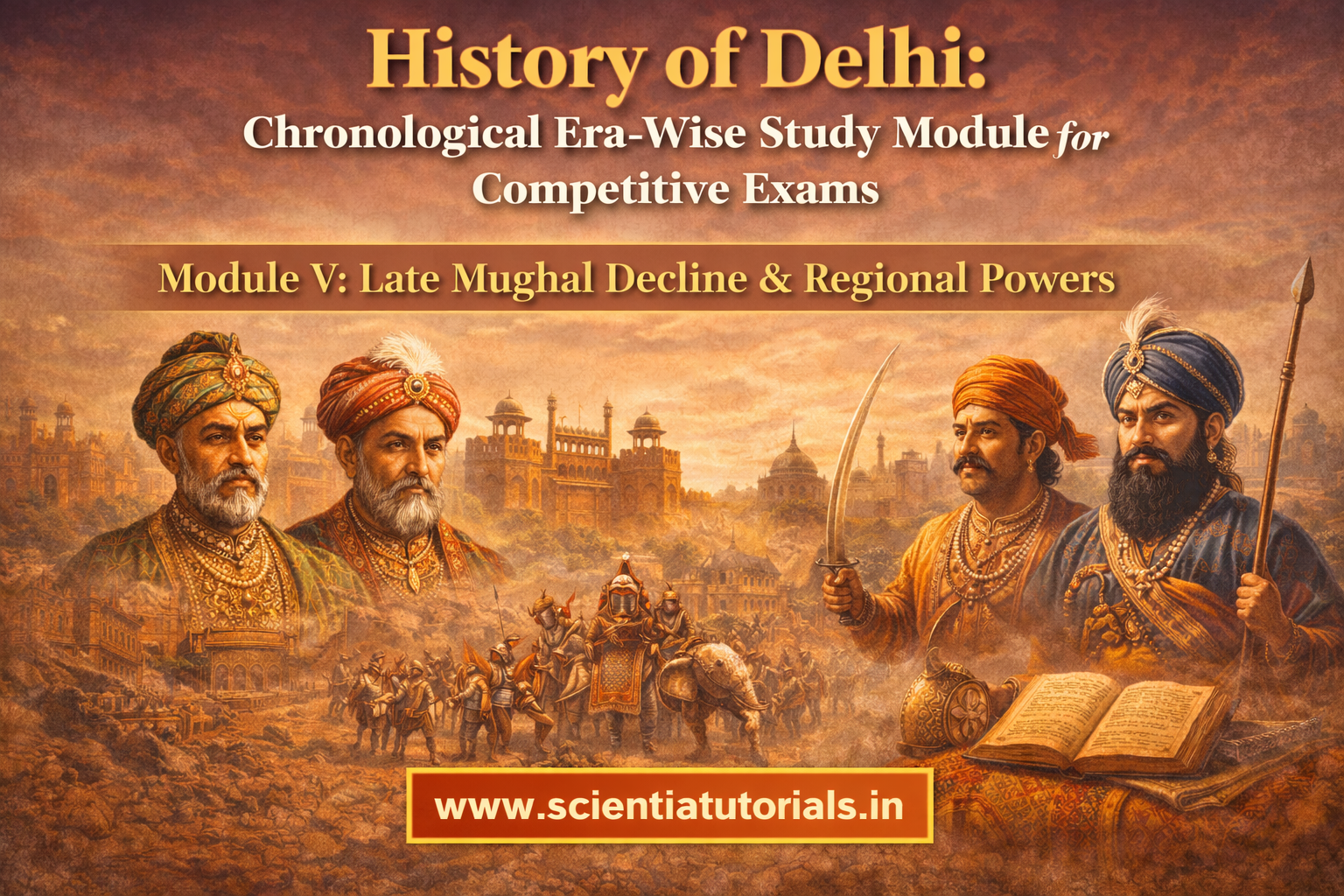
Module V: Late Mughal Decline & Regional Powers
Timeline: 1707 CE – 1803 CE
Historical Context Overview:
This module examines the weakening of Mughal authority and the rise of regional powers, making Delhi vulnerable to invasions and foreign control.
Lesson-wise Breakdown:
- Lesson 1: Successors of Aurangzeb and Imperial Weakening
- Lesson 2: Persian Invasion of Nadir Shah and Sack of Delhi
- Lesson 3: Afghan Invasions and Ahmad Shah Abdali
- Lesson 4: Rise of Marathas in North India
- Lesson 5: Political Instability and Court Politics in Delhi
- Lesson 6: Economic Decline and Urban Decay
- Lesson 7: Prelude to British Intervention in Delhi
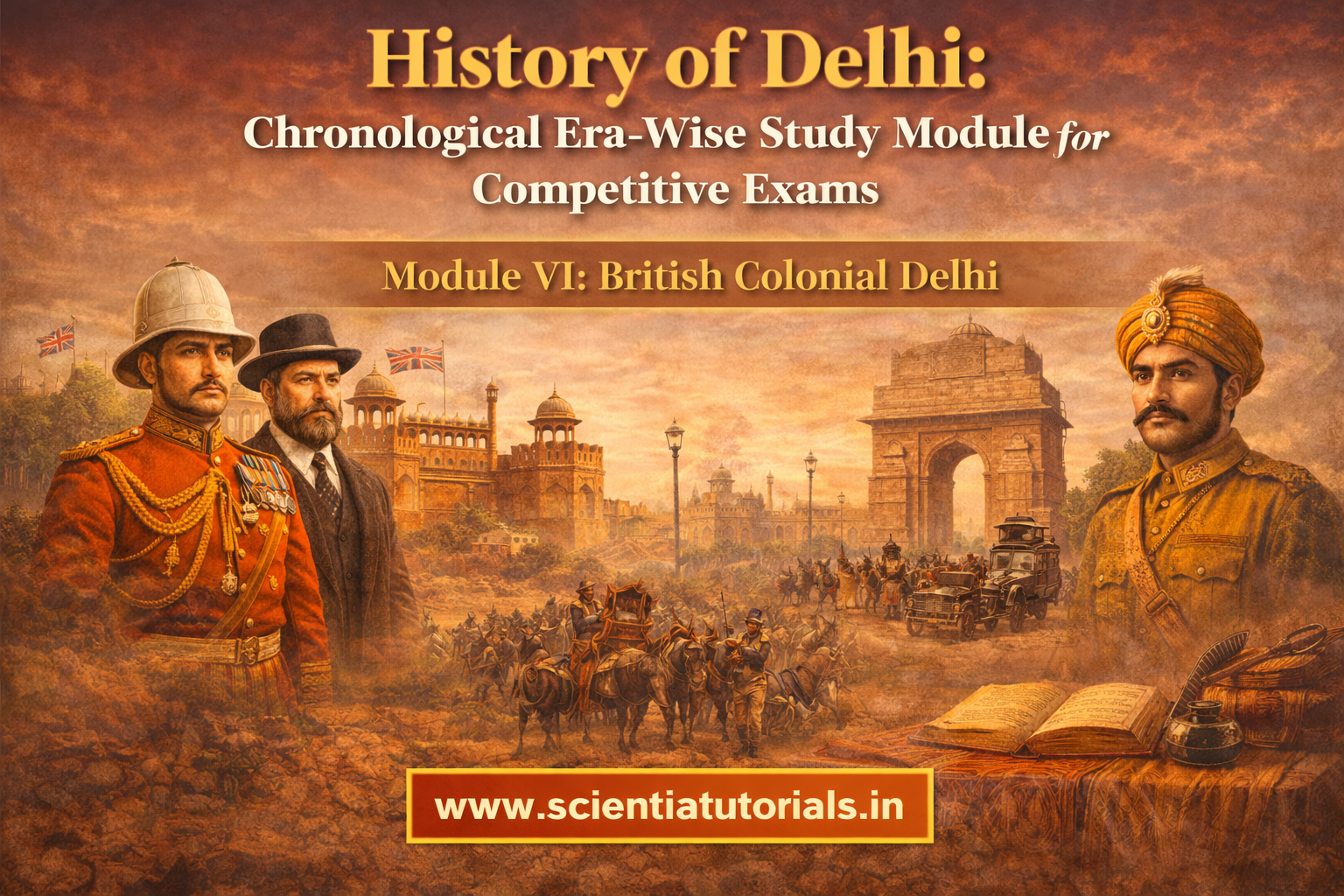
Module VI: British Colonial Delhi
Timeline: 1803 CE – 1911 CE
Historical Context Overview:
Delhi came under British control, transforming from a Mughal capital into a colonial administrative city.
Lesson-wise Breakdown:
- Lesson 1: British Capture of Delhi from the Marathas
- Lesson 2: Decline of Mughal Authority under British Rule
- Lesson 3: Revolt of 1857 and Delhi as Its Epicenter
- Lesson 4: Administrative Changes after the Revolt
- Lesson 5: Colonial Urban Policies and Infrastructure Development
- Lesson 6: Social and Economic Impact of British Rule on Delhi
- Lesson 7: Cultural Transformation under Colonial Influence
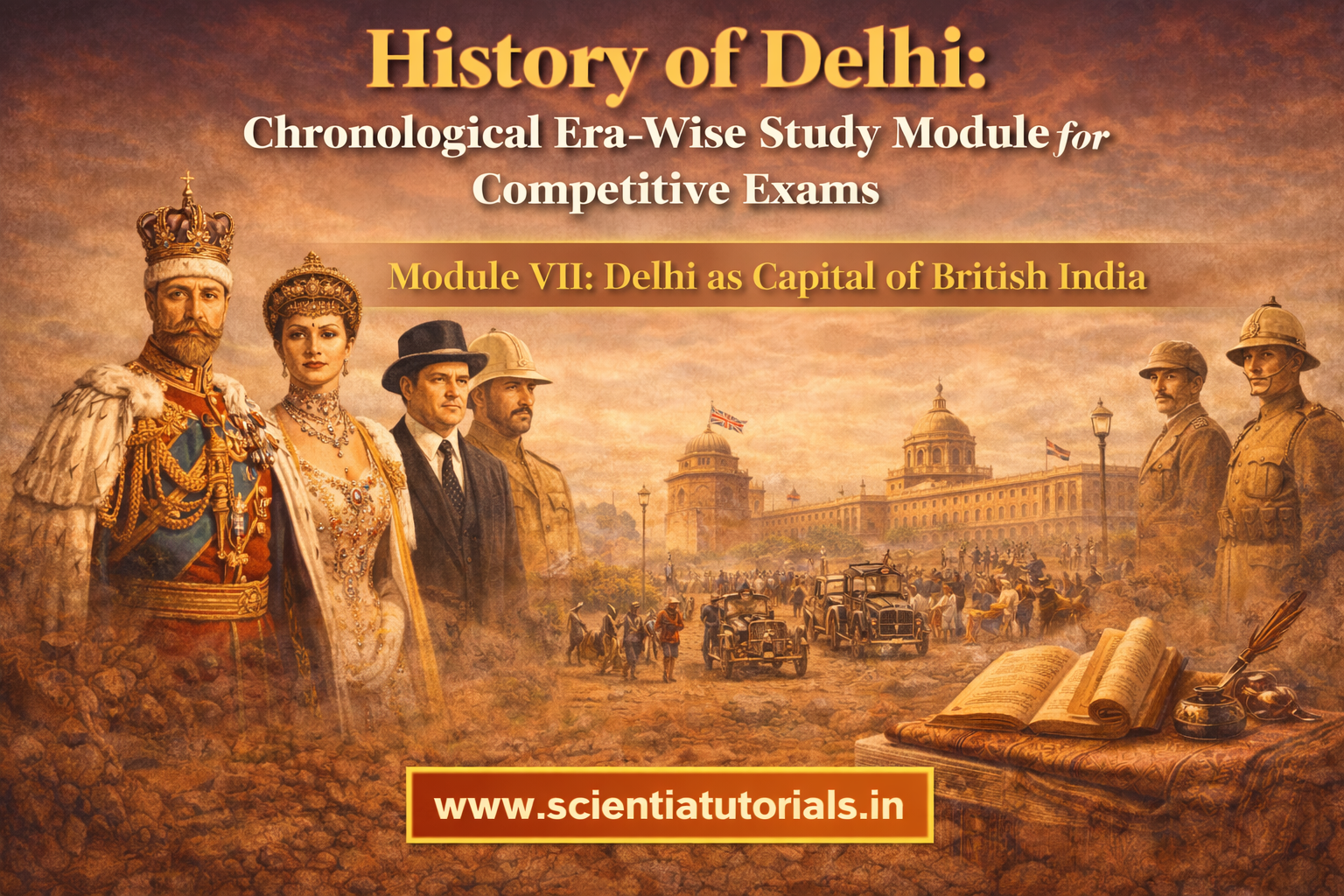
Module VII: Delhi as Capital of British India
Timeline: 1911 CE – 1947 CE
Historical Context Overview:
The transfer of the capital marked Delhi’s emergence as the political nerve center of British India.
Lesson-wise Breakdown:
- Lesson 1: Delhi Durbar of 1911 and Capital Shift
- Lesson 2: Planning and Construction of New Delhi
- Lesson 3: Administrative Significance of Imperial Delhi
- Lesson 4: Delhi and the Indian National Movement
- Lesson 5: Role of Delhi in Revolutionary Activities
- Lesson 6: Socio-Cultural Changes in Late Colonial Delhi
- Lesson 7: Partition, Refugee Crisis, and Urban Transformation
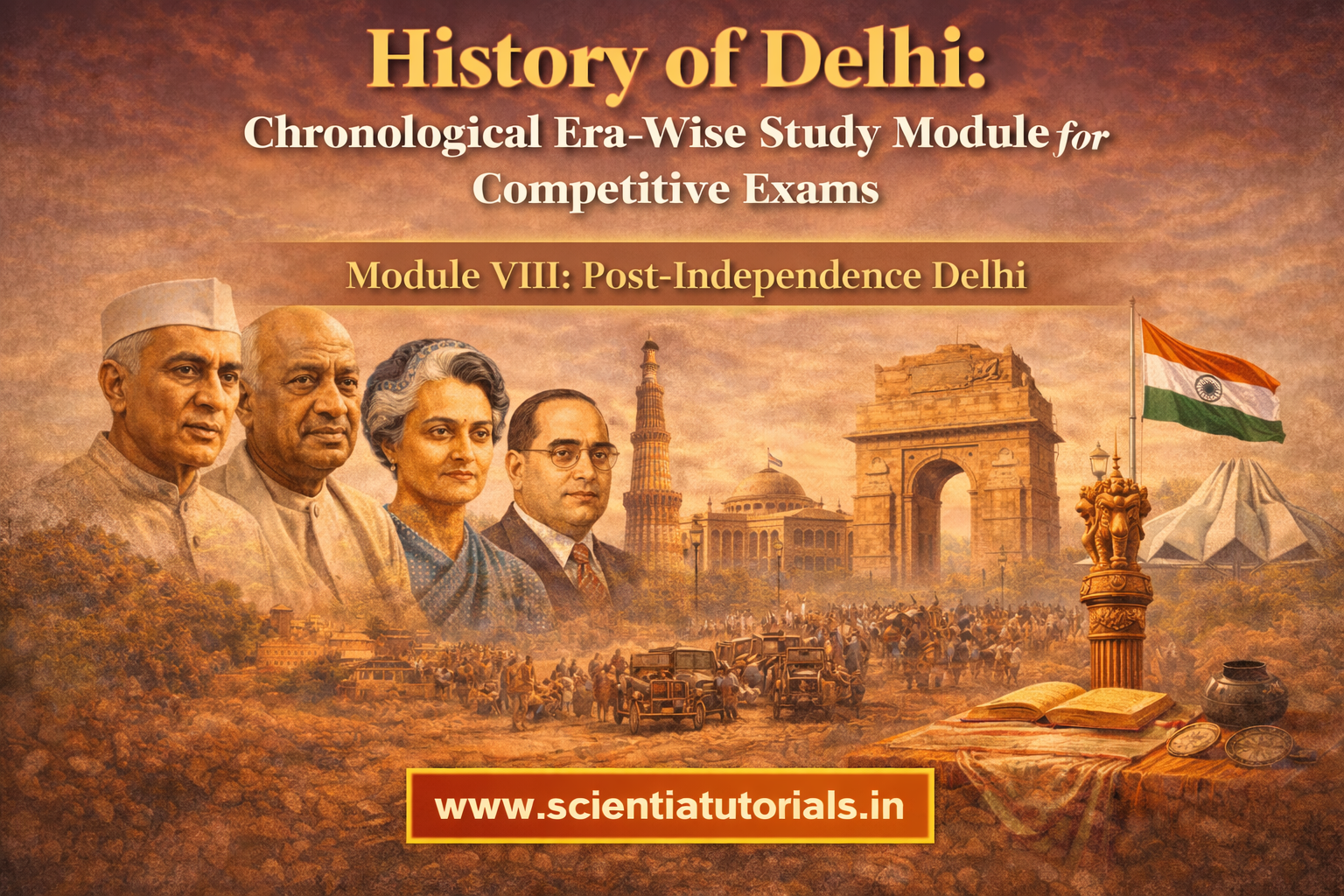
Module VIII: Post-Independence Delhi
Timeline: 1947 CE – Present
Historical Context Overview:
Post-independence Delhi evolved into a national capital territory with complex administrative structures and rapid urban expansion.
Lesson-wise Breakdown:
- Lesson 1: Integration of Delhi into Independent India
- Lesson 2: Administrative Reorganization and Governance Structure
- Lesson 3: Delhi as National Capital Territory – Constitutional Status
- Lesson 4: Urban Expansion, Migration, and Demographic Change
- Lesson 5: Political Developments and Statehood Debate
- Lesson 6: Economic Growth and Infrastructure Development
- Lesson 7: Cultural Pluralism and Contemporary Challenges
Course Disclaimer – History of Delhi: Chronological Era-Wise Study Module for Competitive Exams
This online course, History of Delhi – Chronological Era-Wise Study Module for Competitive Exams, is designed solely for educational and academic purposes. The content has been developed to support aspirants preparing for UPSC, SSC, State PSCs, NET, TET, and other competitive examinations by providing structured, chronological, and concept-based study material on the history of Delhi.
While every effort has been made to ensure historical accuracy, syllabus alignment, and academic reliability in accordance with standard references such as NCERT textbooks and widely accepted historical sources, the course does not claim to represent official examination content, prescribed answers, or guaranteed examination outcomes. Examination patterns, syllabi, and marking schemes are subject to change at the discretion of respective examining authorities.
The course material is intended to be used as a supplementary learning resource and should not be considered a substitute for official textbooks, government publications, or authoritative academic references. Learners are strongly advised to cross-check facts, interpretations, and data with official syllabi and standard reference books while preparing for examinations.
The creators and publishers of this course shall not be held responsible for any discrepancies, omissions, or consequences arising from the use of this content, including examination results or academic decisions. By accessing and using this course, learners acknowledge and agree to this disclaimer.
Curriculum
- 8 Sections
- 58 Lessons
- Lifetime
- Module I: Pre-Historic & Ancient Settlements of Delhi Timeline: Prehistoric Period – 8th Century CEHistorical Context Overview: This module traces the earliest human settlements and ancient political-cultural developments in the Delhi region, highlighting archaeological evidence and early urbanization.7
- 1.1Lesson 1: Prehistoric Settlements and Archaeological Evidence in the Delhi Region
- 1.2Lesson 2: Indraprastha and the Mahabharata Tradition – Myth and History
- 1.3Lesson 3: Painted Grey Ware Culture and Early Iron Age Delhi
- 1.4Lesson 4: Mauryan Administration and Imperial Influence in Delhi
- 1.5Lesson 5: Post-Mauryan Polities and Trade Networks of Ancient Delhi
- 1.6Lesson 6: Gupta Age and Cultural-Administrative Growth in Delhi
- 1.7Lesson 7: Decline of Gupta Authority and Regional Transitions
- Module II: Early Medieval Delhi Timeline: 8th Century CE – 12th Century CEHistorical Context Overview: This era marks Delhi’s transition from ancient polities to early medieval kingdoms, laying foundations for Islamic rule through political fragmentation and regional powers.7
- 2.1Lesson 1: Post-Gupta Political Landscape of North India
- 2.2Lesson 2: Tomara Dynasty and the Foundation of Dhillika
- 2.3Lesson 3: Chauhan Rule and the Rise of Rajput Power in Delhi
- 2.4Lesson 4: Lal Kot and Qila Rai Pithora – Early Fortified Cities
- 2.5Lesson 5: Socio-Economic Life in Early Medieval Delhi
- 2.6Lesson 6: Turkish Invasions and the Battle of Tarain
- 2.7Lesson 7: Transition from Rajput Rule to Sultanate Authority
- Module III: Delhi Sultanate Period Timeline: 1206 CE – 1526 CEHistorical Context Overview: The Delhi Sultanate established centralized Islamic rule, introducing new administrative systems, architecture, and socio-cultural transformations.8
- 3.1Lesson 1: Foundation of the Delhi Sultanate and Slave Dynasty
- 3.2Lesson 2: Qutbuddin Aibak and Iltutmish – Administrative Consolidation
- 3.3Lesson 3: Khalji Dynasty and Market Control Reforms
- 3.4Lesson 4: Tughlaq Experiments in Administration and Economy
- 3.5Lesson 5: Sayyid and Lodi Dynasties – Decline of Central Authority
- 3.6Lesson 6: Administrative Structure of the Delhi Sultanate
- 3.7Lesson 7: Art, Architecture, and Urban Growth under the Sultans
- 3.8Lesson 8: Causes of Decline and the First Battle of Panipat
- Module IV: Mughal Era Delhi Timeline: 1526 CE – 1707 CEHistorical Context Overview: Delhi emerged as a grand imperial capital under the Mughals, witnessing political stability, cultural synthesis, and architectural brilliance.8
- 4.1Lesson 1: Babur and the Establishment of Mughal Rule
- 4.2Lesson 2: Humayun, Sher Shah Suri, and Administrative Reforms
- 4.3Lesson 3: Akbar’s Imperial Policies and Governance Model
- 4.4Lesson 4: Jahangir and Shah Jahan – Cultural and Architectural Zenith
- 4.5Lesson 5: Shahjahanabad – Urban Planning and Imperial Delhi
- 4.6Lesson 6: Aurangzeb and Expansion of the Mughal Empire
- 4.7Lesson 7: Mughal Administration, Mansabdari, and Revenue System
- 4.8Lesson 8: Society, Culture, and Economy in Mughal Delhi
- Module V: Late Mughal Decline & Regional Powers Timeline: 1707 CE – 1803 CEHistorical Context Overview: This module examines the weakening of Mughal authority and the rise of regional powers, making Delhi vulnerable to invasions and foreign control.7
- 5.1Lesson 1: Successors of Aurangzeb and Imperial Weakening
- 5.2Lesson 2: Persian Invasion of Nadir Shah and Sack of Delhi
- 5.3Lesson 3: Afghan Invasions and Ahmad Shah Abdali
- 5.4Lesson 4: Rise of Marathas in North India
- 5.5Lesson 5: Political Instability and Court Politics in Delhi
- 5.6Lesson 6: Economic Decline and Urban Decay
- 5.7Lesson 7: Prelude to British Intervention in Delhi
- Module VI: British Colonial Delhi Timeline: 1803 CE – 1911 CEHistorical Context Overview: Delhi came under British control, transforming from a Mughal capital into a colonial administrative city.7
- 6.1Lesson 1: British Capture of Delhi from the Marathas
- 6.2Lesson 2: Decline of Mughal Authority under British Rule
- 6.3Lesson 3: Revolt of 1857 and Delhi as Its Epicenter
- 6.4Lesson 4: Administrative Changes after the Revolt
- 6.5Lesson 5: Colonial Urban Policies and Infrastructure Development
- 6.6Lesson 6: Social and Economic Impact of British Rule on Delhi
- 6.7Lesson 7: Cultural Transformation under Colonial Influence
- Module VII: Delhi as Capital of British India Timeline: 1911 CE – 1947 CEHistorical Context Overview: The transfer of the capital marked Delhi’s emergence as the political nerve center of British India.7
- 7.1Lesson 1: Delhi Durbar of 1911 and Capital Shift
- 7.2Lesson 2: Planning and Construction of New Delhi
- 7.3Lesson 3: Administrative Significance of Imperial Delhi
- 7.4Lesson 4: Delhi and the Indian National Movement
- 7.5Lesson 5: Role of Delhi in Revolutionary Activities
- 7.6Lesson 6: Socio-Cultural Changes in Late Colonial Delhi
- 7.7Lesson 7: Partition, Refugee Crisis, and Urban Transformation
- Module VIII: Post-Independence Delhi Timeline: 1947 CE – PresentHistorical Context Overview: Post-independence Delhi evolved into a national capital territory with complex administrative structures and rapid urban expansion.7
- 8.1Lesson 1: Integration of Delhi into Independent India
- 8.2Lesson 2: Administrative Reorganization and Governance Structure
- 8.3Lesson 3: Delhi as National Capital Territory – Constitutional Status
- 8.4Lesson 4: Urban Expansion, Migration, and Demographic Change
- 8.5Lesson 5: Political Developments and Statehood Debate
- 8.6Lesson 6: Economic Growth and Infrastructure Development
- 8.7Lesson 7: Cultural Pluralism and Contemporary Challenges
Course Features
- Lectures 58
- Quiz 0
- Duration Lifetime access
- Skill level All levels
- Language English
- Students 0
- Assessments Yes