
Lesson 2: Tomara Dynasty and the Foundation of Dhillika
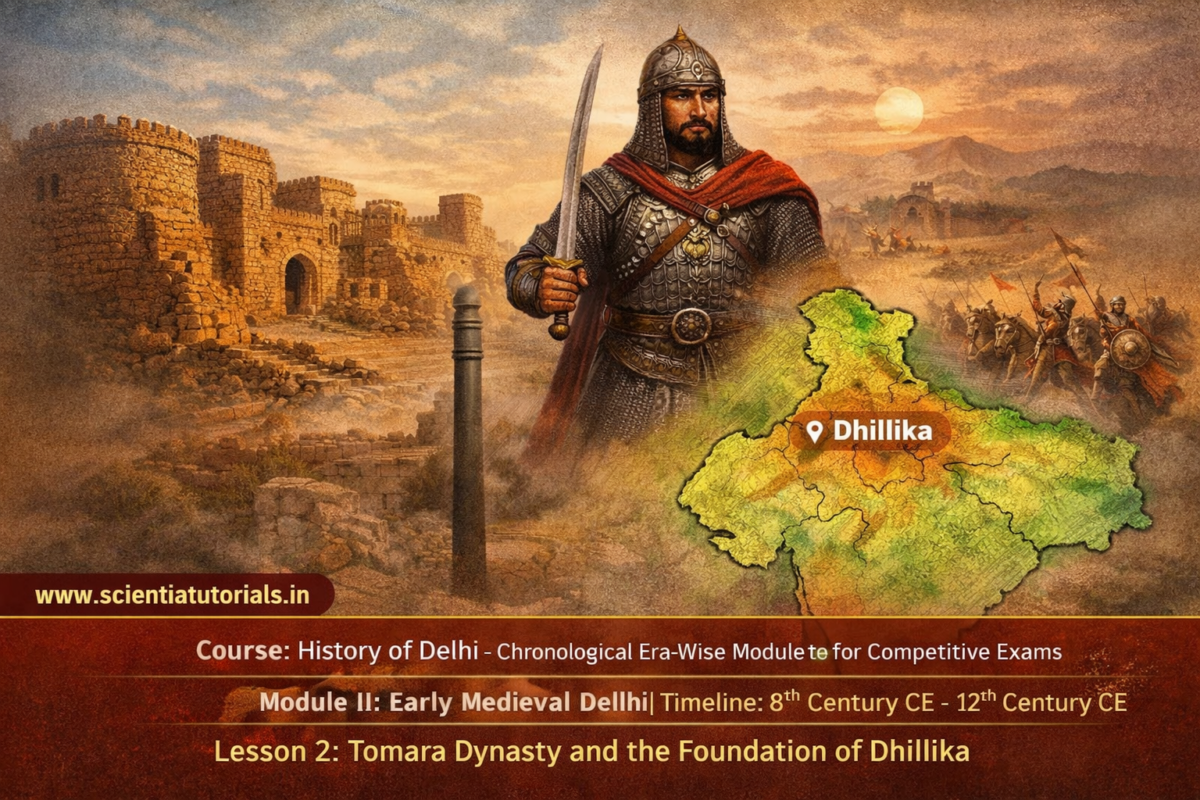

Tomara Dynasty and Foundation of Dhillika | Early Medieval Delhi
History of Delhi – Chronological Era-Wise Study Module for Competitive Exams
Module II: Early Medieval Delhi
Timeline: 8th Century CE – 12th Century CE
Lesson 2: Tomara Dynasty and the Foundation of Dhillika
This lesson is systematically organized into four clearly structured sections, as detailed below:
- Chronologically Structured Study Module
- Short-Answer Type Questions
- Long-Answer Type Questions
- Multiple-Choice Questions (MCQs) with Answers and Detailed Explanations
Chronologically Structured Study Module
1. Introduction: Emergence of Early Medieval Delhi as a Political Centre
The history of Delhi as a political capital did not begin abruptly with the Delhi Sultanate. Its foundations were laid much earlier during the Early Medieval period, particularly under the Tomara rulers. The Tomara Dynasty occupies a crucial position in the historical evolution of Delhi, as it was under their rule that Dhillika (early Delhi) emerged as a fortified settlement and regional power center.
This lesson examines the Tomara Dynasty in a chronological and analytical manner, focusing on their political rise, administrative structures, military initiatives, and most importantly, their role in founding Dhillika. For competitive examinations, this topic is significant because it bridges the gap between post-Gupta regionalism and the later emergence of Delhi as the seat of imperial power.
2. Historical Background: Post-Gupta Political Context
Following the decline of the Gupta Empire, North India witnessed intense political fragmentation. The vacuum created by the collapse of centralized authority enabled regional warrior lineages to rise. By the 8th–9th centuries CE, Rajput clans emerged as dominant political forces across Rajasthan, western Uttar Pradesh, and the Delhi region.
The Delhi region, strategically located between the Indo-Gangetic plains and northwestern India, gradually became an arena of contest among emerging powers. In this context, the Tomaras rose as a prominent Rajput lineage and established their authority over Dhillika.
3. Origins and Identity of the Tomara Dynasty
3.1 Lineage and Rajput Identity
The Tomara Dynasty belonged to the Rajput clan system that gained prominence during the early medieval period. Like other Rajput lineages, the Tomaras claimed Kshatriya descent and derived legitimacy from warfare, land control, and lineage-based authority.
Epigraphic references, bardic traditions, and later historical chronicles point to the Tomaras as one of the earliest Rajput ruling houses associated directly with Delhi.
3.2 Territorial Base
The Tomaras initially controlled territories in present-day Haryana and western Uttar Pradesh. Over time, they consolidated power around Dhillika, which became their political and military headquarters.
4. Foundation of Dhillika: The Birth of Early Delhi
4.1 Meaning and Historical References
Dhillika is the earliest known name of Delhi in historical sources. It appears in inscriptions and later chronicles as a fortified settlement and political center established during the early medieval period.
The foundation of Dhillika marked a decisive shift in the regional importance of Delhi, transforming it from a frontier zone into a seat of dynastic power.
4.2 Strategic Location
The choice of Dhillika as a capital was not accidental. Its location provided:
- Control over land routes connecting Punjab, Rajasthan, and the Gangetic plains
- Natural defense advantages
- Proximity to fertile agrarian zones
These factors made Dhillika an ideal capital for an emerging Rajput power.
5. Role of Anangpal Tomar in the Establishment of Dhillika
5.1 Anangpal Tomar I and II
The most prominent ruler associated with the Tomara Dynasty is Anangpal Tomar. Historical tradition often refers to two rulers bearing this name, with Anangpal Tomar II being credited with strengthening Dhillika.
He is traditionally remembered as:
- The founder or major consolidator of Dhillika
- The builder of early fortifications
- A ruler who transformed Delhi into a durable political center
5.2 Legendary and Historical Significance
Later traditions associate Anangpal Tomar with the installation of the Iron Pillar at Delhi, symbolizing royal authority and continuity. Though partly legendary, these associations highlight the cultural memory of Tomara rule.
6. Lal Kot: The First Fortified Capital of Delhi
6.1 Construction and Purpose
One of the most enduring contributions of the Tomaras was the construction of Lal Kot, the earliest fortified settlement of Delhi. Lal Kot served as:
- A military fortress
- An administrative headquarters
- A symbol of dynastic authority
Its massive stone walls reflect the militarized political environment of early medieval North India.
6.2 Architectural Features
Lal Kot demonstrates early Rajput military architecture, characterized by thick ramparts, strategic gateways, and elevated defensive positions. The fort later became the nucleus around which subsequent rulers expanded Delhi.
7. Political Administration under the Tomaras
7.1 Nature of Governance
The Tomara administration followed the typical Rajput political model:
- Decentralized governance
- Dependence on feudatories and clan chiefs
- Emphasis on military strength rather than bureaucratic institutions
The ruler exercised authority through personal loyalty and land control rather than a centralized bureaucracy.
7.2 Land Grants and Local Elites
Land grants to warriors and religious institutions were common. These grants strengthened local elites but also limited the central authority of the Tomara rulers, reflecting early medieval “feudal tendencies.”
8. Military Organization and Defense
8.1 Constant Warfare
The Tomaras ruled during a period of near-constant warfare among Rajput clans and rival regional powers. Military preparedness was essential for survival.
8.2 Fortification Strategy
The construction of Lal Kot highlights the importance of defense in Tomara political strategy. Control of fortified centers allowed the Tomaras to:
- Protect trade routes
- Resist rival Rajput clans
- Secure their territorial base
Delhi’s later prominence as a fortified city owes much to these early initiatives.
9. Economic and Social Life under the Tomaras
9.1 Agrarian Economy
The Tomara economy was primarily agrarian. Revenue was derived from land, with peasants forming the economic backbone of the state. Control over fertile lands around Delhi ensured economic sustainability.
9.2 Social Structure
Society was hierarchical, dominated by warrior elites and landholding classes. Brahmins played an important role in legitimizing rule through rituals and genealogy.
10. Cultural Contributions and Religious Life
The Tomaras patronized Brahmanical religious institutions. Temples and religious grants reinforced the sacred legitimacy of rule. Though not known for grand cultural achievements, their role in establishing Delhi as a political center had long-lasting cultural implications.
11. Decline of Tomara Power
11.1 Rise of the Chauhans
By the 11th–12th centuries CE, the Tomaras faced growing pressure from rival Rajput clans, particularly the Chauhans. Eventually, Tomara authority over Delhi weakened.
11.2 Transfer of Power
The Chauhans took control of Dhillika and expanded Lal Kot into Qila Rai Pithora. Despite their decline, the Tomaras’ foundational work ensured Delhi’s continued political relevance.
12. Historical Significance of the Tomara Dynasty
The Tomara Dynasty’s importance lies not in imperial expansion but in institution-building. Their achievements include:
- Founding Dhillika as a political center
- Constructing Delhi’s earliest fortifications
- Establishing Delhi as a seat of Rajput power
Without the Tomaras, Delhi might not have emerged as the nucleus of medieval North Indian politics.
13. Examination-Oriented Key Themes
- Tomaras as early Rajput rulers of Delhi
- Dhillika as the earliest form of Delhi
- Lal Kot as the first fortified capital
- Anangpal Tomar’s role in Delhi’s foundation
- Continuity from Rajput Delhi to Sultanate Delhi
14. Conclusion
The Tomara Dynasty represents the formative phase in Delhi’s long political history. Operating within the fragmented and militarized environment of early medieval North India, the Tomaras laid the structural and strategic foundations of Dhillika. Their establishment of Lal Kot and consolidation of Delhi as a regional capital transformed the city into a durable political center.
For competitive examinations, the Tomaras are crucial for understanding how Delhi evolved from a frontier settlement into the future capital of empires. This lesson highlights continuity in Indian history, demonstrating that the rise of Delhi Sultanate rested upon foundations laid centuries earlier by the Tomara rulers.
Short Answer Type Questions
Module II: Early Medieval Delhi
Lesson 2: Tomara Dynasty and the Foundation of Dhillika
1. Who were the Tomaras?
Answer:
The Tomaras were a Rajput dynasty that ruled the Delhi region during the early medieval period and laid the foundation of Dhillika (early Delhi).
2. In which period did the Tomara Dynasty rise to prominence?
Answer:
The Tomara Dynasty rose to prominence between the 9th and 11th centuries CE.
3. What is meant by Dhillika?
Answer:
Dhillika is the earliest known historical name of Delhi, established as a fortified political settlement by the Tomaras.
4. Why is the Tomara Dynasty important in the history of Delhi?
Answer:
The Tomaras founded Dhillika and established Delhi as a fortified political center for the first time.
5. Name the most prominent ruler of the Tomara Dynasty.
Answer:
Anangpal Tomar was the most prominent ruler of the Tomara Dynasty.
6. What role is Anangpal Tomar associated with in Delhi’s history?
Answer:
He is associated with the foundation and consolidation of Dhillika and the construction of early fortifications.
7. What was Lal Kot?
Answer:
Lal Kot was the earliest fortified settlement of Delhi built by the Tomaras.
8. Why was Lal Kot constructed?
Answer:
Lal Kot was constructed to serve as a defensive fortress and administrative center in a period of continuous warfare.
9. Which geographical factors made Dhillika a suitable capital?
Answer:
Its control over trade routes, proximity to fertile lands, and strategic defensive location made it suitable.
10. What type of political system did the Tomaras follow?
Answer:
The Tomaras followed a decentralized Rajput political system based on military power and feudatory loyalty.
11. What were the main sources of Tomara revenue?
Answer:
Agrarian land revenue formed the main source of Tomara income.
12. What role did land grants play in Tomara administration?
Answer:
Land grants strengthened local elites and feudatories, reflecting early medieval feudal tendencies.
13. How was military strength important for the Tomaras?
Answer:
Military strength was essential to defend territory, control trade routes, and resist rival Rajput clans.
14. What does the construction of forts indicate about the period?
Answer:
It indicates political instability, frequent warfare, and the need for strong defensive structures.
15. Which social group dominated Tomara society?
Answer:
Warrior elites and landholding classes dominated Tomara society.
16. What role did Brahmins play under the Tomaras?
Answer:
Brahmins legitimized rule through rituals, genealogy, and religious authority.
17. How did the Tomaras contribute to Delhi’s long-term importance?
Answer:
They transformed Delhi into a permanent political and military center.
18. Which dynasty succeeded the Tomaras in Delhi?
Answer:
The Chauhan dynasty succeeded the Tomaras in controlling Delhi.
19. How did Tomara rule come to an end?
Answer:
Tomara power declined due to military pressure from stronger Rajput dynasties, especially the Chauhans.
20. What was the relationship between Lal Kot and later Delhi forts?
Answer:
Lal Kot formed the nucleus for later expansions such as Qila Rai Pithora.
21. What was the economic base of Dhillika under the Tomaras?
Answer:
It was primarily agrarian, supported by surrounding fertile lands.
22. Why is the Tomara period considered formative in Delhi’s history?
Answer:
It marks the first establishment of Delhi as a fortified capital city.
23. How did Rajput political culture influence Tomara rule?
Answer:
It emphasized honor, lineage, warfare, and decentralized governance.
24. What is the historical significance of Dhillika for medieval India?
Answer:
Dhillika became the foundation upon which later medieval empires built Delhi as a capital.
25. Why is the Tomara Dynasty relevant for competitive examinations?
Answer:
It explains the origins of Delhi as a political center before the Delhi Sultanate.
✅ Examination Tip
Questions on the Tomaras, Dhillika, Lal Kot, and Anangpal Tomar are frequently used to test understanding of early medieval urbanization and political continuity in Delhi’s history.
Long Answer Type Questions
Module II: Early Medieval Delhi
Lesson 2: Tomara Dynasty and the Foundation of Dhillika
1. Discuss the historical significance of the Tomara Dynasty in the evolution of Delhi.
Answer:
The Tomara Dynasty occupies a foundational place in the history of Delhi as the first ruling house to establish it as a fortified political center. Their greatest contribution lies in founding Dhillika and constructing Lal Kot, which transformed Delhi from a frontier zone into a durable seat of power. Though their territorial expansion was limited, the institutional and strategic foundations they laid enabled Delhi to later emerge as the capital of major medieval empires.
2. Analyse the political conditions that enabled the rise of the Tomaras in early medieval North India.
Answer:
The decline of Gupta central authority led to political fragmentation and the rise of regional warrior lineages. In this environment, Rajput clans such as the Tomaras capitalized on military strength and local control of land. The absence of a dominant imperial power and continuous inter-dynastic rivalry created opportunities for the Tomaras to establish authority over the strategically important Delhi region.
3. Examine the Rajput identity of the Tomara Dynasty and its political implications.
Answer:
The Tomaras identified themselves as Rajputs, claiming Kshatriya lineage and legitimacy through warfare and genealogy. Rajput political culture emphasized honor, valor, and lineage rather than centralized bureaucracy. This shaped Tomara governance, which relied on personal loyalty, military prowess, and decentralized administration, influencing both their strengths and limitations.
4. Explain the concept of Dhillika and its importance in early medieval history.
Answer:
Dhillika is the earliest known historical name of Delhi. Its foundation by the Tomaras marked the first deliberate attempt to establish Delhi as a fortified capital. Dhillika symbolized the transition of Delhi from a marginal frontier to a recognized political and administrative center, laying the groundwork for its later imperial status.
5. Assess the role of Anangpal Tomar in the foundation of Dhillika.
Answer:
Anangpal Tomar is traditionally credited with founding or consolidating Dhillika. He strengthened the settlement through fortifications and is remembered in historical memory as the ruler who firmly established Delhi as a Rajput capital. Though some accounts are semi-legendary, his association reflects the lasting impact of Tomara rule on Delhi’s identity.
6. Describe the strategic factors behind the selection of Delhi as a capital by the Tomaras.
Answer:
Delhi’s location provided control over major land routes linking Punjab, Rajasthan, and the Gangetic plains. It also offered defensive advantages and access to fertile agricultural zones. These strategic factors made Delhi an ideal capital for a regional power seeking military security and economic stability.
7. Discuss the construction and significance of Lal Kot.
Answer:
Lal Kot was the earliest fortified settlement of Delhi, constructed by the Tomaras. It served as a military stronghold, administrative center, and symbol of dynastic authority. Its massive walls reflect the militarized nature of early medieval politics and established a tradition of fortified capitals in Delhi’s history.
8. Analyse the administrative structure of the Tomara state.
Answer:
The Tomara administration was decentralized and based on Rajput political traditions. Authority was exercised through personal loyalty, land control, and military leadership rather than a centralized bureaucracy. Feudatories and local chiefs played a significant role in governance, limiting royal control but ensuring regional stability.
9. Examine the role of land grants in Tomara polity.
Answer:
Land grants were given to warriors, officials, and religious institutions. While these grants helped maintain loyalty and social order, they also strengthened local elites and reduced centralized authority. This reflects early medieval feudal tendencies prevalent across North India.
10. Discuss the military organization and defense strategy of the Tomaras.
Answer:
Military strength was central to Tomara survival. The construction of Lal Kot indicates a focus on fortification and defense. The Tomaras maintained armed retainers and relied on fortified centers to protect territory, control trade routes, and resist rival Rajput clans.
11. How did continuous warfare shape Tomara rule?
Answer:
Frequent warfare influenced the Tomaras to prioritize defense, fort construction, and martial values. Resources were directed toward military preparedness rather than administrative expansion, shaping the character of their state as primarily defensive and regional.
12. Examine the economic foundations of the Tomara state.
Answer:
The Tomara economy was primarily agrarian. Revenue was derived from land taxes collected from surrounding fertile regions. Control over agricultural surplus sustained the ruling elite and military establishment, ensuring the economic viability of Dhillika.
13. Describe the social structure under Tomara rule.
Answer:
Society was hierarchical, dominated by warrior elites and landholding classes. Peasants formed the economic base, while Brahmins played an important role in legitimizing rule through religious rituals and genealogical traditions.
14. Analyse the religious and cultural life during the Tomara period.
Answer:
The Tomaras patronized Brahmanical religious institutions and supported temple culture. Though not known for large-scale cultural achievements, their religious patronage reinforced social hierarchy and political legitimacy.
15. Discuss the relationship between the Tomaras and other Rajput dynasties.
Answer:
The Tomaras existed within a competitive Rajput political environment. Rivalries with stronger dynasties, especially the Chauhans, shaped their political fortunes. These conflicts eventually led to the decline of Tomara authority in Delhi.
16. Explain the decline of the Tomara Dynasty.
Answer:
The Tomaras declined due to military pressure from more powerful Rajput clans, particularly the Chauhans. Their limited territorial base and decentralized political structure made sustained resistance difficult.
17. How did the Chauhans build upon Tomara foundations in Delhi?
Answer:
The Chauhans expanded Lal Kot into Qila Rai Pithora, strengthening Delhi’s fortifications and political importance. This continuity shows that later rulers benefited directly from Tomara foundations.
18. Evaluate the Tomaras’ contribution to Delhi’s long-term political history.
Answer:
The Tomaras transformed Delhi into a permanent political and military center. Their role in founding Dhillika ensured that Delhi remained strategically important even after their decline, shaping its future as an imperial capital.
19. Why is the Tomara period considered a formative phase in Delhi’s history?
Answer:
It marks the first establishment of Delhi as a fortified capital, setting patterns of defense, administration, and political centrality that continued into later medieval periods.
20. Analyse the continuity between Rajput Delhi and Sultanate Delhi.
Answer:
The Delhi Sultanate inherited a strategically located, fortified city whose foundations were laid by Rajput rulers like the Tomaras. This continuity highlights the cumulative nature of Delhi’s political evolution.
21. Compare the Tomaras’ political achievements with their limitations.
Answer:
While the Tomaras successfully founded and fortified Delhi, their decentralized administration and limited military resources restricted expansion. Their achievements were foundational rather than imperial.
22. Why is the study of the Tomara Dynasty important for competitive examinations?
Answer:
It explains the origins of Delhi as a political center, highlights early medieval urbanization, and provides context for the later rise of the Delhi Sultanate—making it crucial for understanding historical continuity.
✅ Concluding Note for Aspirants
Questions on Tomaras, Dhillika, Lal Kot, and early Rajput polity are frequently asked to test understanding of early medieval state formation and urban foundations of Delhi. These answers are ideal for Mains questions.
MCQs with Answers & Explanations
Module II: Early Medieval Delhi
Lesson 2: Tomara Dynasty and the Foundation of Dhillika
1. The Tomara Dynasty is primarily associated with the foundation of which city?
A. Kannauj
B. Ajmer
C. Dhillika
D. Thanesar
Correct Answer: C
Explanation:
Dhillika is the earliest historical name of Delhi and was established as a fortified political center under the Tomaras.
2. The Tomaras belonged to which social-political group?
A. Tribal chiefs
B. Brahmanical rulers
C. Rajput warrior lineage
D. Merchant guild leaders
Correct Answer: C
Explanation:
The Tomaras were a Rajput dynasty, emphasizing Kshatriya lineage, warfare, and clan-based authority.
3. Which period best represents the rise of Tomara power in Delhi?
A. 6th–7th centuries CE
B. 8th–9th centuries CE
C. 9th–11th centuries CE
D. 12th–13th centuries CE
Correct Answer: C
Explanation:
The Tomaras rose to prominence roughly between the 9th and 11th centuries CE, during the early medieval period.
4. The establishment of Dhillika marked:
A. The beginning of Mughal rule
B. The first fortification of Delhi
C. The decline of Rajput power
D. The arrival of Turkish rulers
Correct Answer: B
Explanation:
Dhillika’s foundation represents the first known fortified political settlement at Delhi.
5. Which ruler is traditionally associated with the foundation and consolidation of Dhillika?
A. Prithviraj Chauhan
B. Bhoja Paramara
C. Anangpal Tomar
D. Harsha
Correct Answer: C
Explanation:
Anangpal Tomar is remembered in historical tradition as the key ruler who established or strengthened Dhillika.
6. Lal Kot was constructed primarily as a:
A. Religious center
B. Trade hub
C. Fortified capital
D. Pilgrimage town
Correct Answer: C
Explanation:
Lal Kot functioned as a fortified capital, serving military, administrative, and political purposes.
7. The construction of Lal Kot reflects which major feature of early medieval politics?
A. Urban prosperity
B. Maritime expansion
C. Militarization and insecurity
D. Centralized bureaucracy
Correct Answer: C
Explanation:
Frequent warfare and political instability made fortifications essential for survival.
8. Which factor most influenced the selection of Delhi as a Tomara capital?
A. Coastal access
B. Religious sanctity
C. Strategic control of land routes
D. Mineral resources
Correct Answer: C
Explanation:
Delhi controlled important routes linking Punjab, Rajasthan, and the Gangetic plains.
9. Tomara administration can best be described as:
A. Highly centralized
B. Bureaucratic and uniform
C. Decentralized and feudatory-based
D. Democratic
Correct Answer: C
Explanation:
Like other Rajput states, Tomara governance relied on feudatories, local chiefs, and personal loyalty.
10. Which economic base supported the Tomara state?
A. Overseas trade
B. Industrial production
C. Agrarian land revenue
D. Maritime commerce
Correct Answer: C
Explanation:
Agriculture formed the backbone of the Tomara economy, with land revenue as the main income source.
11. Land grants under the Tomaras primarily led to:
A. Stronger central authority
B. Decline of local elites
C. Empowerment of feudatories
D. Abolition of taxation
Correct Answer: C
Explanation:
Land grants strengthened local elites and weakened centralized control, reflecting early medieval feudal tendencies.
12. Which social group played a key role in legitimizing Tomara rule?
A. Merchants
B. Artisans
C. Brahmins
D. Peasants
Correct Answer: C
Explanation:
Brahmins provided ritual, genealogical, and religious legitimacy to Rajput rulers.
13. The Tomaras ruled in a political environment marked by:
A. Long-term peace
B. Continuous warfare
C. Colonial administration
D. Economic centralization
Correct Answer: B
Explanation:
Early medieval North India was characterized by constant inter-dynastic conflicts.
14. Which dynasty eventually replaced the Tomaras in Delhi?
A. Palas
B. Pratiharas
C. Chauhans
D. Rashtrakutas
Correct Answer: C
Explanation:
The Chauhans succeeded the Tomaras and expanded Delhi’s fortifications.
15. Lal Kot later formed the nucleus of:
A. Siri Fort
B. Tughlaqabad
C. Qila Rai Pithora
D. Shahjahanabad
Correct Answer: C
Explanation:
The Chauhans expanded Lal Kot into Qila Rai Pithora, strengthening Delhi’s defenses.
16. The decline of the Tomaras was mainly due to:
A. Peasant revolts
B. Economic collapse
C. Pressure from rival Rajput clans
D. Foreign invasions
Correct Answer: C
Explanation:
Stronger Rajput dynasties, particularly the Chauhans, displaced the Tomaras.
17. The Tomara Dynasty is best described as:
A. An imperial power
B. A foundational regional power
C. A mercantile republic
D. A religious order
Correct Answer: B
Explanation:
Their importance lies in institution-building rather than imperial expansion.
18. Which concept best explains Tomara political organization?
A. Absolute monarchy
B. Theocratic state
C. Feudal tendencies
D. Colonial governance
Correct Answer: C
Explanation:
Decentralization, land grants, and feudatory control reflect feudal characteristics.
19. What was the primary function of fortifications like Lal Kot?
A. Cultural display
B. Trade regulation
C. Military defense
D. Religious ceremonies
Correct Answer: C
Explanation:
Fortifications were essential for defense in a militarized political environment.
20. Which aspect of Delhi’s later history directly benefited from Tomara foundations?
A. Mughal garden culture
B. Sultanate administration
C. Strategic and fortified capital status
D. Colonial urban planning
Correct Answer: C
Explanation:
Later rulers inherited a strategically located and fortified Delhi.
21. The Tomara period is considered formative because it:
A. Introduced Persian culture
B. Established Delhi as a capital city
C. Created pan-Indian unity
D. Ended Rajput rule
Correct Answer: B
Explanation:
The Tomaras were the first to make Delhi a permanent political center.
22. Which term best describes Dhillika in early medieval sources?
A. Trading port
B. Religious shrine
C. Fortified settlement
D. Tribal encampment
Correct Answer: C
Explanation:
Dhillika was a fortified settlement serving political and military purposes.
23. Tomara rule illustrates which broader trend of early medieval India?
A. Centralized empire-building
B. Rise of regional Rajput polities
C. Maritime expansion
D. Industrial urbanization
Correct Answer: B
Explanation:
The Tomaras exemplify the rise of regional Rajput states after the Gupta decline.
24. The relationship between Tomara Delhi and Sultanate Delhi shows:
A. Complete political discontinuity
B. Cultural isolation
C. Historical continuity
D. Economic decline
Correct Answer: C
Explanation:
The Delhi Sultanate built upon earlier Rajput foundations rather than starting afresh.
25. For competitive examinations, the Tomaras are most important for understanding:
A. Mughal administration
B. Early medieval urban foundations of Delhi
C. Maritime trade networks
D. Colonial governance
Correct Answer: B
Explanation:
The Tomaras explain how Delhi first emerged as a fortified political center.
✅ Examination Insight
MCQs on Tomaras, Dhillika, Lal Kot, Anangpal Tomar, and Rajput polity are frequently used to test conceptual clarity on early medieval state formation and urban foundations of Delhi.