
Lesson 2: Qutbuddin Aibak and Iltutmish – Administrative Consolidation
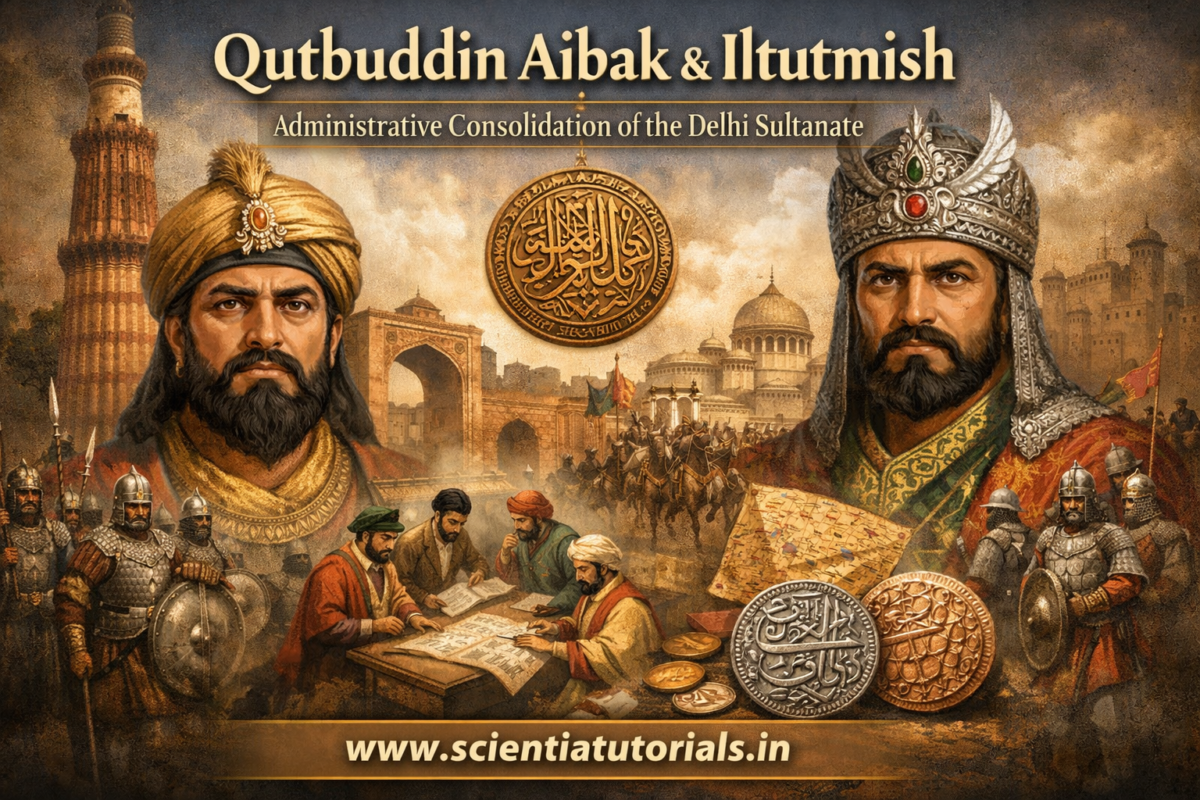

Qutbuddin Aibak & Iltutmish: Administrative Consolidation of Delhi Sultanate
Course: History of Delhi – Chronological Era-Wise Study Module for Competitive Exams
Module III: Delhi Sultanate Period
Timeline: 1206 CE – 1526 CE
Lesson 2: Qutbuddin Aibak and Iltutmish – Administrative Consolidation
This lesson is systematically organized into four clearly structured sections, as detailed below:
- Chronologically Structured Study Module
- Short-Answer Type Questions
- Long-Answer Type Questions
- Multiple-Choice Questions (MCQs) with Answers and Detailed Explanations
Chronologically Structured Study Module
Introduction: Significance of Administrative Consolidation in Early Sultanate History
The establishment of the Delhi Sultanate in the early thirteenth century marked a decisive turning point in the political and administrative history of Delhi and northern India. The transition from fragmented regional powers to a centralized Indo-Islamic state required not merely military conquest but systematic administrative consolidation. Delhi Sultanate, founded in 1206 CE, owed its early survival and institutional stability to the policies and governance of its first two rulers—Qutbuddin Aibak and Iltutmish.
This lesson focuses on how these two rulers laid the foundations of centralized authority through administrative innovation, revenue organization, military restructuring, and judicial governance. For competitive examinations, understanding this consolidation process is crucial, as it explains how Delhi evolved from a conquered territory into a functioning imperial capital.
1. Historical Background: From Ghurid Rule to Independent Sultanate (Pre-1206 Context)
Before 1206 CE, Delhi functioned as a provincial center under the Ghurid Empire. Turkish military commanders governed territories on behalf of their overlords in Ghazni and Ghor. The assassination of Muhammad of Ghor in 1206 created a power vacuum in northern India. In this context, Qutbuddin Aibak, his trusted slave-general, declared independence and laid the foundations of a new polity.
This transition was not smooth. Aibak faced opposition from rival Turkish commanders, Rajput chiefs, and administrative challenges due to the absence of established Islamic institutions in India. The success of the early Sultanate depended on creating durable administrative systems rather than relying solely on military force.
2. Qutbuddin Aibak (1206–1210 CE): Founder and Consolidator in Transition
2.1 Accession and Challenges
Qutbuddin Aibak assumed the title of Sultan in 1206 CE, becoming the first independent ruler of the Delhi Sultanate. His reign was brief but significant. He inherited territories without a centralized bureaucratic apparatus and faced internal threats from fellow Turkish nobles known as the Chahalgani or Forty.
Aibak’s primary challenge was legitimizing his authority in a region with diverse cultural, religious, and political traditions.
2.2 Administrative Policies under Qutbuddin Aibak
Although his reign lasted only four years, Aibak initiated key administrative practices:
a) Continuity of Ghurid Institutions
Aibak retained many administrative structures inherited from the Ghurids. This continuity ensured stability and avoided administrative collapse. Persian remained the official language of administration.
b) Iqta System (Early Form)
Land assignments (iqtas) were granted to military officers in lieu of salaries. While not fully institutionalized during Aibak’s reign, this system laid the groundwork for later fiscal administration.
c) Military Administration
Aibak maintained a strong cavalry-based army. Military commanders were given territorial responsibilities, combining administrative and military authority—an arrangement that would later need reform.
2.3 Judicial and Religious Policy
Aibak patronized Islamic scholars and institutions to legitimize his rule. He supported the ulama and upheld Islamic law (Sharia) in judicial matters involving Muslims, while allowing local customs to prevail in non-Muslim communities.
2.4 Cultural and Architectural Contributions
Aibak’s reign symbolized the beginning of Indo-Islamic architectural expression in Delhi. The construction of the Qutb Minar complex was initiated during his reign, symbolizing political authority and religious legitimacy.
2.5 Limitations of Aibak’s Administration
Despite his contributions, Aibak’s administrative system lacked centralization. Power remained dispersed among nobles, and the absence of a strong royal bureaucracy limited effective governance. His accidental death in 1210 CE halted further reforms.
3. Iltutmish (1211–1236 CE): Architect of Administrative Consolidation
3.1 Accession and Initial Resistance
Iltutmish ascended the throne after defeating rivals and consolidating control over Delhi. Unlike Aibak, his long reign allowed him to introduce systematic reforms and strengthen royal authority.
His reign marks the true institutional foundation of the Delhi Sultanate.
3.2 Centralization of Authority
a) Suppression of Turkish Nobles
Iltutmish curbed the power of the Forty by asserting royal supremacy. Nobles were transferred, dismissed, or executed when necessary.
b) Establishment of Monarchical Authority
The Sultan emerged as the supreme authority in administrative, military, and judicial matters.
4. Administrative Reforms under Iltutmish
4.1 Reorganization of the Iqta System
Iltutmish formalized the iqta system, clearly distinguishing between:
- Iqta holders (Muqtis) – Responsible for revenue collection
- Central Treasury (Diwan-i-Wizarat) – Controlled surplus revenue
This prevented the emergence of autonomous feudal lords and ensured regular revenue flow to the state.
4.2 Creation of Central Administrative Departments (Diwans)
Iltutmish institutionalized a structured bureaucracy:
- Diwan-i-Wizarat – Finance and revenue
- Diwan-i-Arz – Military administration
- Diwan-i-Insha – Royal correspondence
- Diwan-i-Risalat – Religious and charitable affairs
These departments enhanced administrative efficiency and accountability.
4.3 Revenue Administration
Land revenue was systematically assessed and collected. Iltutmish ensured that revenue demands were realistic, avoiding excessive exploitation that could provoke rebellion.
5. Military Reforms and Territorial Control
Iltutmish reorganized the army by separating military command from civil administration wherever possible. He maintained a loyal standing army directly under royal control, reducing dependence on local commanders.
He also defended the Sultanate against external threats, including Mongol invasions, thereby safeguarding administrative stability.
6. Judicial and Legal Consolidation
Justice emerged as a core function of the Sultanate state. Iltutmish upheld Islamic law while allowing flexibility in dealing with India’s diverse population.
The Sultan acted as the highest judicial authority, reinforcing the perception of a just and centralized ruler.
7. Symbolic and Ideological Legitimacy
7.1 Recognition by the Abbasid Caliph
One of Iltutmish’s greatest achievements was receiving formal recognition from the Abbasid Caliph, which legitimized his rule in the wider Islamic world.
7.2 Introduction of Coinage
Iltutmish issued standardized silver tanka and copper jital, strengthening the monetary economy and facilitating revenue administration.
8. Social and Administrative Integration
Iltutmish pursued a policy of cautious accommodation toward Indian elites. Hindu officials were employed in revenue and local administration, ensuring continuity and stability.
This pragmatic approach allowed the Sultanate administration to function effectively in a culturally diverse society.
9. Comparative Assessment: Aibak vs Iltutmish
| Aspect | Qutbuddin Aibak | Iltutmish |
|---|---|---|
| Nature of Rule | Transitional | Consolidative |
| Administrative Structure | Inherited & informal | Institutionalized |
| Iqta System | Early and loose | Fully organized |
| Noble Control | Weak | Strong |
| Legitimacy | Military authority | Religious & political |
10. Historical Significance of Administrative Consolidation
The administrative foundations laid by Aibak and perfected by Iltutmish ensured the survival of the Delhi Sultanate for over three centuries. Their policies influenced later dynasties, including the Khaljis and Tughlaqs.
For competitive examinations, this phase explains:
- The transition from conquest to governance
- The emergence of centralized medieval state systems
- The synthesis of Islamic administrative principles with Indian conditions
Conclusion
The reigns of Qutbuddin Aibak and Iltutmish represent the formative phase of the Delhi Sultanate’s administrative history. Aibak initiated political independence and basic governance structures, while Iltutmish transformed these foundations into a centralized, stable, and legitimate state apparatus. Their combined efforts ensured that Delhi emerged as the enduring political capital of medieval India.
Understanding this lesson is essential for grasping the evolution of medieval Indian administration and for answering analytical and comparative questions in competitive examinations.
Short Answer Type Questions with Answers
1. Who founded the Delhi Sultanate?
Answer: The Delhi Sultanate was founded in 1206 CE by Qutbuddin Aibak, following the death of Muhammad of Ghor.
2. Why is Qutbuddin Aibak regarded as a transitional ruler?
Answer: Aibak is considered transitional because he shifted authority from Ghurid provincial rule to an independent Sultanate but could not fully centralize administration.
3. What was the political background to the rise of Qutbuddin Aibak?
Answer: He rose to power after the collapse of Ghurid authority in India following Muhammad of Ghor’s death in 1206 CE.
4. What administrative language was used during Aibak’s reign?
Answer: Persian was adopted as the official language of administration.
5. What was the early form of the Iqta system under Aibak?
Answer: Military officers were granted land assignments (iqtas) in lieu of salaries, though the system was not yet centralized.
6. Why did Aibak rely heavily on military commanders?
Answer: Due to the absence of a developed bureaucracy, military commanders performed both administrative and military roles.
7. What was the major limitation of Aibak’s administration?
Answer: The lack of centralization and excessive dependence on Turkish nobles weakened royal authority.
8. Name one architectural contribution associated with Aibak.
Answer: The initiation of the Qutb Minar complex in Delhi.
9. Who succeeded Qutbuddin Aibak as the ruler of Delhi?
Answer: Iltutmish succeeded Aibak and ruled from 1211 to 1236 CE.
10. Why is Iltutmish considered the real consolidator of the Delhi Sultanate?
Answer: He established centralized administration, organized revenue and military systems, and asserted royal supremacy.
11. What was the ‘Chahalgani’ or ‘Forty’?
Answer: It was a group of powerful Turkish nobles who dominated early Sultanate politics and challenged royal authority.
12. How did Iltutmish curb the power of the Forty?
Answer: By transferring, dismissing, or punishing nobles and asserting the Sultan as the supreme authority.
13. What reforms did Iltutmish introduce in the Iqta system?
Answer: He separated revenue collection from ownership and ensured surplus revenue was sent to the central treasury.
14. Name the department responsible for finance under Iltutmish.
Answer: The Diwan-i-Wizarat managed state revenue and expenditure.
15. What was the function of the Diwan-i-Arz?
Answer: It was responsible for military administration and organization of the army.
16. Which department handled royal correspondence?
Answer: The Diwan-i-Insha managed official communication and royal orders.
17. How did Iltutmish strengthen the revenue system?
Answer: By systematic assessment of land revenue and ensuring regular collection without overburdening peasants.
18. What measures did Iltutmish take to improve military control?
Answer: He maintained a standing army under royal command and reduced dependence on provincial military chiefs.
19. How did Iltutmish protect the Sultanate from external threats?
Answer: By defending the north-western frontiers, particularly against Mongol invasions.
20. What was the judicial role of the Sultan under Iltutmish?
Answer: The Sultan acted as the highest judicial authority and dispenser of justice.
21. Which Islamic authority recognized Iltutmish’s rule?
Answer: The Abbasid Caliphate formally recognized his sovereignty.
22. Why was Caliphal recognition important for Iltutmish?
Answer: It enhanced the legitimacy of his rule in the Islamic world and strengthened his authority in India.
23. What new coins were introduced by Iltutmish?
Answer: The silver tanka and copper jital were standardized.
24. How did Iltutmish integrate Indian society into administration?
Answer: By employing local Hindu officials in revenue and administrative services.
25. What is the historical significance of administrative consolidation under Aibak and Iltutmish?
Answer: Their policies transformed Delhi from a conquered territory into a stable, centralized Sultanate that lasted over three centuries.
Long Answer Type Questions with Answers
1. Examine the historical circumstances that led to the establishment of the Delhi Sultanate in 1206 CE.
Answer:
The Delhi Sultanate emerged after the death of Muhammad of Ghor in 1206 CE, which created a power vacuum in northern India. Turkish slave commanders governing Indian territories asserted independence. Among them, Qutbuddin Aibak declared himself Sultan at Delhi. The absence of centralized authority, decline of Rajput resistance, and the need for stable governance enabled the formation of an independent Sultanate, marking the beginning of a new political era.
2. Assess the role of Qutbuddin Aibak in laying the foundations of the Delhi Sultanate.
Answer:
Aibak played a foundational role by transforming Delhi from a provincial Ghurid possession into an independent capital. He ensured political continuity, maintained administrative order, and defended the territories from internal threats. Though his reign was short, his actions prevented fragmentation and ensured the survival of the newly formed Sultanate.
3. Why is Qutbuddin Aibak regarded as a transitional ruler rather than a consolidator?
Answer:
Aibak is called a transitional ruler because he largely continued Ghurid administrative practices without introducing strong central institutions. Authority remained decentralized among Turkish nobles, and the bureaucracy was underdeveloped. His role was crucial in transition but limited in consolidation.
4. Discuss the administrative system under Qutbuddin Aibak.
Answer:
Aibak relied on military commanders for administration. Persian was used as the official language. The iqta system existed in a rudimentary form, where land revenues supported soldiers. However, there was no separation between military and civil administration, limiting efficiency and central control.
5. Evaluate the early development of the Iqta system during Aibak’s reign.
Answer:
Under Aibak, iqtas were granted informally to officers in place of salaries. These grants were not transferable or hereditary but lacked strict regulation. This system helped maintain the army but also empowered nobles, posing future challenges to royal authority.
6. Examine the causes and consequences of the weak central authority under Aibak.
Answer:
Weak central authority arose from Aibak’s dependence on Turkish nobles and the absence of a structured bureaucracy. While this ensured short-term stability, it led to factionalism and posed threats to the Sultanate’s unity after his death.
7. Analyse the significance of architecture and religious patronage during Aibak’s reign.
Answer:
Aibak patronized Islamic institutions and initiated monumental architecture, symbolizing sovereignty and legitimacy. These acts strengthened ideological authority and marked the beginning of Indo-Islamic cultural traditions in Delhi.
8. Discuss the challenges faced by Iltutmish on his accession to the throne.
Answer:
Iltutmish faced resistance from rival Turkish nobles, lack of legitimacy, and administrative disorder. He had to assert his claim militarily and politically while defending the Sultanate from external invasions and internal rebellions.
9. Why is Iltutmish considered the real founder of the Delhi Sultanate?
Answer:
Iltutmish transformed a fragile political entity into a centralized state. He organized administration, suppressed powerful nobles, standardized revenue systems, and gained religious legitimacy, thereby ensuring the long-term survival of the Sultanate.
10. Examine the steps taken by Iltutmish to centralize political authority.
Answer:
Iltutmish curtailed the power of Turkish nobles, asserted the supremacy of the Sultan, and made key administrative positions transferable. He ensured loyalty through direct royal control and established Delhi as the undisputed center of authority.
11. Analyse the reorganization of the Iqta system under Iltutmish.
Answer:
Iltutmish institutionalized the iqta system by separating revenue rights from ownership. Muqtis collected revenue on behalf of the state, and surplus income was sent to the central treasury, preventing feudal autonomy.
12. Describe the structure and functions of the central administrative departments (Diwans).
Answer:
Iltutmish established specialized departments: finance (Diwan-i-Wizarat), military (Diwan-i-Arz), correspondence (Diwan-i-Insha), and religious affairs (Diwan-i-Risalat). This specialization improved efficiency and accountability.
13. Discuss the revenue administration under Iltutmish.
Answer:
Land revenue assessment became systematic and realistic. Regular collection ensured a stable income for the state while avoiding excessive exploitation of peasants, which reduced chances of rebellion.
14. Examine the military reforms introduced by Iltutmish.
Answer:
Iltutmish maintained a standing army under direct royal control and reduced dependence on provincial commanders. This strengthened central authority and improved internal security.
15. How did Iltutmish defend the Sultanate from external threats?
Answer:
He successfully checked Mongol incursions on the north-west frontier and maintained territorial integrity, ensuring administrative continuity and political stability.
16. Analyse the judicial system under Iltutmish.
Answer:
Justice was centralized, with the Sultan acting as the highest judicial authority. Islamic law guided decisions involving Muslims, while customary laws were respected for non-Muslims, ensuring social balance.
17. Explain the importance of Caliphal recognition to Iltutmish’s rule.
Answer:
Recognition from the Abbasid Caliphate enhanced Iltutmish’s legitimacy, reinforced his sovereignty, and elevated Delhi’s status within the Islamic world.
18. Discuss the significance of coinage reforms under Iltutmish.
Answer:
The introduction of standardized silver tanka and copper jital strengthened the monetary economy, facilitated revenue collection, and symbolized sovereign authority.
19. Evaluate Iltutmish’s policy toward non-Muslim subjects.
Answer:
Iltutmish adopted a pragmatic approach by employing Hindu officials in administration and respecting local customs. This policy ensured cooperation, continuity, and administrative efficiency.
20. Compare the administrative policies of Qutbuddin Aibak and Iltutmish.
Answer:
Aibak initiated governance with inherited systems and limited centralization, while Iltutmish institutionalized administration, strengthened royal authority, and created durable state structures.
21. How did administrative consolidation contribute to the long survival of the Delhi Sultanate?
Answer:
Centralized authority, organized revenue, loyal military, and judicial stability ensured effective governance, enabling the Sultanate to survive for over three centuries.
22. Critically assess the historical significance of Aibak and Iltutmish in medieval Indian history.
Answer:
Together, Aibak and Iltutmish transformed Delhi into a durable imperial capital. Aibak laid the political foundation, while Iltutmish built a centralized administrative state that shaped medieval Indian governance.
Multiple Choice Questions (MCQs) with Answers & Explanations
1. The Delhi Sultanate was formally founded in 1206 CE by
A. Muhammad of Ghor
B. Mahmud of Ghazni
C. Qutbuddin Aibak
D. Iltutmish
Correct Answer: C
Explanation:
After the death of Muhammad of Ghor in 1206 CE, Qutbuddin Aibak, his slave-general, declared independence in India and founded the Delhi Sultanate.
2. Qutbuddin Aibak is often described as a ‘transitional ruler’ because
A. He ruled for a very long period
B. He abolished Turkish nobility
C. He combined Rajput and Turkish systems
D. He bridged Ghurid rule and independent Sultanate authority
Correct Answer: D
Explanation:
Aibak transitioned Delhi from a Ghurid provincial administration to an independent Sultanate but did not fully centralize authority.
3. The main administrative challenge faced by Qutbuddin Aibak was
A. Peasant revolts
B. Mongol invasions
C. Absence of a centralized bureaucratic system
D. Religious opposition from ulema
Correct Answer: C
Explanation:
Aibak inherited territories without a well-developed bureaucracy and relied heavily on military commanders for governance.
4. Which language was adopted as the official language of administration under Aibak?
A. Arabic
B. Sanskrit
C. Turkish
D. Persian
Correct Answer: D
Explanation:
Persian became the administrative language of the Delhi Sultanate, following Ghurid practice, and remained so for centuries.
5. The early form of the Iqta system under Aibak primarily involved
A. Permanent land grants
B. Revenue-free religious lands
C. Land assignments in lieu of salaries
D. Hereditary feudal estates
Correct Answer: C
Explanation:
Military officers were assigned iqtas to collect revenue instead of receiving cash salaries, though the system lacked regulation.
6. A major weakness of Aibak’s administration was
A. Excessive taxation
B. Weak military
C. Overdependence on Turkish nobles
D. Lack of foreign trade
Correct Answer: C
Explanation:
Powerful Turkish nobles held extensive authority, limiting royal control and administrative centralization.
7. Which architectural project symbolized the beginning of Indo-Islamic architecture in Delhi?
A. Alai Darwaza
B. Quwwat-ul-Islam Mosque
C. Qutb Minar complex
D. Hauz Khas
Correct Answer: C
Explanation:
Construction of the Qutb Minar complex was initiated during Aibak’s reign, symbolizing political and religious authority.
8. Who succeeded Qutbuddin Aibak as the ruler of Delhi?
A. Balban
B. Aram Shah
C. Razia Sultana
D. Iltutmish
Correct Answer: D
Explanation:
Iltutmish emerged as the most capable successor and consolidated the Sultanate after defeating rivals.
9. Iltutmish is regarded as the real founder of the Delhi Sultanate because
A. He expanded territory the most
B. He ruled peacefully
C. He institutionalized administration and centralized power
D. He abolished slavery
Correct Answer: C
Explanation:
Iltutmish transformed a fragile polity into a stable, centralized state with structured administration.
10. The ‘Chahalgani’ or ‘Forty’ refers to
A. Forty provinces of the Sultanate
B. Forty Rajput chiefs
C. A group of powerful Turkish nobles
D. Forty military regiments
Correct Answer: C
Explanation:
The Forty were influential Turkish nobles whose power Iltutmish had to curb to assert royal authority.
11. One of the key measures taken by Iltutmish to weaken the Forty was
A. Granting hereditary rights
B. Transfer and dismissal of nobles
C. Marriage alliances
D. Decentralization
Correct Answer: B
Explanation:
Iltutmish curtailed noble power through transfers, punishments, and direct assertion of the Sultan’s supremacy.
12. Under Iltutmish, the Iqta system was characterized by
A. Hereditary landownership
B. Complete autonomy of nobles
C. Separation of revenue rights from ownership
D. Abolition of land grants
Correct Answer: C
Explanation:
Iqta holders collected revenue on behalf of the state and had to remit surplus to the central treasury.
13. Which department was responsible for finance and revenue?
A. Diwan-i-Arz
B. Diwan-i-Insha
C. Diwan-i-Wizarat
D. Diwan-i-Risalat
Correct Answer: C
Explanation:
The Diwan-i-Wizarat functioned as the finance ministry, managing income and expenditure.
14. The Diwan-i-Arz dealt with
A. Religious affairs
B. Judicial matters
C. Military administration
D. Royal correspondence
Correct Answer: C
Explanation:
This department organized the army, recruitment, and military discipline.
15. Which Diwan handled royal orders and correspondence?
A. Diwan-i-Arz
B. Diwan-i-Insha
C. Diwan-i-Wizarat
D. Diwan-i-Qaza
Correct Answer: B
Explanation:
Diwan-i-Insha was responsible for drafting and issuing royal farmans and letters.
16. Iltutmish strengthened revenue administration mainly by
A. Increasing taxes sharply
B. Systematic land assessment and regular collection
C. Abolishing revenue intermediaries
D. Granting tax exemptions
Correct Answer: B
Explanation:
Balanced revenue policies ensured state income without provoking agrarian unrest.
17. Which reform reduced Iltutmish’s dependence on provincial commanders?
A. Hereditary iqta system
B. Maintenance of a standing army under royal control
C. Decentralized military
D. Local militias
Correct Answer: B
Explanation:
A standing army strengthened central authority and reduced noble autonomy.
18. A major external threat successfully checked during Iltutmish’s reign was
A. Chinese invasion
B. Arab attack
C. Mongol invasion
D. Afghan rebellion
Correct Answer: C
Explanation:
By defending the north-western frontier, Iltutmish ensured administrative and political stability.
19. Under Iltutmish, the Sultan was regarded as
A. Ceremonial head
B. Military chief only
C. Highest judicial authority
D. Religious figure only
Correct Answer: C
Explanation:
The Sultan personally dispensed justice and symbolized centralized sovereignty.
20. Recognition of Iltutmish by which authority enhanced his legitimacy?
A. Ottoman Sultan
B. Persian Shah
C. Abbasid Caliphate
D. Seljuk ruler
Correct Answer: C
Explanation:
Recognition from the Abbasid Caliphate confirmed his sovereignty in the Islamic world.
21. The introduction of silver tanka and copper jital helped to
A. Encourage foreign trade only
B. Replace barter system
C. Standardize currency and revenue collection
D. Promote agriculture
Correct Answer: C
Explanation:
Standard coinage strengthened the monetary economy and administrative efficiency.
22. Iltutmish’s policy toward non-Muslims can best be described as
A. Rigidly orthodox
B. Hostile
C. Pragmatic and accommodative
D. Completely secular
Correct Answer: C
Explanation:
He employed Hindu officials in administration, ensuring continuity and stability.
23. Which factor most clearly distinguishes Iltutmish’s rule from Aibak’s?
A. Military conquests
B. Architectural patronage
C. Institutionalized central administration
D. Use of Persian language
Correct Answer: C
Explanation:
Aibak initiated governance, but Iltutmish institutionalized it through structured departments and centralized authority.
24. Administrative consolidation under Aibak and Iltutmish primarily resulted in
A. Decline of Delhi
B. Short-lived monarchy
C. Long-term survival of the Sultanate
D. Immediate decline of Rajputs
Correct Answer: C
Explanation:
Strong institutions ensured the Sultanate’s continuity for more than three centuries.
25. The greatest historical significance of Iltutmish lies in
A. His architectural works
B. His personal bravery
C. Transforming a fragile conquest into a stable medieval state
D. Eliminating all opposition
Correct Answer: C
Explanation:
Iltutmish converted early military rule into a centralized administrative system that shaped medieval Indian governance.