
Lesson 1: Babur and the Establishment of Mughal Rule
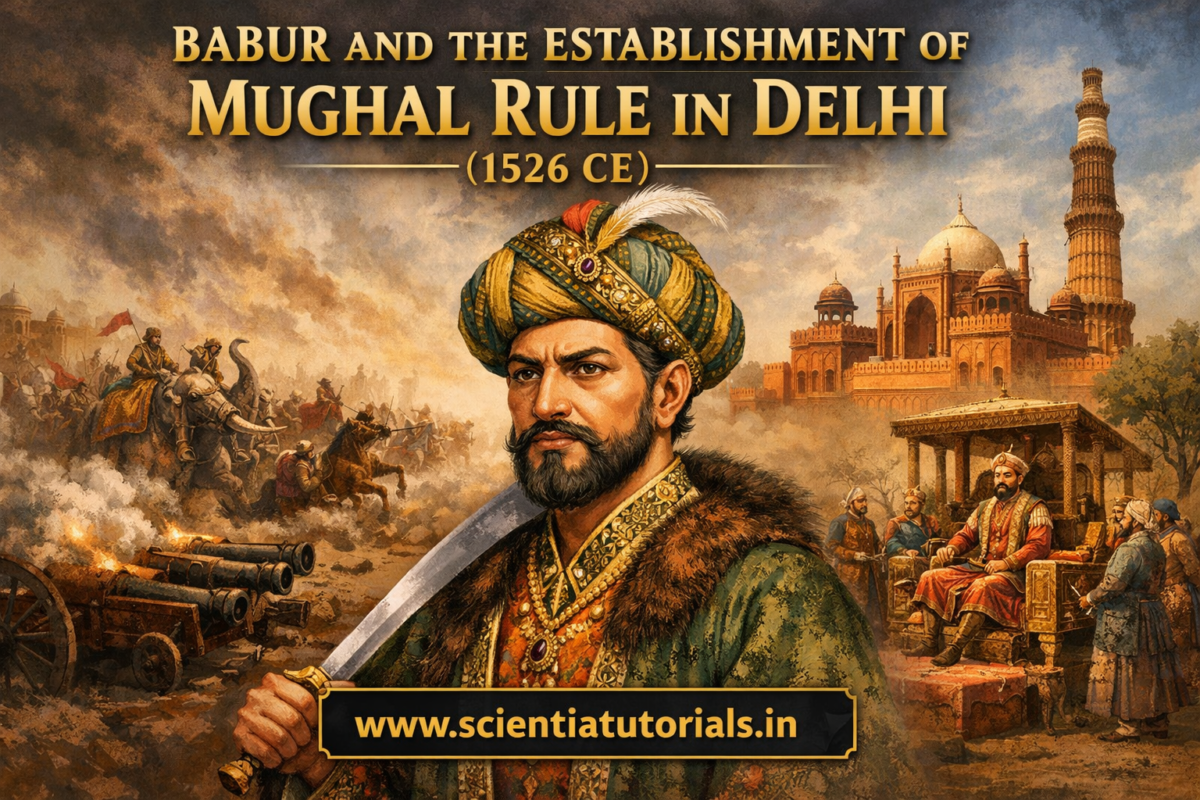

Babur and the Establishment of Mughal Rule in Delhi (1526 CE)
Course: History of Delhi – Chronological Era-Wise Study Module for Competitive Exams
Module IV: Mughal Era Delhi (1526 CE – 1707 CE)
Lesson 1: Babur and the Establishment of Mughal Rule
This lesson is systematically organized into four clearly structured sections, as detailed below:
- Chronologically Structured Study Module
- Short-Answer Type Questions
- Long-Answer Type Questions
- Multiple-Choice Questions (MCQs) with Answers and Detailed Explanations
Chronologically Structured Study Module
Introduction: Transition from Sultanate to Mughal Rule
The year 1526 CE marks a decisive turning point in the political history of Delhi and North India. With the defeat of the Delhi Sultan Ibrahim Lodi at the First Battle of Panipat, the political authority that had governed Delhi since the early thirteenth century came to an end, giving rise to a new imperial system under Babur. This lesson examines the chronological process through which Babur established Mughal rule in Delhi, analysing his background, campaigns, military innovations, administrative vision, and the immediate impact of Mughal conquest on Delhi.
For competitive examinations, Babur’s role is not merely that of a conqueror but of a founder of a new imperial tradition that reshaped Delhi’s political, cultural, and strategic importance for nearly two centuries.
Lesson Objectives
By the end of this lesson, learners should be able to:
- Trace Babur’s Central Asian origins and early struggles
- Understand the political condition of Delhi on the eve of Mughal conquest
- Analyse the First Battle of Panipat (1526 CE) and its significance
- Evaluate Babur’s military innovations, especially gunpowder warfare
- Assess Babur’s early administrative measures in Delhi
- Explain the historical importance of Babur’s conquest for Mughal rule in India
I. Babur: Early Life and Central Asian Background
1. Lineage and Birth
Babur, born in 1483 CE at Andijan in Fergana, belonged to a distinguished lineage:
- On his father’s side, he was a descendant of Timur (Tamerlane)
- On his mother’s side, he traced his ancestry to Genghis Khan
This dual heritage provided Babur with political legitimacy in Central Asia and later strengthened his imperial claims in India.
2. Early Struggles in Central Asia
Babur’s early life was marked by instability:
- Became ruler of Fergana at the age of 12
- Lost and regained Samarkand multiple times
- Faced constant threats from Uzbek leader Shaibani Khan
Repeated failures in Central Asia compelled Babur to look southwards toward India, a region long known for its wealth and political fragmentation.
II. Political Condition of Delhi Before Babur (Early 16th Century)
1. Decline of the Delhi Sultanate
By the early sixteenth century, the Delhi Sultanate was under the Lodi dynasty, characterized by:
- Weak central authority
- Rebellious Afghan nobles
- Absence of disciplined military organization
Sultan Ibrahim Lodi faced opposition from both nobles and regional chiefs, creating conditions favourable for foreign intervention.
2. Afghan Nobility and Internal Dissensions
- Nobles resented Ibrahim Lodi’s autocratic behaviour
- Governors in Punjab and North India revolted
- Some Afghan nobles invited Babur to invade India
These internal divisions played a decisive role in Babur’s success.
III. Babur’s Invasions of India: A Chronological Account
1. Early Expeditions (1519–1524 CE)
Babur conducted multiple reconnaissance raids into India:
- Targeted Punjab region
- Tested military strength of Afghan rulers
- Established contacts with discontented nobles
These expeditions prepared the ground for a full-scale invasion.
2. Final March Towards Delhi (1525–1526 CE)
In late 1525 CE:
- Babur crossed the Indus River
- Advanced with a small but well-trained army
- Faced Ibrahim Lodi near Panipat, north of Delhi
IV. First Battle of Panipat (1526 CE)
1. Date, Place, and Opposing Forces
- Date: 21 April 1526 CE
- Place: Panipat (near Delhi)
- Babur’s Army: ~12,000 soldiers
- Ibrahim Lodi’s Army: ~1,00,000 soldiers and war elephants
Despite numerical inferiority, Babur emerged victorious.
2. Military Innovations Used by Babur
Babur introduced new warfare techniques in India:
- Gunpowder artillery (cannons and matchlocks)
- Tulughma system – division of army into flanks
- Araba system – carts tied with ropes forming defensive walls
These techniques, borrowed partly from Ottoman military practices, neutralized Afghan war elephants and traditional cavalry.
3. Death of Ibrahim Lodi
Ibrahim Lodi was killed on the battlefield, marking:
- End of the Lodi dynasty
- Collapse of Delhi Sultanate authority
- Beginning of Mughal political supremacy
V. Occupation of Delhi and Agra
1. Entry into Delhi
After the victory at Panipat:
- Babur occupied Delhi
- Declared himself Padshah of Hindustan
- Distributed wealth to soldiers and nobles
Delhi symbolized political legitimacy and imperial continuity.
2. Capture of Agra
- Agra was seized without major resistance
- Large treasury of the Lodis came under Mughal control
- Agra later emerged as a major Mughal capital
VI. Challenges to Babur’s Authority in North India
1. Battle of Khanwa (1527 CE)
Babur faced a powerful Rajput confederacy led by Rana Sanga:
- Battle fought near Khanwa (Rajasthan)
- Babur again used artillery and defensive tactics
- Rajputs were decisively defeated
This battle confirmed Mughal dominance over Rajput powers.
2. Afghan Resistance in Eastern India
- Battles of Chanderi (1528) and Ghaghra (1529)
- Suppression of Afghan chiefs in Bihar and Bengal
By 1529 CE, Babur’s authority extended across North India.
VII. Babur’s Administrative Measures in Delhi
1. Nature of Early Mughal Administration
Babur’s rule in India was short (1526–1530 CE), yet significant:
- Retained existing administrative structures
- Appointed trusted nobles as governors
- Ensured revenue collection continued smoothly
He focused more on military consolidation than detailed administration.
2. Attitude Towards Indian Society
- Followed Islamic practices but showed political pragmatism
- Did not impose religious uniformity
- Encouraged stability to secure Mughal rule
VIII. Babur as a Ruler and Thinker
1. Baburnama: A Historical Source
Babur authored Baburnama, a valuable autobiographical work:
- Written in Turki language
- Provides vivid descriptions of India, Delhi, people, and climate
- Important primary source for Mughal history
2. Cultural Sensibilities
- Lover of gardens and architecture
- Introduced Persian-style gardens (Charbagh)
- Laid foundation for Mughal cultural synthesis
IX. Significance of Babur’s Establishment of Mughal Rule
1. End of Medieval Political Order
Babur’s conquest marked:
- Final collapse of Sultanate-era political system
- Introduction of centralized imperial governance
2. Beginning of Mughal Era in Delhi
- Delhi regained importance as imperial centre
- Mughal rule brought political stability
- Set stage for later rulers like Humayun and Akbar
3. Military Transformation
- Permanent introduction of gunpowder warfare
- Decline of war elephants
- Professional standing armies became norm
X. Chronological Summary (Quick Revision for Exams)
- 1483 CE – Birth of Babur
- 1519–1524 CE – Babur’s early Indian raids
- 1526 CE – First Battle of Panipat; capture of Delhi
- 1527 CE – Battle of Khanwa
- 1528–1529 CE – Suppression of Afghan resistance
- 1530 CE – Death of Babur
XI. Examination-Oriented Key Points
- Babur founded the Mughal Empire, not merely conquered Delhi
- Victory due to artillery and military tactics, not numbers
- Panipat (1526) is a landmark battle in Indian history
- Babur’s rule laid foundation for centralized Mughal state
- Baburnama is a primary historical source
Conclusion
Babur’s establishment of Mughal rule in Delhi was a watershed moment in Indian history. Through military innovation, strategic intelligence, and political adaptability, Babur transformed Delhi from a declining Sultanate capital into the nucleus of a powerful Mughal Empire. Though his reign was brief, its consequences were enduring, shaping the political, military, and cultural trajectory of Delhi from 1526 CE onwards.
This lesson forms the gateway to understanding Mughal imperial expansion, administrative evolution, and Delhi’s transformation into the heart of one of the greatest empires in Indian history.
Module IV: Mughal Era Delhi (1526–1707 CE)
Lesson 1: Babur and the Establishment of Mughal Rule
Short Answer Type Questions (with Answers)
1. Who was the founder of the Mughal Empire in India?
Answer: Babur was the founder of the Mughal Empire in India.
2. In which year did Babur establish Mughal rule in Delhi?
Answer: Babur established Mughal rule in 1526 CE.
3. Which battle marked the beginning of Mughal rule in India?
Answer: The First Battle of Panipat (1526 CE) marked the beginning of Mughal rule.
4. Who was the last ruler of the Lodi dynasty defeated by Babur?
Answer: Ibrahim Lodi was the last Lodi ruler defeated by Babur.
5. Where was Babur born?
Answer: Babur was born at Andijan in Fergana (Central Asia).
6. Babur was a descendant of which two great historical figures?
Answer: Babur was a descendant of Timur on his father’s side and Genghis Khan on his mother’s side.
7. What was the political condition of Delhi before Babur’s invasion?
Answer: Delhi was politically unstable due to weak central authority and internal conflicts under the Lodi dynasty.
8. Why did Afghan nobles invite Babur to invade India?
Answer: Afghan nobles were dissatisfied with Ibrahim Lodi’s autocratic rule and sought Babur’s support to overthrow him.
9. Name the capital city captured by Babur after the Battle of Panipat.
Answer: Babur captured Delhi after the Battle of Panipat.
10. What was the approximate strength of Babur’s army at Panipat?
Answer: Babur’s army consisted of about 12,000 soldiers.
11. Mention one major military weakness of Ibrahim Lodi’s army.
Answer: Ibrahim Lodi’s army relied heavily on war elephants and lacked modern artillery.
12. Which new weapon gave Babur a decisive advantage in India?
Answer: Gunpowder artillery, including cannons and matchlocks, gave Babur a decisive advantage.
13. What was the ‘Tulughma’ system used by Babur?
Answer: It was a military tactic involving the division of the army into centre, left, and right flanks for encirclement.
14. What was the ‘Araba’ system in Mughal warfare?
Answer: It involved the use of carts tied with ropes to form a defensive barrier for artillery.
15. Which battle confirmed Mughal supremacy over the Rajputs?
Answer: The Battle of Khanwa (1527 CE) confirmed Mughal supremacy over the Rajputs.
16. Who led the Rajput confederacy against Babur at Khanwa?
Answer: Rana Sanga of Mewar led the Rajput confederacy.
17. Which important city’s treasury strengthened Babur’s position after conquest?
Answer: The treasury of Agra strengthened Babur’s position.
18. Name the autobiographical work written by Babur.
Answer: Babur wrote the Baburnama.
19. In which language was the Baburnama written?
Answer: The Baburnama was written in Turki (Chagatai Turkish).
20. Mention one historical importance of the Baburnama.
Answer: It is a primary source for understanding early Mughal history and Babur’s views on India.
21. How did Babur describe India in general?
Answer: Babur described India as rich in resources but different in climate, customs, and landscape from Central Asia.
22. Which battles finally crushed Afghan resistance to Babur’s rule?
Answer: The Battles of Chanderi (1528 CE) and Ghaghra (1529 CE) crushed Afghan resistance.
23. What title did Babur assume after occupying Delhi?
Answer: Babur assumed the title of Padshah of Hindustan.
24. How long did Babur rule India?
Answer: Babur ruled India from 1526 CE to 1530 CE.
25. State one major historical significance of Babur’s conquest of Delhi.
Answer: Babur’s conquest ended the Delhi Sultanate and laid the foundation of the Mughal Empire in India.
These short answer questions are designed strictly in accordance with Module IV: Mughal Era Delhi and are highly suitable for school-level, undergraduate, and competitive examinations, ensuring clarity, factual accuracy, and chronological understanding.
Module IV: Mughal Era Delhi (1526–1707 CE)
Lesson 1: Babur and the Establishment of Mughal Rule
Long Answer Type Questions with Answers
1. Discuss the early life and Central Asian background of Babur. How did these experiences shape his ambition to conquer India?
Answer:
Babur was born in 1483 CE at Andijan in the Fergana Valley of Central Asia. He inherited a small kingdom at a very young age and spent his early years fighting to retain and expand his territories. Despite repeated attempts, he failed to secure lasting control over Samarkand due to constant pressure from the Uzbek leader Shaibani Khan. These failures forced Babur to abandon his Central Asian ambitions. India, known for its wealth and political fragmentation, appeared as a promising alternative. His early struggles made him a resilient military leader and shaped his ambition to establish a stable empire elsewhere, eventually leading him to India.
2. Examine the political condition of Delhi and North India on the eve of Babur’s invasion.
Answer:
On the eve of Babur’s invasion, Delhi was ruled by the Lodi dynasty, which suffered from weak central authority and internal dissensions. Sultan Ibrahim Lodi alienated Afghan nobles through his autocratic policies. Provincial governors were rebellious, and the army lacked discipline and modern weaponry. The absence of unity among Afghan chiefs and dissatisfaction among nobles created favourable conditions for a foreign invasion. This political instability made Delhi vulnerable to Babur’s military intervention.
3. Analyse the causes that led Babur to invade India repeatedly between 1519 and 1526 CE.
Answer:
Babur’s repeated invasions of India were driven by multiple factors. His failure in Central Asia pushed him to seek a new base of power. India’s immense wealth attracted him, while the disunity among Indian rulers made conquest easier. Invitations from discontented Afghan nobles further encouraged him. Strategically, India provided a secure and fertile region for establishing a lasting empire, unlike the unstable politics of Central Asia.
4. Describe the events leading to the First Battle of Panipat (1526 CE).
Answer:
After several exploratory raids, Babur launched a full-scale invasion in 1525 CE. He crossed the Indus River and advanced through Punjab, facing little resistance. Ibrahim Lodi moved north with a large army to confront him. Both forces met at Panipat in April 1526. Babur carefully prepared the battlefield and arranged his forces strategically, setting the stage for a decisive encounter that would change Indian history.
5. Give a detailed account of the First Battle of Panipat and explain why Babur emerged victorious.
Answer:
The First Battle of Panipat was fought on 21 April 1526 CE. Babur’s army was numerically inferior but highly disciplined. He used gunpowder artillery, matchlocks, and innovative tactics such as the Tulughma and Araba systems. Ibrahim Lodi’s army relied on traditional cavalry and war elephants, which proved ineffective against artillery fire. The Afghan forces were disorganised, and Ibrahim Lodi was killed on the battlefield. Babur’s superior military strategy ensured his decisive victory.
6. Evaluate the significance of the First Battle of Panipat in Indian history.
Answer:
The First Battle of Panipat marked the end of the Delhi Sultanate and the beginning of Mughal rule in India. It introduced gunpowder warfare on a large scale and changed the nature of Indian battles. Politically, it ended Afghan dominance and laid the foundation of a centralized Mughal Empire. The battle stands as a major turning point in medieval Indian history.
7. Explain the role of gunpowder technology in Babur’s success in India.
Answer:
Gunpowder technology played a decisive role in Babur’s success. His use of cannons and firearms neutralized the enemy’s numerical strength and war elephants. The loud noise and destructive power of artillery caused panic in the opposing ranks. This technological advantage allowed Babur to defeat much larger armies and establish Mughal supremacy.
8. Describe the Tulughma and Araba systems of warfare used by Babur.
Answer:
The Tulughma system involved dividing the army into left, right, and centre divisions to encircle the enemy. The Araba system used carts tied with ropes to form a defensive wall protecting artillery. These tactics enabled Babur to combine mobility with defence, ensuring effective use of firearms and preventing enemy advances.
9. How did Babur consolidate his position after occupying Delhi and Agra?
Answer:
After occupying Delhi, Babur declared himself the ruler of Hindustan and distributed rewards to his nobles and soldiers. The capture of Agra provided him access to immense wealth, strengthening his financial position. He appointed trusted officers to govern key regions and focused on military consolidation to suppress opposition.
10. Discuss the Battle of Khanwa (1527 CE) and its importance.
Answer:
The Battle of Khanwa was fought between Babur and a Rajput confederacy led by Rana Sanga. Babur once again used artillery and defensive tactics. Despite fierce resistance, the Rajputs were defeated. This victory established Mughal supremacy over Rajput powers and confirmed Babur’s authority in North India.
11. Examine the Afghan resistance faced by Babur after Panipat.
Answer:
After Panipat, Afghan chiefs continued to resist Babur’s authority, particularly in eastern India. Babur fought campaigns at Chanderi and Ghaghra to suppress them. By defeating Afghan leaders in these battles, Babur eliminated major opposition and secured Mughal control over North India.
12. Assess Babur’s administrative arrangements during his short reign in India.
Answer:
Babur’s reign in India was brief, so his administrative measures were limited. He largely retained existing systems of revenue and governance. Trusted nobles were appointed as governors, and efforts were made to maintain law and order. His primary focus remained military consolidation rather than detailed administrative reforms.
13. Analyse Babur’s attitude towards Indian society and religion.
Answer:
Babur was a devout Muslim but politically pragmatic. He did not attempt forced conversions or impose religious uniformity. His policies aimed at stability and acceptance rather than confrontation, which helped him secure support and reduce resistance.
14. Describe Babur’s personality as revealed through the Baburnama.
Answer:
The Baburnama reveals Babur as a sensitive, observant, and cultured ruler. He appreciated nature, gardens, and poetry. At the same time, he was honest about his failures and weaknesses. This makes the Baburnama a unique autobiographical source in medieval Indian history.
15. Why is the Baburnama considered an important historical source?
Answer:
The Baburnama is a first-hand account written by Babur himself. It provides detailed information about Central Asia, India, military campaigns, society, and climate. Its accuracy and personal tone make it an invaluable primary source for understanding early Mughal history.
16. Examine the cultural contributions of Babur in India.
Answer:
Babur introduced Persian-style gardens and laid the foundation for Mughal aesthetic traditions. His love for architecture and landscaping influenced later Mughal rulers. Though limited by time, his cultural preferences shaped Mughal tastes in art and architecture.
17. How did Babur’s conquest change the political importance of Delhi?
Answer:
Babur’s conquest transformed Delhi into the centre of a new imperial system. Under the Mughals, Delhi regained political prominence and became a symbol of centralized authority, replacing the fragmented Sultanate order.
18. Discuss the reasons for the rapid collapse of the Lodi dynasty.
Answer:
The Lodi dynasty collapsed due to internal disunity, autocratic governance, lack of military innovation, and weak leadership. Ibrahim Lodi failed to command loyalty among nobles, making his regime vulnerable to Babur’s invasion.
19. Evaluate Babur’s role as a military strategist.
Answer:
Babur was an innovative military strategist who successfully adapted Central Asian warfare techniques to Indian conditions. His effective use of artillery, defensive tactics, and battlefield planning allowed him to defeat much larger forces.
20. Explain why Babur is regarded as the founder of the Mughal Empire rather than merely a conqueror.
Answer:
Babur is regarded as the founder because he established a new ruling dynasty with lasting institutions. His victories laid the foundation for a centralized empire that was consolidated and expanded by his successors.
21. Analyse the long-term significance of Babur’s conquest for Indian history.
Answer:
Babur’s conquest introduced a new political order, military technology, and cultural synthesis. It marked the beginning of the Mughal era, which brought stability, administrative efficiency, and cultural flourishing to North India.
22. Compare Babur’s army with that of Ibrahim Lodi.
Answer:
Babur’s army was small but disciplined and technologically advanced. Ibrahim Lodi’s army was large but poorly organized and relied on outdated warfare methods. This contrast explains Babur’s decisive victory.
23. Discuss Babur’s vision of kingship as reflected in his actions in India.
Answer:
Babur viewed kingship as a combination of military strength and moral responsibility. He rewarded loyalty, valued justice, and sought stability. His actions reveal an attempt to establish legitimate and enduring rule.
24. How did Babur’s Central Asian experiences influence Mughal rule in India?
Answer:
Babur brought Central Asian traditions of governance, military organization, and culture to India. These influences shaped Mughal administrative practices, court culture, and military systems.
25. Conclude with an assessment of Babur’s historical legacy.
Answer:
Babur’s historical legacy lies in founding one of the greatest empires in Indian history. Despite his short reign, he transformed Delhi’s political destiny and laid the groundwork for nearly two centuries of Mughal rule, making him a pivotal figure in medieval Indian history.
These long answer questions with detailed answers are fully aligned with Module IV: Mughal Era Delhi and are especially useful for university examinations, civil services preparation, and other competitive exams, ensuring conceptual clarity, chronological understanding, and analytical depth.
Module IV: Mughal Era Delhi (1526–1707 CE)
Lesson 1: Babur and the Establishment of Mughal Rule
Multiple Choice Questions (MCQs) with Answers and Explanations
1. Who founded the Mughal Empire in India?
A. Timur
B. Genghis Khan
C. Babur
D. Humayun
Correct Answer: C
Explanation:
Babur founded the Mughal Empire in India after defeating Ibrahim Lodi in 1526 CE. Timur and Genghis Khan were his ancestors, while Humayun was his successor.
2. In which year did Babur defeat Ibrahim Lodi?
A. 1519 CE
B. 1524 CE
C. 1526 CE
D. 1529 CE
Correct Answer: C
Explanation:
The First Battle of Panipat was fought in 1526 CE, marking the beginning of Mughal rule in India.
3. The First Battle of Panipat was fought between Babur and which ruler?
A. Sikandar Lodi
B. Rana Sanga
C. Daulat Khan Lodi
D. Ibrahim Lodi
Correct Answer: D
Explanation:
Ibrahim Lodi, the last Sultan of the Lodi dynasty, led the Delhi Sultanate forces against Babur at Panipat.
4. What was the approximate strength of Babur’s army at Panipat?
A. 1,00,000 soldiers
B. 50,000 soldiers
C. 12,000 soldiers
D. 25,000 soldiers
Correct Answer: C
Explanation:
Babur’s army was numerically small (around 12,000) but well-trained and technologically advanced.
5. Which military innovation gave Babur a decisive advantage in India?
A. War elephants
B. Heavy cavalry
C. Naval power
D. Gunpowder artillery
Correct Answer: D
Explanation:
Babur’s effective use of cannons and firearms introduced gunpowder warfare on a large scale in India.
6. The ‘Tulughma’ system refers to:
A. Defensive wall of carts
B. Revenue collection method
C. Division of army into flanks for encirclement
D. Use of war elephants
Correct Answer: C
Explanation:
The Tulughma tactic involved dividing forces into left, right, and centre units to surround the enemy.
7. The ‘Araba’ system was used by Babur mainly to:
A. Transport soldiers
B. Protect cavalry
C. Create a defensive barrier for artillery
D. Supply food
Correct Answer: C
Explanation:
Carts tied with ropes formed a protective wall behind which artillery could be safely deployed.
8. Which dynasty ended with the death of Ibrahim Lodi?
A. Slave dynasty
B. Tughlaq dynasty
C. Sayyid dynasty
D. Lodi dynasty
Correct Answer: D
Explanation:
The Lodi dynasty was the last ruling dynasty of the Delhi Sultanate, ending in 1526 CE.
9. Babur belonged to which region before invading India?
A. Persia
B. Afghanistan
C. Central Asia (Fergana)
D. Arabia
Correct Answer: C
Explanation:
Babur was born in Fergana in Central Asia and initially struggled to establish power there.
10. Babur was a descendant of Timur and:
A. Alexander
B. Attila
C. Genghis Khan
D. Chengiz Beg
Correct Answer: C
Explanation:
Babur traced his lineage to Timur on his father’s side and Genghis Khan on his mother’s side.
11. Which city symbolised political legitimacy and was occupied by Babur after Panipat?
A. Lahore
B. Agra
C. Delhi
D. Jaunpur
Correct Answer: C
Explanation:
Delhi had been the seat of imperial authority for centuries, making its occupation crucial for legitimacy.
12. Which battle established Mughal supremacy over the Rajputs?
A. Panipat
B. Chanderi
C. Ghaghra
D. Khanwa
Correct Answer: D
Explanation:
The Battle of Khanwa (1527 CE) against Rana Sanga confirmed Mughal dominance in North India.
13. Who led the Rajput confederacy against Babur at Khanwa?
A. Rana Pratap
B. Rana Kumbha
C. Rana Sanga
D. Udai Singh
Correct Answer: C
Explanation:
Rana Sanga of Mewar united several Rajput chiefs against Babur.
14. Which Afghan ruler invited Babur to invade India due to dissatisfaction with Ibrahim Lodi?
A. Sher Shah
B. Daulat Khan Lodi
C. Sikandar Lodi
D. Mahmud Lodi
Correct Answer: B
Explanation:
Daulat Khan Lodi, governor of Punjab, sought Babur’s help against Ibrahim Lodi.
15. Which battle finally crushed Afghan resistance in eastern India?
A. Panipat
B. Khanwa
C. Chanderi
D. Ghaghra
Correct Answer: D
Explanation:
The Battle of Ghaghra (1529 CE) ended major Afghan opposition to Babur.
16. Babur ruled India from:
A. 1519–1526 CE
B. 1526–1529 CE
C. 1526–1530 CE
D. 1526–1535 CE
Correct Answer: C
Explanation:
Babur’s Indian reign lasted four years, from his victory at Panipat until his death in 1530 CE.
17. What was the main weakness of Ibrahim Lodi’s army?
A. Lack of soldiers
B. Lack of elephants
C. Outdated military techniques
D. Lack of cavalry
Correct Answer: C
Explanation:
Despite large numbers, Ibrahim Lodi’s army lacked modern artillery and discipline.
18. Babur’s autobiography is known as:
A. Akbarnama
B. Tuzuk-i-Jahangiri
C. Humayunnama
D. Baburnama
Correct Answer: D
Explanation:
The Baburnama is Babur’s autobiographical work and a vital historical source.
19. The Baburnama was originally written in:
A. Persian
B. Arabic
C. Hindi
D. Turki (Chagatai Turkish)
Correct Answer: D
Explanation:
Babur wrote his memoirs in Turki, his mother tongue.
20. Which feature makes the Baburnama unique among medieval sources?
A. Religious content
B. Mythical stories
C. First-person personal narrative
D. Court chronicles
Correct Answer: C
Explanation:
It is a candid first-person autobiography, rare for medieval rulers.
21. Babur assumed which title after occupying Delhi?
A. Sultan of Delhi
B. Amir-ul-Mominin
C. Shahanshah
D. Padshah of Hindustan
Correct Answer: D
Explanation:
The title signified his claim as supreme ruler over North India.
22. Which factor did NOT contribute to Babur’s success in India?
A. Afghan disunity
B. Use of artillery
C. Superior tactics
D. Large numerical strength
Correct Answer: D
Explanation:
Babur succeeded despite being numerically inferior, not because of large numbers.
23. What was Babur’s primary focus during his short reign in India?
A. Religious reforms
B. Architectural projects
C. Military consolidation
D. Land revenue reforms
Correct Answer: C
Explanation:
Babur concentrated on securing and expanding his conquests rather than detailed administration.
24. Babur’s conquest marked the end of which political system?
A. Ancient Indian monarchy
B. Mauryan administration
C. Delhi Sultanate system
D. Provincial autonomy
Correct Answer: C
Explanation:
The defeat of the Lodis ended the Sultanate phase of Delhi’s history.
25. Which long-term change did Babur introduce in Indian warfare?
A. Greater use of elephants
B. Guerrilla warfare
C. Naval battles
D. Permanent use of gunpowder weapons
Correct Answer: D
Explanation:
After Babur, gunpowder weapons became a regular feature of Indian armies.
26. Why is Babur regarded as the founder of a dynasty rather than a temporary conqueror?
A. He ruled for many decades
B. He destroyed Indian culture
C. He laid the foundation of a lasting empire
D. He converted most of India
Correct Answer: C
Explanation:
Babur established the Mughal dynasty, which ruled India for nearly two centuries.
These 26 MCQs with detailed explanations are strictly aligned with Module IV: Mughal Era Delhi – Lesson 1 and are highly suitable for school examinations, university assessments, and competitive exams (UPSC, State PSCs, SSC, etc.), ensuring both factual accuracy and conceptual clarity.