
Lesson 2: Decline of Mughal Authority under British Rule
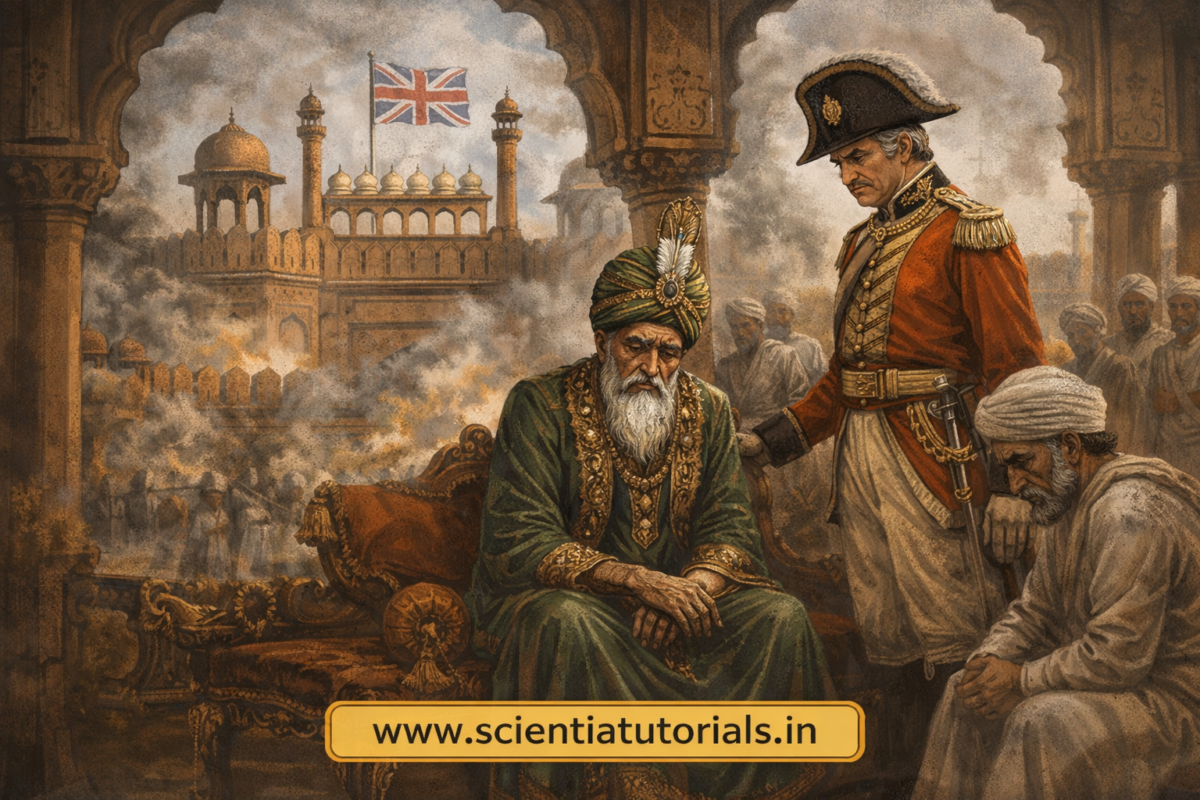

Decline of Mughal Authority under British Rule in Delhi (1803–1858)
Course: History of Delhi – Chronological Era-Wise Study Module for Competitive Exams
Module VI: British Colonial Delhi (1803 CE – 1911 CE)
Lesson 2: Decline of Mughal Authority under British Rule
This lesson is systematically organized into four clearly structured sections, as detailed below:
- Chronologically Structured Study Module
- Short-Answer Type Questions
- Long-Answer Type Questions
- Multiple-Choice Questions (MCQs) with Answers and Detailed Explanations
Chronologically Structured Study Module
Introduction: From Imperial Sovereignty to Colonial Subordination
The capture of Delhi by the British East India Company in 1803 CE marked a decisive rupture in Indian political history. While the Mughal dynasty continued nominally until 1858 CE, real authority steadily shifted from the Mughal emperors to the British. This lesson examines the systematic, phased, and deliberate decline of Mughal authority under British rule, tracing how an imperial dynasty was reduced from sovereign rulers to pensioned dependents and finally eliminated altogether.
For competitive examinations, this topic is crucial as it explains:
- The political strategy of indirect British rule
- The symbolic use and eventual removal of Mughal legitimacy
- The transition from Company rule to Crown rule
- The role of Delhi in the Revolt of 1857
- The end of the Mughal Empire and reconfiguration of Delhi’s status
1. Background: Mughal Position at the Time of British Takeover (1803 CE)
When the British captured Delhi from the Marathas in 1803, the Mughal emperor was Shah Alam II. By this time:
- The Mughal Empire had lost territorial control
- The emperor depended on regional powers for protection
- Delhi had already suffered invasions (Nadir Shah, Ahmad Shah Abdali)
Key Reality (Exam-Oriented Insight):
The British did not overthrow the Mughal emperor immediately. Instead, they retained him as a symbolic authority to legitimize their expanding rule.
2. Phase I (1803–1835): Mughal Emperor as a Protected Puppet
2.1 British Policy of Indirect Control
After 1803, the British adopted a policy of non-interference in Mughal ceremonial authority, while exercising complete control over:
- Military
- Revenue
- Diplomacy
- Law and order
The Mughal emperor:
- Lived within the Red Fort
- Received a fixed pension
- Had no independent army or administration
2.2 Reduction of Sovereign Powers
Key developments:
- British Resident stationed in Delhi
- Emperor forbidden from diplomatic correspondence
- Revenue rights transferred to Company officials
➡️ Exam Note:
This arrangement reflects the British strategy of “control without annexation”, a recurring theme in early colonial governance.
3. Phase II (1806–1835): Accelerated Decline after Shah Alam II
After Shah Alam II’s death in 1806:
- Successor emperors were politically insignificant
- Mughal court culture became ritualistic rather than administrative
Important Emperors of This Phase:
- Akbar II (1806–1837)
Akbar II:
- Had no authority outside Red Fort
- Was denied recognition as “King of India” by the British
- Was referred to as “King of Delhi”, symbolically reducing Mughal status
➡️ Symbolic Degradation:
The British refused to stand in Akbar II’s presence, reversing Mughal court etiquette.
4. Phase III (1835–1857): Cultural Survival, Political Death
4.1 End of Mughal Coinage and Titles
In 1835, a landmark decision was taken:
- Mughal emperor’s name removed from Company coinage
- Persian replaced by English as official language
➡️ Exam Highlight:
This marks the formal end of Mughal sovereignty, even in symbolic terms.
4.2 Rise of Bahadur Shah Zafar**
Ascending the throne in 1837, Bahadur Shah Zafar:
- Was a poet, not a ruler
- Controlled neither army nor revenue
- Became a cultural symbol of Indo-Islamic heritage
Despite political weakness:
- The Mughal court remained a center of Urdu poetry and culture
- Zafar patronized poets like Mirza Ghalib
➡️ Important Insight:
The Mughal Empire survived culturally, even as it died politically.
5. Administrative and Economic Marginalization of the Mughal Court
5.1 Financial Dependence
- Emperor lived on British pension
- Court expenses strictly monitored
- Palace lands confiscated gradually
5.2 Loss of Judicial Authority
- British courts operated independently
- Emperor had no power to administer justice
- Criminal and civil cases bypassed Mughal authority
➡️ Exam Linkage:
This illustrates how colonial rule dismantled indigenous institutions without direct confrontation.
6. The Revolt of 1857: Last Assertion of Mughal Legitimacy
6.1 Why Rebels Chose Bahadur Shah Zafar
In 1857, Indian soldiers and civilians revolted against British rule. Delhi became the symbolic heart of resistance because:
- The Mughal emperor represented legitimate Indian sovereignty
- Rebels needed a unifying authority
Bahadur Shah Zafar was proclaimed:
- “Shahenshah-e-Hind” (Emperor of India)
➡️ Crucial Exam Point:
The revolt was not Mughal-led, but Mughal-symbolized.
6.2 British Response and Fall of Delhi
- British recaptured Delhi after fierce fighting
- Massive destruction of the city
- Mughal princes executed
- Zafar arrested and tried
7. End of the Mughal Empire (1858 CE)
7.1 Trial and Exile of Bahadur Shah Zafar
- Charged with treason
- Exiled to Rangoon (Myanmar)
- Died in 1862 in poverty
With this:
- The Mughal dynasty formally ended
- British Crown assumed direct rule over India
7.2 Abolition of Mughal Title
In 1858:
- British Crown issued the Proclamation of Queen Victoria
- Mughal authority abolished permanently
- Delhi placed under direct British administration
➡️ Exam Fact:
1858 marks both the end of the Mughal Empire and the end of East India Company rule.
8. Delhi after the Mughals: From Imperial Capital to Colonial City
Post-1858:
- Red Fort converted into British military cantonment
- Large sections of Shahjahanabad demolished
- Delhi lost its status as imperial capital
British distrust of Delhi persisted until:
- 1911 CE, when Delhi was re-declared the capital of British India
9. Causes of Mughal Decline under British Rule (Analytical Summary)
Political Causes:
- Lack of military power
- British control over diplomacy
- Systematic erosion of sovereignty
Economic Causes:
- Confiscation of revenue sources
- Dependence on pensions
- Loss of jagirs and estates
Administrative Causes:
- Replacement of Mughal officials
- Introduction of British legal system
- Removal of emperor from governance
Cultural Survival vs Political Collapse:
- Mughal culture survived in literature and art
- Political authority completely extinguished
10. Chronological Timeline (Quick Revision for Exams)
- 1803 – British capture Delhi
- 1806 – Death of Shah Alam II
- 1835 – Mughal name removed from coinage
- 1837 – Bahadur Shah Zafar becomes emperor
- 1857 – Revolt; Zafar proclaimed emperor
- 1858 – End of Mughal Empire
- 1862 – Death of Bahadur Shah Zafar
- 1911 – Delhi becomes British Indian capital
Module VI: British Colonial Delhi (1803–1911 CE)
Lesson 2: Decline of Mughal Authority under British Rule
Short Answer Type Questions with Answers
1. What event in 1803 marked the beginning of British dominance over Delhi?
Answer:
The British East India Company captured Delhi from the Marathas in 1803, marking the beginning of British political dominance over the city.
2. Who was the Mughal emperor when the British captured Delhi in 1803?
Answer:
The Mughal emperor was Shah Alam II.
3. Why did the British retain the Mughal emperor after capturing Delhi?
Answer:
The British retained the Mughal emperor to use him as a symbolic authority to legitimize their rule over Indian territories.
4. What was the political status of the Mughal emperor after 1803?
Answer:
The Mughal emperor became a pensioned ruler with no real political, military, or administrative power.
5. What role did the British Resident play in Delhi?
Answer:
The British Resident supervised the Mughal court and ensured that imperial decisions aligned with British interests.
6. How did the British reduce Mughal military authority?
Answer:
The Mughal emperor was deprived of an independent army, and British forces assumed full control of Delhi’s defense.
7. Name the Mughal emperor who ruled after Shah Alam II and mention his significance.
Answer:
Akbar II ruled after Shah Alam II; his reign symbolized further decline as the British reduced his title to “King of Delhi.”
8. What symbolic insult did the British introduce during Akbar II’s reign?
Answer:
British officials refused to observe Mughal court etiquette, such as standing in the emperor’s presence.
9. Why is the year 1835 important in the decline of Mughal authority?
Answer:
In 1835, the Mughal emperor’s name was removed from British coinage, ending symbolic sovereignty.
10. Which language replaced Persian as the official language under British rule?
Answer:
English replaced Persian as the official language of administration.
11. Who was the last Mughal emperor of India?
Answer:
The last Mughal emperor was Bahadur Shah Zafar.
12. Why is Bahadur Shah Zafar considered a symbolic ruler?
Answer:
He had no administrative or military power and functioned mainly as a cultural and literary figure.
13. How did the Mughal court survive despite political decline?
Answer:
The Mughal court survived as a center of Urdu poetry, art, and Indo-Islamic culture.
14. What was the financial condition of the Mughal emperor under British rule?
Answer:
The emperor depended entirely on a fixed British pension and had no independent revenue sources.
15. How did British judicial reforms affect Mughal authority?
Answer:
British courts replaced Mughal judicial authority, stripping the emperor of legal power.
16. Why did rebels proclaim Bahadur Shah Zafar as emperor during the Revolt of 1857?
Answer:
He symbolized traditional Indian sovereignty and provided legitimacy to the revolt.
17. Was the Revolt of 1857 led by the Mughal emperor?
Answer:
No, the revolt was not Mughal-led but used the Mughal emperor as a symbolic figurehead.
18. What happened to Delhi after the British recaptured it in 1857?
Answer:
Delhi suffered massive destruction, and many Mughal princes were executed.
19. What punishment was given to Bahadur Shah Zafar after the revolt?
Answer:
He was tried for treason and exiled to Rangoon (Myanmar).
20. In which year did the Mughal Empire officially end?
Answer:
The Mughal Empire officially ended in 1858.
21. What major political change occurred in India in 1858?
Answer:
British Crown rule replaced East India Company rule in India.
22. How was the Red Fort used after the fall of the Mughal Empire?
Answer:
The Red Fort was converted into a British military cantonment.
23. Why did the British distrust Delhi after 1857?
Answer:
Delhi was seen as the symbolic center of resistance and rebellion against British authority.
24. When was Delhi re-declared the capital of British India and why is it significant?
Answer:
Delhi was re-declared the capital in 1911, restoring its political importance under British rule.
25. Mention one key reason for the decline of Mughal authority under British rule.
Answer:
The systematic erosion of political, military, and economic power by the British led to Mughal decline.
Module VI: British Colonial Delhi (1803–1911 CE)
Lesson 2: Decline of Mughal Authority under British Rule
Long Answer Type Questions with Answers
1. Examine the circumstances under which the British East India Company assumed control over Delhi in 1803 and its impact on Mughal authority.
Answer:
The British capture of Delhi in 1803 from the Marathas marked a decisive shift in political power. Although the Mughal emperor remained on the throne, real authority passed to the British East India Company. The Mughal ruler lost control over military, revenue, and diplomacy, becoming a dependent pensioner. This arrangement allowed the British to rule indirectly while using Mughal legitimacy to consolidate their power, initiating the gradual decline of Mughal sovereignty.
2. Discuss the political status of the Mughal emperor after 1803 under British rule.
Answer:
After 1803, the Mughal emperor retained only nominal authority. He resided in the Red Fort but had no control over administration, armed forces, or foreign relations. A British Resident supervised court affairs, and the emperor survived on a fixed pension. Thus, the Mughal ruler was reduced to a symbolic figurehead, marking the erosion of imperial power.
3. Analyze the role of Shah Alam II in the transition from Mughal sovereignty to British dominance.
Answer:
Shah Alam II witnessed the final collapse of Mughal political independence. Having earlier depended on regional powers, he accepted British protection in 1803. His reign symbolizes the shift from Mughal sovereignty to British supremacy, as he surrendered effective control while retaining ceremonial status.
4. How did the British policy of indirect rule contribute to the decline of Mughal authority?
Answer:
The British followed a policy of indirect rule by retaining the Mughal emperor as a nominal ruler while exercising real authority themselves. This strategy avoided immediate resistance, ensured continuity, and legitimized British expansion. Over time, however, it systematically dismantled Mughal institutions, rendering the emperor powerless.
5. Evaluate the reign of Akbar II in the context of Mughal decline.
Answer:
Akbar II’s reign (1806–1837) represents further degradation of Mughal prestige. The British reduced his title to “King of Delhi,” denied him imperial recognition, and disregarded court rituals. His reign illustrates how the British undermined Mughal dignity while maintaining symbolic continuity.
6. Explain the significance of the British Resident in Delhi during the early 19th century.
Answer:
The British Resident acted as the Company’s representative at the Mughal court. He supervised imperial decisions, controlled communication, and ensured compliance with British interests. This institution effectively replaced Mughal authority with colonial oversight.
7. Discuss the administrative measures adopted by the British to marginalize Mughal power.
Answer:
The British excluded the emperor from administration, replaced Mughal officials with Company servants, and introduced British courts and laws. Revenue collection and policing were transferred to British authorities, eliminating the emperor’s administrative relevance.
8. Assess the economic decline of the Mughal court under British rule.
Answer:
The Mughal emperor lost control over land revenue and jagirs, becoming dependent on a British pension. Palace expenses were monitored, and imperial estates were confiscated. This economic dependence ensured the emperor’s political helplessness.
9. Why was the removal of the Mughal emperor’s name from coinage in 1835 a turning point?
Answer:
Coinage symbolized sovereignty. Removing the Mughal emperor’s name in 1835 ended even symbolic authority. It signified that political legitimacy now rested solely with the British.
10. Examine the cultural survival of the Mughal court despite political decline.
Answer:
Although politically powerless, the Mughal court remained a center of Indo-Islamic culture, Urdu poetry, and artistic patronage. This cultural resilience highlights the distinction between political collapse and cultural continuity.
11. Analyze the reign of Bahadur Shah Zafar as the last phase of the Mughal Empire.
Answer:
Bahadur Shah Zafar ruled without power, authority, or resources. A poet-emperor, he presided over a court that symbolized India’s imperial past while lacking real governance, marking the final stage of Mughal decline.
12. Why did the Revolt of 1857 transform the symbolic position of the Mughal emperor?
Answer:
The rebels proclaimed Bahadur Shah Zafar as Emperor of India to legitimize their resistance. Though reluctant and powerless, his association turned the revolt into a direct challenge to British sovereignty.
13. Was the Revolt of 1857 a Mughal-led movement? Explain.
Answer:
No, the revolt was not Mughal-led. It was initiated by Indian soldiers and civilians. The Mughal emperor was used as a symbolic figurehead to unify resistance and invoke legitimacy.
14. Describe the British response to the Mughal emperor after the failure of the Revolt of 1857.
Answer:
The British captured Delhi, executed Mughal princes, tried Bahadur Shah Zafar for treason, and exiled him to Rangoon. This marked the deliberate elimination of the Mughal dynasty.
15. Discuss the significance of the year 1858 in Indian history.
Answer:
In 1858, the Mughal Empire was formally abolished, and British Crown rule replaced Company rule. This year marks the end of medieval political authority and the beginning of direct colonial governance.
16. How did the fall of the Mughal Empire affect the city of Delhi?
Answer:
Delhi lost its imperial character. Large sections were destroyed, the Red Fort became a military base, and the city was placed under strict colonial control, ending its role as a traditional power center.
17. Evaluate the long-term consequences of Mughal decline on Indian polity.
Answer:
The decline eliminated indigenous imperial authority, paving the way for centralized colonial rule. It also altered political legitimacy, replacing dynastic sovereignty with imperial colonial governance.
18. Why did the British distrust Delhi after 1857?
Answer:
Delhi was seen as the symbolic heart of rebellion and Mughal legitimacy. British policies aimed to weaken its political importance and prevent future resistance.
19. Explain how the decline of the Mughal Empire illustrates the nature of British colonial strategy.
Answer:
The British dismantled Mughal power gradually through symbolism, administration, and economy rather than immediate overthrow. This reflects a calculated colonial strategy of control without confrontation.
20. Critically analyze the statement: “The Mughal Empire ended not with a battle, but with a policy.”
Answer:
The Mughal Empire collapsed through systematic erosion rather than sudden conquest. British policies of indirect rule, economic dependence, administrative exclusion, and symbolic degradation ensured its quiet demise, validating the statement.
Module VI: British Colonial Delhi (1803–1911 CE)
Lesson 2: Decline of Mughal Authority under British Rule
MCQs with Answers and Explanations
1. The decline of Mughal authority under British rule effectively began after which event?
A. Death of Aurangzeb
B. Battle of Buxar
C. British capture of Delhi
D. Revolt of 1857
Correct Answer: C
Explanation:
The British capture of Delhi in 1803 marked the beginning of direct British dominance over the Mughal capital, reducing the emperor to a symbolic figure.
2. Who was the Mughal emperor at the time of British capture of Delhi in 1803?
A. Akbar II
B. Alamgir II
C. Shah Alam II
D. Bahadur Shah Zafar
Correct Answer: C
Explanation:
Shah Alam II was the ruling emperor when Delhi fell to the British, marking the formal loss of Mughal political power.
3. Why did the British initially retain the Mughal emperor after 1803?
A. Fear of Maratha retaliation
B. Respect for Mughal military power
C. To legitimize British rule
D. Administrative weakness
Correct Answer: C
Explanation:
The British used the Mughal emperor as a symbolic authority to legitimize their expanding rule while exercising real power themselves.
4. After 1803, the Mughal emperor can best be described as a:
A. Absolute monarch
B. Constitutional ruler
C. Pensioned figurehead
D. Military commander
Correct Answer: C
Explanation:
The emperor retained ceremonial status but depended on a British pension and had no real authority.
5. Which British official supervised the Mughal court in Delhi?
A. Governor-General
B. Viceroy
C. British Resident
D. Collector
Correct Answer: C
Explanation:
The British Resident acted as the Company’s representative, controlling court affairs and political decisions.
6. Which Mughal emperor’s reign symbolized the further erosion of imperial dignity through British policies?
A. Shah Alam II
B. Akbar II
C. Muhammad Shah
D. Bahadur Shah Zafar
Correct Answer: B
Explanation:
During Akbar II’s reign, the British reduced the imperial title to “King of Delhi” and undermined court etiquette.
7. The reduction of the Mughal emperor’s title to “King of Delhi” reflects which British strategy?
A. Military conquest
B. Symbolic degradation
C. Religious reform
D. Economic expansion
Correct Answer: B
Explanation:
The British deliberately diminished Mughal prestige to weaken symbolic authority.
8. In which year was the Mughal emperor’s name removed from British coinage?
A. 1803
B. 1818
C. 1835
D. 1857
Correct Answer: C
Explanation:
The 1835 coinage reform ended even symbolic Mughal sovereignty, transferring legitimacy to British authority.
9. The replacement of Persian by English as the official language signified:
A. Cultural continuity
B. Administrative modernization only
C. End of Mughal administrative tradition
D. Religious reform
Correct Answer: C
Explanation:
Persian had been the language of Mughal administration; replacing it marked a decisive colonial break.
10. Who was the last Mughal emperor of India?
A. Akbar II
B. Shah Alam II
C. Alamgir II
D. Bahadur Shah Zafar
Correct Answer: D
Explanation:
Bahadur Shah Zafar was the final Mughal ruler, reigning only in name until 1857.
11. Bahadur Shah Zafar is best remembered as a:
A. Military reformer
B. Religious leader
C. Poet-emperor
D. Administrative innovator
Correct Answer: C
Explanation:
He was primarily a cultural and literary figure with no political power.
12. Why did the Mughal court continue to survive culturally despite political decline?
A. British patronage
B. Economic independence
C. Strong military backing
D. Literary and artistic traditions
Correct Answer: D
Explanation:
The Mughal court remained a center of Urdu poetry and Indo-Islamic culture.
13. Which factor most contributed to the economic decline of the Mughal emperor?
A. Heavy taxation
B. Loss of jagirs and revenue rights
C. Trade embargo
D. Agricultural failure
Correct Answer: B
Explanation:
Confiscation of estates and loss of revenue made the emperor financially dependent on British pensions.
14. The Mughal emperor lost judicial authority primarily because:
A. Islamic law was abolished
B. British courts replaced Mughal courts
C. Nobles rebelled
D. Local zamindars resisted
Correct Answer: B
Explanation:
The establishment of British legal institutions excluded the emperor from judicial functions.
15. During the Revolt of 1857, Bahadur Shah Zafar was proclaimed emperor because he:
A. Planned the rebellion
B. Controlled the army
C. Represented traditional legitimacy
D. Had British support
Correct Answer: C
Explanation:
Rebels used his symbolic authority to legitimize resistance against the British.
16. The Revolt of 1857 was:
A. Led by the Mughal emperor
B. A Mughal restoration movement
C. A British conspiracy
D. A popular revolt using Mughal symbolism
Correct Answer: D
Explanation:
The revolt was not Mughal-led but invoked Mughal legitimacy.
17. What was the immediate British response after recapturing Delhi in 1857?
A. Restoration of Mughal authority
B. Administrative reforms
C. Severe reprisals and executions
D. Granting autonomy
Correct Answer: C
Explanation:
The British punished rebels harshly and eliminated the Mughal royal family’s political presence.
18. What punishment was given to Bahadur Shah Zafar after 1857?
A. Execution
B. Life imprisonment in Delhi
C. Exile to Rangoon
D. Pension increase
Correct Answer: C
Explanation:
He was tried for treason and exiled to Rangoon, where he died in poverty.
19. The year 1858 is significant because it marks:
A. Establishment of Company rule
B. End of Mughal Empire and Company rule
C. Capital shift to Delhi
D. Beginning of Revolt
Correct Answer: B
Explanation:
1858 ended both the Mughal dynasty and East India Company rule, ushering in Crown rule.
20. After 1858, the Red Fort was primarily used as a:
A. Royal palace
B. Cultural center
C. British military cantonment
D. Court of justice
Correct Answer: C
Explanation:
The fort symbolized British control over former Mughal authority.
21. Why did the British deliberately weaken Delhi after 1857?
A. Economic decline
B. Fear of foreign invasion
C. Delhi’s symbolic role in rebellion
D. Administrative inefficiency
Correct Answer: C
Explanation:
Delhi represented Mughal legitimacy and resistance, making it a perceived threat.
22. Which statement best explains British colonial strategy toward the Mughals?
A. Immediate annexation
B. Military extermination
C. Gradual symbolic and administrative erosion
D. Cultural assimilation
Correct Answer: C
Explanation:
The British dismantled Mughal power slowly through policy rather than direct overthrow.
23. The decline of Mughal authority illustrates which broader historical transition?
A. Medieval to modern economy
B. Feudalism to capitalism
C. Indigenous sovereignty to colonial rule
D. Religious to secular state
Correct Answer: C
Explanation:
Mughal decline marked the shift from Indian dynastic rule to British colonial governance.
24. When was Delhi re-declared the capital of British India?
A. 1858
B. 1877
C. 1911
D. 1947
Correct Answer: C
Explanation:
In 1911, Delhi regained political importance under British rule.
25. Which concept best summarizes the decline of Mughal authority under the British?
A. Sudden collapse
B. Military conquest alone
C. Cultural extinction
D. Systematic political marginalization
Correct Answer: D
Explanation:
The Mughal Empire declined through gradual political, economic, and symbolic marginalization rather than a single event.