
Lesson 1: Post-Gupta Political Landscape of North India
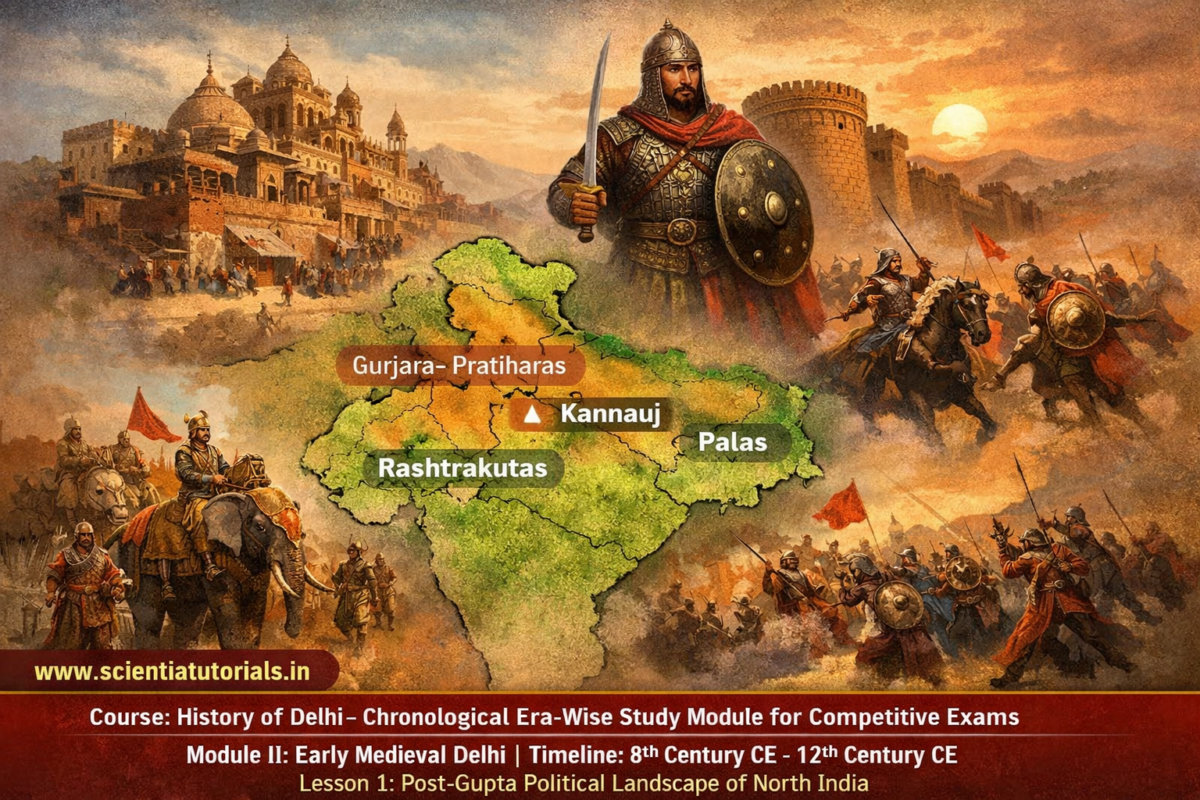

Post-Gupta Political Landscape of North India (8th–12th Century CE)
History of Delhi – Chronological Era-Wise Study Module for Competitive Exams
Module II: Early Medieval Delhi
Timeline: 8th Century CE – 12th Century CE
Lesson 1: Post-Gupta Political Landscape of North India
This lesson is systematically organized into four clearly structured sections, as detailed below:
- Chronologically Structured Study Module
- Short-Answer Type Questions
- Long-Answer Type Questions
- Multiple-Choice Questions (MCQs) with Answers and Detailed Explanations
Chronologically Structured Study Module
1. Introduction: Transition from the Gupta Age to Early Medieval Polity
The decline of the Gupta Empire in the mid-6th century CE marked a decisive turning point in the political history of North India. The classical age of centralized imperial authority, administrative uniformity, and cultural florescence gradually gave way to a fragmented political order characterized by regional kingdoms, shifting alliances, and frequent warfare. This transformation laid the structural foundation of Early Medieval India (c. 8th–12th century CE), within which the Delhi region emerged as a strategically crucial zone.
For aspirants of competitive examinations, understanding the post-Gupta political landscape is essential not merely as a background narrative but as a causal framework explaining the rise of Rajput states, the Tripartite Struggle, and the eventual Turkish conquests of North India. This lesson examines how political decentralization, regionalism, and military contest shaped North India, with special reference to the Delhi region.
2. End of Gupta Centralization and the Political Vacuum
2.1 Decline of Imperial Authority
The Gupta Empire disintegrated due to a combination of internal weaknesses and external pressures. Weak successors, administrative overstretch, and the erosion of revenue systems undermined imperial cohesion. The invasions of the Hunas (Huns) accelerated this decline, devastating urban centers and disrupting agrarian stability.
As centralized authority collapsed, North India witnessed the emergence of multiple regional powers, each asserting sovereignty over limited territories. The political vacuum left by the Guptas resulted in:
- Fragmentation of imperial provinces into independent kingdoms
- Decline of uniform administrative practices
- Rise of local landed elites and warrior chiefs
This transformation marked the transition from classical imperial polity to early medieval regionalism.
3. Rise of Regional Kingdoms in Post-Gupta North India
3.1 Multiplicity of Powers
Between the 7th and 9th centuries CE, North India was dominated by several regional dynasties. Unlike the Guptas, these kingdoms lacked pan-Indian authority but exerted strong control within their regions. Important powers included:
- The Pushyabhutis under Harsha in the 7th century
- The Gurjara-Pratiharas in western and northwestern India
- The Palas in eastern India (Bengal and Bihar)
- The Rashtrakutas from the Deccan influencing northern politics
This era was marked by constant competition for prestige, territory, and symbolic capitals such as Kannauj.
4. The Strategic Importance of Kannauj and North India
4.1 Kannauj as a Political Prize
Kannauj, located in the central Gangetic plain, emerged as the most coveted political center of North India after the Guptas. Control over Kannauj symbolized legitimacy, imperial ambition, and access to fertile agrarian resources.
The struggle for Kannauj culminated in the famous Tripartite Struggle among the Gurjara-Pratiharas, Palas, and Rashtrakutas during the 8th–10th centuries CE. This prolonged contest illustrates the fragmented yet highly competitive political environment of Early Medieval North India.
5. The Tripartite Struggle: Nature and Consequences
5.1 Major Participants
- Gurjara-Pratiharas: Dominant in Rajasthan, Gujarat, and western Uttar Pradesh
- Palas: Rulers of Bengal and Bihar, patrons of Buddhism
- Rashtrakutas: A powerful Deccan-based empire influencing northern politics
5.2 Impact on North India
The Tripartite Struggle prevented the emergence of a stable imperial authority in North India. Instead, it resulted in:
- Political instability and continuous warfare
- Weakening of central authority
- Empowerment of local chiefs and feudatories
For the Delhi region, this instability meant frequent changes in political control and growing militarization.
6. Emergence of Rajput Polities
6.1 Rise of Warrior Lineages
From the 8th century onward, several Rajput clans rose to prominence in North India. These warrior lineages claimed descent from ancient Kshatriyas and established hereditary rule over territories through military strength.
Important Rajput dynasties included:
- Pratiharas
- Chauhans
- Tomaras
- Paramaras
Their political culture emphasized honor, lineage, land control, and warfare.
7. The Delhi Region in the Post-Gupta Era
7.1 Geopolitical Significance of Delhi
The Delhi region occupied a frontier zone between the Indo-Gangetic plains and northwestern India. It controlled:
- Routes linking Punjab, Rajasthan, and the Ganga valley
- Access points vulnerable to invasions from the northwest
As a result, Delhi frequently changed hands among competing dynasties.
7.2 Early Rajput Control
By the 10th–11th centuries CE, Rajput clans such as the Tomaras and Chauhans gained control over the Delhi region. Their rule marked the beginning of Delhi’s emergence as a fortified political center, laying the groundwork for its later prominence.
8. Nature of Early Medieval Political Organization
8.1 Feudal Tendencies
Early medieval polity is often described as “feudal” in nature. Its key features included:
- Grant of land (agraharas and jagirs) to officials and religious institutions
- Decentralization of authority
- Local autonomy under feudatory chiefs
Kings exercised symbolic sovereignty, while actual power often rested with local elites.
8.2 Administrative Fragmentation
Unlike the Gupta bureaucracy, early medieval administration lacked uniformity. Regional rulers adopted varied systems of revenue collection, military organization, and justice, reflecting localized political realities.
9. Military Culture and Fortification
9.1 Continuous Warfare
The post-Gupta political order was characterized by near-constant warfare. Control over land, tribute, and trade routes required military strength. This led to:
- Rise of fortified towns
- Importance of cavalry and warrior elites
- Frequent dynastic conflicts
The Delhi region saw the construction and reinforcement of forts to defend against rival kingdoms and invaders.
10. Cultural and Political Consequences
10.1 Decline of Urban Centers
Political instability led to the decline of many Gupta-era urban centers. Economic activity shifted toward rural agrarian bases, reinforcing the power of landed elites.
10.2 Regional Cultural Identities
With the weakening of centralized rule, regional languages, art styles, and religious traditions flourished. This diversity became a hallmark of early medieval North India.
11. Link to Later Medieval Developments
The fragmented political landscape of post-Gupta North India directly influenced later developments:
- Absence of a strong centralized power facilitated Turkish invasions
- Rajput resistance, though valorous, lacked coordination
- Strategic regions like Delhi became gateways for foreign conquest
Thus, the early medieval political order set the stage for the establishment of the Delhi Sultanate in the late 12th century.
12. Examination-Oriented Key Takeaways
- The post-Gupta period marked the shift from imperial unity to regional fragmentation
- The Tripartite Struggle prevented political consolidation in North India
- The Delhi region gained strategic importance due to its geography
- Rise of Rajput states shaped early medieval political culture
- Decentralization weakened resistance against external invasions
13. Conclusion
The post-Gupta political landscape of North India represents a crucial transitional phase in Indian history. Between the 8th and 12th centuries CE, regional kingdoms replaced imperial authority, warfare became endemic, and political fragmentation defined governance. For the Delhi region, this era was formative, transforming it from a frontier zone into a strategic political center.
Understanding this lesson is essential for competitive examinations, as it explains the structural conditions that led to the rise of Rajput polities and the eventual establishment of medieval Islamic rule in North India. The Early Medieval period, though politically unstable, played a decisive role in shaping the historical destiny of Delhi and the subcontinent.
Short Answer Type Questions
Module II: Early Medieval Delhi
Lesson 1: Post-Gupta Political Landscape of North India
1. What marked the beginning of the post-Gupta political period in North India?
Answer:
The post-Gupta political period began with the decline of the Gupta Empire in the mid-6th century CE, leading to political fragmentation and the rise of regional kingdoms.
2. Name two major causes for the decline of the Gupta Empire.
Answer:
Weak successors and external invasions by the Hunas were major causes of the decline of the Gupta Empire.
3. What kind of political structure replaced Gupta centralization?
Answer:
A decentralized political structure dominated by regional and local kingdoms replaced Gupta centralization.
4. Which century marks the consolidation of early medieval political formations in North India?
Answer:
The 8th century CE marks the consolidation of early medieval political formations in North India.
5. Why is the post-Gupta period considered politically fragmented?
Answer:
It is considered fragmented because no single power exercised pan-Indian authority, and multiple regional kingdoms competed for dominance.
6. Name three major regional powers of post-Gupta North India.
Answer:
The Gurjara-Pratiharas, Palas, and Rashtrakutas were major regional powers.
7. What was the Tripartite Struggle?
Answer:
The Tripartite Struggle was a prolonged conflict among the Gurjara-Pratiharas, Palas, and Rashtrakutas for control over Kannauj.
8. Why was Kannauj politically significant in early medieval North India?
Answer:
Kannauj symbolized political legitimacy and control over the fertile Gangetic plains, making it a prestigious capital.
9. How did the Tripartite Struggle affect political stability in North India?
Answer:
It prevented political consolidation and resulted in prolonged instability and warfare.
10. Which dynasty dominated eastern India during this period?
Answer:
The Pala dynasty dominated eastern India, particularly Bengal and Bihar.
11. What role did the Rashtrakutas play in North Indian politics?
Answer:
Although based in the Deccan, the Rashtrakutas intervened in North Indian politics, especially in the contest for Kannauj.
12. Who were the Rajputs?
Answer:
Rajputs were warrior lineages that emerged as regional rulers in early medieval North India, emphasizing military valor and lineage.
13. Name two Rajput dynasties associated with North India.
Answer:
The Pratiharas and Chauhans were prominent Rajput dynasties.
14. Why was the Delhi region strategically important in the early medieval period?
Answer:
Delhi controlled routes connecting the northwest, Rajasthan, and the Gangetic plains and served as a frontier defense zone.
15. Which Rajput clans ruled the Delhi region before the Turkish invasions?
Answer:
The Tomaras and Chauhans ruled the Delhi region before the Turkish invasions.
16. What is meant by early medieval “feudal tendencies”?
Answer:
It refers to land grants, decentralization of authority, and dependence on local chiefs and feudatories.
17. How did land grants affect political power during this period?
Answer:
Land grants strengthened local elites and weakened central authority.
18. What was the nature of administration in post-Gupta North India?
Answer:
Administration was region-specific, decentralized, and lacked uniform bureaucratic systems.
19. Why did fortified towns become important in this period?
Answer:
Continuous warfare and political instability necessitated strong defenses.
20. How did political instability impact urban centers?
Answer:
Many urban centers declined as economic and political activity shifted toward rural areas.
21. What role did warfare play in early medieval politics?
Answer:
Warfare was central to territorial expansion, defense, and political legitimacy.
22. How did regionalism influence culture in post-Gupta India?
Answer:
Regionalism encouraged the growth of local languages, art styles, and religious traditions.
23. Why were Rajput kingdoms unable to resist foreign invasions effectively?
Answer:
Due to political disunity, lack of coordination, and decentralized power structures.
24. How did the post-Gupta political structure facilitate Turkish invasions?
Answer:
The absence of a strong centralized authority made North India vulnerable to external attacks.
25. Why is the post-Gupta political landscape important for understanding Delhi’s later history?
Answer:
It laid the political and strategic foundations that enabled Delhi to emerge as a major center during the Delhi Sultanate.
✅ Examination Tip:
Most questions from this lesson appear in 1–5 mark answers indirectly through themes like Tripartite Struggle, Rajput polity, feudalism, and Delhi’s strategic importance. Mastery of short answers strengthens conceptual clarity for long answers and prelims.
Long Answer Type Questions
Module II: Early Medieval Delhi
Lesson 1: Post-Gupta Political Landscape of North India
1. Analyse the political consequences of the decline of the Gupta Empire in North India.
Answer:
The decline of the Gupta Empire led to the collapse of centralized imperial authority in North India. This resulted in political fragmentation, the rise of regional kingdoms, and the weakening of uniform administration. Provincial governors and local chiefs asserted independence, creating a decentralized political order. The absence of a strong empire also led to frequent warfare, instability, and the emergence of new power centers, shaping the early medieval political structure.
2. Discuss the nature of political fragmentation in post-Gupta North India.
Answer:
Post-Gupta North India was characterized by the absence of a pan-Indian empire. Power was divided among several regional kingdoms, each exercising authority over limited territories. Political loyalty became localized, and rulers depended heavily on feudatories and military elites. This fragmentation resulted in shifting alliances, frequent conflicts, and unstable boundaries, preventing long-term political consolidation.
3. Examine the rise of regional kingdoms in North India after the Guptas.
Answer:
After the Guptas, regional kingdoms emerged due to weakened central authority and the growing power of local elites. Dynasties such as the Gurjara-Pratiharas, Palas, and Rashtrakutas dominated different regions. These kingdoms focused on regional expansion rather than imperial unity, leading to competitive politics and territorial rivalries that defined early medieval North India.
4. Why did Kannauj become the focal point of political power in early medieval North India?
Answer:
Kannauj occupied a strategic position in the fertile Gangetic plains and symbolized imperial legitimacy after the Guptas. Control over Kannauj implied dominance over North India’s economic heartland. As a result, major dynasties competed for it, making the city the central political prize of early medieval politics.
5. Explain the Tripartite Struggle and its significance.
Answer:
The Tripartite Struggle was a prolonged contest among the Gurjara-Pratiharas, Palas, and Rashtrakutas for control of Kannauj. Its significance lies in the fact that it prevented political unity in North India, drained resources through continuous warfare, and reinforced regionalism. The struggle exemplifies the fragmented nature of early medieval polity.
6. Assess the role of the Gurjara-Pratiharas in North Indian politics.
Answer:
The Gurjara-Pratiharas emerged as a dominant power in western and north-central India. They played a crucial role in resisting Arab invasions from the northwest and maintained influence over large territories. However, their involvement in constant warfare, especially in the Tripartite Struggle, limited their ability to establish a stable empire.
7. How did the Rashtrakutas influence North Indian political affairs?
Answer:
Though primarily a Deccan power, the Rashtrakutas intervened in North Indian politics by repeatedly campaigning for Kannauj. Their military expeditions disrupted northern kingdoms and highlighted the interconnected nature of Indian politics. Their involvement intensified political instability in North India.
8. Examine the political contribution of the Pala dynasty.
Answer:
The Palas controlled eastern India and were major participants in the Tripartite Struggle. They provided relative stability in Bengal and Bihar and promoted administrative continuity in their region. However, their attempts to control Kannauj contributed to prolonged conflict rather than political consolidation.
9. Discuss the emergence of Rajput polities in early medieval North India.
Answer:
Rajput polities emerged as warrior lineages gained control over territories through military strength. Claiming Kshatriya descent, Rajput rulers emphasized honor, lineage, and martial values. Their kingdoms dominated North India from the 8th century onward, shaping its political culture and resistance traditions.
10. Analyse the political culture of Rajput states.
Answer:
Rajput political culture emphasized warfare, personal loyalty, and dynastic prestige. Governance was decentralized, with power shared among clan leaders and feudatories. While this culture promoted valor and resistance, it also limited coordination among states, weakening collective political strength.
11. Why was the Delhi region strategically important in the post-Gupta period?
Answer:
Delhi lay at the crossroads of major trade and military routes connecting the northwest, Rajasthan, and the Gangetic plains. Its location made it a defensive frontier against invasions and a gateway for political expansion. Consequently, it became a contested region among rival powers.
12. Trace the early medieval political history of the Delhi region.
Answer:
During the early medieval period, the Delhi region passed under the control of various regional powers. By the 10th–11th centuries, Rajput clans such as the Tomaras and Chauhans established authority, fortified the region, and laid the groundwork for Delhi’s later political prominence.
13. Explain the concept of early medieval “feudal tendencies.”
Answer:
Early medieval feudal tendencies involved land grants to officials, warriors, and religious institutions in exchange for service or loyalty. These grants reduced royal control over revenue and administration, strengthening local elites and decentralizing political power.
14. How did land grants affect the political structure of North India?
Answer:
Land grants transferred economic and administrative authority to local beneficiaries. Over time, these beneficiaries became semi-independent rulers, weakening the central state and contributing to political fragmentation.
15. Discuss the administrative features of post-Gupta North India.
Answer:
Administration during this period lacked uniformity and was region-specific. Kings depended on feudatories for governance and military support. Bureaucratic systems were less standardized compared to the Gupta period, reflecting decentralized authority.
16. Examine the role of warfare in early medieval politics.
Answer:
Warfare was central to political legitimacy and territorial expansion. Continuous conflicts over land and prestige led to militarization, the construction of forts, and the dominance of warrior elites in governance.
17. Why did fortified towns gain importance in this period?
Answer:
Political instability and frequent invasions necessitated strong defenses. Fortified towns served as military bases, administrative centers, and symbols of authority, especially in frontier regions like Delhi.
18. Analyse the impact of political instability on urban life.
Answer:
Urban centers declined as insecurity disrupted trade and administration. Economic activity shifted toward rural areas, reinforcing agrarian power structures and reducing urban influence.
19. How did regionalism shape culture and politics in post-Gupta India?
Answer:
Regionalism encouraged the development of local traditions, languages, and institutions. Politically, it strengthened regional identities but weakened collective unity, contributing to fragmentation.
20. Explain how the post-Gupta political order paved the way for Turkish invasions.
Answer:
The absence of centralized authority, political disunity among Rajput states, and weak frontier defenses made North India vulnerable. Strategic regions like Delhi became entry points for Turkish forces in the late 12th century.
Note for Aspirants
These long answer questions cover core analytical themes such as political fragmentation, Tripartite Struggle, Rajput polity, feudalism, and Delhi’s strategic importance. Mastery of these answers ensures strong performance in Mains examinations and descriptive papers.
MCQs with Answers & Explanations
Module II: Early Medieval Delhi
Lesson 1: Post-Gupta Political Landscape of North India
1. The post-Gupta political period in North India began after the decline of which empire?
A. Maurya Empire
B. Kushana Empire
C. Gupta Empire
D. Harsha’s Empire
Correct Answer: C
Explanation:
The post-Gupta period refers to the phase following the decline of the Gupta Empire in the mid-6th century CE, which marked the end of centralized imperial rule in North India.
2. Which of the following was NOT a major cause of the decline of the Gupta Empire?
A. Weak successors
B. Hun invasions
C. Administrative decentralization
D. Arab invasions
Correct Answer: D
Explanation:
Arab invasions occurred much later (8th century CE). The decline of the Guptas was primarily due to weak rulers, Hun invasions, and administrative and economic weaknesses.
3. The political structure of post-Gupta North India is best described as:
A. Highly centralized
B. Theocratic
C. Decentralized and regional
D. Tribal confederation
Correct Answer: C
Explanation:
After the Guptas, power was fragmented among regional kingdoms, leading to decentralization and the rise of local rulers.
4. Which century marks the consolidation of early medieval political formations in North India?
A. 6th century CE
B. 7th century CE
C. 8th century CE
D. 10th century CE
Correct Answer: C
Explanation:
From the 8th century CE onwards, early medieval regional kingdoms became firmly established across North India.
5. Which city became the most coveted political center after the Gupta period?
A. Pataliputra
B. Ujjain
C. Kannauj
D. Mathura
Correct Answer: C
Explanation:
Kannauj symbolized political legitimacy and control over the Gangetic plains, making it the focal point of early medieval power struggles.
6. The Tripartite Struggle was fought mainly for the control of:
A. Delhi
B. Kannauj
C. Pataliputra
D. Thanesar
Correct Answer: B
Explanation:
The Tripartite Struggle revolved around Kannauj, a symbol of imperial authority in early medieval North India.
7. Which of the following dynasties was NOT part of the Tripartite Struggle?
A. Gurjara-Pratiharas
B. Palas
C. Rashtrakutas
D. Cholas
Correct Answer: D
Explanation:
The Cholas were a South Indian dynasty and were not involved in the Tripartite Struggle, which was contested by northern and Deccan powers.
8. Which dynasty controlled eastern India during the early medieval period?
A. Pratiharas
B. Palas
C. Rashtrakutas
D. Chauhans
Correct Answer: B
Explanation:
The Palas ruled Bengal and Bihar and were a major power in eastern India from the 8th century CE.
9. The Rashtrakutas were originally based in:
A. Eastern India
B. Northwestern India
C. The Deccan
D. The Gangetic plains
Correct Answer: C
Explanation:
The Rashtrakutas were a Deccan-based empire but frequently intervened in North Indian politics.
10. What was the major political consequence of the Tripartite Struggle?
A. Establishment of a strong empire
B. Political unification of North India
C. Long-term political instability
D. Expansion of urban centers
Correct Answer: C
Explanation:
Continuous warfare among the three powers prevented political consolidation and caused prolonged instability.
11. The rise of Rajput polities is associated mainly with which period?
A. Mauryan period
B. Gupta period
C. Early medieval period
D. Mughal period
Correct Answer: C
Explanation:
Rajput clans emerged as dominant political powers during the early medieval period (8th–12th centuries CE).
12. Rajput political culture emphasized:
A. Trade and commerce
B. Monastic governance
C. Warfare and lineage
D. Bureaucratic administration
Correct Answer: C
Explanation:
Rajput states valued martial strength, honor, and dynastic lineage, which shaped their political culture.
13. Which Rajput clans ruled the Delhi region before Turkish invasions?
A. Palas and Senas
B. Tomaras and Chauhans
C. Pratiharas and Rashtrakutas
D. Chalukyas and Cholas
Correct Answer: B
Explanation:
The Tomaras and later the Chauhans controlled the Delhi region before the late 12th-century invasions.
14. The strategic importance of the Delhi region was mainly due to its:
A. Religious significance
B. Fertile soil
C. Control over trade and invasion routes
D. Coastal location
Correct Answer: C
Explanation:
Delhi controlled routes linking the northwest, Rajasthan, and the Gangetic plains, making it strategically vital.
15. Early medieval political organization is often described as “feudal” because of:
A. Absolute monarchy
B. Extensive land grants
C. Urban dominance
D. Centralized taxation
Correct Answer: B
Explanation:
Land grants to officials and religious institutions led to decentralization and local autonomy, resembling feudal tendencies.
16. Land grants in early medieval India resulted in:
A. Stronger central authority
B. Decline of local elites
C. Empowerment of feudatories
D. Elimination of taxation
Correct Answer: C
Explanation:
Land grants transferred power to local elites, weakening royal authority and increasing decentralization.
17. Administration in post-Gupta North India was characterized by:
A. Uniform bureaucracy
B. Centralized control
C. Regional variation
D. Democratic institutions
Correct Answer: C
Explanation:
Each regional kingdom followed its own administrative practices, lacking Gupta-style uniformity.
18. Continuous warfare in early medieval North India led to the rise of:
A. Universities
B. Fortified towns
C. Maritime trade
D. Urban democracy
Correct Answer: B
Explanation:
Political instability necessitated fortifications for defense, especially in frontier regions like Delhi.
19. Which sector gained importance as urban centers declined?
A. Maritime trade
B. Industrial production
C. Rural agrarian economy
D. Overseas commerce
Correct Answer: C
Explanation:
Political instability shifted economic activity toward rural agrarian bases controlled by local elites.
20. Regionalism in post-Gupta India encouraged:
A. Cultural uniformity
B. Growth of local traditions
C. Decline of religion
D. Political unification
Correct Answer: B
Explanation:
Regional kingdoms patronized local languages, art, and religious traditions, strengthening regional identities.
21. Why were Rajput states unable to form a unified resistance?
A. Economic prosperity
B. Religious differences
C. Political disunity
D. Foreign alliances
Correct Answer: C
Explanation:
Rajput states were divided and lacked coordination, which weakened collective resistance.
22. The fragmented political order made North India vulnerable to:
A. Trade decline
B. Cultural stagnation
C. Foreign invasions
D. Peasant revolts
Correct Answer: C
Explanation:
Absence of centralized authority facilitated foreign invasions, especially from the northwest.
23. Which century witnessed the emergence of Delhi as a fortified political center?
A. 7th century CE
B. 8th century CE
C. 10th–11th centuries CE
D. 13th century CE
Correct Answer: C
Explanation:
Under Rajput rulers, Delhi developed fortifications and political importance in the 10th–11th centuries CE.
24. The post-Gupta political structure directly influenced the rise of:
A. Mughal Empire
B. Mauryan Empire
C. Delhi Sultanate
D. Chola Empire
Correct Answer: C
Explanation:
Political fragmentation and weak defenses paved the way for the establishment of the Delhi Sultanate in the late 12th century.
25. Which of the following best defines early medieval North Indian polity?
A. Centralized imperial administration
B. Stable political boundaries
C. Decentralized regional kingdoms
D. Maritime expansion
Correct Answer: C
Explanation:
Early medieval polity was marked by regional kingdoms, decentralized authority, and frequent warfare.
✅ Examination Insight
Questions from this lesson are high-frequency in prelims, especially on:
- Tripartite Struggle
- Rajput polity
- Feudal tendencies
- Strategic importance of Delhi