
Lesson 1: Delhi Durbar of 1911 and Capital Shift
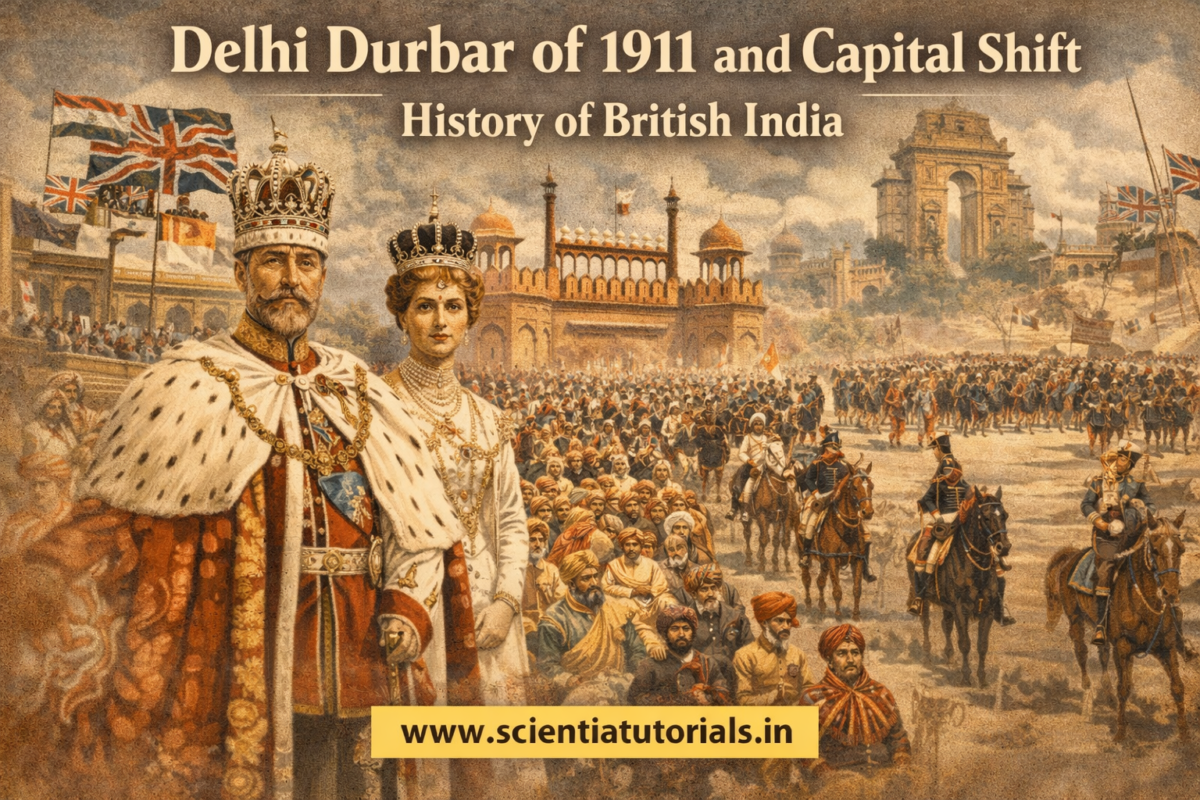

Delhi Durbar of 1911 and Capital Shift | History of British India
Course: History of Delhi – Chronological Era-Wise Study Module for Competitive Exams
Module VII: Delhi as Capital of British India
Timeline: 1911 CE – 1947 CE
Lesson 1: Delhi Durbar of 1911 and Capital Shift
This lesson is systematically organized into four clearly structured sections, as detailed below:
- Chronologically Structured Study Module
- Short-Answer Type Questions
- Long-Answer Type Questions
- Multiple-Choice Questions (MCQs) with Answers and Detailed Explanations
Chronologically Structured Study Module
Introduction: A Turning Point in the History of Colonial Delhi
The Delhi Durbar of 1911 marked one of the most significant moments in the modern history of Delhi. It symbolized not merely an imperial spectacle but a decisive political and administrative transformation: the transfer of the capital of British India from Calcutta to Delhi. This event initiated a new historical phase in which Delhi became the center of British imperial governance until Indian independence in 1947.
The decision taken at the Durbar had far-reaching consequences for India’s political administration, urban planning, imperial symbolism, and nationalist politics. This lesson examines the chronological background, proceedings, decisions, and consequences of the Delhi Durbar of 1911, with special emphasis on its examination relevance.
1. Background: British Capitals before 1911
1.1 Calcutta as the Capital of British India
Before 1911, Calcutta had served as the capital of British India since 1772. It was:
- The headquarters of the East India Company
- A major port and commercial center
- The hub of British administration in eastern India
However, by the early 20th century, Calcutta faced growing challenges:
- Rising nationalist agitation
- Administrative difficulties in governing a vast subcontinent
- Strategic and symbolic limitations
1.2 Political Unrest and the Bengal Partition (1905)
The Partition of Bengal in 1905 intensified political unrest in Calcutta. It led to:
- Mass protests
- Boycott and Swadeshi movements
- Increased hostility toward British rule
Calcutta became a center of nationalist resistance, making it less suitable as an imperial capital.
2. Historical Significance of Delhi in British Thinking
2.1 Delhi’s Imperial Legacy
Delhi had been the capital of:
- Several medieval and early modern Indian empires
- The Mughal Empire for nearly three centuries
For the British, Delhi represented:
- Continuity with India’s imperial past
- Legitimacy through historical symbolism
- A city associated with sovereignty and authority
2.2 Strategic and Administrative Advantages
Delhi offered several practical advantages:
- Central location in northern India
- Better connectivity with major regions
- Proximity to the Punjab, a key military recruitment area
These factors made Delhi strategically preferable to Calcutta.
3. The Delhi Durbar: Concept and Tradition
3.1 What was a Delhi Durbar?
A Delhi Durbar was a grand imperial assembly organized by the British to:
- Proclaim the sovereignty of the British monarch
- Display imperial power and legitimacy
- Secure loyalty of Indian princes and elites
Previous Durbars had been held in:
- 1877 (Queen Victoria proclaimed Empress of India)
- 1903 (Edward VII)
3.2 The Uniqueness of the 1911 Durbar
The Delhi Durbar of 1911 was unique because:
- The reigning monarch attended in person
- It announced major constitutional and administrative decisions
- It marked a capital shift, unlike earlier Durbars
4. Delhi Durbar of 1911: आयोजन और आयोजनक्रम (Proceedings)
4.1 Royal Presence
The Durbar was attended by:
- King George V
- Queen Mary
This was the first and only time a British monarch visited India.
4.2 The Grand Ceremony
Held in December 1911, the Durbar featured:
- Massive ceremonial gatherings
- Participation of Indian princes, chiefs, and officials
- Military parades and displays of imperial grandeur
The spectacle was designed to reinforce British authority and loyalty.
5. Major Announcements at the Delhi Durbar of 1911
5.1 Annulment of the Partition of Bengal
One of the most popular announcements was:
- Cancellation of the 1905 Partition of Bengal
This was intended to:
- Pacify nationalist opposition
- Restore administrative balance
- Regain political legitimacy
5.2 Transfer of Capital from Calcutta to Delhi
The most historic announcement was:
- The decision to shift the capital of British India from Calcutta to Delhi
This decision reshaped India’s political geography for the next 36 years.
6. Reasons for the Capital Shift
6.1 Political Reasons
- Growing nationalist unrest in Calcutta
- Desire to weaken the influence of Bengali nationalism
- Strategic distancing from revolutionary centers
6.2 Administrative Reasons
- Delhi’s central location
- Easier coordination with provinces
- Improved administrative efficiency
6.3 Symbolic and Ideological Reasons
- Association of Delhi with imperial rule
- Projection of British power as successor to Indian empires
- Reinforcement of imperial continuity
The capital shift was as much symbolic as it was practical.
7. Immediate Impact of the Capital Shift
7.1 Administrative Reorganization
After 1911:
- Government offices began shifting to Delhi
- New administrative departments were created
- Delhi’s political importance increased rapidly
7.2 Urban Expansion
The decision necessitated:
- Construction of a new imperial city
- Expansion beyond Shahjahanabad
- Large-scale urban planning initiatives
This laid the foundation for New Delhi.
8. Planning of New Delhi: An Imperial Capital
8.1 Vision of a New Capital
The British aimed to build:
- A planned, monumental capital
- A city reflecting imperial authority and modern governance
Architects:
- Edwin Lutyens
- Herbert Baker
8.2 Separation from Old Delhi
Urban planning reflected colonial ideology:
- Old Delhi (Shahjahanabad) left largely untouched
- New Delhi designed for British administration
- Spatial segregation institutionalized
9. Political and Social Reactions in India
9.1 Response of Indian Princes
- Generally welcomed the move
- Enhanced proximity to imperial authority
- Reinforced princely loyalty to the Crown
9.2 Nationalist Response
Indian nationalists:
- Viewed the Durbar as imperial propaganda
- Remained skeptical of British intentions
- Continued political mobilization
The capital shift did not weaken nationalism in the long term.
10. Delhi as Capital (1911–1947): Long-Term Consequences
10.1 Administrative Centralization
Delhi became:
- The nerve center of colonial administration
- Headquarters of the Viceroy and central government
- The seat of major policy decisions
10.2 Growth of Political Activity
As capital:
- Delhi attracted political leaders
- Became a center of nationalist politics
- Hosted major movements and negotiations
10.3 Symbolic Importance in Freedom Struggle
Key developments:
- Nationalist protests near imperial institutions
- Delhi emerged as a stage for colonial–nationalist confrontation
- The city symbolized both imperial power and resistance
11. Role of the British Raj after 1911
Under the British Raj, Delhi functioned as:
- The heart of imperial governance
- A showcase of colonial authority
- A controlled political space
Yet, imperial control increasingly faced popular resistance.
12. From Imperial Capital to National Capital
By 1947:
- British authority collapsed
- Delhi became the capital of independent India
- Imperial institutions were repurposed for a sovereign state
The decision of 1911 unintentionally ensured Delhi’s post-colonial centrality.
13. Historical Significance of the Delhi Durbar of 1911
Why the Event is Crucial:
- First personal appearance of British monarch in India
- Annulment of Bengal Partition
- Capital shift decision
- Beginning of New Delhi’s construction
- Reorientation of Indian political geography
Conclusion: Delhi Durbar of 1911 in Historical Perspective
The Delhi Durbar of 1911 was not merely a ceremonial display of imperial power; it was a decisive moment that reshaped India’s administrative, political, and urban future. By shifting the capital to Delhi, the British sought legitimacy, control, and continuity with India’s imperial past. Ironically, this decision also strengthened Delhi’s role in the nationalist movement and ensured its position as the capital of independent India.
Key Takeaways for Competitive Exams:
- Delhi Durbar of 1911 as a political turning point
- Reasons behind capital shift
- Symbolic vs administrative motives
- Impact on urban planning and nationalism
- Delhi’s transformation into imperial and national capital
A thorough understanding of this lesson is essential for questions on modern Indian history, colonial administration, and urban transformation.
Short Answer Type Questions with Answers
1. What was the Delhi Durbar of 1911?
Answer:
The Delhi Durbar of 1911 was a grand imperial assembly organized by the British to proclaim the authority of the Crown and announce major political decisions, including the capital shift.
2. In which year was the Delhi Durbar that announced the capital shift held?
Answer:
The Delhi Durbar announcing the capital shift was held in 1911 CE.
3. Which city was declared the new capital of British India in 1911?
Answer:
Delhi was declared the new capital of British India.
4. From which city was the capital shifted to Delhi?
Answer:
The capital was shifted from Calcutta to Delhi.
5. Which British monarch attended the Delhi Durbar of 1911?
Answer:
King George V attended the Delhi Durbar of 1911.
6. Why was the presence of King George V historically significant?
Answer:
It was the first and only visit of a reigning British monarch to India.
7. Name one major political announcement made at the Delhi Durbar of 1911.
Answer:
The annulment of the Partition of Bengal (1905).
8. What was the Partition of Bengal originally implemented in?
Answer:
The Partition of Bengal was implemented in 1905.
9. Why did the British annul the Partition of Bengal in 1911?
Answer:
To reduce nationalist opposition and political unrest, especially in Bengal.
10. Give one political reason for shifting the capital from Calcutta to Delhi.
Answer:
Calcutta had become a center of nationalist agitation, making it unsuitable as the imperial capital.
11. Mention one administrative reason for choosing Delhi as the capital.
Answer:
Delhi’s central location made administration of British India more efficient.
12. What symbolic significance did Delhi hold for the British?
Answer:
Delhi had been the capital of several Indian empires, symbolizing imperial authority and continuity.
13. Which imperial tradition did the British revive through the Delhi Durbar?
Answer:
The tradition of royal assemblies to assert sovereignty and legitimacy.
14. How was the Delhi Durbar of 1911 different from earlier Durbars?
Answer:
It was the only Durbar attended personally by the British monarch and announced major administrative changes.
15. What was the immediate administrative impact of the capital shift?
Answer:
Government offices and departments began relocating from Calcutta to Delhi.
16. What new urban development followed the capital shift?
Answer:
The planning and construction of New Delhi as an imperial capital.
17. Name the two architects associated with the planning of New Delhi.
Answer:
Edwin Lutyens and Herbert Baker.
18. How did British urban planning reflect colonial ideology after 1911?
Answer:
It created spatial segregation, separating New Delhi from Old Delhi.
19. How did Indian princes generally respond to the Delhi Durbar of 1911?
Answer:
Most Indian princes welcomed the Durbar and reaffirmed loyalty to the British Crown.
20. How did Indian nationalists view the Delhi Durbar?
Answer:
They viewed it as imperial propaganda and remained critical of British intentions.
21. Under which authority did Delhi function as the capital after 1911?
Answer:
Under the British Raj.
22. How did becoming the capital affect Delhi’s political importance?
Answer:
Delhi became the central hub of colonial administration and politics.
23. What role did Delhi play in the nationalist movement after 1911?
Answer:
Delhi emerged as key center for political protests, negotiations, and nationalist activity.
24. Until which year did Delhi remain the capital of British India?
Answer:
Delhi remained the capital until 1947 CE.
25. Why is the Delhi Durbar of 1911 important for competitive examinations?
Answer:
It marks a major political, administrative, and urban turning point in modern Indian history.
Long Answer Type Questions with Answers
1. Explain the historical background that led to the Delhi Durbar of 1911.
Answer:
The Delhi Durbar of 1911 was organized against the backdrop of growing political unrest in British India, especially after the Partition of Bengal in 1905. Calcutta, the then capital, had become the center of nationalist agitation, revolutionary activity, and mass protests. Administratively, Calcutta was located at the eastern edge of the empire, making governance difficult. Symbolically, the British sought a location that reflected imperial continuity and authority. Delhi, with its long imperial legacy, appeared ideal. These factors together led to the organization of the Delhi Durbar of 1911, where major political announcements were planned.
2. Discuss the political significance of the Delhi Durbar of 1911.
Answer:
The Delhi Durbar of 1911 was politically significant because it was used to announce key policy decisions aimed at stabilizing British rule. The annulment of the Partition of Bengal was intended to pacify nationalist sentiment, while the capital shift was meant to weaken the influence of Bengali nationalism. The Durbar also reinforced British authority by securing the loyalty of Indian princes and elites. Thus, it served both conciliatory and authoritarian political objectives.
3. Analyse why the British decided to shift the capital from Calcutta to Delhi.
Answer:
The decision to shift the capital was driven by multiple factors. Politically, Calcutta had become a stronghold of nationalism and anti-British activities. Administratively, Delhi’s central location allowed better control over northern and northwestern regions, including Punjab, a crucial military recruitment area. Symbolically, Delhi represented imperial authority, having served as the capital of several Indian empires. The British aimed to project themselves as legitimate successors to India’s imperial past.
4. Examine the role of imperial symbolism in the choice of Delhi as the capital.
Answer:
Imperial symbolism played a crucial role in the capital shift. Delhi was associated with sovereignty and empire, having been the seat of the Delhi Sultanate and the Mughal Empire. By establishing their capital in Delhi, the British sought to appropriate this historical legitimacy and portray themselves as inheritors of India’s imperial tradition. The Durbar itself was designed as a theatrical display of imperial power and continuity.
5. Describe the main features of the Delhi Durbar of 1911.
Answer:
The Delhi Durbar of 1911 was marked by grand ceremonies, military parades, and elaborate displays of imperial power. It was attended by King George V and Queen Mary, making it unique among all Durbars. Indian princes, chiefs, and dignitaries participated, reaffirming their loyalty to the British Crown. The event combined spectacle with political announcements, making it both a cultural and administrative milestone.
6. Why was the personal attendance of King George V at the Delhi Durbar historically important?
Answer:
The attendance of King George V was historically significant because it was the first and only time a reigning British monarch visited India. His presence elevated the Durbar’s importance and reinforced imperial authority. It also demonstrated the Crown’s direct involvement in Indian governance, strengthening the legitimacy of the announcements made at the event.
7. Analyse the annulment of the Partition of Bengal announced at the Delhi Durbar.
Answer:
The annulment of the Partition of Bengal was a strategic political move. The partition had triggered widespread protests, boycotts, and the Swadeshi movement. By reversing it, the British aimed to placate moderate nationalists and reduce unrest. However, the decision did not end nationalist resistance; instead, it revealed the strength of popular opposition and encouraged further political mobilization.
8. Discuss the administrative reasons behind the capital shift.
Answer:
Administratively, Delhi offered several advantages over Calcutta. Its central location facilitated coordination with various provinces. It was closer to the Punjab, which was vital for military recruitment and defense. Improved railway connectivity made Delhi a more efficient administrative hub. These practical considerations made Delhi suitable for governing a vast and diverse colony.
9. Examine the immediate administrative changes following the capital shift.
Answer:
After the capital shift announcement, government departments and offices began relocating from Calcutta to Delhi. New administrative structures were established, and Delhi’s political importance increased rapidly. The city became the seat of the Viceroy and central government, marking a shift in India’s administrative geography.
10. Trace the planning and construction of New Delhi after 1911.
Answer:
The capital shift necessitated the construction of a new imperial city. British planners envisioned New Delhi as a monumental capital reflecting imperial authority. Architects Edwin Lutyens and Herbert Baker designed wide avenues, grand buildings, and spacious layouts. New Delhi was spatially separated from Old Delhi, reflecting colonial ideas of order, control, and segregation.
11. How did colonial urban planning reflect British ideology after the capital shift?
Answer:
Colonial urban planning emphasized hierarchy, segregation, and visibility of power. New Delhi was designed for British officials, with wide roads and monumental architecture, while Old Delhi remained densely populated and underdeveloped. This spatial division reinforced racial and administrative hierarchies, reflecting the ideological priorities of colonial rule.
12. Assess the response of Indian princes to the Delhi Durbar of 1911.
Answer:
Most Indian princes welcomed the Delhi Durbar and the capital shift. Participation in the Durbar allowed them to display loyalty to the British Crown and maintain their privileged status. The event strengthened princely ties with the empire, even as nationalist politics gained momentum elsewhere.
13. How did Indian nationalists react to the Delhi Durbar and capital shift?
Answer:
Indian nationalists viewed the Durbar as an extravagant display of imperial propaganda. While the annulment of Bengal’s partition was welcomed by some, the capital shift was seen as a strategy to consolidate British control rather than a genuine reform. Nationalist leaders continued their struggle, shifting focus toward broader demands for self-government.
14. Evaluate the role of Delhi as the capital in the growth of nationalist politics after 1911.
Answer:
As the capital, Delhi became a focal point of nationalist politics. Major political events, protests, and negotiations occurred near imperial institutions. The proximity of nationalist leaders to the colonial administration intensified political engagement and confrontation, making Delhi central to the freedom struggle.
15. Discuss the long-term political consequences of making Delhi the capital.
Answer:
The capital shift centralized power in Delhi and made it the nerve center of colonial governance. Over time, this also made Delhi a center of resistance. The city hosted key events of the freedom struggle, negotiations, and ultimately the transfer of power in 1947. Thus, a decision intended to strengthen imperial control inadvertently strengthened nationalist mobilization.
16. Analyse the strategic importance of Delhi for the British Empire.
Answer:
Strategically, Delhi’s location allowed effective control over northern India. Its proximity to Punjab ensured quick mobilization of troops. Rail connectivity enhanced communication and logistics. These factors made Delhi a secure and efficient base for imperial administration.
17. How did the Delhi Durbar of 1911 reinforce imperial ideology?
Answer:
The Durbar reinforced imperial ideology through ritual, spectacle, and symbolism. The presence of the monarch, participation of princes, and display of military power projected the image of an unchallenged empire. It sought to legitimize British rule by blending tradition with authority.
18. Critically assess whether the capital shift succeeded in weakening nationalism.
Answer:
While the capital shift temporarily reduced pressure in Calcutta, it did not weaken nationalism overall. Instead, nationalist activity spread across India and intensified over time. Delhi itself became a center of political activism. Thus, the strategy failed to achieve its long-term objective.
19. Explain the role of the British Raj in shaping Delhi after 1911.
Answer:
Under the British Raj, Delhi was transformed into an imperial capital with centralized administration and monumental architecture. Policies emphasized control, segregation, and symbolism. However, the same administrative concentration also facilitated organized nationalist resistance, shaping Delhi’s dual role as a city of power and protest.
20. Why is the Delhi Durbar of 1911 considered a turning point in modern Indian history?
Answer:
The Delhi Durbar of 1911 marked a major shift in political geography, administrative organization, and imperial strategy. It led to the capital shift, annulment of Bengal’s partition, and construction of New Delhi. These developments reshaped India’s colonial and post-colonial trajectory, making the event a crucial turning point.
MCQs with Answers and Explanations
1. The Delhi Durbar of 1911 is historically significant because it announced:
A. Introduction of dyarchy
B. End of Company rule
C. Transfer of capital to Delhi
D. Formation of the Indian National Congress
Correct Answer: C. Transfer of capital to Delhi
Explanation:
The most important announcement at the Delhi Durbar of 1911 was the shift of the capital of British India from Calcutta to Delhi.
2. Which British monarch attended the Delhi Durbar of 1911?
A. Queen Victoria
B. Edward VII
C. George V
D. George VI
Correct Answer: C. George V
Explanation:
King George V attended the Durbar along with Queen Mary, making it the only Durbar attended by a reigning British monarch.
3. The capital of British India before 1911 was:
A. Bombay
B. Madras
C. Calcutta
D. Simla
Correct Answer: C. Calcutta
Explanation:
Calcutta had served as the capital of British India since 1772 until the decision of 1911.
4. One major political reason for shifting the capital from Calcutta was:
A. Poor port facilities
B. Frequent floods
C. Intense nationalist agitation
D. Lack of British population
Correct Answer: C. Intense nationalist agitation
Explanation:
Calcutta had become a major center of nationalist protests, especially after the Partition of Bengal (1905).
5. Which event intensified political unrest in Calcutta before 1911?
A. Simon Commission
B. Partition of Bengal
C. Jallianwala Bagh massacre
D. Home Rule Movement
Correct Answer: B. Partition of Bengal
Explanation:
The 1905 Partition of Bengal sparked mass protests, boycotts, and revolutionary activities.
6. Which announcement at the Delhi Durbar of 1911 was meant to pacify nationalist sentiment?
A. Introduction of councils
B. Formation of provinces
C. Annulment of Bengal Partition
D. Expansion of railways
Correct Answer: C. Annulment of Bengal Partition
Explanation:
The British annulled the Partition of Bengal to reduce political opposition and unrest.
7. Why was Delhi considered symbolically suitable as a capital?
A. It was a port city
B. It was economically dominant
C. It had been the capital of earlier Indian empires
D. It had a large British population
Correct Answer: C. It had been the capital of earlier Indian empires
Explanation:
Delhi had served as the capital of the Delhi Sultanate and the Mughal Empire, symbolizing imperial authority.
8. The Delhi Durbar was primarily a display of:
A. Democratic reform
B. Imperial power and legitimacy
C. Economic development
D. Cultural integration
Correct Answer: B. Imperial power and legitimacy
Explanation:
The Durbar was designed to project British sovereignty and secure loyalty from Indian princes.
9. Which earlier Durbars preceded the Delhi Durbar of 1911?
A. 1858 and 1885
B. 1877 and 1903
C. 1885 and 1901
D. 1905 and 1909
Correct Answer: B. 1877 and 1903
Explanation:
The 1877 Durbar proclaimed Queen Victoria as Empress of India, and the 1903 Durbar celebrated Edward VII.
10. Which authority governed India after 1858 and during the capital shift?
A. East India Company
B. Mughal Empire
C. British Raj
D. Provincial councils
Correct Answer: C. British Raj
Explanation:
After 1858, India was ruled directly by the British Crown under the British Raj.
11. Delhi was formally made the capital of British India in:
A. 1905
B. 1911
C. 1916
D. 1921
Correct Answer: B. 1911
Explanation:
The decision was announced at the Delhi Durbar held in December 1911.
12. What immediate consequence followed the capital shift decision?
A. Dissolution of provinces
B. Transfer of government offices to Delhi
C. Introduction of universal suffrage
D. End of princely states
Correct Answer: B. Transfer of government offices to Delhi
Explanation:
Administrative departments gradually moved from Calcutta to Delhi.
13. The planning of New Delhi after 1911 aimed to create:
A. An industrial city
B. A native residential town
C. A monumental imperial capital
D. A commercial port
Correct Answer: C. A monumental imperial capital
Explanation:
New Delhi was designed to reflect imperial authority, order, and grandeur.
14. Who were the chief architects of New Delhi?
A. Charles Correa and Baker
B. Lutyens and Herbert Baker
C. Curzon and Hardinge
D. Irwin and Mountbatten
Correct Answer: B. Lutyens and Herbert Baker
Explanation:
Edwin Lutyens and Herbert Baker were responsible for designing New Delhi’s imperial layout.
15. Colonial urban planning after 1911 led to:
A. Integration of Old and New Delhi
B. Decline of urban population
C. Spatial segregation
D. Abolition of municipalities
Correct Answer: C. Spatial segregation
Explanation:
New Delhi was planned separately from Old Delhi, reinforcing colonial social and racial hierarchies.
16. How did Indian princes generally respond to the Delhi Durbar of 1911?
A. They boycotted it
B. They opposed it
C. They welcomed it
D. They ignored it
Correct Answer: C. They welcomed it
Explanation:
Most princes saw the Durbar as an opportunity to reaffirm loyalty and status under British rule.
17. How did Indian nationalists view the Delhi Durbar?
A. As democratic reform
B. As genuine reconciliation
C. As imperial propaganda
D. As irrelevant
Correct Answer: C. As imperial propaganda
Explanation:
Nationalists criticized the Durbar as a display meant to legitimize colonial domination.
18. Which region’s military importance influenced the choice of Delhi as capital?
A. Bengal
B. Deccan
C. Punjab
D. Assam
Correct Answer: C. Punjab
Explanation:
Punjab was a major source of military recruitment, and Delhi’s proximity enhanced strategic control.
19. Delhi remained the capital of British India until:
A. 1935
B. 1942
C. 1947
D. 1950
Correct Answer: C. 1947
Explanation:
Delhi continued as the capital until Indian independence in 1947.
20. Which long-term effect did the capital shift unintentionally produce?
A. Decline of Delhi
B. Weakening of nationalism
C. Strengthening of Delhi as a nationalist center
D. End of political protests
Correct Answer: C. Strengthening of Delhi as a nationalist center
Explanation:
As the capital, Delhi became a major center for nationalist politics and resistance.
21. The Delhi Durbar of 1911 is best described as:
A. A cultural festival
B. A military conference
C. A ceremonial-political event
D. A legislative assembly
Correct Answer: C. A ceremonial-political event
Explanation:
It combined imperial ceremony with major administrative and political announcements.
22. Which Viceroy is most closely associated with the capital shift decision?
A. Lord Curzon
B. Lord Hardinge
C. Lord Irwin
D. Lord Linlithgow
Correct Answer: B. Lord Hardinge
Explanation:
Lord Hardinge supported and implemented the decision to shift the capital to Delhi.
23. The capital shift aimed primarily to:
A. Promote Indian self-rule
B. Improve agricultural production
C. Strengthen imperial control
D. Encourage industrialization
Correct Answer: C. Strengthen imperial control
Explanation:
The move was designed to enhance administrative efficiency and political control.
24. Which aspect best reflects the ideological motive behind the capital shift?
A. Economic decentralization
B. Imperial continuity with India’s past
C. Religious neutrality
D. Provincial autonomy
Correct Answer: B. Imperial continuity with India’s past
Explanation:
Delhi’s imperial legacy helped the British portray themselves as rightful successors.
25. Why is the Delhi Durbar of 1911 important for competitive examinations?
A. It marks the beginning of Company rule
B. It explains medieval politics
C. It represents a major colonial administrative turning point
D. It focuses on rural reforms
Correct Answer: C. It represents a major colonial administrative turning point
Explanation:
The Durbar reshaped India’s political geography, administration, and urban development.