
Lesson 2: Administrative Reorganization and Governance Structure
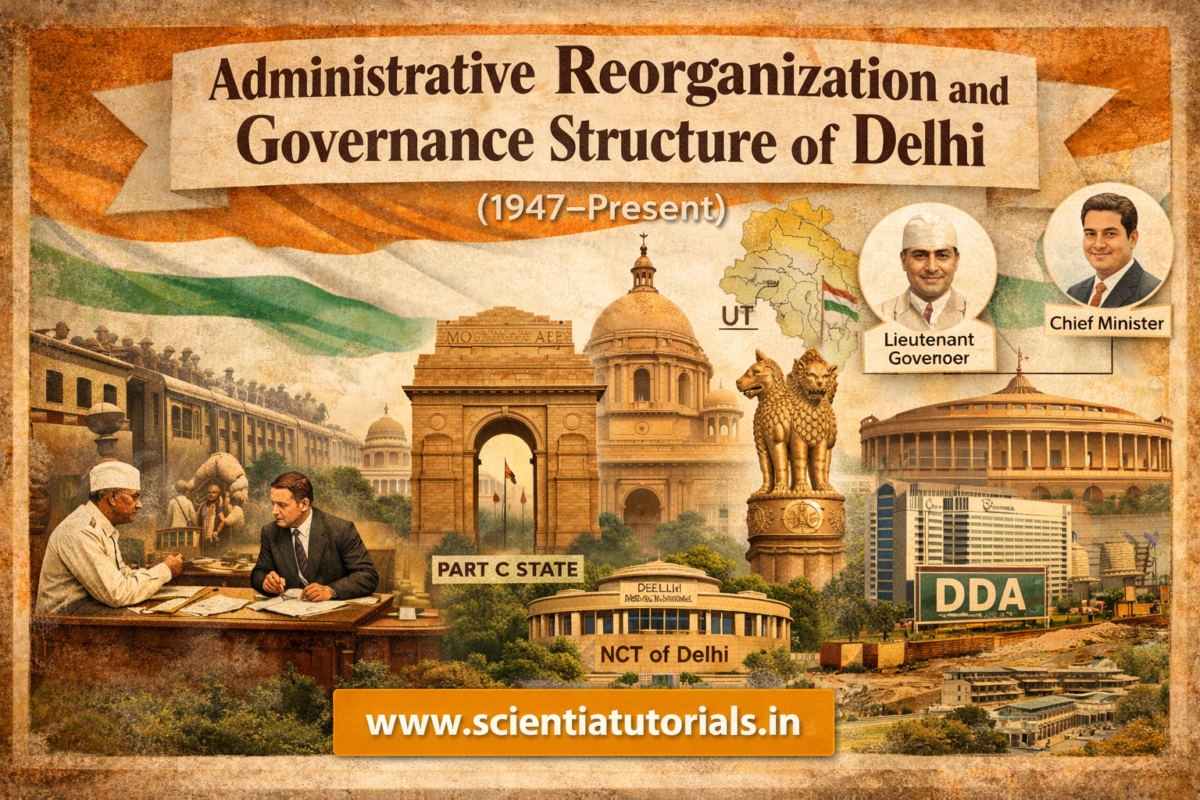

Administrative Reorganization and Governance Structure of Delhi
Course: History of Delhi – Chronological Era-Wise Study Module for Competitive Exams
Module VIII: Post-Independence Delhi
Timeline: 1947 CE – Present
Lesson 2: Administrative Reorganization and Governance Structure
This lesson is systematically organized into four clearly structured sections, as detailed below:
- Chronologically Structured Study Module
- Short-Answer Type Questions
- Long-Answer Type Questions
- Multiple-Choice Questions (MCQs) with Answers and Detailed Explanations
Chronologically Structured Study Module
Lesson Objectives
This lesson is designed to enable learners to:
- Understand the chronological evolution of Delhi’s administrative structure after independence.
- Analyze the changing governance models applied to Delhi from 1947 to the present.
- Examine the constitutional, legislative, and institutional frameworks governing Delhi.
- Explain the balance between central authority and local self-government in the National Capital.
- Develop exam-oriented clarity on key Acts, Amendments, institutions, and governance debates related to Delhi.
I. Introduction: Governance Challenges in Post-Independence Delhi
After 1947, Delhi faced governance challenges unlike any other Indian city. As the national capital, Delhi was simultaneously:
- A symbol of Indian sovereignty
- The administrative nerve centre of the Union Government
- A rapidly expanding urban settlement due to Partition-induced migration
These overlapping roles required a special administrative arrangement, distinct from both states and ordinary Union Territories. Consequently, Delhi’s governance evolved through multiple phases of reorganization, reflecting changing political priorities and constitutional thinking.
II. Immediate Post-Independence Administration (1947–1950)
1. Continuity from Colonial Administration
At independence, Delhi inherited the Chief Commissioner’s administrative system, a legacy of British rule. The immediate focus of governance was:
- Maintenance of law and order
- Refugee relief and rehabilitation
- Continuation of essential services
The Government of India exercised direct control, as the instability of the Partition period made decentralization impractical.
2. Rationale for Centralized Governance
Delhi’s governance was kept centralized because:
- It housed Parliament, Supreme Court, and foreign missions
- National security concerns were paramount
- Administrative continuity was essential during crisis
This phase laid the foundation for Delhi’s long-term administrative exceptionalism.
III. Delhi as a Part C State (1950–1956)
1. Constitutional Framework under the Constitution of India
With the enforcement of the Constitution in 1950, Delhi was designated a Part C State. This category applied to territories requiring special administrative arrangements.
Key features:
- Administered by a Chief Commissioner appointed by the President
- Limited scope for representative governance
- Significant powers retained by the Centre
This arrangement attempted to combine constitutional legitimacy with administrative control.
2. Introduction of Representative Institutions (1951)
In 1951, Delhi witnessed the creation of:
- A Legislative Assembly
- A Council of Ministers
This was the first major attempt to introduce democratic governance in post-independence Delhi.
However, the experiment faced constraints:
- Limited legislative jurisdiction
- Financial dependence on the Centre
- Overlapping authority between elected representatives and administrators
IV. States Reorganisation and Union Territory Status (1956)
1. Impact of the States Reorganisation Act, 1956
The States Reorganisation Act reorganized India primarily on linguistic lines. Delhi, however, was excluded due to its capital status.
Consequences:
- Abolition of Delhi’s Legislative Assembly
- Conversion of Delhi into a Union Territory
- Direct administration by the President through an Administrator
This marked a decisive shift toward centralized governance.
2. Administrative Implications of Union Territory Status
As a Union Territory:
- Delhi lacked a separate state government
- All major decisions were taken by the Centre
- Democratic participation was restricted to municipal bodies
This structure prioritized national interests over local autonomy.
V. Rise of Municipal and Urban Governance Institutions
1. Municipal Corporation of Delhi (1958)
To provide civic governance, the Municipal Corporation of Delhi (MCD) was established.
Functions included:
- Public health and sanitation
- Primary education
- Roads and urban services
The MCD became the primary platform for democratic participation in the absence of a legislative assembly.
2. Delhi Development Authority (1957)
The creation of the Delhi Development Authority (DDA) reflected the need for planned urban growth.
Key responsibilities:
- Preparation of Master Plans
- Regulation of land use
- Development of housing and infrastructure
The DDA symbolized centralized urban planning as a governance tool.
VI. Governance without Legislature: 1956–1991
1. Administrative Structure
During this long phase:
- Delhi was governed by an Administrator / Lieutenant Governor
- Key departments were controlled by central ministries
- Municipal bodies handled local services
This period witnessed rapid urbanization but limited political representation.
2. Democratic Deficit and Political Mobilization
By the 1970s and 1980s:
- Delhi’s population expanded dramatically
- Residents demanded greater political participation
- Political parties advocated restoration of an elected assembly
These pressures exposed the limitations of prolonged central rule.
VII. Constitutional Reforms and the NCT of Delhi (1991)
1. 69th Constitutional Amendment Act, 1991
A major turning point came with the 69th Constitutional Amendment Act, which created the National Capital Territory (NCT) of Delhi.
Objectives:
- Restore representative democracy
- Retain central control over sensitive matters
- Establish a balanced governance framework
2. National Capital Territory of Delhi Act, 1991
The National Capital Territory of Delhi Act operationalized the amendment.
Key provisions:
- Creation of an elected Legislative Assembly
- Council of Ministers headed by a Chief Minister
- Defined division of powers between the Centre and Delhi Government
Excluded subjects:
- Public order
- Police
- Land
VIII. Role of the Lieutenant Governor
The Lieutenant Governor (LG) emerged as a central figure in Delhi’s governance.
Key functions:
- Represents the President of India
- Exercises discretionary powers
- Acts as a link between the Union and Delhi Government
The LG’s role ensures continued central oversight in the capital.
IX. Governance Structure of Delhi in the Post-1991 Era
1. Dual Control Model
Delhi operates under a dual governance framework:
- Elected Government: Health, education, transport, welfare
- Union Government: Police, land, public order
This arrangement is unique in Indian federalism.
2. Administrative Complexity
The coexistence of:
- Union ministries
- Delhi Government departments
- Municipal bodies
- Development authorities
has made Delhi’s governance institutionally complex and politically sensitive.
X. Judicial Interpretation and Governance Debates
Post-1991 governance has seen frequent:
- Constitutional disputes
- Judicial interventions
- Debates on federal balance
The courts have played a crucial role in clarifying:
- Powers of the LG
- Scope of Delhi Government’s authority
- Nature of cooperative federalism in Delhi
XI. Chronological Summary for Quick Revision
- 1947–50 – Central administration under Chief Commissioner
- 1950 – Delhi becomes Part C State
- 1951–56 – Legislative Assembly experiment
- 1956 – Delhi becomes Union Territory
- 1957–58 – DDA and MCD established
- 1956–91 – Governance without legislature
- 1991 – NCT of Delhi created with elected assembly
XII. Examination-Oriented Key Points
- Delhi’s governance evolved through administrative experimentation
- Capital status remained the decisive factor in all reorganizations
- 1991 reforms created a hybrid governance model
- Questions frequently focus on Acts, Amendments, and power distribution
XIII. Analytical Significance for Competitive Exams
This lesson is crucial for:
- Understanding Indian federalism in practice
- Linking modern history with Indian polity
- Analyzing Centre–State relations in special territories
Delhi serves as a case study of how governance adapts to political, constitutional, and urban realities.
Conclusion
The administrative reorganization and governance structure of post-independence Delhi reflects India’s attempt to reconcile democratic representation with national imperatives. From centralized control to a carefully balanced representative framework, Delhi’s governance journey underscores the flexibility and complexity of the Indian constitutional system. Rather than a static arrangement, Delhi’s administrative structure continues to evolve, making it a vital topic for understanding contemporary Indian governance.
Short Answer Type Questions (With Answers)
Lesson 2: Administrative Reorganization and Governance Structure
1. Why did post-independence Delhi require a special administrative structure?
Answer:
Because Delhi was the national capital, hosting key Union institutions, and faced extraordinary challenges due to Partition-induced migration and rapid urban growth.
2. Which administrative system governed Delhi immediately after independence?
Answer:
Delhi was governed under the Chief Commissioner’s system, inherited from British colonial administration.
3. Why did the Government of India retain centralized control over Delhi after 1947?
Answer:
Centralized control was retained to ensure national security, administrative continuity, and effective refugee rehabilitation.
4. What was Delhi’s administrative status under the Constitution of India (1950)?
Answer:
Delhi was classified as a Part C State under the Constitution of India.
5. Who administered Delhi as a Part C State?
Answer:
Delhi was administered by a Chief Commissioner appointed by the President of India.
6. When was a Legislative Assembly first introduced in post-independence Delhi?
Answer:
A Legislative Assembly was introduced in 1951.
7. What was the main limitation of the Delhi Legislative Assembly (1951–1956)?
Answer:
The Assembly had limited legislative and financial powers, with major authority retained by the Centre.
8. Which Act abolished Delhi’s Legislative Assembly in 1956?
Answer:
The States Reorganisation Act abolished the Assembly.
9. What administrative status did Delhi acquire after 1956?
Answer:
After 1956, Delhi became a Union Territory.
10. Why was Delhi excluded from linguistic reorganization in 1956?
Answer:
Because Delhi’s role as the national capital made linguistic reorganization administratively and politically unsuitable.
11. Who administered Delhi as a Union Territory after 1956?
Answer:
Delhi was administered by the President through an Administrator, later designated as the Lieutenant Governor.
12. Which institution became the main forum of democratic participation after 1956?
Answer:
Municipal bodies became the primary forum of democratic participation.
13. When was the Municipal Corporation of Delhi established?
Answer:
The Municipal Corporation of Delhi was established in 1958.
14. State two major functions of the Municipal Corporation of Delhi.
Answer:
Public health and sanitation, and primary education.
15. Why was the Delhi Development Authority created?
Answer:
The Delhi Development Authority was created to ensure planned urban development and regulate land use.
16. Which document guided Delhi’s planned urban growth in the post-independence period?
Answer:
The Master Plan of Delhi (1962) guided planned urban growth.
17. Why did demands for representative governance grow after 1960?
Answer:
Rapid population growth, urbanization, and political awareness created pressure for democratic representation.
18. Which constitutional amendment transformed Delhi’s governance in 1991?
Answer:
The 69th Constitutional Amendment Act, 1991 transformed Delhi’s governance structure.
19. What is the National Capital Territory (NCT) of Delhi?
Answer:
The NCT of Delhi is a special administrative unit with an elected legislature but limited powers under the Union Government.
20. Which law defines Delhi’s present administrative framework?
Answer:
The National Capital Territory of Delhi Act defines Delhi’s governance framework.
21. Name three subjects excluded from the powers of the Delhi Legislative Assembly.
Answer:
Public order, police, and land.
22. Who represents the President of India in Delhi’s administration?
Answer:
The Lieutenant Governor represents the President of India.
23. What is meant by the ‘dual governance model’ in Delhi?
Answer:
It refers to the division of powers between the elected Delhi Government and the Union Government.
24. Why is Delhi’s governance structure considered administratively complex?
Answer:
Because multiple authorities—Union ministries, Delhi Government, municipal bodies, and development authorities—operate simultaneously.
25. Why is Delhi often described as a unique case in Indian federalism?
Answer:
Because it combines features of both a state and a Union Territory, creating a hybrid or quasi-federal governance model.
Long Answer Type Questions with Answers
Lesson 2: Administrative Reorganization and Governance Structure
1. Explain why Delhi required a distinct administrative framework after independence.
Answer:
After independence, Delhi occupied a position unlike any other Indian city. As the national capital, it housed Parliament, the Supreme Court, foreign embassies, and central ministries. Simultaneously, Delhi experienced massive population growth due to Partition-induced refugee inflows. These factors made ordinary state-level governance unsuitable. National security, diplomatic sensitivity, and administrative continuity necessitated a governance framework under strong central supervision. Consequently, Delhi’s administration evolved as a special case within Indian federalism.
2. Describe the administrative system governing Delhi immediately after 1947.
Answer:
Immediately after independence, Delhi continued under the Chief Commissioner’s system, inherited from British rule. The Government of India exercised direct control over administration. The focus during this phase was maintaining law and order, managing refugee rehabilitation, and ensuring uninterrupted functioning of national institutions. This continuity helped stabilize governance during the turbulent Partition period.
3. Analyze the rationale behind centralized governance of Delhi in the early post-independence years.
Answer:
Centralized governance was considered essential due to Delhi’s capital status and the volatile political environment following Partition. Granting autonomy could have disrupted national administration and security. The Union Government believed that direct control would ensure uniform policies, effective crisis management, and protection of national interests. Thus, centralization was a strategic choice rather than a denial of democratic principles.
4. Discuss Delhi’s administrative position as a Part C State under the Constitution of India.
Answer:
Under the Constitution of India (1950), Delhi was categorized as a Part C State, a classification meant for territories requiring special administrative arrangements. It was governed by a Chief Commissioner appointed by the President. Although constitutionally recognized, Delhi’s governance remained centrally controlled, with limited scope for popular representation. This arrangement reflected a cautious approach to decentralization in the national capital.
5. Evaluate the introduction of representative institutions in Delhi in 1951.
Answer:
The establishment of a Legislative Assembly and Council of Ministers in 1951 marked Delhi’s first experiment with representative governance. While this move reflected democratic intent, the Assembly’s powers were restricted. Financial dependence on the Centre and overlapping authority with administrators limited its effectiveness. Although short-lived, this experiment demonstrated the tension between democratic aspirations and central control.
6. Why was the experiment with the Legislative Assembly (1951–1956) discontinued?
Answer:
The Assembly was discontinued due to administrative inefficiency, jurisdictional conflicts, and Delhi’s growing strategic importance. Policymakers felt that the national capital required direct and uniform governance rather than fragmented authority. These concerns culminated in the abolition of the Assembly in 1956.
7. Examine the impact of the States Reorganisation Act, 1956 on Delhi’s governance.
Answer:
The States Reorganisation Act reorganized India mainly on linguistic lines. Delhi, lacking a dominant linguistic identity and serving as the national capital, was excluded. As a result, Delhi was converted into a Union Territory and its Legislative Assembly was abolished. This marked a decisive shift toward centralized administration.
8. Why was Delhi excluded from linguistic reorganization in 1956?
Answer:
Delhi’s heterogeneous population and its role as the national capital made linguistic reorganization impractical. Applying linguistic principles could have undermined administrative neutrality and national unity. Therefore, Delhi remained under direct Union control.
9. Describe the administrative structure of Delhi as a Union Territory after 1956.
Answer:
As a Union Territory, Delhi was administered by the President through an Administrator, later designated as the Lieutenant Governor. Legislative powers rested entirely with the Centre, while municipal bodies handled local civic functions. This structure emphasized national priorities over regional self-government.
10. Assess the role of municipal governance in Delhi between 1956 and 1991.
Answer:
With the absence of a legislative assembly, municipal bodies became the primary institutions of local governance. The Municipal Corporation of Delhi played a vital role in managing civic services such as sanitation, health, education, and infrastructure. Although limited in scope, municipal governance provided a degree of democratic participation.
11. Discuss the significance of the Delhi Development Authority in Delhi’s administrative reorganization.
Answer:
The Delhi Development Authority (DDA) was created to address unplanned urban growth. It introduced systematic planning through the Master Plan of Delhi (1962), regulated land use, and developed residential and industrial areas. The DDA symbolized centralized planning as a governance strategy in post-independence Delhi.
12. Analyze governance challenges in Delhi during the period 1956–1991.
Answer:
During this period, Delhi experienced rapid urbanization without representative political institutions. Administrative decisions were centralized, leading to a democratic deficit. Growing population, civic demands, and political mobilization exposed the limitations of prolonged Union control and increased calls for democratic reform.
13. Explain the political and administrative pressures that led to constitutional reforms in 1991.
Answer:
By the late 20th century, sustained demands for democratic representation, administrative complexity, and recommendations from committees compelled the Union Government to reconsider Delhi’s governance model. These pressures resulted in the 69th Constitutional Amendment, aiming to balance democracy with national interests.
14. Describe the objectives of the 69th Constitutional Amendment Act, 1991.
Answer:
The amendment aimed to restore representative government in Delhi, create a constitutionally recognized territorial identity, and retain central control over sensitive matters such as law and order. It sought a middle path between statehood and Union Territory administration.
15. Examine the provisions of the National Capital Territory of Delhi Act, 1991.
Answer:
The National Capital Territory of Delhi Act established an elected Legislative Assembly and Council of Ministers headed by a Chief Minister. However, public order, police, and land were reserved for the Union Government, ensuring continued central oversight.
16. Why is Delhi’s post-1991 governance described as a dual control model?
Answer:
Governance in Delhi is divided between the elected Delhi Government and the Union Government. While local matters such as education and health fall under the Delhi Government, critical subjects remain with the Centre. This division creates a dual control framework.
17. Examine the role of the Lieutenant Governor in Delhi’s governance structure.
Answer:
The Lieutenant Governor represents the President and exercises discretionary powers, particularly over reserved subjects. In case of conflict between the Centre and Delhi Government, the LG plays a decisive role, reinforcing central authority.
18. Discuss the administrative complexity of Delhi’s governance structure.
Answer:
Delhi’s governance involves multiple authorities—Union ministries, the Delhi Government, municipal bodies, and development agencies. This multiplicity often leads to jurisdictional overlaps, policy conflicts, and administrative challenges.
19. Analyze the role of judicial interpretation in shaping Delhi’s governance.
Answer:
Courts have played a crucial role in interpreting the division of powers between the Centre and Delhi Government. Judicial rulings have clarified the scope of authority of the Lieutenant Governor and reinforced the principle of cooperative federalism.
20. Why is Delhi considered a unique case in Indian federalism?
Answer:
Delhi combines features of a state and a Union Territory. It has an elected legislature but lacks full control over key subjects. This hybrid structure makes Delhi a distinctive and unparalleled example in Indian federalism.
21. Evaluate how Delhi’s capital status has influenced its administrative evolution.
Answer:
Delhi’s role as the seat of national power has consistently shaped its governance. Security, diplomacy, and administrative neutrality have justified central control at every stage of its evolution.
22. Discuss the relationship between urbanization and administrative reorganization in Delhi.
Answer:
Rapid urbanization increased demands for efficient governance, infrastructure, and services. Administrative reorganization, particularly the creation of planning and municipal institutions, was a response to these pressures.
23. Critically assess the argument for granting full statehood to Delhi.
Answer:
Supporters argue that statehood would enhance democratic accountability, while opponents fear it could undermine national security and administrative neutrality. This debate reflects unresolved tensions in Delhi’s governance model.
24. Explain how Delhi’s governance reflects the flexibility of the Indian Constitution.
Answer:
Delhi’s evolving administrative arrangements demonstrate constitutional adaptability. Through amendments, legislation, and judicial interpretation, the Constitution has accommodated Delhi’s unique needs.
25. Conclude by assessing the overall administrative reorganization of post-independence Delhi.
Answer:
Delhi’s administrative reorganization has been gradual and experimental, shaped by its capital status, demographic pressures, and democratic aspirations. Rather than a fixed model, Delhi’s governance represents an evolving compromise between central authority and representative government, making it a vital case study in Indian polity and governance.
MCQs with Answers & Explanations
Lesson 2: Administrative Reorganization and Governance Structure
1. Why did Delhi require a special administrative structure after 1947?
A. It was economically backward
B. It lacked linguistic identity only
C. It was the national capital with strategic importance
D. It was a newly formed princely state
✅ Correct Answer: C
Explanation:
Delhi’s role as the national capital, hosting Parliament, Supreme Court, and diplomatic missions, made ordinary state governance unsuitable and necessitated special administrative arrangements.
2. Which administrative system governed Delhi immediately after independence?
A. Governor’s Province system
B. Chief Commissioner’s system
C. Lieutenant Governor system
D. State government system
✅ Correct Answer: B
Explanation:
Delhi continued under the Chief Commissioner’s system inherited from British rule to ensure continuity during the Partition crisis.
3. Which authority exercised direct control over Delhi’s administration after 1947?
A. Constituent Assembly
B. State Government of Punjab
C. Government of India
D. Municipal authorities
✅ Correct Answer: C
Explanation:
Delhi was administered directly by the Government of India due to its national importance and security considerations.
4. Under the Constitution of India (1950), Delhi was classified as a:
A. Part A State
B. Part B State
C. Part C State
D. Union Territory
✅ Correct Answer: C
Explanation:
Delhi was placed in the Part C category, meant for territories requiring special administrative arrangements under central supervision.
5. Who administered Delhi as a Part C State?
A. Governor
B. Chief Minister
C. Chief Commissioner
D. Lieutenant Governor
✅ Correct Answer: C
Explanation:
Part C States were administered by Chief Commissioners appointed by the President, not by elected governors.
6. In which year was a Legislative Assembly first introduced in Delhi?
A. 1947
B. 1950
C. 1951
D. 1956
✅ Correct Answer: C
Explanation:
Delhi was provided with a Legislative Assembly and Council of Ministers in 1951 as an experiment in representative governance.
7. What was the main limitation of the Delhi Legislative Assembly (1951–1956)?
A. Absence of elections
B. Complete lack of executive powers
C. Limited legislative and financial authority
D. No Council of Ministers
✅ Correct Answer: C
Explanation:
Although elected, the Assembly had restricted powers, with major subjects and finances controlled by the Centre.
8. Which Act abolished Delhi’s Legislative Assembly?
A. Government of India Act, 1935
B. Indian Independence Act, 1947
C. States Reorganisation Act
D. Union Territories Act, 1963
✅ Correct Answer: C
Explanation:
The States Reorganisation Act, 1956 converted Delhi into a Union Territory and abolished its Legislative Assembly.
9. After 1956, Delhi was administered as a:
A. Full-fledged State
B. Autonomous region
C. Union Territory
D. Special category state
✅ Correct Answer: C
Explanation:
Post-1956, Delhi became a Union Territory administered directly by the President.
10. Why was Delhi excluded from linguistic reorganization in 1956?
A. It had no dominant language
B. It was economically weak
C. It was the national capital
D. It opposed reorganization
✅ Correct Answer: C
Explanation:
Delhi’s capital status and national role made linguistic reorganization politically and administratively unsuitable.
11. Who administered Delhi as a Union Territory after 1956?
A. Governor
B. Chief Commissioner
C. Administrator / Lieutenant Governor
D. Chief Minister
✅ Correct Answer: C
Explanation:
Delhi was administered by an Administrator appointed by the President, later designated as the Lieutenant Governor.
12. Which institution became the primary forum for democratic participation after 1956?
A. Parliament
B. Legislative Assembly
C. Municipal bodies
D. Planning Commission
✅ Correct Answer: C
Explanation:
With no legislative assembly, municipal institutions became the main democratic platforms.
13. The Municipal Corporation of Delhi (MCD) was established in:
A. 1950
B. 1956
C. 1957
D. 1958
✅ Correct Answer: D
Explanation:
The Municipal Corporation of Delhi was established in 1958 to manage civic administration.
14. Which of the following was NOT a function of the Municipal Corporation of Delhi?
A. Public health
B. Primary education
C. Foreign policy
D. Sanitation
✅ Correct Answer: C
Explanation:
Foreign policy is a Union subject; MCD handled civic services like health, sanitation, and education.
15. Why was the Delhi Development Authority (DDA) created?
A. To conduct elections
B. To manage law and order
C. To ensure planned urban development
D. To regulate linguistic policy
✅ Correct Answer: C
Explanation:
The Delhi Development Authority was created to regulate land use and guide planned urban growth.
16. The Master Plan of Delhi (1962) primarily focused on:
A. Electoral reforms
B. Linguistic zoning
C. Planned urban expansion
D. Refugee rehabilitation only
✅ Correct Answer: C
Explanation:
The Master Plan provided a blueprint for zoning, housing, transport, and infrastructure development.
17. Between 1956 and 1991, Delhi was governed without:
A. Municipal bodies
B. Planning agencies
C. Legislative Assembly
D. Central supervision
✅ Correct Answer: C
Explanation:
During this period, Delhi had no elected legislative assembly and was directly administered by the Centre.
18. Growing demands for democratic governance after 1960 were mainly due to:
A. Decline in municipal efficiency
B. Rapid population growth and political awareness
C. Linguistic movements
D. Industrial decline
✅ Correct Answer: B
Explanation:
Urban expansion and increased political consciousness led to demands for representative institutions.
19. Which Constitutional Amendment fundamentally altered Delhi’s governance in 1991?
A. 42nd Amendment
B. 44th Amendment
C. 69th Amendment
D. 73rd Amendment
✅ Correct Answer: C
Explanation:
The 69th Constitutional Amendment created the National Capital Territory of Delhi with an elected legislature.
20. The National Capital Territory (NCT) of Delhi was created in:
A. 1989
B. 1990
C. 1991
D. 1992
✅ Correct Answer: C
Explanation:
The NCT of Delhi was established in 1991 following constitutional reforms.
21. Which law defines Delhi’s present governance framework?
A. Union Territories Act, 1963
B. Delhi Municipal Act
C. National Capital Territory of Delhi Act
D. Government of India Act, 1935
✅ Correct Answer: C
Explanation:
This Act operationalized the constitutional amendment and defined power distribution.
22. Which subjects are excluded from the powers of Delhi’s Legislative Assembly?
A. Education, health, transport
B. Police, land, public order
C. Agriculture, irrigation, trade
D. Finance and taxation
✅ Correct Answer: B
Explanation:
These subjects remain under Union Government control due to Delhi’s capital status.
23. Who represents the President of India in Delhi’s administration?
A. Chief Minister
B. Speaker of Assembly
C. Lieutenant Governor
D. Mayor
✅ Correct Answer: C
Explanation:
The Lieutenant Governor acts as the President’s representative and exercises special powers.
24. Delhi’s post-1991 governance is best described as:
A. Fully federal
B. Unitary
C. Dual control model
D. Confederation
✅ Correct Answer: C
Explanation:
Governance is shared between the elected Delhi Government and the Union Government.
25. Why is Delhi considered a unique case in Indian federalism?
A. It has no constitution
B. It has no municipal bodies
C. It combines features of a state and a Union Territory
D. It is governed only by Parliament
✅ Correct Answer: C
Explanation:
Delhi’s hybrid governance structure makes it neither a full state nor a typical Union Territory.