
Lesson 1: British Capture of Delhi from the Marathas
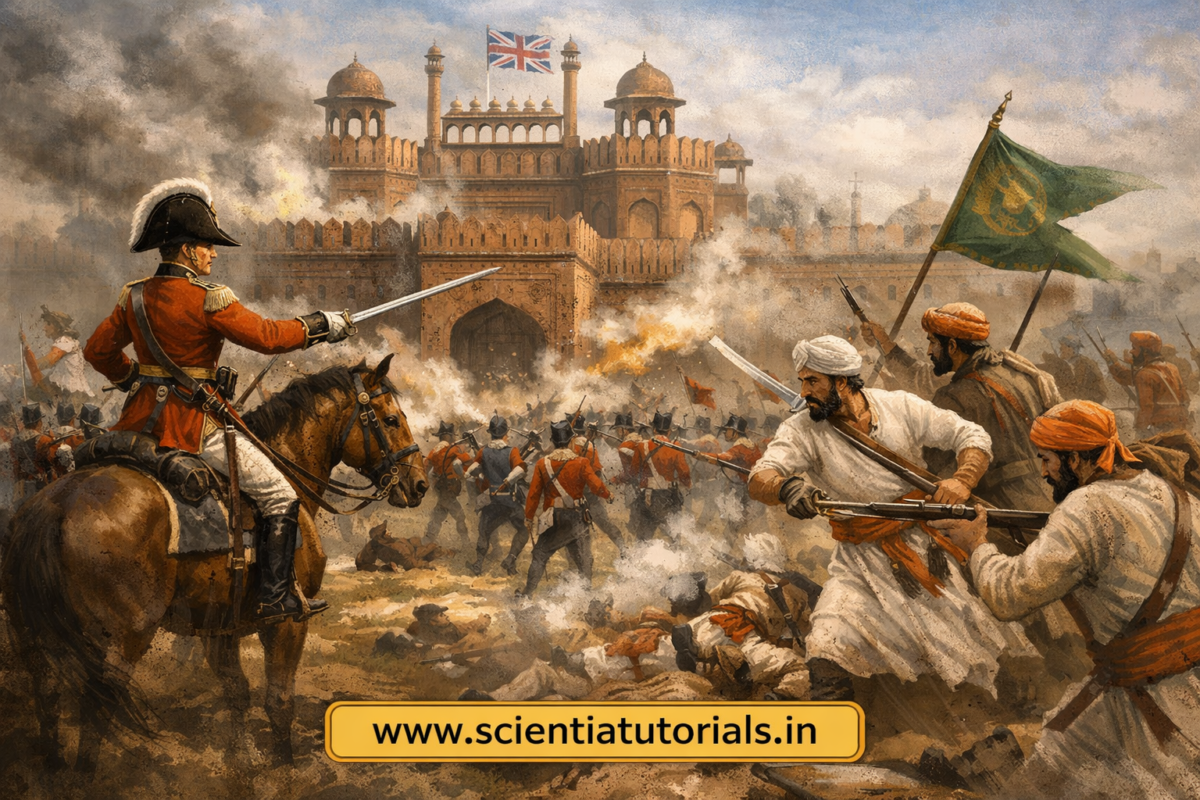

British Capture of Delhi (1803) – Marathas Defeated & Colonial Rule Begins
Course: History of Delhi – Chronological Era-Wise Study Module for Competitive Exams
Module VI: British Colonial Delhi
Timeline: 1803 CE – 1911 CE
Lesson 1: British Capture of Delhi from the Marathas
This lesson is systematically organized into four clearly structured sections, as detailed below:
- Chronologically Structured Study Module
- Short-Answer Type Questions
- Long-Answer Type Questions
- Multiple-Choice Questions (MCQs) with Answers and Detailed Explanations
Chronologically Structured Study Module
Introduction: A Turning Point in Delhi’s History
The British capture of Delhi in 1803 CE marks a decisive watershed in the city’s long political history. For the first time since the establishment of the Delhi Sultanate in the 13th century, Delhi passed under the control of a European colonial power. Although the Mughal emperor continued to reside in the Red Fort, real authority shifted permanently to the British East India Company, inaugurating the phase known as British Colonial Delhi.
This lesson examines the chronological process, political background, military events, and consequences of the British capture of Delhi from the Marathas. For competitive examinations, this topic is vital because it explains how British political supremacy was established in North India, the end of Maratha influence in Delhi, and the transformation of the Mughal emperor into a colonial pensioner.
1. Background: Delhi on the Eve of 1803 CE
Decline of Mughal Authority
By the end of the 18th century, Mughal authority in Delhi had been reduced to a symbolic presence. The emperor exercised no independent military or administrative power and depended entirely on external protectors.
The reign of Shah Alam II illustrates this condition. Blinded by Ghulam Qadir Rohilla and repeatedly displaced, the emperor survived largely at the mercy of stronger regional powers.
2. Maratha Control over Delhi (1771–1803 CE)
Marathas as Protectors of the Mughal Emperor
After defeating Afghan influence in North India, the Marathas reoccupied Delhi in 1771 CE and projected themselves as protectors of the Mughal emperor.
Key features of Maratha control:
- Emperor reduced to a pensioner
- Real power exercised by Maratha chiefs
- Revenue extracted without long-term urban development
- Weak administrative integration of Delhi
While Maratha dominance restored some stability, it remained military and extractive, not institutional.
3. Anglo-Maratha Rivalry and British Expansion
British East India Company’s Rise
Following victories at Plassey (1757) and Buxar (1764), the British East India Company emerged as the strongest power in eastern India.
By the late 18th century:
- The Company controlled Bengal’s revenues
- Maintained a modern standing army
- Expanded westwards into North India
Delhi, though economically weakened, held immense symbolic value, making it a strategic target.
4. Second Anglo-Maratha War (1803–1805)
Immediate Context
The Second Anglo-Maratha War erupted due to:
- Internal divisions among Maratha chiefs
- British policy of territorial expansion
- Conflict over dominance in North India
The British sought to eliminate Maratha influence in the Gangetic plain, with Delhi as a crucial objective.
5. Military Campaign Leading to the Capture of Delhi
British Advance on Delhi
In 1803, British forces under Lord Lake advanced towards Delhi.
Battle of Delhi (1803 CE)
- British forces confronted Maratha troops stationed near Delhi
- Despite strong resistance, Maratha forces were defeated
- British troops entered Delhi in September 1803
This marked the end of Maratha authority in the city.
6. Entry of the British into Delhi
Occupation of the City
After the battle:
- British troops occupied strategic points
- Red Fort placed under British supervision
- Maratha garrisons removed
The transition of power occurred with minimal resistance from the local population, reflecting Delhi’s political exhaustion.
7. Position of Shah Alam II after 1803
From Nominal Emperor to British Pensioner
The British restored Shah Alam II to the Red Fort but stripped him of all real authority.
Key changes:
- Emperor placed under British “protection”
- Granted a fixed pension
- Forbidden from independent diplomacy or military action
The Mughal emperor became a symbolic relic, useful for legitimising British rule.
8. Nature of British Control in Delhi (1803–1806)
British authority in Delhi was initially indirect:
- Mughal court retained ceremonial status
- Company officials controlled revenue and defence
- Judicial and administrative authority shifted to British hands
This strategy avoided immediate confrontation while consolidating power.
9. End of Maratha Political Influence in Delhi
The British capture of Delhi effectively:
- Eliminated Maratha supremacy in North India
- Reduced Maratha power to western and central India
- Altered the balance of power irreversibly in favour of the British
Delhi ceased to be a contested prize and became a colonial possession.
10. Strategic Importance of Delhi for the British
Symbolic and Political Value
Delhi was not economically vital but politically crucial:
- Association with Mughal sovereignty
- Psychological dominance over Indian rulers
- Legitimisation of Company authority
Control of Delhi strengthened British diplomatic leverage across North India.
11. Administrative Consequences of British Capture
Transformation of Governance
Post-1803:
- British Residents supervised Mughal court
- Revenue administration restructured
- Military cantonments established
Delhi began its transition from imperial capital to colonial city.
12. Impact on Mughal Nobility and Court Culture
- Mughal nobles lost political influence
- Court culture survived only in ceremonial form
- Persian court traditions declined gradually
The Red Fort became a symbol of the past rather than a seat of power.
13. Popular Response to British Capture
The capture of Delhi did not provoke widespread resistance initially because:
- The city had experienced decades of instability
- Mughal authority was already discredited
- British rule appeared comparatively orderly
However, resentment would surface later, especially in 1857.
14. British Delhi between 1803 and 1806
During Shah Alam II’s final years:
- British authority consolidated quietly
- Delhi remained under indirect rule
- Mughal emperor’s death in 1806 removed even symbolic resistance
15. Long-Term Consequences of the Capture of Delhi
Political
- End of indigenous sovereignty in Delhi
- Beginning of uninterrupted colonial rule
Administrative
- Integration into Company’s North Indian system
Historical
- Prepared ground for direct British control after 1857
16. Chronological Summary
- 1771: Marathas reoccupy Delhi
- 1803: Second Anglo-Maratha War
- September 1803: British defeat Marathas and capture Delhi
- 1803–1806: Shah Alam II under British protection
- 1806: Death of Shah Alam II
17. Importance for Competitive Examinations
Key Analytical Themes
- Transition from regional to colonial dominance
- Symbolic politics of legitimacy
- British preference for indirect control
- End of Mughal–Maratha power struggle
Frequently Asked Focus Areas
- Role of Lord Lake
- Status of Mughal emperor after 1803
- Difference between Maratha and British control of Delhi
Conclusion: Delhi Enters the Colonial Age
The British capture of Delhi in 1803 CE was not merely a military event but a civilisational turning point. It ended centuries of indigenous imperial rule and inaugurated a new phase of colonial dominance. While the Mughal emperor continued to sit on the throne, sovereignty had irreversibly passed into British hands.
For competitive examinations, this lesson highlights a critical insight: colonial conquest in India succeeded not only through military strength but through the exploitation of political decay and symbolic legitimacy. Delhi’s capture stands as the clearest example of this strategy.
Short Answer Type Questions with Answers
1. In which year did the British capture Delhi from the Marathas?
Answer:
The British captured Delhi in 1803 CE.
2. Which war led to the British capture of Delhi?
Answer:
The Second Anglo-Maratha War (1803–1805) led to the British capture of Delhi.
3. Who controlled Delhi immediately before the British capture?
Answer:
Delhi was under Maratha control before 1803 CE.
4. Name the Mughal emperor ruling at the time of British capture of Delhi.
Answer:
Shah Alam II was the Mughal emperor at the time.
5. What was the real political status of Shah Alam II in 1803 CE?
Answer:
He was a nominal ruler without real political or military power.
6. Who led the British military campaign that resulted in the capture of Delhi?
Answer:
The campaign was led by Lord Lake.
7. What was the Battle of Delhi (1803)?
Answer:
It was a battle in which British forces defeated the Maratha troops stationed near Delhi.
8. Why was Delhi important to the British despite its economic decline?
Answer:
Because Delhi symbolised Mughal sovereignty and political legitimacy.
9. How did the British treat the Mughal emperor after capturing Delhi?
Answer:
They placed him under British protection and granted him a pension.
10. Did the British abolish the Mughal throne in 1803?
Answer:
No, the Mughal throne was retained for symbolic legitimacy.
11. What happened to Maratha authority in Delhi after 1803?
Answer:
Maratha authority in Delhi ended completely.
12. Why was Maratha control over Delhi considered weak?
Answer:
It was primarily military and extractive, without stable administration.
13. What role did the British East India Company play in Delhi after 1803?
Answer:
It exercised real administrative and military control over the city.
14. What was the nature of British rule in Delhi immediately after 1803?
Answer:
British rule was indirect, operating through the Mughal emperor.
15. Where was the Mughal emperor allowed to reside after 1803?
Answer:
In the Red Fort of Delhi, under British supervision.
16. Why was there little popular resistance to the British capture of Delhi?
Answer:
Because Delhi had already suffered long political instability and decline.
17. What happened to Mughal nobles after the British takeover?
Answer:
They lost political power and survived mainly on pensions and court rituals.
18. How did British capture of Delhi affect North Indian politics?
Answer:
It established British supremacy in North India.
19. Which British institution benefited most from the capture of Delhi?
Answer:
The British East India Company benefited most.
20. How long did Shah Alam II live after the British capture of Delhi?
Answer:
He lived until 1806 CE, about three years after the capture.
21. What major change occurred in Delhi’s political status after 1803?
Answer:
Delhi became a colonial-controlled city rather than an imperial capital.
22. What strategic advantage did the British gain by controlling Delhi?
Answer:
They gained symbolic authority and legitimacy over Indian rulers.
23. How did the capture of Delhi affect Maratha power in North India?
Answer:
It permanently weakened Maratha influence in North India.
24. Why is the capture of Delhi in 1803 considered a historical turning point?
Answer:
It marked the beginning of British colonial dominance in Delhi.
25. State one key lesson from the British capture of Delhi.
Answer:
Political fragmentation and weak sovereignty enable foreign domination.
Long Answer Type Questions with Answers
1. Examine the political condition of Delhi on the eve of the British capture in 1803 CE.
Answer:
On the eve of 1803 CE, Delhi was a city of immense symbolic value but negligible political power. Mughal authority had collapsed, and the emperor exercised no real control over administration, revenue, or military affairs. The city was under Maratha protection, but Maratha control was primarily military and extractive, lacking stable governance. Decades of invasions, court politics, and economic decline had weakened Delhi, making it vulnerable to British intervention.
2. Analyse the decline of Mughal authority that made British capture of Delhi possible.
Answer:
The decline of Mughal authority after 1707 CE was marked by weak emperors, factional court politics, and loss of provincial control. By the reign of Shah Alam II, the emperor had become a symbolic figure dependent on regional powers. The inability of the Mughal state to defend Delhi or govern effectively created a power vacuum that facilitated British entry.
3. Discuss the nature of Maratha control over Delhi between 1771 and 1803 CE.
Answer:
The Marathas reoccupied Delhi in 1771 and acted as protectors of the Mughal emperor. While they restored some political stability, their control was essentially military and revenue-oriented. They did not integrate Delhi into a coherent administrative system, nor did they revive the city economically. This weak and unstable control made it easier for the British to dislodge them in 1803.
4. Why was Delhi strategically important to the British despite its economic decline?
Answer:
Delhi’s importance lay in its symbolic association with Mughal sovereignty. Control over Delhi meant control over imperial legitimacy, which could be used to dominate North Indian politics. The British understood that political authority in India required symbolic acceptance, and Delhi provided that legitimacy even after its economic decline.
5. Trace the rise of the British East India Company as a political power before 1803.
Answer:
The British East India Company evolved from a trading body into a political power after its victories at Plassey (1757) and Buxar (1764). These victories granted the Company revenue rights in Bengal, Bihar, and Orissa, providing financial resources to maintain a modern army. By the late eighteenth century, this power base enabled British expansion into North India, including Delhi.
6. Examine the causes of the Second Anglo-Maratha War.
Answer:
The Second Anglo-Maratha War (1803–1805) was caused by internal divisions among Maratha chiefs, British expansionist ambitions, and competition for supremacy in North India. The British sought to eliminate Maratha influence in the Gangetic plain, while Maratha disunity weakened resistance. Delhi became a major strategic objective during this conflict.
7. Describe the military campaign that led to the British capture of Delhi.
Answer:
British forces under Lord Lake advanced towards Delhi in 1803. The decisive engagement, known as the Battle of Delhi, resulted in the defeat of Maratha troops stationed near the city. Following this victory, British forces entered and occupied Delhi in September 1803.
8. Analyse the significance of the Battle of Delhi (1803).
Answer:
The Battle of Delhi marked the end of Maratha dominance in the city and established British military supremacy in North India. It was not merely a battlefield victory but a political triumph that enabled the British to control the Mughal emperor and appropriate imperial legitimacy.
9. How did the British consolidate control over Delhi after 1803?
Answer:
After capturing Delhi, the British occupied strategic locations, supervised the Red Fort, and stationed troops in and around the city. They avoided direct annexation and instead ruled indirectly through the Mughal emperor, ensuring minimal resistance while consolidating real power.
10. Examine the position of Shah Alam II after the British capture of Delhi.
Answer:
After 1803, Shah Alam II was restored to the Red Fort but stripped of all sovereign authority. He was placed under British protection, granted a fixed pension, and prohibited from independent political action. The emperor became a symbolic figure used to legitimise British rule.
11. Why did the British retain the Mughal emperor instead of abolishing the throne?
Answer:
The British retained the Mughal emperor to exploit his symbolic authority. By ruling in the emperor’s name, they reduced resistance from Indian elites and avoided immediate confrontation. This policy of indirect rule allowed the British to consolidate power gradually.
12. Compare Maratha and British control over Delhi.
Answer:
Maratha control was military and extractive, lacking administrative integration and long-term stability. British control, though initially indirect, was systematic and institutional. The British restructured administration, revenue, and defence, transforming Delhi into a colonial city rather than a contested prize.
13. Discuss the administrative changes introduced in Delhi after 1803.
Answer:
Post-1803, British Residents supervised the Mughal court, revenue administration was reorganised, and military cantonments were established. Judicial and fiscal authority shifted from Mughal institutions to Company officials, marking the beginning of colonial governance.
14. Analyse the impact of British capture on Mughal nobility and court culture.
Answer:
Mughal nobles lost political power and became dependent on pensions. Court culture survived only in ceremonial form, while Persian administrative traditions gradually declined. The Red Fort ceased to function as a centre of governance.
15. Why was there little immediate popular resistance to the British capture of Delhi?
Answer:
Delhi had experienced decades of instability, invasions, and economic decline. Mughal authority was already discredited, and British rule initially appeared orderly and stable. As a result, the capture of Delhi did not provoke immediate mass resistance.
16. Examine the role of Delhi in British North Indian strategy after 1803.
Answer:
Delhi became a symbolic centre rather than an administrative capital. Control over the city strengthened British diplomatic authority across North India and reinforced their claim to legitimacy derived from Mughal sovereignty.
17. How did the capture of Delhi affect Maratha power in North India?
Answer:
The loss of Delhi marked the irreversible decline of Maratha influence in North India. Their power was confined to western and central regions, while the British emerged as the dominant force.
18. Discuss the long-term consequences of the British capture of Delhi.
Answer:
The capture ended indigenous political sovereignty in Delhi and inaugurated uninterrupted colonial rule. It prepared the ground for direct British control after the Revolt of 1857 and permanently altered the city’s political trajectory.
19. Why is the capture of Delhi in 1803 considered a historical turning point?
Answer:
It marked the transition from regional power struggles to colonial domination. For the first time, Delhi came under European control, ending centuries of indigenous imperial rule.
20. Conclude by assessing how political decay enabled British conquest of Delhi.
Answer:
The British capture of Delhi succeeded not merely due to military superiority but because of prolonged Mughal decline, Maratha instability, and political fragmentation. Delhi’s fall demonstrates how internal decay and loss of sovereignty pave the way for foreign domination.
MCQs with Answers and Explanations
1. The British capture of Delhi took place in:
A. 1761 CE
B. 1771 CE
C. 1803 CE
D. 1818 CE
Correct Answer: C
Explanation:
Delhi was captured by the British in 1803 CE during the Second Anglo-Maratha War, marking the start of British colonial rule in the city.
2. Which power controlled Delhi immediately before the British occupation?
A. Mughals
B. Afghans
C. Marathas
D. Sikhs
Correct Answer: C
Explanation:
From 1771 to 1803 CE, Delhi remained under Maratha control, though the Mughal emperor continued as a nominal ruler.
3. The British capture of Delhi was part of which conflict?
A. First Anglo-Maratha War
B. Second Anglo-Maratha War
C. Third Anglo-Maratha War
D. Anglo-Sikh War
Correct Answer: B
Explanation:
The Second Anglo-Maratha War (1803–1805) led directly to the British capture of Delhi.
4. Who was the Mughal emperor at the time of the British capture of Delhi?
A. Alamgir II
B. Muhammad Shah
C. Akbar II
D. Shah Alam II
Correct Answer: D
Explanation:
Shah Alam II ruled in name when the British captured Delhi but had no real authority.
5. The Mughal emperor in 1803 CE was best described as:
A. An absolute ruler
B. A military commander
C. A symbolic sovereign
D. A reformist administrator
Correct Answer: C
Explanation:
By 1803 CE, the Mughal emperor was only a symbolic figure, dependent on external powers.
6. Which British general led the campaign that resulted in the capture of Delhi?
A. Lord Cornwallis
B. Warren Hastings
C. Lord Wellesley
D. Lord Lake
Correct Answer: D
Explanation:
Lord Lake commanded British forces in North India and defeated the Marathas near Delhi.
7. The Battle of Delhi (1803) was fought between:
A. British and Mughals
B. British and Afghans
C. British and Marathas
D. Marathas and Sikhs
Correct Answer: C
Explanation:
British forces defeated the Maratha troops stationed near Delhi in 1803.
8. What happened to Maratha authority in Delhi after 1803 CE?
A. It strengthened
B. It continued under British supervision
C. It ended completely
D. It was shared with the Mughals
Correct Answer: C
Explanation:
The British victory ended Maratha political control over Delhi permanently.
9. Why was Delhi strategically important to the British?
A. It was a major industrial centre
B. It was rich in minerals
C. It symbolised Mughal legitimacy
D. It controlled coastal trade
Correct Answer: C
Explanation:
Delhi’s value lay in its symbolic association with Mughal sovereignty, not its economy.
10. After capturing Delhi, the British initially followed which policy?
A. Direct annexation
B. Complete withdrawal
C. Indirect rule through the Mughal emperor
D. Military dictatorship
Correct Answer: C
Explanation:
The British retained the Mughal emperor to legitimise their authority and rule indirectly.
11. After 1803 CE, Shah Alam II was:
A. Exiled from Delhi
B. Executed
C. Restored as an independent ruler
D. Maintained as a pensioner
Correct Answer: D
Explanation:
Shah Alam II lived in the Red Fort under British protection and received a fixed pension.
12. The British power in Delhi after 1803 was exercised by:
A. The British Crown
B. The Mughal court
C. The Maratha chiefs
D. British East India Company
Correct Answer: D
Explanation:
The British East India Company exercised real administrative and military power.
13. Maratha control over Delhi before 1803 can best be described as:
A. Stable and administrative
B. Popular and legitimate
C. Military and extractive
D. Democratic
Correct Answer: C
Explanation:
Maratha authority focused on military control and revenue extraction, not governance.
14. Why was there little immediate resistance to British occupation of Delhi?
A. British military weakness
B. Popular support for British rule
C. Long-standing political exhaustion of the city
D. Religious affinity
Correct Answer: C
Explanation:
Delhi had faced decades of instability and decline, reducing resistance capacity.
15. Which institution supervised the Mughal court after 1803 CE?
A. Governor-General’s Council
B. British Resident
C. Maratha Sardars
D. Imperial Parliament
Correct Answer: B
Explanation:
A British Resident oversaw the Mughal court, ensuring Company control.
16. The capture of Delhi in 1803 marked the end of:
A. Mughal cultural traditions
B. Maratha–Mughal alliance
C. Indigenous political sovereignty in Delhi
D. British expansion in India
Correct Answer: C
Explanation:
1803 ended all forms of independent Indian political power in Delhi.
17. Which of the following BEST explains British success in capturing Delhi?
A. Superior numbers alone
B. Religious motivation
C. Political fragmentation among Indian powers
D. Naval supremacy
Correct Answer: C
Explanation:
Indian disunity and weak sovereignty were crucial to British success.
18. After British capture, Delhi became primarily a:
A. Commercial capital
B. Religious centre
C. Colonial-controlled city
D. Military frontier town
Correct Answer: C
Explanation:
Delhi lost its imperial role and became a colonial city under Company control.
19. Which year marks the death of Shah Alam II?
A. 1799 CE
B. 1803 CE
C. 1806 CE
D. 1818 CE
Correct Answer: C
Explanation:
Shah Alam II died in 1806 CE, three years after British capture of Delhi.
20. The British capture of Delhi primarily strengthened British control over:
A. South India
B. Western Ghats
C. North India
D. Coastal India
Correct Answer: C
Explanation:
Control of Delhi consolidated British dominance in North India.
21. Which feature distinguishes British control of Delhi from Maratha control?
A. Greater taxation
B. Institutional administration
C. Use of force
D. Dependence on Mughal emperor
Correct Answer: B
Explanation:
British rule was systematic and institutional, unlike Maratha military dominance.
22. The capture of Delhi occurred during the Governor-Generalship of:
A. Warren Hastings
B. Lord Cornwallis
C. Lord Wellesley
D. Lord Hastings
Correct Answer: C
Explanation:
Lord Wellesley pursued aggressive expansion during the Second Anglo-Maratha War.
23. Which of the following was NOT an immediate consequence of the capture of Delhi?
A. End of Maratha influence
B. British supervision of Mughal court
C. Abolition of Mughal throne
D. Establishment of British cantonments
Correct Answer: C
Explanation:
The Mughal throne was not abolished in 1803; it was retained symbolically.
24. The capture of Delhi in 1803 can best be described as:
A. A sudden accidental event
B. A purely economic conquest
C. A strategic political takeover
D. A religious war
Correct Answer: C
Explanation:
The British deliberately targeted Delhi for political legitimacy.
25. Which statement BEST summarises Lesson 1 of Module VI?
A. British rule in Delhi began in 1857
B. Marathas permanently controlled Delhi
C. Delhi fell due to internal decay and colonial strategy
D. Delhi was conquered mainly for economic wealth
Correct Answer: C
Explanation:
The British capture of Delhi succeeded because of political decay, symbolic legitimacy, and strategic expansion.