
Lesson 1: Foundation of the Delhi Sultanate and Slave Dynasty
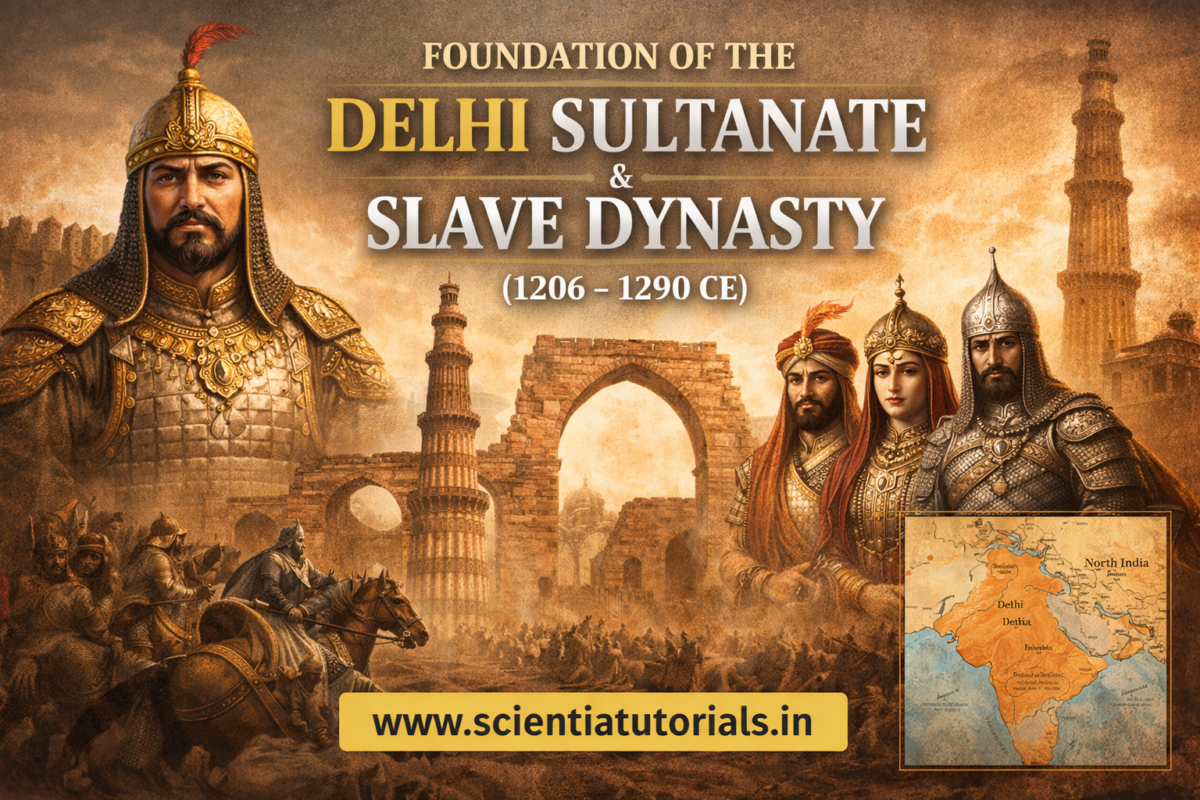

Foundation of the Delhi Sultanate and Slave Dynasty (1206–1290 CE)
Course: History of Delhi – Chronological Era-Wise Study Module for Competitive Exams
Module III: Delhi Sultanate Period (1206 CE – 1526 CE)
Lesson 1: Foundation of the Delhi Sultanate and Slave Dynasty
This lesson is systematically organized into four clearly structured sections, as detailed below:
- Chronologically Structured Study Module
- Short-Answer Type Questions
- Long-Answer Type Questions
- Multiple-Choice Questions (MCQs) with Answers and Detailed Explanations
Chronologically Structured Study Module
Introduction: From Early Medieval Transition to Sultanate State Formation
The establishment of the Delhi Sultanate in 1206 CE marks one of the most decisive political transformations in Indian history. With the decline of Rajput political authority in North India and the success of Turkic military elites, Delhi emerged as the nucleus of a new Islamic imperial polity. This lesson focuses on the foundation of the Delhi Sultanate and the rise of the Slave Dynasty (Mamluk Dynasty), laying the institutional, military, administrative, and ideological foundations of medieval Indian statecraft.
Chronologically, this phase bridges the end of early medieval India and the beginning of high medieval political consolidation, setting patterns that continued until 1526 CE. For competitive examinations, understanding this lesson is essential for grasping state formation, centralization, and Indo-Islamic governance.
1. Historical Background to the Foundation of the Delhi Sultanate
1.1 Ghurid Expansion into North India
The roots of the Delhi Sultanate lie in the Ghurid conquests of the late 12th century. Under Muhammad Ghori, Turkic forces penetrated deep into North India after defeating Rajput powers in key battles such as Tarain (1192 CE) and Chandawar (1194 CE).
Unlike earlier invaders, the Ghurids aimed not merely at plunder but at territorial control and political domination. To administer conquered regions, Muhammad Ghori appointed trusted military commanders—many of whom were Turkish slaves (mamluks)—as governors.
1.2 Delhi as a Strategic Political Centre
Delhi’s location near the Indo-Gangetic plains and north-western invasion routes made it ideal as a capital. By the early 13th century, Delhi transformed from a frontier town into the administrative heart of a new Sultanate.
2. Foundation of the Delhi Sultanate (1206 CE)
2.1 Accession of Qutbuddin Aibak
After the assassination of Muhammad Ghori in 1206 CE, his Indian territories lacked direct central control. In this vacuum, Qutbuddin Aibak, the former slave and trusted general of Muhammad Ghori, declared himself Sultan of Delhi.
This event formally marks the foundation of the Delhi Sultanate.
Key Features of Aibak’s Accession:
- First independent Muslim ruler of Delhi
- Laid foundations of Turkish rule in India
- Established Delhi as the capital of a sovereign state
2.2 Significance of Slave Origin
Aibak’s rise illustrates a distinctive feature of early Sultanate politics: slaves trained in warfare and administration could rise to supreme power. This system weakened hereditary aristocracy and strengthened centralized authority based on loyalty and merit.
3. The Slave (Mamluk) Dynasty: Meaning and Character
3.1 Why “Slave Dynasty”?
The first dynasty of the Delhi Sultanate is called the Slave Dynasty because its rulers were former military slaves (mamluks) of the Ghurids. Slavery in the Islamic world was institutional and professional, very different from agrarian slavery.
Slaves were:
- Educated in Persian and Arabic
- Trained as cavalry soldiers
- Groomed for administration
3.2 Chronological Rulers of the Slave Dynasty
| Ruler | Reign |
|---|---|
| Qutbuddin Aibak | 1206–1210 |
| Aram Shah | 1210–1211 |
| Iltutmish | 1211–1236 |
| Ruknuddin Firoz Shah | 1236 |
| Razia Sultana | 1236–1240 |
| Bahram Shah | 1240–1242 |
| Alauddin Masud Shah | 1242–1246 |
| Nasiruddin Mahmud | 1246–1266 |
| Ghiyasuddin Balban | 1266–1287 |
4. Consolidation under Iltutmish (1211–1236 CE)
4.1 Political Challenges
When Iltutmish came to power, the Sultanate faced:
- Rival Turkish nobles
- Hostility from Rajput chiefs
- Threats from Mongol invasions
4.2 Administrative Achievements
Iltutmish is regarded as the real consolidator of the Delhi Sultanate.
Major Contributions:
- Introduced Iqta system for revenue and military administration
- Standardized coinage (silver tanka and copper jital)
- Organized nobility into the Chalisa (Group of Forty)
- Secured Caliph’s recognition, giving religious legitimacy
4.3 Territorial Consolidation
Iltutmish extended Sultanate authority over:
- Delhi
- Punjab
- Ganga-Yamuna Doab
- Parts of Bengal and Malwa
This marked the transformation of the Sultanate into a territorial state.
5. Razia Sultana and Gender in Sultanate Politics
5.1 Accession of Razia Sultana
Razia Sultana became the first and only woman ruler of the Delhi Sultanate.
5.2 Challenges to Her Rule
Razia faced:
- Opposition from Turkish nobles
- Patriarchal resistance to female authority
- Political instability
Despite her competence, she was overthrown, highlighting the limits of social acceptance in medieval politics.
6. Era of Political Instability (1240–1266 CE)
After Razia’s death, weak rulers dominated the throne while Turkish nobles exercised real power. This period exposed the dangers of aristocratic dominance over central authority.
7. Balban and the Theory of Kingship
7.1 Rise of Ghiyasuddin Balban
Ghiyasuddin Balban emerged as the strongest ruler after Iltutmish, restoring the prestige of the monarchy.
7.2 Theory of Divine Kingship
Balban introduced:
- Concept of Zill-i-Ilahi (Shadow of God)
- Strict court discipline (sijda and paibos)
- Suppression of rebellious nobles
7.3 Military and Administrative Measures
- Strengthened frontier defenses against Mongols
- Reorganized army
- Reduced power of the Chalisa
Balban’s reign marked the final consolidation of the Slave Dynasty.
8. Administrative Structure of the Early Sultanate
8.1 Central Administration
Key offices included:
- Diwan-i-Wizarat (Finance)
- Diwan-i-Arz (Military)
- Diwan-i-Insha (Correspondence)
8.2 Provincial Administration
Provinces (iqtas) were governed by military commanders who collected revenue in return for service.
9. Military System and Defense
The Sultanate relied heavily on:
- Cavalry-based army
- Centralized recruitment
- Standing army (especially under Balban)
This military structure ensured survival against internal revolts and Mongol threats.
10. Cultural and Architectural Developments
10.1 Indo-Islamic Architecture
Early Sultanate architecture combined:
- Indian craftsmanship
- Islamic arches and domes
The construction of the Qutb Minar complex symbolized political authority and religious identity.
10.2 Persian Cultural Influence
- Persian became the court language
- Chronicles and administrative records flourished
- Delhi emerged as a cultural capital
11. Historical Significance of the Slave Dynasty
The Slave Dynasty:
- Established centralized monarchy
- Introduced durable administrative systems
- Created a political framework followed by later dynasties
It laid the institutional foundations of the Delhi Sultanate, enabling its survival for over three centuries.
Conclusion: Legacy of the Foundation Phase
The foundation of the Delhi Sultanate and the rule of the Slave Dynasty represent the birth of medieval Indian imperial governance. Through military conquest, administrative innovation, and ideological restructuring, the early Sultans transformed Delhi into a permanent center of power.
For competitive examinations, this lesson is crucial for understanding:
- State formation
- Centralization vs nobility
- Indo-Islamic political culture
The Slave Dynasty was not merely a transitional phase but the architect of Sultanate stability and longevity.
✔ Exam-Oriented Takeaways
- 1206 CE marks the foundation of the Delhi Sultanate
- Iltutmish and Balban were key consolidators
- Slave origin strengthened centralized authority
- Delhi became the enduring capital of medieval India
Short Answer Type Questions with Answers
Q1. In which year was the Delhi Sultanate founded?
Answer:
The Delhi Sultanate was founded in 1206 CE.
Q2. Who founded the Delhi Sultanate?
Answer:
The Delhi Sultanate was founded by Qutbuddin Aibak.
Q3. Why is the first dynasty of the Delhi Sultanate called the Slave Dynasty?
Answer:
Because its rulers were former Turkish military slaves (mamluks) who rose to power through service and loyalty.
Q4. What was the political significance of Muhammad Ghori’s death in 1206 CE?
Answer:
His death created a power vacuum that enabled Qutbuddin Aibak to establish an independent Sultanate in Delhi.
Q5. What does the term ‘mamluk’ mean?
Answer:
Mamluk means owned slave, trained for military and administrative service.
Q6. Name the capital of the Delhi Sultanate during the Slave Dynasty.
Answer:
Delhi was the capital of the Delhi Sultanate.
Q7. Who was the real consolidator of the Delhi Sultanate?
Answer:
Iltutmish is regarded as the real consolidator.
Q8. What was the Chalisa or Chahalgani?
Answer:
The Chalisa was a group of forty powerful Turkish nobles formed during Iltutmish’s reign.
Q9. What was the iqta system?
Answer:
The iqta system assigned land revenue to officials in return for military and administrative services.
Q10. Which coins were standardized by Iltutmish?
Answer:
Silver tanka and copper jital.
Q11. Why was Caliph’s recognition important for Iltutmish?
Answer:
It provided religious legitimacy to the Delhi Sultanate.
Q12. Who was the first woman ruler of the Delhi Sultanate?
Answer:
Razia Sultana.
Q13. Why did Razia Sultana face opposition?
Answer:
Due to resistance from Turkish nobles and patriarchal attitudes toward female authority.
Q14. What period followed the death of Razia Sultana?
Answer:
A period of political instability and weak rulers (1240–1266 CE).
Q15. Who restored the authority of the Sultanate after instability?
Answer:
Ghiyasuddin Balban.
Q16. What was Balban’s theory of kingship called?
Answer:
Zill-i-Ilahi (Shadow of God on Earth).
Q17. What court practices did Balban introduce to enhance royal authority?
Answer:
Sijda (prostration) and Paibos (kissing the feet).
Q18. Which foreign threat did the early Sultanate constantly face?
Answer:
The Mongol invasions from Central Asia.
Q19. What was the primary military strength of the early Delhi Sultanate?
Answer:
A cavalry-based standing army.
Q20. Name the major departments of the central administration.
Answer:
- Diwan-i-Wizarat (Finance)
- Diwan-i-Arz (Military)
- Diwan-i-Insha (Correspondence)
Q21. What role did Persian language play in the Sultanate?
Answer:
Persian was the official language of administration and court culture.
Q22. Which architectural complex symbolizes early Sultanate authority?
Answer:
The Qutb Minar complex.
Q23. How was slavery different under the Sultanate compared to agrarian slavery?
Answer:
Sultanate slavery was institutional and professional, not agricultural.
Q24. Why was Delhi chosen as the capital of the Sultanate?
Answer:
Due to its strategic location controlling North India and invasion routes.
Q25. What is the historical importance of the Slave Dynasty?
Answer:
It laid the administrative, military, and ideological foundations of the Delhi Sultanate.
Long Answer Type Questions with Answers
Q1. Explain the historical circumstances that led to the foundation of the Delhi Sultanate in 1206 CE.
Answer:
The foundation of the Delhi Sultanate was the outcome of long-term political instability in North India and the expansionist ambitions of the Ghurids. After the decline of strong Rajput confederacies, Turkic forces under Muhammad Ghori defeated major Indian powers in battles such as Tarain (1192 CE) and Chandawar (1194 CE). Unlike earlier invaders, the Ghurids aimed at territorial control rather than plunder. Muhammad Ghori appointed trusted slave commanders to govern conquered territories. His assassination in 1206 CE created a power vacuum, enabling Qutbuddin Aibak to declare independence at Delhi, marking the birth of the Delhi Sultanate.
Q2. Assess the role of Qutbuddin Aibak in the establishment of the Delhi Sultanate.
Answer:
Qutbuddin Aibak played a foundational role as the first independent ruler of the Delhi Sultanate. Though his reign (1206–1210 CE) was short, he established Delhi as the political capital and asserted sovereign authority over former Ghurid territories in India. Aibak relied on Turkish military elites and laid the initial administrative framework. His greatest contribution was political continuity—preventing fragmentation after Muhammad Ghori’s death and ensuring the survival of a centralized Muslim state in North India.
Q3. Why is the first dynasty of the Delhi Sultanate known as the Slave (Mamluk) Dynasty?
Answer:
The dynasty is called the Slave Dynasty because its rulers were originally mamluks, or military slaves, trained in warfare and administration. In the Islamic world, slavery was institutional and professional, allowing capable individuals to rise to high office. Qutbuddin Aibak, Iltutmish, and Balban were all former slaves. Their rise weakened hereditary aristocracy and strengthened centralized authority based on loyalty, discipline, and merit.
Q4. Examine the significance of Delhi as the capital of the Sultanate.
Answer:
Delhi’s strategic location near the north-western invasion routes and the fertile Indo-Gangetic plains made it ideal for imperial control. As capital, Delhi served as the administrative, military, and cultural center of the Sultanate. Its selection enabled the Sultans to monitor frontier threats, especially Mongol invasions, and to expand authority over North India. Over time, Delhi became a permanent seat of power for successive dynasties.
Q5. Analyze the administrative reforms introduced by Iltutmish.
Answer:
Iltutmish is regarded as the real consolidator of the Delhi Sultanate. He organized administration on a systematic basis by introducing the iqta system, standardizing coinage (tanka and jital), and structuring the nobility. He also secured recognition from the Abbasid Caliph, granting religious legitimacy. These reforms transformed the Sultanate from a military occupation into a stable territorial state.
Q6. Discuss the iqta system and its role in the early Delhi Sultanate.
Answer:
The iqta system involved assigning land revenue to military and administrative officers in lieu of salaries. Iqtadars were responsible for revenue collection and maintaining troops. This system ensured a standing army without burdening the treasury and helped maintain central control over provinces. However, it also required strong supervision to prevent local autonomy.
Q7. How did Iltutmish deal with internal and external challenges to the Sultanate?
Answer:
Internally, Iltutmish subdued rebellious Turkish nobles and Rajput chiefs. Externally, he skillfully avoided direct confrontation with the Mongols by diplomacy and strategic retreat. His balanced approach ensured the survival of the Sultanate during a period of extreme vulnerability.
Q8. Evaluate the importance of Caliphal recognition for the Delhi Sultanate.
Answer:
Recognition by the Abbasid Caliph provided religious legitimacy to Iltutmish’s rule, distinguishing the Delhi Sultanate from regional rulers. It strengthened the Sultan’s authority among Muslim elites and reinforced the ideological foundation of kingship based on Islamic political traditions.
Q9. Examine the reign of Razia Sultana in the context of gender and power.
Answer:
Razia Sultana was the first and only woman ruler of the Delhi Sultanate. Despite administrative competence, she faced strong opposition from Turkish nobles unwilling to accept female authority. Her reign highlights both the flexibility and limitations of medieval political systems, where ability could be acknowledged but social norms ultimately prevailed.
Q10. What factors led to political instability after Razia Sultana’s death?
Answer:
After Razia’s fall, weak rulers ascended the throne while Turkish nobles dominated politics. Frequent changes in rulers, factionalism, and lack of strong leadership weakened central authority. This phase demonstrated the dangers of aristocratic dominance over monarchy.
Q11. Assess the role of the Turkish nobility in early Sultanate politics.
Answer:
The Turkish nobility initially supported the Sultanate but later became power-hungry. Groups like the Chalisa (Group of Forty) often interfered in succession, undermining royal authority. Their dominance necessitated strong rulers like Balban to restore central control.
Q12. Examine the rise of Ghiyasuddin Balban and his contribution to the Sultanate.
Answer:
Ghiyasuddin Balban restored the authority of the monarchy after years of instability. He emphasized discipline, loyalty, and absolute obedience to the Sultan, transforming kingship into a powerful institution.
Q13. Explain Balban’s theory of kingship.
Answer:
Balban propagated the concept of Zill-i-Ilahi (Shadow of God), portraying the Sultan as divinely ordained. He introduced strict court rituals like sijda and paibos to enhance royal prestige. This theory strengthened centralized authority and reduced noble interference.
Q14. How did Balban curb the power of the nobility?
Answer:
Balban dismantled the Chalisa, punished rebellious nobles, and enforced strict discipline. He emphasized merit and loyalty over lineage, ensuring that power remained concentrated in the monarchy.
Q15. Discuss the military organization of the early Delhi Sultanate.
Answer:
The Sultanate relied on a cavalry-based standing army supported by the iqta system. Emphasis on mobility, discipline, and centralized command allowed the Sultans to suppress revolts and defend against Mongol invasions.
Q16. Analyze the impact of Mongol invasions on the policies of the Slave Dynasty.
Answer:
The constant Mongol threat forced the Sultans to strengthen frontier defenses, maintain a standing army, and prioritize internal stability. Balban, in particular, adopted a defensive strategy to safeguard the north-western frontiers.
Q17. Describe the central administrative structure under the Slave Dynasty.
Answer:
The central administration consisted of specialized departments such as Diwan-i-Wizarat (finance), Diwan-i-Arz (military), and Diwan-i-Insha (correspondence). This bureaucratic structure enhanced efficiency and control.
Q18. Examine the provincial administration of the early Sultanate.
Answer:
Provinces were governed as iqtas by military commanders. While they collected revenue and maintained order, ultimate authority remained with the Sultan, ensuring centralized governance.
Q19. Discuss the cultural and architectural developments during the Slave Dynasty.
Answer:
The period witnessed the emergence of Indo-Islamic architecture, blending Indian craftsmanship with Islamic forms. Persian language and culture flourished, transforming Delhi into a cultural center.
Q20. How did Persian influence administration and culture in the Sultanate?
Answer:
Persian became the official language of administration, historiography, and court culture. It facilitated efficient record-keeping and linked India with the wider Islamic world.
Q21. Compare the nature of kingship under the Slave Dynasty with earlier Indian polities.
Answer:
Unlike lineage-based kingship, Sultanate kingship emphasized conquest, administrative competence, and religious legitimacy. Authority was institutional rather than personal.
Q22. Examine the role of slavery in strengthening centralized authority.
Answer:
Military slaves owed personal loyalty to the Sultan, reducing the influence of hereditary nobles. This system strengthened central authority and administrative efficiency.
Q23. Assess the historical importance of Iltutmish and Balban in shaping the Sultanate.
Answer:
Iltutmish provided stability and institutional structure, while Balban reinforced royal authority and discipline. Together, they ensured the survival and consolidation of the Sultanate.
Q24. Why is the Slave Dynasty considered foundational for later Sultanate dynasties?
Answer:
It established administrative systems, military organization, and ideological frameworks that were adopted and refined by later dynasties.
Q25. Conclude with an assessment of the Slave Dynasty’s legacy in medieval Indian history.
Answer:
The Slave Dynasty laid the political, administrative, and ideological foundations of the Delhi Sultanate. It transformed Delhi into a durable imperial capital and shaped the course of medieval Indian history for over three centuries.
Multiple Choice Questions (MCQs) with Answers & Explanations
Q1. The Delhi Sultanate was formally established in which year?
A. 1192 CE
B. 1194 CE
C. 1206 CE
D. 1211 CE
Correct Answer: C
Explanation:
The Delhi Sultanate was founded in 1206 CE when Qutbuddin Aibak declared himself the Sultan after the death of Muhammad Ghori.
Q2. Who was the immediate cause for the establishment of an independent Sultanate at Delhi?
A. Defeat of Rajputs at Chandawar
B. Mongol invasion
C. Death of Muhammad Ghori
D. Rise of Turkish nobility
Correct Answer: C
Explanation:
The assassination of Muhammad Ghori in 1206 CE created a political vacuum, allowing his slave general Qutbuddin Aibak to establish independent rule.
Q3. Why is the first dynasty of the Delhi Sultanate known as the Slave Dynasty?
A. Slaves were employed in agriculture
B. Rulers were elected by slaves
C. Rulers were former military slaves
D. Economy was slave-based
Correct Answer: C
Explanation:
The rulers of the first dynasty were mamluks (military slaves) trained in warfare and administration, who rose to political power.
Q4. Which ruler is regarded as the real consolidator of the Delhi Sultanate?
A. Qutbuddin Aibak
B. Aram Shah
C. Iltutmish
D. Balban
Correct Answer: C
Explanation:
Iltutmish consolidated the Sultanate by organizing administration, securing Caliphal recognition, and stabilizing territories.
Q5. Which system was introduced to manage revenue and military obligations in the Sultanate?
A. Zamindari system
B. Jagirdari system
C. Mansabdari system
D. Iqta system
Correct Answer: D
Explanation:
The iqta system assigned land revenue to officials in return for military and administrative service, ensuring a standing army.
Q6. The ‘Chalisa’ or ‘Chahalgani’ refers to:
A. A tax system
B. A military regiment
C. A group of forty Turkish nobles
D. A religious council
Correct Answer: C
Explanation:
The Chalisa was a powerful group of forty Turkish nobles formed during Iltutmish’s reign, later becoming a threat to royal authority.
Q7. Which coinage system was standardized by Iltutmish?
A. Gold dinar and silver rupiya
B. Silver tanka and copper jital
C. Copper paisa and silver dam
D. Gold mohurs only
Correct Answer: B
Explanation:
Iltutmish introduced standardized coinage—silver tanka and copper jital—to strengthen economic administration.
Q8. Why was recognition from the Abbasid Caliph important for Iltutmish?
A. It provided military support
B. It ensured trade privileges
C. It granted religious legitimacy
D. It ended Mongol threats
Correct Answer: C
Explanation:
Caliphal recognition gave the Sultan religious and ideological legitimacy, strengthening his authority among Muslim elites.
Q9. Who was the first woman ruler of the Delhi Sultanate?
A. Nur Jahan
B. Razia Sultana
C. Chand Bibi
D. Jahanara Begum
Correct Answer: B
Explanation:
Razia Sultana ruled from 1236–1240 CE and was the only woman Sultan of Delhi.
Q10. The main reason for Razia Sultana’s failure was:
A. Foreign invasion
B. Economic crisis
C. Opposition from Turkish nobles
D. Peasant revolts
Correct Answer: C
Explanation:
Razia faced strong opposition from Turkish nobles unwilling to accept female authority, despite her administrative competence.
Q11. The period between 1240 and 1266 CE is characterized by:
A. Territorial expansion
B. Political stability
C. Strong monarchy
D. Political instability
Correct Answer: D
Explanation:
After Razia’s death, weak rulers and powerful nobles led to political instability until Balban’s rise.
Q12. Who re-established the authority of the monarchy after prolonged instability?
A. Nasiruddin Mahmud
B. Balban
C. Alauddin Khalji
D. Firoz Shah Tughlaq
Correct Answer: B
Explanation:
Ghiyasuddin Balban restored royal authority through strict discipline and centralized control.
Q13. Balban’s theory of kingship emphasized that the Sultan was:
A. Elected by nobles
B. Equal to nobles
C. Shadow of God on Earth
D. Tribal leader
Correct Answer: C
Explanation:
Balban introduced the concept of Zill-i-Ilahi (Shadow of God) to elevate royal authority above nobles.
Q14. Which court practices were introduced by Balban to enforce discipline?
A. Jharokha and Darbar
B. Sijda and Paibos
C. Mansab and Jagir
D. Zakat and Jizya
Correct Answer: B
Explanation:
Balban enforced sijda (prostration) and paibos (kissing the feet) to emphasize the Sultan’s supremacy.
Q15. Which external threat most influenced the military policy of the Slave Dynasty?
A. Portuguese
B. Timurids
C. Mongols
D. Arabs
Correct Answer: C
Explanation:
Repeated Mongol invasions forced the Sultans to maintain a strong standing army and fortified frontiers.
Q16. The main strength of the early Delhi Sultanate army was:
A. Infantry
B. Elephants
C. Navy
D. Cavalry
Correct Answer: D
Explanation:
The Sultanate relied on a highly mobile cavalry-based army, superior to traditional Indian military formations.
Q17. Which department handled military affairs in the Sultanate administration?
A. Diwan-i-Wizarat
B. Diwan-i-Insha
C. Diwan-i-Arz
D. Diwan-i-Risalat
Correct Answer: C
Explanation:
The Diwan-i-Arz was responsible for military organization, recruitment, and discipline.
Q18. Persian language became important in the Sultanate because it was:
A. The language of peasants
B. Used in religious rituals only
C. The official administrative language
D. A regional dialect
Correct Answer: C
Explanation:
Persian served as the official language of administration, historiography, and court culture.
Q19. The Qutb Minar complex symbolizes:
A. Gupta architecture
B. Rajput dominance
C. Early Sultanate authority
D. Mughal grandeur
Correct Answer: C
Explanation:
The Qutb Minar complex represents the political authority and architectural beginnings of the Delhi Sultanate.
Q20. Slavery under the Delhi Sultanate differed from agrarian slavery because it was:
A. Hereditary
B. Economic exploitation
C. Professional and institutional
D. Rural-based
Correct Answer: C
Explanation:
Sultanate slavery was institutional, focusing on training slaves as soldiers and administrators.
Q21. Why was Delhi chosen as the capital of the Sultanate?
A. Religious importance
B. Coastal location
C. Strategic position
D. Ancient heritage
Correct Answer: C
Explanation:
Delhi’s strategic location allowed control over invasion routes and the Indo-Gangetic plains.
Q22. Which ruler dismantled the power of the Chalisa?
A. Aibak
B. Iltutmish
C. Razia
D. Balban
Correct Answer: D
Explanation:
Balban crushed the power of the Chalisa to reassert centralized monarchy.
Q23. The Slave Dynasty laid foundations mainly in which area?
A. Maritime trade
B. Centralized administration
C. Village self-government
D. Temple economy
Correct Answer: B
Explanation:
The dynasty established centralized administration, military organization, and kingship ideology.
Q24. Which of the following best describes the nature of kingship under the Slave Dynasty?
A. Clan-based
B. Democratic
C. Feudal
D. Absolute and centralized
Correct Answer: D
Explanation:
Kingship under the Slave Dynasty was absolute and centralized, especially under Balban.
Q25. The historical importance of the Slave Dynasty lies in the fact that it:
A. Ended all regional powers
B. Introduced Mughal institutions
C. Founded durable Sultanate institutions
D. Eliminated nobility
Correct Answer: C
Explanation:
The Slave Dynasty laid the institutional foundations that enabled the Delhi Sultanate to survive for over three centuries.