
Lesson 2: Persian Invasion of Nadir Shah and Sack of Delhi
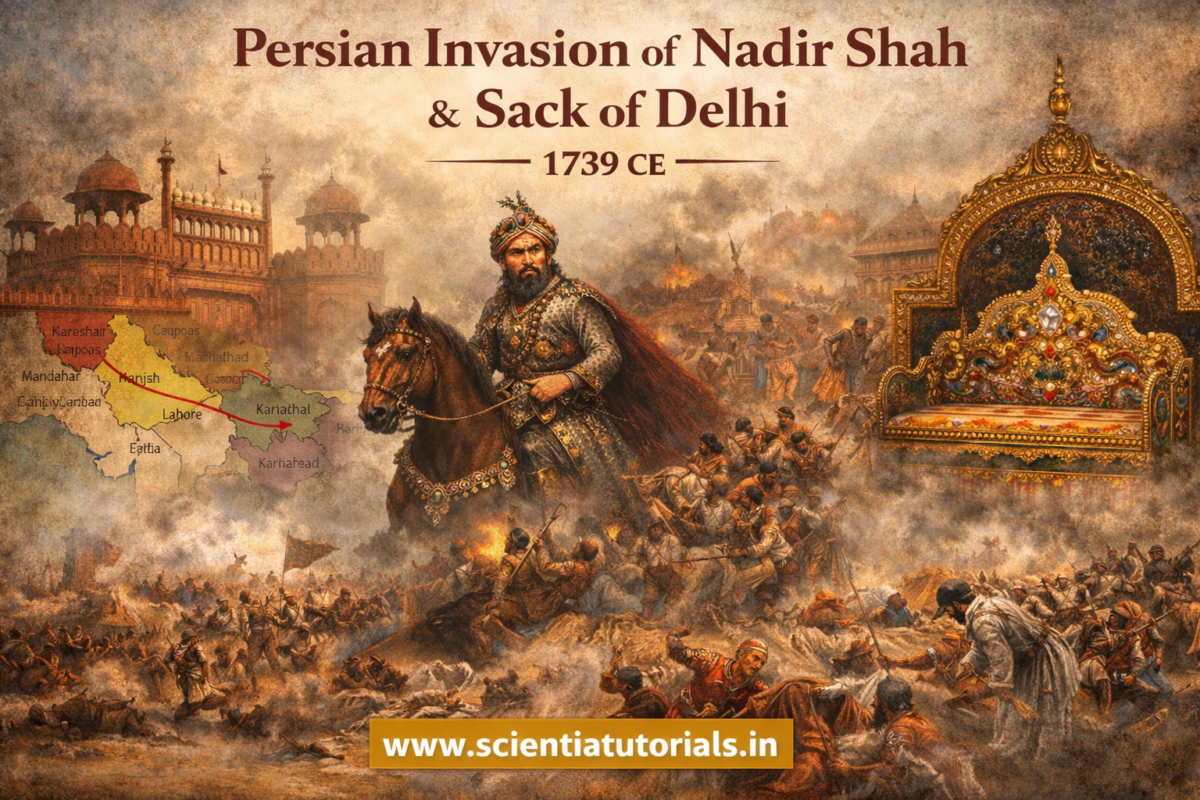

Nadir Shah’s Invasion of Delhi (1739): Sack of Delhi & Mughal Decline
Course: History of Delhi – Chronological Era-Wise Study Module for Competitive Exams
Module V: Late Mughal Decline & Regional Powers
Timeline: 1707 CE – 1803 CE
Lesson 2: Persian Invasion of Nadir Shah and Sack of Delhi
This lesson is systematically organized into four clearly structured sections, as detailed below:
- Chronologically Structured Study Module
- Short-Answer Type Questions
- Long-Answer Type Questions
- Multiple-Choice Questions (MCQs) with Answers and Detailed Explanations
Chronologically Structured Study Module
Introduction: A Watershed Moment in Mughal History
The Persian invasion of India led by Nadir Shah in 1739 CE stands as one of the most catastrophic events in the history of Delhi and the Mughal Empire. More than a mere military raid, this invasion exposed the complete hollowness of Mughal power, shattered the myth of imperial invincibility, and accelerated the empire’s decline. The sack of Delhi was not only a material disaster but also a psychological rupture that permanently altered the political balance of North India.
This lesson offers a chronologically structured, examination-oriented analysis of the causes, course, and consequences of Nadir Shah’s invasion, situating it within the broader context of late Mughal decline.
I. Background: Declining Mughal Authority Before 1739 CE
By the early 18th century, the Mughal Empire had already entered a phase of irreversible decline.
1. Political Instability
- Weak successors of Aurangzeb
- Frequent succession wars
- Increasing dominance of nobles and kingmakers
2. Administrative Breakdown
- Jagirdari crisis due to shortage of revenue-yielding lands
- Corruption and inefficiency in revenue collection
- Provincial governors asserting autonomy
3. Military Weakness
- Decline of mansabdari system
- Poor discipline and outdated tactics
- Irregular payment of troops
4. External Vulnerability
- Afghan and Persian frontiers left undefended
- Mughal inability to check incursions from the northwest
By the reign of Muhammad Shah, the empire was culturally vibrant but politically fragile—making it an easy target for a determined invader.
II. Rise of Nadir Shah: The Persian Context
Who Was Nadir Shah?
Nadir Shah was a brilliant military commander who rose from humble origins to become the ruler of Persia (Iran). By the 1730s, he had:
- Reunified Persia
- Rebuilt its military strength
- Established control over Central Asia and Afghanistan
Strategic Motivation for Indian Invasion
- Enormous wealth of India, especially Delhi
- Weak Mughal defenses
- Pursuit of Afghan rebels who had taken refuge in Mughal territory
Repeated Mughal failure to control frontier regions gave Nadir Shah a legitimate pretext for invasion.
III. Causes of the Persian Invasion
1. Immediate Causes
- Mughal refusal or inability to extradite Afghan rebels
- Breakdown of diplomatic communication between Persia and the Mughal court
2. Underlying Causes
- Financial weakness of the Mughal state
- Ineffective leadership under Muhammad Shah
- Disunity among Mughal nobles
- Absence of a strong frontier defense policy
Thus, the invasion was not accidental but the outcome of long-term imperial decay.
IV. March Towards India (1738–1739 CE)
Route of Invasion
Nadir Shah advanced rapidly through:
- Kandahar
- Kabul
- Peshawar
- Lahore
Mughal governors offered little resistance, often surrendering without battle. This revealed the collapse of provincial loyalty to the Mughal center.
V. Battle of Karnal (February 1739 CE)
Location and Forces
- Fought near Karnal, north of Delhi
- Mughal army: numerically superior but poorly organized
- Persian army: smaller but disciplined and well-led
Outcome
- Crushing defeat of the Mughal forces within a few hours
- Capture of key Mughal commanders
- Total exposure of Mughal military incompetence
Role of Muhammad Shah
Muhammad Shah surrendered and invited Nadir Shah to Delhi, sealing the fate of the imperial capital.
VI. Entry of Nadir Shah into Delhi
In March 1739, Nadir Shah entered Delhi as a victorious conqueror.
Initial Phase
- Persian forces maintained discipline
- Mughal emperor retained nominal authority
- Nadir Shah crowned Muhammad Shah symbolically
However, this fragile calm was short-lived.
VII. The Sack of Delhi (March 1739 CE)
Trigger for Massacre
A rumor spread in Delhi that Nadir Shah had been assassinated. In the resulting chaos:
- Persian soldiers were attacked by locals
- Nadir Shah retaliated with brutal force
Scale of Destruction
- Mass slaughter of civilians
- Widespread looting
- Destruction of markets and residential quarters
Duration
The massacre lasted for several hours, leaving Delhi devastated both physically and demographically.
VIII. Loot and Economic Plunder
Wealth Carried Away
Nadir Shah seized:
- The Peacock Throne
- Koh-i-Noor diamond
- Vast quantities of gold, silver, and jewels
Economic Impact
- Mughal treasury emptied
- Severe blow to urban economy of Delhi
- Long-term disruption of trade and craft production
The loot was so immense that Nadir Shah reportedly abolished taxes in Persia for several years.
IX. Psychological Impact on Mughal Authority
The sack of Delhi had consequences far beyond material loss.
1. Loss of Prestige
- Mughal emperor reduced to a helpless spectator
- Myth of Mughal invincibility destroyed
2. Encouragement to Regional Powers
- Marathas intensified northern expansion
- Provincial governors asserted independence
- Afghan and Rohilla chiefs became bolder
3. Decline of Central Authority
After 1739, Mughal sovereignty survived only in name.
X. Withdrawal of Nadir Shah
After securing immense wealth and formal submission from Muhammad Shah, Nadir Shah:
- Restored the emperor to the throne
- Appointed Mughal officials nominally
- Returned to Persia in May 1739
The Mughal Empire survived territorially, but its moral and political foundation was shattered.
XI. Long-Term Consequences of the Invasion
1. Accelerated Mughal Decline
- Financial bankruptcy
- Military demoralization
- Administrative paralysis
2. Afghan Invasions
The power vacuum enabled later invasions by Ahmad Shah Abdali, further destabilizing North India.
3. Rise of Regional States
- Awadh
- Bengal
- Hyderabad
- Maratha Confederacy
These states acknowledged Mughal authority only ceremonially.
XII. Delhi After 1739: A Changed City
Political Condition
- Frequent occupation by foreign and regional forces
- Mughal court reduced to symbolic status
Economic Decline
- Population loss
- Decline of artisanal centers
- Reduced commercial activity
Cultural Continuity
Despite devastation, Delhi remained a center of:
- Persian and Urdu literature
- Music and intellectual life
XIII. Comparative Perspective: Why Nadir Shah Succeeded
Persian Strength
- Unified leadership
- Modern military tactics
- Strong cavalry and artillery
Mughal Weakness
- Fragmented nobility
- Outdated military organization
- Lack of strategic vision
The invasion highlighted the contrast between a reviving Persian state and a decaying Mughal empire.
XIV. Examination-Oriented Analysis
Key Causes
- Weak Mughal leadership
- Administrative and military decay
- Frontier negligence
Key Effects
- Sack of Delhi
- Loss of imperial prestige
- Acceleration of regionalization
Historiographical Importance
Historians view 1739 as the point of no return for Mughal imperial power.
XV. Key Takeaways for Competitive Exams
- Nadir Shah’s invasion was a symptom, not the sole cause, of Mughal decline
- The Battle of Karnal exposed Mughal military weakness
- The sack of Delhi destroyed imperial prestige permanently
- Regional powers and European companies benefited from Mughal collapse
- Delhi’s political decline contrasted with its cultural resilience
Conclusion
The Persian invasion of Nadir Shah and the sack of Delhi in 1739 CE represent a decisive rupture in Indian history. It transformed the Mughal Empire from a weakened imperial structure into a hollow symbol of authority. While the dynasty survived for several more decades, real power had irreversibly passed into the hands of regional states and, eventually, European colonial forces.
Understanding this lesson is essential for grasping the transition from medieval to early modern India, making it a cornerstone topic for competitive examinations and the historical study of Delhi.
Module V: Late Mughal Decline & Regional Powers (1707–1803 CE)
Lesson 2: Persian Invasion of Nadir Shah and Sack of Delhi
Short Answer Type Questions with Answers (25 Questions)
1. Who led the Persian invasion of India in 1739 CE?
Answer: The invasion was led by Nadir Shah, the ruler of Persia.
2. Which Mughal emperor was ruling India at the time of Nadir Shah’s invasion?
Answer: Muhammad Shah was the Mughal emperor in 1739 CE.
3. Why is Nadir Shah’s invasion considered a turning point in Mughal history?
Answer: It permanently shattered Mughal military prestige and accelerated imperial decline.
4. Mention one immediate cause of Nadir Shah’s invasion of India.
Answer: The Mughal failure to control Afghan rebels who had taken refuge in Mughal territory.
5. Name two long-term causes that made the Mughal Empire vulnerable to invasion.
Answer:
- Administrative and financial weakness
- Decline of military efficiency
6. Through which north-western route did Nadir Shah enter India?
Answer: Through Kabul, Peshawar, and Lahore.
7. Which major battle preceded the sack of Delhi in 1739 CE?
Answer: The Battle of Karnal.
8. Where was the Battle of Karnal fought?
Answer: Near Karnal, north of Delhi.
9. Why did the Mughal army lose the Battle of Karnal despite being numerically superior?
Answer: Due to poor leadership, lack of discipline, and outdated military tactics.
10. What was the result of the Battle of Karnal?
Answer: A decisive defeat of the Mughal army and the surrender of Muhammad Shah.
11. How did Nadir Shah enter Delhi after the Battle of Karnal?
Answer: As a victorious conqueror, accompanied by the Mughal emperor.
12. What event triggered the massacre during the sack of Delhi?
Answer: A false rumor that Nadir Shah had been assassinated.
13. What orders did Nadir Shah give after the outbreak of violence in Delhi?
Answer: He ordered a general massacre and widespread plunder of the city.
14. Name two valuable items taken by Nadir Shah from Delhi.
Answer:
- The Peacock Throne
- The Koh-i-Noor diamond
15. How did the sack of Delhi affect the Mughal treasury?
Answer: The treasury was completely emptied, leading to financial bankruptcy.
16. What was the economic impact of the sack of Delhi on the city?
Answer: Severe population loss, destruction of markets, and long-term decline in trade and crafts.
17. How did Nadir Shah’s invasion affect Mughal imperial prestige?
Answer: It destroyed the image of Mughal invincibility and reduced the emperor to a powerless figure.
18. How did regional powers respond after the sack of Delhi?
Answer: They asserted greater autonomy and challenged Mughal authority more openly.
19. Which later Afghan ruler took advantage of the weakened Mughal Empire?
Answer: Ahmad Shah Abdali.
20. How long did Nadir Shah remain in Delhi after the invasion?
Answer: For about two months, from March to May 1739 CE.
21. Did Nadir Shah annex Mughal territory permanently?
Answer: No, he plundered Delhi but restored Muhammad Shah to the throne.
22. Why is the year 1739 often called the ‘point of no return’ for the Mughal Empire?
Answer: Because Mughal political and military authority never recovered after the invasion.
23. How did the invasion affect the Mughal military psychologically?
Answer: It caused demoralization and loss of confidence among Mughal forces.
24. What contradiction is seen in Delhi’s condition after 1739?
Answer: Political and economic decline alongside continued cultural activity.
25. Why is the Persian invasion of Nadir Shah important for competitive examinations?
Answer: It explains the collapse of Mughal prestige and the rise of regional and foreign powers in India.
Module V: Late Mughal Decline & Regional Powers (1707–1803 CE)
Lesson 2: Persian Invasion of Nadir Shah and Sack of Delhi
Long Answer Type Questions with Answers (25 Questions)
1. Examine the political and administrative condition of the Mughal Empire on the eve of Nadir Shah’s invasion.
Answer:
By the late 1730s, the Mughal Empire was politically fragile and administratively weakened. Succession struggles after Aurangzeb, factionalism among nobles, and ineffective leadership under Muhammad Shah had eroded central authority. Provincial governors exercised autonomy, the jagirdari system was in crisis, and the military suffered from poor discipline and outdated tactics. These weaknesses made the empire vulnerable to foreign invasion.
2. Who was Nadir Shah and how did he rise to power in Persia?
Answer:
Nadir Shah rose from humble origins to become a powerful military leader in Persia. Through military skill and strategic vision, he reunified Persia, strengthened its army, and established control over Central Asia and Afghanistan. His success created the conditions for external expansion, including the invasion of India.
3. Analyze the immediate and underlying causes of Nadir Shah’s invasion of India.
Answer:
The immediate cause was the Mughal failure to check Afghan rebels who had fled into Mughal territory. Underlying causes included Mughal military weakness, financial exhaustion, internal disunity, and the immense wealth of India, which tempted Nadir Shah. The invasion was thus the result of long-term Mughal decline.
4. Trace the route followed by Nadir Shah during his invasion of India.
Answer:
Nadir Shah advanced through Kandahar, Kabul, Peshawar, and Lahore before moving towards Delhi. Mughal provincial authorities offered little resistance, revealing the collapse of frontier defense and loyalty to the Mughal center.
5. Describe the Battle of Karnal (1739 CE) and explain its significance.
Answer:
The Battle of Karnal was fought near Delhi between the Mughal and Persian armies. Despite numerical superiority, the Mughal forces were decisively defeated due to poor leadership and inferior tactics. The battle exposed Mughal military weakness and opened the road to Delhi.
6. Why did the Mughal army fail at the Battle of Karnal despite its size?
Answer:
The Mughal army lacked coordination, discipline, and effective leadership. In contrast, Nadir Shah’s forces were well-trained, mobile, and strategically commanded. This contrast ensured a swift Persian victory.
7. Discuss the role of Muhammad Shah during and after the Battle of Karnal.
Answer:
Muhammad Shah failed to provide decisive leadership and surrendered after defeat. He accompanied Nadir Shah to Delhi, symbolizing the complete subordination of Mughal authority to the invader.
8. Describe the entry of Nadir Shah into Delhi.
Answer:
Nadir Shah entered Delhi as a conqueror but initially maintained order. He symbolically confirmed Muhammad Shah as emperor, masking the reality that real power lay with the Persian ruler.
9. What events led to the sack of Delhi in March 1739?
Answer:
A false rumor that Nadir Shah had been assassinated led to attacks on Persian soldiers by Delhi’s populace. In retaliation, Nadir Shah ordered a massacre and large-scale plunder.
10. Assess the scale and nature of destruction during the sack of Delhi.
Answer:
Thousands of civilians were killed, markets and residential areas destroyed, and immense wealth looted. The sack devastated Delhi’s population, economy, and urban life.
11. What treasures were taken away by Nadir Shah from Delhi?
Answer:
He seized enormous wealth, including the Peacock Throne and the Koh-i-Noor diamond, along with vast quantities of gold and silver.
12. Analyze the economic consequences of Nadir Shah’s invasion for the Mughal Empire.
Answer:
The Mughal treasury was emptied, trade disrupted, and artisans displaced. The empire became financially bankrupt, undermining its ability to maintain administration and military forces.
13. Examine the psychological impact of the sack of Delhi on Mughal authority.
Answer:
The invasion destroyed the myth of Mughal invincibility. The emperor’s helplessness undermined loyalty among nobles and subjects, accelerating imperial disintegration.
14. How did the invasion encourage the rise of regional powers in India?
Answer:
After 1739, regional rulers openly asserted independence, recognizing Mughal authority only nominally. The power vacuum strengthened states like Awadh, Bengal, and Hyderabad.
15. Discuss the connection between Nadir Shah’s invasion and later Afghan invasions.
Answer:
The weakened Mughal state invited further incursions, notably by Ahmad Shah Abdali, who exploited the same vulnerabilities in North India.
16. Why did Nadir Shah not permanently annex Mughal territories?
Answer:
His primary objective was plunder rather than administration. He restored Muhammad Shah to the throne to ensure stability after extracting wealth.
17. Evaluate the impact of the invasion on Delhi as a city.
Answer:
Delhi suffered population loss, economic decline, and repeated political occupations. Yet, it retained cultural significance as a center of literature and learning.
18. Compare Persian military organization with Mughal military weaknesses.
Answer:
Persian forces were disciplined, mobile, and led by a single commander. Mughal forces were fragmented, poorly paid, and lacked strategic coordination.
19. Why is 1739 described as the ‘point of no return’ in Mughal history?
Answer:
After the sack of Delhi, Mughal authority never recovered financially, militarily, or psychologically, making decline irreversible.
20. Discuss how Nadir Shah’s invasion fits into the broader theme of Late Mughal Decline.
Answer:
The invasion was both a symptom and an accelerator of decline, exposing internal weaknesses and hastening political fragmentation.
21. How did the invasion affect Mughal relations with European trading companies?
Answer:
Political instability enabled European companies, especially the British, to expand influence under the guise of trade and protection.
22. Analyze the historiographical importance of Nadir Shah’s invasion.
Answer:
Historians view the invasion as a decisive blow that transformed Mughal decline from gradual to irreversible.
23. Explain the contradiction between political collapse and cultural continuity in Delhi after 1739.
Answer:
While political power declined, Delhi remained culturally vibrant due to patronage of poetry, music, and scholarship.
24. In what ways did Nadir Shah’s invasion alter the balance of power in North India?
Answer:
It weakened Mughal authority, empowered regional states, and paved the way for colonial dominance.
25. Why is the study of Nadir Shah’s invasion important for competitive examinations?
Answer:
It explains the collapse of Mughal prestige, the rise of regional powers, and the transition toward colonial rule—key themes in Indian history syllabi.
Module V: Late Mughal Decline & Regional Powers (1707–1803 CE)
Lesson 2: Persian Invasion of Nadir Shah and Sack of Delhi
Multiple Choice Questions (MCQs) with Answers and Explanations
1. Who led the Persian invasion of India in 1739 CE?
A. Timur
B. Ahmad Shah Abdali
C. Nadir Shah
D. Babur
Correct Answer: C
Explanation:
The invasion was led by Nadir Shah, the ruler of Persia, whose military campaigns revived Persian power and exposed Mughal weakness.
2. Which Mughal emperor was ruling at the time of Nadir Shah’s invasion?
A. Jahandar Shah
B. Farrukhsiyar
C. Muhammad Shah
D. Shah Alam II
Correct Answer: C
Explanation:
Muhammad Shah ruled during the invasion and failed to organize effective resistance.
3. One immediate cause of Nadir Shah’s invasion was:
A. Religious conflict
B. Trade rivalry
C. Mughal failure to control Afghan rebels
D. Maratha expansion
Correct Answer: C
Explanation:
Afghan rebels fleeing into Mughal territory were not extradited, providing Nadir Shah with a pretext for invasion.
4. Which long-term condition made the Mughal Empire vulnerable to invasion?
A. Strong central administration
B. Military modernization
C. Administrative and financial decay
D. Popular support for the emperor
Correct Answer: C
Explanation:
By the 1730s, Mughal administration and finances had weakened severely, reducing defensive capacity.
5. Through which region did Nadir Shah enter India?
A. Bengal
B. Deccan
C. Gujarat
D. North-West Frontier (Kabul–Peshawar route)
Correct Answer: D
Explanation:
Nadir Shah followed the traditional north-western invasion route via Kabul, Peshawar, and Lahore.
6. Which major battle opened the way to Delhi for Nadir Shah?
A. Battle of Panipat
B. Battle of Karnal
C. Battle of Buxar
D. Battle of Plassey
Correct Answer: B
Explanation:
The Battle of Karnal (1739) decisively defeated the Mughal army and exposed military weakness.
7. The Battle of Karnal was fought in which year?
A. 1720
B. 1730
C. 1739
D. 1748
Correct Answer: C
Explanation:
The battle occurred in February 1739, shortly before the sack of Delhi.
8. Why did the Mughal army lose the Battle of Karnal despite numerical strength?
A. Shortage of soldiers
B. Lack of artillery
C. Poor leadership and discipline
D. Betrayal by allies
Correct Answer: C
Explanation:
The Mughal army suffered from weak command, outdated tactics, and poor coordination.
9. What was the immediate result of the Battle of Karnal?
A. Persian withdrawal
B. Mughal victory
C. Surrender of Muhammad Shah
D. Maratha intervention
Correct Answer: C
Explanation:
After defeat, Muhammad Shah surrendered and accompanied Nadir Shah to Delhi.
10. Nadir Shah entered Delhi in 1739 as:
A. A friendly ally
B. A trade ambassador
C. A victorious conqueror
D. A religious pilgrim
Correct Answer: C
Explanation:
He entered Delhi after military victory, though initially maintaining order.
11. What event triggered the sack and massacre in Delhi?
A. Mughal rebellion
B. Food shortage
C. False rumor of Nadir Shah’s death
D. Refusal to pay tribute
Correct Answer: C
Explanation:
A false rumor of Nadir Shah’s assassination led to attacks on Persian soldiers, provoking retaliation.
12. The sack of Delhi took place in:
A. January 1739
B. February 1739
C. March 1739
D. May 1739
Correct Answer: C
Explanation:
The massacre and plunder occurred in March 1739, devastating the city.
13. Which Mughal city suffered the greatest destruction during Nadir Shah’s invasion?
A. Agra
B. Lahore
C. Delhi
D. Multan
Correct Answer: C
Explanation:
Delhi was brutally looted and massacred, suffering immense loss.
14. Which famous Mughal symbol of sovereignty was taken by Nadir Shah?
A. Red Fort
B. Taj Mahal
C. Peacock Throne
D. Buland Darwaza
Correct Answer: C
Explanation:
The Peacock Throne symbolized Mughal imperial power and its loss marked humiliation.
15. Which famous diamond was carried away by Nadir Shah?
A. Hope Diamond
B. Regent Diamond
C. Koh-i-Noor
D. Orlov Diamond
Correct Answer: C
Explanation:
The Koh-i-Noor diamond was among the most valuable treasures looted.
16. What was the immediate economic impact of the invasion on the Mughal Empire?
A. Economic revival
B. Expansion of trade
C. Financial bankruptcy
D. Agricultural reform
Correct Answer: C
Explanation:
The Mughal treasury was emptied, crippling administration and military funding.
17. How did the invasion affect Mughal imperial prestige?
A. Strengthened it
B. Left it unchanged
C. Destroyed the myth of invincibility
D. Increased popular support
Correct Answer: C
Explanation:
The emperor’s helplessness shattered the image of Mughal supremacy.
18. Which power gained confidence to expand in North India after 1739?
A. Rajputs
B. Marathas
C. Portuguese
D. Dutch
Correct Answer: B
Explanation:
The weakening of Mughal authority encouraged Maratha expansion into North India.
19. Which later invader exploited the weakened Mughal Empire after Nadir Shah?
A. Timur
B. Ahmad Shah Abdali
C. Babur
D. Ranjit Singh
Correct Answer: B
Explanation:
Ahmad Shah Abdali launched repeated invasions, further destabilizing North India.
20. Why did Nadir Shah not permanently annex Mughal territory?
A. Military weakness
B. Lack of interest
C. Primary objective was plunder, not administration
D. Fear of Marathas
Correct Answer: C
Explanation:
Nadir Shah aimed to extract wealth rather than govern India.
21. After the invasion, Muhammad Shah was:
A. Executed
B. Exiled to Persia
C. Restored as emperor under humiliation
D. Replaced by Abdali
Correct Answer: C
Explanation:
Muhammad Shah remained emperor, but Mughal sovereignty was hollow.
22. Which aspect of Delhi survived despite political devastation?
A. Military power
B. Administrative control
C. Cultural and literary life
D. Economic prosperity
Correct Answer: C
Explanation:
Delhi continued to flourish culturally despite political and economic decline.
23. Historians often call 1739 the ‘point of no return’ because:
A. Mughal dynasty ended
B. British rule began
C. Mughal authority never recovered
D. Delhi was abandoned
Correct Answer: C
Explanation:
After 1739, Mughal power declined irreversibly.
24. Which system was most weakened due to the financial impact of the invasion?
A. Zamindari system
B. Judicial system
C. Mansabdari system
D. Guild system
Correct Answer: C
Explanation:
Without revenue, mansabdars could not be paid, weakening military organization.
25. The Persian invasion of Nadir Shah is important in Indian history because it:
A. United India
B. Ended Maratha power
C. Accelerated Mughal decline and regionalization
D. Introduced new religion
Correct Answer: C
Explanation:
The invasion exposed Mughal weakness, encouraged regional powers, and paved the way for colonial dominance.