
Lesson 2: Planning and Construction of New Delhi
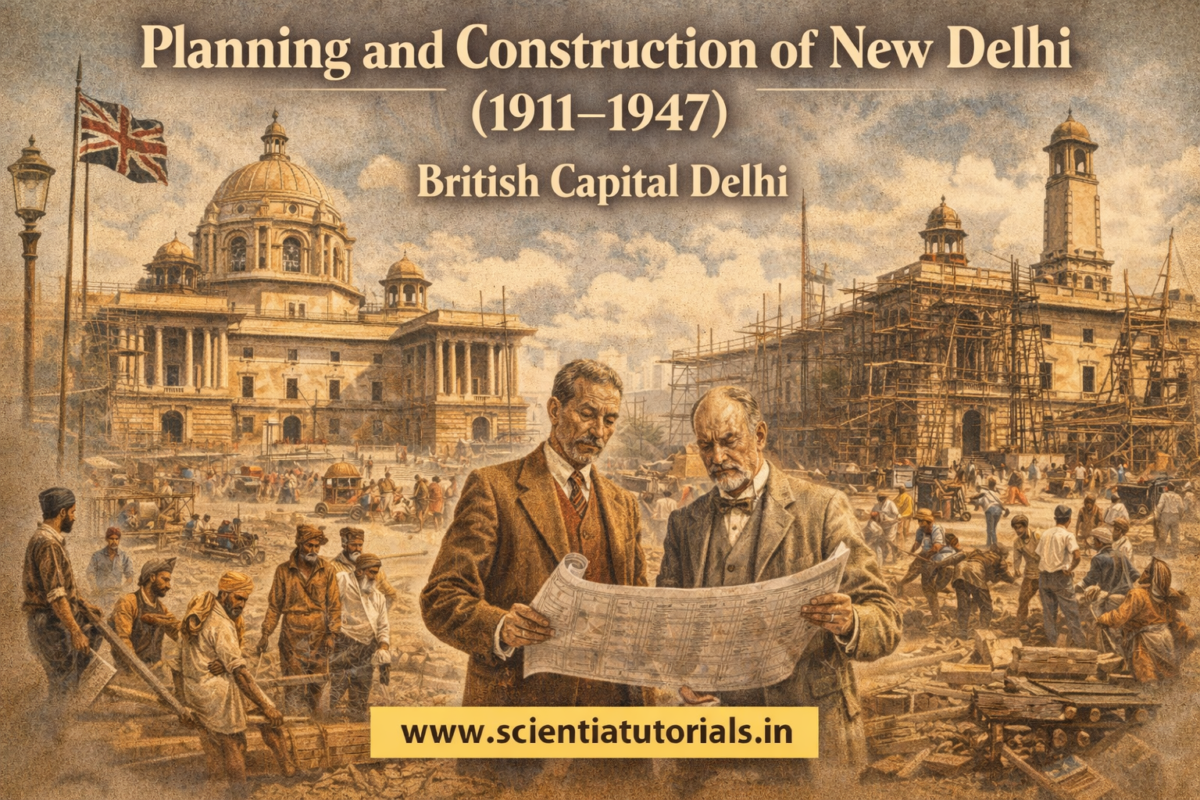

Planning and Construction of New Delhi (1911–1947) | British Capital Delhi
Course: History of Delhi – Chronological Era-Wise Study Module for Competitive Exams
Module VII: Delhi as Capital of British India
Timeline: 1911 CE – 1947 CE
Lesson 2: Planning and Construction of New Delhi
This lesson is systematically organized into four clearly structured sections, as detailed below:
- Chronologically Structured Study Module
- Short-Answer Type Questions
- Long-Answer Type Questions
- Multiple-Choice Questions (MCQs) with Answers and Detailed Explanations
Chronologically Structured Study Module
Introduction: Birth of a New Imperial Capital
The decision to shift the capital of British India from Calcutta to Delhi in 1911 fundamentally transformed the city’s historical trajectory. While Old Delhi (Shahjahanabad) symbolized the Mughal imperial past, the British envisioned a new, planned capital that would embody imperial authority, administrative efficiency, and modern urban planning. This vision culminated in the planning and construction of New Delhi, one of the most ambitious colonial urban projects of the twentieth century.
Between 1911 and 1947, New Delhi evolved from a conceptual plan into the political and administrative heart of British India. This lesson examines the chronological development, ideological foundations, architectural principles, planning process, and long-term significance of New Delhi, with special focus on its relevance for competitive examinations.
1. Background: Why a New Capital City Was Needed
1.1 Limitations of Old Delhi
After 1911, British administrators realized that Old Delhi:
- Was densely populated
- Had narrow streets unsuitable for modern administration
- Reflected Mughal, not British, imperial values
- Lacked space for large government complexes
The British deliberately avoided using Shahjahanabad as the seat of power.
1.2 Colonial Vision of an Imperial Capital
The British aimed to build:
- A monumental capital symbolizing imperial dominance
- A city planned according to modern European principles
- A spatially segregated administrative zone
- A capital that visually communicated authority and permanence
Thus, New Delhi was conceived not as an extension of Old Delhi, but as a separate imperial city.
2. Selection of Site for New Delhi
2.1 Geographical Considerations
The site chosen:
- Lay south of Shahjahanabad
- Had relatively open land
- Allowed grand axial planning
- Was elevated, symbolically overlooking Old Delhi
The Raisina Hill area became the focal point of imperial planning.
2.2 Strategic and Symbolic Location
From Raisina Hill:
- The Viceroy’s residence would dominate the cityscape
- The new capital would visually assert authority
- British power would appear superior to earlier Indian empires
The spatial hierarchy was intentional and ideological.
3. Appointment of Architects and Planners
3.1 Edwin Lutyens and Herbert Baker
Two prominent architects were appointed:
- Edwin Lutyens
- Herbert Baker
Their collaboration shaped the physical and symbolic form of New Delhi.
3.2 Division of Responsibilities
- Lutyens: Overall city plan, Viceroy’s House, major avenues
- Baker: Secretariat buildings, institutional structures
However, disagreements between them later influenced design outcomes.
4. Planning Principles of New Delhi
4.1 Imperial Urban Planning Ideology
New Delhi was planned based on:
- Order and symmetry
- Monumentality
- Axial planning
- Clear separation of functions
Urban planning served as a tool of political control and symbolism.
4.2 Axial Layout and Grand Vistas
Key features included:
- Broad ceremonial avenues
- Long visual axes
- Clear sightlines to imperial buildings
The most important axis connected:
- India Gate (All-India War Memorial)
- Kingsway (now Rajpath)
- Viceroy’s House (now Rashtrapati Bhavan)
5. Architectural Style: Imperial Classicism
5.1 Fusion of Styles
British architects adopted:
- Classical European architectural forms
- Selected Indian motifs (chhatris, domes, jaalis)
This hybrid style aimed to:
- Appear culturally sensitive
- Reinforce imperial legitimacy
- Blend authority with familiarity
5.2 Viceroy’s House (Rashtrapati Bhavan)
Key features:
- Built on Raisina Hill
- Largest residence of any head of state at the time
- Central dome inspired by Indian stupas
- Massive scale to symbolize imperial supremacy
It served as the seat of the Viceroy and symbol of British rule.
6. Major Components of New Delhi
6.1 Secretariat Buildings
- North Block and South Block
- Housed key government departments
- Designed by Herbert Baker
- Located below the Viceroy’s House, reflecting hierarchy
The placement symbolized administrative subordination to imperial authority.
6.2 Legislative and Memorial Spaces
- Council House (now Parliament House)
- India Gate as a war memorial
- Open spaces for ceremonial functions
These structures reinforced imperial identity and state power.
7. Segregation and Social Planning
7.1 Racial and Functional Segregation
New Delhi planning ensured:
- Separate residential zones for Europeans
- Indian populations remained largely in Old Delhi
- Limited integration between the two urban spaces
This reflected colonial racial hierarchies.
7.2 Absence of Indian Participation
- Indians were excluded from planning decisions
- Urban needs of local populations were ignored
- Planning served rulers, not residents
New Delhi was an elite administrative enclave.
8. Construction Process (1912–1931)
8.1 Delays and Challenges
Construction faced:
- World War I disruptions
- Financial constraints
- Technical challenges
- Design disputes between architects
As a result, progress was slow.
8.2 Inauguration of New Delhi (1931)
- Official inauguration: 1931
- Marked the completion of major structures
- Delhi formally became the functioning capital
By this time, nationalist movements were intensifying.
9. New Delhi under the British Raj (1931–1947)
Under the British Raj, New Delhi functioned as:
- Administrative headquarters
- Residence of the Viceroy
- Center of imperial governance
However, it increasingly became a stage for political confrontation.
10. Nationalist Response to New Delhi
10.1 Symbol of Imperial Power
Indian nationalists viewed New Delhi as:
- A symbol of colonial arrogance
- A city built at Indian expense
- An imposed imperial space
Monumentality was seen as dominance, not progress.
10.2 Political Mobilization
Despite its imperial origins:
- Protests occurred near government buildings
- Negotiations and conferences were held in Delhi
- The city became central to freedom struggle politics
Imperial space was gradually reclaimed by nationalist activity.
11. Economic and Labour Aspects
11.1 Construction Labour
- Thousands of Indian laborers employed
- Poor working conditions
- Low wages and lack of recognition
Their contribution remains largely invisible in official narratives.
11.2 Economic Impact on Delhi
- Growth of service sectors
- Migration of officials and workers
- Expansion of urban economy
Yet, benefits were uneven and colonial in nature.
12. Comparison with Other Colonial Capitals
New Delhi differed from:
- Calcutta (commercial-administrative city)
- Bombay (port and industrial city)
New Delhi was:
- Primarily administrative
- Politically symbolic
- Less economically diverse
Its purpose was governance, not commerce.
13. Long-Term Legacy of New Delhi
13.1 Post-Independence Transformation
After 1947:
- New Delhi became capital of independent India
- Imperial buildings repurposed
- Colonial symbolism reinterpreted
Structures once representing domination became symbols of sovereignty.
13.2 Enduring Urban Influence
New Delhi’s planning influenced:
- Later urban development
- Administrative zoning
- Monumental architecture in India
Its layout continues to shape governance today.
14. Historical Significance for Competitive Exams
Key Points to Remember:
- Capital shift (1911) → New Delhi planning
- Architects: Lutyens and Baker
- Raisina Hill and axial planning
- Imperial symbolism in architecture
- Segregation and colonial ideology
- Inauguration in 1931
- Role till 1947 and beyond
Conclusion: New Delhi as a Colonial and National Capital
The planning and construction of New Delhi was one of the most ambitious urban projects undertaken by the British Empire. Designed to project authority, control, and imperial continuity, New Delhi embodied the political ideology of colonial rule. Yet, history transformed its meaning. What began as an imperial capital eventually became the seat of independent India’s democracy.
For students of history, New Delhi represents the intersection of power, planning, architecture, and nationalism. Understanding its origins is essential for comprehending both colonial governance and modern India’s political geography.
Short Answer Type Questions with Answers
1. Why did the British decide to build a new capital city after 1911?
Answer:
Old Delhi was congested and symbolized Mughal authority; the British wanted a planned imperial capital reflecting their power and administrative needs.
2. Which decision led directly to the planning of New Delhi?
Answer:
The capital shift from Calcutta to Delhi in 1911 led to the planning of New Delhi.
3. Where was New Delhi constructed in relation to Old Delhi?
Answer:
New Delhi was constructed south of Old Delhi (Shahjahanabad).
4. Why was Raisina Hill chosen as the focal point of New Delhi?
Answer:
Raisina Hill was elevated and symbolically dominant, allowing imperial buildings to overlook the city and assert authority.
5. Name the two chief architects of New Delhi.
Answer:
Edwin Lutyens and Herbert Baker.
6. What was Edwin Lutyens mainly responsible for?
Answer:
He designed the overall city plan, ceremonial avenues, and the Viceroy’s House.
7. Which buildings were designed by Herbert Baker?
Answer:
The North Block and South Block Secretariat buildings.
8. What was the Viceroy’s House known as after independence?
Answer:
It became Rashtrapati Bhavan.
9. What architectural style dominated the buildings of New Delhi?
Answer:
Imperial Classicism, combining European classical forms with selected Indian elements.
10. Mention two Indian architectural features used in New Delhi buildings.
Answer:
Chhatris and domes (also jaalis in some structures).
11. What was the main ceremonial avenue of New Delhi called originally?
Answer:
Kingsway (now Rajpath / Kartavya Path).
12. Which memorial marks the eastern end of the main axis of New Delhi?
Answer:
India Gate.
13. What was the primary function of New Delhi?
Answer:
To serve as the administrative and political capital of British India.
14. How did New Delhi’s planning reflect colonial ideology?
Answer:
Through monumentality, symmetry, hierarchy, and spatial segregation.
15. What type of segregation was built into New Delhi’s design?
Answer:
Racial and functional segregation, separating European areas from Indian localities.
16. Were Indians involved in planning decisions for New Delhi?
Answer:
No, Indians were excluded from the planning and decision-making process.
17. When did construction of New Delhi begin?
Answer:
Construction began around 1912 CE.
18. What major event delayed the construction of New Delhi?
Answer:
World War I (1914–1918).
19. In which year was New Delhi officially inaugurated?
Answer:
New Delhi was inaugurated in 1931 CE.
20. Under which authority did New Delhi function after inauguration?
Answer:
Under the British Raj.
21. How did Indian nationalists view New Delhi?
Answer:
As a symbol of imperial domination and colonial arrogance.
22. What role did New Delhi later play in the freedom struggle?
Answer:
It became a center of political negotiations, protests, and nationalist activity.
23. Who mainly built New Delhi during its construction phase?
Answer:
Thousands of Indian laborers, often under poor working conditions.
24. How did New Delhi affect Delhi’s economy?
Answer:
It expanded the service sector and administrative employment, though benefits were unequal.
25. Why is the planning of New Delhi important for competitive exams?
Answer:
It explains colonial urban planning, imperial ideology, architecture, and the roots of modern Delhi.
Long Answer Type Questions with Answers
1. Explain why the British felt the need to build a new capital city after 1911.
Answer:
After the capital shift from Calcutta to Delhi, the British realized that Old Delhi (Shahjahanabad) was unsuitable for modern colonial administration. It was densely populated, had narrow streets, and symbolized Mughal imperial authority rather than British power. The British wanted a purpose-built capital that reflected administrative efficiency, order, and imperial dominance. Hence, New Delhi was conceived as a planned city distinct from Old Delhi.
2. Discuss the ideological objectives behind the planning of New Delhi.
Answer:
The planning of New Delhi was deeply ideological. It aimed to project British imperial authority, permanence, and legitimacy. Monumental architecture, symmetry, axial planning, and elevation were used to visually communicate dominance. The city was designed not merely for governance but as a symbolic space that portrayed the British as rightful successors to earlier Indian empires.
3. Analyse the reasons for selecting the area south of Old Delhi for the new capital.
Answer:
The area south of Old Delhi offered open land suitable for large-scale planning. It allowed the British to design wide avenues, grand vistas, and monumental buildings without disrupting existing settlements. Symbolically, placing New Delhi on higher ground enabled imperial structures to overlook the old city, reinforcing spatial and political hierarchy.
4. Examine the significance of Raisina Hill in the planning of New Delhi.
Answer:
Raisina Hill became the focal point of New Delhi because of its elevation and visibility. The Viceroy’s House was placed here to dominate the cityscape. This location symbolized authority and control, ensuring that the seat of imperial power visually overshadowed both New Delhi and Old Delhi.
5. Discuss the role of Edwin Lutyens in the planning of New Delhi.
Answer:
Edwin Lutyens was the chief architect responsible for the overall city plan. He designed the grand axial layout, ceremonial avenues, and the Viceroy’s House. Lutyens emphasized classical symmetry, monumentality, and long vistas. His vision shaped New Delhi as a cohesive imperial capital reflecting British ideals of order and authority.
6. Analyse the contribution of Herbert Baker to New Delhi’s architecture.
Answer:
Herbert Baker designed key administrative buildings, especially the North Block and South Block secretariats. These buildings housed major government departments and reinforced bureaucratic hierarchy. Their placement below the Viceroy’s House symbolized administrative subordination to imperial authority. Baker’s work complemented Lutyens’ vision, though differences between the two influenced final designs.
7. Explain the principle of axial planning used in New Delhi.
Answer:
Axial planning involved creating long, straight ceremonial avenues aligned with important buildings. The central axis connected India Gate, Kingsway (now Kartavya Path), and the Viceroy’s House. This created dramatic vistas and emphasized order, control, and grandeur—key features of imperial urban design.
8. Discuss the architectural style adopted in New Delhi.
Answer:
New Delhi’s architecture followed Imperial Classicism, blending European classical elements with selected Indian motifs. Columns, domes, and symmetry reflected Western traditions, while chhatris, jaalis, and Indian-inspired domes provided a superficial cultural connection. This fusion aimed to legitimize British rule while maintaining imperial superiority.
9. Examine the design and significance of the Viceroy’s House.
Answer:
The Viceroy’s House, now Rashtrapati Bhavan, was the centerpiece of New Delhi. Built on Raisina Hill, it was the largest residence of any head of state at the time. Its massive scale, central dome, and commanding position symbolized imperial power and authority, serving as the political heart of British India.
10. Analyse the importance of the Secretariat buildings in New Delhi.
Answer:
The Secretariat buildings housed key administrative departments. Their symmetrical placement flanking the central axis reinforced bureaucratic order and hierarchy. Designed by Herbert Baker, they visually and functionally supported the Viceroy’s authority, reflecting the centralization of colonial administration.
11. Discuss the concept of segregation in the planning of New Delhi.
Answer:
New Delhi was planned as an elite administrative enclave. European residential and official zones were separated from Indian localities, which largely remained in Old Delhi. This spatial segregation reflected racial hierarchies and colonial ideology, ensuring social distance between rulers and the ruled.
12. Critically examine the absence of Indian participation in planning New Delhi.
Answer:
Indians were excluded from planning and decision-making. The city was designed to serve colonial administrators, not local needs. Indigenous housing, transport, and welfare concerns were ignored. This exclusion highlights the authoritarian nature of colonial urban planning.
13. Trace the construction process of New Delhi from 1912 to 1931.
Answer:
Construction began around 1912 but faced delays due to World War I, financial constraints, and design disagreements. Thousands of Indian laborers worked under difficult conditions. Despite setbacks, major structures were completed by 1931, when New Delhi was officially inaugurated.
14. Discuss the impact of World War I on the construction of New Delhi.
Answer:
World War I diverted resources, labor, and attention away from construction. Financial shortages and material constraints slowed progress. As a result, New Delhi took nearly two decades to complete instead of a shorter planned period.
15. Examine the inauguration of New Delhi in 1931 and its significance.
Answer:
The inauguration of New Delhi in 1931 marked the completion of the imperial capital. It symbolized the formal establishment of Delhi as the administrative center of British India. Ironically, it occurred at a time when nationalist movements were gaining strength.
16. Analyse New Delhi’s role under the British Raj.
Answer:
Under the British Raj, New Delhi functioned as the nerve center of colonial governance. It housed the Viceroy, central government offices, and major institutions. At the same time, it became a focal point of nationalist protests and political negotiations.
17. How did Indian nationalists perceive New Delhi?
Answer:
Nationalists viewed New Delhi as a symbol of imperial arrogance and exploitation. Its grandeur was seen as imposed at Indian expense. However, they also used the city as a stage for political resistance, protests, and dialogue with colonial authorities.
18. Discuss the economic and labour aspects of constructing New Delhi.
Answer:
Construction relied heavily on Indian laborers who worked under harsh conditions for low wages. While the project generated employment and stimulated certain sectors, benefits were uneven and primarily served colonial interests. Labor contributions remained largely unacknowledged.
19. Compare New Delhi with other colonial capitals like Calcutta or Bombay.
Answer:
Unlike Calcutta (commercial-administrative) or Bombay (port-industrial), New Delhi was primarily an administrative and symbolic capital. It lacked economic diversity and was designed mainly for governance and imperial display rather than trade or industry.
20. Evaluate the long-term legacy of New Delhi after independence.
Answer:
After 1947, New Delhi became the capital of independent India. Colonial buildings were repurposed for a democratic state, and imperial symbolism was reinterpreted. Despite its colonial origins, New Delhi continues to shape India’s administrative, political, and urban life.
MCQs with Answers and Explanations
1. The planning of New Delhi began as a direct consequence of:
A. The Revolt of 1857
B. The Partition of Bengal
C. The capital shift announced in 1911
D. The Government of India Act, 1935
Correct Answer: C. The capital shift announced in 1911
Explanation:
The decision to shift the capital of British India to Delhi in 1911 made it necessary to construct a new administrative capital.
2. Why was Old Delhi considered unsuitable as the British capital?
A. It was economically backward
B. It symbolized Mughal authority and was overcrowded
C. It lacked railway connectivity
D. It was too far from Calcutta
Correct Answer: B. It symbolized Mughal authority and was overcrowded
Explanation:
Old Delhi (Shahjahanabad) represented Mughal imperial power and had narrow streets and dense population, making it unsuitable for colonial administration.
3. New Delhi was constructed primarily:
A. East of Old Delhi
B. North of Old Delhi
C. South of Old Delhi
D. Inside Shahjahanabad
Correct Answer: C. South of Old Delhi
Explanation:
The British chose open land south of Old Delhi to build a spacious and planned imperial capital.
4. Which location became the focal point of New Delhi’s imperial planning?
A. Chandni Chowk
B. Connaught Place
C. Raisina Hill
D. India Gate
Correct Answer: C. Raisina Hill
Explanation:
Raisina Hill was selected due to its elevation and symbolic dominance, making it ideal for placing the Viceroy’s residence.
5. Who was the chief architect responsible for the overall plan of New Delhi?
A. Herbert Baker
B. Lord Hardinge
C. Edwin Lutyens
D. Lord Curzon
Correct Answer: C. Edwin Lutyens
Explanation:
Lutyens designed the city’s master plan, ceremonial avenues, and the Viceroy’s House.
6. The Secretariat buildings (North and South Block) were designed by:
A. Edwin Lutyens
B. Lord Irwin
C. Robert Clive
D. Herbert Baker
Correct Answer: D. Herbert Baker
Explanation:
Herbert Baker was responsible for major administrative buildings, particularly the Secretariat.
7. The architectural style of New Delhi is best described as:
A. Pure Indo-Islamic
B. Gothic Revival
C. Imperial Classicism with Indian elements
D. Modernist Functionalism
Correct Answer: C. Imperial Classicism with Indian elements
Explanation:
European classical forms were blended with Indian features like domes and chhatris to legitimize imperial rule.
8. Which Indian architectural feature was incorporated into New Delhi buildings?
A. Minarets
B. Pagodas
C. Chhatris
D. Gopurams
Correct Answer: C. Chhatris
Explanation:
Chhatris and domes were selectively used to give an Indian appearance to imperial structures.
9. The main ceremonial avenue of New Delhi was originally called:
A. Queensway
B. Kingsway
C. Imperial Road
D. Lutyens Avenue
Correct Answer: B. Kingsway
Explanation:
Kingsway (now Kartavya Path) formed the central axis of New Delhi’s ceremonial layout.
10. Which monument marks the eastern end of the central axis of New Delhi?
A. Rashtrapati Bhavan
B. Parliament House
C. India Gate
D. Secretariat
Correct Answer: C. India Gate
Explanation:
India Gate served as a war memorial and visual anchor of the imperial axis.
11. The Viceroy’s House is known today as:
A. Parliament House
B. North Block
C. Raj Bhavan
D. Rashtrapati Bhavan
Correct Answer: D. Rashtrapati Bhavan
Explanation:
After independence, the Viceroy’s House became the official residence of the President of India.
12. What principle guided the use of long straight roads and vistas in New Delhi?
A. Organic planning
B. Axial planning
C. Vernacular planning
D. Grid planning
Correct Answer: B. Axial planning
Explanation:
Axial planning emphasized symmetry, order, and visual dominance of imperial buildings.
13. New Delhi’s planning reflected colonial ideology mainly through:
A. Mixed land use
B. Urban equality
C. Monumentality and segregation
D. Decentralization
Correct Answer: C. Monumentality and segregation
Explanation:
The city’s scale and spatial separation reflected imperial hierarchy and control.
14. Which type of segregation was built into New Delhi’s design?
A. Linguistic
B. Religious
C. Racial and functional
D. Occupational only
Correct Answer: C. Racial and functional
Explanation:
European administrative and residential areas were separated from Indian localities.
15. Indians were largely excluded from planning New Delhi because:
A. They lacked technical skills
B. Planning was centralized under colonial authority
C. They opposed the project
D. They preferred Old Delhi
Correct Answer: B. Planning was centralized under colonial authority
Explanation:
Colonial urban planning served imperial needs and excluded Indian participation.
16. Construction of New Delhi began around:
A. 1905
B. 1912
C. 1920
D. 1931
Correct Answer: B. 1912
Explanation:
Actual construction work started shortly after the 1911 capital shift announcement.
17. Which global event significantly delayed New Delhi’s construction?
A. Russian Revolution
B. Great Depression
C. World War I
D. World War II
Correct Answer: C. World War I
Explanation:
World War I diverted resources and labor, slowing down construction.
18. New Delhi was officially inaugurated in:
A. 1921
B. 1927
C. 1931
D. 1935
Correct Answer: C. 1931
Explanation:
By 1931, major imperial structures were completed and the capital became fully functional.
19. After inauguration, New Delhi functioned under the authority of the:
A. East India Company
B. Indian National Congress
C. Princely States
D. British Raj
Correct Answer: D. British Raj
Explanation:
New Delhi served as the administrative headquarters of British India until 1947.
20. Indian nationalists viewed New Delhi mainly as:
A. A progressive urban experiment
B. A symbol of imperial domination
C. A cultural revival project
D. A democratic space
Correct Answer: B. A symbol of imperial domination
Explanation:
Its grandeur and cost symbolized colonial power rather than Indian welfare.
21. Who primarily built New Delhi during its construction?
A. British engineers alone
B. European settlers
C. Indian laborers
D. Prison labor
Correct Answer: C. Indian laborers
Explanation:
Thousands of Indian workers built New Delhi, often under harsh conditions.
22. Economically, New Delhi’s construction led to:
A. Industrialization of Delhi
B. Growth of administrative and service sectors
C. Decline of population
D. Ruralization of the city
Correct Answer: B. Growth of administrative and service sectors
Explanation:
The capital attracted officials and services but did not promote industrial growth.
23. Compared to Calcutta or Bombay, New Delhi was primarily a:
A. Commercial city
B. Port city
C. Industrial hub
D. Administrative capital
Correct Answer: D. Administrative capital
Explanation:
New Delhi was designed mainly for governance and imperial display.
24. After 1947, New Delhi’s colonial buildings were:
A. Demolished
B. Abandoned
C. Repurposed for independent India
D. Sold to private owners
Correct Answer: C. Repurposed for independent India
Explanation:
Imperial structures became institutions of a sovereign democratic state.
25. Why is the planning and construction of New Delhi important for competitive exams?
A. It explains medieval town planning
B. It links architecture with colonial power
C. It focuses only on labor history
D. It has limited historical relevance
Correct Answer: B. It links architecture with colonial power
Explanation:
New Delhi exemplifies how urban planning and architecture were used as tools of imperial control.