
Lesson 2: Indraprastha and the Mahabharata Tradition – Myth and History
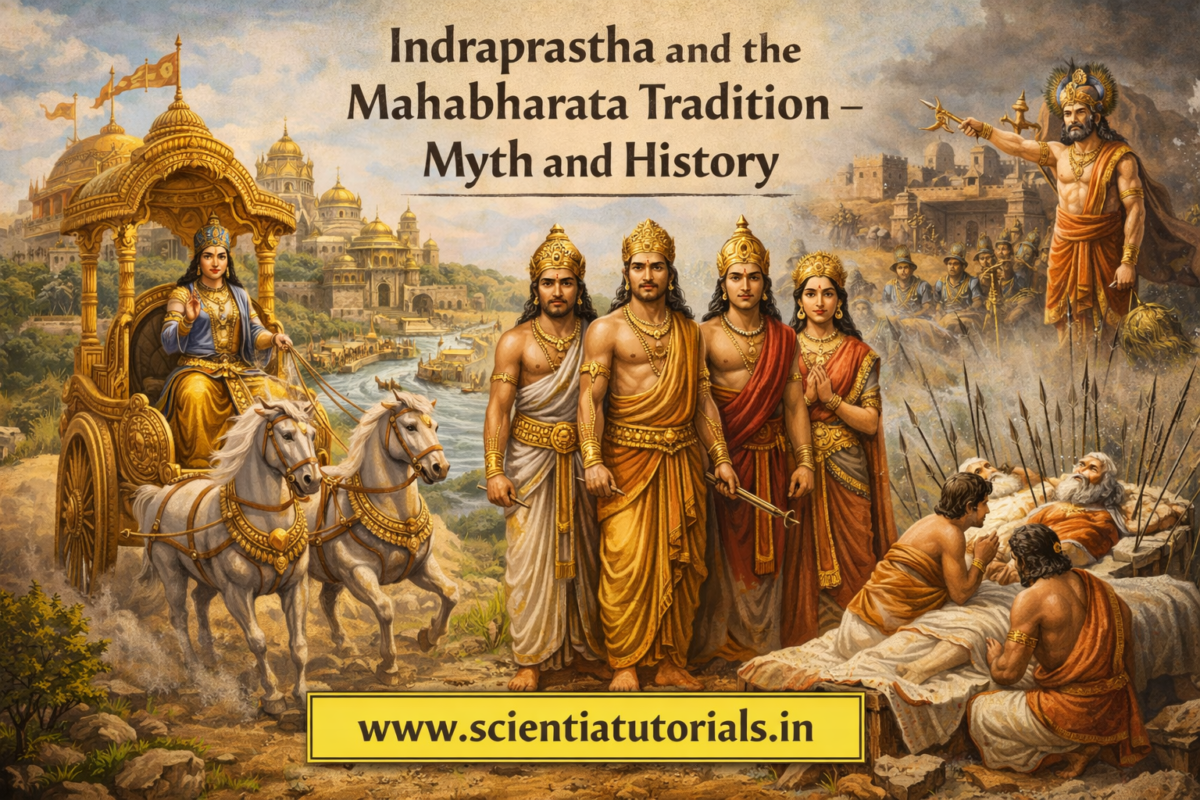

Indraprastha and Mahabharata Tradition | Myth, History & Archaeology of Delhi
History of Delhi – Chronological Era-Wise Study Module for Competitive Exams
Module I: Pre-Historic & Ancient Settlements of Delhi
Timeline: Prehistoric Period – 8th Century CE
This lesson is systematically organized into four clearly structured sections, as detailed below:
- Chronologically Structured Study Module
- Short-Answer Type Questions
- Long-Answer Type Questions
- Multiple-Choice Questions (MCQs) with Answers and Detailed Explanations
Chronologically Structured Study Module
Lesson 2: Indraprastha and the Mahabharata Tradition – Myth and History
1. Introduction: Indraprastha in the Historical Consciousness of Delhi
Among all ancient traditions associated with Delhi, none is as enduring or influential as Indraprastha, the legendary city of the Pandavas described in the Mahabharata. Revered in Indian cultural memory, Indraprastha represents the earliest civilizational identity of the Delhi region.
This lesson critically examines Indraprastha through a chronological and archaeological lens, distinguishing between mythological narrative, textual tradition, and material evidence. For competitive examinations, such an analytical approach is crucial, as questions often test the ability to correlate literary sources with archaeological data.
2. Chronological Framework of the Indraprastha Tradition
The Indraprastha tradition is generally placed within the Late Vedic to Early Iron Age period, approximately:
- c. 1500 BCE – 1000 BCE: Composition and oral transmission of early Vedic texts
- c. 1200 BCE – 600 BCE: Cultural horizon of the Mahabharata tradition
- c. 1000 BCE – 600 BCE: Painted Grey Ware (PGW) culture
- Post-600 BCE: Transition into early historic settlements
This period marks the shift from prehistoric cultures to protohistoric and early historic societies in North India.
3. Indraprastha in the Mahabharata Narrative
3.1 Founding of Indraprastha
According to the Mahabharata, Indraprastha was established by the Pandavas after they received the Khandavaprastha forest as part of a political settlement. Under the leadership of Yudhishthira, the forest was transformed into a grand city named Indraprastha, symbolizing state formation and royal authority.
3.2 Political and Cultural Significance
In the epic narrative, Indraprastha emerges as:
- A capital city of the Pandava kingdom
- A center of governance, diplomacy, and ritual authority
- The site of the famous Rajasuya Yajna
These descriptions reflect the ideals of kingship and urbanism prevalent in Late Vedic society.
4. Myth versus History: A Historiographical Perspective
4.1 Nature of the Mahabharata as a Source
The Mahabharata is an itihasa (epic tradition), combining:
- Myth
- Genealogy
- Cultural memory
- Ethical philosophy
While not a historical chronicle in the modern sense, it preserves valuable information about social organization, political structures, and geographical knowledge of early India.
4.2 Limits of Mythological Interpretation
Historians caution against literal interpretation of:
- Supernatural elements
- Exaggerated city descriptions
- Divine interventions
Instead, the focus lies on corroborating literary tradition with archaeology.
5. Archaeological Context of Indraprastha
5.1 Identification with Purana Qila
Most scholars associate Indraprastha with Purana Qila, located on the banks of the Yamuna River. Excavations at Purana Qila have revealed:
- Continuous habitation layers
- Cultural deposits from the Iron Age onwards
This makes it one of the most significant archaeological sites in Delhi.
6. Painted Grey Ware (PGW) Culture and Indraprastha
6.1 Characteristics of PGW Culture
Painted Grey Ware culture (c. 1200–600 BCE) is marked by:
- Fine grey pottery with black geometric designs
- Iron tools and weapons
- Rural and semi-urban settlements
6.2 PGW Evidence at Delhi
PGW sherds found in and around Purana Qila strongly suggest:
- An Iron Age settlement
- Social organization consistent with Mahabharata-era societies
Exam Insight: PGW culture is frequently linked with the Mahabharata tradition in UPSC and State PSC questions.
7. Urbanization and State Formation
The Indraprastha tradition reflects an early phase of:
- Territorial states (janapadas)
- Hereditary kingship
- Agrarian surplus economy
The transformation of forest land into a capital city symbolizes human control over nature and emergence of political authority.
8. Geographical Significance of Indraprastha
The location of Indraprastha was strategically chosen due to:
- Proximity to the Yamuna River
- Fertile alluvial plains
- Natural defense provided by river bends
This geography ensured agricultural prosperity and facilitated trade and communication.
9. Indraprastha and the Kuru Political Sphere
Indraprastha was part of the larger Kuru kingdom, with Hastinapura as another major center. While Hastinapura symbolized dynastic legitimacy, Indraprastha represented political expansion and innovation.
10. Decline and Transformation of Indraprastha
By the end of the Mahabharata period:
- Political centers shifted
- New janapadas emerged
- Urban continuity weakened
However, habitation in the Delhi region never ceased, leading to later historic settlements.
11. Transition to Early Historic Delhi
After c. 600 BCE:
- Iron technology expanded
- Trade networks intensified
- Delhi became part of the Mauryan and post-Mauryan political landscape
Indraprastha thus forms a cultural bridge between prehistoric Delhi and early historic urban centers.
12. Indraprastha in Later Traditions
Later texts and traditions continued to identify Delhi with Indraprastha, reinforcing:
- Sacred geography
- Cultural continuity
- Political symbolism
Medieval rulers also sought legitimacy by associating their capitals with ancient Indraprastha.
13. Examination-Oriented Key Takeaways
- Indraprastha is a Mahabharata-era capital associated with the Pandavas
- It reflects Late Vedic–Iron Age society
- PGW culture provides archaeological support
- Purana Qila is widely identified with Indraprastha
- Mythological texts require critical historical analysis
14. Model Practice Questions
- Examine the historical significance of Indraprastha in the Mahabharata tradition.
- Discuss the archaeological evidence linking Indraprastha with Purana Qila.
- Analyze the relationship between Painted Grey Ware culture and the Mahabharata period.
- Critically assess the role of mythology in reconstructing ancient Delhi’s history.
15. Conclusion
Indraprastha stands at the intersection of myth and history, representing Delhi’s earliest remembered urban identity. While the Mahabharata provides the narrative framework, archaeology—especially PGW evidence—grounds this tradition in historical reality. For competitive exam aspirants, understanding Indraprastha is essential to grasp the deep-rooted continuity of Delhi as a center of power, culture, and settlement.
Short Answer Type Questions – Lesson 2
Indraprastha and the Mahabharata Tradition – Myth and History
Course: History of Delhi – Chronological Era-Wise Study Module for Competitive Exams
Module I: Pre-Historic & Ancient Settlements of Delhi
1. What is Indraprastha?
Indraprastha is the legendary capital city of the Pandavas described in the Mahabharata and is considered the earliest cultural identity of the Delhi region.
2. In which literary source is Indraprastha primarily mentioned?
Indraprastha is primarily mentioned in the Mahabharata, an ancient Indian epic belonging to the itihasa tradition.
3. Who founded Indraprastha according to tradition?
According to tradition, Indraprastha was founded by the Pandavas under the leadership of Yudhishthira.
4. What was the original name of the area where Indraprastha was built?
The area was originally known as Khandavaprastha, a forest region later cleared and developed into Indraprastha.
5. Which period is Indraprastha generally associated with?
Indraprastha is generally associated with the Late Vedic to Early Iron Age period, around 1200–600 BCE.
6. What type of text is the Mahabharata considered by historians?
The Mahabharata is considered an itihasa, combining myth, genealogy, cultural memory, and ethical philosophy.
7. Why is Indraprastha important in Delhi’s historical tradition?
Indraprastha represents the earliest remembered urban and political identity of the Delhi region.
8. What is the main historiographical challenge in studying Indraprastha?
The main challenge lies in separating mythological narrative from historical and archaeological evidence.
9. Which archaeological culture is linked with the Mahabharata period?
The Painted Grey Ware (PGW) culture is commonly linked with the Mahabharata period.
10. What are the key features of Painted Grey Ware culture?
PGW culture is characterized by fine grey pottery with black designs, iron tools, and early agrarian settlements.
11. Where has PGW evidence been found in Delhi?
PGW evidence has been found at sites associated with ancient Delhi, particularly around Purana Qila.
12. Which site is widely identified with Indraprastha?
Purana Qila is widely identified by historians as the site of ancient Indraprastha.
13. Why is Purana Qila archaeologically significant?
Purana Qila shows continuous habitation from the Iron Age to early historic periods.
14. What role did the Yamuna River play in the location of Indraprastha?
The Yamuna provided water, fertile land, transportation routes, and natural defense, making it ideal for settlement.
15. How does Indraprastha reflect early state formation?
Indraprastha reflects early state formation through centralized kingship, territorial control, and urban planning.
16. What political ritual enhanced the prestige of Indraprastha in the epic?
The Rajasuya Yajna performed by Yudhishthira enhanced the political prestige of Indraprastha.
17. How is Indraprastha related to the Kuru kingdom?
Indraprastha was part of the Kuru political sphere, with Hastinapura as another major center.
18. What does the clearing of Khandava forest symbolize historically?
It symbolizes human control over nature, agricultural expansion, and the emergence of political authority.
19. Why do historians avoid literal interpretation of the Mahabharata?
Because the epic contains supernatural and symbolic elements that require critical analysis and corroboration.
20. What happened to Indraprastha after the Mahabharata period?
Its political importance declined, but the region continued to be inhabited without a complete cultural break.
21. How did iron technology influence settlements during the Indraprastha period?
Iron tools improved agriculture, warfare, and settlement expansion, supporting early state structures.
22. What type of economy existed during the Indraprastha phase?
A primarily agrarian economy supported by surplus production and rural settlements existed.
23. How does Indraprastha connect prehistoric and early historic Delhi?
It acts as a cultural and chronological bridge between prehistoric settlements and early historic urban centers.
24. Why is Indraprastha important for competitive examinations?
It helps candidates understand the relationship between mythology, archaeology, and early Indian history.
25. What is the overall historical significance of Indraprastha?
Indraprastha represents the earliest remembered phase of Delhi’s political, cultural, and urban evolution.
These short answer questions are aligned with UPSC, State PSC, SSC, and university-level examinations, emphasizing clarity, chronology, and concept-based understanding.
Long Answer Type Questions – Lesson 2
Indraprastha and the Mahabharata Tradition – Myth and History
Course: History of Delhi – Chronological Era-Wise Study Module for Competitive Exams
Module I: Pre-Historic & Ancient Settlements of Delhi
1. Discuss the significance of Indraprastha in the historical tradition of Delhi.
Indraprastha occupies a central place in Delhi’s historical consciousness as the earliest remembered political and cultural center of the region. Described as the capital of the Pandavas, it symbolizes the transition from forest-based settlements to organized urban and political life. Even though its description comes mainly from epic literature, the tradition of Indraprastha establishes Delhi’s antiquity and continuity as a seat of power from ancient times.
2. Examine Indraprastha as described in the Mahabharata.
In the Mahabharata, Indraprastha is portrayed as a grand and prosperous city founded by the Pandavas after clearing the Khandavaprastha forest. It served as the center of governance, diplomacy, and ritual authority, most notably during Yudhishthira’s Rajasuya Yajna. The epic depiction reflects ideals of kingship, state formation, and social order prevalent in Late Vedic society.
3. Analyze the historiographical challenges in reconstructing the history of Indraprastha.
The primary challenge lies in distinguishing myth from historical reality. The Mahabharata blends mythology, symbolism, and moral philosophy with references to real places and societies. Historians must critically analyze the text and corroborate it with archaeological evidence, avoiding literal interpretation while extracting socio-political and cultural insights.
4. Explain the concept of ‘myth versus history’ in the study of Indraprastha.
‘Myth versus history’ refers to the tension between epic narratives and empirical historical methods. While Indraprastha is described in mythological terms, archaeology provides material evidence that helps ground the tradition in a historical context. The study of Indraprastha demonstrates how myths can preserve collective memory of real historical processes.
5. Discuss the chronological placement of the Indraprastha tradition.
Indraprastha is generally placed in the Late Vedic to Early Iron Age period, roughly between 1200 BCE and 600 BCE. This era corresponds with the Painted Grey Ware cultural horizon and the emergence of early territorial states (janapadas) in North India.
6. Evaluate the role of Painted Grey Ware (PGW) culture in understanding Indraprastha.
PGW culture provides crucial archaeological support for the Mahabharata tradition. Characterized by fine grey pottery with black designs and associated iron tools, PGW sites reflect social conditions similar to those described in the epic—agrarian communities, early state formation, and iron technology. PGW evidence near Delhi strengthens the historical plausibility of Indraprastha.
7. Examine the archaeological importance of Purana Qila in relation to Indraprastha.
Purana Qila is widely identified with ancient Indraprastha due to continuous habitation layers from the Iron Age onwards. Excavations have revealed PGW pottery and early historic remains, indicating long-term settlement. Its strategic location near the Yamuna further supports its identification with the epic city.
8. Analyze the geographical factors that favored the location of Indraprastha.
The proximity to the Yamuna River provided water, fertile alluvial soil, and natural defense. The surrounding plains supported agriculture, while river routes facilitated communication and trade. These factors made the region ideal for establishing a political capital.
9. Discuss the political significance of Indraprastha in the Mahabharata narrative.
Indraprastha symbolized the political legitimacy and sovereignty of the Pandavas. Events such as the Rajasuya Yajna reflect the assertion of imperial authority and hierarchical political order. The city thus represents an early model of centralized kingship.
10. Explain the transformation of Khandavaprastha into Indraprastha and its historical symbolism.
The clearing of the Khandava forest symbolizes human mastery over nature, agricultural expansion, and the beginning of urban life. Historically, it reflects the transformation of forested landscapes into settled agrarian and political centers during the Iron Age.
11. Examine the relationship between Indraprastha and the Kuru kingdom.
Indraprastha functioned within the broader Kuru political sphere, alongside Hastinapura. While Hastinapura represented dynastic continuity, Indraprastha symbolized expansion and innovation. Together, they reflect the dual centers of Kuru political authority.
12. Discuss the role of iron technology during the Indraprastha period.
Iron tools improved agricultural productivity, enabled forest clearance, and enhanced warfare capabilities. This technological advancement supported population growth, surplus production, and the emergence of early states such as Indraprastha.
13. Analyze the economic base of the Indraprastha society.
The economy was primarily agrarian, supported by fertile plains and riverine resources. Agricultural surplus enabled the maintenance of political authority, rituals, and urban centers, as reflected in the epic narrative.
14. Evaluate the decline of Indraprastha and its transformation over time.
After the Mahabharata period, political prominence shifted to other centers, and Indraprastha gradually declined. However, the region did not experience complete abandonment, as continuous habitation is evident through later historical periods.
15. Explain how Indraprastha acts as a bridge between prehistoric and early historic Delhi.
Indraprastha represents the transitional phase from prehistoric settlements to early historic urban centers. It connects archaeological cultures like PGW with later political developments under historic empires.
16. Discuss the relevance of Indraprastha in later historical and cultural traditions.
Later traditions continued to associate Delhi with Indraprastha, reinforcing its sacred and political symbolism. Medieval rulers often sought legitimacy by linking their capitals to this ancient tradition.
17. Assess the importance of literary sources in reconstructing early Delhi’s history.
Literary sources like the Mahabharata provide valuable cultural and geographical information, but they must be critically evaluated. When combined with archaeology, they enrich our understanding of early Delhi.
18. Explain why historians do not consider Indraprastha a fully proven historical city.
The lack of definitive inscriptions or large-scale urban ruins from the Mahabharata period makes it difficult to conclusively identify Indraprastha as a historical city. Evidence remains circumstantial but suggestive.
19. Discuss the importance of Indraprastha for competitive examinations.
Indraprastha is important for understanding the correlation between mythology, archaeology, and early Indian history. Questions often test knowledge of PGW culture, epic traditions, and early state formation.
20. Conclude by evaluating the historical importance of Indraprastha in Delhi’s long-term evolution.
Indraprastha stands as the earliest remembered phase of Delhi’s urban and political life. Though rooted in epic tradition, archaeological evidence lends historical credibility to the narrative. Its study reveals the deep continuity of settlement and power in the Delhi region, making it essential for a comprehensive understanding of Delhi’s ancient history.
These long answer questions are structured to meet UPSC, State PSC, and university examination standards, emphasizing critical analysis, chronology, and integration of literary and archaeological perspectives.
Multiple Choice Questions (MCQs) with Answers & Explanations – Lesson 2
Indraprastha and the Mahabharata Tradition – Myth and History
Course: History of Delhi – Chronological Era-Wise Study Module for Competitive Exams
Module I: Pre-Historic & Ancient Settlements of Delhi
MCQ 1
Indraprastha is primarily associated with which ancient Indian epic?
A. Ramayana
B. Puranas
C. Mahabharata
D. Arthashastra
Correct Answer: C
Explanation:
Indraprastha is described as the capital of the Pandavas in the Mahabharata. It forms a key geographical and political reference in the epic narrative.
MCQ 2
According to tradition, who founded Indraprastha?
A. Bhishma
B. Arjuna
C. Yudhishthira and the Pandavas
D. Duryodhana
Correct Answer: C
Explanation:
The Mahabharata credits the Pandavas, under Yudhishthira’s leadership, with founding Indraprastha after clearing the Khandavaprastha forest.
MCQ 3
The area where Indraprastha was established was originally known as:
A. Hastinapura
B. Kurukshetra
C. Khandavaprastha
D. Ahichchhatra
Correct Answer: C
Explanation:
Khandavaprastha was a forested region that was transformed into Indraprastha, symbolizing early urbanization and agrarian expansion.
MCQ 4
Indraprastha is generally placed in which chronological phase?
A. Early Harappan period
B. Late Vedic–Early Iron Age period
C. Mauryan period
D. Gupta period
Correct Answer: B
Explanation:
Historians associate Indraprastha with the Late Vedic to Early Iron Age phase (c. 1200–600 BCE), corresponding to early state formation.
MCQ 5
Which archaeological culture is most closely linked with the Mahabharata period?
A. Black-and-Red Ware
B. Northern Black Polished Ware
C. Painted Grey Ware
D. Red Ware
Correct Answer: C
Explanation:
Painted Grey Ware (PGW) culture is widely associated with the Mahabharata tradition and early Iron Age settlements.
MCQ 6
Painted Grey Ware culture is characterized by:
A. Bright red pottery with animal motifs
B. Grey pottery with black geometric designs
C. Glazed pottery
D. Terracotta figurines only
Correct Answer: B
Explanation:
PGW pottery is fine grey ware decorated with black painted geometric patterns, typical of early Iron Age North India.
MCQ 7
Which site in Delhi is widely identified with ancient Indraprastha?
A. Mehrauli
B. Qutub Minar
C. Purana Qila
D. Red Fort
Correct Answer: C
Explanation:
Purana Qila has yielded archaeological layers from the Iron Age onwards, making it the strongest candidate for identification with Indraprastha.
MCQ 8
Why is Purana Qila archaeologically significant?
A. It contains only medieval remains
B. It shows continuous habitation from Iron Age to historic times
C. It has inscriptions of the Mahabharata period
D. It was built by the Guptas
Correct Answer: B
Explanation:
The significance of Purana Qila lies in its long occupational sequence, supporting continuity from protohistoric to historic Delhi.
MCQ 9
The Mahabharata is best described by historians as a:
A. Court chronicle
B. Religious law book
C. Itihasa combining myth and tradition
D. Purely fictional text
Correct Answer: C
Explanation:
The Mahabharata is an itihasa—an epic that blends myth, genealogy, cultural memory, and ethical discourse rather than strict history.
MCQ 10
Which methodological approach is most appropriate for studying Indraprastha?
A. Literal interpretation of epic texts
B. Complete rejection of literary sources
C. Correlation of literary tradition with archaeology
D. Reliance only on inscriptions
Correct Answer: C
Explanation:
Historians combine textual analysis with archaeological evidence to reconstruct the historical core of Indraprastha.
MCQ 11
The Rajasuya Yajna mentioned in the Mahabharata signifies:
A. Religious pilgrimage
B. Assertion of political sovereignty
C. Decline of kingship
D. Agricultural ritual
Correct Answer: B
Explanation:
The Rajasuya Yajna symbolized imperial authority and political dominance, highlighting Indraprastha’s status as a royal capital.
MCQ 12
Indraprastha was part of which larger political entity?
A. Panchala kingdom
B. Magadha kingdom
C. Kuru kingdom
D. Kosala kingdom
Correct Answer: C
Explanation:
Indraprastha and Hastinapura were major centers of the Kuru political sphere during the Late Vedic period.
MCQ 13
What role did iron technology play during the Indraprastha phase?
A. It had no impact
B. It reduced agricultural output
C. It enabled forest clearance and farming
D. It was limited to ornaments
Correct Answer: C
Explanation:
Iron tools facilitated forest clearance, agricultural expansion, and settlement growth, supporting early state formation.
MCQ 14
The clearing of Khandava forest symbolically represents:
A. Religious conversion
B. Human control over nature and agrarian expansion
C. Decline of pastoralism
D. Foreign invasion
Correct Answer: B
Explanation:
This transformation symbolizes the shift from forested landscapes to settled agrarian and urban life.
MCQ 15
Which river played a crucial role in the location of Indraprastha?
A. Ganga
B. Saraswati
C. Yamuna
D. Chambal
Correct Answer: C
Explanation:
The Yamuna provided water, fertile plains, and strategic advantages, making it central to early settlement.
MCQ 16
Why do historians avoid treating Indraprastha as a fully proven historical city?
A. Complete absence of settlement remains
B. Lack of inscriptions directly naming Indraprastha
C. Contradictory medieval records
D. Climatic changes
Correct Answer: B
Explanation:
While archaeological evidence is suggestive, there are no inscriptions explicitly identifying the site as Indraprastha.
MCQ 17
Which type of economy supported Indraprastha?
A. Nomadic pastoral economy
B. Maritime trade economy
C. Agrarian surplus-based economy
D. Industrial economy
Correct Answer: C
Explanation:
Agriculture formed the economic base, supported by fertile plains and iron tools.
MCQ 18
After the Mahabharata period, Indraprastha:
A. Was completely abandoned
B. Continued as a major imperial capital
C. Declined politically but remained inhabited
D. Shifted to coastal India
Correct Answer: C
Explanation:
Political importance declined, but archaeological continuity indicates uninterrupted habitation.
MCQ 19
Which feature best connects Indraprastha with early historic Delhi?
A. Sudden urbanization
B. Long-term settlement continuity
C. Foreign trade dominance
D. Monumental stone architecture
Correct Answer: B
Explanation:
Continuous habitation from the Indraprastha phase laid the foundation for later historic Delhi.
MCQ 20
Painted Grey Ware sites are generally associated with:
A. Nomadic hunter-gatherers
B. Early Iron Age agrarian communities
C. Mature urban centers
D. Coastal traders
Correct Answer: B
Explanation:
PGW sites reflect early Iron Age rural and semi-urban agrarian societies.
MCQ 21
Indraprastha is best understood as a:
A. Fully mythological city
B. Medieval capital
C. Tradition rooted in both myth and archaeology
D. Harappan metropolis
Correct Answer: C
Explanation:
Indraprastha lies at the intersection of epic tradition and archaeological evidence, making it both mythical and historically grounded.
MCQ 22
Which aspect of Indraprastha is most useful for competitive exams?
A. Mythological stories only
B. Correlation of PGW culture with epic tradition
C. Medieval architectural remains
D. Gupta inscriptions
Correct Answer: B
Explanation:
Exams often test the linkage between PGW culture, Mahabharata tradition, and early state formation.
MCQ 23
The study of Indraprastha helps in understanding:
A. Only religious history
B. Medieval Delhi Sultanate
C. Transition from prehistory to early history
D. Colonial urban planning
Correct Answer: C
Explanation:
Indraprastha represents the crucial transition phase between prehistoric settlements and early historic polities.
MCQ 24
Which statement best describes the historical value of the Mahabharata?
A. It is an exact historical record
B. It is purely fictional
C. It preserves cultural and geographical memory
D. It contains only religious teachings
Correct Answer: C
Explanation:
While not a chronicle, the epic preserves valuable cultural, social, and geographical information.
MCQ 25
Overall, Indraprastha is significant in Delhi’s history because it:
A. Marks the beginning of medieval rule
B. Explains colonial urban growth
C. Represents the earliest remembered political center
D. Was the capital of the Mauryas
Correct Answer: C
Explanation:
Indraprastha represents Delhi’s earliest remembered political and urban identity, linking mythic tradition with archaeological continuity.
✔ These MCQs are designed to meet UPSC, State PSC, SSC, and university-level standards, with strong emphasis on chronology, archaeology–literature correlation, and conceptual clarity.