
Lesson 1: Successors of Aurangzeb and Imperial Weakening
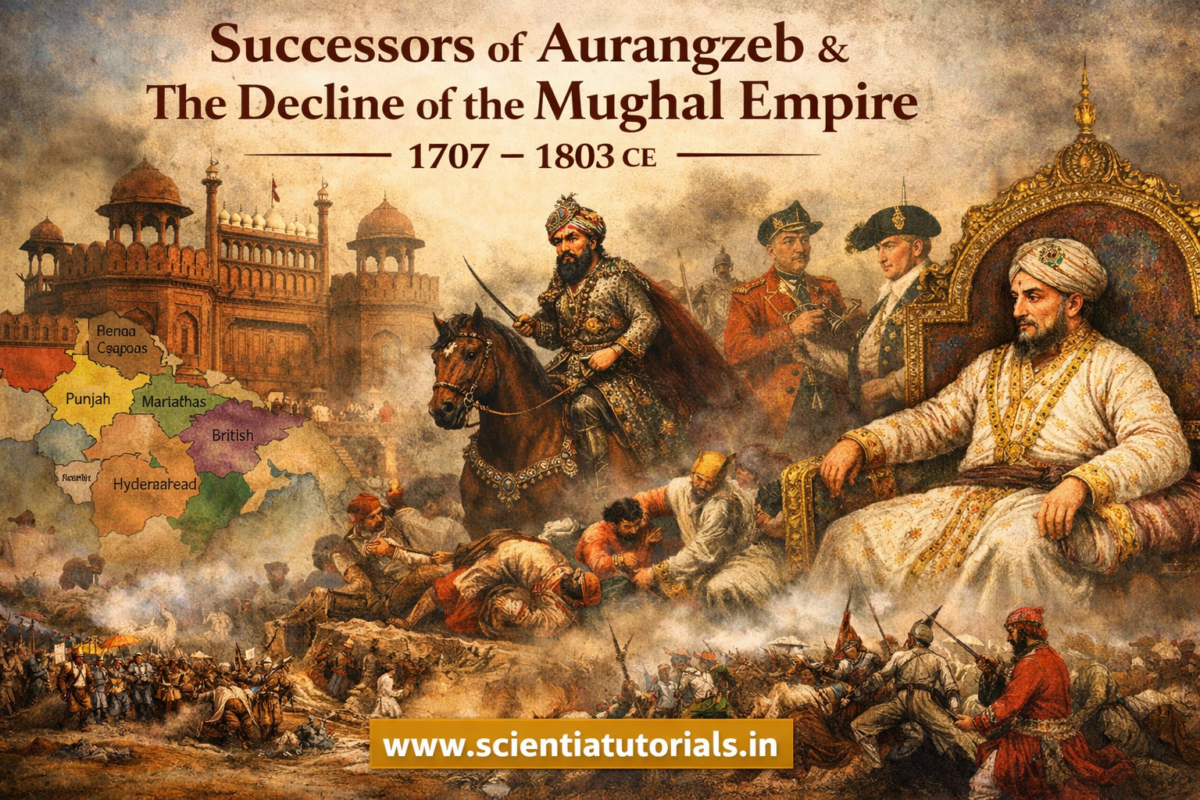

Successors of Aurangzeb: Decline of the Mughal Empire (1707–1803 CE)
Course: History of Delhi – Chronological Era-Wise Study Module for Competitive Exams
Module V: Late Mughal Decline & Regional Powers
Timeline: 1707 CE – 1803 CE
Lesson 1: Successors of Aurangzeb and Imperial Weakening
This lesson is systematically organized into four clearly structured sections, as detailed below:
- Chronologically Structured Study Module
- Short-Answer Type Questions
- Long-Answer Type Questions
- Multiple-Choice Questions (MCQs) with Answers and Detailed Explanations
Chronologically Structured Study Module
Introduction: Transition from Imperial Zenith to Decline
The death of Aurangzeb in 1707 CE marked a decisive turning point in the history of Delhi and the Mughal Empire. His long reign had expanded imperial boundaries but exhausted administrative resources, alienated key social groups, and militarized governance. The era following Aurangzeb is characterized by a rapid succession of weak rulers, factional court politics, fiscal breakdown, and the emergence of powerful regional states.
This lesson examines the successors of Aurangzeb, tracing the chronological weakening of Mughal imperial authority, with special emphasis on Delhi as the symbolic and political heart of the empire. The narrative is structured chronologically to meet competitive examination requirements and focuses on causes, processes, and consequences of imperial decline.
I. Structural Weaknesses Inherited After Aurangzeb (1707 CE)
Before analyzing individual successors, it is essential to understand the structural problems that plagued the Mughal state after 1707:
1. Financial Exhaustion
- Prolonged Deccan wars drained the imperial treasury.
- Jagirdari crisis intensified as revenue assignments exceeded available land income.
- Increasing reliance on revenue farming weakened central control.
2. Military Overstretch
- Standing armies became expensive and ineffective.
- Mansabdari system declined due to irregular payments.
- Regional commanders gained autonomy.
3. Administrative Centralization Without Capacity
- Over-centralized authority failed to respond to local challenges.
- Absence of institutional succession mechanisms led to repeated civil wars.
4. Social and Political Alienation
- Rajputs, Marathas, Sikhs, and Jats became increasingly hostile.
- Religious orthodoxy under Aurangzeb reduced elite consensus.
These weaknesses formed the backdrop against which Aurangzeb’s successors ruled.
II. Bahadur Shah I (1707–1712): Fragile Stability
Accession and Background
Bahadur Shah I, also known as Muazzam, emerged victorious after a brief war of succession. His accession restored temporary stability but failed to reverse decline.
Key Policies and Challenges
- Attempted reconciliation with Rajputs by restoring their lands.
- Adopted a more tolerant religious policy compared to Aurangzeb.
- Failed to decisively suppress:
- Sikh resistance in Punjab
- Maratha expansion in Deccan
Assessment
Bahadur Shah I provided short-term administrative calm, but his inability to assert firm imperial control allowed regional forces to consolidate power.
III. Jahandar Shah (1712–1713): Court Corruption and Moral Decline
Rise to Power
Jahandar Shah ascended the throne with the support of the powerful noble Zulfiqar Khan.
Features of His Reign
- Dominance of court favorites.
- Administrative paralysis.
- Decline in imperial dignity and discipline.
Downfall
- Defeated by Farrukhsiyar with the support of the Sayyid Brothers.
- Marked the increasing role of kingmakers in Mughal politics.
IV. Farrukhsiyar (1713–1719): The Era of Kingmakers
The Sayyid Brothers
Farrukhsiyar ruled under the control of Sayyid Brothers—Abdullah Khan and Husain Ali Khan.
Major Developments
- Farmans issued to the English East India Company granting trading privileges (1717 CE).
- Administrative decisions dictated by factional interests.
- Repeated conflicts between emperor and kingmakers.
End of Reign
- Farrukhsiyar was deposed and executed.
- Demonstrated the emperor’s reduced authority.
Historical Significance
This phase exposed the hollowness of Mughal sovereignty, where emperors reigned but did not rule.
V. Rapid Successions and Puppet Emperors (1719–1720)
Between 1719 and 1720, the Mughal throne witnessed unprecedented instability:
- Rafi-ud-Darajat
- Rafi-ud-Daulah
- Muhammad Shah
Short-lived reigns highlighted:
- Nobles’ dominance over succession.
- Complete erosion of imperial prestige.
VI. Muhammad Shah ‘Rangeela’ (1719–1748): Cultural Flourish Amid Political Collapse
Nature of Rule
Muhammad Shah presided over one of the longest reigns of the late Mughal period.
Positive Aspects
- Revival of art, music, and literature in Delhi.
- Cultural refinement of the Mughal court.
Political Failures
- Loss of Deccan provinces under Nizam-ul-Mulk.
- Inability to check Maratha expansion in North India.
Nadir Shah’s Invasion (1739)
- Nadir Shah invaded India.
- Sack of Delhi.
- Massive loss of life and wealth.
- Peacock Throne and Koh-i-Noor taken to Persia.
Impact
- Mughal military weakness exposed.
- Psychological blow to imperial authority.
- Regional rulers asserted independence openly.
VII. Post-Nadir Shah Phase: Empire in Disarray (1748–1761)
Ahmad Shah Bahadur (1748–1754)
- Weak ruler dominated by nobles.
- Afghan invasions under Ahmad Shah Abdali.
Alamgir II (1754–1759)
- Continued Afghan interference.
- Increasing Maratha dominance in Delhi politics.
Third Battle of Panipat (1761)
- Marathas defeated by Abdali.
- Mughal emperor reduced to a spectator.
VIII. Shah Alam II (1759–1806): Emperor Without Empire
Early Struggles
Shah Alam II wandered across North India seeking allies.
Battle of Buxar (1764)
- Defeat by the British East India Company.
- Treaty of Allahabad (1765).
Life in Delhi
- Lived under Maratha protection.
- Later blinded by Ghulam Qadir Rohilla.
Historical Importance
- Symbolizes the transition from Mughal to British dominance.
- Emperor survived as a ceremonial figure.
IX. Delhi as a City During Imperial Weakening
Political Condition
- Frequent occupations by Afghans, Marathas, and Rohillas.
- Mughal court reduced to a pensioned household.
Economic Decline
- Disruption of trade routes.
- Decline of artisanal production.
- Increasing taxation by occupying forces.
Cultural Resilience
- Despite chaos, Delhi remained a center of Urdu poetry, music, and scholarship.
X. Causes of Imperial Weakening: Analytical Summary
Internal Factors
- Weak successors.
- Factional nobility.
- Jagirdari crisis.
- Military inefficiency.
External Pressures
- Maratha expansion.
- Afghan invasions.
- European commercial penetration.
Systemic Failure
- Absence of reform.
- Overdependence on personalities rather than institutions.
XI. Examination-Oriented Key Takeaways
- Aurangzeb’s successors lacked authority and vision.
- Mughal emperors became puppets of nobles and regional powers.
- Delhi’s political centrality survived symbolically, not practically.
- Imperial decline was gradual and structural, not sudden.
- Set the stage for British political dominance by 1803 CE.
Conclusion
The period from 1707 to 1803 CE represents the terminal phase of Mughal imperial power. While the dynasty survived in name, real authority fragmented among regional states and foreign powers. The successors of Aurangzeb failed to arrest decline due to structural weaknesses, poor leadership, and external invasions. Delhi’s transformation from imperial capital to contested city reflects the broader collapse of centralized Mughal governance.
This lesson provides a chronological and analytical foundation for understanding how imperial weakening paved the way for colonial rule—an essential theme for competitive examinations and the historical study of Delhi.
Module V: Late Mughal Decline & Regional Powers (1707–1803 CE)
Lesson 1: Successors of Aurangzeb and Imperial Weakening
Short Answer Type Questions with Answers (20–30 Questions)
1. What event in 1707 CE marked the beginning of the decline of Mughal imperial authority?
Answer: The death of Aurangzeb in 1707 CE marked the beginning of rapid imperial decline due to weak successors and unresolved structural problems.
2. Name the immediate successor of Aurangzeb.
Answer: Bahadur Shah I was the immediate successor of Aurangzeb.
3. Why is Bahadur Shah I’s reign considered only a temporary stabilization?
Answer: Although he adopted conciliatory policies, he failed to suppress regional powers like the Sikhs and Marathas, resulting in only short-term stability.
4. Who was Jahandar Shah and why is his reign important?
Answer: Jahandar Shah ruled briefly (1712–1713) and his reign highlighted court corruption and noble dominance over the emperor.
5. Who were the Sayyid Brothers and what role did they play?
Answer: The Sayyid Brothers were powerful nobles who controlled Mughal politics and installed and removed emperors between 1713–1720.
6. Which Mughal emperor granted trade concessions to the English East India Company in 1717?
Answer: Farrukhsiyar granted trade privileges to the English East India Company in 1717.
7. Why is Farrukhsiyar’s reign seen as a symbol of imperial weakness?
Answer: He ruled under the dominance of nobles and was ultimately deposed and executed by the Sayyid Brothers.
8. What was the significance of the rapid succession of emperors between 1719–1720?
Answer: It demonstrated extreme political instability and the collapse of centralized Mughal authority.
9. Which Mughal emperor is associated with cultural revival but political decline?
Answer: Muhammad Shah, also known as ‘Rangeela’.
10. What major invasion during Muhammad Shah’s reign weakened the Mughal Empire irreversibly?
Answer: The invasion of Nadir Shah in 1739 CE.
11. Mention two consequences of Nadir Shah’s invasion of Delhi.
Answer:
- Massive loss of wealth and population in Delhi.
- Exposure of Mughal military weakness and loss of imperial prestige.
12. Which Mughal province was effectively lost under Nizam-ul-Mulk?
Answer: The Deccan, where Nizam-ul-Mulk established autonomous rule.
13. Who was Ahmad Shah Abdali and how did he affect Mughal authority?
Answer: Ahmad Shah Abdali repeatedly invaded India, further weakening Mughal control over North India.
14. Which battle in 1761 reshaped North Indian politics?
Answer: The Third Battle of Panipat (1761).
15. Why did the Mughal emperor play no decisive role in the Third Battle of Panipat?
Answer: The emperor lacked military power and had become politically irrelevant.
16. Who was Shah Alam II?
Answer: Shah Alam II was a late Mughal ruler who reigned without real power and depended on regional and foreign forces.
17. Which battle marked the beginning of British political dominance over the Mughal emperor?
Answer: The Battle of Buxar (1764).
18. What was the Treaty of Allahabad (1765)?
Answer: A treaty that made Shah Alam II a pensioned ruler under British protection.
19. How did the condition of Delhi reflect imperial decline?
Answer: Delhi faced repeated invasions, economic decline, and loss of political authority, though it retained cultural importance.
20. What was the jagirdari crisis?
Answer: A shortage of revenue-yielding land assignments, causing dissatisfaction among nobles and weakening central control.
21. Name two internal causes of Mughal imperial decline after Aurangzeb.
Answer:
- Weak and ineffective successors.
- Factionalism among nobles.
22. Name two external factors responsible for Mughal decline.
Answer:
- Afghan invasions.
- Expansion of the Marathas.
23. Why is the late Mughal emperor often called an “emperor without empire”?
Answer: Because he retained only nominal authority while real power lay with regional rulers or foreign powers.
24. How did cultural life continue in Delhi despite political decline?
Answer: Delhi remained a center of Urdu poetry, music, and intellectual activity even during political instability.
25. How did the decline of the Mughal Empire help the British East India Company?
Answer: Political fragmentation and weak central authority allowed the Company to expand its influence and control.
26. Why did Mughal rulers fail to reform the imperial system in the 18th century?
Answer: Due to lack of capable leadership, resistance from nobles, and absence of institutional reform mechanisms.
27. What is the historical importance of the period 1707–1803 CE?
Answer: It marks the transition from Mughal imperial dominance to British political supremacy in India.
28. Why is this lesson important for competitive examinations?
Answer: It explains the causes, process, and consequences of Mughal decline—an essential theme in medieval and modern Indian history.
Module V: Late Mughal Decline & Regional Powers (1707–1803 CE)
Lesson 1: Successors of Aurangzeb and Imperial Weakening
Long Answer Type Questions with Answers (20–30 Questions)
1. Examine the structural weaknesses inherited by the Mughal Empire after the death of Aurangzeb.
Answer:
The Mughal Empire after 1707 inherited deep structural weaknesses. Prolonged wars, especially in the Deccan, had exhausted the treasury. The jagirdari system suffered from scarcity of revenue-yielding lands, causing noble discontent. Military overstretch reduced effectiveness, while over-centralization without efficient institutions weakened administration. These factors ensured that the empire was fragile even before weak successors came to power.
2. Critically evaluate the reign of Bahadur Shah I.
Answer:
Bahadur Shah I attempted reconciliation with Rajputs and followed a relatively tolerant policy. However, his reign failed to resolve the core issues of imperial decline. He could not suppress Sikh uprisings or Maratha expansion. Thus, his rule provided temporary stability without structural reform, allowing decline to continue.
3. Why is the post-Aurangzeb succession struggle considered a major cause of imperial decline?
Answer:
The absence of a clear law of succession led to repeated civil wars. These conflicts drained resources, empowered nobles and military commanders, and weakened respect for imperial authority. Succession struggles became frequent, preventing continuity in governance.
4. Discuss the significance of the reign of Jahandar Shah in Mughal history.
Answer:
Jahandar Shah’s reign symbolized moral and political decay at the Mughal court. His dependence on favorites and nobles undermined royal authority. Administration deteriorated, highlighting the emperor’s loss of control over governance.
5. Assess the role of the Sayyid Brothers in Mughal politics.
Answer:
The Sayyid Brothers dominated Mughal politics by acting as kingmakers. They installed and removed emperors at will, reducing the emperor to a puppet. While they initially aimed to stabilize administration, their dominance accelerated the decline of imperial prestige.
6. Analyze the reign of Farrukhsiyar with reference to imperial authority.
Answer:
Farrukhsiyar’s reign exposed the weakness of the Mughal monarchy. He lacked independent authority and depended heavily on powerful nobles. His eventual deposition demonstrated that the emperor no longer controlled the state.
7. Explain the importance of the rapid succession of emperors between 1719 and 1720.
Answer:
This period saw unprecedented instability, with multiple emperors ruling briefly. It reflected the complete erosion of centralized authority and the dominance of factional politics among nobles.
8. Evaluate the reign of Muhammad Shah.
Answer:
Muhammad Shah’s long reign witnessed cultural revival but political collapse. While art and music flourished, provinces like the Deccan slipped out of imperial control. His inability to defend the empire exposed Mughal weakness.
9. Discuss the causes and consequences of the invasion of Nadir Shah.
Answer:
The invasion was caused by Mughal military weakness and internal disunity. Its consequences included the sack of Delhi, loss of immense wealth, and a severe blow to Mughal prestige, encouraging regional independence.
10. How did the rise of autonomous states under leaders like Nizam-ul-Mulk affect the Mughal Empire?
Answer:
Autonomous states weakened central authority by retaining revenue and military power locally. Though they acknowledged Mughal sovereignty nominally, they ruled independently, fragmenting the empire.
11. Examine the impact of Afghan invasions led by Ahmad Shah Abdali.
Answer:
Repeated Afghan invasions devastated North India and further weakened Mughal authority. They exposed the empire’s inability to defend itself and accelerated political fragmentation.
12. Analyze the significance of the Third Battle of Panipat (1761).
Answer:
The battle marked the decline of Maratha power in North India but did not restore Mughal authority. The emperor remained powerless, proving that the Mughal state could no longer shape political outcomes.
13. Discuss the reign of Shah Alam II as a symbol of imperial decline.
Answer:
Shah Alam II ruled without real authority, relying on regional powers and later the British. His defeat at Buxar and subsequent pensioned status symbolized the end of Mughal sovereignty.
14. Explain how the Battle of Buxar (1764) altered Mughal–British relations.
Answer:
The battle established British political dominance in North India. The Mughal emperor became dependent on British protection, marking a shift from Mughal to colonial rule.
15. Analyze the changing political status of Delhi during the 18th century.
Answer:
Delhi transformed from an imperial capital to a contested city controlled by various powers. Though politically weak, it remained symbolically important.
16. Discuss the jagirdari crisis and its role in imperial decline.
Answer:
The shortage of productive jagirs led to noble dissatisfaction and corruption. It weakened the mansabdari system and undermined administrative efficiency.
17. Examine the decline of the Mughal military system after Aurangzeb.
Answer:
Irregular payments, outdated tactics, and lack of discipline reduced military effectiveness. Commanders often pursued personal interests, weakening central defense.
18. Assess the role of factionalism among nobles in weakening the empire.
Answer:
Factional rivalry disrupted administration and succession. Nobles prioritized personal gain over imperial stability, accelerating decline.
19. How did European trading companies exploit Mughal weakness?
Answer:
They used political fragmentation to secure trade privileges and military influence, eventually emerging as territorial powers.
20. Evaluate the cultural life of Delhi during political decline.
Answer:
Despite instability, Delhi remained a hub of Urdu poetry, music, and intellectual activity, reflecting cultural resilience amid political decay.
21. Why did the Mughal Empire fail to reform itself in the 18th century?
Answer:
Weak leadership, resistance from nobles, and lack of institutional mechanisms prevented meaningful reform.
22. Discuss the distinction between nominal and real sovereignty in the late Mughal period.
Answer:
Emperors retained titles and rituals, but real power lay with regional rulers or foreign powers.
23. Analyze the cumulative impact of internal and external factors on Mughal decline.
Answer:
Internal weaknesses combined with invasions and regional assertion to dismantle centralized authority.
24. Explain how Mughal decline paved the way for British supremacy.
Answer:
Political fragmentation and weak central authority created conditions favorable for British expansion.
25. “The decline of the Mughal Empire was gradual, not sudden.” Explain.
Answer:
The decline unfolded over decades due to structural weaknesses, weak rulers, and continuous external pressures.
26. Assess the historical importance of the period 1707–1803 CE.
Answer:
This period marks the transition from Mughal imperial dominance to British colonial rule.
27. Why is the study of Aurangzeb’s successors crucial for understanding Indian history?
Answer:
It explains how imperial decline reshaped political power and enabled colonial expansion.
28. How does this lesson contribute to competitive exam preparation?
Answer:
It provides a clear chronological and analytical understanding of Mughal decline, a core theme in Indian history syllabi.
Module V: Late Mughal Decline & Regional Powers (1707–1803 CE)
Lesson 1: Successors of Aurangzeb and Imperial Weakening
Multiple Choice Questions (MCQs) with Answers and Explanations
1. The death of which Mughal emperor in 1707 CE marked the beginning of rapid imperial decline?
A. Shah Jahan
B. Jahangir
C. Aurangzeb
D. Bahadur Shah I
Correct Answer: C
Explanation:
The death of Aurangzeb ended a long but exhausting reign. His policies left the empire financially strained, militarily overstretched, and politically divided, making decline inevitable under his successors.
2. Who was the immediate successor of Aurangzeb?
A. Jahandar Shah
B. Farrukhsiyar
C. Muhammad Shah
D. Bahadur Shah I
Correct Answer: D
Explanation:
Bahadur Shah I succeeded Aurangzeb in 1707 CE. Though he tried conciliatory measures, he failed to resolve deep structural problems.
3. Why is Bahadur Shah I’s reign considered only a temporary stabilization?
A. He expanded the empire aggressively
B. He abolished the mansabdari system
C. He failed to curb Maratha and Sikh power
D. He shifted the capital from Delhi
Correct Answer: C
Explanation:
Despite adopting moderate policies, Bahadur Shah I could not suppress emerging regional powers, which continued to weaken Mughal authority.
4. Which Mughal ruler’s reign symbolized moral and political decay at the court?
A. Farrukhsiyar
B. Jahandar Shah
C. Ahmad Shah Bahadur
D. Shah Alam II
Correct Answer: B
Explanation:
Jahandar Shah depended heavily on nobles and court favorites, reflecting the decline of imperial discipline and authority.
5. The Sayyid Brothers are best described as:
A. Religious reformers
B. Provincial governors
C. Powerful kingmakers
D. Military commanders of the Marathas
Correct Answer: C
Explanation:
The Sayyid Brothers controlled the Mughal court (1713–1720), installing and removing emperors at will.
6. Which Mughal emperor granted important trade concessions to the English East India Company in 1717 CE?
A. Jahandar Shah
B. Muhammad Shah
C. Farrukhsiyar
D. Alamgir II
Correct Answer: C
Explanation:
Farrukhsiyar’s farman of 1717 strengthened British commercial power, later aiding political expansion.
7. The rapid succession of emperors between 1719–1720 mainly indicates:
A. Efficient succession planning
B. Military strength
C. Severe political instability
D. Religious conflict
Correct Answer: C
Explanation:
Multiple short reigns showed that emperors had become puppets of powerful nobles, weakening central authority.
8. Which Mughal emperor is remembered for cultural revival but political failure?
A. Bahadur Shah I
B. Farrukhsiyar
C. Muhammad Shah
D. Shah Alam II
Correct Answer: C
Explanation:
Muhammad Shah encouraged art and music but failed to defend the empire from invasions and provincial breakaways.
9. The invasion of Delhi in 1739 CE exposed Mughal military weakness. The invader was:
A. Ahmad Shah Abdali
B. Nadir Shah
C. Timur
D. Babur
Correct Answer: B
Explanation:
The invasion by Nadir Shah resulted in the sack of Delhi and a massive loss of wealth and prestige.
10. Which Mughal ruler was on the throne during Nadir Shah’s invasion?
A. Jahandar Shah
B. Farrukhsiyar
C. Muhammad Shah
D. Ahmad Shah Bahadur
Correct Answer: C
Explanation:
Muhammad Shah’s inability to resist the invasion revealed the hollowness of Mughal power.
11. One major consequence of Nadir Shah’s invasion was:
A. Expansion of Mughal territory
B. Revival of Mughal military strength
C. Psychological blow to imperial prestige
D. Strengthening of Delhi’s economy
Correct Answer: C
Explanation:
The sack of Delhi shattered the image of Mughal invincibility and encouraged regional independence.
12. Which Mughal noble founded an autonomous state in the Deccan?
A. Saadat Khan
B. Nizam-ul-Mulk
C. Zulfiqar Khan
D. Mir Qasim
Correct Answer: B
Explanation:
Nizam-ul-Mulk established the Hyderabad state, weakening Mughal control over the Deccan.
13. Repeated Afghan invasions in the mid-18th century were led by:
A. Nadir Shah
B. Timur Shah
C. Ahmad Shah Abdali
D. Dost Mohammad Khan
Correct Answer: C
Explanation:
Ahmad Shah Abdali’s invasions devastated North India and further weakened Mughal authority.
14. The Third Battle of Panipat (1761) was fought mainly between:
A. Mughals and British
B. Afghans and Sikhs
C. Marathas and Afghans
D. Mughals and Rajputs
Correct Answer: C
Explanation:
Although decisive for Maratha power, the battle did not restore Mughal dominance.
15. The Mughal emperor during the Third Battle of Panipat was politically:
A. Powerful and decisive
B. Militarily dominant
C. Largely irrelevant
D. Leading the Maratha forces
Correct Answer: C
Explanation:
By 1761, the Mughal emperor had little real authority and played no active role.
16. Which Mughal ruler is often called an “emperor without empire”?
A. Muhammad Shah
B. Ahmad Shah Bahadur
C. Alamgir II
D. Shah Alam II
Correct Answer: D
Explanation:
Shah Alam II wandered in search of allies and later lived under British protection, symbolizing Mughal decline.
17. The Battle of Buxar (1764) was fought between:
A. Mughals and Afghans
B. Marathas and British
C. British East India Company and Indian powers including the Mughal emperor
D. Sikhs and Mughals
Correct Answer: C
Explanation:
Buxar marked decisive British political supremacy in North India.
18. The Treaty of Allahabad (1765) resulted in:
A. Restoration of Mughal military power
B. End of British trade privileges
C. Mughal emperor becoming a British pensioner
D. Revival of central administration
Correct Answer: C
Explanation:
After Buxar, Shah Alam II accepted British protection and revenue arrangements.
19. The jagirdari crisis refers to:
A. Decline of agriculture
B. Shortage of revenue-yielding jagirs
C. Religious conflict
D. Rise of zamindars
Correct Answer: B
Explanation:
Insufficient jagirs led to noble dissatisfaction, corruption, and administrative breakdown.
20. Which factor most weakened the Mughal military after Aurangzeb?
A. Modern weaponry
B. Strong leadership
C. Irregular payment and indiscipline
D. Increased recruitment
Correct Answer: C
Explanation:
Financial shortages led to unpaid troops, declining morale, and poor military performance.
21. Delhi in the 18th century can best be described as:
A. A stable imperial capital
B. A politically weak but culturally vibrant city
C. Completely abandoned
D. A British military base
Correct Answer: B
Explanation:
Despite invasions and instability, Delhi remained a center of culture and learning.
22. Which of the following was NOT an internal cause of Mughal decline?
A. Weak successors
B. Factional nobility
C. Jagirdari crisis
D. European industrialization
Correct Answer: D
Explanation:
European industrialization was external and indirect; internal decline stemmed from administrative and political weaknesses.
23. Which external force benefited most from Mughal political fragmentation?
A. Rajputs
B. Sikhs
C. Afghans
D. British East India Company
Correct Answer: D
Explanation:
The Company exploited Mughal weakness to expand from trade to territorial control.
24. The decline of the Mughal Empire after 1707 CE was:
A. Sudden and unexpected
B. Caused by one invasion
C. Gradual and structural
D. Limited to Delhi alone
Correct Answer: C
Explanation:
Long-term economic, administrative, and military problems combined with external pressures caused gradual decline.
25. The period 1707–1803 CE is historically important because it marks:
A. Revival of Mughal power
B. End of Indian monarchy
C. Transition from Mughal to British dominance
D. Rise of the Gupta Empire
Correct Answer: C
Explanation:
This era bridges medieval and modern Indian history, culminating in British control of Delhi in 1803.