
Lesson 2: Humayun, Sher Shah Suri, and Administrative Reforms
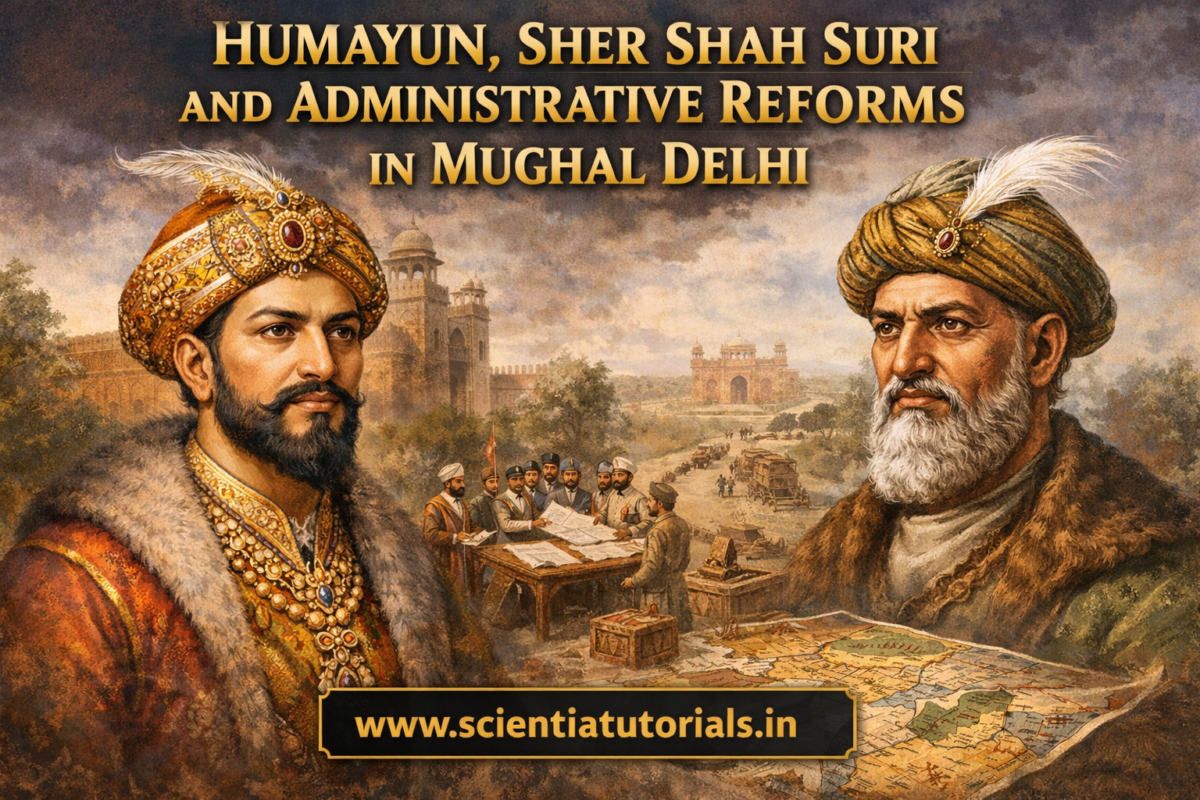

Humayun, Sher Shah Suri and Administrative Reforms in Mughal Delhi
Course: History of Delhi – Chronological Era-Wise Study Module for Competitive Exams
Module IV: Mughal Era Delhi (1526 CE – 1707 CE)
Lesson 2: Humayun, Sher Shah Suri, and Administrative Reforms
This lesson is systematically organized into four clearly structured sections, as detailed below:
- Chronologically Structured Study Module
- Short-Answer Type Questions
- Long-Answer Type Questions
- Multiple-Choice Questions (MCQs) with Answers and Detailed Explanations
Chronologically Structured Study Module
Introduction: A Phase of Interruption and Administrative Innovation
The period between 1530 CE and 1556 CE represents a crucial transitional phase in the history of Mughal Delhi. After the foundation of Mughal rule by Babur, his successor Humayun faced severe political and military challenges that temporarily disrupted Mughal authority. This interregnum was marked by the rise of Sher Shah Suri, whose short but highly impactful rule introduced path-breaking administrative reforms that deeply influenced later Mughal governance.
This lesson chronologically examines Humayun’s reign, his failure and exile, Sher Shah Suri’s administration, and the long-term significance of Sur administrative innovations for the Mughal Empire, particularly under Akbar.
Lesson Objectives
By the end of this lesson, learners will be able to:
- Analyse the early reign and difficulties of Humayun
- Understand the rise of Sher Shah Suri and the fall of Mughal authority
- Examine the administrative reforms of Sher Shah Suri
- Compare Mughal and Sur governance systems
- Evaluate the long-term impact of Sher Shah’s reforms on Mughal administration
- Appreciate Delhi’s political role during this transitional phase
I. Accession of Humayun and Inheritance of a Fragile Empire (1530 CE)
1. Humayun’s Accession
Humayun ascended the Mughal throne in 1530 CE after the death of Babur. Unlike his father, Humayun inherited an empire that was:
- Newly established
- Militarily fragile
- Surrounded by hostile Afghan powers
The Mughal administration had not yet fully consolidated its authority in Delhi and North India.
2. Partition of the Empire
Following Timurid tradition, Humayun divided territories among his brothers:
- Kamran – Kabul and Kandahar
- Askari and Hindal – regional governorships
This division weakened central authority and encouraged rebellion.
II. Challenges Faced by Humayun
1. Afghan Threats and Sher Khan
The most serious threat to Humayun came from Sher Khan, an Afghan noble in Bihar and Bengal, later known as Sher Shah Suri.
- Controlled fertile eastern regions
- Built a strong military base
- Gradually challenged Mughal supremacy
2. Humayun’s Military Weaknesses
Humayun suffered from:
- Lack of decisive leadership
- Poor coordination among nobles
- Over-reliance on astrology and fortune
These weaknesses proved disastrous during his conflict with Sher Shah.
III. Battles of Chausa and Kannauj: Collapse of Mughal Rule
1. Battle of Chausa (1539 CE)
- Fought near the Ganges River
- Sher Shah defeated Humayun decisively
- Humayun narrowly escaped death
2. Battle of Kannauj (1540 CE)
- Also known as the Battle of Bilgram
- Sher Shah again defeated Humayun
- Mughal authority in Delhi collapsed
After this defeat, Humayun fled India, marking the end of the first phase of Mughal rule.
IV. Sher Shah Suri and the Establishment of Sur Rule (1540–1545 CE)
1. Coronation and Political Vision
After defeating Humayun, Sher Shah assumed the title of Sultan and established Sur rule over Delhi.
- Ruled from 1540 to 1545 CE
- Though his reign was short, it was administratively transformative
- Governed a vast empire from Bengal to Punjab
2. Capital and Delhi
Delhi once again became the centre of imperial power. Sher Shah rebuilt and strengthened Delhi’s fortifications, especially around Purana Qila, symbolising Afghan sovereignty.
V. Administrative Reforms of Sher Shah Suri
Sher Shah Suri is remembered as one of the greatest administrators in Indian history.
1. Central Administration
- Sultan was the supreme authority
- Empire divided into sarkars and parganas
- Officers such as Amil, Shiqdar, and Qanungo appointed
This system ensured efficient governance and accountability.
2. Revenue Reforms
Sher Shah introduced a scientific land revenue system:
- Land measured using standard units
- Classification based on fertility
- Revenue fixed at one-third of produce
Written records (patta and qabuliat) were maintained, protecting peasants from exploitation.
3. Currency Reforms
- Introduced a standard silver coin called the Rupiya
- Laid the foundation of modern Indian currency
- Ensured uniformity in trade
4. Road and Communication Network
Sher Shah built an extensive road network:
- Reconstructed the Grand Trunk Road from Bengal to Indus
- Sarais (rest houses) every few miles
- Separate quarters for Hindus and Muslims
This enhanced trade, military movement, and communication.
5. Law and Order
- Strict justice system
- Strong control over crimes
- Responsibility of local officials for safety of travelers
His emphasis on law and order made roads secure.
VI. Sher Shah Suri as a Ruler
Sher Shah combined firmness with welfare policies:
- Efficient tax collection
- Protection of peasants
- Merit-based appointments
Despite being an Afghan ruler, he adopted pragmatic governance rather than religious orthodoxy.
VII. Death of Sher Shah Suri and Decline of Sur Dynasty
Sher Shah died in 1545 CE due to an accident during the siege of Kalinjar Fort. His successors:
- Lacked administrative capability
- Faced internal conflicts
- Failed to maintain the strong system he built
This decline created conditions for Mughal restoration.
VIII. Humayun’s Exile and Return (1540–1555 CE)
1. Years of Exile
Humayun spent nearly 15 years in exile:
- Took refuge in Persia
- Received military support from the Safavid ruler
- Learned Persian administrative and cultural practices
2. Reconquest of Delhi (1555 CE)
- Defeated the weak Sur rulers
- Recaptured Delhi and Agra
- Restored Mughal authority
This marked the second phase of Mughal rule in Delhi.
IX. Humayun’s Second Reign and Legacy
1. Administrative Limitations
Humayun’s restored rule was brief (1555–1556 CE):
- Did not introduce major reforms
- Relied heavily on Persian nobles
- Focused on stabilization
2. Cultural Contributions
- Strengthened Persian influence at the Mughal court
- Encouraged art, literature, and architecture
X. Comparative Analysis: Humayun vs Sher Shah Suri
| Aspect | Humayun | Sher Shah Suri |
|---|---|---|
| Administrative skill | Weak | Highly efficient |
| Military leadership | Indecisive | Strong strategist |
| Revenue system | Underdeveloped | Scientific and systematic |
| Legacy | Dynastic continuity | Administrative blueprint |
XI. Impact of Sher Shah’s Reforms on Mughal Administration
- Akbar adopted Sher Shah’s revenue model
- Road and sarai system continued
- Currency reforms sustained
- Administrative divisions retained
Thus, Sher Shah indirectly shaped the Mughal administrative state.
XII. Chronological Summary (For Quick Revision)
- 1530 CE – Accession of Humayun
- 1539 CE – Battle of Chausa
- 1540 CE – Battle of Kannauj; Mughal fall
- 1540–1545 CE – Sher Shah Suri’s rule
- 1545 CE – Death of Sher Shah
- 1555 CE – Humayun recaptures Delhi
- 1556 CE – Death of Humayun
XIII. Examination-Oriented Key Points
- Humayun lost empire due to weak leadership
- Sher Shah Suri was a great administrator, not just a conqueror
- Revenue and road reforms were revolutionary
- Mughal administration later built upon Sur foundations
- Delhi remained central to imperial legitimacy
Conclusion
The period of Humayun and Sher Shah Suri represents a critical interlude in Mughal history. While Humayun failed to consolidate Babur’s empire, Sher Shah Suri demonstrated how effective administration could stabilize and strengthen a vast empire in a short time. His reforms in revenue, administration, currency, and infrastructure left a lasting imprint on Indian governance. The restored Mughal Empire under Humayun and later Akbar would draw heavily from these Sur innovations, making this phase indispensable to understanding the evolution of Mughal Delhi.
Module IV: Mughal Era Delhi (1526–1707 CE)
Lesson 2: Humayun, Sher Shah Suri, and Administrative Reforms
Short Answer Type Questions (with Answers)
1. Who succeeded Babur as the Mughal ruler in 1530 CE?
Answer: Humayun succeeded Babur as the Mughal ruler in 1530 CE.
2. Why was the Mughal Empire weak at the time of Humayun’s accession?
Answer: The empire was newly established, politically unstable, and lacked strong administrative consolidation.
3. Which Afghan leader emerged as the main rival of Humayun?
Answer: Sher Shah Suri emerged as Humayun’s main rival.
4. What was Sher Shah Suri’s original name?
Answer: Sher Shah Suri’s original name was Sher Khan.
5. Name the two major battles in which Humayun was defeated by Sher Shah.
Answer: The Battle of Chausa (1539 CE) and the Battle of Kannauj (1540 CE).
6. What was the immediate result of the Battle of Kannauj (1540 CE)?
Answer: Mughal rule in Delhi collapsed, and Humayun fled India.
7. For how many years did Sher Shah Suri rule India?
Answer: Sher Shah Suri ruled from 1540 to 1545 CE.
8. Which fort in Delhi is associated with Sher Shah Suri?
Answer: Purana Qila is associated with Sher Shah Suri.
9. What administrative divisions did Sher Shah use for governance?
Answer: The empire was divided into sarkars and parganas.
10. Name any two officials in Sher Shah’s administrative system.
Answer: Amil and Shiqdar (also Qanungo).
11. What was Sher Shah Suri’s most significant revenue reform?
Answer: He introduced a scientific land revenue system based on land measurement and fertility.
12. What proportion of produce was fixed as land revenue under Sher Shah?
Answer: Approximately one-third of the produce.
13. Which documents were used to record land revenue agreements?
Answer: Patta and Qabuliat.
14. Which silver coin was introduced by Sher Shah Suri?
Answer: The Rupiya was introduced by Sher Shah Suri.
15. How did Sher Shah Suri improve trade and communication?
Answer: By building and repairing roads, especially the Grand Trunk Road, and constructing sarais.
16. What were sarais?
Answer: Sarais were rest houses built along highways for travelers and traders.
17. How did Sher Shah ensure law and order on highways?
Answer: Local officials were held responsible for crimes, ensuring traveler safety.
18. How did Sher Shah Suri die?
Answer: He died in 1545 CE due to an accident during the siege of Kalinjar Fort.
19. Why did the Sur dynasty decline after Sher Shah’s death?
Answer: His successors were weak and incapable of maintaining strong administration.
20. Where did Humayun take refuge during his exile?
Answer: Humayun took refuge in Persia (Iran).
21. Which foreign ruler helped Humayun during his exile?
Answer: The Safavid ruler of Persia supported Humayun.
22. In which year did Humayun recapture Delhi?
Answer: Humayun recaptured Delhi in 1555 CE.
23. How long did Humayun’s second reign last?
Answer: Humayun’s second reign lasted from 1555 to 1556 CE.
24. Name one administrative limitation of Humayun.
Answer: He failed to introduce a strong or systematic administrative structure.
25. How did Sher Shah’s reforms influence later Mughal rulers?
Answer: Later Mughal rulers, especially Akbar, adopted his revenue, road, and administrative systems.
26. Mention one reason why Sher Shah Suri is regarded as a great administrator.
Answer: He introduced efficient revenue, currency, and communication systems within a short reign.
27. State one major difference between Humayun and Sher Shah as rulers.
Answer: Humayun was an indecisive ruler, while Sher Shah was a strong and efficient administrator.
28. What was the political importance of Delhi during this period?
Answer: Delhi symbolized imperial legitimacy and remained the centre of power for both Sur and Mughal rulers.
These 28 short answer questions with clear and precise answers are fully aligned with Module IV: Mughal Era Delhi – Lesson 2 and are highly suitable for school examinations, undergraduate courses, and competitive exams, ensuring strong chronological understanding and conceptual clarity.
Module IV: Mughal Era Delhi (1526–1707 CE)
Lesson 2: Humayun, Sher Shah Suri, and Administrative Reforms
Long Answer Type Questions with Answers
1. Examine the circumstances under which Humayun ascended the Mughal throne.
Answer:
Humayun ascended the Mughal throne in 1530 CE after the death of Babur. He inherited a newly established empire that lacked strong administrative foundations. The Mughal territories were scattered, the loyalty of nobles was uncertain, and Afghan chiefs remained powerful in eastern India. Moreover, the Timurid tradition of dividing territories among brothers further weakened central authority. Thus, Humayun began his reign under difficult political and military circumstances.
2. Discuss the major weaknesses of Humayun as a ruler.
Answer:
Humayun lacked decisive leadership and military firmness. He relied heavily on astrology and delayed crucial decisions. His failure to maintain unity among nobles and brothers weakened Mughal authority. Unlike his father Babur, Humayun could not effectively counter Afghan resistance, leading to repeated military setbacks.
3. Analyse the rise of Sher Khan as a powerful Afghan leader in eastern India.
Answer:
Sher Khan emerged as a strong Afghan leader in Bihar and Bengal by efficiently organizing revenue, strengthening the army, and winning the support of local chiefs. His control over fertile regions gave him economic strength. Over time, he challenged Mughal authority and positioned himself as the main rival of Humayun.
4. Describe the Battle of Chausa (1539 CE) and its consequences.
Answer:
The Battle of Chausa was fought on the banks of the Ganges between Humayun and Sher Khan. Humayun suffered a humiliating defeat due to poor military planning. He narrowly escaped death. This defeat significantly weakened Mughal power and boosted Sher Khan’s confidence and prestige.
5. Explain the Battle of Kannauj (1540 CE) and its historical importance.
Answer:
The Battle of Kannauj, also known as the Battle of Bilgram, resulted in a decisive defeat of Humayun by Sher Khan. After this battle, Mughal authority collapsed completely, and Sher Khan became the ruler of Delhi. It marked the end of the first phase of Mughal rule in India.
6. How did Sher Shah Suri establish the Sur Empire?
Answer:
After defeating Humayun, Sher Khan assumed the title Sher Shah Suri and established the Sur Empire in 1540 CE. He extended his control from Bengal to Punjab and ruled from Delhi, asserting strong central authority and efficient governance.
7. Assess the administrative vision of Sher Shah Suri.
Answer:
Sher Shah Suri was a visionary administrator who aimed at strong central control, justice, and economic stability. He believed in practical governance rather than royal luxury. His policies focused on efficiency, accountability, and public welfare, making his short reign highly impactful.
8. Describe the administrative divisions under Sher Shah Suri.
Answer:
Sher Shah divided his empire into sarkars, which were further subdivided into parganas. Each pargana had officials like the Amil, Shiqdar, and Qanungo. This system ensured effective administration, supervision, and revenue collection at the local level.
9. Explain Sher Shah Suri’s land revenue reforms in detail.
Answer:
Sher Shah introduced a scientific land revenue system based on measurement and assessment of land fertility. Land revenue was fixed at one-third of the produce. Written agreements called patta and qabuliat were used to protect peasants from arbitrary taxation, ensuring fairness and stability.
10. Evaluate the importance of Sher Shah Suri’s currency reforms.
Answer:
Sher Shah introduced a standardized silver coin known as the Rupiya. This ensured uniformity in trade and taxation across the empire. His currency system became the basis of the later Mughal and modern Indian monetary systems.
11. Discuss Sher Shah Suri’s road and communication reforms.
Answer:
Sher Shah rebuilt and extended major highways, including the Grand Trunk Road from Bengal to the Indus region. Sarais were built at regular intervals for travelers, traders, and officials. These measures promoted trade, administration, and military mobility.
12. How did Sher Shah Suri maintain law and order?
Answer:
Sher Shah enforced strict justice and made local officials responsible for crimes within their jurisdictions. Even powerful nobles were punished for misconduct. This created a sense of security, especially on highways, and enhanced public confidence in governance.
13. Examine Sher Shah Suri’s policy towards peasants.
Answer:
Sher Shah aimed to protect peasants from exploitation. Fixed revenue rates, written records, and fair assessment reduced the burden on cultivators. His policies ensured agricultural stability and increased state revenue simultaneously.
14. Analyse the causes of Sher Shah Suri’s sudden death.
Answer:
Sher Shah Suri died in 1545 CE due to an accidental explosion during the siege of Kalinjar Fort. His unexpected death deprived the empire of strong leadership, leading to instability and decline.
15. Why did the Sur dynasty decline after Sher Shah Suri’s death?
Answer:
Sher Shah’s successors lacked administrative ability and unity. Internal conflicts, weak leadership, and failure to maintain efficient governance led to rapid decline, creating an opportunity for Mughal restoration.
16. Describe Humayun’s period of exile and its significance.
Answer:
Humayun spent nearly fifteen years in exile, mainly in Persia. He received military support from the Safavid ruler and was influenced by Persian culture and administration. This exposure later shaped Mughal court culture and governance.
17. Explain how Humayun regained the Mughal throne in 1555 CE.
Answer:
Taking advantage of the weakness of Sur rulers, Humayun returned with Persian support and defeated them. He recaptured Delhi and Agra, restoring Mughal authority.
18. Assess Humayun’s second reign as Mughal emperor.
Answer:
Humayun’s second reign was brief and focused on consolidation rather than reform. He relied heavily on Persian nobles and did not introduce major administrative changes. His death in 1556 CE ended this phase abruptly.
19. Compare Humayun and Sher Shah Suri as administrators.
Answer:
Humayun lacked administrative efficiency and decisiveness, while Sher Shah was highly systematic and practical. Sher Shah’s reforms strengthened governance, whereas Humayun failed to institutionalize administration.
20. Discuss the impact of Sher Shah Suri’s reforms on later Mughal administration.
Answer:
Sher Shah’s revenue system, administrative divisions, road network, and currency were adopted and refined by later Mughal rulers, especially Akbar. Thus, Sur administration became the blueprint of Mughal governance.
21. Evaluate the role of Delhi during the Humayun–Sher Shah period.
Answer:
Delhi remained the symbol of imperial legitimacy. Control over Delhi signified political authority, whether under the Sur rulers or the Mughals, highlighting its central role in North Indian politics.
22. Why is Sher Shah Suri regarded as one of the greatest administrators in Indian history?
Answer:
Despite ruling for only five years, Sher Shah introduced lasting reforms in administration, revenue, currency, and infrastructure. His practical governance ensured stability and influenced future empires, earning him a distinguished place in history.
23. How did this transitional phase prepare the ground for Akbar’s rule?
Answer:
The administrative foundations laid by Sher Shah and the Persian influence brought by Humayun provided Akbar with tested systems of governance. Akbar built upon these to create a strong and centralized Mughal Empire.
24. Analyse the historical significance of the Sur interregnum in Mughal history.
Answer:
The Sur interregnum demonstrated that efficient administration could ensure stability even under short rule. It corrected Mughal weaknesses and indirectly strengthened the Mughal state after Humayun’s restoration.
25. Conclude with an assessment of the Humayun–Sher Shah Suri phase in Delhi’s history.
Answer:
This phase represents a crucial transition marked by Mughal failure and Afghan administrative excellence. While Humayun preserved dynastic continuity, Sher Shah Suri contributed enduring administrative institutions. Together, they shaped the evolution of Mughal governance in Delhi.
These 25 long answer questions with comprehensive answers are fully aligned with Module IV: Mughal Era Delhi – Lesson 2 and are especially suitable for university examinations, civil services preparation, and other competitive exams, ensuring analytical depth, chronological clarity, and conceptual understanding.
Module IV: Mughal Era Delhi (1526–1707 CE)
Lesson 2: Humayun, Sher Shah Suri, and Administrative Reforms
Multiple Choice Questions (MCQs) with Answers and Explanations
1. Who succeeded Babur as the Mughal emperor in 1530 CE?
A. Akbar
B. Babur II
C. Humayun
D. Kamran
Correct Answer: C
Explanation:
Humayun, the eldest son of Babur, ascended the Mughal throne in 1530 CE. He inherited a fragile and recently established empire.
2. What was the most serious weakness of the Mughal Empire under Humayun?
A. Lack of territory
B. Religious opposition
C. Weak administration and leadership
D. Absence of foreign trade
Correct Answer: C
Explanation:
Humayun lacked decisive leadership and administrative efficiency, which weakened Mughal authority and encouraged Afghan resistance.
3. Which Afghan leader defeated Humayun and established the Sur Empire?
A. Daulat Khan Lodi
B. Mahmud Lodi
C. Sher Shah Suri
D. Sikandar Suri
Correct Answer: C
Explanation:
Sher Khan, later known as Sher Shah Suri, defeated Humayun and founded the Sur Empire in 1540 CE.
4. The Battle of Chausa was fought in which year?
A. 1536 CE
B. 1538 CE
C. 1539 CE
D. 1541 CE
Correct Answer: C
Explanation:
The Battle of Chausa (1539 CE) marked the first major defeat of Humayun by Sher Khan.
5. Which battle completely ended the first phase of Mughal rule in India?
A. Panipat
B. Chausa
C. Kannauj (Bilgram)
D. Ghaghra
Correct Answer: C
Explanation:
The Battle of Kannauj (1540 CE) resulted in the complete collapse of Mughal authority in Delhi.
6. After defeating Humayun, Sher Shah Suri ruled from which capital?
A. Agra
B. Lahore
C. Delhi
D. Jaunpur
Correct Answer: C
Explanation:
Sher Shah Suri ruled his empire from Delhi, restoring it as the centre of imperial authority.
7. Sher Shah Suri ruled India for how many years?
A. 3 years
B. 5 years
C. 10 years
D. 15 years
Correct Answer: B
Explanation:
Sher Shah ruled from 1540 to 1545 CE. Though brief, his reign was administratively significant.
8. Which fort in Delhi is closely associated with Sher Shah Suri’s rule?
A. Red Fort
B. Tughlaqabad
C. Firoz Shah Kotla
D. Purana Qila
Correct Answer: D
Explanation:
Sher Shah strengthened and rebuilt Purana Qila, making it a symbol of Sur rule in Delhi.
9. What was Sher Shah Suri’s original name?
A. Farid Khan
B. Sher Khan
C. Ibrahim Khan
D. Sikandar Khan
Correct Answer: B
Explanation:
Before becoming ruler, Sher Shah Suri was known as Sher Khan.
10. Which administrative division was the largest unit under Sher Shah?
A. Pargana
B. Iqta
C. Suba
D. Sarkar
Correct Answer: D
Explanation:
The Sur Empire was divided into sarkars, which were further subdivided into parganas.
11. Which official was mainly responsible for revenue collection in a pargana?
A. Shiqdar
B. Qazi
C. Amil
D. Kotwal
Correct Answer: C
Explanation:
The Amil was the chief revenue officer responsible for land revenue assessment and collection.
12. Sher Shah fixed land revenue at approximately:
A. One-fourth of produce
B. One-half of produce
C. One-third of produce
D. Fixed cash amount
Correct Answer: C
Explanation:
Sher Shah assessed land revenue scientifically and fixed it at about one-third of the produce.
13. Which documents recorded agreements between the state and peasants?
A. Farman and sanad
B. Ain and dastur
C. Patta and Qabuliat
D. Roznamcha and daftar
Correct Answer: C
Explanation:
Patta (state record) and qabuliat (peasant’s acceptance) ensured transparency and fairness.
14. Which coin introduced by Sher Shah Suri became the basis of modern Indian currency?
A. Tanka
B. Dinar
C. Mohur
D. Rupiya
Correct Answer: D
Explanation:
Sher Shah introduced the silver rupiya, which became the foundation of India’s currency system.
15. Sher Shah Suri is especially remembered for improving:
A. Naval trade
B. Temple architecture
C. Roads and communication
D. Court rituals
Correct Answer: C
Explanation:
He rebuilt major highways, especially the Grand Trunk Road, and constructed sarais.
16. Sarais built by Sher Shah were mainly meant for:
A. Soldiers only
B. Religious scholars
C. Travelers and traders
D. Royal officials
Correct Answer: C
Explanation:
Sarais served as rest houses and ensured safety and comfort for travelers and merchants.
17. How did Sher Shah ensure law and order on highways?
A. Military patrols only
B. Rewarding villagers
C. Holding local officials responsible for crimes
D. Religious preaching
Correct Answer: C
Explanation:
Local officials were held strictly accountable for crimes in their areas, ensuring security.
18. How did Sher Shah Suri die?
A. Natural illness
B. Assassination
C. Accidental explosion during siege of Kalinjar
D. Battle injury
Correct Answer: C
Explanation:
Sher Shah died in 1545 CE due to an accidental explosion while besieging Kalinjar Fort.
19. What happened to the Sur Empire after Sher Shah’s death?
A. It expanded rapidly
B. It merged with Persia
C. It declined due to weak successors
D. It became a republic
Correct Answer: C
Explanation:
Sher Shah’s successors lacked ability and unity, leading to the decline of the Sur Empire.
20. Where did Humayun spend most of his exile?
A. Arabia
B. Afghanistan
C. Central Asia
D. Persia (Iran)
Correct Answer: D
Explanation:
Humayun took refuge in Persia and received support from the Safavid ruler.
21. Which influence did Humayun bring back from Persia?
A. Afghan military tactics
B. Persian culture and administration
C. Chinese technology
D. Roman law
Correct Answer: B
Explanation:
Persian administrative and cultural traditions deeply influenced later Mughal rule.
22. In which year did Humayun recapture Delhi?
A. 1550 CE
B. 1553 CE
C. 1555 CE
D. 1558 CE
Correct Answer: C
Explanation:
Humayun regained Delhi in 1555 CE after defeating the weak Sur rulers.
23. Humayun’s second reign lasted from:
A. 1550–1560 CE
B. 1553–1558 CE
C. 1555–1556 CE
D. 1545–1550 CE
Correct Answer: C
Explanation:
Humayun ruled briefly after restoration and died in 1556 CE.
24. Which Mughal ruler later adopted Sher Shah’s administrative reforms extensively?
A. Humayun
B. Jahangir
C. Shah Jahan
D. Akbar
Correct Answer: D
Explanation:
Akbar refined and institutionalised Sher Shah’s revenue and administrative systems.
25. What is the historical importance of the Humayun–Sher Shah phase?
A. End of Mughal dynasty
B. Rise of Rajput power
C. Foundation of strong administrative systems
D. Decline of Delhi
Correct Answer: C
Explanation:
This phase demonstrated administrative efficiency under Sher Shah and provided a blueprint for later Mughal governance.
26. Which statement best describes Sher Shah Suri?
A. Religious reformer
B. Temporary usurper
C. Efficient administrator and capable ruler
D. Weak military leader
Correct Answer: C
Explanation:
Sher Shah is remembered not merely as a conqueror but as one of India’s greatest administrators.
These 26 MCQs with detailed explanations are strictly aligned with Module IV: Mughal Era Delhi – Lesson 2 and are ideal for school exams, university assessments, and competitive examinations (UPSC, State PSCs, SSC, etc.), ensuring strong conceptual clarity and chronological understanding.