
Lesson 1: Prehistoric Settlements and Archaeological Evidence in the Delhi Region
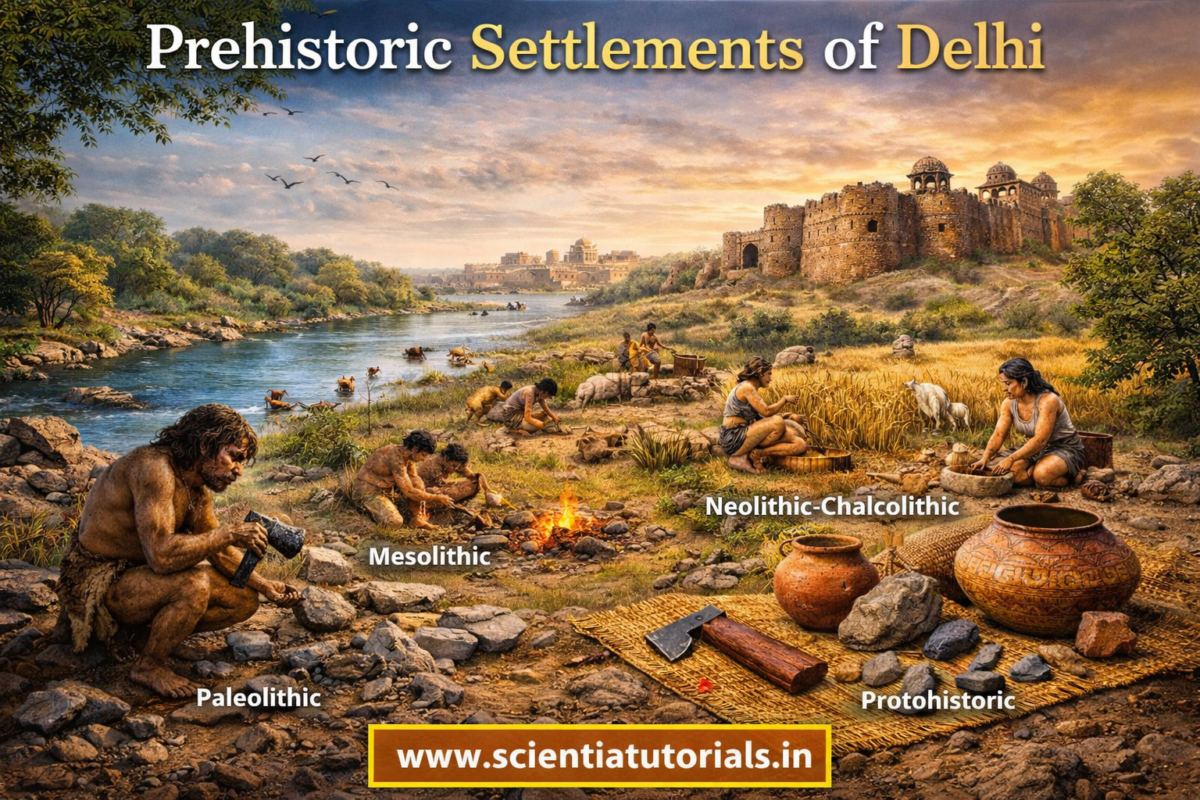

Prehistoric Settlements of Delhi | Archaeological Evidence & Chronology
History of Delhi – Chronological Era-Wise Study Module for Competitive Exams
Module I: Pre-Historic & Ancient Settlements of Delhi
Timeline: Prehistoric Period – 8th Century CE
Lesson 1: Prehistoric Settlements and Archaeological Evidence in the Delhi Region
This lesson is systematically organized into four clearly structured sections, as detailed below:
- Chronologically Structured Study Module
- Short-Answer Type Questions
- Long-Answer Type Questions
- Multiple-Choice Questions (MCQs) with Answers and Detailed Explanations
Chronologically Structured Study Module
1. Introduction: Significance of Prehistoric Delhi in Indian History
The region that later evolved into Delhi has been continuously inhabited for thousands of years, making it one of the most archaeologically significant landscapes of North India. Long before the rise of historic cities, empires, and dynasties, early human communities settled along the banks of the Yamuna River, on the rocky ridges of the Aravalli extensions, and in fertile alluvial plains.
The study of prehistoric settlements in the Delhi region helps aspirants of competitive examinations understand long-term human adaptation, technological evolution, and environmental interaction. This lesson focuses on archaeological discoveries that illuminate Delhi’s journey from hunter-gatherer societies to early agrarian and proto-urban cultures, laying the foundation for its later historical prominence.
2. Chronological Framework of Prehistoric Delhi
To ensure conceptual clarity, the prehistoric phase of Delhi is studied within a well-defined chronological structure:
- Paleolithic Period (c. 2 million BCE – 10,000 BCE)
- Mesolithic Period (c. 10,000 BCE – 6,000 BCE)
- Neolithic and Chalcolithic Developments (c. 6,000 BCE – 2,000 BCE)
- Protohistoric Phase and Early Harappan Influence (c. 3,000 BCE – 1,500 BCE)
- Transition to Early Historic Period (c. 1,500 BCE – 8th Century CE)
This timeline-based approach is essential for competitive exams, where questions often test chronological sequencing and cultural transitions.
3. Paleolithic Settlements in the Delhi Region
3.1 Environmental and Geographical Context
During the Paleolithic age, the Delhi region consisted of open grasslands, riverine belts, and rocky outcrops formed by the ancient Aravalli range. The availability of water from seasonal streams and the Yamuna made it suitable for early human occupation.
3.2 Archaeological Evidence
Archaeological excavations in and around Delhi have yielded a variety of Paleolithic stone tools, primarily made of quartzite. These include:
- Hand axes
- Cleavers
- Choppers
- Scrapers
These tools indicate a Lower and Middle Paleolithic culture, comparable to other North Indian sites.
3.3 Key Sites and Discoveries
Excavations near the Delhi Ridge and Yamuna floodplain reveal scattered Paleolithic artefacts. Though Delhi does not possess large cave sites like Bhimbetka, its open-air sites are crucial for understanding early human migration across the Indo-Gangetic plains.
3.4 Lifestyle and Subsistence
Paleolithic communities in the Delhi region were:
- Nomadic hunter-gatherers
- Dependent on wild animals, fruits, roots, and tubers
- Living in temporary shelters made from natural materials
Exam Tip: Paleolithic Delhi is characterized by tool-based survival and environmental dependence, not permanent settlements.
4. Mesolithic Phase: Transition and Adaptation
4.1 Climatic Changes and Human Response
The Mesolithic period marked a transition from the Ice Age to a warmer climate. This resulted in:
- Expansion of forests and grasslands
- Increased availability of flora and fauna
- Greater human mobility and settlement density
4.2 Mesolithic Tools and Technology
Archaeological finds from the Delhi region include microliths, such as:
- Blades
- Points
- Burins
These tools were often hafted onto wooden shafts, indicating improved hunting techniques.
4.3 Settlement Patterns
Mesolithic communities in Delhi:
- Occupied open-air camps near water sources
- Showed seasonal movement
- Began to exploit fishing and small game
4.4 Cultural Developments
Though direct rock art evidence in Delhi is limited, Mesolithic cultures across North India demonstrate:
- Symbolic expression
- Social bonding
- Early rituals
Exam Relevance: The Mesolithic period is crucial for understanding the shift from nomadism to semi-settled life.
5. Neolithic and Chalcolithic Developments in the Delhi Region
5.1 Introduction of Agriculture and Domestication
The Neolithic phase marked a revolutionary shift in human history. In the Delhi region:
- Early agriculture began with wheat and barley
- Animal domestication included cattle and goats
- Settlements became more permanent
5.2 Pottery and Material Culture
Neolithic-Chalcolithic layers reveal:
- Handmade and wheel-made pottery
- Storage jars indicating surplus production
- Use of copper tools alongside stone tools
5.3 Archaeological Indicators
Sites in the broader Delhi-NCR area demonstrate continuity from Mesolithic traditions with gradual adoption of agriculture. These developments align with Chalcolithic cultures of North-West India.
Exam Tip: Neolithic Delhi represents the foundation of settled life, essential for later urbanization.
6. Protohistoric Phase and Harappan Influence
6.1 Delhi and the Indus Valley Cultural Sphere
Although Delhi was not a core Harappan city, archaeological finds indicate cultural contact with the Indus Valley Civilization.
6.2 Evidence of Harappan Interaction
Key indicators include:
- Harappan-style pottery
- Standardized brick sizes in nearby regions
- Beads and terracotta objects
These suggest Delhi functioned as a peripheral zone connected to the Harappan trade and cultural network.
6.3 Decline and Transformation
After the decline of the Harappan civilization (c. 1900 BCE), Delhi witnessed:
- Ruralization of settlements
- Continuity of agrarian life
- Emergence of local cultures
7. Transition from Prehistory to Early Historic Period
7.1 Vedic and Post-Vedic Influences
By the late second millennium BCE:
- Iron technology began to appear
- Tribal settlements expanded
- Social stratification increased
7.2 Archaeological Continuity
Sites like Purana Qila show evidence of continuous occupation from prehistoric to early historic times, highlighting Delhi’s long settlement history.
7.3 Cultural Synthesis
This phase saw:
- Integration of prehistoric traditions with early historic cultures
- Growth of agriculture-based economies
- Foundations for urban centers
8. Importance of Archaeology in Reconstructing Prehistoric Delhi
Archaeology plays a vital role in reconstructing Delhi’s prehistoric past through:
- Stratigraphic excavations
- Tool typology analysis
- Environmental studies
These methods help historians understand how Delhi evolved from scattered prehistoric camps into one of India’s most enduring urban regions.
9. Examination-Oriented Key Takeaways
- Delhi’s prehistoric history spans Paleolithic to protohistoric phases
- Early humans exploited riverine and ridge environments
- Mesolithic microliths mark technological advancement
- Neolithic agriculture laid the groundwork for permanent settlements
- Harappan influence connected Delhi to wider cultural networks
- Continuous habitation explains Delhi’s later political importance
10. Practice Questions for Competitive Exams
- Discuss the significance of Paleolithic tools found in the Delhi region.
- Explain the transition from Mesolithic to Neolithic life in prehistoric Delhi.
- Analyze the extent of Harappan influence on the Delhi region.
- Why is the Yamuna River significant in the context of prehistoric settlements?
11. Conclusion
The prehistoric settlements of the Delhi region form the deep historical foundation of the city’s later prominence. From Paleolithic hunter-gatherers to early agrarian communities, Delhi’s landscape nurtured human innovation, adaptation, and continuity. For competitive exam aspirants, understanding this chronological evolution is essential not only for factual accuracy but also for appreciating Delhi as a living archaeological and historical continuum.
Short Answer Type Questions – Lesson 1
Prehistoric Settlements and Archaeological Evidence in the Delhi Region
Module I: Pre-Historic & Ancient Settlements of Delhi
1. What is the chronological scope of prehistoric settlements in the Delhi region?
The prehistoric settlements of the Delhi region span from the Paleolithic period to the early protohistoric phase, roughly from c. 2 million BCE to about 1500 BCE, before the emergence of early historic cultures.
2. Why is the Delhi region considered archaeologically significant in prehistoric studies?
Delhi is significant because it shows evidence of continuous human occupation from prehistoric times, supported by stone tools, habitation sites, and its strategic location along the Yamuna River and Aravalli ridges.
3. Which natural features attracted prehistoric humans to the Delhi region?
The Yamuna River, seasonal streams, fertile alluvial plains, and quartzite-rich Aravalli ridges attracted prehistoric communities for water, food, and raw materials.
4. What type of tools characterize the Paleolithic culture of the Delhi region?
The Paleolithic culture is characterized by large stone tools such as hand axes, cleavers, choppers, and scrapers, mainly made of quartzite.
5. What do Paleolithic tools indicate about the lifestyle of early humans in Delhi?
They indicate a nomadic hunter-gatherer lifestyle dependent on hunting animals and gathering wild plant resources.
6. How does the Paleolithic evidence of Delhi compare with sites like Bhimbetka?
Unlike Bhimbetka’s cave and rock-shelter sites, Delhi’s Paleolithic evidence mainly comes from open-air sites near riverbeds and ridges.
7. What major changes occurred during the Mesolithic period in the Delhi region?
The Mesolithic period saw climatic warming, development of microlithic tools, increased reliance on fishing and small game, and semi-nomadic settlement patterns.
8. What are microliths and why are they important?
Microliths are small stone tools such as blades and points; they are important because they reflect technological advancement and more efficient hunting methods.
9. How did Mesolithic humans adapt to environmental changes in Delhi?
They adapted by diversifying food sources, exploiting riverine resources, and adopting seasonal movement patterns.
10. What evidence suggests increasing social organization during the Mesolithic period?
Standardized microlithic tools, repeated habitation sites, and shared subsistence practices suggest growing social coordination.
11. What marks the beginning of the Neolithic phase in the Delhi region?
The beginning of agriculture, domestication of animals, use of pottery, and establishment of more permanent settlements mark the Neolithic phase.
12. Which crops and animals were associated with early Neolithic life near Delhi?
Early cultivation of wheat and barley and domestication of cattle and goats are associated with Neolithic life.
13. What role did pottery play in Neolithic-Chalcolithic societies?
Pottery was used for storage, cooking, and surplus management, indicating settled life and food security.
14. Why is the Chalcolithic phase considered a transitional stage?
It represents a transition because both stone and copper tools were used alongside agricultural practices.
15. Was Delhi a core center of the Indus Valley Civilization?
No, Delhi was not a core Harappan center but functioned as a peripheral region influenced by Harappan culture and trade networks.
16. What archaeological evidence suggests Harappan influence in the Delhi region?
Harappan-style pottery, beads, and standardized material culture indicate cultural interaction with Harappan settlements.
17. What happened to settlements in the Delhi region after the decline of the Harappan Civilization?
After the decline, settlements became more rural and localized, but agriculture and habitation continued.
18. How did the transition from prehistory to early history occur in Delhi?
The transition occurred through the introduction of iron technology, expansion of agrarian communities, and gradual social stratification.
19. Why is the Yamuna River crucial to understanding prehistoric Delhi?
The Yamuna provided water, fertile land, food resources, and served as a natural corridor for human movement and settlement.
20. What is the significance of sites like Purana Qila in prehistoric studies?
Purana Qila shows long-term continuity of settlement, linking prehistoric occupation with early historic urban development.
21. What methods do archaeologists use to study prehistoric Delhi?
They use stratigraphy, tool typology, environmental analysis, and comparative cultural studies.
22. How do stone tools help in dating prehistoric cultures?
Tool types and manufacturing techniques change over time, allowing archaeologists to assign relative dates to cultures.
23. What does the shift from hunting-gathering to agriculture signify?
It signifies economic stability, population growth, and the foundation of permanent settlements.
24. Why is chronological study important for competitive examinations?
It helps candidates understand cultural transitions, sequence of developments, and answer timeline-based questions accurately.
25. How did prehistoric settlements lay the foundation for Delhi’s later historical importance?
Continuous habitation, agricultural development, and strategic geography enabled Delhi to evolve into a major political and urban center in historic times.
These short answer questions are designed to match UPSC, State PSC, and other competitive examination standards, focusing on clarity, chronology, and conceptual understanding.
Long Answer Type Questions – Lesson 1
Prehistoric Settlements and Archaeological Evidence in the Delhi Region
Course: History of Delhi – Chronological Era-Wise Study Module for Competitive Exams
Module I: Pre-Historic & Ancient Settlements of Delhi
1. Examine the geographical factors that made the Delhi region suitable for prehistoric human settlements.
The Delhi region offered a combination of favorable geographical features such as the Yamuna River, fertile alluvial plains, seasonal streams, and the quartzite-rich Aravalli ridges. These features ensured availability of water, food resources, raw materials for tool-making, and natural shelter. The riverine environment supported hunting, fishing, and gathering, while the ridges provided elevated, secure habitation zones. Together, these factors made Delhi a natural corridor for early human migration and settlement.
2. Discuss the significance of Paleolithic tools found in the Delhi region.
Paleolithic tools such as hand axes, cleavers, and choppers found in the Delhi region reflect the technological abilities of early humans. Made mainly of quartzite, these tools indicate a hunter-gatherer economy dependent on hunting animals and processing plant materials. Their typology helps archaeologists date human activity and understand survival strategies during the Lower and Middle Paleolithic periods.
3. Analyze the lifestyle of Paleolithic communities in the Delhi region.
Paleolithic communities in Delhi followed a nomadic lifestyle. They lived in temporary shelters, moved seasonally in search of food, and depended entirely on natural resources. Social organization was simple, and survival was based on collective hunting and gathering. Their life was closely tied to environmental conditions, especially the availability of water and game.
4. Compare the Paleolithic evidence of Delhi with major Indian prehistoric sites such as Bhimbetka.
While Bhimbetka is known for cave shelters and rock art, Delhi’s Paleolithic evidence largely comes from open-air sites near riverbeds and ridges. Both regions show similar stone tool traditions, but Delhi lacks extensive rock art. This comparison highlights regional variations in prehistoric habitation patterns across India.
5. Explain the impact of climatic changes on Mesolithic settlements in the Delhi region.
Climatic warming after the Ice Age led to expansion of forests and grasslands, increasing biodiversity. Mesolithic humans adapted by diversifying food sources, including fishing and small game hunting. Improved climate allowed more stable seasonal camps and greater population density compared to the Paleolithic period.
6. Describe the technological advancements of the Mesolithic period in Delhi.
The hallmark of the Mesolithic period is the use of microlithic tools—small, finely crafted stone implements such as blades and points. These tools were often hafted onto wooden or bone handles, making weapons more effective. This technological shift reflects improved hunting efficiency and innovation.
7. Discuss settlement patterns during the Mesolithic phase in the Delhi region.
Mesolithic settlements were semi-nomadic, often located near rivers and lakes. Communities established seasonal camps rather than permanent villages. Repeated occupation of certain sites suggests increasing familiarity with the landscape and early forms of territoriality.
8. Trace the transition from Mesolithic to Neolithic life in the Delhi region.
The transition involved gradual adoption of agriculture and animal domestication. Humans began cultivating crops like wheat and barley and domesticating cattle and goats. This shift reduced dependence on hunting-gathering and led to more permanent settlements, marking the beginning of village life.
9. Examine the importance of agriculture in the Neolithic phase of Delhi.
Agriculture brought food security, surplus production, and population growth. It enabled permanent settlements and social differentiation. In the Delhi region, early farming laid the economic foundation for later urban and political development.
10. Analyze the role of pottery in Neolithic-Chalcolithic societies.
Pottery was essential for storage, cooking, and transportation of food. The presence of wheel-made pottery indicates technological advancement and organized production. Pottery also serves as a key archaeological marker for identifying cultural phases.
11. Why is the Chalcolithic phase considered a transitional stage in Delhi’s prehistoric history?
The Chalcolithic phase is transitional because it combines stone tools with early use of copper. Agricultural practices expanded, and settlements became more structured. This phase bridges the gap between purely stone-age cultures and metal-using societies.
12. Evaluate the extent of Harappan influence on the Delhi region.
Although Delhi was not a core urban center of the Indus Valley Civilization, archaeological finds such as Harappan-style pottery and beads indicate cultural interaction. Delhi functioned as a peripheral zone connected through trade and exchange networks.
13. Discuss the significance of Delhi as a peripheral zone of the Indus Valley Civilization.
As a peripheral zone, Delhi absorbed Harappan cultural elements while retaining local traditions. This interaction facilitated technological diffusion and economic integration without full urbanization, showing the flexible nature of Harappan influence.
14. Analyze the changes in settlement patterns after the decline of the Harappan Civilization.
Following the decline, large urban centers disappeared, but rural settlements continued. In the Delhi region, agriculture persisted, and local cultures evolved independently, ensuring continuity of habitation.
15. Explain the transition from prehistoric to early historic phases in the Delhi region.
The transition was marked by the introduction of iron technology, expansion of agrarian communities, and increasing social stratification. These changes laid the groundwork for early historic settlements and political structures.
16. Assess the archaeological importance of sites like Purana Qila.
Purana Qila is significant because it shows evidence of continuous occupation from prehistoric to early historic times. It helps historians trace Delhi’s long settlement history and urban evolution.
17. Discuss the role of the Yamuna River in shaping prehistoric Delhi.
The Yamuna provided water, fertile land, and food resources. It also acted as a natural route for migration and trade, making it central to the survival and growth of prehistoric communities.
18. Explain how stone tools help archaeologists reconstruct prehistoric chronology.
Changes in tool types, manufacturing techniques, and materials allow archaeologists to establish relative chronology. Stone tools thus serve as key indicators for dating prehistoric cultures.
19. Describe the methods used by archaeologists to study prehistoric Delhi.
Methods include stratigraphic excavation, typological analysis of tools, environmental studies, and comparative analysis with other sites. These methods help reconstruct human activity and cultural development.
20. Critically analyze the importance of studying prehistoric Delhi for understanding its later historical role.
Studying prehistoric Delhi reveals long-term human adaptation, continuity of settlement, and economic foundations. These factors explain why Delhi emerged as a major political and cultural center in historic times, making prehistoric studies essential for a holistic understanding of Delhi’s history.
These long answer questions are designed to meet UPSC, State PSC, and university-level examination standards, emphasizing analytical depth, chronological clarity, and integrated understanding of prehistoric Delhi.
Multiple Choice Questions (MCQs) with Answers & Explanations
Lesson 1: Prehistoric Settlements and Archaeological Evidence in the Delhi Region
Course: History of Delhi – Chronological Era-Wise Study Module for Competitive Exams
Module I: Pre-Historic & Ancient Settlements of Delhi
MCQ 1
The earliest evidence of human activity in the Delhi region belongs to which period?
A. Neolithic
B. Chalcolithic
C. Paleolithic
D. Mesolithic
Correct Answer: C. Paleolithic
Explanation:
Archaeological finds such as hand axes and choppers made of quartzite indicate Paleolithic occupation. This period represents the earliest phase of human activity in the Delhi region.
MCQ 2
Which natural feature played the most crucial role in attracting prehistoric settlers to Delhi?
A. Thar Desert
B. Yamuna River
C. Vindhya Range
D. Deccan Plateau
Correct Answer: B. Yamuna River
Explanation:
The Yamuna River provided water, fertile alluvial soil, food resources, and served as a natural route for migration, making it central to prehistoric settlement.
MCQ 3
Paleolithic tools found in the Delhi region are primarily made of:
A. Granite
B. Basalt
C. Quartzite
D. Limestone
Correct Answer: C. Quartzite
Explanation:
Quartzite was easily available in the Aravalli ridges around Delhi and was durable, making it suitable for tool-making during the Paleolithic period.
MCQ 4
Which of the following tools is NOT associated with the Paleolithic culture of Delhi?
A. Hand axe
B. Cleaver
C. Microlith
D. Chopper
Correct Answer: C. Microlith
Explanation:
Microliths are characteristic of the Mesolithic period, whereas Paleolithic tools are larger and cruder, such as hand axes and choppers.
MCQ 5
The Paleolithic communities of Delhi primarily followed a:
A. Pastoral lifestyle
B. Agrarian lifestyle
C. Nomadic hunter-gatherer lifestyle
D. Urban lifestyle
Correct Answer: C. Nomadic hunter-gatherer lifestyle
Explanation:
Paleolithic humans depended on hunting animals and gathering wild plants, with no permanent settlements or agriculture.
MCQ 6
Compared to sites like Bhimbetka, prehistoric evidence in Delhi is mainly found in:
A. Cave shelters
B. Rock-cut temples
C. Open-air sites
D. Coastal settlements
Correct Answer: C. Open-air sites
Explanation:
Delhi lacks extensive caves; hence most prehistoric tools are discovered from open-air sites near riverbeds and ridges.
MCQ 7
Which climatic change marked the beginning of the Mesolithic period?
A. Extreme cooling
B. Onset of monsoon failure
C. Post-Ice Age warming
D. Volcanic eruptions
Correct Answer: C. Post-Ice Age warming
Explanation:
Warmer climatic conditions after the Ice Age increased flora and fauna, enabling diversified subsistence strategies during the Mesolithic period.
MCQ 8
The defining technological feature of the Mesolithic period is:
A. Copper tools
B. Polished stone tools
C. Microliths
D. Iron implements
Correct Answer: C. Microliths
Explanation:
Microliths—small, sharp stone tools—represent technological advancement and improved hunting efficiency during the Mesolithic age.
MCQ 9
Mesolithic settlements in the Delhi region were generally:
A. Fully urban
B. Permanently agricultural
C. Semi-nomadic and seasonal
D. Isolated and uninhabited
Correct Answer: C. Semi-nomadic and seasonal
Explanation:
Mesolithic communities established seasonal camps near water sources, reflecting partial settlement but continued mobility.
MCQ 10
Which economic activity first appeared during the Neolithic phase in the Delhi region?
A. Trade
B. Fishing
C. Agriculture
D. Metallurgy
Correct Answer: C. Agriculture
Explanation:
The Neolithic period marked the beginning of agriculture, with cultivation of crops like wheat and barley.
MCQ 11
Animal domestication in Neolithic Delhi mainly included:
A. Horses and camels
B. Sheep and pigs
C. Cattle and goats
D. Elephants and buffaloes
Correct Answer: C. Cattle and goats
Explanation:
Domestication of cattle and goats supported agriculture and settled village life.
MCQ 12
The introduction of pottery is associated with which prehistoric phase?
A. Paleolithic
B. Mesolithic
C. Neolithic
D. Upper Paleolithic
Correct Answer: C. Neolithic
Explanation:
Pottery reflects settled life, surplus storage, and cooking practices, all characteristic of the Neolithic phase.
MCQ 13
Why is the Chalcolithic phase considered transitional?
A. Absence of tools
B. Use of both stone and copper tools
C. Complete urbanization
D. Decline of agriculture
Correct Answer: B. Use of both stone and copper tools
Explanation:
The Chalcolithic phase bridges the Stone Age and Metal Age through limited use of copper alongside stone tools.
MCQ 14
Delhi’s relationship with the Indus Valley Civilization can best be described as:
A. Core urban center
B. Capital city
C. Peripheral interaction zone
D. Completely isolated region
Correct Answer: C. Peripheral interaction zone
Explanation:
Delhi was not a Harappan city but showed cultural influence through pottery and trade connections.
MCQ 15
Which archaeological evidence suggests Harappan influence in the Delhi region?
A. Roman coins
B. Ashokan inscriptions
C. Harappan-style pottery
D. Megalithic burials
Correct Answer: C. Harappan-style pottery
Explanation:
Harappan pottery and beads indicate cultural interaction rather than direct urban presence.
MCQ 16
After the decline of the Harappan Civilization, settlements in Delhi:
A. Completely disappeared
B. Became more rural and localized
C. Turned into large cities
D. Shifted to coastal areas
Correct Answer: B. Became more rural and localized
Explanation:
Agriculture and habitation continued, but large urban centers declined, leading to rural settlement patterns.
MCQ 17
The transition from prehistory to early history in Delhi is marked by the use of:
A. Bronze tools
B. Gold ornaments
C. Iron technology
D. Glass beads
Correct Answer: C. Iron technology
Explanation:
Iron tools enabled agricultural expansion and social complexity, marking early historic development.
MCQ 18
Which site reflects long-term continuity from prehistoric to early historic Delhi?
A. Mehrauli
B. Purana Qila
C. Qutub Minar
D. Red Fort
Correct Answer: B. Purana Qila
Explanation:
Purana Qila shows archaeological layers indicating continuous occupation across multiple periods.
MCQ 19
Stone tool typology helps archaeologists primarily in:
A. Determining absolute dates
B. Understanding religious beliefs
C. Establishing relative chronology
D. Identifying political systems
Correct Answer: C. Establishing relative chronology
Explanation:
Changes in tool types over time help archaeologists sequence prehistoric cultures.
MCQ 20
Why is the study of prehistoric Delhi important for competitive exams?
A. It focuses only on mythology
B. It explains medieval architecture
C. It provides a foundation for understanding historical continuity
D. It deals only with art history
Correct Answer: C. It provides a foundation for understanding historical continuity
Explanation:
Prehistoric studies explain long-term settlement, environmental adaptation, and cultural evolution, which are essential for understanding Delhi’s later historical importance.
MCQ 21
Which factor best explains continuous habitation in the Delhi region?
A. Coastal location
B. Abundant mineral wealth
C. Strategic riverine geography
D. Dense forests
Correct Answer: C. Strategic riverine geography
Explanation:
The Yamuna River and fertile plains ensured survival and sustained habitation across prehistoric periods.
MCQ 22
Microlithic tools are most closely associated with:
A. Hunting efficiency
B. Urban planning
C. Script development
D. Monumental architecture
Correct Answer: A. Hunting efficiency
Explanation:
Microliths were lighter, sharper, and often hafted, improving hunting methods.
MCQ 23
Which statement best describes Neolithic settlements in Delhi?
A. Entirely nomadic
B. Permanent agricultural villages
C. Industrial centers
D. Military outposts
Correct Answer: B. Permanent agricultural villages
Explanation:
Neolithic life involved settled villages supported by farming and animal domestication.
MCQ 24
The main contribution of archaeology to prehistoric Delhi is:
A. Literary reconstruction
B. Religious interpretation
C. Material-based historical reconstruction
D. Political chronology
Correct Answer: C. Material-based historical reconstruction
Explanation:
In the absence of written records, archaeology reconstructs history through tools, pottery, and settlement remains.
MCQ 25
Which concept best explains Delhi’s early historical importance?
A. Sudden urban growth
B. Foreign invasions alone
C. Long-term settlement continuity
D. Mythological origin
Correct Answer: C. Long-term settlement continuity
Explanation:
Continuous habitation from prehistoric times created economic, social, and geographical foundations for Delhi’s later political prominence.
✔ These MCQs are fully aligned with UPSC, State PSC, SSC, and university-level examinations, focusing on chronology, concepts, and analytical clarity.