
Christian Missions and Cultural Transformation
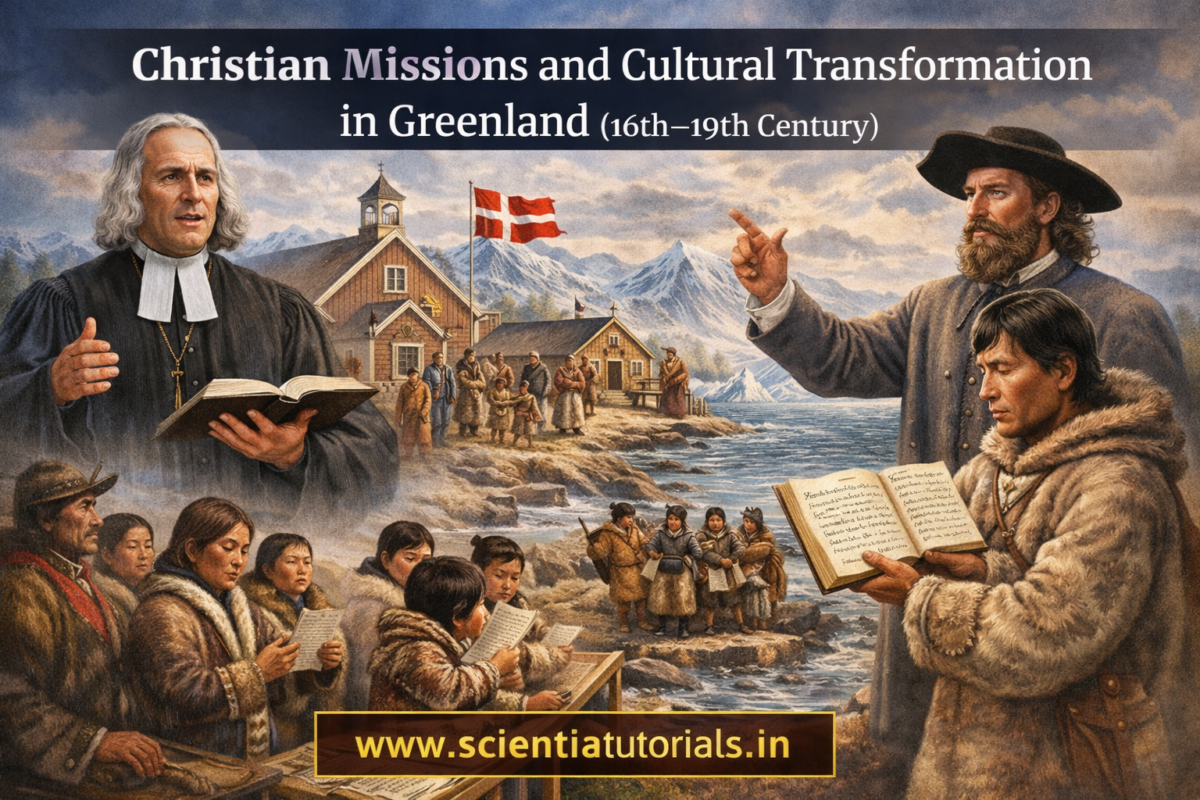

Christian Missions and Cultural Transformation in Greenland (16th–19th Century)
Course: Greenland: Historical Evolution and Its Global Strategic Importance
Module 3: Colonial Encounters and Early Modern Transformations
Era Framework: 16th Century – 19th Century
(European expansion, mercantilism, missionary activity)
Lesson: Christian Missions and Cultural Transformation
This lesson is systematically organized into four clearly structured sections, as detailed below:
- Chronologically Structured Study Module
- Short-Answer Type Questions
- Long-Answer Type Questions
- Multiple-Choice Questions (MCQs) with Answers and Detailed Explanations
Chronologically Structured Study Module
Lesson Objectives
This lesson aims to enable learners to:
- Understand the origins and motivations of Christian missionary activity in Greenland
- Trace the chronological development of missions from the 16th to the 19th century
- Examine the role of missionaries in colonial expansion and governance
- Analyze the cultural, social, and linguistic transformations among Inuit society
- Evaluate the long-term legacy of Christian missions in shaping Greenland’s identity
I. Introduction: Christianity and the Early Modern Arctic World
The early modern era marked an important turning point in Greenland’s history, as Christian missions became a central instrument of European expansion and colonial consolidation. While medieval Norse settlers had introduced Christianity to Greenland centuries earlier, the collapse of Norse settlements led to a long period in which Indigenous Inuit belief systems developed independently.
From the 16th century onward, renewed European interest in Greenland was closely linked to religious revivalism, mercantilist expansion, and imperial rivalry. Christian missions were not isolated spiritual endeavors; they were deeply embedded in the political, cultural, and economic objectives of colonial powers, particularly Denmark–Norway.
II. Pre-Colonial Inuit Belief Systems
Before sustained European missionary contact, Inuit communities practiced animistic and shamanistic traditions:
- Spiritual life centered on harmony with nature
- Shamans (angakkuit) mediated between human and spiritual worlds
- Beliefs emphasized animals, the sea, and seasonal cycles
These belief systems were adaptive, communal, and closely linked to survival in the Arctic environment. Understanding them is essential for assessing the depth of cultural change brought by Christian missions.
III. European Religious Context and the Missionary Impulse (16th–17th Centuries)
1. Reformation and Confessional Competition
The Protestant Reformation reshaped European Christianity, intensifying missionary zeal. Lutheran Denmark viewed missionary expansion as both:
- A religious obligation
- A symbol of sovereign legitimacy
Greenland, believed to be a former Christian land lost to paganism, became a powerful ideological target.
2. Christianity as an Instrument of Empire
Christian missions served multiple functions:
- Spiritual conversion
- Cultural transformation
- Political stabilization
- Justification of territorial claims
Thus, missionary work in Greenland was inseparable from colonial expansion.
IV. The Mission of Hans Egede and the Beginning of Organized Christian Missions (18th Century)
1. Hans Egede’s Arrival (1721)
The foundation of sustained Christian missions in Greenland began with Hans Egede, a Lutheran pastor whose expedition marked the start of Denmark’s formal colonial presence.
Egede’s objectives included:
- Re-Christianizing supposed Norse descendants
- Restoring Greenland to the Christian world
- Establishing Danish sovereignty
Although no Norse Christians were found, Egede redirected his efforts toward the Inuit population.
2. Establishment of Mission Stations
Mission stations such as Godthåb (Nuuk) became:
- Centers of worship
- Schools for religious instruction
- Hubs of colonial administration
Christian missions thus laid the structural foundation for long-term colonial control.
V. Missionaries as Cultural Intermediaries and Colonial Agents
Missionaries occupied a unique position in Greenlandic society:
- They lived among Inuit communities
- Learned the Greenlandic language
- Acted as translators and educators
This dual role made missionaries both agents of cultural change and mediators between colonial authorities and Indigenous populations.
VI. Linguistic Transformation and Literacy
1. Development of Written Greenlandic
One of the most significant outcomes of missionary activity was the creation of a written Greenlandic language:
- Biblical texts translated into Greenlandic
- Catechisms and hymns produced
- Literacy promoted among Inuit converts
This paradoxical effect meant that while missions aimed at cultural transformation, they also preserved linguistic identity.
2. Education and Social Discipline
Mission schools emphasized:
- Christian morality
- European norms of behavior
- Sedentary lifestyles
Education became a tool for reshaping Inuit social structures and values.
VII. Moravian Missions and Alternative Christian Approaches (18th–19th Centuries)
1. Arrival of the Moravian Brethren
The arrival of Moravian Church introduced a distinctive missionary model:
- Emphasis on emotional devotion
- Focus on community life
- Greater cultural sensitivity
Moravian missionaries established settlements such as:
- New Herrnhut
- Lichtenfels
2. Comparative Impact of Moravian Missions
Moravian missions:
- Encouraged Indigenous participation
- Fostered strong communal bonds
- Reduced overt coercion
Despite this, they still contributed to cultural transformation and integration into the colonial order.
VIII. Cultural Transformation of Inuit Society
1. Religious Change
Christianity reshaped Inuit spirituality:
- Traditional rituals declined
- Christian festivals and sacraments spread
- New moral frameworks emerged
However, conversion was often gradual and selective, resulting in syncretic practices.
2. Social Reorganization
Christian norms influenced:
- Family structures
- Gender roles
- Community authority
Missionaries promoted monogamy, regular worship, and obedience to colonial authority.
IX. Resistance, Adaptation, and Indigenous Agency
Not all Inuit communities accepted Christianity passively:
- Some resisted conversion
- Others selectively adopted Christian practices
- Indigenous agency shaped how Christianity was practiced
This demonstrates that cultural transformation was negotiated rather than imposed uniformly.
X. Christianity and Colonial Governance
Christian missions reinforced colonial authority by:
- Legitimizing Danish rule
- Encouraging obedience and order
- Supporting trade monopolies
Missionaries often advised colonial administrators and influenced legal and moral regulation.
XI. 19th-Century Consolidation of Christian Influence
By the 19th century:
- Christianity was firmly established
- Churches became central community institutions
- Missionary education expanded
Denmark increasingly used missions to justify policies of isolation and protectionism, portraying colonial rule as benevolent guardianship.
XII. Long-Term Consequences of Christian Missions
1. Cultural Legacy
Christian missions contributed to:
- A hybrid Inuit-Christian identity
- Persistence of Greenlandic language
- Transformation of worldview and values
2. Political and Strategic Implications
Christianization strengthened Denmark’s claim to Greenland as:
- A civilized Christian territory
- A stable colonial possession
- A strategic North Atlantic outpost
XIII. Conclusion: Christian Missions in Historical Perspective
Christian missions played a decisive role in Greenland’s early modern transformation. They were not merely religious enterprises but powerful instruments of colonial expansion, cultural restructuring, and political control. While missions disrupted Indigenous belief systems and social practices, they also produced enduring legacies—most notably literacy, linguistic preservation, and new forms of cultural identity.
Understanding Christian missions in Greenland is essential for interpreting:
- The nature of Danish colonialism
- Inuit cultural resilience and adaptation
- Greenland’s modern social and political development
Short Answer Type Questions and Answers
1. Why did Christian missions become important in Greenland during the early modern period?
Christian missions became important due to European expansion, religious revivalism, and Denmark–Norway’s desire to legitimize colonial control.
2. Which Indigenous belief system existed in Greenland before Christian missions?
Inuit society followed animistic and shamanistic beliefs centered on nature, spirits, and survival.
3. Who were the angakkuit in Inuit society?
Angakkuit were shamans who acted as spiritual mediators between humans and the spirit world.
4. How did the Protestant Reformation influence missionary activity in Greenland?
The Reformation intensified missionary zeal and encouraged Lutheran states to expand Christianity alongside empire.
5. Why was Greenland viewed as a “lost Christian land” by Denmark–Norway?
Because medieval Norse settlers had introduced Christianity before their settlements disappeared.
6. Who initiated organized Christian missionary work in Greenland in 1721?
Hans Egede initiated organized Christian missionary work in 1721.
7. What were the primary objectives of Hans Egede’s mission?
To re-Christianize Greenland, reassert Danish sovereignty, and integrate Greenland into the Christian world.
8. Why did Hans Egede redirect his mission toward the Inuit population?
Because no surviving Norse Christian communities were found in Greenland.
9. What role did mission stations play in Greenlandic society?
They functioned as centers of worship, education, and colonial administration.
10. How did missionaries act as cultural intermediaries?
They learned the Greenlandic language and mediated between Inuit communities and colonial authorities.
11. What was the significance of translating Christian texts into Greenlandic?
It promoted literacy and helped preserve the Greenlandic language.
12. How did missionary education influence Inuit social life?
It promoted Christian morality, European norms, and sedentary lifestyles.
13. Which missionary group introduced an alternative approach to Lutheran missions?
The Moravian Church introduced a more community-oriented approach.
14. How did Moravian missions differ from Danish Lutheran missions?
They emphasized emotional devotion, communal living, and greater cultural sensitivity.
15. What was a major cultural consequence of Christianization among the Inuit?
Traditional spiritual practices declined and were replaced or blended with Christian beliefs.
16. What is meant by “syncretism” in the context of Greenlandic Christianity?
It refers to the blending of Christian beliefs with Indigenous spiritual practices.
17. Did all Inuit communities accept Christianity uniformly?
No, acceptance varied, with resistance, adaptation, and selective conversion.
18. How did Christianity influence Inuit family and social structures?
It promoted monogamy, new moral norms, and altered traditional authority systems.
19. In what way did missions support Danish colonial governance?
They legitimized Danish rule and encouraged obedience and social order.
20. How were missionaries involved in colonial administration?
They advised officials, influenced moral regulation, and supported governance structures.
21. What role did churches play in 19th-century Greenlandic communities?
Churches became central institutions for education, worship, and community life.
22. Why did Denmark link Christian missions with protectionist policies?
To portray colonial rule as benevolent guardianship of Indigenous society.
23. How did Christian missions contribute to Greenland’s cultural hybridity?
They combined Inuit traditions with Christian beliefs, creating a hybrid identity.
24. What long-term linguistic impact did missions have in Greenland?
They helped preserve Greenlandic through literacy and written texts.
25. Why are Christian missions crucial for understanding Greenland’s colonial history?
They reveal how religion shaped cultural transformation, colonial authority, and Indigenous adaptation.
Long Answer Type Questions and Answers
1. Examine the role of Christian missions in Greenland within the broader context of early modern European expansion.
Christian missions in Greenland were an integral part of early modern European expansion. From the 16th century onward, European powers combined religious objectives with imperial ambitions. In Greenland, missionary activity supported Denmark–Norway’s territorial claims, legitimized colonial rule, and facilitated cultural integration into the European Christian world. Missions thus functioned as both spiritual enterprises and instruments of empire.
2. Discuss the nature of pre-Christian Inuit belief systems and their significance in understanding cultural transformation.
Before Christian missions, Inuit society practiced animistic and shamanistic belief systems rooted in nature, animals, and spiritual balance. Shamans (angakkuit) mediated between the physical and spiritual worlds. These beliefs were closely tied to survival in the Arctic environment. Understanding them highlights the depth of cultural disruption and adaptation caused by Christianization.
3. Analyze the impact of the Protestant Reformation on missionary activity in Greenland.
The Protestant Reformation intensified missionary zeal, particularly among Lutheran states like Denmark–Norway. Missionary activity became a means of asserting confessional identity and political sovereignty. Greenland, viewed as a former Christian land lost after the Norse decline, became a symbolic target for Protestant missionary revival.
4. Evaluate the significance of Greenland being viewed as a “lost Christian land.”
The belief that Greenland had once been Christian under the Norse settlers provided ideological justification for missionary intervention. This perception allowed Denmark–Norway to frame colonization as religious restoration rather than conquest, strengthening both moral and legal claims over the territory.
5. Assess the contribution of Hans Egede to the establishment of Christian missions in Greenland.
Hans Egede played a foundational role in Greenland’s Christianization. Arriving in 1721, he aimed to re-Christianize supposed Norse descendants but redirected his mission toward the Inuit. His efforts established permanent mission stations, introduced Lutheran Christianity, and laid the groundwork for Danish colonial administration.
6. Examine the objectives and outcomes of Hans Egede’s missionary enterprise.
Egede’s objectives included religious conversion, restoration of Christianity, and assertion of Danish sovereignty. Although he failed to locate Norse Christians, his mission succeeded in initiating organized missionary work, promoting literacy, and securing Denmark’s lasting colonial presence in Greenland.
7. Describe the role of mission stations in Greenlandic colonial society.
Mission stations functioned as centers of worship, education, and governance. They became focal points for cultural interaction, religious instruction, and administrative control. Over time, they evolved into permanent settlements shaping Greenland’s colonial landscape.
8. Analyze missionaries as cultural intermediaries between Inuit society and colonial authorities.
Missionaries learned the Greenlandic language and lived among Inuit communities, enabling communication between Indigenous populations and Danish officials. This intermediary role allowed missionaries to influence governance while shaping cultural transformation through education and religious instruction.
9. Discuss the linguistic impact of Christian missions in Greenland.
Missionaries translated religious texts into Greenlandic and developed a written form of the language. This promoted literacy and unintentionally preserved Greenlandic linguistic identity, even as cultural and religious practices were transformed under colonial influence.
10. Examine the role of education in Christian missionary strategy.
Education was central to missionary efforts. Schools taught literacy, Christian doctrine, and European moral values. Education promoted sedentary lifestyles and discipline, reshaping Inuit social structures and reinforcing colonial authority.
11. Compare Lutheran missionary methods with those of the Moravian Church in Greenland.
Lutheran missions emphasized doctrinal instruction and alignment with colonial administration, while Moravian missions focused on emotional devotion, communal living, and greater cultural sensitivity. Despite differences, both contributed to Christianization and cultural transformation.
12. Assess the cultural consequences of Christianization for Inuit spiritual life.
Christianization led to the decline of traditional rituals and belief systems, replacing them with Christian doctrines and moral frameworks. However, conversion was gradual and often selective, resulting in syncretic practices combining Indigenous and Christian elements.
13. Discuss the concept of syncretism in the context of Greenlandic Christianity.
Syncretism refers to the blending of Christian beliefs with Indigenous spiritual traditions. In Greenland, Inuit converts adapted Christianity to local contexts, preserving certain cultural values while adopting new religious practices.
14. Analyze Indigenous responses to Christian missionary activity.
Inuit responses varied widely. Some communities resisted conversion, others selectively adopted Christian practices, and many adapted Christianity to their own cultural frameworks. This demonstrates Indigenous agency rather than passive acceptance.
15. Examine the role of Christianity in reshaping Inuit social and family structures.
Christian missions promoted monogamy, new gender norms, and redefined authority structures. These changes altered traditional kinship systems and community leadership, contributing to long-term social transformation.
16. Discuss how Christian missions reinforced Danish colonial governance.
Christian missions legitimized Danish rule by promoting obedience, moral discipline, and social order. Missionaries often advised colonial officials and supported policies that aligned religious conversion with political stability.
17. Evaluate the consolidation of Christian influence in Greenland during the 19th century.
By the 19th century, Christianity was firmly established. Churches became central institutions, missionary education expanded, and Christian norms shaped everyday life. Missions supported Denmark’s isolationist and protectionist colonial policies.
18. Analyze the long-term cultural legacy of Christian missions in Greenland.
Christian missions contributed to the formation of a hybrid Inuit-Christian identity. While traditional beliefs declined, Greenlandic language and communal cohesion persisted, reshaped within a Christian framework.
19. Discuss the political and strategic implications of Christianization for Denmark’s control over Greenland.
Christianization strengthened Denmark’s claim to Greenland as a civilized and stable colony. It reinforced sovereignty, reduced foreign influence, and enhanced Greenland’s role as a strategic North Atlantic territory.
20. Critically assess the overall historical significance of Christian missions in Greenland.
Christian missions were transformative forces that reshaped Greenland’s religious, cultural, and social landscape. While they disrupted Indigenous belief systems and supported colonial domination, they also fostered literacy, cultural adaptation, and enduring hybrid identities. Their legacy remains central to understanding Greenland’s colonial past and modern development.
MCQs with Answers and Explanations
1. Christian missionary activity in Greenland during the early modern period was closely linked to:
A. Industrialization
B. European expansion and colonial consolidation
C. Agricultural colonization
D. Scientific exploration
Correct Answer: B
Explanation:
Christian missions were integral to European expansion, serving religious, political, and cultural objectives that supported colonial control.
2. Prior to Christian missions, Inuit belief systems were primarily:
A. Monotheistic
B. Buddhist
C. Animistic and shamanistic
D. Polytheistic temple-based
Correct Answer: C
Explanation:
Inuit spirituality emphasized nature, spirits, and balance, with shamans mediating between the human and spiritual worlds.
3. Who were the angakkuit in pre-Christian Inuit society?
A. Tribal chiefs
B. Traders
C. Shamans and spiritual mediators
D. Colonial administrators
Correct Answer: C
Explanation:
Angakkuit were shamans who played central roles in healing, ritual practice, and spiritual mediation.
4. The Protestant Reformation influenced missions in Greenland by:
A. Reducing religious activity
B. Encouraging Catholic dominance
C. Intensifying Lutheran missionary zeal
D. Promoting religious neutrality
Correct Answer: C
Explanation:
The Reformation strengthened Lutheran missionary efforts, especially in territories claimed by Protestant states such as Denmark–Norway.
5. Greenland was considered a “lost Christian land” because of:
A. Roman Catholic expansion
B. Medieval Norse Christian settlements
C. Early Anglican missions
D. Crusader expeditions
Correct Answer: B
Explanation:
Medieval Norse settlers had introduced Christianity before their settlements disappeared, shaping later missionary ideology.
6. Organized Christian missionary work in Greenland began in 1721 under:
A. Erik the Red
B. Hans Egede
C. Vitus Bering
D. Jens Munk
Correct Answer: B
Explanation:
Hans Egede’s expedition in 1721 marked the beginning of sustained Christian missions and colonial presence.
7. The original goal of Hans Egede’s mission was to:
A. Convert Inuit hunters
B. Establish plantation colonies
C. Re-Christianize Norse descendants
D. Promote Arctic trade
Correct Answer: C
Explanation:
Egede believed Norse Christians still lived in Greenland and sought to restore them to Christianity.
8. When no Norse Christians were found, missionaries redirected their efforts toward:
A. European settlers
B. Asian traders
C. Inuit communities
D. Foreign whalers
Correct Answer: C
Explanation:
Missionary activity shifted focus to the Indigenous Inuit population, leading to long-term cultural transformation.
9. Mission stations in Greenland primarily functioned as:
A. Military forts
B. Agricultural estates
C. Religious, educational, and administrative centers
D. Mining hubs
Correct Answer: C
Explanation:
Mission stations became focal points of worship, schooling, and colonial governance.
10. Missionaries served as cultural intermediaries mainly because they:
A. Enforced colonial law
B. Learned Greenlandic and lived among Inuit
C. Led military expeditions
D. Controlled trade monopolies
Correct Answer: B
Explanation:
Their linguistic skills and close contact with Inuit communities enabled mediation between Indigenous society and colonial authorities.
11. One major linguistic outcome of Christian missions was:
A. Loss of Indigenous language
B. Replacement by Danish
C. Development of written Greenlandic
D. Exclusive use of Latin
Correct Answer: C
Explanation:
Missionaries translated religious texts into Greenlandic, promoting literacy and language preservation.
12. Missionary education in Greenland mainly promoted:
A. Nomadic lifestyles
B. Industrial skills
C. Christian morality and European norms
D. Political independence
Correct Answer: C
Explanation:
Education aimed to reshape social behavior, morality, and discipline in line with Christian values.
13. Which missionary group introduced a more community-oriented and emotional approach?
A. Jesuits
B. Dominicans
C. Moravian Church
D. Anglicans
Correct Answer: C
Explanation:
Moravian missionaries emphasized communal living, devotion, and relatively greater cultural sensitivity.
14. Compared to Lutheran missions, Moravian missions were notable for:
A. Strong military backing
B. Emotional devotion and community life
C. Exclusive use of Danish
D. Focus on trade administration
Correct Answer: B
Explanation:
Moravian missions fostered emotional religious expression and strong communal bonds.
15. Christianization led to which major cultural change among Inuit communities?
A. Complete cultural disappearance
B. Immediate rejection of tradition
C. Decline of traditional rituals and beliefs
D. End of social organization
Correct Answer: C
Explanation:
Traditional spiritual practices declined, though change was gradual and adaptive rather than absolute.
16. The blending of Christian beliefs with Indigenous practices is known as:
A. Secularization
B. Assimilation
C. Syncretism
D. Isolation
Correct Answer: C
Explanation:
Syncretism reflects the selective adaptation of Christianity within Inuit cultural frameworks.
17. Inuit responses to missionary activity were best characterized by:
A. Uniform acceptance
B. Total resistance
C. Adaptation, negotiation, and selective conversion
D. Forced compliance only
Correct Answer: C
Explanation:
Indigenous agency played a major role in shaping how Christianity was practiced locally.
18. Christian missions influenced Inuit family structures by promoting:
A. Polygamy
B. Clan warfare
C. Monogamy and new moral norms
D. Matrilineal inheritance
Correct Answer: C
Explanation:
Christian teachings reshaped family life, gender roles, and social authority.
19. Missionaries reinforced Danish colonial authority mainly by:
A. Leading military campaigns
B. Encouraging moral discipline and obedience
C. Promoting foreign trade
D. Eliminating Indigenous leaders
Correct Answer: B
Explanation:
Christian morality and social order supported political stability and colonial governance.
20. By the 19th century, Christianity in Greenland was:
A. Marginal and declining
B. Confined to Europeans
C. Firmly established across communities
D. Actively resisted everywhere
Correct Answer: C
Explanation:
Christianity had become central to community life, education, and governance.
21. Churches in 19th-century Greenland functioned primarily as:
A. Trading houses
B. Military centers
C. Community and educational institutions
D. Judicial courts
Correct Answer: C
Explanation:
Churches were key social institutions shaping daily life and moral order.
22. Denmark linked Christian missions with protectionist policies in order to:
A. Encourage tourism
B. Promote free trade
C. Present colonial rule as benevolent guardianship
D. Expand agriculture
Correct Answer: C
Explanation:
Missionary activity was used to justify isolation and paternalistic colonial policies.
23. A major long-term cultural legacy of Christian missions in Greenland was:
A. Cultural extinction
B. Complete Europeanization
C. Hybrid Inuit-Christian identity
D. Political independence
Correct Answer: C
Explanation:
Christianity blended with Indigenous traditions, creating a distinctive hybrid identity.
24. From a strategic perspective, Christianization helped Denmark by:
A. Increasing population size
B. Strengthening sovereignty claims
C. Eliminating rival powers militarily
D. Expanding agriculture
Correct Answer: B
Explanation:
Christian missions reinforced Denmark’s claim to Greenland as a civilized and stable colony.
25. Studying Christian missions is essential to understanding Greenland’s history because they:
A. Explain prehistoric settlement
B. Reveal links between religion, culture, and colonial power
C. Focus only on theology
D. Replace economic analysis
Correct Answer: B
Explanation:
Christian missions illuminate how religion functioned as a tool of cultural transformation and colonial governance.